On this date in 1795, the attorney who had engineered the Terror was guillotined for engineering the Terror.
Antoine Quentin Fouquier de Tinville (English Wikipedia page | French), or just plain Fouquier-Tinville, had emerged during the Revolution from penurious obscurity to wrangle a jury foreman’s position courtesy of his connection to Camille Desmoulins. When Desmoulins ally Georges Danton spearheaded creation of a Revolutionary Tribunal (French link), Fouquier-Tinville drew the choice gig of Public Prosecutor.
From that perch, he would supply the arbitrary exercises of the Committee of Public Safety their (increasingly scanty) scaffolding of formal legality in Paris’s greatest show trials.
Fouquier-Tinville’s own onetime benefactors, Danton and Desmoulins. (He struggled to contain Danton’s rhetorical fireworks, as depicted in the 1983 film Danton — we see him plying his trade from about 3:29 of this clip.)
Heck … when the Terror ended, our good state’s attorney even signed off on the execution of Robespierre, with what must have been a lump in his throat. He was himself denounced within days, and narrowly preserved from the summary justice of his fellow-prisoners upon incarceration.
Naturally, like every criminal barrister since, Fouquier-Tinville’s defense was, hey, don’t blame me: the law made me do it. “I had only acted in the spirit of the laws passed by a Convention invested with all powers. Through the absence of its members [on trial], I find myself the head of a conspiracy I have never been aware of.”
I have been told by a gentleman who was at school with Fouquier, and has had frequent occasions of observing him at different periods since, that he always appeared to him to be a man of mild manners, and by no means likely to become the instrument of these atrocities; but a strong addiction to gaming having involved him in embarrassments, he was induced to accept the office of Public Accuser to the Tribunal, and was progressively led on from administering to the iniquity of his employers, to find a gratification in it himself.
And, indeed, he was condemned by his own hand. His lawyerly letter to the Convention during Danton’s trial — “the accused are behaving like madmen and demand the summoning of their witnesses … our judicial powers do not furnish us with any means of refusing” — duly elicited those heretofore absent powers, which the prosecutor immediately deployed to gag the defense.
Antoine Quentin Fouquier de Tinville, the sinister mediocrity who gave villainy the cover of law, was guillotined this morning in 1795 to the delight of the Paris mob: the last head to roll in a batch of 16.
[Alarum. Fight at sea. Ordnance goes off. Enter a Captain, a Master, a Master’s Mate, WALTER WHITMORE, and others; with them SUFFOLK, and others, prisoners.]
SUFFOLK.
Obscure and lowly swain, King Henry‘s blood,
The honourable blood of Lancaster,1
Must not be shed by such a jaded groom.
Hast thou not kiss’d thy hand and held my stirrup?
Bare-headed plodded by my foot-cloth mule
And thought thee happy when I shook my head?
How often hast thou waited at my cup,
Fed from my trencher, kneel’d down at the board,
When I have feasted with Queen Margaret?2
Remember it and let it make thee crest-fallen,
Ay, and allay thus thy abortive pride,
How in our voiding lobby hast thou stood
And duly waited for my coming forth.
This hand of mine hath writ in thy behalf,
And therefore shall it charm thy riotous tongue.
WHITMORE.
Speak, captain, shall I stab the forlorn swain?
CAPTAIN.
First let my words stab him, as he hath me.
SUFFOLK.
Base slave, thy words are blunt and so art thou.
CAPTAIN.
Convey him hence, and on our long-boat’s side
Strike off his head.
SUFFOLK.
Thou dar’st not, for thy own.
CAPTAIN.
Yes, Pole!
SUFFOLK.
Pole!
CAPTAIN.
Pool! Sir Pool! lord!
Ay, kennel, puddle, sink, whose filth and dirt
Troubles the silver spring where England drinks.
Now will I dam up this thy yawning mouth
For swallowing the treasure of the realm;3
Thy lips that kiss’d the queen shall sweep the ground;
And thou that smil’dst at good Duke Humphrey‘s death4
Against the senseless winds shalt grin in vain,
Who in contempt shall hiss at thee again.
And wedded be thou to the hags of hell,
For daring to affy a mighty lord
Unto the daughter of a worthless king,
Having neither subject, wealth, nor diadem.
By devilish policy art thou grown great
And, like ambitious Sylla, overgorg’d
With gobbets of thy mother’s bleeding heart.
By thee Anjou and Maine were sold to France,
The false revolting Normans thorough thee
Disdain to call us lord, and Picardy
Hath slain their governors, surpris’d our forts,
And sent the ragged soldiers wounded home.5
The princely Warwick, and the Nevils all,
Whose dreadful swords were never drawn in vain,
As hating thee are rising up in arms;
And now the house of York, thrust from the crown
By shameful murther of a guiltless king6
And lofty proud encroaching tyranny,
Burns with revenging fire, whose hopeful colours
Advance our half-fac’d sun, striving to shine,
Under the which is writ ‘Invitis nubibus.’
The commons here in Kent are up in arms;7
And, to conclude, reproach and beggary
Is crept into the palace of our king,
And all by thee.–Away! convey him hence.
SUFFOLK.
O that I were a god, to shoot forth thunder
Upon these paltry, servile, abject drudges!
Small things make base men proud; this villain here,
Being captain of a pinnace, threatens more
Than Bargulus the strong Illyrian pirate.8—
Drones suck not eagles’ blood but rob bee-hives.
It is impossible that I should die
By such a lowly vassal as thyself.
Thy words move rage and not remorse in me.
I go of message from the queen to France;
I charge thee waft me safely cross the Channel.9
CAPTAIN.
Walter,–
WHITMORE.
Come, Suffolk, I must waft thee to thy death.
SUFFOLK.
Gelidus timor occupat artus; it is thee I fear.
WHITMORE.
Thou shalt have cause to fear before I leave thee.
What, are ye daunted now? now will ye stoop?
1 GENTLEMAN.
My gracious lord, entreat him, speak him fair.
SUFFOLK.
Suffolk’s imperial tongue is stern and rough,
Us’d to command, untaught to plead for favour.
Far be it we should honour such as these
With humble suit; no, rather let my head
Stoop to the block than these knees bow to any
Save to the God of heaven and to my king,
And sooner dance upon a bloody pole
Than stand uncover’d to the vulgar groom.
True nobility is exempt from fear;
More can I bear than you dare execute.
CAPTAIN.
Hale him away, and let him talk no more.
SUFFOLK.
Come, soldiers, show what cruelty ye can,
That this my death may never be forgot!
Great men oft die by vile bezonians:
A Roman sworder and banditto slave
Murther’d sweet Tully; Brutus’ bastard hand
Stabb’d Julius Caesar; savage islanders
Pompey the Great; and Suffolk dies by pirates.10
1 Shakespeare brackets Suffolk clearly into the political faction that would become the winning contestant in the War of the Roses and give rise to the Tudor dynasty that ruled England at the time of the play’s writing. Suffolk’s key ally, Somerset, was slain in 1455 at the first battle of the generation-long conflict.
2 Margaret of Anjou was wed to the feebleminded King Henry VI by William de la Pole’s offices. Shakespeare portrays Suffolk and Margaret as maybe a little too close. When Suffolk’s head is posthumously retrieved for her, she laments,
… who can cease to weep and look on this?
Here may his head lie on my throbbing breast;
But where’s the body that I should embrace?
3 William de la Pole had a serious popularity problem, on several scores (as we shall see). Endemic corruption that had dissipated the wealth of the crown during Henry VI’s reign was among the most explosive, and laid at his door because of his proximity to power (and because Suffolk had not failed to exploit the revenue opportunities afforded by his position).
4 Another grievance: Humphrey, Duke of Gloucester, the popular uncle to the king and onetime Lord Protector, had been arrested for treason at the Suffolk-Beaufort faction’s instigation in 1447. He died shortly thereafter, which naturally gave rise to suspicions of assassination.
5 Perhaps most damaging of all for Suffolk, England’s foothold in northern France from which it had maintained itself during the Hundred Years’ War preceding, had suddenly collapsed in the 1440s. Maine was handed directly over to Charles VII — the price, critics charged, of the king’s marriage to Anjou. Then an ill-advised offensive had invited a French counterattack that rousted the English from Normandy and brought furious domestic recriminations for the debacle.
Incidentally, as a younger man, this day’s victim had been one of the commanders besieging Orleans when Joan of Arc famously relieved the city. He was captured by the Maid shortly thereafter, and eventually ransomed.
6 Again, a clear identification of the the factions taking shape for the Wars of the Roses. Richard, Duke of York, the standard-bearer of (obviously) the Yorkist cause in the coming conflict, had been Suffolk’s main rival at court, and is a key suspect in engineering Suffolk’s death. The guiltless king referred to is Richard II, overthrown a half-century before by Henry Bolingbroke which gave rise to the competing claims of legitimacy that would color the York-Lancaster contest.
7 Weeks after Suffolk’s death, Jack Cade’s rebellion erupted in Kent, an infamous affair whose dubious connection to York was great fodder for Tudor propaganda like, well, Henry VI, Part 2. Be that as it may, the Bard placed one of his immortal lines in the mouth of one of Cade’s peasants:
The first thing we do, let’s kill all the lawyers.
8 This reference may be an anachronism. Pirates operating from Illyria — the uskoci (or uskoks) — plagued the Adriatic Sea in Shakespeare’s time.
9 As a royal minister, Suffolk was essentially immune from Parliament as long as the king backed him … unless he could be hit with a treason charge. Given his unpopularity, a great many mostly outlandish charges of treason were duly conjured early in 1450, and Suffolk had not the political support to repel them. Henry VI, still Suffolk’s supporter, exiled the noble to protect him from possible execution. He was intercepted as he left England for France, however, and what the House of Commons had wanted done by a bill of attainder was simply handled extrajudicially upon the seas instead.
10 The duke was beheaded (“within half a dozen strokes” of “a rusty sword”) upon one of the pirate vessel’s small boats.
On this date in 1676, two sisters were beheaded in Stockholm in one of Sweden’s most famous witch trials.
The great Swedish witch hunt of 1668-1676 was at its crescendo, having spread from the provinces to the capital. Here was repeated pattern by now familiar — children accusing adult women of taking them to witches’ sabbaths, and various and sundry infernally-inspired offenses against the civic order.
Brita Zippel (or Britta Sippel) was a natural magnet for accusations. Born well-off but fallen into poverty, and hot-tempered (as we shall see) besides, she had already survived two previous witch trials.
Her sister Anna remained a member of the town’s elite, but her status proved no use to her when suspicion fell on the family. Rumors and accusations snowballed over a period of months — that the sisters kidnapped children; that they committed arson; that both Anna’s wealth and Brita’s poverty proved their diabolical affiliations. That Anna Zippel and her business partner Anna Mansdotter made money selling medicines to the rich and powerful hardly decreased suspicion. The children who drove all this really made the most of the limelight — fainting spells, supernatural tales, the whole nine yards.
While the well-heeled Annas maintained a dignified stoicism during their trial — which only served to condemn them — Brita gave rein to all her furious indignation — which only served to condemn her. Anna Zippel defended herself calmly. Brita threatened witnesses, attacked her sister, and poured invective on her persecutors. Same result.
Their contrast in demeanor continued to the scaffold itself.
Shaking her chains, threatening her confessor with her posthumous vengeance, and cursing her onlookers, Brita required the offices of five men to wrestle her to the block for her beheading. (She went first because of the scene she was making.) Anna Zippel followed quietly, and then (quieter still) Anna Mansdotter, who had managed to commit suicide in prison but whose corpse still suffered the same fate of decapitation and burning.
These first witch-hunt victims in Stockholm were not the last, but they would presage the collapse of an enterprise that had consumed some 200 lives over the preceding eight years. According to Witch Hunts in Europe and America,
[i]n the spring of 1676, the court of appeals in Stockholm began investigating cases directly, rather than simply examining the records local officials forwarded. This resulted in the appointment of yet more royal commissions, but these were completely dominated by skeptical Stockholm officials. Turning the pressure on the accusers, the commissions gained several confessions from child accusers stating that they had made the whole thing up. The witch-hunt quickly collapsed, and four accusers, including a boy of 13, were executed.
Of no direct relevance, our dalliance with Scandinavian witchery offers a pretext to excerpt Benjamin Christiensen‘s freaky (and censored) 1922 silent classic Haxan: Witchcraft Through the Ages.
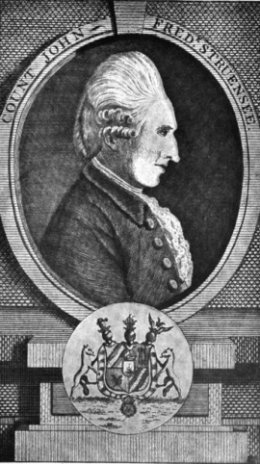
The 1700s were a time of radical reform, and as the Enlightenment reached the shores of Denmark, it suddenly became possible to be a professed atheist and not lose your head. That is, of course, as long as you didn’t also try to usurp the crown, undermine the aristocracy, and agitate the commoners while you were at it.
Such was the course that ended the rise of Johann Friedrich Struensee on this date in 1772. His friend and sometime cohort Enevold Brandt (Danish Wikipedia entry) was put on the block on the same day.
Struensee was born in 1738 in present day Germany and educated in Prussia, a doctor by trade and a budding Enlightenment political writer by practice. He seemed an unlikely character to involve himself in the court of King Christian VII of both Denmark and Norway, but Struensee was a vain and social man who managed to befriend the right people at the right time.
The first was Brandt. The second was Count Schack Karl Rantzau. A lawyer and Supreme Court justice, Brandt was a court favorite* and planted Struensee’s name as a capable doctor: young, kind, and competent, he would make a perfect personal physician for a king known for being a bit off: Christian was likely schizophrenic. Rantzau, meanwhile, was Count of the Holy Roman Empire, exiled from Copenhagen some 15 years before he met young Struensee, and eager to get back into politics.
In June 1768, Struensee took a post as the king’s traveling physician in England, and he immediately attached to Christian’s loneliness. The regent was interested in literature, philosophy, and music, and Struensee obliged him with patient regard for his charge, for which he was duly rewarded with access to a social life much more fulfilling than in Prussia. As a traveling physician, though, Struensee’s post had a finite span, and he lobbied hard to become a member of the Danish court.
With some help from others in the king’s court, Struensee managed to retain a permanent post, and his clamber up the nearest cliff to power began.
The young doctor, it seems, had a talent for playing two sides for personal gain. It started with the king, who had immense trust in Struensee and began to confide almost everything. Struensee was tactful with this information, adhering to an early form of patient-doctor privilege that endeared him to Christian. The other side was Queen Mathilde, Princess of Wales, by all accounts a beautiful woman who was not happy in Denmark and even less happy to be married to a mad and deteriorating king.
Mathilde initially disliked Struensee — or, at the very least, was indifferent to his actions. But near the end of 1769, the queen finally admitted Struensee into her chambers, and their relationship took off. He ably gamed Mathilde by convincing her that she was the kingdom’s future; Christian, meanwhile, remained ill, and Struensee remained a steady presence in his life. Come spring, Crown Prince Frederick VI also came under Struensee’s care, and as smallpox ravaged Copenhagen, the doctor pressed for inoculation. The king and queen assented, Frederick survived the epidemic, and Struensee garnered himself an official advisorship. It’s also suspected that, while Struensee and Mathilde watched over Frederick as he recovered from the inoculation,** their love affair began.
With a taste of power, Struensee pressed King Christian VII for cabinet changes — which he got — and was named Privy Councilor before 1770 was out. Now the principal advisor to the king, Struensee was able to advance his Enlightenment agenda, notably freedom of the press, the abolition of torture, limiting the death penalty, changing the rules of appointments, numbering the houses in Copenhagen, lighting the streets, and, perhaps in anticipation, removing penalties against those who produced illegitimate children. He was a bold visionary, but he also intoxicated by his growing power … and his programme obviously gored many an ox.
Struensee ascended still further early in 1771 when the king became practically unfit to rule. He was mentally faltering, and Struensee was all but running the show, and more.
In early July, the queen gave birth to a daughter who was widely assumed to be Struensee’s child. Days later, and just three years after being introduced to King Christian VII, Johann Friedrich Struensee effectively appointed himself Privy Cabinet Minister with dictatorial authority through one of King Christian’s edicts. Struensee’s orders would now have the force of law, and, as Christian’s proclamation noted, “They shall be immediately obeyed.”
Enevold Brandt (top), not to be confused with Brandt, the Big Lebowski lackey (bottom).
Struensee spent the next six months turning the European aristocracy inside-out and foisting an aggressive set of cabinet orders on the Danish people — over 1,000, by some counts. Having ridden on the coattails of a queen and king, he now pushed them aside. He moved the court to Schleswig-Holstein, in Prussia, and pleasingly enjoyed both the prerogatives of aristocracy and a middle class contempt for them.
Struensee was, to say the least, not a favorite abroad;† that he and his friends dominated the king and queen did not sit well with Danish commoners. Even Brandt was becoming disaffected, writing in a letter asking for either a larger salary or a resignation from the court:
No despot ever arrogated such power as yourself, or exercised it in such a way. The King’s pages and domestics tremble at the slightest occurrence: all are seized with terror. They talk, they eat, they drink, but they tremble as they do so. Fear has seized on all who surround the minister, even on the Queen…
But Brandt stayed on, and as 1771 drew to a close, Copenhagen became hostile territory for the royal family and their favorite doctor.
After the season’s first masquarade ball, on 16 January 1772, the Queen Dowager — Christian’s step-mother — Juliana Marie exposed Struensee’s affair and had Struensee, Brandt, the queen,‡ and many other Struensee accomplices arrested, ostensibly by order of the king.
Struensee was charged with lèse-majesté, a crime against the crown, for his affair with the queen; though he initially denied the charges — and though Mathilde did her best to shield him from harm — he was found guilty. Brandt was charged with the same crime for allegedly assaulting the king after being himself threatened with a flogging for impertinence (he even had a nip at Christian’s finger). Brandt’s punishment was the same. Each had his right hand chopped off, then was beheaded, drawn, and quatertered.
The queen, meanwhile, went into exile in France. Juliana Marie effectively ruled the kingdom through her son for over a decade, rolling back many of Struensee’s reforms and reverting power back to the aristocracy. This also turned out to be unpopular (the Danes and Norwegians are fickle people), and Mathilde’s son Frederick VI was able to regain power for his father in 1784, eventually moving to liberal reforms more in line with his erstwhile physician’s ideals.
Struensee’s epic rise and fall have spawned a variety of writings since his death. A memoir appeared just months after his execution which detailed his final months. He was also the subject of the Per Olov Enquist novel The Royal Physician’s Visit, which examines his life from multiple perspectives. Queen Mathilde’s life was put to ballet by Peter Maxwell Davies. And for a more contemporary cultural artifact, there’s the 2012 film A Royal Affair.
* Brandt was a court favorite, but after attempting to destroy the position of another minister, he was briefly expelled from Copenhagen, shortly after Struensee accepted his post.
** These inoculations predated “safe” inoculations by non-fatal, related disease strains such as cowpox. Frederick would have been made ill through the small pox strain Variola Minor, which had a mortality rate of about 1%. By contrast, Variola Major was fatal in about 30% of cases.
† While Struensee seems to have been book smart, his feel for international politics was limited, and his standing abroad would have unraveled had it ever raveled in the first place. He repeatedly upset the Russians, and Mathilde’s relatives were not pleased with him. Had he not been downed by public sentiment, it seems likely he would have fallen victim to one of his many royal detractors abroad.
‡ In a curious twist, Rantzau was the queen’s arrestor, and one of the principal conspirators in the dowager’s plot was a cabinet minister Struensee was responsible for ejecting very early in his career.
On this date in 1521, the day after winning the decisive battle in the Castilian War of the Communities, royalist forces beheaded its three principal leaders in Villalar.
Even while the Spanish Empire was burgeoning in the New World, its home peninsula remained a house divided.
The Iberian Kingdoms of Aragon and Castile had joined in a personal union with the marriage of Ferdinand and Isabella in the late 15th century.
When the couple passed, it was not a given that their conjoined territory would become, as it did, the germ of a unified Spain.
Instead, the royal power couple’s crazy daughter was kept under lock and key while her infant son grew into the redoubtable Emperor Charles V. To exacerbate the local annoyance, Chas had continent-spanning territories, and ambitions; Spain was not his base, merely one of his provinces. (He’d grown up in Flanders. Ah, dynastic politics.)
The Emperor was only a teenager when his Castilian subjects rose against his levies, and against the paradoxical perception that the first true King of Spain was a foreign ruler.
A riot in Toledo mushroomed into a revolt, and everyone started drawing up sides. (Spanish link) Things went south when the commoner rebels started adopting an unwelcome radicalism (beyond rebelling against the king, that is), enabling the imperial rep (and future pope) Adrian of Utrecht to pull back into the royalist camp rebellious nobles increasingly fearful of expropriation at the hands of the firebrands.
The Execution of the Comuneros of Castile, by Antonio Gisbert. Segovian Juan Bravo allegedly asked to die first, so as not to witness the death of so good a knight as Padilla.
The demise of the “Caballeros Comuneros” pretty much squelched the revolt — although Padilla’s widow Maria Pacheco defended the rebel ground zero of Toledo for several months more.
The comuneros have lived on ever since as a symbol in literature and propaganda, among monarchists (for whom they are a symbol of perfidy), liberals (rather the reverse) and Castilian nationalists. Though “comuneros” was for a period an all-purpose smear against agitators in the Spanish dominions, April 23 (the date of the fateful battle) has been Castile and Leon Day, a public observance, since 1986.
This monolith in the Villalar town plaza commemorates the Comuneros. Image (c) Julio Alvarez, and used with permission.
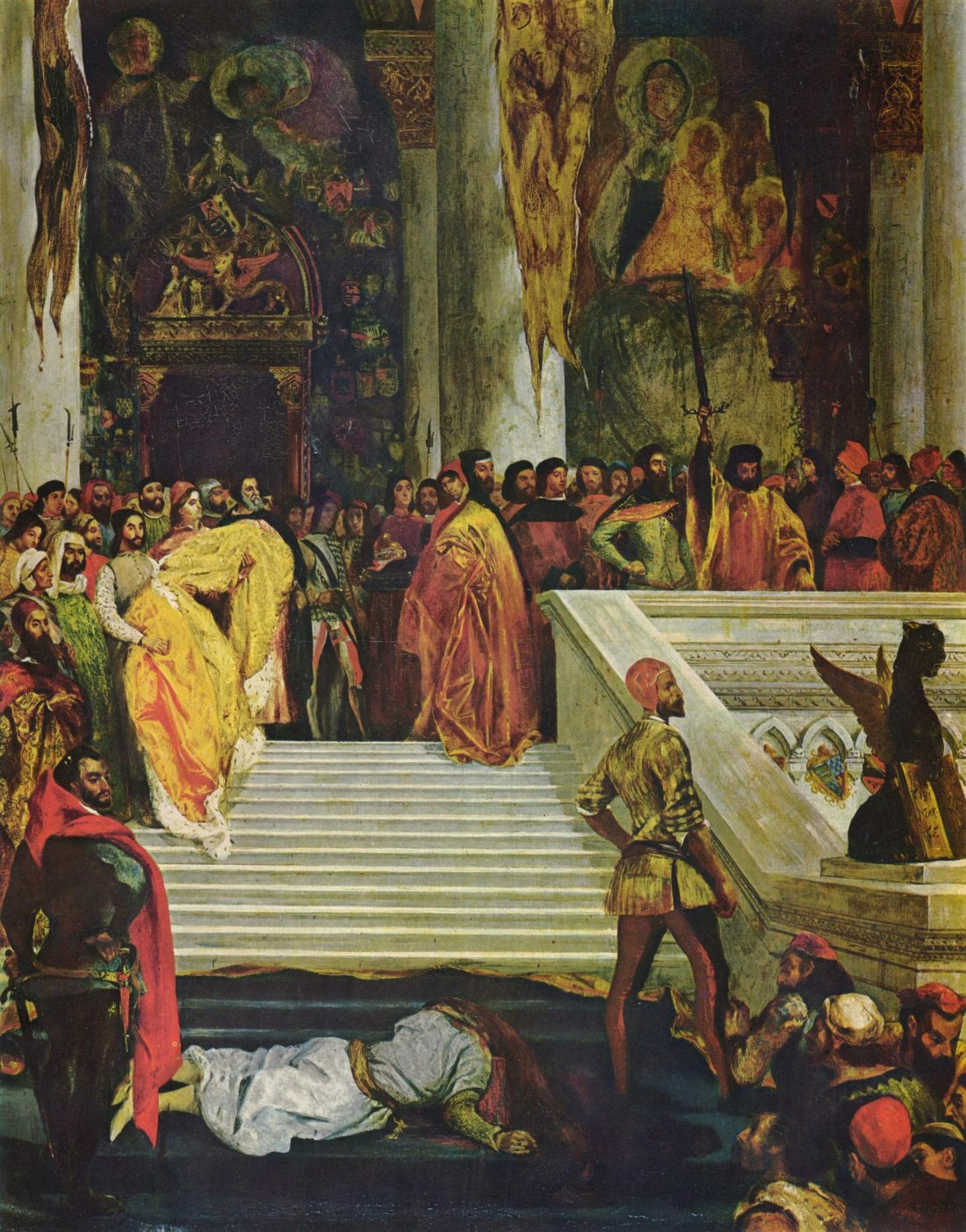
On this date in 1355, Marino Faliero* was escorted to the spot where he had been crowned Doge of Venice scant months before. There, he was ceremoniously relieved of his robes of state … and then his head.
Some fog surrounds the day’s proceedings, product not only of time but of the Doge’s executioners’ damnatio memoriae upon their victim. What was written was circumspect; even Faliero‘s portrait in the great hall of the Doge’s Palace was veiled.
What is known — or at any rate, was admitted by the elderly first citizen — is that the ruler attempted a coup against the overweening power of Venice’s great families.
The putsch was supposed to occur on April 15, with the bell of St. Mark’s Cathedral tolling on a fabricated hue and cry. In the tumult, the Doge’s supporters meant to cut down the nobles who flexed the real political muscle in the maritime republic and consolidate ducal power.
Why?
The salacious version has the old goat in a tiff with a noble, who made fun of his May-December marriage —
Marino Faliero of the beautiful wife,
Others enjoy her while he maintains her
A tribunal of fellow-nobles let the rascal off with a slap on the wrist.
Power being what it is, and princes and nobilities being born for conflict with one another across the centuries in Europe, one may as well discern a straightforward political intent — heightened, perhaps, by the then-dire state of Venice’s naval contest with Genoa.
Downright Byronic under either scenario … and Byron wrote a play about Faliero. The doomed ruler gives throat to quite a magnificent curse upon his city, with all the foresight of Byron’s half-millennium of hindsight:
I perish, but not unavenged; far ages
Float up from the abyss of time to be,
And show these eyes, before they close, the doom
Of this proud city, and I leave my curse
On her and hers for ever! —
…
— She shall be bought
And sold, and be an appanage to those
Who shall despise her! — She shall stoop to be
A province for an empire, petty town
In lieu of capital, with slaves for senates,
Beggars for nobles, panders for a people!
…
Amidst thy many murders, think of mine!
Thou den of drunkards with the blood of princes!
Gehenna of the waters! thou sea Sodom!
Thus I devote thee to the infernal gods!
Thee and thy serpent seed!
[Here the Doge turns, and addresses the executioner.]
Slave, do thine office!
Strike as I struck the foe! Strike as I would
Have struck those tyrants! Strike deep as my curse!
Strike — and but once!
This sort of thing knocking about among litterateurs in the 19th century practically guarantees an opera.
* Or simply “Marin Falier”, in the Venetian dialect.
On this date in 1178 B.C.E., according to some enterprising astronomers, the Greek hero Odysseus returned home to Ithaca from a 20-year absence and slaughtered the suitors who had taken up lodgings in his palace.
This sort of putative historical specificity extracted from what could as well be read as literary devices — e.g., an eclipse — for a literary episode might gratify an advocate of “the higher naivete”, but the reader is well entitled to doubt.
Similarly, and more specifically for this venue, is the problem of whether the summary justice exacted by a Bronze Age chieftain meets the definition of an “execution”. This dubious case is resolved here by the unique subject matter.
Crafty quasi- (or altogether) mythical hero Odysseus (aka Ulysses), having left a generation before for the decade-long Trojan War which he finally resolved with the famous Trojan Horse strategem, then spent the next decade wandering about the sea en route to his home island.
When he gets there, he finds that 108 ill-mannered suitors have moved in, dissipated his fortune in merrymaking, and have ceaselessly dogged his faithful wife (and presumed widow) Penelope to remarry one of them.*
Together with his now-grown son Telemachus, Odysseus punishes them terribly .
“Dogs, did you think that I should not come back from Troy? You have wasted my substance, have forced my women servants to lie with you, and have wooed my wife while I was still living. You have feared neither God nor man, and now you shall die.”
They turned pale with fear as he spoke, and every man looked round about to see whither he might fly for safety, but Eurymachus alone spoke.
“If you are Ulysses,” said he, “then what you have said is just. We have done much wrong on your lands and in your house. But Antinous who was the head and front of the offending lies low already. It was all his doing. It was not that he wanted to marry Penelope; he did not so much care about that; what he wanted was something quite different, and Jove has not vouchsafed it to him; he wanted to kill your son and to be chief man in Ithaca. Now, therefore, that he has met the death which was his due, spare the lives of your people. We will make everything good among ourselves, and pay you in full for all that we have eaten and drunk. Each one of us shall pay you a fine worth twenty oxen, and we will keep on giving you gold and bronze till your heart is softened. Until we have done this no one can complain of your being enraged against us.”
Ulysses again glared at him and said, “Though you should give me all that you have in the world both now and all that you ever shall have, I will not stay my hand till I have paid all of you in full. You must fight, or fly for your lives; and fly, not a man of you shall.”
The suitors fight back, and most of the resulting deaths occur in the fray. But it’s about as one-sided as the contest on any proper scaffold.
As eagle-beaked, crook-taloned vultures from the mountains swoop down on the smaller birds that cower in flocks upon the ground, and kill them, for they cannot either fight or fly, and lookers on enjoy the sport — even so did Ulysses and his men fall upon the suitors and smite them on every side. They made a horrible groaning as their brains were being battered in, and the ground seethed with their blood.
And if many of the doomed die with their boots on, there are at least a couple of specific instances that clearly have a summary-execution character.
Leiodes then caught the knees of Ulysses and said, “Ulysses I beseech you have mercy upon me and spare me. I never wronged any of the women in your house either in word or deed, and I tried to stop the others. I saw them, but they would not listen, and now they are paying for their folly. I was their sacrificing priest; if you kill me, I shall die without having done anything to deserve it, and shall have got no thanks for all the good that I did.”
Ulysses looked sternly at him and answered, “If you were their sacrificing priest, you must have prayed many a time that it might be long before I got home again, and that you might marry my wife and have children by her. Therefore you shall die.”
With these words he picked up the sword that Agelaus had dropped when he was being killed, and which was lying upon the ground. Then he struck Leiodes on the back of his neck, so that his head fell rolling in the dust while he was yet speaking.
The minstrel Phemius, whose services had been procured by force, has better luck pleading for clemency when Telemachus intervenes before Odysseus can give him the chop. But the explorer’s son has no use at all for twelve corrupt handmaids who have abetted the suitors’ predations. I like this version in the chilling verse form quoted by Dr. Samuel Haughton in an 1866 paper on hanging that weirdly goes on to produce the physics necessary to demonstrate the intuitively obvious point that this must have required the main rope to anchor to pillars between each suspended noose, rather than all twelve on a single line.
…leading forth
The women next, they shut them close between
The lofty wall and scullery, narrow, straight,
And dreadful, whence no prisoner might escape.
Then, prudent, thus Telemachus advised:
The death of honour would I never grant
To criminals like these, who poured contempt
On mine and on my mother’s head, and lay
By night enfolded in the suitors’ arms.
He said, and noosing a strong galley rope
To a huge column, led the cord around
The spacious dome, suspended so aloft,
That none with quivering feet might reach the floor.
As when a flight of doves entering the copse,
Or broad-winged thrushes, strike against the net
Within; ill rest, entangled, there they find;
So they, suspended by the neck, expired
All in one line together. Death abhorred!
With restless feet awhile they beat the air,
Then ceased.
On whatever date imagined, or strictly as fiction, this whole bloodbath fixes the climax of one of seminal works of the western literary canon.
On this date in 1548, the Spanish crown cemented its authority over the territory of the former Incan Empire by beheading its rebellious conquistador authorities.
Gonzalo Pizarro (English Wikipedia entry | Spanish) had served in the force that late elder half-brother Francisco used to destroy the Incas. The poor bloke was always second banana in the conquistador game; when he wasn’t being one-upped by his flesh and blood, he was bailing on the expedition that “discovered” and navigated the Amazon River. (Francisco de Orellana earned those honors instead.)
No, Gonzalo had a more prosaic specialty: killing.
While big bro went off to pacify more territory, Gonzalo along with siblings Hernando and Juan, the Baldwin brothers of New World conquest, chilled in the former Incan capital Cusco and sparked a rebellion in the 1530’s with their iron-fisted rule.
Appointed Governor of Quito in 1541 — he forced the appointment with some exemplary hangings — Gonzalo was just the sort to get a burr in his saddle when the Emperor Charles V promulgated the New Laws requiring slightly less crappy treatment of the natives.
And that was a low bar to clear indeed.
Although the following passage is not particular to Gonzalo Pizarro, gadfly monk Bartolome de las Casasdescribed (perhaps exaggeratedly, but still) the previous Spanish depredations in “Perusia”:
[T]he Spaniards, without the least provocation on their part, as soon as they entred [sic] upon these Territories, did burn at the Stake their most Potent Caciq Ataliba, Prince of the whole Country, after they had extorted from him above Two Millions of Gold, and possessed themselves of his Province, without the least Opposition … As also some few days after, the Ruler of the Province of Quitonia, who was burnt, without any Cause given, or Crime laid to his Charge … and in like manner, burnt the Feet of Alvidis, the greatest of all the Quitonian Lords, and rackt him with other Torments to Extract from him a discovery of Ataliba’s Treasure, whereof as appear’d after, he was totally ignorant …
[T]hese Eyes of mine the Spaniards for no other reason, but only to gratifie their bloody mindedness, cut off the Hands, Noses, and Ears, both of Indians and Indianesses, and that in so many places and parts, that it would be too prolix and tedious to relate them. Nay, I have seen the Spaniards let loose their Dogs upon the Indians to bait and tear them in pieces, and such a Number of Villages burnt by them as cannot well be discover’d: Farther this is a certain Truth, that they snatched Babes from the Mothers Embraces, and taking hold of their Arms threw them away as far as they would from them: (a pretty kind of barr-tossing Recreation.) They committed many other Cruelties, which shook me with Terror at the very sight of them, and would take up too much time in the Relation …
More urgent than “recreation,” Pizarro (and many of the New World’s new landholding elite) were miffed that meddlesome European bleeding hearts types were going to cut into their profit margins.
Pizarro revolted, enlisting the brilliant officer Francisco de Carvajal, a longtime fixture of the Old World battlefield. Now an octogenarian, he had lost neither vigor in command, nor cruelty in conquest. (He played bad cop to Gonzalo’s good cop.) The two killed the guy sent to impose the emperor’s decree.
This uprising forced the next Spanish viceroy to repeal the hated New Laws in order to win political support against Pizarro and Carvajal — a happy outcome for Pizarro’s base, but not for the conquistador himself.
Pedro de la Gasca’s adroit diplomacy caused the entire rebel force to desert before the fight at the “Battle” of Jaquijahuana in Sacsayhuaman.
The two principals were quickly arraigned. Carvajal, at his age, could be wry about being singled out for punishment: “very merciful is the Lord President; for, if the victory had been ours, there would have fallen on this spot nine hundred men.”
Carvajal was hanged and Pizarro beheaded, both of them winding up on pikestaffs at the gates of the city Francisco Pizarro had founded — Lima.
Their partnership — and the arc of Spanish exploits in the New World — is covered in this Google Books freebie.
On this date in 1697, Godfrey McCulloch was beheaded for murder.
A lesser Scotch noble, McCulloch was heir to a family that had seen better times. His forebears had built and laid their [attached] heads at cozy Cardoness Castle, but hard times had seen the Gordon clan foreclose a bum McCulloch mortgage, and that put the families at pistols drawn.*
A minor confrontation between Godfrey McCulloch and Sir William Gordon saw McCulloch plant in Gordon’s leg a bullet wound that festered into a fatal infection.
McCulloch fled to the continent, but eventually — there’s no place like home — returned, and was recognized in Edinburgh.
One boring scaffold speech later, and that was that … unless you credit the legend that his headless body sprang up and ran 100 yards.
McCulloch was beheaded on the Maiden, a guillotine precursor that automated the chopping process.
He seems to have the distinction of being the last person so executed. (Update:Perhapsnot.)
* McCulloch, who was also a member of the Scottish Parliament, held a sheriff’s commission in Wigton. Although anti-Covenanter, he washed his hands of the Wigtown martyrs case.
On this date in 1945, a Hamburg coal worker was executed for an excessively realistic take on the war effort.
Although — or because — Germany’s administrative infrastructure was falling apart under the Allied onslaught late in World War II, its judiciary had no compunction about doling out death sentences.
While the overall number of cases dealt with by most special courts was much lower than in previous years, due to the gradual collapse of the court system, in these last months of the war some judges passed proportionally more death sentences than ever before. Legal officials continued to justify their brutal sentencing by claiming that this would prevent another ‘stab in the back’.
Poor Max Schlichting, a coal worker with an unfortunate communist past, was sentenced to death for Wehrkraftzersetzung — “subversion” or “undermining the war effort,” the same thing they got Remarque’s sister on.
Specifically: he remarked to a soldier, in the aftermath of the American landing at Normandy, that Germany was going to lose the war. An undercover Gestapo spy overheard him.

 Antoine Quentin Fouquier de Tinville (English Wikipedia page | French), or just plain Fouquier-Tinville, had emerged during the Revolution from penurious obscurity to wrangle a jury foreman’s position courtesy of his connection to Camille Desmoulins. When Desmoulins ally Georges Danton spearheaded creation of a Revolutionary Tribunal (French link), Fouquier-Tinville drew the choice gig of Public Prosecutor.
 Such was the course that ended the rise of



 Gonzalo Pizarro (
 A minor confrontation between Godfrey McCulloch and Sir William Gordon saw McCulloch plant in Gordon’s leg a bullet wound that festered into a fatal infection.