1789: Thomas Phipps the elder and Thomas Phipps the younger

From the Newgate Calendar (with thanks to frequent guest poster Meaghan Good of the Charley Project for the find):


These malefactors were father and son; and their final exit from this life was attended by circumstances of the most heart-rending and melancholy description.

The father was a man of good property, and lived on his own estate at Llwyney Mapsis, in Shropshire; and he and his son were indicted for uttering a note of hand for twenty pounds, purporting to be that of Mr. Richard Coleman of Oswestry, knowing the same to have been forged.

It was proved on their trial that Mr. Coleman never had had any transactions with Mr. Phipps that required the signing of any note whatever; that about the Christmas before, Mr. Coleman was served with a copy of a writ at the suit of Mr. Phipps the elder, which action Mr. Coleman defended, and for want of further proceedings on the part of the plaintiff, a non pros. was signed, with two pounds three shillings costs of suit against Phipps.

Upon this an affidavit was drawn up and sworn by Phipps the elder, Phipps the younger, and William Thomas, their clerk, for the purpose of moving the Court of Exchequer to set aside the judgment of non pros. and therein they swore that the cause of action was a note of the said Coleman’s for twenty pounds, which was given as satisfaction for a trespass by him committed in carrying some hay off the land of one of Mr. Phipps the elder’s tenants.

The Court thereupon granted a rule to show cause why the judgment should not be set aside; but Mr. Coleman insisting that the note was a forgery, the present prosecution was instituted against the father, son, and Thomas.

After a full hearing at the assizes at Shrewsbury, the father and son were pronounced “Guilty of uttering and publishing the note, knowing it to be forged;” and William Thomas was found “Not Guilty.”

Though convicted on the fullest evidence, the unhappy men, until the morning of their execution, persisted in their innocence; but when about to leave the jail, young Phipps made the following confession: “It was I alone who committed the forgery: my father is entirely innocent, and was ignorant of the note being forged when he published it.”

They were taken in a mourning-coach to the place of execution, accompanied by a clergyman and a friend who attended them daily after their condemnation.

On their way to the fatal tree the father said to the son, “Tommy, thou hast brought me to this shameful end, but I freely forgive thee;” to which the son made no reply. It being remarkably wet weather, their devotions were chiefly performed in the coach.

When the awful moment arrived, Mr. Phipps said to his son, “You have brought me hither; do you lead the way!” which the youth immediately did, and in the most composed manner ascended the ladder to a temporary scaffold erected for the purpose of their execution, followed by his father.

When their devotions were finished, and the halters tied to the gallows, this most wretched father and son embraced each other, and in a few moments the scaffold fell, and they were hand-in-hand launched into eternity, September the 5th 1789, amid a vast concourse of pitying spectators.

The father was forty-eight, and the son just twenty years of age.

On this day..

1783: William Wynne Ryland, court engraver

On this date in 1783, British engraver William Wynne Ryland hanged at Tyburn* before a throng of gallows-voyeurs such as “had not been seen on a like occasion since the execution of Dr. Dodd.” (Morning Chronicle and London Advertiser, Aug. 30, 1783)

“[H]is evil genius prompted him, for gold, to debase his talents in engraving,” the Newgate Calendar opined. “By one fatal act, he entirely ruined his reputation as a man: but his name as an artist will ever stand in the highest estimation.”

French- and Italian-trained, Ryland was a premier court artist in his day, noted for importing stipple engraving from the continent to England. He earned a royal pension for his portraits of Hanoverian elites.


Some Ryland portraiture, from the National Portrait Gallery: King George III and his queen, Sophia Charlotte.

Although Ryland’s first attempt to parlay his draftsmanship into a print-selling business had gone bankrupt in 1771, he does not seem to have been entirely neglected by the muse of business acumen, either. Over the subsequent decade he had discharged all his previous debts and stockpiled assets to the amount of £10,000. “I am rich beyond temptation,” he protested to the jurors who tried him for his life. The Crown could produce little in the way of an immediate motive for the forgery. (“It is impossible for us to penetrate so far into the heart of man as to know what his inducements are.”)

But lucre is its own motivation, and the facts of the case weighed heavily against Ryland.

He had come into (legitimate) possession of £200 bill of exchange issued by the East India Company and dated October 5, 1780. Somehow it transpired that Ryland then exchanged two copies of this bill — one on September 19, 1782 with the banker Sir Charles Asgill, and then once again on November 4, 1782 to a banking firm with the Dickensian name of Ransom & Co.

Both bills were identical to every inspection, with the same amount, date, and cheque number, and Ryland the expert engraver could give no convincing account of the second note’s provenance. In the public’s mind, the fact that he had fled the indictment and then dramatically attempted suicide when his capture was imminent surely cinched the case.

Ryland’s attempts to inspire in the jurors a sufficient doubt as to whether the East India Company might not have accidentally circulated two identical bills was fatally undone when it turned out that a difference between the two bills could be found after all — by the paper manufacturer, who proved to the court that the second bill was inscribed on paper whose watermark established that did not exist on its purported date of issue.

this sheet of paper was made at the mill, on that particular mould, it has a defect on it; on the 21st of January, 1782, of the same mould of which this note is now shewn me, I made this sheet of paper; there is a defect of the mould, either by an injury it has received, or in consequence of the quantity of paper made on it, the bill has the same defect; and there is likewise a defect which the bill has not, so that the sheet of paper on which the bill was written, was made from that mould. This could not happen in the same places, and situations in any two moulds.

The jury needed only half an hour to convict him.

By the Morning Chronicle and London Advertiser‘s account, he was London’s star attraction on his hanging day.

At half past nine a man on the steps of newgate called out, “Mr. Ryland’s coach,” upon which a mourning-coach, that was standing opposite the Sessions-house, drew up to the door of the prison, and in about two minutes after the unhappy man walked down the steps at a brisk pace, and entered the vehicle; presently after which [fellow condemned prisoner John] Lloyd went into another mourning coach. The Ordinary of Newgate, another clergyman, a gentleman in mourning, (said to be a relation of he convict’s) and a sheriff’s Officer, went in the coach with Mr. Ryland …

These coaches, which immediately followed the Sheriffs’ carriages, having drawn a few yards from the door of the prison, two carts were drawn up; [James] Brown, [Thomas] Burgess, and [John] Edwards were tied in the first, as was [James] Rivers in the last cart …

The gallows was fixed about 50 yards nearer the park wall than usual. About five minutes before 11 o’clock, Ryland’s coach drew on the right of the gallows, as did Lloyd’s on the left; and between them the cart; soon after which a violent storm of thunder, lightning, and rain came on, when the Sheriffs gave orders for a delay of the execution. When the storm had subsided, and some time had been employed in prayer, Rivers was lifted from one into the other cart, which backing to Lloyd’s coach, he alighted therefrom, and entered the vehicle, and after the ropes had been fixed about the necks of these unfortunate men, Ryland stepped from the coach to join his unhappy fellow sufferers. After a conversation of at least ten minutes between Ryland and Mr. Villette, Ordinary of Newgate, and the same time employed in an earnest discourse between Lloyd and Burgess, all the malefactors joined in singing the hymn, called, “The Sinners Lamentation”


Editor’s note: I’m not certain whether this is the hymn alluded to.

Ryland was the object that attracted the general attention, from Newgate to Tyburn, the sound that reverberated from every quarter, amidst the immense multitude was, “Which is ryland? There, that is Ryland in the first coach!” Exclusive of the usual accommodations, a vast number of temporary stages were erected; and gentlemens and hired carriages were innumerable. Some rooms, for accommodating private companies, were actually let at the enormous rate of from six to ten guineas.

Notwithstanding the vast press of the crowd, amidst the astonishing number of horsemen, carriages, and people on foot, we have not heard that any body was materially hurt, though many were forced down and trod on.

Ryland was in mourning, and wore a tail wig … Through the whole of this trying scene [he] conducted himself with remarkable serenity and fortitude, strongly indicating that he was prepared for, and perfectly reconciled to his fate.

The wheel of fortune turning against the mighty — especially when they should hazard their lives for a needless pittance — being irresistible to other artists, Ryland is the title character of a a comedic play.

* One of the very last hangings at Tyburn.

On this day..

1787: Jacob “Hannikel” Reinhard

Robber Jakob Reinhard, better known as Hannikel, was hanged on this date in 1787 in Sulz am Neckar in Wurttemberg.

The captain of a brigand company stalking the Black Forest, Hannikel (English Wikipedia entry | German) kept one step ahead of pursuers for many years simply by exploiting the fragmented map of southern Germany: the next lord’s border was never more than a few strides away. Like his near-contemporary Schinderhannes, the bandit prince earned the affection due charismatic rogues for the usual reasons, viz., turning the wheel of fortune against the great and the good whom they made to stand and deliver.

Hannikel elevated his crew’s outlawry level from nuisance to anathema in 1786 by killing a guy in the course of a home invasion, which featured the less romantic part of the robber’s job: dripping burning resin on the lady of the house until she yielded up the concealed ducats. This incurred the wrath of the Duke of Wurttemberg, and the great bailiff (and early criminologist) Jacob Georg Schaeffer damned the borders and pursued the marauders all the way to Switzerland before he finally had them all rounded up.

Hannikel hanged along with three others of his gang; other members received lengthy prison sentences at hard labor.


1788 illustration of Hannikel imprisoned in the Schloss Sargans. Via this German-language summary (pdf) of Hannikel’s career.

On this day..

1786: Joseph Rickards, aspiring milkman

(Thanks to Meaghan Good of the Charley Project for the guest post. -ed.)

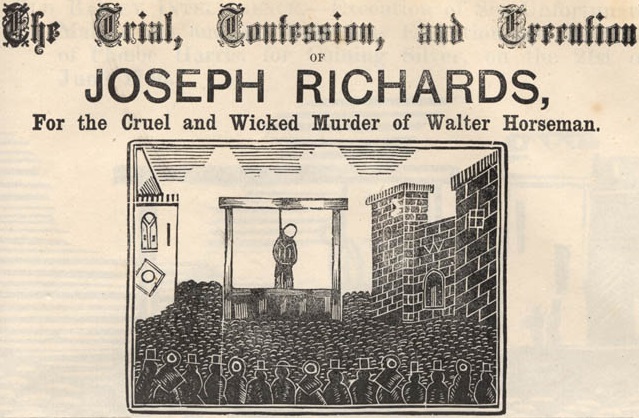
On this day in 1786, Joseph Richards or Rickards was executed in Kentish Town, London for the murder of his former employer, Walter Horseman, whom he attacked on February 11.

Graham Jackson and Cate Ludlow described the crime in the most graphic terms in their book A Grim Almanac of Georgian London:

At around 2:00 a.m., Mary Horseman of Kentish Town was woken by the sound of her ten-year-son calling out that his father, London milkman Walter Horseman, needed her… Mary found her husband sitting on his bed. By the light of the moon, which was flooding through the large bay windows, she could see that he was quite black with blood, which covered him from his face to his waist. “Lord bless me,” he said. “Something has run over my face!”

“Run over your face?” she responded. “Why, you are nothing but blood!” She ran for a candle, and when she returned, the light revealed a truly hideous sight: her husband was cut to pieces, his forehead, eyes and nose smashed. His skull, which was broken, was described in court as “cut and mangled in a desperate manner.” The two sections of the skull had broken apart, and his eye sockets had been smashed into shards.

There was nothing to be done for Walter, but amazingly, he lingered until the 19th, over a week after the assault. Due to his head injuries and the fact that he’d been attacked while he was sleeping, he wasn’t able to provide any useful information as to what happened.

The murder weapons were left behind at the crime scene: they proved to be a wooden hedge stake and an iron bar, which was “jellied” with gore.

Only a few farthings were missing from the house. The Horsemans’ four-year-old daughter, who was sleeping in the same room as her father, was not harmed. Suspicion quickly fell on Rickards, the Horsemans’ former apprentice, whom they’d recently sacked for laziness. He had no alibi for the night of the murder, a night watchman saw him near the Horsemans’ home about an hour after the attack, and Mary identified the hedge stake as one he had cut several days before the attack.

Nevertheless, he seemed confident and didn’t bother to leave the area. In fact, in an incredible display of chutzpah, he actually visited his ailing former master and shook his hand before Walter died. Perhaps his cockiness — or obliviousness — was a product of his immaturity; in an age of doubtful record-keeping, we can’t be sure of Joseph Rickards’s age but he was certainly quite young. Mary Horseman speculatively pegged the ex-apprentice as an 18-year-old; the London Times (Feb. 24, 1786) thought that he did “not appear to be more than sixteen years of age.” Although even 16 would be quite old enough to hang in Bloody Code London, the magistrate felt constrained on account of the boy’s age to caution his jurors against excess confidence in the confession he ultimately produced:

I should not for one, though he is very near the state of manhood, chuse to rest singly and merely on his confession, as he is not at full age, though he is above that age of discretion, which the law assigns to be at the age of fourteen years, and certainly it is near the time that human reason is supposed to be mature.

On the 20th, the day after Walter’s death, Rickards was arrested. Within a day he had admitted to concealing himself in a large cupboard in one of the bedrooms in order to beat his former boss to death in his bed. (The trial records are here.) He tried to shift some of the blame to Mary Horseman, claiming they had frequently kissed and he had “laid hold of” her breasts, and that she had told him she wished her husband was dead.

He was hanged in a field across the way from the Horseman family’s dairy — a pathetic spectacle, to judge by the account of the Public Advertiser (Feb. 28, 1786), during which he recanted his allegations against the milkman’s widow.

In his way to the place of execution, the convict appeared to be in a state of mind bordering upon stupefaction: He had no book, nor did he employ the short remnant of time in those preparations for eternity which his miserable situation rendered so indispensably necessary.

Before being turned off, the prisoner desired to see the widow of the deceased; she was sent for to her house, but was gone to London: he declared he had no accomplice in the fact, and that he was induced to the perpetration thereof by the supposition, that after the decease of his master he should succeed to his business as a milkman. Just before coming to the village, he burst into tears, and when he came to the place of execution wept bitterly; his expressions of sorrow and contrition being only interrupted by fervent appeals to Heaven for mercy till the last moment of his existence. He desired his hat might be given to one, and his buckles to another man; and he also made some other trifling dispositions.

One of the Sheriffs, and a great number of their officers on horseback and on foot, attended on the above occasion. Considering the nature of the criminal’s offence, and the disposition of the English to behold spectacles of horror, the crowd was not near so great as might have been expected, owing, no doubt, to the fall of snow, and going so early. The body of the malefactor was conveyed from Kentish Town to Surgeons Hall for dissection, without a shell, and covered only with a coarse cloth, which by the motion of the cart was frequently so removed, that the head and different parts of the body were frequently seen by the passengers on the road and in the streets.

The anatomization, and accompanying public lecture on the late Rickards’s thorax, was performed by a “Dr. Cooper” (General Evening Post, Feb. 28-Mar. 2, 1786); this would appear to be the budding anatomist Astley Cooper who was only 17 years old himself at this time — just at the outset of a scintillating medical career.


THE TRIAL.

Old Bailey, February 24th, 1786.

Joseph Richards was arraigned for the wilful murder of Walter Horseman, milkman, in Kentish Town. The deceased’s widow deposed, that the prisoner was formerly a servant to her husband; that he was discharged for negligence; that he had frequently threatened vengeance on the deceased; that on the morning the murder was committed, she was awakened by a noise, and on entering the room her husband slept in, she found him sitting up in the bed, and as far as his waist in blood; that a stick which the prisoner had cut some time before, lay in the room, and an iron bar, covered with blood; that her husband was mangled in a shocking manner: — he lingered a few days, and died a shocking spectacle.

Four other witnesses were examined, whose testimony proved certain corroborating circumstances; such as, being from his lodging the night the murder was committed, being seen to melt lead, and to pour it into the stick that was found in the deceased’s room, &c.

The prisoner confessed the murder to one of the magistrates who committed him for trial; but pleaded Not Guilty at the bar.

The jury, after a few minutes’ consideration, brought in their verdict Guilty.

Mr. Recorder pronounced judgment. He said the voice of innocent blood cried to heaven for vengeance. He dwelt upon the atrociousness of the crime of murder, observing, that the Divine Law had ordained, that whoever sheddeth man’s blood, &c., and then expatiated on the peculiar circumstances of the murder, the murder of an innocent master, to whom he owed duty and reverence.

The sentence was then passed as usual, that he be hanged till dead, and anatomized; and an order of Court was made out, to execute him on Monday, at Kentish Town, as near as possible to the house of the deceased.

THE EXECUTION.

Joseph Richards, a youth about eighteen, who was convicted on Friday last, for the wilful murder of Walter Horseman, with whom he lived servant, was executed at Kentish Town, opposite the house where the horrid fact was perpetrated. The malefactor came out of Newgate about twenty minutes before eight o’clock, and with some alertness stepped into the cart, which conveyed him through Smithfield, Cow Cross, and by the two small-pox hospitals to the spot, where he was removed from that society of which he had proved himself a most unworthy member, at a time of life when such atrocity of guilt as he possessed has been seldom known to degrade humanity. In his way to the place of execution, the convict appeared to be in a state of mind bordering upon stupefaction; he had no book, nor did he employ that short remnant of time in those preparations for eternity which his miserable situation rendered so indispensably necessary.

Before being turned off, the prisoner desired to see the widow of the decreased; she was sent for to her house, but was gone to London; he declared he had no accomplice in the fact, and that he was induced to the perpetration thereof by the supposition, that after the decease of his master he should succeed to his business as a milkman. Just before coming to the village, he burst into tears and when he came to the place of execution, wept bitterly; his expressions of sorrow and contrition being only interrupted by fervent appeals to Heaven for mercy till the last moment of his existence.

On this day..

1785: Barbara Erni, the Golden Boos

Tiny Liechtenstein last conducted an execution 230 years ago today: Barbara Erni — the legendary “Golden Boos”.

Nicknamed for her strawberry blond hair, the Golden Boos had an ingenious scam that required every bit of her Bunyanesque strength: she would wander the countryside and check into inns with a large chest or pack. Intimating that the parcel contained something of great value, she would insist upon its overnight safekeeping in a very secure room.

Once the inn had tucked in for the night, a diminutive accomplice would emerge from the trunk, plunder the lonely room of its valuables, and the two would escape into the night. Evidently, secure rooms in 18th century Liechtenstein were never secured from the inside.

She admitted to 17 such thefts. Liechtentein, whose population at the present time numbers fewer than 40,000 souls, had to import the executioner to chop off Barbara Erni’s Golden Boos on a public scaffold in Vaduz on February 26, 1785.

Liechtenstein officiall abolished the death penalty in 1987.

On this day..

1788: John Price Posey, “superlative villain”

(Thanks to Meaghan Good of the Charley Project for the guest post. -ed.)

On this date in 1788, John Price Posey was publicly hanged in Richmond, Virginia for arson.

He was 35 years old, with two children.

Posey, born in 1752, didn’t have the kind of background you would expect for an executed felon. His uncle was the Revolutionary War general Thomas Posey. Posey himself was a childhood playmate of John Parke “Jacky” Custis, stepson of Founding Father George Washington.

John Price Posey grew up near the Washingtons’ Mount Vernon plantation and was a frequent guest there. After he completed his education, Washington helped him find a job. When Jacky Custis reached legal age, he appointed Posey as steward of his plantation in New Kent County.

All went well for awhile. Posey even became justice of the peace and served in the house of delegates between 1780 and 1781.

The situation soured, however, after Jacky died in November 1781. George Washington learned that his deceased stepson’s erstwhile friend had been embezzling money from Jacky’s estate. He had sold off some of Jacky’s slaves and pocketed the profits, and later on he was caught stealing a cow from the plantation. For this “abuse and misapplication” of his duties, Posey was fined a total of £225 and removed from his position as justice of the peace. In his correspondence, General Washington referred to him as a “Superlative Villain.”

In June 1787, Posey was arrested for assaulting a sheriff and sentenced to a month in jail. On July 12, he escaped. Three days later, he and an accomplice, Thomas Green, returned to the jail with two slaves called Sawney and Hercules. The four men set fire to the jail, went two miles up the road and then set the county clerk’s office on fire. It burned to the ground and all the county records stored within were destroyed.*

Posey was back in custody within a day of the arson attacks, and after his arrest, Thomas Green confessed to his role in the affair. Posey was brought to Richmond in chains to stand trial for arson, which was a capital crime at the time. Convicted on October 1, he filed an appeal. On January 18, 1788 the Virginia Court of Appeals voted nine to one to reject his petition for clemency, and told him he must die.

Posey then sent a written request to the governor, Edmund Randolph:

The unfortunate and most unhappy John Price Posey begs that a further indulgence of a few days could be allowed him — Hopeful that it would be attended with giving further relief to the peace of mind that your unfortunate petitioner is now in search of.

This bought him a week’s stay. On January 25, he was hanged on Richmond’s gallows alongside James M’Connell Fox, a murderer. His body was buried in an unmarked grave, possibly in the Mount Airy area.

Virginia law allowed the state to confiscate a person’s property in cases of capital convictions, but in this case, unusually, the Virginia legislature returned everything to Posey’s widow, Anne Kidley Posey. She ultimately remarried.

As for his partners-in-crime: Thomas Green was never tried for his role in the arson attacks, and the slaves Sawney and Hercules were ultimately pardoned and given back to their owner, Posey’s brother-in-law.

* New Kent County’s archives also held colonial-era records for several other counties. Posey’s spiteful torch wiped out a trove of invaluable colonial-era records and is still lamented by historians and genealogists whose work touches that period as “the greatest loss”.

On this day..

1781: Twelve Aymara rebels

[M]ore than 14,000 will have perished in this unhappy city, the great majority through starvation; others were shot, and still others were beheaded by the rebels in the fields that many attempted to cross even though they knew that the rebels would not show them any mercy if they looked Spanish in any way. And I, in the middle of all this misfortune and despite having as many bullets pass over me as passed over Carlos Federico of Prussia, I am still alive up to this date and after having satisfactorily carried out all the enterprises entrusted to me by my friend Commander Segurola, and having shown myself on all occasion to be very competent, and with a selfless love of service towards both Majesties, risking my life and everything I own to defend this hapless city. And everybody has celebrated, but especially said Commander, my activity and boldness at night as well as during the day, as I could always be found in the most dangerous areas of this wretched city, supervising and reprimanding those officers who were slack in their duties. Whatever happens from now on, God was served.

There is no Indian who is not a rebel; all die willingly for their Inca King, without coming to terms with God or his sacred law. On October 26th twelve rebels were beheaded and none of them were convinced to accept Jesus; and the same has happened with another 600 that have died in executions during both sieges.

The head of the infamous Tupac Catari still hangs from one of the gallows of this square, and on the 20th of last month they began to form the cases against twenty-four of the principal rebel officers who served under his perverse and iniquitous command. Equal diligence is being practiced against five women who are being held in the command post of this square. Among them is Catari’s sister and one of his women with the same inclinations as that iniquitous Indian, who must have come from the depths of hell.

More troops are needed from both Viceroyalties or from Spain, some 8,0000 to 10,000 men to make Our Sovereign’s name respected throughout the entire Sierra and to finally, once and for all, cut off some heads and be finished with all these cursed relics.

-Dec. 3, 1781 letter from Juan Bautisa Zavala “summarizing the calamities” of La Paz under Aymara siege over the foregoing months (As quoted in this anthology)

On this day..

1782: Bartolina Sisa, indigenous rebel

September 5 is International Indigenous Women’s Day, in honor of the torturous execution in Bolivia on this date in 1782 of the Aymara peasant rebel Bartolina Sisa.

Sisa (English Wikipedia entry | Spanish) shared with her husband Tupac Katari leadership of a huge indigenous uprising against the Spanish.

Eighteen months before Bartolina’s execution, she and Tupac Katari — Julian Apasa, to use his given name before he staked out a nom de guerre claiming the inheritance of Tupac Amaru and Tomas Katari — laid La Paz* under siege with an army 40,000 strong. Over the course of that spring summer, the Bolivian capital lost 10,000 souls and teetered on the brink of collapse — actually in two separate three-month sieges with a brief interim between.

Bartolina Sisa was recognized by the rebels as the coequal of her husband; the two took command decisions together in consultation.

As such, when the siege was finally relieved and the natives defeated that October, Sisa was in line to share her husband’s fate. This was easy to effect because she had been betrayed into Spanish hands between the first and second sieges. Her enemies refused Tupac Katari’s every blandishment to exchange her, and in time had the cruel pleasure of forcing her to watch her defeated husband’s butchery. Nearly a year later Sisa tasted a like fate, and her body was thereafter chopped up to display as a warning in various towns to cow potential future native insurgents.

A present-day peasant women’s union bears Sisa’s name, the Bartolina Sisa Confederation; the president of Brazil’s 2006 Constituent Assembly that drafted the country’s current constitution was an indigenous Quechua woman named Silvia Lazarte, who was the Bartolina Sisa Confederation’s former executive secretary.

* The city‘s full original name was Nuestra Señora de La Paz, “Our Lady of Peace”. It was founded in 1548 at the site of a former indigenous village and the “peace” referred to is the restoration of calm after Gonzalo Pizarro‘s rising.

On this day..

1788: John and Robert Winter, father and son

On August 6, 1788, “John and Robert Winter, the father and son, were executed at Morpeth, pursuant to their sentence, for breaking open the house of William Charlton, esq., of Hesleyside. As they had lived for many years in a course of the most daring and shameless villainy, at their death, they testified the most brutal want of feeling, fear, or compunction.”

On this day..

1785: John Winship, family planner

On this date in 1785, a Sunderland-area farmer named John Winship was hanged for killing his maidservant Grace Smith with a poisonous draught of corrosive mercury sublimate which Winship had intended to induce an abortion.

His body was delivered to a local surgeon, who autopsied it and “in the presence of many gentlemen of the faculty” lectured on Winship’s organs as he dug them out (and extracted two intestinal worms).

the doctrine of the late Mr. Hewson, F.R.S. was demonstrated, that, in executions of this kind, death is not produced, as has been generally supposed, by an extravation of blood, occasioned by the rupture of the vessels of the brain, but by suffocation: as in the case of drowning, etc. (Newcastle Courant, July 30, 1785, quoted in this anti-abortion tract)

Grace Smith, who died four agonizing days after she ingested the toxin, perhaps did not sympathize overmuch with her killer’s unpleasant strangulation.

On this day..