1817: Not Hall or Read, prosecuted for blood-money

Miscarriages of justice perpetrated by actors in a position to extract private benefit from generating criminal prosecutions is a story as old as the hills. This one, as reprinted in the London Morning Chronicle, Aug. 25, 1817, at least has a happy ending:

EXTRAORDINARY CIRCUMSTANCE

Two soldiers, named Hall and Morrison, were on the 26th July tried for a highway robbery at the Stafford Assizes, before Baron Garrow, convicted, and ordered to be executed. They were prosecuted by a man named Read, a bricklayers labourer, who swore that they knocked him down and robbed him of a shilling and a penny, in a church-yard at Wolverhampton, on the 23d July. The evidence of the woman in whose house the prisoners resided, went to prove that they did not sleep at home on the night of the imputed robbery. To those two witnesses the evidence was confined, and against it there appeared nothing upon the trial, except the declarations of the prisoners, containing facts which were afterwards sworn to be others, and which, after the utmost labour of a few benevolent persons, were the means of saving the innocent prisoners from a death which appeared to all to be inevitable.

The two soldiers were, upon the 23d of July, drinking at an hour too late for admission at their lodging at Wolverhampton, and, after applying in vain to be allowed to go into the guardroom to sleep, walked about the village to kill time.

In loitering through the church-yard they met a man who seemed to be in want of work, and, like themselves, without a lodging for the night. A conversation ensued, and the stranger told them his name was Read; that he was a bricklayer’s labourer out of employment, and a Hertfordshire man.

It happened, that in his description he hit upon the part of the country from which one of the prisoners came. A jesting dialogue took place between them, and at length it was agreed that they should wrestle.

Hall was the friendly opponent of Read upon the occasion, and he was thrown in the first round of wrestling. In the second, however, Hall was more successful in the feat of activity, but his triumph nearly robbed him of his life. The vanquished man dropped a shilling and a penny from his pocket. Morrison immediately picked up the money, said it would do for beer, and put it into his pocket. The soldiers quizzed Read about his loss, and were heard by a watchman near the spot acknowledging that they had the shilling, and would certainly dispose of it in the most convivial way.

Read growled about his money, and showed a disposition to quarrel, but did not utter a word about his being robbed of it. About five o’clock in the morning the three were seen near the market-place by another watchman, and the soldiers were bantering Read upon the same subject.

The good humour of Read, however, at this time, appeared quite broken up; he spoke of having the soldiers taken into custody, but was answered by a laugh from them. A grocer, named Powis, saw them all under similar circumstances, and heard Read complain of no attempt at robbery, but saw that he was not pleased at being laughed at.

The grocer soon after met a man named Roberts, the keeper of the House of Correction at Wolverhampton, and mentioned to him that Read said two soldiers had got his money. The answer of Roberts, which did not strike the grocer as extraordinary at first, was, “I must see that man; this is a good job.”

The event, however, soon explained the language. Roberts immediately inquired after Read, questioned him upon the loss he had sustained, and in a very short time apprehended the two soldiers upon the charge of robbing Read in the highway of a shilling and a penny. Before the magistrate, Read swore that the soldiers knocked him down and robbed him of his money in the church-yard. Their commitment was immediately made out, and they were sent to the Assizes of Stafford, where, on the Saturday following they were tried and condemned for the capital offense.

The inhabitants of Wolverhampton knew nothing of the intention of Read upon the interference of Roberts in this transaction. It was generally concluded amongst them that the angry state of mind in which Read appeared, would have influenced him to swear a common assault, but nothing at all serious was apprehended from the wrestling bout. There was consequently no interference upon the part of those who were acquainted with many of the circumstances; and the matter died away until the village was struck with horror at an account in the Stafford paper of the proceedings of the Assizes. An old man was reading the paper in an ale-house to a number of politicians, who were not much affected at any thing they heard until he came to that part which stated the number of persons left for execution. Amongst the names were those of Hall and Morrison. The whole population of Wolverhampton instantly showed how they felt upon an occasion so dreadful.

The Rev. Mr. Guard, one of the most venerable characters in that part of the country, who officiates in the village where Hall’s family resides, upon hearing the event of the trial, set out for Wolverhampton, where he found the people already meeting and acting upon this subject. The men were to be hanged this day (Saturday last), and not a moment was to be lost. Mr. Guard, who had known Hall from his infancy, and would have staked his life upon the integrity of the young man, made a quick but deep inquiry into the facts, and having found every thing confirmatory of his innocence, followed Baron Garrow on his circuit to state what he had learned from the very best authority, and obtain a respite.

He saw Mr. Baron Garrow, but his Lordship appeared to see no reason to alter the opinion which he had formed from hearing the trial. The worthy Clergyman, however, was so well convinced of the truth of his own information, that he could not help exclaiming, with more zeal than discretion, “I see you are determined to hang these poor men.”

Mr. Baron Garrow was naturally offended at this intemperate observation, and an eminent Barrister remarked, that Mr. Guard’s object was wholly defeated by the use of it.

Mr. Guard was not, however, to be turned from the endeavour to save the lives of the two soldiers; there was another quarter to which he could apply. He immediately came to town, and went without ceremony to Lord Sidmouth, to whom he obtained an easy access. He remained in conversation with his Lordship between three and four hours, and Lord Sidmouth afterwards declared, that he never in his life saw such an interest taken in the fate of men who were not related by domestic ties to the individuals whom he was labouring to save. This meeting gave Mr. Guard hopes; though Lord Sidmouth had observed, that in cases of this kind the Judge was necessarily better acquainted with all the bearings of the evidence than the Secretary of State, and therefore his power was seldom interfered with, except under circumstances of strong fact.

Mr. Guard posted back to Wolverhampton the moment after he parted from the Secretary. A meeting of the inhabitants was called, at which Mr. Mander, and all the other respectable residents of Wolverhampton attended.

The witnesses were sworn, and a Petition to the Prince Regent was signed and delivered into the hands of Mr. Guard, who, accompanied by Mr. Charles Mander, very soon after arrived in town. These two gentlemen went, with Mr. Pearsall, of Cheapside, to Lord Sidmouth, and put into his hands the evidence of the innocence of the soldiers. His Lordship requested that Mr. Pearsall would relate the circumstance.

That gentleman repeated the manner in which Read and the two soldiers had acted in the presence of the watchmen and the grocer. Lord Sidmouth was just going up with the Recorder’s Report, and said, that upon his return he would examine the affidavits, and act upon them. Mr. Pearsall observed, that the men were ordered for execution on Saturday, but was assured by his Lordship that their case should not be neglected, and that the affidavits should be laid before the Attorney-General.

Upon the next meeting, Lord Sidmouth said there had been no necessity for laying the affidavits before the Attorney-General. The case, he observed, was one of the most interesting that ever came before him.

Indeed, such was the effect of the affidavits upon him, that he was not only immediately convinced that the soldiers should not be executed, but, in the absence of his clerks, he wrote the dispatch for their respite with his own hand, and sent it to the Sheriff; “because,” said his Lordship, “I could not endure the thought that the soldiers should have one hour more of unnecessary anxiety.”

Mr. Pearsall said there was no doubt that the men had no intention of felony; it would also appear, at another time, that the prosecutor had no intention of indicting them, until he was instigated by Roberts, with the view of gaining the reward called “Blood-money,” which was accordingly pocketed by Read and the keeper of the prison, to the amount of 80l.

Lord Sidmouth declared, that, under such circumstances, an immediate investigation should take place. He coincided in the opinion of the impropriety of Roberts’s conduct, and said a pardon would be instantly granted to the soldiers. He also complimented, in the warmest manner, the conduct of Mr. Guard and the other gentleman, who had exerted themselves. In the course of his observations to Lord Sidmouth, Mr. Guard said he would give up half his fortune to save the life of Hall, so convinced was he of his honesty.

While these operations were going forward in London, affidavits, copied from those handed to the Secretary, were brought to Mr. Baron Garrow by Lieut. Buchanan, of the same regiment as the soldiers, and a respite was instantly granted by his Lordship when he read them.

The Officer stated, that Baron Garrow, upon reading the affidavits, said, if the facts had been known before, their respite should have been granted; and asked whether they would, upon being pardoned, be taken into the regiment again? Lieutenant Buchanan immediately replied, that they would be most gladly received.

On this day..

1817: Four arsonists in the rain

Account from the Derby Mercury, Aug. 21, 1817:

THE EXECUTION OF
John Brown, Thos. Jackson, Geo. Booth & John King.

The above unfortunate men were arraigned at our late Assizes for setting fire to certain hay and corn stacks, the property of Winfield Halton, Esq. of Southwingfield, in this county, and after a long and impartial trial were found guilty on the most satisfactory evidence, by a very respectable jury of their fellow countrymen. The awful sentence of the law was passed upon them in the most impressive manner by the Judge, who endeavoured to prepare them for the fate which awaited them by assuring them that the heinous nature of their offence precluded all hopes of mercy.

For some days after their condemnation, however, they cherished a hope that pardon or at least a mitigation of their sentence might be extended to them. Under this impression they persisted in asserting their innocence of the crime for which they were about to suffer, and even when this delusion could no longer influence their conduct, their denial of all participation in the offence of which they had been convicted was repeatedly made in the most solemn manner. The faithful exhortations of the Chaplain, and also of a Dissenting Minister, who at their own request attended Brown and Booth, failed to draw a confession of the fact from them. Still they did not appear unimpressed by certain religious convictions which might have been expected to lead to contrition. But in the midst of their profession of forgiveness towards their prosecutor and the witnesses who appeared against them, there was a manifest irritation of mind and a vindictive expression of feeling which justified a doubt of the sincerity of their repentance.

This was particularly the case with Brown and Booth, who were confined together. Jackson exhibited a calmer state of spirit, but still protested that he was not guilty. King shewed the most absolute submission to the fate which awaited him, and his assertions of innocence seemed to be made more in deference to the wishes of his fellow criminals, than to arise from another cause. Indeed he had made a confession of the offence before his trial, but was led subsequently to retract what he had admitted.

It was vainly hoped that at the place of execution they would prove by their confession that their general professions of contrition were sincere. But they had previously stated that they should die with the protestations of innocence on their lips, and not even the dread prospect of that eternity on which they were about to enter was able to produce a charge in this determination.

They were brought out upon the scaffold about a quarter before one o’clock, and seemed but little affected by the sad solemnities by which they were surrounded. After the Chaplain had concluded his devotions, in which they appeared to unite with some degree of fervour, they sang a hymn, all joining in it except King, whose manner expressed a firmness bordering on indifference, and a high disdain of the enthusiastic fervours by which the others seemed to be sustained. Booth and Brown addressed the immense multitudes who were assembled before them; the former expressing himself in unwarrantable terms against individuals whom he named, and the latter exhorting the croud to religious faith and practice.

They, as well as Jackson spoke familiarly to their acquaintances who came to witness their tragical end, and their whole behaviour betrayed an insensibility to their real situation which it was painful to observe, and would be difficult to account for, were not their previous abandoned characters sufficient to furnish the solution. The drop fell from under them about five minutes after one o’clock, and they seemed to die almost without a struggle.

Such was the deportment of these wretched men; even in the closing scene of their lives, aggravating the heavy criminality of their former conduct, by their continued protestations of innocence. Many circumstances tended to produce this. The state of the prison in which they were confined did not, unfortunately, admit of their being in solitary cells, and their intercourse with each other seems to have given them hardihood to deny what had been so clearly proved against them, by evidence which has not been in the slightest degree affected by any circumstances that have subsequently transpired. Indiscreet communications from their friends, by which they were assured that their innocence was believed by their neighbours, farther tended to make them persevere in their first protestations. They seemed unwilling to destroy the sympathy which they believed they had succeeded in exciting.

Still it appears incredible to many that guilt should be so bold, and the professions of religion loudly made by two of the criminals are thought by some to be greatly in favour of their sincerity. Nothing however is more common than protestations of innocence even at the place and hour of execution; nor is it wonderful, where all moral feeling has been outraged during a long course of years that it should not be displayed in a nice regard to truth even in the most awful moments.

The professions of religion made by men who have not been brought by penitence to confession, may well be regarded with suspicion, and such conduct would be inconceivable were we not aware that a species of fanaticism is abroad in the world which separates religion from morals, and substitutes mere profession in the place of practice.

As every fact which may tend to illustrate the principles of human action deserves notice, it is worth observing, that a heavy shower happening, whilst the men were singing the hymn, two of them deliberately retreated to the shelter of an umbrella which was expanded on the drop, and a third placed himself under cover of the door way. The inconvenicne of being wet was felt and avoided by men who knew they had not five minutes longer to live!! The whole of the scene now recorded was one of great horror, increased by the conduct of the criminals themselves. The many thousands of spectators behaved with great decorum, but retired from the spectacle apparently little impressed with sympathy towards men who had evinced so much insensibility to the real nature of their own unhappy condition.

On this day..

1815: Eliza Fenning, for the dumplings

Two hundred years ago today, an Irish serving-girl named Eliza Fenning hanged for poisoning her master’s family. The reliability of the judgment against her was widely questioned in 1815 and has not improved with age.

Robert Turner’s family, along with one of his apprentice stationers all sat down to a meal of dumplings that Eliza, a cook, had prepared for dinner on March 21 of that same year. Within minutes, all were in agony. As Charlotte Turner, who was the mistress of the house even though only a few months older than Ms. Fenning, told the Old Bailey:

I was taken ill myself in less than three minutes afterwards; the effect was so violent, that I had hardly time to get into the yard before my dinner came up. I felt considerable heat across my stomach and chest, and pain.

Q. Was the vomitting of a common kind?

I never experienced any thing before like it for violence; I was terribly irritated; it was not more than a quarter of an hour my apprentice Roger Gadsell was taken very ill in a similar way to myself.

It appeared from the symptoms — and from the blackened dough of the dumplings — that the meal had been laced with arsenic, that cunningly ubiquitous terror of the 19th century. The inference of family, Crown, and eventually court was that Eliza had availed the opportunity of preparing the food to revenge herself on the Turners because Charlotte Turner had caught her some days before sneaking into the apprentices’ room for a snog.

It’s a sure thing that homo sapiens has murdered for feebler reasons than this, but the insufficiency of the provocation, the vociferous denials of the condemned, and the puzzling fact that she too ate the noxious dumplings — all these things militated against confidence in the verdict which was hotly disputed in the public at large. Methods of establishing the presence and quantity of arsenic in a sample were extremely primitive in general, and painfully specious as applied by the surgeon who came to that verdict in the Fenning case.

The court inconclusively pursued the various ingredients in the dish: the same flour had been used for a meat pie that had brought up nobody’s dinner, so that was out; Eliza suggested the milk might be to blame, or a new yeast the house obtained on the eve of the dinner party. There is a wide-ranging effort in the transcript to establish the young woman’s access to an arsenic packet that Robert Turner kept in a desk drawer to poison mice, but this seems little relevant; it was an unlocked desk drawer in a busy household, plus arsenic was widely available in town. Everyone had effective access to arsenic, should she or he have a mind to find it.

As friend of the site (and occasional guest blogger) Richard Clark puts it in his overview, “it is difficult to be sure whether Eliza was guilty or not” even all these years later. But it’s a certainty that what was developed against her in 1815 would fall leagues short of any present-day standard for a confident conviction. Was she really unbalanced enough to try to murder the entire household over a tongue-lashing, yet steely enough to eat the poisoned dish herself to dispel suspicion, yet incautious enough not to have readied any other alibi for the moment when attention would turn to the cook? What possible basis could she have had for believing that she could salt in enough of the toxin to kill everyone else but eat a safely sub-lethal dose herself?

And maybe, as with Cameron Willingham, we might best begin with the premise: was there actually a dose of arsenic, laid in by a sinister hand — or might some contaminant carelessly proximate to the food supply of an unruly metropolis have been the true and undetected culprit?*

The case dissolves under even mild scrutiny into a tissue of social and medical quackery: the uppity servant, the sexually precocious Irishwoman, the assassin infiltrating the dumplings. (See Judith Flanders’s The Invention of Murder: How the Victorians Revelled in Death and Detection and Created Modern Crime for a scathing defense of Fenning.)

Whatever it was that the family puked up, everyone did so speedily enough to remain among the living. Attempted murder, however, was still a capital crime in England, and would remain so until 1861.

Though her case would attract widespread sympathy and public controversy, Eliza Fenning’s defense before the bar was all but nonexistent: four good-character witnesses, plus this statement:

My lord, I am truly innocent of all the charge, as God is my witness; I am innocent, indeed I am; I liked my place, I was very comfortable; as to my master saying I did not assist him, I was too ill. I had no concern with the drawer at all; when I wanted a piece of paper I always asked for it.

That’s the whole of it — complete and unabridged. It is a pathetic thought to consider this helpless plea in light of the idea that the food might have been poisoned accidentally; tunnel vision had already settled on a semi-coherent story of the embittered serving-girl’s revenge,** and without the art to draw out some different interpretation of the few facts available, Eliza found her place fixed by the self-validating suspicions cast upon her.

She held to her innocence all the way to the end; it was put about that a Newgate screw had overheard her father bid her do so no matter what lest he lose all honor after she died. One last character assassination for the road.

Supporters — and she has had many, down to the present day — flocked to Eliza’s Irish wake in the days after her hanging (the body “being placed in the kitchen of the house, and dressed out in ribbons, flowers, &c.”†) and then thronged a funerary procession from Red Lion Square to the tombs of St. George Bloomsbury.

* In 1900, to the consternation of brewers, around 6,000 pub-fanciers in northern England fell ill from beer that turned out to be contaminated with arsenic present in an ingredient (sulphuric acid) that made a different ingredient (glucose) that went into the beer.

** As Fenning was condemned just a few weeks before Waterloo, the paranoia that England’s burghers nurtured over the prospect of incipient Jacobinism must be presumed a relevant part of the scenario … doubly so, considering the young lady’s nationality.

The Lincoln, Rutland and Stamford Mercury, Aug. 4, 1815. Reports that the family had the effrontery to accept 40 quid worth of gifts from well-wishers were also lamely represented by Fenning’s persecutors as black marks on the family name.

On this day..

1819: Neyonibe and Naugechek

From the Northern Sentinel, June 18, 1819:

Extract of a letter, dated Danbury, (Ohio) May 6, 1819, addressed to a gentleman in Albany.

I thought it would be prudent to inform you of some unhappy circumstances which have recently occurred in our neighborhood, in order to save you from any groundless alarm, which common report might create about us.

Last Sunday, a week, (April 25,) we received the intelligence, that two of our neighbors, George Bishop and John Wood, had been found a little above the forks of Portage river, cruelly butchered by the Indians. We immediately armed ourselves, and proceeded to the river’s mouth, where the bodies had been brought.

An inquest was immediately held over them, and on examining them, found “they were murdered willfully, by persons unknown.” — I dare say, in your time, you have seen men sufficiently cut up, but never like them. On the head of Bishop alone, there were six strokes of a tomahawk, each of which let out the brain; his eyes ran out, &c. A page would not be sufficient to give you a description of one body.

The Indians in the neighborhood appeared much alarmed, and kept coming in all day. A number of them volunteered their services to go with us in pursuit of the murderers — some of them we accepted.

After we had buried the bodies, we held a council among ourselves, and agreed that we would parade all the Indians, and express to them what our determination was. The duty of addressing them was performed by me, through an interpreter, in which I set forth to them, our determination to have the murderers at all hazards — our ample abilities to take them, wherever they were — and it was their duty to have had Indians cut off to prevent future crimes.

After I had finished, Sasa, a young, bold and enterprising chief, (who with the other Indians, had listened with extreme attention, and great solemnity,) said in answer “that he with his party, would find the bad Indians, or never return again; he was thankful that the white men did not think them guilty, and they would show by their conduct, that our confidence in them was not misplaced.”

We organized them under a Mr. Tupper, and two other white men — gave them rations, and on Monday morning early they started. They left their squaws to whom we issued rations.

We then returned home, to act as circumstances should require.

On Wednesday, an express came to us, with the report that the murderers, with many of their tribe (Potowattomies,) had assembled near the place of the murder with hideous shrieks, yells, &c.

We immediately got together and I was chosen to command. Away we marched, or rather ran, and encamped at Portage, after sunset. Early in the morning we started — forded rivers, creeks, marshes and prairies, and crosses Toupoint river, before noon, (30 miles,) about two miles beyond this river we met Tupper & his party, with the three murderers, prisoners. These had taken them by the consent of their chiefs two nights before, near the forks of the Miami river — surprised them in their camp about midnight, in the midst of a large settlement of that powerful tribe, and travelled back, with all their strength for fear of being pursued and overpowered. We were still among them and in danger of a rescue.

I accordingly ordered our refreshments to be given them, and in fiteen [sic] minutes we marched again. Before dark we reached Portage again; and the next day at 4 o’clock we delivered them at Portland, or Sandusky city, to the sheriff.

The same night a legal examination of the prisoners took place, who made a full confession of the murder. They also told where they had secreted the plunder. A party was despatched to find it, who have returned it. Our circuit court sits the 18th of this month, and they will undoubtedly condemn them to be hung.

There is not in the annals of the United States, an instance of such a rapid pursuit and capture of Indian murderers, as the one I have now related. Our friendly Indians received handsome presents, and all is now in peace and quietness.*


From the Cleveland Register, June 8, 1819:

TRIAL FOR MURDER.

We have been politely favored with the trial of the three Indians, who were taken on suspicion of having murdered Messrs. Wood and Bishop, on Portage river, Huron county, Ohio.

At the court of Common Pleas, held at Norwalk, Huron county, Ohio, May term, 1819: three Indians by the names of Neyonibe, Naugechek, and Negossum, were indicted and tried for a murder committed a few weeks since on the bodies of two white men John Wood and George Bishop — Wood and Bishop were out hunting and taken lodgings for the night, in a small hut, a few rods from Carrying river, and 8 or 10 miles from its mouth, where the horrid deed was perpetrated.

The Indians could neither speak nor understand English; all communications with them was [sic] by means of an interpreter. Counsel were assigned them by the court, and on the indictment being read and interpreted to them, they elected to be tried by the court of common pleas, and severally plead not guilty, and the court proceeded to try them separately.

Neyonibe was first tried, who was informed of his privilege of peremptorily challenging twenty three jurors. This privilege, on the jurors being singly called and presented to his view and after a short but critical view of the jurors countenance, he exercised with much promptness and decision. He challenged nearly half that were called.

The evidence to support the charge was chiefly derived from the confession of the prisoner. From these, it appeared to have been a deliberately formed plan by Nangachek and Neyonibe, who knew where Wood and Bishop spent their nights, to murder them and pillage their property.

They accordingly accompanied by Negossum, and armed with hatchets, went in the night to the hut where Wood and Bishop were; and each took his man in a profound sleep, and by repeated strokes with their hatchets, upon the heads and breasts of their victims, they dispatched them, in a few moments and took what property they had with them a part of which they concealed near the place.

It was proved that the property was afterwards found in the place, where they acknowledged they had concealed it.

This case was so plain that the counsel, on both sides deemed it useless to argue it to the jury. Judge Todd, on submitting the cause to the jury, in a very concise and lucid manner instructed them, by what principles they were to be governed in forming their verdict; and the jury after retiring a short time, returned a verdict of Guilty.

Naugechek was next tried and convicted. This case did not differ in a material point from Neyonibe’s, and the circumstances attending their trials were similar.

The case of Negossum who was last tried excited much the most interests.

He is a lad about 16 years old, of good appearance, and as was proved had sustained a good character.

He also peremptorily challenged a number of jurors.

The principal evidence in this case was also derived from his confession, and his declarations accompanying them. From these it appeared, that the other two had taken him into their company without disclosing to him their plan, until they had approached near to the place of murder.

He then being partially intoxicated went on with them voluntarily, but carried no weapon to the hut where Wood and Bishop were; but it did not appear that he knew that to be the place where they lodged, until he entered it with his companions.

Upon entering the hut he went to the opposite side from where Wood and Bishop were, asleep, and there stayed until the murder was committed.

Then Naugechek, told him he should do something, and ordered him to come and strike but he did not move, Naugachek then reached forth his bloody hatchet, and in anger told him to come and strike, he then took the hatchet, and with the handle of it, struck several times across the legs of the dead body of Bishop.

He took none of the plunder, at the hut, but some of it was given to him, afterwards by the other Indians.

After hearing the testimony, the attorney for the state entered a Nolle Prosequi, and the prisoner was released.

Naugechek, and Neyonibe received their sentence, and are to be executed on the first day of July next, between the hours of ten and twelve o’clock. They are of the Potawatama tribe — Negossum is of the Ottowa tribe.

Naugechek, in attempting after he was taken to make his escape, was severely wounded by a shot from one of the keepers. Probably he never could recover from his wounds, and they may prove mortal before the time set for his execution.


From the Utica (N.Y.) Columbian Gazette, July 20, 1819:

Warren, (Ohio) July 8. — On Thursday last, agreeably to their sentence, Naugechek and Neyonibe were executed for the murder of John Wood and George Bishop, at Huron [county, specifically Norwalk -ed.].

They met their fate, we are informed by a gentleman who was present at the execution, with that stubborn impertinence and unconcern so characteristic of the savage tribes; regretting only that they could not be shot or tomahawked instead of being hung, stating the the Great Spirit would be angry with them for appearing before him with a halter about their necks.

One of them, however, a day or two previous to their execution, expressed a wish that he might live to kill six more white people to make up the number of twenty, saying that he had already killed fourteen — and then he would not care how he died. It was thought that there were upwards of two thousand spectators present; and among them but six Indians, who viewed the scene with apparent indifference.

* The reader will surely guess that no pleasant feelings from this or any other incident between the peoples would serve to protect the Potawatomi in the end from westward removal — which is why the name of this nation from the Great Lakes region adorns a creek in Kansas, and the pre-Civil War “Pottawatomie massacre” of John Brown‘s anti-slavery partisans that occurred near said creek.

On this day..

1816: Five Ely and Littleport rioters

On this date in 1816, England hanged five men for a bread riot.

The war against Napoleon, only just concluded, had from 1812 enthroned a dyed-in-the-wool reactionary government under the Earl of Liverpool.

The 1810s were rough years for England’s working population, and distinguished by violent class conflict whose suppression was among the Crown’s chief cares.

The particular locus of conflict here is the most pressing and ancient in civilization: the price of bread.

During the Napoleonic Wars, Napoleon had embargoed continental Europe’s trade with Britain. With the Corsican’s end, the Tory government had in 1815 enacted Corn Laws protecting English grain markets from a sudden onset of competition.

This sop to the Tories’ landowner supporters propped up the already inflated price of bread and triggered social unrest throughout Great Britain.

Preoccupied as she was by the specter of Jacobinism, London could hardly imagine that even geology was conspiring against her: the gigantic 1815 eruption of Mount Tambora in Indonesia caused a global volcanic winter that made 1816 a year without a summer in the northern hemisphere — crippling agriculture across Europe.

But the bottom line was that war-inflated grain prices having fallen precipitously in the immediate aftermath of Napoleon’s defeat turned right around and spiked back up once British farmers were protected from import competition. Wages, it need hardly be said, did not enjoy a similar spike; to the contrary, they were suppressed by the legions of demobilized soldiers who returned from Waterloo in glory to discover a ruinous cost of living with scant prospect for employment. Dr. Marjorie Bloy contends that Britons “suffered more, economically, socially, and politically” during the aftermath of the Napoleonic Wars than during their prosecution.

Landholders as a class had gained more than anyone else from the preceding generation of warfare and its attendant embargo, and not neglected to aggressively enclose more and more acreage on which to raise their ever more lucrative produce. Their transparent cupidity in gouging from the hard-won peace chagrined their countrymen. In “Age of Bronze” (1823), Lord Byron skewered the sententious patriotism of “The landed interest — (you may understand / The phrase much better leaving out the land)”:

See these inglorious Cincinnati swarm,
Farmers of war, dictators of the farm;
Their ploughshare was the sword in hireling hands,
Their fields manured by gore of other lands;
Safe in their barns, these Sabine tillers sent
Their brethren out to battle — why? for rent!
Year after year they voted cent per cent,
Blood, sweat, and tear-wrung millions — why? for rent!
They roar’d, they dined, they drank, they swore they meant
To die for England — why then live? — for rent!
The peace has made one general malcontent
Of these high-market patriots; war was rent!
Their love of country, millions all mis-spent,
How reconcile? by reconciling rent!
And will they not repay the treasures lent?
No: down with every thing, and up with rent!
Their good, ill, health, wealth, joy, or discontent,
Being, end, aim, religion — rent, rent, rent!

On May 22, 1816, some residents of the Cambridgeshire village of Littleport collected at a local pub to commiserate with one another about this common grievance.

Fortified by their tankards, the crowd spilled out into the streets and began abusing their most prosperous neighbors — in some cases merely menacing them; in others, invading and looting homes, extorting money, and gorging on wine.

A Rev. John Vachell fled the unfolding riot to the nearby (and larger) town of Ely where he alerted authorities. By daybreak, the Ely rioters, now swollen to a mob of hundreds and armed with pitchforks and guns, had arrived at Ely too. There local grandees engaged them in a dilatory negotiation with liberal wage concessions to mellow the mood — while the dragoons, cavalry, and militia that had been called for at Rev. Vachell’s first alarm were being summoned from Bury St. Edmunds.

They did not arrive until late the afternoon of the 23rd, and were not able to press their confrontation with the unrulies until the following day.

A small-scale but frightening urban skirmish took place on May 24 with rioters firing at the gendarmes from houses and the soldiers returning same, until the crowd was pinned down at last in the George and Dragon and from there its members either surrendered or scattered to flight.

Out of an estimated 300 or so rioters, about 80 went to trial, and 24 received capital sentences — all of this taking place within a month after events. The court understood in imposing its sentences that the punitive bloodbath would be a bit more constrained: 19 sentences were commuted, many of them joining comrades who had been directly sentenced to convict transportation.

William Beamiss, George Crow, John Dennis, Isaac Harley, and Thomas South were the five left to pay for the day’s excesses; their black-shrouded gallows-cart had to be rented from Cambridge lest a local provisioner incur the wrath of the populace.

Hauled to the suitably evil-sounding “Parnell Pits”, they were swung off after making penitential remarks submitting to the justice of their doom. As an example, Dennis (who also managed to attribute his end to those old gallows saws, “Sabbath-breaking, whoremongery, and bad company”) begged the crowd come to watch him die to “refrain from breaking the laws of your country! Remember the words o the Judge, that tried us for the crimes for which we are now going to suffer, who said, ‘The law of the land will always be too strong for its assailants, and those who defy the law, will, in the end, be subdued by the law, and be compelled to submit to its justice or its mercy.'” (Norfolk Chronicle and Norwich Gazette, July 6, 1816)

Though the speaker evidently meant his words earnestly, some of those onlookers scrabbling to afford their daily bread must have heard them with a certain amount of bitterness. To argue the law’s strength is not to argue its justice.

But the address, and the strangulation that its author was put to directly thereafter, served their purpose. Cambridgeshire’s fens became quiescent — though it was very far from deterring the rest of the English working class.


Memorial to the executed rioters at St. Mary’s church, Ely. ((cc) image from John McCullough)

The Corn Laws were not repealed until 1846.

* Edward Christian, older brother of HMS Bounty mutineer Fletcher Christian, was Chief Justice of the Isle of Ely (not a literal island) and one of the presiding magistrates at the rioters’ tribunal.

On this day..

1816: Peter Lung, uxoricide

(Thanks to Meaghan Good of the Charley Project for the guest post. -ed.)

On this date in 1816, middle-aged uxoricide Peter Lung was hanged in Middletown, Connecticut for the murder of his wife the previous year.

The facts of the case are simple: both Mr. and Mrs. Lung were alcoholics. Peter, a laborer, thought it was all right for him for drink as much as he wanted, but he was violently opposed to his wife Lucy doing any tippling of her own. But tipple she did, and she and her husband had frightful quarrels about it.

On July 15, 1815, Peter came home late. He found the front door wide open, no dinner on the table, and Lucy passed out cold in her bed and reeking of liquor. Her husband violently kicked her awake and then told her to make him some dinner. She told him to go fix his own food if he was so hungry.

Things went downhill from there and the argument ended with Peter punching his wife several times and then kicking her in the backside. He then went out to the garden and dug up some vegetables for the family dinner. The couple passed the rest of the night normally — for their argument, violent though it was, was typical for them.

A day or so later, Lucy began complaining that her right side was hurting her. Her side hurt too badly for her to lie down two days after the beating and she fell asleep in her rocking chair, and never woke up. The autopsy showed she’d died of internal injuries: evidently Peter’s kicks had ruptured something inside her.

He was charged with capital murder. He had a long-standing habit of mistreating his wife, and everyone knew it. The jury was decidedly unsympathetic to his protests that he’d never meant to kill her.

The Lung case is one of those miscarriages of justice that people often don’t think about: where a person is indeed culpable, but not necessarily guilty as charged. Peter obviously did not intend homicide when he and his wife had their last fight, and neither of them were aware that he’d seriously injured her until it was far too late. Certainly he was responsible for Lucy’s death, but was it manslaughter more than murder?

Connecticut’s judiciary was aware of this issue, and Lung’s original conviction in September 1815 was actually overturned as a result. But he was re-convicted of the same charge at his second trial in December. It was probably his bad reputation that ultimately doomed him.

He was hanged before “a multitude, amounting as was supposed to eleven or twelve thousand.” It was the third execution in Middlesex County.

Poulson’s American Daily Advertiser, July 1, 1816.

The deportment of the prisoner on this awful occasion, was such as to justify a strong hope that by a sincere and timely repentance, he had found the mercy of his Saviour equal to the greatness and enormity of his guilt. He conversed freely on his past life — declared that he believed his wife died in consequence of the wounds he gave her, but denied that he ever intended her death — He fully acquiesced in the justice of his sentence; — that his life was justly forfeited and that it was an atonement due from him to the offended laws of society.

During the religious solemnities previous to his execution, his deportment manifested resignation and composure. He marched with the guard to the fatal spot, ascended the Gallows, warned the silent and solemn auditory, against the evils of intemperance, and ungoverned passions; and a few minutes before four o’clock, was launched into eternity. The official duty of the execution was performed with great propriety and with such fatal exactness that the unfortunate sufferer sunk into the arms of Death without a single struggle, and almost in the same moment, was a tenant of both worlds. The day was pleasant, and few occasions of this kind we believe, have drawn together a greater concourse of spectators.

Among the immense crowd assembled in this place to witness the execution last week, a regular company of pick-pockets was present, which must have enriched their finds very considerably, as a number of gentlemen were deprived of their Pocket Books, containing money and notes to a large amount, with a dexterity which would do honor to the most regular bred gentry in the streets of London. A very valuable horse was also taken from a stable in this city, the night succeeding.

On this day..

1815: George Lyon, career thief and possible poltergeist

Two hundred years ago today, Lancaster Castle hosted a quintuple hanging, starring career thief George Lyon.

At age 54, Lyon could be considered a throwback: he openly styled himself “The King of Robbers”, inspiring a sarcastic hack “to congratulate the inhabitants of Wigan and the neighbourhood, and indeed the country at large, on the conviction of George Lyon.” (This notice ran in a number of publications at the time.) He was basically a well-known crook and authorities were thrilled to get one of his fellows to turn Crown’s Evidence on him and make a charge stick.

He had eleven indictments including a stickup of the Liverpool mail, and on this basis has been described as the last highwayman executed at Lancaster — but in the main his methods less romantic and more straightforward. The crime that hanged them — for Lyon died along with two confederates, plus two other unconnected men — was taking advantage of the access a house-painting hire afforded them to just loot the joint.

Lyon did make sure to class it up for his hang-day, however, in a natty black suit and jockey boots to be on point for some 5,000 Lancastrians who reportedly crowded the banks of the castle moat to gawp.

Lyon’s wife arranged to take the body — saving the old footpad from a posthumous anatomization — and buried it in Upholland in the grave of their daughter, Nanny Lyon. (The stone can still be seen to this date: it does not mention George.) It’s been alleged that his spirit has been spooking the place in the 200 years since, including at the venerable White Lion Pub, adjacent to Nanny and George’s final resting place.


Lancaster Gazette and General Advertiser, April 29, 1815

On this day..

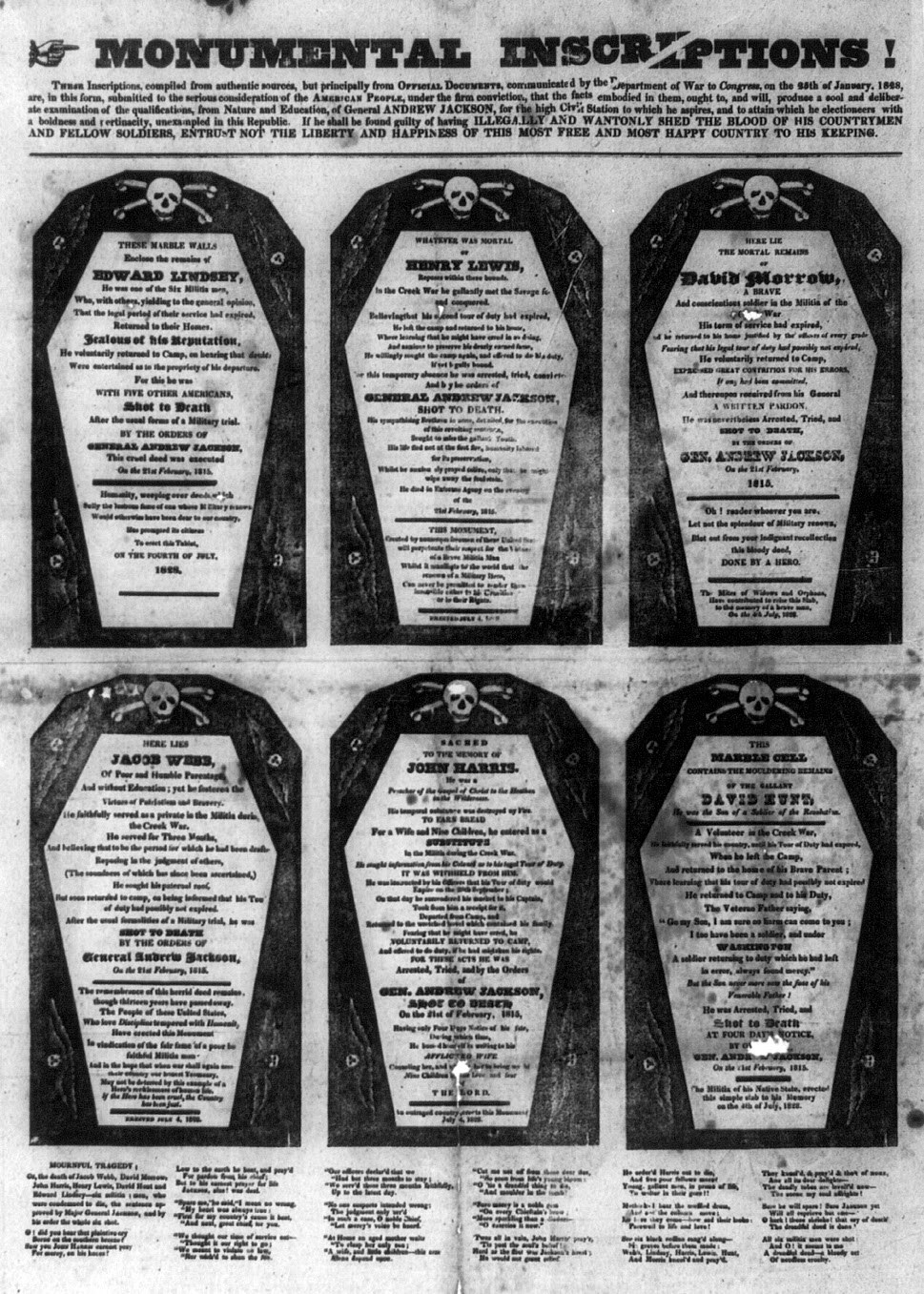
1815: Six militiamen, Andrew Jackson’s electoral dirty laundry

If present-day electoral politics strike you as disreputable, take comfort in the knowledge that the Republic has survived its share of low-down, brass-knuckle campaigns in the past. The presidential election of 1828 might have been the very dirtiest.

This race pitted incumbent John Quincy Adams, the silver-spoon New Englander and son of Federalist founding father John Adams, against Andrew Jackson, the uncouth self-made westerner of Scotch peasant stock. Jackson was [in]famous for his duels, and his willingness to push the envelope on acceptable use of the military forces he commanded. Some foes saw him as an American Napoleon; some supporters, likewise.

One of the juiciest gobs of slung mud in that 1828 campaign involved Jackson’s actions as a Major General during the War of 1812, and specifically right around the Battle of New Orleans.

Karl Rove would have approved of this tactical attack on the strength of a candidate, for it was to this service that Jackson owed his national repute. De Tocqueville, who considered Jackson “a man of violent temper and very moderate talents,” said that he “was raised to the Presidency, and has been maintained there, solely by the recollection of a victory which he gained, twenty years ago, under the walls of New Orleans.”*

At any rate, back in 1815, when army regulars were engaged on the east coast (or in the quixotic attempt to invade Canada), battle in the south and west pitted shaky American militia against British-allied Indian tribes in dirty, bloody ethnic cleansing.

Immediately prior to New Orleans, Jackson, west Tennessee’s biggest landowner and therefore its militia commander, took his forces south to Alabama, combined them with other militia, and routed the Creek, ending the Creek War subplot to the War of 1812. ‘Twas this conquest gave Jackson his “Old Hickory” nickname for controlling the Muscogee Creeks of Hickory Ground.

Cool beans for A.J., but not everyone on his team was equally excited.

After the Creek surrendered at the newly-raised Fort Jackson — vanity, vanity, all is vanity! — a number of soldiers stationed there with the 1st Regiment West Tennessee Militia started agitating to pack up and leave, even with the British navy still lurking. Come September, some even went so far as to demonstratively tramp out of Fort Jackson, vowing to return to hearth and home.

These were not enlisted soldiers of a standing army, so they did not necessarily conceive themselves bound to fight the British in Louisiana or the Creeks in Alabama: rights and obligations and loyalties were still being sorted out in the young Republic. These deserters had, however, been mustered that June for an announced six-month term, and September was only three months later. Moreover, these weren’t the only rumblings of desertion in Jackson’s ambit, and since he was potentially facing the prospect of defending the whole Gulf Coast against the world’s preeminent military power using nothing but a motley collection of farmers, Indian allies, pirates, and what-have-you, Old Hickory was not inclined to countenance anything that could erode his forces’ tenuous unity. Like George Washington before him, Jackson shot some malcontents today to pre-empt trouble tomorrow.

On November 21, 1814, Jackson ordered the six deserters/mutineers to court-martial. The next day, he departed to New Orleans where he would cover himself with glory.

After winning that battle, Jackson adjudicated a message from the Alabama court-martial, announcing six men condemned who had not been recommended for leniency.

As is well-known, the War of 1812 had officially been settled by treaty for weeks at this point, but it took approximately f.o.r.e.v.e.r for word to get around in these pre-telegraph days. Jackson didn’t know the war was over: he did know that British ships were still lurking around in the Gulf. (They also didn’t know the war was over.)

So Jackson behaved just as if he had a going conflict on his hands and sent back confirmation of the sentences. His six mutineers were shot kneeling on their coffins before 1,500 troops in Mobile, Ala. on February 21, 1815. Only after that did everybody (British included) find out that there wasn’t anything left to fight for.

But when Andrew Jackson eventually ran for U.S. President in 1828, the poor militiamen were exhumed (only metaphorically!) to traduce the general, whose reputation already ran to the bloodthirsty. This was a country where a great many of the men casting ballots would be, actually or potentially, subject to militia duty: the prospect of a frontier Queeg actually executing militia was calculated to impair Jackson’s famous appeal to the common man and raise the specter of the president as a potential strongman.

Propaganda pamphlets circulated this execution story widely that year, the swiftboating of the 19th century.

Their inevitable inclusion of six coffin-shaped blocks to symbolize the dead men this date eventually gave to anti-Jackson broadsides the name “Coffin Handbills” — a term that eventually extended to the entire genre of political libels. This linguistic relic is surely due for a bicentennial resurrection.

Sordid campaigning over Jackson’s questionable military freelancing was somewhat ironic in 1828, since Jackson also had that reputation from his extra-legal Florida incursions, after the War of 1812. Those adventures rankled many within the Monroe administration, but were stoutly defended by Monroe’s Secretary of State — none other than John Quincy Adams. (Adams’s own signature graces the 1819 treaty with Spain which ceded Florida; it was largely secured by Jackson’s depredations.)

Irony or no, the attacks had to be dealt with.

Jackson’s partisans responded with equal vigor. For instance, newspapers (the excerpt below comes from the May 1, 1828 Maryland Gazette) carried a lengthy vindication penned by a Jackson partisan and fellow-Tennessean then sitting his first term in Congress … but destined in time to follow Jackson to the White House.**

I had supposed it scarcely possible that any candid, intelligent man, could for a moment doubt the correctness of General Jackson’s conduct, in relation to this subject … No man has ever been more misrepresented and slandered by his political adversaries than Gen. Jackson, and upon no subject more than that in relation to the execution of the ‘six militia men.’ …

The corps to which the ‘six militiamen’ belonged, was stationed at Fort Jackson. Between the 10th and 20th of September 1814, before the period even of three months, much less six months, had expired, an alarming mutiny, such as was seldom ever witnessed in any army, took place in the camp, of which these ‘six militia men’ were the ringleaders. Harris who seems to have been the principal, several days before the mutiny broke out, carried about a subscription paper thro’ the camp, obtaining the signatures of all who would agree to go home. In defiance of their officers commanding the post, they on the 19th of September 1814, violently and tumultuously assembled together, to the number of near two hundred, broke open the public stores, took out provisions, demolished the bake house, shot down breves, and in the face of authority, left the camp on the next morning ‘at the end of revielle beat;’ yelling and firing scattering guns as they departed, proclaiming to all who would, to follow them.

Th proceedings of the court martial were forwarded to General Jackson then at New Orleans, for his approval. The six ringleaders were not recommended to mercy by the court martial. No palliating circumstances existed in their case, known to him. He knew they had been tried by a court martial composed of their fellow citizens and neighbours at home. The news of peace had not then arrived. The enemy’s forces were still in our waters and on our border. When an attack might be made was unknown, and the militia under General Winchester‘s command at Mobile, were ‘threatening to mutiny.’ … General Jackson saw that the salvation of the country was still in jeopardy, if subordination was not preserved in the army. He approved the sentence, and these six unfortunate, tho’ guilty men, were executed. This approval of the sentence of the court martial was made at New Orleans on the 22d of January, 1815. The first intimation which the General had of the news of peace even by rumour, was received on the 18th or 19th of February, 1815 … Col. G.C. Russell, who commanded on the day the sentence of the court martial was carried into execution, states in a letter of the 29th of July, 1827, that ‘we had no knowledge of a treaty of peace having been signed at Ghent, till more than a month after the approval of the sentence, and fifteen or twenty days after its execution.’ The official news of peace did not reach General Jackson until the 18th of March, 1815, and on the 19th of the same month, the British commander received the official intelligence from his government. It was not until after this period that the British forces left their position on that border of the union.

The effect which the execution of these men produced in the army was most salutary. Not a whisper was afterwards heard of the mutiny which had threatened General Winchester’s command. Subordination was restored, and all the troops in the service were willing, and did without a murmur perform their duty. Mutiny and desertion were no longer heard of in that part of the military service.

it is impossible to conceive how censure can attach to General Jackson. At the time he approved the sentence of the six ringleaders, he pardoned all those who had been recommended to mercy by the court martial that tried them. At the time of the execution all acquiesced in its justice. Every officer in the army responded to the importance of the example, for the good of the service. At that time the whole country was satisfied. Not a whisper of censure was heard against the commanding General, or any member of the court martial in reference to it.

James K. Polk

Polk, indeed, advised his friend Jackson closely during the latter’s 1828 campaign, and specifically counseled an active campaign to rebut the “six militiamen” attacks.

Polk’s energetic response and others like it must have worked well enough: Jackson crushed John Quincy Adams as handily as he had once done the Creeks, and wound up with his hatchet face on the American $20 bill.

* The De Tocqueville quote in the text is the part germane to this post, but it disdainfully goes on to pronounce New Orleans “a victory which was, however, a very ordinary achievement and which could only be remembered in a country where battles are rare. Now the people who are thus carried away by the illusions of glory are unquestionably the most cold and calculating, the most unmilitary, if I may so speak, and the most prosaic of all the nations of the earth.” Sniff.

** And to follow Jackson’s policy of dubious southerly land-grabs.

On this day..

1813: W. Clements, War of 1812 deserter

(Thanks to Meaghan Good of the Charley Project for discovering the original June 1813 broadsheet we reprint here.)

LINES

COMPOSED ON THE EXECUTION OF

W. CLEMENT’S: [maddening sic]

Who was SHOT for Desertion, on Fort Independence, Feb. 18
having been four times Pardoned, but having last Deserted his Post, was condemned to die.

The thoughts of death to every mind,
Most sad reflection’s [sic] brings;
But when man’s life is seek’d for crimes,
Then conscience gives its stings.

No cheering hope attends the soul,
Which with black guilt is stain’d;
The waves of trouble o’er it roll,
And seldom peace is gain’d,

Alas! that man should treasure woe,
And bring upon his head,
The curse of heaven, the curse of man.
To strike his comforts dead.

Ah! how the bosom of a wife,
Must throb with anxious care,
When once the object of her love,
Is caught in guilt’s dire snare.

His children raise their little hands,
Compassion to implore;
But oh! the father whom they love
Shall never see them more.

Condemn’d for crimes his life to pay,
The fatal hour draws nigh;
Stern justice heard no widow’s moans,
Nor heeds the orphan’s cry.

His comrads [sic] silent stand around,
And heave the mournful sigh,
Their bosoms heave with mingled grief,
No eye from tears is dry.

And now the solemn dirge begins,
They march towards the spot
Where he receives his crimes reward,
And meets his dreadful lot.

For him, perhaps a mother sighs,
And hopes relief to come;
He’ll never bless her longing eyes,
But hear the muffled drum.

And now the holy man of God,
To Heaven addresses prayer
And bids the poor unhappy man,
For his sad doom prepare.

And now the solemn drum rebounds.
His last funereal hymn,
Again the trumpet slowly sounds,
Each eye with grief is dim.

Advancing to the fatal spot,
Still sadder flows the strain;
Ah! now the dreaded scene is o’er,
The corps returns again.

See, see him welt’ring in his blood,
His spirit now has fled,
His life has paid the fatal debt,
He’s number’d with the dead.

Learn, then, ye who for Freedom fight,
To stand firm by your post,
To vindicate your country’s Right,
Nor let your fame be lost.

O! let poor CLEMENT’S [sic] awful fate,
A warning be to all,
Remember he who duty slights,
Will meet a dreadful fall.

On this day..

1814: Private John McMillan, deserter

HEAD QUARTERS, FALLS OF NIAGARA
OCTOBER 28TH 1814.

At a General Court Martial, held at Stamford, on the 25th instant, and continued by adjournment to the 28th of the same month, Private John McMillan, of the 2nd regiment of Lincoln Militia, was arraigned on the following charges, viz.: —

1st. For having deserted to the Enemy, with his Arms and Accoutrements, when on Duty, on or about the 6th of Octoer, 1813.

2nd. For having been taken bearing Arms in the Service of the Enemy on or about the 17th of September last.

And “The Court, after duly considering the Evidence for the Prosecution and on behalf of the Prisoner, were clearly of the opinion that he is guilty of both charges, and therefore Sentence him to suffer Death, at such place and time as His Honor the President may be pleased to direct.”

His Honor the President approves the finding and Sentence of the Court, and directs that the same be carried into Execution at Bridgewater [Niagara Falls] on Monday morning next, the 31st instant, at 11 o’clock

British militia general order during the War of 1812

On this day..