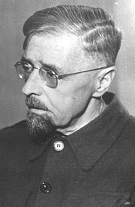
1946: Gen. Leopold Okulicki murdered in Soviet prison

The fate of the last Commander in Chief of Home Army General Leopold Okulicki “Niedzwiadka”, imprisoned in Moscow and murdered there, symbolize the postwar fate of the Home Army and of Poland.

-2012 resolution of the Polish parliament

On this date in 1946, Polish Home Army General Leopold Okulicki was murdered by the NKVD in a Moscow prison.

Okulicki (English Wikipedia entry | the much more detailed Polish) embarked his military career at the tender age of 16, when he ditched school in favor of an Austrian legion on the eastern front of World War I — then segued directly into newly independent Poland‘s subsequent war against the Soviets.

Already a veteran soldier, Okulicki proceeded to the Warsaw military academy and made soldiering his career. He had advanced to the brass by the time Hitler and Stalin destroyed Poland in 1939. Okulicki had the tragic honor to maintain the hopeless defense of Warsaw, but went underground thereafter with the remains of the Polish state — hunted by Germans and Soviets alike.

The NKVD caught him in January 1941, but his residence in the discomfiting environs of Lubyanka prison was ended by the Soviet Union’s arrangement with Poland following Operation Barbarossa. Paroled back into the field, he played a leading part for the Polish Home Army for the balance of the war — finally becoming its supreme commander in the last weeks of the war.

Now that the Nazis were no longer knocking on the gates of Moscow, the Soviets renewed their interest in detaining Okulicki, which was again effected with relative ease. (Comparing German and Soviet secret police, Okulicki would say that the NKVD made the Gestapo look like child’s play.) Sentenced “only” to a 10-year prison term at the Russians’ postwar show trial of Polish leadership, Okulicki disappeared into Soviet detention and was never seen again.

In the Khrushchev era, the USSR revealed that Okulicki had died on Christmas eve of 1946 at Butyrka prison; subsequent revelations of the medical records there revealed that he had succumbed to organ damage suggestive of having been beaten to death — perhaps as punishment for hunger-striking.

The post-Communist Russian state has posthumously exonerated Okulicki of his show-trial conviction; he is, of course, an honored figure in post-Communist Poland where many streets and squares bear his name.


Plaque honoring Gen. Okulicki in Warsaw. (cc) image from Tadeusz Rudzki.

On this day..

1946: One sex killer and four POW camp murderers

This date in 1946 saw the largest mass execution in Alberta: five men all hanged for murder.

One of these, Donald Sherman Staley, was a hated sex-murderer who had raped and killed boys in Calgary and Alberta that summer. But he is the undercard in this event.*

The remaining four were all German prisoners of war from the lately concluded world war. They did not, as their onetime commanders in Europe, face judgment for war crimes: no, Bruno Perzonowsky, Walter Wolf, Heinrich Busch and Willi Mueller had while marking time in the Medicine Hat POW camp contrived to execute a fellow-prisoner as a subversive.

Naturally this camp “execution” was rank murder from a legal perspective. But the day-to-day reality of the Medicine Hat camp was that the few Canadian officials banked on the 12,000 or so German detainees to run the place themselves.**

Medicine Hat’s German leadership consisted of Nazi ideologues, but the politics and life experiences of its inmates, regular grunts snatched from various battlefields, deviated widely from the Reich’s ideal. In 1943, convinced that the less fascist elements in camp were cogitating a plot to displace the Nazi silverbacks in camp, that clique convened a drumhead trial and hanged August Plaszek, a Catholic and former French Foreign Legionnaire.

After the war ended, this murder too resulted in a hanging — but as of the second killing that is the focus of this post, the Canadian investigation was being stonewalled and the true believer types still bossed Medicine Hat with near-impunity.

The second murder was triggered by a threat not to Nazi authority in Medicine Hat — but in Berlin.

After the shock of the Valkyrie plot that came within a whisker of assassinating Hitler, the Fuhrer publicly demanded a purge of traitors, anywhere and everywhere.

The POW Karl Lehmann was just such a one, to Hitlerian eyes. Another Catholic — a dubious class for sure — Lehmann was a husky former languages professor who had been dragooned into the military and subsequently captured in Tunisia.† He had been in Medicine Hat for two years when Col. Stauffenberg’s bomb went off in Wolfsschanze, growing ever bolder vilifying the Third Reich and anticipating its approaching defeat.

In September 1944, our quartet of future gallows-fodder lured Lehmann to a room where he sometimes gave lectures, and there began browbeating him about communists in camp. As Lehmann vainly denied any such connection, his assailants got a noose around him and hoisted him to his death.

Having now had two political assassinations on their watch, Canada finally got serious and threatened the entire population of prisoners with the prospect of being punished as murderers were they merely to fail to report a murder plot to which they had become privy. They also started reshuffling the prisoner population in an effort to break up the Nazi prison gang. Both measures worked — aided, of course, by the advance of Allied armies in the European theater — and nobody had the ill fortune to follow Karl Lehmann’s fate.

Lethbridge Gaol had to be outfitted with a whole new condemned bloc just to hold the prisoners bound for their end this date. (Its existing capacity was only two.)

* Staley’s desperate argument for clemency was that he was a “sexual insane” who could not govern his compulsions: “I must have been born this way and should not be held responsible for what I done, but should receive treatment of some kind instead of being condemned to die for something I can’t help.” “Merciful” proposals ran towards employing him as a guinea pig for mental health hospitals’ experiments with, e.g., lobotomy.

** Canada’s deference to German detainees also made it party to a scandalous execution of Wehrmacht deserters conducted by a surrendered German army in Canadian custody in 1945. (Canada helpfully supplied their prisoners the necessary guns.)

† Under Field Marshal Rommel‘s command, no less: though he was perhaps Hitler’s ablest general, the Desert Fox all but openly disdained national socialism. He was himself implicated in the July 20 plot, and made to commit suicide.

On this day..

1946: The Neuengamme camp war criminals

On this date in 1946, eleven men convicted by a British war crimes court of war crimes at the Neuengamme concentration camp hanged at Hamelin prison.

Neuengamme held about 106,000 prisoners from 1938 until the British overran it on May 3, 1945. (In a tragic coda, many of the last prisoners died when the ships to which they had been transferred were mistakenly strafed by the Royal Air Force that same day.)

Though its primary purpose was slave labor — Neuengamme inmates cranked out bricks and armaments — rather than extermination, close on half of its residents died of the maltreatment. Anne Frank’s elderly roommate-in-hiding “Albert Dussel” (his real name was Fritz Pfeffer) died there of enterocolitis in 1944; Suriname national hero Anton de Kom succumbed to tuberculosis at Neuengamme days before it was liberated.

Nor was Neuengamme above more direct methods — of course it wasn’t. As the Third Reich collapsed, Neuengamme was used to dispose of 71 leftists for no better reason than the Nazis begrudged their potential postwar life; meanwhile, Jewish children who had been subjected to medical experiments were hanged by their stonehearted SS doctor.

That gentleman, Alfred Trzebinski, was one of the men in the dock for Neuengamme, and ultimately, one of the men on the scaffold.*

Camp commandant Max Pauly and SS Schutzhaftlagerführer Anton Thumann were among the 10 others executed for Neuengamme, all together on October 8, 1946.

* Sigmund Freud’s grandson Walter worked for the War Crimes Investigation Unit on (among other cases) Trzebinski’s Bullenhuser Damm school hangings.

On this day..

1946: Leon Rupnik, Erwin Rosener, and Lovro Hacin, for the occupation of Slovenia

On this date in 1946, the postwar state of Yugoslavia executed a trio of World War II occupation figures.


Left to right: Leon Rupnik, Erwin Rosener, and Lovro Hacin.

An Austro-Hungarian subject by birth, Leon Rupnik followed his native Slovenian soil into (proto-)Yugoslavia after the empire collapsed in World War I, and climbed the military ranks in the interwar era.

General Rupnik, as he could then be called, was the man tasked with engineering fortifications along the Italian and Austrian borders to ward off a fascist invasion. Modeled on the Maginot Line and every bit as effective, the Rupnik Line was little more than a speed bump when the Germans and Italians swept in during April of 1941.

But Gen. Rupnik was an open Nazi sympathizer, so sentimentality for his failed bunkers scarcely deterred him from joining the new occupation government as an enthusiastic collaborator, and he served or a time as the president of the German puppet province and the mayor of its capital, Ljubljana.

Erwin Rosener was a onetime brownshirt who became an SS General and was tasked by Heinrich Himmler with suppressing partisan resistance in Slovenia. He did the usual dirty things such a job entails, ordering torture and executions of hostages; Gen. Rosener also helped Gen. Rupnik organize the right-wing paramilitary Home Guard (Domobranci).

Lovro Hacin, the third member of the doomed party, was the police chief of Ljubljana.

Rupnik was shot. Rosener and Hacin were executed by hanging.


Rupnik (leftmost on the platform) reviews fascist Dombranci militia with Bishop Rozman and (rightmost) Gen. Rosener, January 30 1945.

Three others escaped execution at the same trials. Vilko Vizjak and Mha Krek both drew prison terms; Bishop Gregorij Rozman did as well, but his trial occurred in absentia and Rozman lived out his in exile.

On this day..

1946: Vojtech Tuka, Slovakian Prime Minister

Slovak fascist politician Vojtech Tuka was hanged on this date in 1946 by the postwar Czechoslovakian government.

A lawyer, academic, and journalist, Tuka spent the decade leading up to World War II in prison for inciting Czechoslovakia’s Slovakian half to break with the Czechs.

These calls found their footing in 1938-39 when the Third Reich’s expansion crippled Czechoslovakia; a newly autonomous Slovak region under Prime Minister Jozef Tiso soon began pushing for outright independence.

In fact, one of the last actions of the pre-war Czechoslovakian state was to deploy troops to occupy Slovakia under martial law and (momentarily) depose Tiso on March 9, 1939. This desperate attempt to preserve Czechoslovakia was the action triggering Germany’s outright takeover of Czech territory. Tiso was in full support, and in reward he got restored as leader of the now “independent” Slovakia … in reality a German client state.

Tuka was right there for the ride.

In October 1939, Tiso became President of Slovakia, and appointed our man Vojtech the Prime Minister. Tuka would hold that office for the bulk of the coming war years, until ousted by the Slovak National Uprising late in 1944, and distinguish himself early for his enthusiasm in deporting Jews to German camps — and implementing comprehensive domestic anti-Semitic laws.*

But that decade in prison had not done Tuka’s health any favors. He suffered a stroke late in the war, and emigrated, wheelchair-bound, to Austria. He was arrested there and returned to Slovakia; by the time of his trial, he had suffered multiple strokes and was partially paralyzed.

Nevertheless, he was condemned as a war criminal for throwing Slovakia into war against the Soviet Union and for the defeated Slovak Republic’s anti-Jewish measures.

* Dieter Wisliceny, an Eichmann assistant, was a key German liaison to the Slovaks.

On this day..

1946: Ion Antonescu

Romania’s wartime fascist dictator Ion Antonescu was shot on this date in 1946.

Antonescu (hand raised) and Adolf at Nazi headquarters in June 1941. Behind them are Ribbentrop and Keitel.

An army officer who worked his way up to the brass via his exploits in the Second Balkan War and then in World War I, Antonescu emerged as a major nationalist politician in the interwar period. He was the elite political figure who allied with Corneliu Codreanu‘s Iron Guard movement.

Antonescu became the Defence Minister in a a far-right government, was temporarily shouldered out of the state by King Carol II‘s coup, and then re-emerged as the leading alternative when Carol’s government was undone by the tectonic political crises in the run-up to World War II. After territorial concessions wrung by Romania’s neighbors triggered protests against the king in Bucharest, Antonescu on September 5, 1940, forced Carol to transfer dictatorial power to him — and shortly thereafter, he forced Carol to abdicate altogether.*

That left Carol’s son Michael the figurehead of state, and Ion Antonescu the actual strongman — at least, once he tamed the Iron Guard.

Antonescu oriented Romania towards Hitler’s Germany, including a fairly enthusiastic involvement in the Holocaust.**

For Germany, it was an important alliance: Romania’s oil fields were essential to powering the Reich’s mechanized army. And Romania ultimately fielded the largest Axis army other than Germany and Italy themselves with well over one million men under arms by the summer of 1944. For Romania, well, opportunism is as opportunism does: as Antonescu put it, echoing an ancient argument, “in today’s circumstances a small country which is under threat, such as ours, does not do what it wishes, but what it can.”

The Romanian “General Antonescu Army Group” joined the fateful invasion of the Soviet Union. Romanian divisions were prominent at Stalingrad where some 150,000 were lost as casualties or prisoners.

The turn of the war’s tide put Romania in a grievous dilemma whose parameters ran something like this:

  • Maintain Antonescu’s personal grip on power
  • Maintain the territorial expansion Romania had achieved early in the war
  • Exit the war without going down in Germany’s Gotterdammerung

… pick one of three. Provided it’s the last one.

As the Red Army approached from the northeast and American bombers struck from Italy and North Africa, Antonescu scrambled to sound out what kind of a deal he could cut with the Allies.

Antonescu might perhaps have negotiated without the desperation due his position,† and dilated with his decreasingly patient enemies while the Germans flattered him with the dream that he could still retain conquered Bessarabia (present-day Moldova). Only with the Soviet army on his doorstep was Antonescu finally disabused of the statesman’s dream and office both — when King Michael ousted Antonescu and immediately switched Romania to the Allied side.‡ This move accepted the Soviet occupation that was about to become a fait accompli, and put Romanian soldiers into the field for the last months of the war fighting against their former German allies.

It also put Antonescu into Soviet custody. He rode out the war under guard in Moscow, then was shipped back to postwar Romania where he would serve as the feature attraction of the People’s Tribunals.

One hundred eighty-seven people answered war crimes charges to these bodies; there were 13 death sentences, but only four were actually executed.§ All four — Transnistria governor Gheorghe Alexianu, Interior Minister Constantin Vasiliu, and Foreign Minister Mihai Antonescu (no relation — were shot on this date at Jilava. The executions were filmed.

* Carol went into exile, never to see his native soil again. He died in Portugal in 1953.

** “Of all the allies of Nazi Germany, Romania bears responsibility for the deaths of more Jews than any country other than Germany itself,” according to a 2003-2004 commission. “Efforts to rehabilitate the perpetrators of these crimes are particularly abhorrent and worrisome. Nowhere else in Europe has a mass murderer like Ion Antonescu, Hitler’s faithful ally until the very end, been publicly honored as a national hero.” (The full report is available here; the quoted lines come from its executive summary.)

† Berlin was keeping an eye on Romania’s separate-peace feelers, too, and had prepared a plan to occupy Romania should it attempt to desert the Axis. This is precisely the fate that befell Nazi-allied Hungary … but in Romania’s case, Germany never had the moment to implement the plan.

‡ Michael was, like his father, forced into exile in 1947; he did not return to Romania until after the collapse of Communism. Now in his nineties, King Michael is still alive as of this posting and remains the claimant should Romania ever re-establish its monarchy.

§ Six of the 13 death sentences were delivered in absentia. Notable among those fled souls was the Hungarian writer Albert Wass: Wass had escaped to the United States, which refused repeated appeals by Communist Romania to deport him. There is a running struggle in both Hungary and Romania over whether to rehabilitate Wass or posthumously rescind his death sentences. (Postwar Hungary condemned him, too.)

On this day..

1946: Ernst Lohmeyer, theologian

On this date in 1946, the Soviets occupying East Germany executed Bible scholar Ernst Lohmeyer.

A fifty-five-year-old professor when the NKGB whisked him out of his apartment without explanation to his dumbfounded wife, Lohmeyer (English Wikipedia entry | German) was an important Protestant theologian of the interwar period with a knack for eschewing the opportunistic choice.

By refusing to disavow Jewish associates, his academic career got derailed in the 1930s, despite his producing influential critical commentary on the Gospel of Mark;* by patriotically serving in the Wehrmacht despite his reservations about the Third Reich, he set himself up to profile as an undesirable after World War II.

For a long time, Lohmeyer’s fate was, if not difficult to guess, obscure in its particulars. Not until 1957 was his execution in a forest near Hanshagen officially confirmed; he had been condemned by a military tribunal for participating in the German occupation of Sloviansk even though he wasn’t personally associated with any known atrocities.

The post-Soviet Russian state officially exonerated Lohmeyer in 1996. The University of Greifswald, where Lohmeyer was teaching when arrested, has a theology faculty building named for him.

* Lohmeyer postulated that the Gospel of Mark reflected a contemporary-to-the-evangelist (that is, post-Jesus) conflict between Christian communities in different locales, and that Mark himself was associated with Galilee’s Christians and therefore structured his narrative to exalt this location.

On this day..

1946: Neville Heath, torture-killer

(Thanks to Meaghan Good of the Charley Project for the guest post. -ed.)

On this date in 1946, 29-year-old torture-murderer Neville George Clevely Heath was hanged at Pentonville Prison for the murder of Margery Aimee Brownell Gardner, 32, an aspiring film actress.

Heath was one of the most notorious British killers of the mid-twentieth century. Although his victims numbered only two (the other being 21-year-old Doreen Margaret Marshall), he stood out from the pack by his brutality and sheer sadism. The Murders of the Black Museum, 1870-1970 provides this graphic description of the terrible injuries he inflicted on Doreen:

She had been struck several times on the back of her head. There were also abrasions on her back, a bruise on her right shoulder and an area of redness around the left collar-bone, as if someone had knelt on her. The left side of her chest was bruised and a rib had fractured, piercing the left lung. Her left arm was bruised, as were both wrists, which appeared to have been tightly tied; they also bore finger-nail imprints of her assailant. The fingers of both her hands were badly cut on the inside, as if she had seized a knife in self-defence. All these injuries had been inflicted before she died, her death itself having been caused by a haemorrhage resulting from two deep knife-cuts across her throat.

After death a nipple had been bitten off and her body had been mutilated. A jagged series of slashes reached from her vagina vertically up to her chest, where they were joined by a deep diagonal cut from each nipple to the centre of her body, forming a Y. A rough instrument, possibly a branch, had also perforated and torn her vagina and anus.

Heath came from a respectable, lower-middle-class background. His parents scraped together enough money for him to attend a private Catholic school, where early on he developed as a reputation as a bully.

As an adult he fell into crime, but there was nothing on his record to suggest he was capable of such gruesome acts; his previous convictions had been for offenses such as fraud, forgery, burglary and deserting the military.

In between stints in jail, he married a woman from a wealthy, prominent family and they had a son. By 1945, however, they were divorced.

Margery, Heath’s first victim, was separated from her husband at the time of her death. She had a masochistic predilection for bondage and flagellation, but even so, Heath was too much for her. In May 1946, they checked into a hotel together and he was so violent that she got scared and had to be rescued by hotel security.

Incredibly, however, when Heath called her to ask her out on another date, she agreed and they met again on June 20. They got drunk at a nightclub and took a cab to a hotel. No one heard any unusual noises during the night, but the next morning Margery’s bound, gagged and mutilated corpse was found in her fourth-floor room.

She had horrific injuries, all inflicted while she still lived, including cuts on her face, arms and back in an unusual criss-cross pattern. The cause of death was suffocation.

There was no sign of Heath, but within a day or two he’d been identified as a possible suspect and was sought for questioning.

Heath’s fiancee read about the murder in the papers and asked him about it. He told her he’d stumbled across the scene after Mrs. Gardner was already dead, and promised to go to the police and make a statement. He never did, but he did send a letter to the chief inspector, saying he’d lent his hotel key to Mrs. Gardner because she had nowhere else to sleep. She went to bed with a man named “Jack” but told Heath to come to her room after 2:00 a.m. to spend the rest of the night with her.

When he did, he wrote, “I found her in the condition of which you are aware. I realized that I was in an invidious position, and rather than notify the police, I packed my belongings and left.” Heath said he had the murder weapon and was mailing it to the police station in a separate package. He never did.

Instead, he went to Bournemouth and checked into the Tolland Royal Hotel under the name Rupert Brooke, after one of Britain’s most famous poets.

There he met Doreen Marshall.

Doreen Marshall.

Heath encountered Doreen on July 3 and asked her to have tea with him. She agreed. Tea turned into dinner, and the date didn’t end until almost midnight. At this time Heath said he would walk Doreen home, although she wanted to take a taxi instead. She was never seen alive again.

On July 5 she was reported missing and the Tolland Royal Hotel staff, knowing she’d dined with Heath, asked him to get in touch with the police. He did so, identifying himself by his alias Rupert Brooke. He told the story about their date and saying he’d left her on the pier and walked back to the Tolland Royal alone.

One of the police officers interviewing him about Doreen Marshall recognized Heath as the man wanted for questioning about Margery’s murder and confronted him, saying, “Isn’t your real name Heath?”

“Rupert Brooke” denied this, and when the police said they were detaining him for further questioning, he asked to be allowed to go to the hotel and get his coat. He’d come back right away, he said.

The cops were not that stupid and sent one of their own officers to fetch the coat. Inside was half a train ticket in Doreen Marshall’s name, as well as a cloakroom ticket issued at a train station on June 23. The police went to the train station to fetch what their prisoner had stored there: it turned out to be a suitcase containing several incriminating items, including clothing monogrammed with Heath’s real name, a bloodstained scarf and handkerchief, and a bloodstained riding crop woven in a criss-cross pattern that, it turned out, matched the marks on Margery’s body.

On July 8, Heath was formally charged with Margery’s murder. At around the same time, Doreen’s body turned up: she’d been dumped, naked, in a clump of bushes about a mile from the Tolland Royal Hotel.

At his trial, none of Heath’s friends or family members came to testify on his behalf. Given the evidence against him, his defense attorney could hardly argue that their client was innocent. Instead they claimed he was insane: only a madman could have committed such acts.

But Heath’s calm, composed manner, and his obvious efforts to cover up his crimes, went against the insanity defense and the jury had no trouble convicting him.

In his final letter to his parents, he wrote, “My only regret at leaving the world is that I have been damned unworthy of you both.” Just before his hanging, he was offered the customary drink of whiskey. He agreed and added, “Better make it a double.”

On this day..

1946: Anton Mussert, Dutch collaborator

On this date in 1946, the Dutch fascist leader Anton Mussert was shot

Mussert was a young engineer who came to the fore in the interwar period as a strident right-wing populist. He co-founded in 1931 the Netherlands’ homegrown Nazi knockoff, the Nationaal-Socialistische Beweging; by 1935, it was polling 300,000 votes.

Mussert of course welcomed the German incursion into the Netherlands on the way to someplace else. That put the Dutch under wartime Nazi administration, but Mussert didn’t score a Quislingesque head-of-state plum out of the arrangement.

Instead, Mussert found himself brusquely shut out of any real power; the Austrian Arthur Seyss-Inquart ran the country instead, and would eventually hang via the Numremberg trial for his occupation atrocities, such as the wholesale deportation of the Dutch Jewish population that swept up diarist Anne Frank. Plum or no, however, what Mussert had done was more than enough to elevate him to the most conspicuous Nazi collaborator in the postwar Netherlands.

Mussert was captured after the war and shot at the open-air location near The Hague where over 250 people had been put to death during the war years.

On this day..

1946: Bela Imredy, Hungarian fascist prime minister

On this date in 1946, Bela Imredy, the fascist former prime minister of Hungary, was shot in Budapest.

Imredy was a Catholic financier who steered Hungarian economic policy in a succession of state posts during the chaotic 1930s.

When one of those governments fell in 1938, regent Miklos Horthy appointed Imredy prime minister. He was forced out of office the next year on revelations that he had Jewish ancestry.

This did nothing to moderate Imredy’s anti-Semitic views; he returned at the head of a new fascist party and nearly became Prime Minister under the German occupation in 1944.

Horthy demurred, and another future gallows-bird got the job instead. Imredy took the Minister of Economic Coordination as his last political gig.

A “People’s Tribunal” condemned Imredy after the war for war crimes and Nazi collaboration.

On this day..