1946: Cristino Garcia, Spanish Republican and French Resistance hero

On this date in 1946, ten* Spanish Republicans were shot — most famously including Cristino Garcia.

Garcia, a Communist veteran of the Spanish Civil War, had put his guerrilla skills to good use by joining the French Resistance during World War II.

Garcia ultimately held the rank of Lieutenant Colonel in the Resistance, and was perhaps the most individually famous of the numerous Spaniards** who fought as maquisards. His unit broke out hundreds of people before potential deportation to German death camps, and Garcia helped orchestrate the guerrilla-led liberation of Foix in August 1944. (There’s a lengthier roundup of Garcia’s career in the field in Spanish, here.)

The French had nothing but good feelings for this guy, but Garcia wasn’t looking to take a pension from De Gaulle and settle down in a vineyard. As France fell to Allies, Garcia — going on ten years a professional leftist revolutionary — headed back to Spain (Spanish link) to carry on the fight against fascism closer to home.

His tasks over a few months in 1945 ran to the less legendary: bank attacks and the like, blurring the line between “ordinary” and “political” crimes. Garcia was also detailed as a result of intra-party politicking to murder fellow-Communist Gabriel Leon Trilla (Spanish link).†

Garcia and his group were arrested shortly thereafter and faced a military tribunal on January 22, 1946. (Spanish source)

As an agent of the Spanish Communist Party, which was backed by a French Communist Party riding high on its World War II heroics, Garcia’s situation became a national cause celebre. French left parties uniformly protested the planned execution, and the government made repeated diplomatic overtures to Madrid to stay the sentence. Editorialists protested floridly.

Have we forgotten that fascism exists at our border; Was it not against all fascisms that Cristino Garcia and thousands of our Spanish brothers fought with us on our soil? Did they not fall beside us, as at the Eysses prisons, under the same Nazi bullets, for France? And today will we disown their sacrifice, their blood and their martyrdom because the fight against fascism has moved to the other side of the Pyrenees? (from the Franc-Tireur, quoted here

Incensed when Franco ignore their appeals and shot the men anyway, France retaliated by closing its border with Spain on March 1, 1946. Spain did not neglect to point out the irony that, during the war years, innumerable resistance fighters and others fleeing Naziism or the Vichy regime had taken refuge by crossing that very border. (Less stress was understandably laid on the Francoists’ onetime demand — not honored by Paris — that France close its border against escaping Republicans in 1939.)

* I believe from press reports that there were 12 total executions of Republicans Feb. 21-22, 10 of which took place on Feb. 21. However, I might be mistaken about the overall numbers or their distribution by dates. Garcia’s, certainly, took place on Thursday the 21st.

** The Resistance was blessed by with no small amount of foreign blood. (French)

† Garcia delegated this task to two subalterns, one of whom (Francisco Esteban Carranque) was shot with him on this date. The other man, Jose Olmedo, was arrested in 1947 and executed in 1948.

On this day..

1946: Franz Strasser

On this date in 1946, former Nazi Kreisleiter Franz Strasser was hanged at Landsberg Prison for war crimes.

Strasser was condemned for shooting five downed American airmen in Czechoslovakia in December 1944, an American tribunal dismissing the defense: “There is not a scintilla of evidence to support STRASSER’s contention that he shot the prisoners to prevent their escape.” (A pdf scan of the entire verdict is here.)

On this day..

1946: Chu Minyi, collaborationist Foreign Minister

On this date in 1946, China executed Chu Minyi for serving as the Foreign Minister of the wartime Japanese puppet government.

Chu was a nationalist dating back to the Qing dynasty, though he spent most of the first decade after the revolution at European universities.

He returned to China as a Koumintang supporter in the 1920s.

The guy had the bad luck to be the brother-in-law of notorious quisling figure Wang Jingwei, who enjoyed the title of President of China under the Japanese aegis.

For what’s generally interpreted as reasons of personal more than political loyalty, Chu accordingly agreed to serve in Wang’s cabinet as Foreign Minister. “Chen Gongbo‘s mouth, Zhou Fuohai‘s pen and Chu Minyi’s legs” was the government’s tagline. (Chu was also a noted martial artist.)

But it was Hirohito’s guns they relied upon, and none of them would much outlive Japan’s surrender. Chu was tried as a traitor in April 1946.

On this day..

1946: Public Execution in Debica

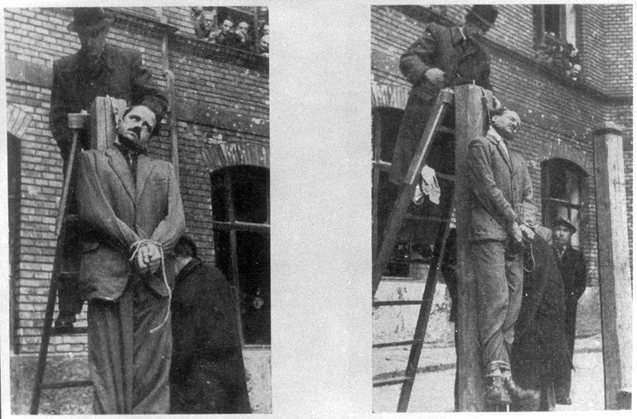
On this date in 1946, market day in the southeastern Polish town of Debica, three captured fighters* from the anti-communist Freedom and Independence (WiN) movement were publicly hanged.

This salutary, and surprise, hanging was a nasty public message during the dirty post-war war to consolidate communist authority in Poland.

The message, however, was not exactly meant for a world wider than Poland itself, so the fact that it was captured in a grainy photograph snapped by WiN agent Józef Stec and subsequently smuggled out to the West was not at all to the liking of Polish authorities.

According to a WiN eyewitness report also presumed to have been filed by Stec,

First the MO [local militia], the UB, and the military occupied the execution square holding their machine guns ready to fire. Then, a car came with uniformed individuals who placed the noose on the hook. After a short time the same car brought three condemned men in white shirts. Their hands and legs were tied with barbed wire. A Jewish prosecutor read the sentence and passed the condemned into the hands of the executioner. Before the execution, one of the condemned yelled: “Long live the Home Army. Long live General Anders and General Bor-Komorowski. Down with the commies. Brothers persevere or you’ll die like us. I swear before God that I have never been a bandit [as communist authorities designated them]. I am dying for the Motherland. Lord forgive them [the executioners] because they know not what they are doing.

* The victims were Józef Grebosz, Józef Kozlowski, and Franciszek Noster, according to the 2003 monograph After the Holocaust: Polish-Jewish conflict in the wake of World War II, by Marek Jan Chodakiewicz. This monograph is also the source for Stec’s quoted report on the hanging.

On this day..

1946: Laszlo Baky and Laszlo Endre, Hungarian Holocaust authors

On this date in 1946, fascist Hungarian politicians Laszlo Baky and Laszlo Endre were executed by hanging in Budapest for their role in the decimation of Hungarian Jewry.

These two charmers were major figures in Hungary’s horrible final months of World War II.

Post-Stalingrad, the Hungarians had realized they were yoked to the losing side and started looking for an exit strategy; instead, early in 1944, they got a German occupation.

This occupation lifted the virulent anti-semites Baky and Endre into national power, because along with keeping Hungary in the Axis coalition, the Nazis also forcibly overcame its junior partner’s former reticence about Jewish genocide.

Adolf Eichmann arrived into Nazified Hungary and used our day’s two principals (along with another executed collaborator, Andor Jaross, they’re known as the “deportation trio”) as his instruments. Within months, hundreds of thousands of Hungarian Jews were being shipped to the gas chambers. This period is one of the waypoints of pernicious Nazi race theory, when the collapsing German regime spent military resources urgently needed at the front to organize the mass slaughter of Jews.*

And they had to work fast, because by that next winter the Red Army was seizing Budapest. These enthusiastic fascist operators did not fare well by the postwar government.

Most photos from Kuruc.info (the garishly branded ones) and the Yad Vashem database (the not garishly branded).


Laszlo Endre under arrest.


Both men, just prior to their execution.

* To do justice to the breadth of the human capacity, this is also the time and place where we find Raoul Wallenberg minting lifesaving Swedish passports by the thousands.

On this day..

1946: Andrei Vlasov, turncoat Soviet general

On this date in 1946, Soviet Gen. Andrei Vlasov and 11 fellow members of the Russian Liberation Army were condemned to death in Moscow for German collaboration, and immediately hanged.*

Vlasov was at the peak of his career at the outset of World War II, and earned a decoration for his part in defending Moscow against the Nazi invasion.

So far fortunate, the Red Army ran him out at the head of an army mounting an ill-fated attempt to lift the withering Siege of Leningrad.

Vlasov was encircled and captured.

And then, as a German prisoner, he switched sides.

The conversion of a top Soviet general, who now professed anti-bolshevism, was a stupefying propaganda coup for Germany, and the recent hero of Moscow was quickly employed authoring anti-Soviet leaflets and persuading POWs of the virtues of working for Berlin.

Somewhat more guarded were the Germans when it came to forming up the military unit our defector was supposed to be head of, the Russian Liberation Army, a phantom force of patriotic anti-communist Russians fighting for their country’s self-determination free of Uncle Joe.


By hanging other Russians from trees.

In reality, this “army” didn’t exist beyond the patches slapped onto the various anti-Soviet Russians who signed up to fight against the motherland. And it’s not too hard to reckon why.

Though Russian nationalism might be an expedient club to beat the Red Army with, it was just as liable to boomerang on a Reich itself bent on eastward expansion. A German interrogator of Vlasov in 1942 writing of the captive officer’s notions of national renewal concluded his report editorially (Russian link), “Russia for hundreds of years has constantly threatened Germany, regardless of whether it was the tsarist or the Bolshevik regime. Germany is not interested in reviving the Russian state.”

Besides, given the Nazis’ racial ideology, could these Slavs be trusted in a pinch? Enough to hand them their own command structure? The thousands of eastern front POWs who volunteered to serve Berlin could be suspected of having made the devil’s choice due less to principled anti-Stalinism than the fearful privations of a German camp. (Vlasov himself is often accused of changing teams for some venal reason of cowardice or greed.)

Only late in 1944, when the prospective long-term problems of Russian nationalism had been rendered academic to Berlin by the progress of the war, did the scattered collaborator units get organized into an actual army under Vlasov’s command.

The ineffectual ROA only got into one real scrap with the Red Army, and confirmed German suspicions about Slavic reliability in the last days of the war by turning its German guns against the SS in support of the Czechs’ Prague Uprising.

But surely nobody counted on returning to Stalin’s good graces with this last-second conversion.

From that successful engagement, Vlasov’s men fled out of Prague towards the American occupation zone, desperate not to be taken by the Red Army.

They made it. But after just a few days in American hands, Vlasov was turned over at a Russian checkpoint.

Though structured by the Allied powers’ Yalta accords, which stipulated repatriation into Stalin’s hands of any Soviet citizens held in the West, Vlasov’s handover might at the moment have been part of what must have been innumerable quid pro quo arrangements to sort out command and control in the disaster area late dignified as the Third Reich.

Historian Patricia Wadley has hypothesized that Vlasov’s detention by the Soviets conditioned the landing just an hour later of an airlift to evacuate the airman’s POW camp Stalag Luft I from behind Soviet lines.

However they got their hands on him, the Soviets made no mistake once they had him. Most of Vlasov’s junior officers were executed, and his rank and file dispatched to Siberia. The brass got a three-day trial — in camera, not a show trial; they were still defiant — from July 30 to August 1, with the inescapable result.

Vlasov’s legacy after the fact remains debatable. In the official Soviet story, of course, he’s a Nazi collaborator and that’s that. Aleksandr Solzhenitsyn attempted to vindicate Vlasov in The Gulag Archipelago, and one can find pro-Vlasov posts and tributes — but post-Communist Russia has shown no interest in overturning the verdicts against the ROA.

One might allow him sincerity in his convictions, but only at the cost of allowing that his movement had no independent force in the war save what Germany breathed into it for Germany’s own reasons. Something like that holds true for nearly every human being caught up in the eastern front in those terrible years.

Some have characterized Vlasov a vile collaborator; others have seen him as a Russian national hero. Neither description quite fits. Andrei Andreevich Vlasov, given to drink and fits of fatalism and inertia in captivity, lacked the sterling character deemed essential for a martyr. On the other hand, the ROA chief was anything but a Nazi — he caused his German supporters discomfort with his strong Russian nationalism and his personal refusal to lend his voice to the prevailing, official anti-semitism. He possessed neither a Quisling‘s moral blindness to questions of patriotism nor a Joan of Arc‘s penchant for self-immolation. He came closer to the mean of most humans, aptly personifying the nightmarish predicament which confronted millions of the Eastern Front’s victims. Vlasov, like multitudes of other helpless Soviet citizens, was cruelly pulverized between the enormous and unfeeling millstones of Nazism and Communism. Shuffled about Europe’s wargame board, first by Stalin, then by Hitler, Vlasov was a pawn in the epic struggle just like the lowliest POW or forced laborer. He fantasized a Russia minus Marx, and though his failure was complete, he still came closer than any other Russian since the Civil War to fulfilling that dream.

-Mark Elliott, “Andrei Vlasov: Red Army General in Hitler’s Service,” Military Affairs, Apr. 1982

* Vlasov’s execution was announced in Pravda on Aug. 2, but with no reference to the precise time. (The sentence was certainly issued in the very early morning of Aug. 1.) Though some sources continue to list Aug. 2 as Vlasov’s execution date, Aug. 1 seems much better attested.

On this day..

1946: Phillip and William Heincy, father and son

(Thanks to author Dick Haws for graciously allowing us to reprint this chapter from Iowa and the Death Penalty: A Troubled Relationship, 1834-1965. Check out the book for more on the other 44 men (no women) hanged in the Hawkeye State. -ed.)

Phillip and William Heincy established several firsts when they were hanged on the same scaffold at the Iowa State Penitentiary in Fort Madison. They were the first — and only — father and son team to be executed by the State of Iowa. And Phillip, at 72, was the oldest. But it was the two men’s ignorance, their dim-wittedness, that also must have set some kind of record. Together, they had lived well over 100 years on the planet yet they had remained sublimely ignorant of the world around them. Phillip, or “Dad” to William, testified that he had gone to school off and on through the second grade, that he couldn’t write, couldn’t read, had never placed a long-distance telephone call, didn’t know the significance of Easter nor the number of months in a year, nor the number of days in a week, nor anything special about the Fourth of July, except that “I have to work every Fourth of July.” For his part, William, or “Bill” to “Dad,” testified he was born on Christmas Day 1900 but never knew the significance of that day nor Easter nor the Fourth of July. He said he had attended school for “parts of four years.” Their defense attorney, K. B. Welty, summed up his clients’ plight. “These men came into this world with very limited capacities, never attending Sunday School or church except for a few times, and school was limited, and society in which they traveled was limited and opportunities were limited because their intelligence did not permit them to get into proper society.”?

But that isolation didn’t prevent them from becoming ruthless criminals, and, in the end, murderers. Dad didn’t enter prison until he was 51, which suggests, as their Catholic priest on death row observed, that son Bill “apparently is the dominant personality and the father seems to follow his lead.” The two were Missourians and, in 1924, were arrested for the first time for stealing a Ford touring car and escaping from jail. Dad got seven years in a Missouri prison, Bill, four years. After their release, they headed north in to Iowa, and in 1931, near Iowa Falls, they held up a couple at gunpoint, kidnapped them and stole their car. About two weeks later, they shot it out with Mason City police and were apprehended. They were convicted under the false names they gave — P. H. Smith for Dad, W. H. Baker for Bill — and sentenced to a maximum of 25 years at the Iowa State Penitentiary. Dad was paroled after nine years, Bill got out after about 10 years.

In 1944, they were back together and ready to attack again. On the evening of Dec. 14, 1944, Bill and Dad boarded a train out of Quincy, Ill., bound for Spirit Lake in northern Iowa. During an earlier spring Dad had worked for a short time on a farm near Spirit Lake while Bill had helped out at a nearby resort on West Lake Okoboji, run by Robert and Esther Raebel, a prominent, deeply religious, childless couple who were known for the hours they spent with the children of the Spirit Lake Methodist Church. The Heincys would later claim they had headed to northern Iowa to retrieve a car they had stored there and to make some money hiring out to pick corn. Dickinson County Attorney W. B. Bedell never believed them; he maintained their only reason for coming to Spirit Lake was to steal and murder. Bedell cross-examined Dad, getting him to admit that he didn’t know where the car was, that he and his son carried no luggage with them, no extra clothes, no work gloves, but that they did bring along a gun and a billy club. “You didn’t expect to pick corn with a billy and a gun, did you?” Bedell asked. After arriving in Spirit Lake, Bill said in his confession, they loitered around the railroad depot for a few hours, undecided about what to do next. They went to a tavern and had a beer, then ate a sack of donuts. Then, almost by chance and with apparently little forethought, the two said in their confessions they decided to walk the four and one half miles to the Raebel resort, planning to rob the couple of the large amounts of money they believed they had on hand. Bill and Dad said they watched through a resort window as the Raebels ate supper, washed the dishes, and moved into the living room, where Esther addressed Christmas cards at a card table. When Robert got up to go down the basement to check the furnace, the Heincys struck, breaking into the resort. Bill, who was carrying both the .22-caliber revolver and the billy club, shot Robert just as he was coming back up the stairs. He staggered into the living room and fell on the floor, almost at his wife’s feet. The bullet entered his neck below the right ear and severed his aorta, causing him to bleed to death. From Esther, the Heincys demanded money and the car. She gave them all the money she had — about $28 — and the car keys. Before fleeing, Bill slugged the woman several times over the head with the billy club, knocking her unconscious to the floor. In their confessions, the Heincys said they believed they had killed both the Raebels, but, within about two hours, Mrs. Raebel had recovered enough to call the Okoboji telephone operator, who spread the alarm. Mrs. Raebel was also able to identify her assailants.

“Have you ever seen the men before?” she was asked at the coroner’s inquest.

“Oh, yes, absolutely,” she responded. “I just know it is those men, see, that worked at our place.”

“Both men worked at your place?”

“No, no, just the one. The old man stayed with Jens.”

“Jens Anderson?”

“Yes. He worked on the farm there. That is right.”

“Would you know the man’s name?”

“Well, his name, Heinke, something like that.”?

“Was it Heincy?”

“Yes, that is right. Yes,” she repeated and identified photographs of the two.

The Raebels’ car was found the next day abandoned in downtown Storm Lake. Nineteen days later, the Heincys were arrested without incident in Quincy, Ill. They were returned to Iowa, quickly confessed, pleaded guilty and awaited sentencing from Judge Fred M. Hudson. The Heincys hoped to escape the death penalty by arguing that they intended only to rob the Raebels, not kill them, that Robert’s death was unintentional. But Judge Hudson was unpersuaded. “If robbery was all they intended,” he asked rhetorically at their sentencing hearing, “why did they not stop there? The facts of these cases warrant the finding that these defendants completed their robbery and then in order to make good their escape and avoid detection and identification, purposely inflicted what they thought were fatal injuries upon both the victims of their robbery, and killed one victim and thought they had killed the other. In so doing they thought they had eliminated the only two persons who knew them and who could identify them as the robbers.” The judge said he also tried to determine whether one of the Heincys was more guilty than the other. “The younger man apparently did the shooting and most if not all of the beating,” Judge Hudson said. “However, the older man planned the robbery with him, entered upon the perpetration of it armed and knowing the younger man was armed and in what manner, demanded and received the money of at least part of it, handed the billy to the young man to use. How can it be said under our law that both are not equally guilty and responsible?” Bill and Dad were sentenced to be hanged on March 29, 1946.

The effort to spare the lives of the Heincys focused on Gov. Robert Blue, not the Iowa Supreme Court, because the Heincys’ attorney, K. B. Welty, did not believe his clients had been treated unfairly in the court process. “They (Dickinson County authorities) did a grand job,” he told the governor. The appeal to Gov. Blue didn’t come to a head until March 4, 1946 — only 25 days before the scheduled executions — and it raised arguments about the mental acuity of the Heincys. “Actually,” Welty told the governor, “these men are poor, wretched, depraved souls and, although you may feel there is no value of them to society, I say to your honor, we should not hang them. As you well know, we have institutions all over this country where we keep our mentally defective and crippled people.” Welty suggested that if the Heincy defense had had the money to hire psychiatrists, “possibly and probably a different result could have been obtained.” Welty also blamed society for allowing the Heincys freedom in the first place. “Perhaps they should have been kept in the penitentiary long ago and I presume that society has laxed in not seeing to it.” But the governor bored in on the question of the Heincys’ insanity, asking Welty whether the Dickinson County judge had heard any testimony about it. “No, your honor,” Welty responded. “You didn’t call any local doctors that would have any knowledge of psychiatry?” the governor asked. “No, sir,” Welty responded. “Did you raise that question with the court?” the governor continued. “No, sir,” Welty answered. “Do you feel they know the difference between right and wrong?” the governor asked. “Yes, sir, at times, but I think there are times in their lives that they were so crazed that they lost control of themselves,” Welty responded. “Any feeling on your part that they are insane, or are they uneducated persons who lack self-control?” the governor asked. “In respect to the elder Heincy, I have sensed that he is rather unbalanced,” Welty responded. “I think the younger fellow is not that bad.” The governor didn’t delay in announcing his decision. “Their whole history has disclosed that they were at war with society,” Gov. Blue said. “I can find in statements made to me no reason for granting executive clemency.”

But Welty battled on. Only days before the scheduled execution, he asked for a sanity hearing. Arguing that Dad Heincy had “the mentality of an 8-year-old boy,” Welty said, “we certainly would not hang an 8-year-old boy in this state. I can’t believe that the great State of Iowa, on the eve of its one hundredth birthday, will bloody its hands by taking lives in this manner. The time will come when this state will follow other intelligent states and do away with executions.” Welty was partially successful. The Iowa Board of Control ordered an immediate sanity examination of the Heincys. Two psychiatrists and a psychologist questioned the two men for more than two hours on the Wednesday before they were scheduled to be hanged. Their conclusion? Neither of the Heincys was insane nor feebleminded.

The hangings went off as scheduled. Dad and Bill, on the night before their executions, got baths, shaves and haircuts, and the prison-made suits, hats, shoes and ties. The traps were sprung by Dickinson County Sheriff Joe McQuirk at 6:01 a.m. Bill dropped a split second before Dad. Dad was pronounced dead after 11 minutes, Bill after 12.

NOTES
Sources include Governor’s Correspondence on Criminal Matters, Phillip Heincy file, State Historical Society of Iowa, Des Moines; Governor’s Correspondence on Criminal Matters, William Heincy file, State Historical Society of Iowa, Des Moines; the Spirit Lake Beacon; the Des Moines Tribune; the Des Moines Register.

On this day..

1946: A triple execution in Washington, DC

“Death, administered in the law’s deliberate way, exacted a three-fold toll in the District [of Columbia]’s electric chair” on this date in 1946, announced the next day’s Washington Post.*

It was as many people as the nation’s capital had put to death in the previous four years combined. The clientele: three unconnected men, condemned for unconnected murders.

“Joseph Dunbar Medley, suave slayer of a Washington divorcee,” was the most (in)famous of the three. “The debonair man who blazed a trail of crime from the Middle West” had that April made a daring escape from District Jail — which was rather renowned for its escapability, but still, this was a guy on death row, and who was only a few weeks from his then-scheduled electrocution.

Medley and another condemned man, Earl McFarland, charmed their way into their guards’ confidence. During a card game played in one of the guards’ rooms, they imprisoned their jailers, nicked their clothes, and cut their way into a ventilation shaft and out to the roof.

Medley himself was captured hours later hiding in a sewer pipe on the Anacostia River, pithily remarking to reporters, “You can’t blame a guy for trying, and I’m going to try again.” (Chicago Tribune, April 4, 1946) If he did try again, he didn’t make it.

But the bloodhounds couldn’t pick up McFarland, whose manhunt made nationwide headlines for more than a week until he was finally tracked down in Knoxville, Tenn. (He was executed solo in July.)

While [Medley] waited [for three hours of last-second appeals to clear], the chair claimed two other slayers, both Negroes.

William Copeland, 38-year-old slayer of his sister-in-law, Mrs. Dora Johnson, walked into the chamber, jauntily smoking a cigar which he clenched in his teeth while he smiled. He helped guards adjust the straps and the leather face mask smothered his last smile …

Second to die was Julius Fisher, 32, convicted of beating to death Miss Catherine Reardon, librarian at the Washington Cathedral … bludgeoned to death with a piece of firewood and her body hidden in a sub-basement crypt. He strangled and struck her after she had complained about the way he had cleaned under her desk.

* Charles J. Yarbrough, “Death Hour Delayed by Futile Court Maneuver,” The Washington Post, Dec 21, 1946.

On this day..

1946: Marcel Petiot, Vichy serial killer

Paris, 1942.

On the run from the Gestapo — as a Jew or a Gypsy, a common criminal or a Resistance fighter whose cover is blown — you get wind of a man who can help.

“Dr. Eugène” will (for a fee) spirit you over the Pyrenees and thence to South America. In his house at rue le Sueur, you make the arrangements. One small matter: the tropics requires an inoculation, which le bon docteur will readily provide. One small prick of the needle and then …

The needle contained cyanide and the destination turned out to be a lime pit, and so “Dr. Eugène” — Marcel Petiot — was guillotined this date in 1946.

His opportunistic exploitation of the dangerous Vichy years is what he’s famous for, but Petiot had decades of crime behind him by the time he got his phony “underground railroad” up and running.

From youthful compulsive thieving, Petiot graduated into a shady medical practice in Villeneuve-sur-Yonne where he was the resident black market abortionist.

He’s thought to have killed a mistress there, and maybe a couple of others, but was able to segue into a political career by winning the mayoralty of Villaneuve when he sabotaged his opponent’s campaign appearances. The sticky-fingered Petiot naturally plundered the town treasury and was forced out of office in 1931.

By the time the war years had rolled around, Petiot had judiciously relocated to Paris where he retained his capacity for professional advancement in the face of profoundly disturbed behavior: he was institutionalized for kleptomania the same year he was appointed an official médecin d’état-civil.

So he had the requisite two-faced background for his whackadoodle wartime “escape route”, which he creepily code-named “Fly-Tox.”

Twists and turns elided — trutv.com and crimemagazine.com both have detailed biographies/case histories — Petiot’s enterprise was quasi-exposed early in 1944 when the stink of incinerating bodies prompted neighbors to summon the police and uncover his charnel house.

Amazingly, Petiot was able to beg off with the claim that he was a Resistance activist — these were French police — and that the victims were Nazis or collaborators who had been eliminated by his network on orders. The Gestapo had sniffed him out too late in the war to do anything about him, but its judgment that Petiot was a “dangerous lunatic” actually turned out to bolster the deranged doctor’s case that he was an anti-fascist.

The alibis fell apart as the war wrapped up, and Petiot was finally recognized in a Paris manhunt and brought to trial for 27 homicides. Police thought 60-plus was more like it — maybe even into the hundreds — but secured 26 of the 27 counts. That’s more than enough to do a man to death, especially since they were the for-fun-and-profit murders of desperate people already on the run from the late and hated occupying army. Bit of a touchy subject in France in ’46.

But there was good news.

This London Times (May 27, 1946) observed that Petiot’s beheading marked

the first time that the guillotine has been used since the war. Until now executions have been by firing squads. Although gruesome, it is one more indication of the return of this country to normal civil ways of life.

On this day..

1946: The Nuremberg Trial War Criminals

Victor’s justice was never better served than this date in 1946, when the brass of Third Reich hung for crimes against humanity during the late World War II.

[audio:http://www.stelzriede.com/ms/mus/nuremexe.mp3]

(From this page of original period audio files.)

The landmark legal proceeding* is covered well enough in many other sources for this humble venue to break new ground.

Apart from trailblazing international law, the trial was notable for the gut-punching film of German atrocities; this relatively novel piece of evidence is available for perusal thanks to the magic of the Internet. Caution: Strong stuff. An hour’s worth of Nazi atrocities.The climactic hangings in the predawn hours this day in Nuremberg were conducted by an American hangman who used the American standard drop rather than the British table calibrated for efficacious neck-snapping. As a result, at least some hangings were botched strangulation jobs, a circumstance which has occasionally attracted charges of intentional barbarism.

Media eyewitness Kingsbury Smith’s taut report of the night’s executions (well worth the full read) described just such an ugly end for propagandist Julius Streicher.

At that instant the trap opened with a loud bang. He went down kicking. When the rope snapped taut with the body swinging wildly, groans could be heard from within the concealed interior of the scaffold. Finally, the hangman, who had descended from the gallows platform, lifted the black canvas curtain and went inside. Something happened that put a stop to the groans and brought the rope to a standstill. After it was over I was not in the mood to ask what he did, but I assume that he grabbed the swinging body of and pulled down on it. We were all of the opinion that Streicher had strangled.

There were in all 12 condemned to death at Nuremberg; all hanged this day except Martin Bormann (condemned in absentia; it was only years later that his death during the Nazi regime’s 1945 Gotterdammerung was established) and Hermann Goering (who cheated the executioner with a cyanide capsule two hours before hanging). The ten to die this day were:

* Its resultant Nuremberg Principles comprise a lofty articulation of principles whose actual application, as Noam Chomsky has observed, would have meant that “every post-war American president would have been hanged.”

On this day..