1326: Edmund FitzAlan, the Earl of Arundel

On this date in 1326, Edmund FitzAlan, Earl of Arundel was beheaded at Hereford for his support of King Edward II, during the rebellion of Queen Isabella and her lover Roger Mortimer.

Arundel’s relationship with doomed king had not always been so fatally chummy. That he turned out to be one of the few great nobles to back Edward against his wife’s adulterous coup d’etat would probably have surprised his own younger self — for 15 years before his execution he had joined the Lords Ordainers in opposition to Edward and hated royal favorite Piers Gaveston. Indeed, Arundel was one of the men who eventually condemned Gaveston to execution. Two years after that, he passed on aiding Edward’s Scottish campaign and the upshot of that was the great defeat of Bannockburn.

But these two foes were able to see their way to an arrangement as the 1310s unfolded, and Arundel married his son — the boy who would succeed as the next Earl of Arundel when our man got his head cut off* — to the daughter of the next royal favorite, Hugh Despenser.

This dynastic alliance with the man swiftly becoming the most powerful lord in England put Arundel firmly on Team Edward, with very lucrative results. When other nobles who hated the new favorite rebelled in the early 1320s, Arundel helped to put that disturbance down, and pocketed portions of the traitors’ forfeited estates for his trouble — including that of the attainted Mortimer himself.

These enemies were permanent.

Mortimer managed to escape the Tower of London and fled into exile, eventually taking up with the disaffected Queen Isabella, who was a French princess herself. When Mortimer and Isabella mounted an invasion in 1326, Arundell and his brother-in-law Surrey were the only earls to keep the king’s side. (Temporarily: Surrey made peace with the new regime when it carried the day.)

Captured by John Charleton, a Welsh landowner who’d been personally piqued by Arundel’s growing acquisitions in that region, he was hauled before Queen Isabella and put to summary execution. But not too summary: there’s a report by a chronicler that the “worthless wretch” wielding the blade required no fewer than 22 hacks to part head from shoulders.

Kathryn Warner’s excellent and venerable Edward II blog has a very thorough post on the Earl of Arundell as well as a separate one on John Daniel and Robert de Micheldever, two obscure courtiers who shared the same fate on the same occasion.

(Warner has also just recently — in October of 2014 — published her book about Edward II.)

* Technically Richard FitzAlan only became the 10th Earl of Arundel in 1331, when Edward III, having deposed the regime of his mother and Mortimer, re-granted the title. This fellow had a long and distinguished career that culminated in a touchingly intimate sarcophagus likeness with his wife, which inspired the 20th century Philip Larkin poem “An Arundel Tomb”. (“What will survive of us is love.”)

Things worked out less beautifully for his son, the 11th Earl of Arundel: that guy also exited via executioner.

On this day..

610: Phocas, “will you rule better?”

It was on this date in 610 that the Byzantine Emperor Phocas was overthrown and put to summary execution — by the very hand, legend says, of his successor Heraclius.*

Perhaps Byzantium’s most anathematized emperor — one Byzantine historian elided his whole 8-year reign because “speaking of suffering is itself suffering” — Phocas’s own rise to the purple owed itself to extrajudicial executions.

That gentleman was a mere army officer of no regal proximity during the previous emperor’s campaigns to ward off the incursions of the Slavs and Avars into the Balkans. While this campaign on the whole enjoyed its successes, Phocas enters the historical scene about 600 as the leader of a delegation sent from the legions to Constantinople to object when the cash-poor imperial court refused to pony up ransom money for comrade soldiers taken prisoner. Phocas was abused at court, and the Avars executed their hostages.

By 602 the policy of having the soldiery take it in the braccae (soldiers’ own allotments had also been pinched by the same budget strictures) blew back when the foul-tempered army was ordered to winter on the far side of the remote Danube. The government collapsed in the face of a military mutiny; Phocas was crowned emperor; and he executed the former emperor Maurice, plus Maurice’s six sons. Much as we are accustomed to think of the old Roman emperors ever on the edge of violent overthrow, this event was for its contemporaries a great novelty and a dangerous precedent. There had not been a regime change by coup d’etat in Constantinople since that city’s namesake set it up as his capital nearly three centuries before.

This fact is a small part of Phocas’s vile reputation for later historians. But — and we will come to this — that reputation is also heavily colored by the perspective of the regime that would eventually overthrow Phocas himself. For Phocas’s subjects, while he had subjects, he was very far form universally hated. He found particular favor with the church, delivering the gorgeous pagan Pantheon to the pontiffs for use as a church. When touring Rome, you might learn that the very last imperial monument in the Forum is the Column of Phocas.**


Erected in gratitude by the Exarch of Ravenna.

Phocas’s reign, however, was defined by war with the Persians. And it was in the time of Phocas that King Khosrau, who actually owed his throne to previous Roman support, started breaking through the weakened Byzantine frontiers and tearing off huge pieces of territory.

By the last years of Phocas the Persians had taken Upper Mesopotamia and Armenia, and begun pressing into Anatolia where resistance collapsed with frightful ease. A Persian raid reached as far as Chalcedon in 608. There’s just something about having an enemy army in the suburbs of your capital that tends to overwhelm the value of any goodwill you got from cozying up to the pope.

In that same year (and this was surely a factor in the Persians’ shocking penetration into Anatolia) the Exarch of Africa began a revolt against the former centurion wearing the purple. From his position he was able to cut off grain shipments to the capital from the empire’s breadbasket, Egypt, which put Phocas in a truly desperate position. This exarch’s name was Heraclius but it was the man’s son, also named Heraclius, who would do the usurping.

Approaching the capital in 610, the Heraclii were able to quickly gather allies. Even the Excubitors, Constantinople’s Praetorian Guards under the leadership here of Phocas’s own son-in-law, saw where the winds were blowing and deserted immediately.

The rebels took Constantinople without a fight, and two patricians seized Phocas and presented him to the new sovereign.

“Is this how you have ruled, wretch?”

To which Phocas sneered,

“And will you rule better?”

Heraclius wasn’t in in the mood to be upstaged by his doomed predecessor, and got the latter’s execution, together with his own immediate coronation, enacted straighaway.

his right arm was removed from the shoulder, as well as his head, his hand was impaled on a sword, and thus it was paraded along the Mese, starting from the Forum. His head was put on a pole, and thus it too was paraded around. The rest of the body was dragged along on the belly, and was brought in the direction of the Chalce of the Hippodrome … And about the ninth hour of the same Monday, heraclius was crowned emperor in the most holy Great Church by Sergius patriarch of Constantinople. And on the following day, Tuesday … the head of Leontius the syrian [the former finance minister] was brought in and burnt in the Hippodrome, along with the image of Phocas which during his lifetime, foolish men wearing white robes had conducted into the Hippodrome with lighted candles. (Chronicon Paschale, as quoted here)

As if in retort to Phocas’s dying taunt, Heraclius held power for 30 distinguished years — “the brightness of the meridian sun,” in the estimation of Gibbon, for “the honor of Rome and Heraclius was gloriously retrieved by the exploits and trophies of six adventurous campaigns” that rescued Byzantium from the brink of destruction, drove back the Persians, enlarged the empire, and even returned the True Cross to Jerusalem. Heraclius himself commanded the army in the field, a practice long out of fashion for emperors. “Since the days of Scipio and Hannibal, no bolder enterprise has been attempted than that which Heraclius achieved for the deliverance of the empire.”

Phocas’s reputation did not profit from the comparison, and for Heraclius the last guy made a convenient foil to whom every evil of the realm could be attributed. We know Phocas almost exclusively through the accounts of later historians dating to this period, which is undoubtedly a factor in the black name our principal enjoys all the way to the present. The excellent History of Byzantium podcast attempts a balanced portrait of this era in an episode aptly named “In Fairness to Phocas”. The subsequent episode, “Heraclius to the Rescue”, deals with Phocas’s unpleasant exit from the scene.

* The new emperor personally executing his rival had a Roman precedent.

** Other Phocas achievement: he re-introduced the beard onto the imperial fashion scene. His predecessors had almost universally gone for the clean-cut look.

On this day..

1651: Marubashi Chuya, Keian Uprising conspirator

On this date in 1651, the ronin Marubashi Chuya was crucified for a failed attempt to topple the Tokugawa shogunate.

Allegedly disaffected of the national unification dynasty by having lost his father to battle against it, Marubashi orchestrated, along with a fellow martial arts adept named Yui Shosetsu, a daring plot betrayed only by illness. When shogun Tokugawa Iemitsu died in 1651, leaving power to a 10-year-old heir, the conspirators meant to set fire to Edo (Tokyo) and seize Edo Castle as well as other cities.

But Marubashi came down with a very ill-timed fever and in delirium raved treasonable plot details that got passed along to Tokugawa authorities. The so-called Keian Uprising never made it into execution.


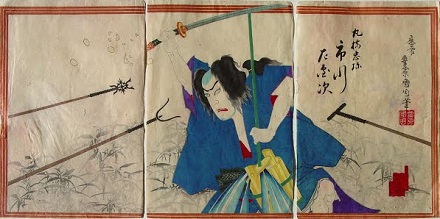
The Keian Uprising inspired many literary interpretations. This 1883 woodblock print depicts actor Ichikawa Sadanji as Marubashi Chûya.

This is more than can be said about the uprisers.

Yui managed to commit seppuku before capture, but Murabashi and a number of the other rebels paid the ultimate price. So too did family members of the rebels.

Marubashi’s is reputed to be the first execution to take place at the Suzugamori execution grounds. The little quarter-acre patch maintained this grim role for the ensuing 220 years, during which time an estimated 100,000 people were put to death there.

That venerable execution grounds was retired in 1871. There’s a memorial marking its onetime site in present-day Tokyo near the junction of Kyu-tokaido Street and Daiichikeihin Avenue.

On this day..

1963: Lazhar Chraiti and nine other Tunisian conspirators

Ten men were executed at dawn on this date in 1963 in Tunis for an assassination plot against President Habib Bourguiba.

Lazhar Chraiti. His daughter has founded a center dedicated to rehabilitating his memory.

Bourguiba was first president of the independent Republic of Tunisia, having led that country out of French domination in the 1950s … and this plot was the first major threat to his rule. “It is a miracle that I am still alive,” he told a women’s conference at the western city of El Kef after it was discovered on December 19. Kebair Meherzi, an officer of President’s Guard (who was among those executed this date) had been privy to the plot, and intended to admit the assassins to Bourguiba’s own bedside. (London Times, Dec. 27, 1962)

Twenty-six people faced a military trial for this attempted coup in early January with thirteen death sentences handed down — most notably including legendary Arab independence guerrilla Lazhar Chraiti (by now a respected official in the ruling Neo Destour party).

One of those 13 was condemned in absentia, having already fled the country to Algeria — the plotters’ Algerian ties caused Tunisia to withdraw its embassy — while two other army officers were reprieved to life and hard labor.

On this day..

1980: Erdal Eren, leftist student

On this date in 1980, 17-year-old Turkish student radical Erdal Eren was hanged as a terrorist by the military regime.

Eren (Turkish Wikipedia link; most other links here are also in Turkish) was one of about 50 people executed following the military coup of September 12, 1980.

After a decade of bloody left-right civil strife, the Turkish generals toppled the civilian government on that date. Hundreds of thousands of arrests with rampant torture marked the period, but it did quell the endemic street fighting and terrorism of the 1970s.

Erdal Eren was actually arrested during the chaotic pre-coup period. February 1980 student protests after the murder of Sinan Suner, an activist of the communist Patriotic Revolutionary Youth Association, turned into a melee that resulted in an officer shot dead under confused circumstances. Eren was among 24 students rounded up.

Despite his youth, Eren was sentenced to die in a March 19 trial — but his appeals had legs until the post-coup military junta abruptly sent him to the gallows on December 13.

Eren went to his death with a brave step, gamely writing his family that he had witnessed so much torture in prison that death was a relief and not a terror.

He’s very warmly remembered today. A number of cultural artifacts pay tribute to the young martyr, including two different songs (“Two Children”, “Seventeen”) by Teoman, a relative of Erdal Eren’s.

On this day..

602: Emperor Maurice and all his heirs

On this date in 602 (although some sources prefer November 23, but that’s close enough for ancient history) the 20-year reign of Byzantine Emperor Maurice came to a most unpleasant conclusion.

No gangster of love, Maurice made his bones (and other bones) as a military commander in a running war with the Sassanids unproductively engaged by the forgettable successors of Justinian.

So successful was the progress of his arms that Emperor Tiberius II Constantine married his daughter to Maurice and set him up as the official heir, a sage expedient considering that Roman commanders had once been known to take the succession into their own hands.

In fact, that’s exactly what happened to Maurice.

As a reward for his many victories in the field, Maurice got to take charge of a badly stumbling state: war both east and west (Maurice made peace with the Persians and brought the Slavs and Avars to heel in the Balkans), the intractable intra-Christian Monophysite controversy (Maurice extended a politic religious toleration), the bankruptcy of his state (Maurice cleaned up the reckless prodigality of his predecessors). For twenty years Maurice managed as well as anyone a very messy situation that in clumsier hands might easily have consumed the state entirely.

In the end this might be his legacy, for good and ill: a manager, not a visionary. Byzantium maybe doesn’t even survive without Maurice, but he was not fated to be familiar to posterity’s every schoolchild like Octavian Augustus — merely to lose his job to office politics.

Maurice, says Charles William Previte-Orton, “was a better judge of policy than of men.” And while the emperor “saw the dire need of economy,” he “forgot that the army did not” and so fatally disregarded “the ferment among the overtried soldiery.”

Maurice had already irritated his Dacian legions by refusing to pay an Avar ransom for their captured brethren — that fiscal rectitude thing, always a dangerous virtue to exercise in proximity to armed men. Now, he provocatively dialed back their pay and then tried to keep them beyond the frontier in Avar territory rather than retiring to home winter quarters.

The legions mutinied, thrusting a mere centurion named Phocas (or Phokas) to their fore. As Maurice commanded neither love nor fear in his home precincts, Constantinople itself yielded readily to the rebels while the enervated erstwhile emperor crossed the Bosphorus and there resigned to his fate not only himself but the several sons he had been designating to succeed him on thrones East and West. Gibbon:

Phocas made his public entry in a chariot drawn by four white horses: the revolt of the troops was rewarded by a lavish donative; and the new sovereign, after visiting the palace, beheld from his throne the games of the hippodrome. … The ministers of death were despatched to Chalcedon: they dragged the emperor from his sanctuary; and the five sons of Maurice were successively murdered before the eyes of their agonizing parent. At each stroke, which he felt in his heart, he found strength to rehearse a pious ejaculation: “Thou art just, O Lord! and thy judgments are righteous.” And such, in the last moments, was his rigid attachment to truth and justice, that he revealed to the soldiers the pious falsehood of a nurse who presented her own child in the place of a royal infant. The tragic scene was finally closed by the execution of the emperor himself, in the twentieth year of his reign, and the sixty-third of his age. The bodies of the father and his five sons were cast into the sea; their heads were exposed at Constantinople to the insults or pity of the multitude; and it was not till some signs of putrefaction had appeared, that Phocas connived at the private burial of these venerable remains. In that grave, the faults and errors of Maurice were kindly interred. His fate alone was remembered; and at the end of twenty years, in the recital of the history of Theophylact, the mournful tale was interrupted by the tears of the audience.

Maurice’s widow Constantina and his daughters were suffered to live, but only for a few years more: they too were eventually put to death for plotting. It was the perfect way to kick off a calamitous century for the Byzantines.

Phocas wore the purple from 602 to 610. Just guess how his term in office ended.

The History of Byzantium podcast covers Maurice’s rough go at the top in episode 34, 35, and 36.

On this day..

1998: Twenty-four Sierra Leone rebels

Fifteen years ago today, thousands of Freetown residents piled into a stone quarry on the outskirts of the Sierra Leone capital to cheer the firing squad executions of two dozen soldiers linked to the previous year’s coup.

In an episode of Sierra Leone’s intractable 1990s civil war, the government of Ahmad Tejan Kabbah was overthrown in 1997 by a military clique in alliance with the murderous Revolutionary United Front (RUF).

This was the height of Sierra Leone’s “blood diamond” chaos, and the RUF had earned an international reputation for savagery in exploiting this lucrative trade — most vividly symbolized by thousands of civilians whose arms or legs were chopped off in an effort to induce population flight away from the diamond mines it intended to control.

The RUF lived down to its terrifying reputation when it marched into Freetown with its military allies in May 1997. Disorderly gangs brandishing AK-47s looted buildings in Freetown* as President Kabbah fled the country.

The oppressive putsch was short-lived: Nigerian-backed intervention reversed the coup early in 1998, causing the RUF to melt back into the bush.**

The Freetown populace’s enthusiasm for revenge against the rebels is to be understood in this light. Those shot at the quarry this date included some major figures in the coup, according to the New York Times: “Brig. Samuel Koroma, a former chief of defense staff and the elder brother of the junta leader, Johnny Paul Koroma, who is a fugitive, and Cpl. Tamba Gborie, the man who announced the coup. The junta secretary general, Col. Abdul Karim Sesay, was also executed.”

The African Commission on Human and Peoples’ Rights later found Sierra Leone in violation of the African Charter on Human and Peoples’ Rights for denying the soldiers a “right of appeal to competent national organs” which “falls short of the requirement of the respect for fair trial standards expected of such courts.” Sierra Leone was so little perturbed by the non-binding and unenforceable ruling that it didn’t even bother defending itself against the complaint.

* Dubbed “Operation Pay Yourself”.

** They weren’t done by a long shot. In January 1999, the RUF’s more systematically homicidal “Operation No Living Thing” attack on Freetown claimed 7,000 lives, half of them civilians.

On this day..

Corpses Strewn: The Streltsy

Peter the Great’s ruthless destruction of the Streltsy played out as bloody public theater in October of 1698.

A strelets (or strelitz in a more Germanic transliteration) was a professional guardsman stationed in the Russian capital. Ivan the Terrible had formed the corps initially in the 16th century to give himself a standing musketeer* force when he otherwise had to depend on dicey peasant recruits.

By the 18th century, they were just one more sclerotic Russian bureaucracy.

Their nominal duty to garrison Moscow against invaders was nearly superfluous. Top-level Streltsy had ample time to exploit their tax-favored treatment to become merchants … from which some made enough money to hire out other underemployed Streltsy to fill their occasional duty shifts. Once elite recruits, they now handed down their cushy appointments father to son. Further down the lists, rank-and-file Streltsy politicized as pro-peasant, anti-foreigner, and supportive of the Old Believer movement.

So an institution of 22,000 armed men in the capital with grievances and free time: any government would find this dangerous.


The fall of the Streltsy is connected intimately with the rise of Peter the Great, and some backstory on the latter will be necessary to make sense of the former.

Peter’s father was Alexis I, who ruled Russia from 1645 to 1676. (He’s notable for backing the church reforms that opened the schism between mainline Orthodoxy and the unreconstructed Old Believers.)

Alexis had two wives and sixteen legitimate children, but at his death he left a shaky succession. The crown passed initially to the sickly teenager Fyodor III, but Fyodor died in 1682 without an heir of his own.

Who would rule next? The families of Tsar Alexis’s two wives, the Miloslavskys and the Naryshkins, contended for power.

Ivan, the only remaining son of Alexis’s Miloslavsky first wife, was mentally infirm. Peter, the son of Alexis’s (still-surviving) Naryshkin second wife, wasn’t even 10 years old yet.

A boyar duma selected Peter, the younger son of the younger wife.

On this, the Miloslavsky family incited the Streltsy to revolt with rumors that the upstart Naryshkins had poisoned off Fyodor and shoved aside the legitimate heir, nicely marrying these grievances to long-overdue Streltsy back pay the cash-poor government had been withholding. The result was a savage May 1682 mutiny of guardsmen who ran amok through the undefended Kremlin. Scenes of unspeakable horror played out before young Peter’s own eyes: shaggy praetorians ransacking the palace in search of noblemen whom Peter had grown up around, and who were now wildly accused of regicide, treason, and tight-fistedness. These men would be put to savage and summary death by the armed mob: hurled onto spearpoints, tortured to death in the dungeons, or just cut apart on the streets. To abate the rampaging death squad after several harrowing days, Peter’s mother was forced to give up her own brother Ivan — especially hated of the Streltsy — to torture and murder.


Alexei Korzukhin’s 1882 depiction of the Streltsy dragging Ivan Naryshkin to his death as a young Peter the Great consoles his mother.

The Streltsy had threatened to slaughter every last boyar in the Kremlin had she not done so.

Their depredations forced the appointment of the infirm Miloslavsky candidate Ivan as Peter’s co-tsar, both sovereigns under the regency of Ivan’s strong-willed elder sister Sophia.

They carried that day and, by virtue of Sophia’s rule, the remainder of the 1680s. But as Peter aged into manhood, the two parties were bound for confrontation once again, and Peter finally took Russia in hand and forced Sophia into a convent in 1689.

So that’s the scene: Peter’s in charge. He has a living rival locked up in a nunnery. And the Streltsy have a definite preference between them.


For obvious reasons, Peter returned the low opinion of the Streltsy.

Due care for his throne dovetailed conveniently with payback for uncle Ivan’s murder, and Peter took every opportunity to reduce the privileged position of this dangerous body in favor of his new Preobrazhensky and Semenovsky regiments. After the Azov campaigns in the mid-1690s, Peter returned in triumph with his prized western-trained armies, leaving Streltsy to garrison his Black Sea outpost.

Disaffected Streltsy started thinking that Sophia would look real good back on the throne.

In June 1698, incensed by an order to march hundreds of miles to the Polish-Lithuanian frontier — and having been secretly in contact with Sophia — four Streltsy regiments mutinied and made for the capital. Peter was away in Vienna, but his general Alexei Shein intercepted the rebels 30 miles from the city and routed them. “Not one got away,” in the words of the communique to Peter. Shein himself executed well over 100 of the captured Streltsy right in the field. Another nineteen hundred were left to wait the pleasure of their returning sovereign and enemy.

Peter was not a man for half-measures; his city, St. Petersburg, remains today a monument to his vision but was thrown up on a fetid quagmire over the bones of countless laborers. Progressive despots don’t always encounter a backward army whose claims to semi-feudal privileges throw the country into commotion, but when they do, they purge wholesale.

“How sharp was the pain, how great the indignation to which the Czar’s Majesty was mightily moved, when he knew of the rebellion of the Strelitz, betrayed openly a mind panting for vengeance,” wrote the Austrian diplomat Johann Georg Korb — present in Moscow for the occasion, and a man whom the xenophobic Streltsy might well have lynched given the opportunity.

[Peter] began to have suspicions of everybody’s loyalty, and began to cogitate about a fresh investigation. The rebels that were kept in custody, in various places in the environs, were all brought in by four regiments of the guards, to a fresh investigation and fresh tortures … No day, holy or profane, were the inquisitors idle; every day was deemed fit and lawful for torturing. As many as there were accused there were knouts, and every inquisitor was a butcher.


The Morning of the Execution of the Streltsy by Vasily Surikov (1881). In fact, there were several different Streltsy executions in October 1698, which Surikov has pictorially conflated.

The journal of the astonished Korb is our guide for the Streltsy executions. “The whole month of October was spent in butchering the backs of the culprits with knout and with flames: no day were those that were left alive exempt from scourging or scorching, or else they were broken upon the wheel, or driven to the gibbet, or slain with the axe,” he notes.

For the occasion, we’re introducing a new post series concept. These executions did not occur on consecutive days, but on several different days over the course of October 1698 — each occasion with a macabre new twist on the proceedings to make the lesson really stick. Intermingled with our regular fare, we’ll cover each distinct execution anniversary as the days come, looping back to this parent series post on each occasion.

In all, 1,182 Streltsy prisoners were put to death. Most of the rest were exiled to Siberia. By 1705 the Streltsy force had been completely abolished.

One last footnote: Peter interrogated his half-sister Sophia personally over her role in the potential coup, and he threatened to handle her like Queen Elizabeth handled Mary, Queen of Scots. (Kinship was no safeguard from brutality where Peter was concerned.) In the end he decided to spare her — but forced her into a cloister under heavy guard, never allowed to receive visitors until her death six years later.

* Strelets derives from the Russian verb to shoot; when formed around 1550, they were armed with arquebuses.

On this day..

1698: The Streltsy executions begin

This entry in our Corpses Strewn series on the October 1698 extirpation of the Streltsy is courtesy of the diaries of Austrian diplomat Johann Georg Korb, an eyewitness to the events.

To this exhibition of avenging justice the Czar’s Majesty invited all the ambassadors of foreign fovereigns, as it were to aflert anew on his return that fovereign prerogative of life and death which the rebels had disputed with him.

The barracks in Bebraschentsko end in a bare field which rises to the summit of a rather steep hill. This was the place appointed for the executions. Here were planted the gibbet stakes, on which the foul heads of these confessedly guilty wretches were to be fet, to protract their ignominy beyond death. There the first scene of the tragedy lay exposed. The strangers that had gathered to the spectacle were kept aloof from too close approach; the whole regiment of guards was drawn up in array under arms. A little further off, on a high tumulus in the area of the place, there was a multitude of Muscovites, crowded and crushing together in a dense circle. A German Major was then my companion; he concealed his nationality in a Muscovite dress, besides which he relied upon his military rank and the liberty that he might take in consequence of being entitled by reason of his being in the service of the Czar to share in the privileges of the Muscovites. He mingled with the thronging crowd of Mufcovites, and when he came back announced that five rebel heads had been cut off in that spot by an axe that was swung by the noblest arm of all Muscovy. [i.e., Peter’s own] The river Jaufa flows pall the barracks in Bebraschentsko, and divides them in two.

On the opposite fide of this stream there were a hundred criminals set upon those little Muscovite carts which the natives call Sbosek, awaiting the hour of the death they had to undergo. There was a cart for every criminal, and a soldier to guard each. No priestly office was to be seen; as if the condemned were unworthy of that pious compassion. But they all bore lighted tapers in their hands, not to die without light and cross. The horrors of impending death were increased by the piteous lamentations of their women, the sobbing on every fide, and the shrieks of the dying that rung upon the sad array. The mother wept for her fon, the daughter deplored a parent’s fate, the wife lamenting a husband’s lot, bemoaned along with the others, from whom the various ties of blood and kindred drew tears of sad farewell. But when the horses, urged to a sharp pace, drew them off to the place of their doom, the wail of the women rose into louder sobs and moans. As they tried to keep up with them, forms of expression like these bespoke their grief, as others explained them to me: “Why are you torn from me so soon? Why do you desert me? Is a last embrace then denied me? Why am I hindered from bidding him farewell?” With complaints like these they tried to follow their friends when they could not keep up with their rapid course. From a country seat belonging to General Schachin [Shein] one hundred and thirty more Strelitz were led forth to die. At each side of all the city gates there was a gibbet erected, each of which was loaded with six rebels on that day.

When all were duly brought to the place of execution, and the half dozens were duly distributed at their several gibbets, the Czar’s Majesty, dressed in a green Polish cloak, and attended by a numerous suite of Muscovite nobles, came to the gate where, by his Majesty’s command, the imperial Lord Envoy had flopped in his own carriage, along with the representatives of Poland and Denmark. Next them was Major-General de Carlowiz, who had conducted his Majesty on his way from Poland, and a great many other foreigners, among whom the Muscovites mingled round about the gate. Then the proclamation of the sentence began, the Czar exhorting all the bystanders to mark well its tenor. As the executioner was unable to dispatch so many criminals, some military officers, by command of the Czar, came under compulsion to aid in this butcher’s task. The guilty were neither chained nor fettered; but logs were tied to their legs, which hindered them from walking fast, but still allowed them the use of their feet. They strove of their own accord to ascend the ladder, making the sign of the cross towards the four quarters of the world; they themselves covered their eyes and faces with a piece of linen (which is a national custom); very many putting their necks into the halter sprang headlong of themselves from the gallows, in order to precipitate their end. There were counted two hundred and thirty that expiated their flagitious conduct by halter and gibbet.

On this day..

1981: Mustapha Danso

On this date in 1981, Mustapha Danso was executed for an attempted coup in Gambia.

Gambia (or “The Gambia”: we’re going to dispense with the article here) is a sliver of a country hugging the Gambia River, entirely surrounded (save the coast) by Senegal.

It became independent of Great Britain in 1970 under the leadership of Dawda Jawara, who held the Gambian presidency democratically from that time until 1994. Mustapha Danso, our date’s principal, was one of a coterie of disaffected Gambian junior officers who were scheming a coup against Jawara as the 1980s got underway.

In October 1980, Danso walked up to the deputy commander of the Gambia Field Force, Eku Mahoney, and coolly shot him dead. “Although the first speculations blamed the constable’s action on possible illicit drug influence,” notes a book about Gambia’s subsequent, and successful, 1994 junior officers’ coup, “Mustapha Danso’s unresentful attitude after the incident convinced many people that there was more to it than what met the eye.” Mahoney may have been killed because he was viewed by the prospective coupists as an obstacle.

Danso caught a death sentence, but since Gambia never actually executed anyone, it was essentially symbolic.

That is, until July 1981, when Jawara was in London to attend the wedding of Prince Charles and Lady Diana. Danso’s former comrades in the Field Force seized the opportunity to join a coup mounted by leftist politician Kukoi Samba Sanyang against the “corrupt, tribalistic, and despotic” Jawara in favor of “the dictatorship of the proletariat.”

From London, Jawara summoned Senegalese aid: Gambia’s neighbor and sometime rival dispatched troops who successfully crushed the rebellion within a week. Some 500 people lost their lives during the turmoil, and its leaders fled abroad. (Kukoi Sanyang died a few months ago as of this writing, but his version of the “people’s revolution under my able leadership” can be perused here.)

While the coup itself was suppressed, Jawara went pretty easy (as these things go) on his actual or perceived enemies. Danso was the only party to the plot who was executed, and Jawara went out of his way to declare normalcy instead of using a national security emergency to smash up everything.

“In the aftermath of this threat to our internal security some have asked whether it would be appropriate at the time to consolidate both the power of the State and the power of the executive. Let me state categorically and unequivocally that the system of democracy that has always existed will prevail. There will be no dictatorship in The Gambia — neither by the President, nor by the Government, nor by the proletariat.” (Source)

Danso was the first and, for 30 years the only, person executed in Gambia; the country has retained the death penalty in law, but was long considered de facto abolitionist. That changed suddenly in August 2012 when current president Yahya Jammeh unexpectedly ordered nine condemned prisoners put to death on a single day.

On this day..