On this date in 1537, a Scottish noblewoman suffered the fate decreed for her treason — in the terse entry of the judicial record, combusta.
Knocking around Glamis Castle — where Shakespeare’s great villain Macbeth got his start, as Thane of Glamis* — Janet Douglas had the going enmity of Scottish king James V on the substantial grounds that Janet’s father had held the teen-king his virtual prisoner for a few years in the 1520s. Once James got free, he proscribed the lady’s brother, the Earl of Angus (whom Janet continued to shelter when occasioned), confiscated properties, forbade Douglases from approaching his person, and all that sort of thing.
Presumably according to this same anti-Douglas animus, an abortive attempt was made in 1531 to try our Lady Glamis for poisoning her late first husband, Lord Glamis. However, the charge foundered on the refusal of her peers to participate: “the lairds of Ardoch, Braco, Fingask, Abernethy, Piferran, Lawers, Carnock, Moncreiff, Anstruther, Lord Ruthven, Lord Oliphant, and many others, were fined for absenting themselves from the jury.”
Six years later she was more successfully returned to the dock, this time on a charge of plotting to poison the king himself. There seems to remain very little detail that would trace the precise unfolding of those years and offer later interlocutors a clear interpretation; while “innocent noble railroaded” is the most conventional read — Henry VIII’s agent reported that the conviction was secured “without any substanciall ground or proyf of mattir” — this book gives it a “maybe she did, maybe she didn’t” spin. That whole embittered proscription thing cuts both ways, as motives go.
At any rate, torture induced Janet Douglas’s own 16-year-old son John to testify that she had procured a potion intended to resolve that feud, and despite reported doubts and a spirited defense, the judges found her “committit art and part of the tressonabill Conspiratioune and ymaginatioune of the slauchter and destructioune of our soverane lordis” and therefore to “be had to Castell hill of Edinburghe, and thair brynt in ane fyre to the deid as ane Traytour.” (John was reprieved of this fate, but he still had to watch.)
King Jamie took over Glamis Castle and hung his spurs there until his own death in 1542 … whereupon his crown passed to Mary, Queen of Scots, and the castle reverted to that young John, the new Lord Glamis.
By the jaw-droppingly horrific murder he committed, George Robertson certainly earned the distinction.
Not actually topical save to George Robertson’s milestone as Edinburgh’s literal last drop; this Last Drop Pub is at the city’s Grassmarket where historic public hangings (long gone by Robertson’s day) were conducted. Image (c) Sh0rty and used with permission.
His ex-wife, Elizabeth McGarry, had recently kicked him out of the house after an attempted reunion led right back to the prolific domestic abuse that had ended their marriage in the first place. She was an unwed, unemployed mother of two teenage children, but anything beats being tied up and threatened with a hatchet.
Mother and children — 18-year-old son George Jr., and 16-year-old daughter Jean — lived in waking terror of the vengeful ex-patriarch; in the days before restraining orders, they kept doors constantly bolted and jammed with chairs under the doorknobs, and a poker within reach whenever possible.
According to this retrospective — and read the whole thing for a slasher film in prose — the estranged George managed to get into the house on the night of February 28, 1954, while everyone was asleep.
He summoned his former spouse to the kitchen and knifed her to death, then attacked young George Jr. when he arrived, too. Then he mounted the stairs — where Jean was desperately trying to escape out a window — carrying
the blood-drenched body of his ex-wife, a gaping hole in her stomach and a white handkerchief stuffed in her mouth, hands bound together.
George Alexander Robertson was just in the midst of trussing up Jean and stabbing her to death when the mangled George Jr. distracted the killer by reviving well enough to burst out onto the balcony and into the public quadrangle below. There, he
threw himself through a neighbour’s kitchen window, where he begged for help.
Following him, just yards behind, enraged and still clutching his knife, came his father.
The Hay family, whose quiet home was now about to become a murder scene, cowered in terror as blow after blow rained down on the terrified teen as he screamed for help.
Defenceless against his father’s brutality, young George finally slumped to the floor, dying.
Job done, his father threw his body over his shoulder and strolled home leaving a bloody trail across Tron Square.
The savage “brainstorm” to which he would later attribute this wild spree must have been abating. As he returned to his former domicile, he didn’t bother finishing off Jean, but stuck his head in the kitchen gas oven, where responding police found him.
The obviously unbalanced paterfamilias attempted to plead guilty to avoid the spectacle of the trial (no dice: two days of horror from the witness box riveted the city) and did not attempt to fight the inevitable sentence once imposed. He was dead within 15 weeks of the bloodbath, at the skillful hands of Albert Pierrepoint.
Cycles of violence often climax in executions. On this date in 1736, the execution of Andrew Wilson instead initiated the cycle … which culminated in one of the most notorious riots in Scottish history.
That January, Wilson, George Robertson, and William Hall had robbed an excise tax collector of £200, earning all three of them a death sentence. Hall drew a commutation, and Robertson spectacularly escaped from the condemned men’s sermon when he bolted for the door while Wilson obstructed the guards. (All the civilians present stood aside for the fleeing man, who successfully reached Holland and safety.)
Public sympathy for the self-sacrificing Wilson — whose victim was collecting a much-resented levy for the much-resented new British Union — had become acute by April 14th, when Wilson was to be publicly executed in the Grassmarket.
[The escape of Robertson] made them take a closer care of Wilson who had the best character of them all (til his foly made him seek reprisals at his own hand), which had gaind him so much pity as to raise a report that a great mob would rise on his execution day to relieve him, which noise put our Magistrates on their guard and maybe made some of them unco flayd [unusually afraid] as was evidenced by their inviting in 150 of the Regement that lys [lies] in Cannongate, who were all drawn up in the Lawn Market, while the criminal was conducted to the tree by Captain Porteous and a strong party of the City Guard.
This Captain John Porteous of the also-resented Edinburgh City Guard was not a well-calculated selection to calm everyone’s nerves.
He’d hooked up the lucrative officers’ appointment courtesy of political pull, then proceeded to become a violent, overbearing ass and “procured him the universal hatred of the people in that city.”
Wilson was executed, as Ramsay says, “with all decency & quietnes,” but when the body was being removed the irritable crowd favored its obnoxious guards with a few missiles. Porteous, who obviously wasn’t the turn-the-other-cheek type, destructively escalated the confrontation.
After he was cut down and the guard drawing up to go off, some unlucky boys threw a stone or two at the hangman, which is very common, on which the brutal Porteous (who it seems had ordered his party to load their guns with ball) let drive first himself amongst the inocent mob and commanded his men to folow his example which quickly cleansed the street but left three men, a boy and a woman dead upon the spot, besides several others wounded, some of whom are dead since. After this first fire he took it in his head when half up the Bow to order annother voly & kill’d a taylor in a window three storys high, a young gentleman & a son of Mr Matheson the minister’s and several more were dangerously wounded and all this from no more provocation than what I told you before, the throwing of a stone or two that hurt no body. Believe this to be true, for I was ane eye witness and within a yard or two of being shot as I sat with some gentlemen in a stabler’s window oposite to the Galows. After this the crazy brute march’d with his ragamuffins to the Guard, as if he had done nothing worth noticing but was not long there till the hue and cry rose from them that had lost friends & servants, demanding justice. … I could have acted more discreetly had I been in Porteous’s place.
There were up to 30 casualties, and the temper of that fierce Edinburgh mob went from bad to worse over the ensuing months.
Authorities were obliged by public outrage to arrest Porteous for murder, and in an electric trial with a good deal of witness testimony scrambled by the post-hanging chaos, Porteous himself was condemned to hang.
We might, however, suppose with Scott that “if Captain Porteous’s violence was not altogether regarded as good service, it might certainly be thought, that to visit it with a capital punishment would render it both delicate and dangerous for future officers” — to say nothing of the “natural feeling, on the part of all members of Government, for the general maintenance of authority.” It’s not as if there are a lot of cops charged with capital crimes today for even the most egregious homicides.
Intervention to block the hanging came straight from London at the instigation of first Prime Minister Robert Walpole, whose intervention was also not liable to tame any passions. Instead …
In the ensuing riot, an Edinburgh lynch mob overpowered Captain Porteous’s guards at the Tolbooth and hauled the scoundrel out to the Grassmarket where he was beaten and hanged on a dyer’s pole.
Despite a £200 reward for the authors of Porteous’s death, and a passing Parliamentary threat to revoke the city’s charter altogether, no Edinburgher ever talked, and no person was ever prosecuted for the Porteous riots.
It was not until 1973, with “all passion spent”, that this memorial stone was erected for John Porteous in Greyfriars Kirkyard. (cc) image from Kio Stark.
The Heart of Midlothian, Scott’s novel that features these infamous riots, was also the nickname for the the Old Tolbooth, the Edinburgh gaol where both Wilson and Porteous were housed before their respective unfortunate demises. Today, the Heart only remains as a literal heart-shaped mosaic in the city’s paving-stones marking the building’s former location.
Generations of passersby have paused to hawk a loogie on this design as a gesture of the citizenry’s lasting contempt for the long-demolished prison.
The present-day “Heart of Midlothian” in Edinburgh’s paving-stones. (cc) image from Lee Carson.
Much less hostile is the reception given Walter Scott’s oeuvre.
The names of the novelist’s books and their characters were often repurposed by Scots to name nigh anything … stuff like, a Heart of Midlothian Dancing Club in Edinburgh, from which in turn emerged a cadre of sportive youth who formed the still-extant Heart of Midlothian Football Club.
That prospectively apocalyptic year of 1666 saw the onset of the Scottish Covenanters‘ mass martyr-making under the English gallows.
Three dozen or so were put to death in the aftermath of the Battle of Rullion Green. Among them, nine men — seven in Ayr, two in Edinburgh — paid with their necks on this date.
The Covenanter tragedy stretches back to the first English Civil War, when English parliamentarians enlisted the aid of Scottish Presbyterians by agreeing to a covenant guaranteeing presbyterian church governance in Scotland and England. Essentially, that meant representative ecclesiastical authority, rather than top-down power from the king, via bishops.
The Presbyterians took this covenant very seriously indeed.
This expedient political arrangement flew apart post-hostilities, especially when the Presbyterians’ parliamentary faction got on the wrong side of Cromwell‘s New Model Army.* “Pride’s Purge”, the de facto army coup d’etat which made possible the execution of Charles I, essentially consisted of kicking out of Parliament the Presbyterian types who were ready to strike a deal with the king at the army’s expense and then governing with the remainder.
This made Presbyterians, for whom reformed church governance was the issue, amenable to inroads from the royalist camp. As soon as Charles I lost his head, the un-purged Presbyterian Scottish Parliament recognized Charles II … on condition that he get on board.
Charles was not exactly an enthusiastic partner.
A political cartoon shows Scottish Presbyterians literally holding King Charles II’s nose to the grindstone.
Nevertheless, Charles II did sign on the dotted line as the price for a Scottish throne and a play at restoration … but the army stomped that, too. An exasperated Cromwell asked of these quarrelsome Scots with their presbyter hangup,
“I beseech you, in the bowels of Christ, think it possible you may be mistaken!”
Mistaken or not, the beaten Presbyterians were optimistic — it’s a ridiculous optimism, in retrospect — that the post-Cromwell Restoration of the exiled monarch would finally Presbyterianize the island. But in 1660, it was Charles wielding the grindstone.
Much to his former allies’ chagrin, Charles rolled back the previous years’ church reforms, booted dissenting clerics, and cemented episcopacy.
The Presbyterian frustration here is understandable; they twice came out on the winning side in the civil war carrying signed pledges from the victors, and were twice balked of their prize. And the balked prize was only God’s work on earth.
The remaining seven executed this date in Ayr are notable in part because they ought to have been eight.
Memorial stone for the Covenanters executed in Ayr on December 27, 1666. Image (c) Stephen Wagstaff and used with permission.
Ayr’s public executioner fled rather than put godly Scotsmen to death. A Highlander named William Sutherland, who served the same office, was retrieved from nearby Irvine, but he too refused even when threatened with torture.**
The beneficiary of these principled refusals, in body if not in soul, was Cornelius Anderson, one of the eight doomed to die in Ayr who was finally prevailed upon to take the job of hanging his fellows in exchange for his life. Faltering spirit fortified with too much brandy, Anderson clumsily dispatched this group; later, since the obdurate Irvine hangman had been sacked, he had to do the same to two more Covenanters there.
Guilt-ridden and reviled, Anderson actually might have been the most miserable man on the scaffold. He came to a miserable end.
His conscience troubling him, he went to Ireland, where he was no better; nobody would either give him work or lodging. He built a little house in some common place near Dublin, where he and it and all were burnt to ashes. (Source)
* Specifically, they wanted to disband said army, and do so without coughing up its back pay.
** Sutherland’s torture included the summoning of a firing squad ostensibly to execute him if he failed to perform the executions. He called that bluff and was not executed, thereby depriving this site of a rare and precious “Executioner executed for failing to execute” entry.
On this date in 1573, William Kirkcaldy of Grange was hanged at Edinburgh. A marker at Edinburgh Castle honors the man who “held this castle for Queen Mary from May 1568 to May 1573 and after its honourable surrender suffered death for devotion to her cause.”
It’s a surprising epitaph.
The fellow’s father, James Kirkcaldy, was one of the realm’s prominent Protestants, and young William worked in France as an English secret agent in the 1550’s while that same Queen Mary held court there as the consort of crown prince turned underprepared child-king Francis II.
After Francis died in 1560, his widow returned to Scotland — not only as Mary, Queen of Scots but as a potential Catholic champion for the throne of England itself.
Kirkcaldy was a natural enemy in a confusing political situation. Scotland in the 1560s slid into civil war between the “Marian” party and the (more Protestant, more pro-English) “king’s men” supporting the regents governing in the name of Mary’s son, James VI.*
As one might expect, Kirkcaldy was a king’s man. He beat Mary in battle in 1567 and took her prisoner, helping force her abdication; after she escaped and had another go at it, he beat her again, and Mary fled to England, never to see Scotland again.
But a funny thing happened to Kirkcaldy on his way to the winner’s circle. In the jockeying that followed Mary’s flight, a fellow pol pulled him over to the Marian party.
Kirkcaldy’s considerable talents now strained themselves for the return of the monarch and the curtailment of the regents. He lost.
When it came again to open conflict, the king’s men (backed by aid from England) trapped Kirkcaldy in Edinburgh Castle and besieged it until the man was forced to surrender to the scanty mercy of his captors and the immortality of that latter-day plaque.
On this date in 1705, another century’s supposed terrorist was hanged on Leith Sands with two of his “pirate” crew by a Scottish court “drunk with patriotic prejudice.”*
This execution took place in the feverish run-up to England and Scotland’s Acts of Union welding the neighboring realms into Great Britain in 1707.
Arising as it did from the same causes that animated that national marriage of convenience, Green’s execution also endangered it: Daniel Defoe, who was at this time a pro-Unionist mole (and prolific pamphleteer) for English pol Robert Harley, described this hanging as one of the six crises that had to be overcome en route to the Union.
A Man, A Plan, A Calamity
Panama.
That’s where it all started, for Green and Union alike.
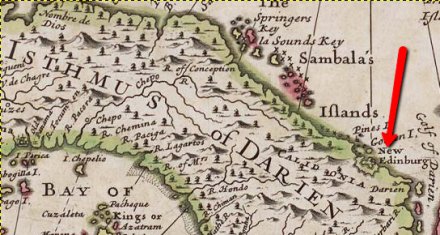
Mired in economic backwardness as neighboring European states carved up the world, Scotland made a bold, doomed bid for a chit in the empire game: the Darien scheme. One part visionary and (at least) two parts daft, this venture attempted to establish a Scottish colony on the Isthmus of Panama (aka the Isthmus of Darien) with a view to porting freight across the narrow strip of land separating Atlantic and Pacific, and dominating the dramatically more efficient east-west trade route that would result.
Students of the Panama Canal project will be aware that this malarial tropic would not be described as especially hospitable; to the natural disadvantages of the climate were added the political interpositions of England herself, whose hostility to the advent of her Caledonian neighbor as a New World rival was expressed in legislation choking the Darien adventure of foreign aid.
(Also a problem: Spain. The colony was abandoned at last under Spanish siege.)
So Scotland went it intrepidly, injudiciously alone in this last bid for real independent muscle in Europe. The hyperbole of the Isthmus’s publicists eventually sucked in 20 percent or more of the capital circulating in Scotland. And when Darien-dot-com went bust by 1700 at the cost of a couple thousand lives, it cratered the Scottish economy too. That set the stage for Edinburgh’s partnership in a different scheme: Great Britain.
Green with Envy
In the years following the Darien catastrophe, the Scottish corporation chartered to undertake it was still throwing stuff against the wall in the world trade game, trying to get something to stick to at least take the edge off the losses.
This company (theoretically a potential rival of England’s own East India Company) had suffered the further national indignity of having one of its ships, the Annandale, seized in the Thames for infringing the East India Company’s royal monopoly. Its appeals for redress falling on deaf ears, the Darien company apparently induced Scottish authorities to undertake the retaliatory seizure of an English merchant ship, the Worcester, that had the ill luck to weather a storm at the Firth of Forth.
Rumor soon connected this ship to another vanished Darien company vessel overdue from its return trip from the East Indies … and, as it quickly became understood by all right-thinking Scots, overtaken in the Indian Ocean by this same Worcester and its crew butchered.
Captain Thomas Green and his English crew were hailed before an Admiralty court** on piracy charges on this extremely fantastical connection in a virtual mob atmosphere.
It never was clearly established that an act of piracy had been committed as a distinct fact, but by putting certain circumstances together it was inferred that Green was guilty of piracy. The very shape in which the accusation is set forth, shows that the accusers could not point to the specific act of piracy which had been committed …
[There] was no specification as to the vessel taken, which might enable the accused to prove that it had not been taken; no names of parties murdered, who might be shown still to be alive; no ownership of cargo, which might admit of proof that the owner’s goods had arrived safe. As Green himself is made justly to say in the document published as his dying speech, “We are condemned as pirates and murderers on a coast far distant from this place — is there any of you who wants either a friend whom we have murdered, or whose goods we have taken?”
Worcester Sauce
The Worcester‘s Malabari cook provided a highly dubious charge — dubious, for he was not yet among the crew when it last called at the location he claimed the crime took place — of Green and crew hatchet-murdering approximately ten English-speaking mariners on an unnamed vessel off the Indian coast.
Upon this evidence, 14 or more members (the ready sources are a little loose on the total number) of the Worcester crew were condemned for piracy, and initially slated for three batches of hangings. Queen Anne‘s personal intervention managed a stay,
The Scottish Privy Council unto the very last hours debated what to do with the diplomatic appeals, with evidence forwarded from London to the effect that the crew these Worcester men had supposedly slaughtered were alive, their vessel having been hijacked in another place, by another man.
But a surging Scottish mob aggrieved by the preceding years’ misadventures and the impending shotgun marriage to Westminster rather than anything Green himself had really done was already engorged on the blood of the supposed English corsairs. Most of the Council thought better than to deny them their sacrifice.†
The Streets fill’d with Incredible Numbers of Men, Women and Children, calling for Justice upon those ENGLISH Murtherers. The Lord Chancellor Seafield‘s Coach happening to pass by, they stop’d it, broket he Sashes, haul’d him out, and oblig’d him to promise Execution should speedily be done before he could get from ’em … According to the Chancellors promise, soon after, on the same Day, being Wednesday, Captain Green, Madder [the mate], and Sympson [the gunner] were brought out, and convey’d to Execution, which was at Leith Road upon the Sands, and all the way was Huzza’d in Triumph as it were, and insulted with the sharpest and most bitter Invectives. Being come to the place of Execution, Good God! what a moving sight was it to see those Men stand upon the very Varge of Life, just launching in to Eternity, and at the same time see the whole Multitudet ransported with Joy!”
-From an anonymous Letter From Scotland To a Friend in London, quoted by James Kelly, “The Worcester Affair,” The Review of English Studies, Feb. 2000
In the event, these three were the only ones actually hanged; passions cooled enough for the other “pirates” to be quietly released.
But the wider, national passions unleashed by this date’s executions would long provide fodder for intemperate patriotic recrimination, and specifically anti-Unionist propaganda — on both sides of the border.
Competing propagandisticbroadsides framed and re-framed the events, as the affair of unscrupulous English buccaneers or perfidious highland barbarians. (Defoe, maneuvering for Union, wrote to chill such bad-for-business hostility: “Nothing could be more horrid, than that the Scots should Execute these Men on a meer Pique at the English Nation. Nothing can be more like it, than to conclude rashly, that it is so, and improve it on purpose to Exasperate our People against the Scots.” (Kelly))
And that, of course, is precisely the viewpoint that prevailed.
While the hemp neckties issued to Green et al this date threatened to (ahem) scotch the Union project, that very danger might have ultimately hastened its completion — as elites recognized, in Defoe’s words, that Union represented “the only way to preserve the publick Tranquillity, and prevent the certain Mischiefs that threatened the whole Body,” (Kelly, again) and rammed it through with dispatch.‡
‡ The ebb and flow of national resentment continued long after the Acts of Union, of course; continuing Scottish support for the restoration of the Stuart monarchy was one expression of Scottish nationalism and anti-Union sentiment.
Wanted: corpses. Apply to Doctor Robert Knox, MD, FRSCEd, Professor of Medical Studies, Barclay’s Medical College, Surgeon’s Square, Edinburgh. Reference William Burke, hanged Jan. 28, 1829.
Robert Knox was a noted physician in his prime, in the early 1800s.
A surgeon, anatomist, and zoologist, Knox studied anatomy in London, then headed off to Africa in the army. Field surgery was a brutal business, and the poor anatomical knowledge at the time made it even more terrifying for those involved.
In 1821, Knox moved to France to work in the shadow of his heroes, Georges Cuvier and Étienne Geoffroy Saint-Hilaire; a year later, he was back in Edinburgh, making himself a career academic.
When his old professor came calling in 1826 with an opportunity to teach at Surgeon’s Square in Edinburgh, Knox jumped at the chance. As a partner to Barclay and curator of the school’s museum, Knox was well aware of the significant problem that faced the school: corpses were hard to come by.
And since the Royal College of Surgeons at Edinburgh certified the school as a prep course for entrance to University, coming up with bodies became a very important task.
If there’s one way to ruin your career, it’s to be caught paying a few pounds for fresh murder victims.
So it was for Knox, who gave out 7 pounds, 10 shillings for the body of an itinerant lodger who died in William Burke’s building in 1827.
This transaction led Burke to realize that such lodgers weren’t paying as much alive as dead. As a collector of bodies, Knox also had a strict no-questions-asked policy, and Burke and his partner William Hare exploited that to its fullest extent.
Almost a score of suspicious bodies later (and after the price had inflated to 10 pounds per), the pair was found out, given away as suspects by the lame and mentally disabled “Daft Jamie” Wilson, then caught when the late Marjory Campbell Docherty was found by a fellow tenant under one of Burke’s lodge’s beds.
Hare copped to a string of murders* and played stool pigeon in exchange for a lighter sentence.
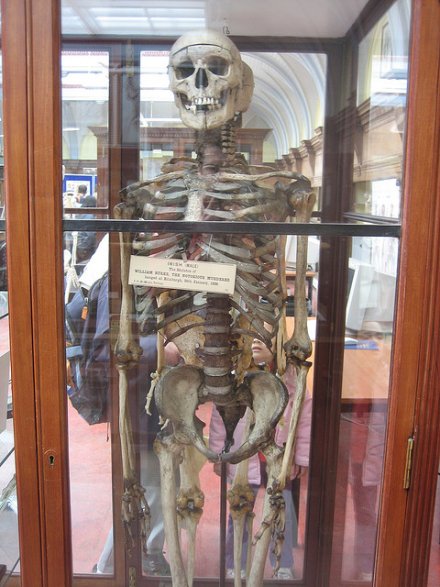
Burke went to the gallows to “vehement cheering from every quarter, mingled with groans and hisses.” (London Times, Feb. 2, 1829)
“When the cheers had subsided, the wretched man was assailed with every epithet of contempt and abhorrence,” the Times continued. “Not a single indication of pity was observable among the vast crowd: on the contrary, every countenance wore the lviely aspect of a gala-day.”
William Burke’s hanging.
As a corpse himself, Burke made one final contribution to science’s insatiable desire for bodies: his cadaver went straight from the gallows to the practiced hands of one Dr Alexander Monro, who performed a complete lecture while dissecting the murderer’s corpse.
Knox, for his part, paid not with his neck but with his reputation.
Though never charged with a crime, the doctor was run out of the the lecturing business, first by subtle and not-so-subtle actions by the University, and eventually by the passage of the Anatomy Act of 1832.
He was also unable to obtain any surgical post after the incident and spent his later years writing academic books and papers, none of which have lasted like the doggerel that shadowed his steps.
Burke’s the butcher, Hare’s the thief,
Knox, the boy who buys the beef.
A few books about Burke and Hare
Anatomy of Anatomy
Robert Knox was operating under the Murder Act of 1751, which expressly forbade the burial of an executed murderer while permitting the malefactor’s dissection.
The Act had the dual effect of allowing the state to gibbet executed criminals (both hanging in chains and dissection were considered an added ignominy, beyond the punishment of the gallows), and of supplying the budding medical community with an immediate source of fresh bodies.
As courses in anatomy became more commonplace, though, the need for cadavers increased dramatically, and the business of selling bodies for science was born.
Typically, these sales manifested themselves in body-snatching — wherein “resurrectionists” illicitly exhumed a freshly buried corpse and conveyed it to some physician’s ready scalpel.
This grim trade in turn spawned a variety of security measures. The favored dead were defended by fences, watchtowers, and human lookouts. But nothing could eliminate the industry.
In particular, those with little money or no immediate relatives were unlikely to be buried in these gated graves; that left their remains ripe for the remaindering. As well, the increase in demand made so-called anatomy murder a possibility. Burke and Hare may have been notorious for the offense,** but they did not invent it.
In that case, two nurses (Jean Waldie and Helen Torrence) on death watch bartered a decent price of two shillings to sell the body of an ill child to a local surgical college. His death was delayed, and the nurses smothered him, possibly through simple carelessness.
Shortly after the Murder Act, simple economics made pikers of Torrence and Waldie. In the 17th century, England executed hundreds of prisoners a year, each a potential dissection. As Dr D.R. Johnson writes in his Introductory Anatomy:
The dissections performed on hanged felons were public: indeed part of the punishment was the delivery from hangman to surgeons at the gallows following public execution, and later public exhibition of the open body itself. …
Agents representing surgeons would bargain with condemned prisoners not under sentence of dissection (remember this only happened for murder: hanging was in vogue for stealing a sheep or even a loaf): occasionally prisoners struck a bargain to pay expenses, to provide for a family or to buy the customary decent apparel for the hanging.
Supply was unreliable, however: riots at public hangings became common, partly because of the paltry nature of hanging events, partly from superstition. The body was often reclaimed by relatives and the unpopular anatomists stoned, defeated and out of pocket. Competition was often so fierce that a rival anatomy school carried off the body.
Dissection was unpopular and other medical uses were to be found for a recently hung body – the cure of scofula, goitre, wens, ulcers, bleeding tumours, cancers and withered limbs for example. To prevent riots and disorder the Sheriff of London took all bodies of hanged men, except those sentenced to dissection, into his own custody and handed them to the relatives for burial.
Human Trafficking
Hanoverian Britain sure did keep the gallows busy. But the pace of hangings had abated by the 19th century just as demand boomed. The math didn’t add up.
Anatomy schools (officially) dissected some 592 corpses in 1825; at the time of the Burke and Hare murders, only about 50 executions were carried out annually, and each college was guaranteed just one a year.
That meant a shortfall of close to 550 bodies. With limited supply and significant demand, surgical colleges and anatomical lecturers were willing to pay top dollar for new cadavers … and the anatomical murder business really got legs.
And while the execution of Burke was met with applause from the community, in London, another group was already hard at work both body snatching and murdering its way into the classroom.
The London Burkers were caught in 1831 and convicted of murdering a 14-year-old whose cadaver they sold to St Bartholemew’s Hospital for 9 guineas.† The killers, Thomas Williams and John Bishop, had offed several others prior to the lad in question, making about the same price on each body.‡ In the grand, Burkean tradition of anatomical murderers, these miscreants were also dissected after their execution.§
Williams and Bishop were just two of a group of resurrectionists known collectively as the London Burkers, who claimed to have stolen upwards of 1,000 bodies from nearby cemeteries. That made the Burkers the largest known exploiters of the anatomical trade.
Over the decades after the Murder Act, though, resurrectionists were walking a dangerous line in their communities.
Reverence for the dead sparked community outrage when graves were found empty or disturbed, and it was often the anatomists themselves who felt the wrath of crowds.§§ In Glasgow in 1803, surgeons were threatened by an unruly mob and were forced to seek police protection; in 1813, an empty grave caused a similar furor. Punishments moved from fines to jail time as the surging demand made body-snatching an ever more lucrative trade.
A few books about body-snatching
By the time of the Burkers, anatomists were generally presumed to be body thieves in some capacity, a hostile sentiment graphically underscored during the Aberdeen riots of 1831. When a dog unearthed what looked like a human bone behind the Aberdeen surgical college, a mob coalesced and stormed the lecture hall.
The lecturer (“Dr Moir” — little else is known about the man) fled in terror as the hall was burned to the ground. Soldiers and police clashed with the crowd, which was thought to be over 10,000 strong. Hours later, the riot subsided, but Aberdeen was no longer a friendly place for a prospective medical talent.
And where Burke and Hare were still not quite sufficient to convince the House of Lords to take up a measure providing anatomists with alternatives for corpse acquisition, the Burkers and the Aberdeen riots apparently were.
The underground economy of resurrectionists was supplanted by the Anatomy Act of 1832, which allowed individuals to donate themselves or their unwilled kin to science for a pittance of compensation.
Anatomy murder is, of course, still the subject of horror movies. Like this one, or for the more classically inclined, this 1945 Boris Karloff/Bela Lugosi vehicle adapted from a Robert Louis Stevenson story inspired by Burke and Hare:
* The murders included at least one husband/wife pair, a mother and, later, her (adult) daughter, and a grandmother and her young grandson. They are also known as the West Port Murders.
** Burke entered the English language as a verb meaning … well, pretty much exactly what Burke got up to.
Dr. Murray, in the new English Dictionary, gives the following definition of the verb to ‘burke.’ ‘To murder in the same manner or for the same purpose as Burke did: to kill secretly by suffocation or strangulation, or for the purpose of selling the victim’s body for dissection,’ and the familiar lines are quoted from the Ingoldsby Legends: —
But when beat on his knees, that confounded De Guise
Just whipped out the “fogle” that caused all the breeze,
Pulled it tight round his neck until backwards it jerked him,
And the rest of the rascals jumped on him and burked him.
† 9 pounds, 9 shillings; by the time of the transactions, the guinea was no longer technically in use, but the term had stuck at the 21-shilling mark.
‡ Over the course of their 6 active months, the pair went from asking 8 guineas to asking 12 guineas; apparently 9 was the negotiated price with St Bartholemew’s.
§ The Burkers are the subject of the song “The Resurrectionist” by the Pet Shop Boys. (Lyrics)
§§ Edinburgh also had trouble as far back as 1742, when several surgeons’ homes were attacked by locals; a local beadle suspected of the crimes also had his home, dubbed resurrectionist hall, burned during the mob incident.
Of John Stewart, who was executed within the Flood-
Mark at Leith, upon the 4th January 1721, for
the Crime of Piracy and Robbery.
UPON the 28 Day of March, one Thousand seven Hundred and Ninteen Years ; I Sailed from Dartmouth in England, in the Ship, called, the Mark de Campo, belonging to Ostend, Captain Mathias Garribrae Commander, in Order to make a Voyage to Guinea, and Mosambequie in the East-Indies; and having in some short Time thereafter arrived upon the Cost of Guinea; We hapned to our sad Misfortune upon the 2d Day of June next, thereafter, to be taken by a Pirate Ship, commanded by Captain Davies;* after we had made what Resistance we could, they compelled me and several others out of our Ship to go along with them; and upon our Refusal threatned to puts us immediatly to Death, or leave us upon some Desolate Island, which was nothing better than Death; and I refer it to every ode to Judge, whither or not any Man would have preferred immediat Death to go along with them, while there remained some Hopes of making an Escape, which I and those that were taken with me still endeavoured, and made several Attemps to Effectuat.
And I do solemnly Declare as a dying Man, that whatever I did while I was Aboard of the Pirate Ship, was by Force, and upon the Peril of my Life; and that I and these taken With me, are not only Innocent of What is laid to our Charge, but during the Time We Was Aboard of them, I never seed them wrong Man, Woman or Child; and I with several others having at last made our Escape, We Sailed for Britain, with no other Design but to free and clear our selves from the Tyranny of those Pirates, that had detained so fair contrary to our Inclinations; and having landed in the West of Scotland, every Body knew how we have been treated since that Time, and I might have purchast my Life, had my Conscience allowed me to Comply with the Sollicitation of them, who would have had me appear as an Evidence against those that were as Innocent as my self, but I never could think of Saving my Life at so dear a Rate.
And for the Judge and Jury I shall not Reflect on them, but do declare that I am Innocently put to Death, as to the Crimes for which I am condemned; And beg GOD Almighty that he may not lay this Innocent Blood to their Charge, but forgive them as I do. And begs GOD may forgive my other Sins, (through the Merits of JESUS CHRIST my only Redeemer) which has been the Cause of this Dismal Death.
Into thy Hands, O GOD, I recommend my Spirit.
EDINBURGH, Printed by Robert Brown in Forrester’s-Wynd, 1721.
(From the National Library of Scotland’s Digital Library here.)
* Stewart apparently refers to the Welsh buccaneer Hywel Davies, aka Howell Davis, and this story of hijacking would put Stewart in some pretty august company: it was approximately this time and area that the Davies crew captured the slave ship Princess carrying third mate Bartholomew Roberts, who was pressed into navigational service for the freebooters.
Davies was killed in another pirate adventure later that same month of June 1719, and Roberts was elected to succeed him despite being only a few weeks aboard the ship. The latter went on to one of the most illustrious raiding careers in the Golden Age of Piracy … the original Dread Pirate Roberts.
On this day in 1818 in Edinburgh, Scotland, 22-year-old Robert Johnston faced capital punishment for the robbery of a candlemaker. The authorities were nothing if not zealous: that day, Johnston would be hanged no less than four times.
Alex Young, in his book The Encyclopaedia of Scottish Executions 1750 to 1963, provides an account of the gruesome debacle that was Robert Johnston’s execution:
After praying and shaking hands with the clergymen, he mounted the scaffold and looked boldly around him, before helping the executioner adjust the rope, and giving the signal.
The drop fell – but the excessively short length of rope enabled him to stand on the platform. As the Magistrates ordered carpenters to cut a wider opening, cries of “Murder” came from the crowd.
The cries were followed by a shower of stones, which sent the Magistrates and the carpenters to the shelter of the Tolbooth Church doorway, through which they passed into the police office.
Almost every window glass in the church suffered from the stones, as did Johnston who had been abandoned on the platform.
“Cut him down—he’s alive!” rang out, as the crowd took possession of the scaffold. Johnston, despite hanging many minutes, was alive, and after taking the rope from his neck and arms and the cap from his head, he was carried off towards High Street. The scaffold structure proved too robust, but Johnston’s waiting coffin was broken up and thrown through the church windows.
The police and military combined forces to wrest the hapless Johnston from his would-be saviors and took him, unconscious, to the police office, where a surgeon bled him until he was determined fit to be re-hanged.
This time Johnston was carried by six men and the scaffold, surrounded by soldiers.
Again the executioner made a bungle of it. The rope was now too long and Johnston had to be lifted while the rope was shortened by winding it around the hook.
Again, shouts of “Murder!” and “Shame! Shame!” rang out, and only the military presence prevented another riot. Johnston struggled for many minutes before passing into eternity.
The next day, the Magistrates fired both the master of works and the executioner, who was named John Simpson. They also issued a fifty-guinea reward for information leading to the identification of Johnston’s rescuers. It went unclaimed.
On this date in 1591, Scotsman John Dickson was condemned to death (which he immediately suffered) for murdering his father.
“The criminal record,” observes this volume of Scottish crime, “contains neither the particulars of the murder, nor the evidence against the prisoner.”
What is particular to this case is the method of execution: the breaking-wheel, or something very similar to it, a tortuous death used throughout continental Europe but that never caught on in the British Isles.
John Dickson, younger of Belchester, being apprehended, ta’en, and brought to Edinburgh, was put to the knawledge of ane assize for the slaughter of his awn natural father [in July 1588], and also for the lying for the said offence at the process of excommunication. [Being convicted, he was] brought to the scaffold, and at the Cross broken on ane rack, [and] worried—where he lay all that night, and on the morn [was] carried to the gallows of the Burgh-moor, where the rack was set up, and the corpse laid thereupon. (Passage from here or here.)
Dickson’s is the first of only two such “breaking” death sentences, in which the doomed is staked out spread-eagled and has his limbs shattered one by one, documented in Scotland. (The other is that of Robert Weir in 1604; an assassin in 1571 “is said, also” to have suffered such a fate, but actual documentation has been lost.)


 It’s a surprising epitaph.
 Almost a score of suspicious bodies later (and after the price had inflated to 10 pounds per), the pair was found out, given away as suspects by the lame and mentally disabled “Daft Jamie” Wilson, then caught when the late Marjory Campbell Docherty was found by a fellow tenant under one of Burke’s lodge’s beds.