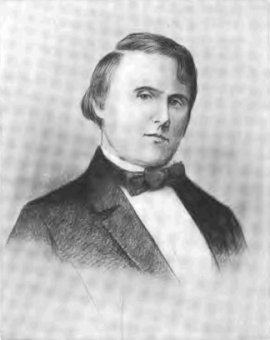
1938: Corneliu Codreanu, Romanian fascist martyr

“In place of the weak and beaten man who bends with every breeze, a man who is all too common in politics and other fields, we must create for this nation a man who does not bend, who is inflexible.”

-Corneliu Codreanu

On this date in 1938, 14 political prisoners of the Romanian Legionary movement were extrajudicially executed — including Corneliu Codreanu, one of the Romanian right’s leading spirits.

The son of a Bukovina schoolteacher in what was then Austria-Hungary, Codreanu came to political maturity in the interwar heyday of Greater Romania. It was a moment of national aspiration — the Romanian state had never before grown so large — but it was abutted by the great threats of Germany and Russia, and haunted by nationalism, economic crisis, shaken political authority, and all the other spooks conjured by the first World War.

For Codreanu as for many at that time it was the stage for a blood-and-soil death struggle against Communist agitators and sinister Jewish financiers.

But his vision was an intensely positive one as well: a valiant new Romania founded by a courageous new man, honorable and true to the virtues of the nation’s noble peasant stock. “We shall create,” Codreanu declared, “a spiritual atmosphere, a moral atmosphere, in which the heroic man may be born and on which he can thrive.”

Codreanu’s vehicle for stamping out these heroic countrymen was the Legion of the Archangel Michael* which our principal founded in 1927. Named for God’s ass-kickingest enforcer, this movement/militia was not above creating its spiritual atmosphere with political assassinations by adherents widely noted for a willingness to die for the cause.

Later known as the Iron Guard, the Legion, in the view of German historian Ernst Nolte, “plainly appears to be the most interesting and the most complex fascist movement, because like geological formations of superimposed layers it presents at once both prefascist and radically fascist characteristics.” (Qutoed here.)

As his Legion’s name suggested, Codreanu was intently religious — virtually a mystic, and a messianic Romanian Orthodox Christianity was essential to his new Romania. His movement took root in a peasant society, not an industrial state with a revolutionary working class to crush or co-opt. Rather, it organized in opposition to a mediocre king and a feckless, heavily non-Romanian oligarchy which maintained its enervating grip on the nation with “endless appeals to the Fatherland which it does not love, to God in whom it does not believe, to the Church where it never sets foot, to the Army which it sends to war with empty hands.”*

And also to the police, which clapped Codreanu and his confederates in prison after the revolutionaries declined the elite incumbents’ offer of political collaboration.

In 1938, Codreanu was hit with a long prison sentence for sedition. Uncowed, the Legion grew ever more overtly aggressive when Nazi Germany successfully dismembered Czechoslovakia; Berlin made the Legions plainly aware that it saw their movement as Romania’s future, German-allied government. Futilely maneuvering for his own scope of action, Carol attempted to decapitate the Iron Guard by having its imprisoned leadership “shot while trying to escape” on this date.

This did not turn out to help the king. Codreanu’s movement traded stripe for stripe with its foes; within two years, Carol had been forced to abdicate and the Iron Guard helped govern (albeit with tension) a fascist state.

The contemporary Romanian right aggressively reclaimed Capitanul, “the Captain”, after the fall of communism. Codreanu is now revered among not only among Romanian nationalists but in fascism’s wider populist Strasserite tradition. (Gregor Strasser, who liked the socialist part of national socialism too much for Hitler’s taste, was among those murdered on Nazi Germany’s Night of the Long Knives.)

* Eugen Weber in Varieties of Fascism, quoted by Anthony James Joes in “Fascism: The Past and the Future,” Comparative Political Studies, April 1974

On this day..

1541: Cristóvão da Gama, Portuguese crusader in Ethiopia

On this date in 1541, Cristóvão da Gama — “the most chivalrous soldier of a chivalrous age” — was beheaded in Ethiopia.

This moment was the apex of Lisbon’s empire-building, most vividly symbolized by Cristovao’s famous dad, explorer Vasco de Gama. In the Age of Discovery, Caravels bore Portuguese colors from Brazil to Japan.

Alas, Portugal’s global maritime empire of coastal colonies and remote ports was immediately menaced by rival powers like the also at-its-apex Ottoman Empire.

Young Cristovao would be ground up in this conflict whose mixture of geopolitics and sectarianism overtly smacked of those old-time Crusades.

After a jaunt to India in the train of his older brother, appointed the Portuguese governor of India, Cristavao was sidetracked on a return voyage for an intervention on the Christian side in a raging local war. For Europeans who for generations had trafficked in the vague and fantastical rumors of mythical Abyssinian ruler “Prester John”, putting a thumb on the scale for Ethiopian Christians against the rampant Arabs must have been nigh irresistible.

Let’s listen in.

Joao III and his government, faced with mounting debts as the costs of military operations in the East steadily grew, were now forced to re-evaluate their global commitments … the new viceroy, Estevao da Gama, was ordered to destroy the Turkish fleet in Suez …

Estevao da Gama’s raid into the Red Sea became one of the best remembered episodes in the history of the Portuguese Estado da India. The fleet assembled at Massawa on the African shore and then proceeded to Suakin which was burnt and plundered. Part of the fleet then returned to Massawa while the rest sailed on to Suez where the Turkish ships proved to be securely based and inaccessible. On the shore of Sinai, as close to Jerusalem as the Portuguese were ever to come, Estevao da Gama enacted some of the rituals of crusading chivalary and made a number of knights before returning to Massawa. Meanwhile, Dom Joao de Castro, who accompanied the expedition, used the time to produce his famous guide to the Red Sea, the Roteiro do Mar Roxo, complete with the meticulous drawings of the ports and anchorages, a masterpiece of Portuguese Renaissance geography and science.


One of Joao de Castro’s drawings. (Source, a Portuguese pdf)

Meanwhile the Portuguese at Massawa had suffered extreme privations and a hundred of them had deserted, having been persuaded by [untrustworthy Potuguese-descended Ethiopian ambassador Joao] Bermudes of the richness and wealth of the interior. Their fate was to be captured and massacred by Ahmed Gran. Estevao da Gama now dispatched a force of four hundred soldiers under the command of his brother, Cristovao da Gama, into the interior to assist the Ethiopian king. Cristovao da Gama advanced from the coast with a force much the same size as that which Cortez had led into Mexico in 1519. He had with him horses, arquebuses and eight small cannon. His first objective was to link up with the fugitive Ethiopian king and his followers, but da Gama got separated from his supplies and was forced to fight a superior Somali force supported by Turkish mercenaries. The result was catastrophe. The small Portuguese army was badly mauled and da Gama himself fled wounded from the battlefield and was taken prisoner.

The capture of the viceroy’s brother, son of the great admiral, carried with it huge importance for the Turks. After being ritually humiliated (his beard being set on fire and his face buffeted with the shoes of his negro servant) Cristovao da Gama was beheaded.* For the Portuguese this was a disaster, the symbolic significance of which far transcended the military consequences of the defeat. However, the Christian church had long experience of turning catastrophe into triumph and, soon after the news of Cristovao da Gama’s death reached the outside world, rumours of miracles began to circulate.** Da Gama became one of the first martyrs of the new church overseas which in a hundred years of expansion had had all too few heroic deeds to celebrate.

After the death of their commander fewer than two hundred of the original army survived, but they were able to meet up with the Christian Ethiopian forces and, when the next campaigning season started in 1542, the combined army inflicted a heavy defeat on the Muslims, a defeat which took on a decisive complexion when it was realised that the leader of the jihad, Ahmed Gran, had been killed in the battle.

Da Gama’s expedition had been mounted from the resources of the official empire and had been commanded by one of the leading fidalgos of the Estado da India. However, few of da Gama’s soldiers returned to India Instead they settled in Ethiopia and married Ethiopian women, establishing a ‘Portuguese’ community that mirrored the ‘Portuguese’ communities in Aythia, Bengal, Kongo and elsewhere where soldiers had offered their military expertise to local rulers an had been content to settle and make their fortures far removed from the jurisdiction of the Portuguese Crown.

Although da Gama’s own end was unfortunate, his surviving force’s exploits on a side badly pressed could arguably be considered the decisive factor enabling Christianity to survive in Ethiopia’s highlands interior. Prester John would have been proud.

* “I write what I heard, it may well be that it was thus, for all that is barbarous and cruel about the Moorish king can be believed. The body, after death, was dismembered and sent to various places … because once when Granha was speaking with Dom Christovao, he asked him: ‘If you had me in your power, as I have you, what would you do to me?’ Dom Christovao, with great resolution and freedom replied, ‘If I had you in my power, I would have you killed, the head I would send to one place and the quarters I would distribute to other places’ (naming them, but I do not recall them). And Granha, they say that it was because he heard this, scattered the body to various places.”

** “Directly they cut off his head, God worked a great and manifest miracle through it, which was, that in the place where they slew him a fountain of running water gushed out, which had never been seen before: its water, through the goodness and power of God, gives sight to the blind, and cures those ill of other diseases. It appears that this miracle is like the one that God did in Rome for His Apostle St. Paul. The remains of the body of D. Christovao smell sweetly, giving forth so delightful an odour, that it seems rather of heaven than of earth.”

On this day..

1851: Col. William Logan Crittenden, nephew of the Attorney General

“An American kneels only to his God, and always faces his enemy,”* declared William Logan Crittenden, refusing to kneel before his executioners in Havana this date in 1851.

This well-bred** Kentuckian veteran of the Mexican-American War ditched a New Orleans customs-house gig when Narciso Lopez formed a private filibustering expedition to try to steal Cuba from the Spanish.

Placed at the head of one of Lopez’s three battalions, Crittenden’s force was cut off and overwhelmed by the Spanish. (The detailed progress of the campaign is described here.)

He and 50 of his command captured with him were all ordered for immediate execution, six at a time, as pirates, with just a few hours’ allowance to take down official statements and scribble their hasty goodbyes. With “not the heart to write to any of my family,” Crittenden sent one to a friend giving his farewells … then, just before the end, dashed off another addressed to the Attorney General of the United States — his uncle, John J. Crittenden.†

Dear Uncle: In a few moments some fifty of us will be shot. We came with Lopez. You will do me the justice to believe that my motive was a good one. I was deceived by Lopez — he, as well as the public press,‡ assured me tat the island was in a state of prosperous revolution.

I am commanded to finish writing at once.

Your nephew,
W.L. Crittenden

I will die like a man

(Some other affecting last letters from Crittenden’s party can be perused here.)

All this scene, including a post-mortem mutilation by the enraged mob of onlookers, became a bloody banner for U.S. Southerners — since expanding the slave power was core to the entire filibustering project.

When word of the shootings reached New Orleans, a crowd sacked the Spanish consulate.

But in the international relations game, the U.S. had disavowed filibustering and its raiders enjoyed no special diplomatic protection. When a number of the later prisoners were returned in chains to Spain, the Millard Fillmore administration asked their release, but had no grounds to demand it. It was a touchy diplomatic situation … one that our late Crittenden’s uncle, as a member of cabinet, was right in the middle of.

Fillmore eventually secured the captives’ release, atoning the insult to the European power’s agents by causing the Spanish colors to be saluted in New Orleans in honor of the birth of the Infanta Isabella.

All this mincing instead of brawling struck a certain variety of hothead as distinctly unmanful.

Our flag has been wantonly insulted in the Caribbean sea … captured citizens of our country [were] sent in a slave ship to the coast of Spain, fettered, according to the custom of that inhuman traffic, and released, not as an acknowledgement of wrong on demand of our government, but as a gracious boon accorded to a friendly suit … Whilst the dying words of Crittenden yet rung in the American ear, and the heart turned sickening away from the mutilated remains of his liberty-loving followers; whilst public indignation yet swelled at the torture which had been inflicted on our captive countrymen, even then we were called upon to witness a further manifestation of the truckling spirit of the administration …

–Jefferson Davis (yes, that one)

* An alternative version has Crittenden declaring that Kentuckians kneel only to their God.

** According to this public domain book (pdf; it’s also on Google books) of the Lopez expedition, William Crittenden’s cousin George Bibb Crittenden — eventually a Confederate general — was among the Texan filibusters to survive the Black Bean Lottery.

William Crittenden’s brother Thomas Theodore Crittenden fought on the Union side of the Civil War, and became Governor of Missouri in 1881. He’s noteworthy for having issued the bounty on outlaw Jesse James that led to the latter’s assassination by Robert Ford.

† Family in the president’s cabinet was just no guarantee of preferential treatment, abroad or at home; just a few years before, a son of the sitting Secretary of War had been hanged at sea for mutiny.

‡ The Spanish press likewise excoriated American yellow journalism in terms that no few present-day scribes would also deserve.

New Orleans papers, there is your work! There is the result of your diragations, of your iniquitous falsehoods, of your placards with large black letters, and your detestable extras … This blood must flow, drop by drop, upon your heads — this blood will torment you in your sleep, for they have lost their lives when you were in security in your houses.

On this day..

1949: Husni al-Za’im, Syrian president

On this date in 1949, Syrian President Husni al-Za’im and his Prime Minister Mohsen Berazi were seized in a military coup, conducted to a court martial, and immediately put to death.

An ethnic Kurd, al-Za’im had cut his teeth in the armed forces of two different empires — the Ottoman and the French — before Syria attained independence following World War II.

The ambitious al-Za’im had got out from under a Vichy-era prison sentence for corruption and established himself as army chief of staff in time for the 1948 Arab-Israeli War.

Syrian forces’ underwhelming performance in this campaign set the stage for what would follow — both for al-Za’im and, arguably, down to the present day.

Syria actually sported an open and democratic polity; it had a successful election in 1947. But the civilian leaders were essentially wealthy landowners who, having successfully led the movement for independence, had scant agenda for actual governance save enriching themselves and their allies. It was “an edifice of nepotism and mismanagement … [a] creaking network of family patronage and administrative venality.”

A stagnant economy, kleptocratic elite, and political malaise came into sharp focus with the debacle of the Arab-Israeli War. Arab commander Fawzi al-Qawuqji would charge that feckless Arab elites ran the war “from behind their office desks, and in accordance with their own personal interests, ambitions, and whims.”

Encouraged by the United States — just then breaking into the growth industry of short-sighted oil patch coups — al-Za’im overthrew the civilian government to “put things right and restore this nation its honour, its dignity and its freedom.”

This undergraduate thesis makes a case for the Za’im coup as the turning point normalizing and privileging military intervention in Syrian politics. This was the fear of a young American diplomat in Syria, who reckoned American support for the coup “the stupidest, most irresponsible action a diplomatic mission like ours could get itself involved in … we’ve started a series of these things that will never end.”

So it was that on this date the next domino toppled, a counter-coup that ended al-Za’im’s installment of the dictatorship series most abruptly.

Colonel Sami Hinnawi, an officer who had served under Husni Zaim, then sat as president of a “higher war council” of 12 senior officers, which tried the President and Prime Minister and condemned them to death. Sentence was carried out at once at the Mezza fortress near Damascus. Mohsen Berazi was shot first. He protested, although Husni Zaim, who stood by waiting his turn, urged him to be quiet.

–London Times, Aug. 15, 1949

Hinnawi last another year before a relative of Mohsen Berazi assassinated him in revenge, and on it went. It was during Syria’s sequence of unstable military juntas in the 1950s that the young Hafez al-Assad earned his stripes in the Syrian air force.

Assad would eventually execute a much more permanent takeover, rule the country for 30 years, and upon his death in 2000, bequeath leadership to his son Bashar — a fellow who, as of this writing, stands in some danger of winning an entry of his own in these pages should his ruthless crackdown against pro-democracy protesters prove unavailing.

On this day..

1674: The Chevalier de Rohan and Franciscus van den Enden

On this date in 1674, the former Grand Huntsman of France was beheaded in Paris for conspiring to betray Normandy during the Franco-Dutch War.

Your basic debt-mired noble and court cad, the Chevalier de Rohan (French Wikipedia link) through an accomplice “intimated that Normandy was very much dispos’d to a revolt, & that if hee would send a fleet with 6 thousand men, & armes for twenty thousand, with necessaries for sieges & two million of livres, that there was a greate man who would engage himself upon the assurance of thirty thousand crownes pension …”

The correspondence was discovered and Rohan arrested, but his role in the plot was sufficiently anonymized that even an absolutist state didn’t have the goods to convict him. Meanwhile, Rohan’s accomplice was hunted to ground and killed in Rouen during the attempt to arrest him.

This left the authorities in the position, common to every cop show and not a few real-life cases, of requiring a confession from the accused to proceed at all. Rohan’s friends realized this too, and tried desperately to warn him against self-incrimination.

Persons attached to the chevalier de Rohan went every evening round the Bastile, crying through a speaking trumpet, “La Tuanderie is dead, and has said nothing;” but the chevalier did not hear them. The commissioners, not being able to get any thing from him, told him, “that the king knew all, that they had proofs, but only wished for his own confession, and that they were authorized to promise him pardon if he would declare the truth.” The chevalier, too credulous, confessed the whole. Then the perfidious commissioners changed their language. They said, “that with respect to the pardon, they could not answer for it: but that they had hopes of obtaining it, and would go and solicit it.” This they troubled themselves very little about; and condemned the criminal to lose his head. He was conducted on a platform to the scaffold, by means of a gallery raised to the height of the window of the armoury in the arsenal, which looks towards the little square at the end of the Rue des Tournelles. He was beheaded on November 27, 1674.

It is hoped that, should the reader ever become a person of police interest, s/he will recall from Rohan’s example that inspectors do not have suspects’ best interests in mind.

A couple of other nobles also lost their heads along with our chevalier.

Hanged for his trouble was Franciscus van den Enden (English Wikipedia page | Dutch), the elderly Dutchman — and accused Dutch agent — who recruited these toffs for the purpose of seizing Le Havre.

Van den Enden is an interesting, perhaps underappreciated, radical intellectual of secular-democratic persuasion (he attracted the suspicion of atheism, and his Vrye Politijke Stellingen made an unabashed case for democratic government). He’s best known for being a schoolmaster of philosopher Baruch Spinoza; W.N.A. Klever, in an October 1991 paper in the Journal of the History of Philosophy (“A New Source of Spinozism: Franciscus Van den Enden”) traces the connections between the philosophy of the master and that of the pupil and rather dramatically argues that

Van den Enden must be considered as a kind of “Proto-Spinoza.” … He was the hidden agent behind Spinoza’s genius … [t]he origin of Spinoza’s anomalous philosophy.

A variety of (untranslated) references to the “Proto-Spinoza” from 17th century correspondence are available here.

Those inclined more towards geopolitics than philosophy might enjoy Victor Magagna’s podcast lecture on the great-power calculus driving France’s conflict with the Netherlands — which, as we have noticed in these pages, claimed the life of the longtime Dutch leader Johan de Witt.

On this day..

555: Rusticus and John

On an uncertain date in the autumn of 555, a Byzantine commander and his brother were put to death for the treacherous murder of the vassal king of Lazica.

Rusticus, the commander, probably had good cause to be annoyed with Gubazes II, who ruled a borderlands realm on the eastern edge of the Black Sea, in modern-day Georgia.

Gubazes had gone from calling in Persian aid in 541 against Lazica’s Byzantine masters, to summoning Byzantine help against the Persians a few years later. Now, he was kvetching to Byzantine Emperor Justinian about the Byzantine generals he’d called for.

We’ll let J.B. Bury take it from here:

King Gubazes, who had been engaged in frequent quarrels with the Roman commanders, sent a complaint to Justinian accusing them of negligence in conducting the war. Bessas, Martin, and Rusticus were specially named. The Emperor deposed Bessas from his post, but assigned the chief command to martin and did not recall Rusticus. This Rusticus was the Emperor’s pursebearer who had been sent to bestow rewards on soldiers for special merit. He and Martin determined to remove Gubazes. To secure themselves from blame, they despatched John, brother of Rusticus, to Justinian with the false message that Gubazes was secretly favouring the Persians. Justinian was surprised, and determined to summon the king to Constantinople. “What,” asked John, “is to be done, if he refuses?” “Compel him,” said the Emperor; “he is our subject.” “But if he resist?” urged the conspirator. “Then treat him as a tyrant.” And will he who should slay him have naught to fear?” “Naught, if he act disobediently and be slain as an enemy.” Justinian signed a letter to this effect, and armed with it John returned to Colchis. The conspirators hastened to execute their treacherous design. Gubazes was invited to assist in an attack on the fortress of Onoguris, and with a few attendants he met the Roman army on the banks of the Chobus. An altercation arose between the king and Rusticus, and on the pretext that the gainsayer of a Roman general must necessarily be a friend of the enemy, John drew his dagger and plunged it in the royal breast. The wound was not mortal but it unhorsed the king, and when he attempted to rise from the ground, a blow from the squire of Rusticus killed him outright.

The Lazi silently buried their king according to their customs, and turned away in mute reproach from their Roman protectors. They no longer took part in the military operations, but hid themselves away as men who had lost their hereditary glory. The other commanders, Buzes and Justin the son of Germanus, concealed the indignation which they felt, supposing that the outrage had the Emperor’s authority. Some months later, when winter had begun, the Lazi met in secret council in some remote Caucasian ravine, and debated whether they should throw themselves on the protection of Chosroes. But their attachment to the Christian religion as well as their memory of Persian oppression forbade them to take this step, and they decided to appeal for justice and satisfaction to the Emperor, and at the same time to supplicate him to nominate Tzath, the younger brother of Gubazes, as their new king. Justinian promptly complied with both demands. Athanasius, a senator of high repute, was sent to investigate the circumstances of the assassination, and on his arrival he incarcerated Rusticus and John, pending a trial. In the spring (A.D. 555) Tzath arrived in royal state, and when the Lazi beheld the Roman army saluting him as he rode in royal apparel, a tunic embroidered with gold reaching to his feet, a white mantle with a gold stripe, red shoes, a turban adorned with gold and gems, and a crown, they forgot their sorrow and escorted him in a gay and brilliant procession. It was not till the ensuing autumn that the authors of the death of the late king were brought to justice, and the natives witnessed the solemn procedure of a Roman trial. Rusticus and John were executed. Martin’s complicity was not so clear, and the Emperor, to whom his case was referred, deposed him from his command in favour of his own cousin Justin, the son of Germanus. Martin perhaps would not have been acquitted if he had not been popular with the army and a highly competent general. (link)

“The historical importance of the Lazic War,” Bury says, “lay in the fact that if the Romans had not succeeded in holding the country and thwarting the design of Chosroes, the great Asiatic power would have had access to the Euxine and the Empire would have had a rival on the waters of that sea. The serious menace involved in this possibility was fully realised by the Imperial government and explains the comparative magnitude of the forces which were sent to the defence of the Lazic kingdom.”

On this day..

1769: Nicolas de Lafreniere and four others for the Louisiana Rebellion

On this date in 1769, five French Creoles were shot in New Orleans for a revolt the previous year against a Spanish takeover.

This date’s story begins with the French King Louis XV getting his French clock cleaned in the French and Indian War. This conflict blew an ill wind all over Francophone North America, much of which was taken by the British. Result: a quarter-millennium later, this blog is in English.

Even what France kept, she did not keep. In a secret pact, France ceded to wartime ally Spain “the country known as Louisiana, as well as New Orleans and the island in which the city is situated.”

This projection onto New World colonists of Old World diplomatic horse-trading was rife with potential hostility among the traded horses. In this instance, Louisianans were widely dismayed when they were finally informed that they’d become Spaniards.

When they did get the memo — and Louis XV declined to reconsider — they launched the Louisiana Rebellion of 1768, expelling the new Spanish govenror Antonio de Ulloa.*

These weren’t mere rabble who showed Ulloa “insubordination … a sense of liberty and independence,” but elites of French New Orleans. Nicolas de Lafreniere was the attorney general.

“The name of Lafreniere deserves rank with those of foremost American patriots,” Americans later reckoned. O’Reilly’s reputation did not fare as well in the patriotic literature, but he perhaps had the best of the law.

Between a rock and a hard place, the leftover French adjutant Charles-Philippe Aubry refused to support the rebels, but also refused to fire on fellow Frenchmen. Meanwhile, Ulloa refused to provide his credentials to the uppity colonists. Louis XV refused to receive the delegations sent to implore him to keep Louisiana.

All these refuseniks found the matter adjudicated by immigrant Irish officer Alejandro O’Reilly, plucked out of Cuba to replace Ulloa and lay down the law. He spoke softly when he landed, but the amnesty he offered was followed a few months later by the surprise arrest of the chief rebels.

Lafreniere, Joseph Milhet, Jean-Baptiste Noyan, Pierre Caresse, and Pierre Marquis were ordered hanged on this date. Noyan, nephew of the city’s founder and a young man just married, was offered his pardon, but melodramatically refused.

It was found that there was no hangman in the colony, so the condemned prisoners were ordered to be shot. When the day of execution came, hundreds of people left the city. Those who could not leave went into their houses, closed the doors and windows and waited in an agony of sickening dread to hear the fatal shots. Only the tramping of soldiers broke the deathlike stillness which brooded over the crushed and helpless city. At three o’clock on a perfect October afternoon in 1769, the condemned men were led to the Spanish barracks. Lafreniere, it is said, gave the order to fire. A volley of muskets broke out on the still air, and five patriots went to their death, — the first Louisianians to give their blood for the cause of freedom.

–A History of Louisiana

The details and historiography of this event are the subject of this 146-page master’s thesis. (pdf)

Whether or not all that stuff about Louisiana planters as freedom-loving patriots trod down by the barbarous Spanish has any real merit to it, that’s the way they’ve been memorialized.

Lafreniere Park in Metairie, La. — home of anti-death penalty VIP Sister Helen Prejean — is named for Nick Lafreniere.

When next visiting the Louisiana State House, keep an eye out for this day’s victims on the frieze to the right of the main entrance. And when next visiting New Orleans, keep an ear out for the ghost of the priest that buried them.

* Ulloa was also a scientist and gave his name to the Ulloa Halo, a “physical illusion consisting of a white luminous ring or arch that can sometimes be seen in mountainous regions, typically in foggy weather, while facing an area opposite the Sun.”

On this day..

1672: Cornelis and Johan de Witt lynched

Chapter 1. A Grateful People

On the 20th of August, 1672, the city of the Hague, always so lively, so neat, and so trim that one might believe every day to be Sunday, with its shady park, with its tall trees, spreading over its Gothic houses, with its canals like large mirrors, in which its steeples and its almost Eastern cupolas are reflected,–the city of the Hague, the capital of the Seven United Provinces, was swelling in all its arteries with a black and red stream of hurried, panting, and restless citizens, who, with their knives in their girdles, muskets on their shoulders, or sticks in their hands, were pushing on to the Buytenhof, a terrible prison, the grated windows of which are still shown, where, on the charge of attempted murder preferred against him by the surgeon Tyckelaer, Cornelius de Witt, the brother of the Grand Pensionary of Holland was confined.
…

the whole town was crowding towards the Buytenhof, to witness the departure of Cornelius de Witt from prison, as he was going to exile; and to see what traces the torture of the rack had left on the noble frame of the man who knew his Horace so well.

Yet all this multitude was not crowding to the Buytenhof with the innocent view of merely feasting their eyes with the spectacle; there were many who went there to play an active part in it, and to take upon themselves an office which they conceived had been badly filled,–that of the executioner.

There were, indeed, others with less hostile intentions. All that they cared for was the spectacle, always so attractive to the mob, whose instinctive pride is flattered by it,–the sight of greatness hurled down into the dust.

-Alexandre Dumas, pere, The Black Tulip

That ominous mob got its spectacle this date in 1672, lynching the Dutch Republic’s longtime de facto head of state, Johan de Witt along with his brother Cornelis/Cornelius.


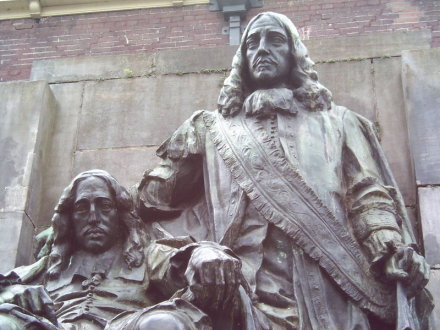
A statue of Johan (standing) and Cornelis de Witt in their native Dordrecht.

The mercantile powerhouse that was the 17th century Dutch Republic was the stage for a long-running conflict between the Orange monarchists (hence the soccer uniforms) and the Republican merchant class.

With the sudden death of the young William II, Prince of Orange in 1650, leaving the (non-hereditary) executive office of stadtholder vacant, the Republicans became ascendant.

And the outstanding figure of the First Stadtholderless Period was Johan de Witt, scion of a Dordrecht merchant family powerful enough that William II had imprisoned de Witt’s own father during a power struggle.

Elevated in 1653 and at the tender age of 28 to the leadership position of Grand Pensionary, Johan de Witt’s “eloquence, sagacity and business talents” guided the Dutch ship of state for essentially the remainder of his life.

This was the apex of the Dutch Golden Age. The Dutch East India Company dominated Asian trade routes,* and the Low Countries’ culture thrived on the wealth: Rembrandt and Vermeer were at the height of their talents; Spinoza revolutionized philosophy; van Leeuwenhoek invented the microscope.

While all these guys were landing themselves in their respective canons, Johan de Witt was trying to keep the age Golden.

Having only relatively recently broken free of Spain, the small country was an up-and-comer on the horns of a serious security dilemma: its leading commercial position put it into maritime competition with England, while its continental location made it vulnerable to the enormous army of the neighboring continental hegemon, France. Ultimately, even with its trade wealth, it did not have the resources to keep up with both of western Europe’s leading powers.

For a generation, de Witt’s statecraft kept the men of the Low Countries out of that predicament, while his brother Cornelis chipped in with a couple of timely naval victories. (Actually authored by Michiel de Ruyter, but Cornelis rode shotgun.)

In 1654, Johan brought the First Anglo-Dutch War to a close, making with Oliver Cromwell a secret pact he was only too happy to enforce never to allow William II’s son, the eventual William III, to be named stadtholder. Reason being: William III was the grandson of the Stuart king Cromwell beheaded, Charles I, and thus a potential claimant to the English throne. Both Protestant Republics had a distinct interest in keeping this monarchist well away from power. (Both would be sorely disappointed.)

A decade and a Stuart Restoration later, de Witt maintained (mostly) Dutch dominance of the seas in the Second Anglo-Dutch War, then held off France (with the help of a timely alliance with the recent adversary, England) in the War of Devolution.

In each case, he kept at least one of England or France on the sideline, or in his own camp.

But the Third Anglo-Dutch War was the charm — as it was also the Franco-Dutch War, and therefore 1672 was Rampjaar: disaster year. While the Dutch were aces on the waves, a massive French invasion easily overwhelmed them on terra firma.

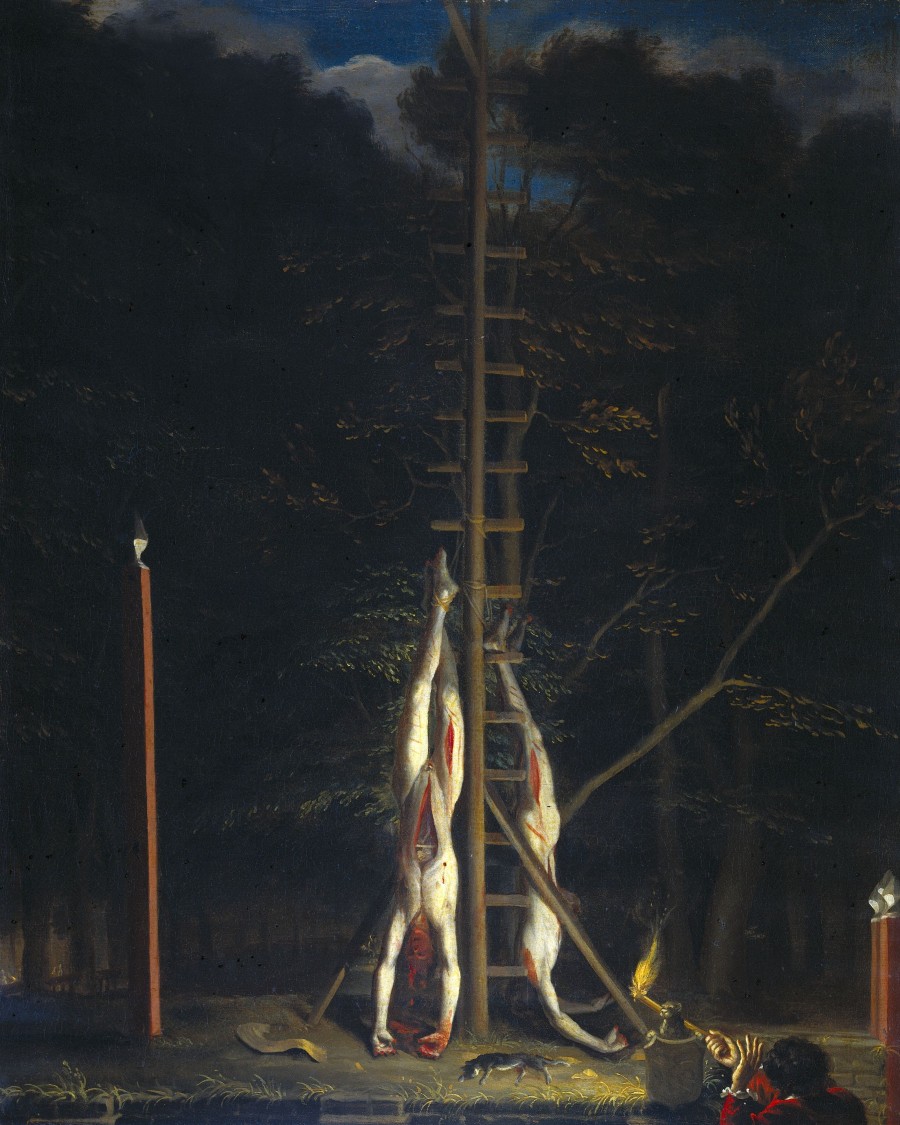
Detail view (click for the full image) of a grisly painting of the mutilated de Witt brothers strung up at The Hague. It’s attributed to Jan de Baen, who in better times took Johan de Witt’s portrait.

De Witt’s never-beloved mercantile oligarchy speedily collapsed with the military reverses, and the now all-grown-up William III was there to pick up the pieces to popular acclaim. Arrested for treason, Cornelis sustained torture without confessing, but when Johan visited him in prison — and William III incriminatingly withdrew the cavalry protecting the brothers — the mob quenched its fury with the de Witts’ blood.

every one of the miscreants, emboldened by his [Johan’s] fall, wanted to fire his gun at him, or strike him with blows of the sledge-hammer, or stab him with a knife or swords, every one wanted to draw a drop of blood from the fallen hero, and tear off a shred from his garments.

And after having mangled, and torn, and completely stripped the two brothers, the mob dragged their naked and bloody bodies to an extemporised gibbet, where amateur executioners hung them up by the feet.

Then came the most dastardly scoundrels of all, who not having dared to strike the living flesh, cut the dead in pieces, and then went about the town selling small slices of the bodies of John and Cornelius at ten sous a piece.

-Dumas

The word “ungrateful” comes to mind.

De Witt stood altogether on a lower plane than Cromwell. We regard him rather as a man of rare and singular talent, than as one of the chosen great ones of the earth, which Cromwell was. He stands far above the common run of men; and he was head and shoulders above nearly all the notable men of his time. He would have been greater if the movement of his limbs had been less burdened with the Dutch governing apparatus … He is not one whom the world can ever greatly admire or love.

–History of the administration of John De Witt, grand pensionary of Holland, a Google books freebie.

(Here’s another, and here’s a 17th century volume de Witt himself coauthored.)

The rise of William III came with the decline of that Dutch Golden Age: the country fended off the immediate military threat, but it increasingly slipped behind its larger neighbors. Costly as was the Franco-Dutch War, it is a step on the path towards the present-day Europe, and this gives us enough excuse to notice that the Eurovision lead-in tune is actually from a Te Deum composed to mark its end.

But William’s own ascent to this wealthy sovereignty was just the beginning for him. Sixteen years later, the House of Orange’s champion vindicated Cromwell’s trepidation about him and gained a far more satisfactory position from which to do battle with his Gallic rival Louis XIV by stunningly overthrowing the Stuart dynasty and becoming King of England in the Glorious Revolution.**

* The Dutch remained the sole western contact of closed Japan until 1854, which is why Japan’s eventual period of scientific advancement became known as ‘Dutch Learning’.

** Albion did not forget the de Witts, either: according to this 1785 cant dictionary, the term “dewitted” had a 17th-18th century run in English to denote — well, exactly what happened to Cornelis and Johan.

On this day..

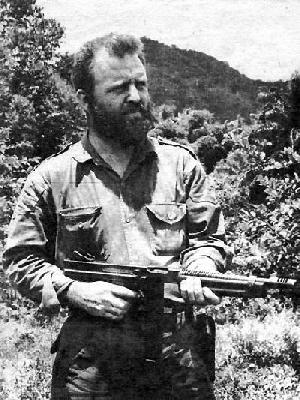
1961: William Morgan, the Americano

On this date in 1961, American William Morgan — once an anti-Batista rebel — was shot in Havana’s La Cabana fortress for counter-revolutionary activity against the Castro government.

The high school dropout and army washout went to Cuba around late 1957 or early 1958.

He’d had an unsettled life, this Morgan. He’d been a convict, a circus sideshow, a wanderer. But he was about to make his name.

This strange gringo soon to be nicknamed “El Americano” walked into the Escambray Mountains and joined a group of anti-Batista rebels that was unaffiliated with Castro’s 26th of July Movement. Morgan won the respect of Cubans for his courage and his evidently un-mercenary commitment to the cause.

Fatally for him, that cause was a constitutional-democracy take on opposing the Batista dictatorship.

Morgan was stridently anti-Communist and not shy about saying so.

“There isn’t anyone in Cuba who doesn’t know where I stand-Fidel, Raul, or anyone. I am anticommunist. I don’t like them.”

That attitude would put him on a collision course with the only other foreigner to hold a comandante rank among the anti-Batista guerrillas: Argentinian Ernesto “Che” Guevara.

Those two men’s columns nearly exchanged shots when Guevara was dispatched by Castro to reach an understanding with Morgan. Morgan and Guevara came to terms that day — there was a revolution to be won, after all — but animosity would remain between these two impassioned freedom-fighters whose visions of freedom could never be reconciled.

They personify the competing choices before post-Batista Cuba, in those first years when Cuba kept to a tenuous hold on non-alignment.

Morgan supported that revolution; he even made the headlines for dramatically foiling a Dominican-backed plot to topple Castro in 1959.

But it was Guevara who was the future. More radical July 26th members won senior spots in the new administration, while outsiders like Morgan got assignments like frog-farming. Geopolitical events saw Cuba sliding into the Soviet camp.

Disenchanted, Morgan started plotting for real.* It didn’t work.

He was caught in late 1960, held incommunicado for a period, then tried, convicted and condemned two days before his execution (along with fellow-traveler and -plotter Jesus Carreras Zayas (Spanish link)) after nightfall March 11, 1961.

Morgan’s execution was carried out by a fellow Yanqui, Herman Marks — himself destined to run afoul of the Castro regime down the road. (Marks fled back to the U.S.) The sympathetic account of el Americano‘s death is quite the flowery affair, with the Cubans kneecapping Morgan when he defiantly refuses to kneel.

Castro himself is sometimes said to be present, the shadowy observer issuing the fatal commands to which Morgan will not bow, like the insouciant silhouette of Stalin behind a screen at trials where his former henchmen were purged.

A poetic touch, though one would think a head of state might have more pressing business than personally orchestrating executions: and indeed, it seems that Fidel actually spent that evening at a diplomatic reception with Soviet and Chinese ambassadors. Two months later, Castro officially declared Cuba a socialist state.

And as with Morgan, so with many of his brethren-in-arms from the Escambray Mountains. It took Havana the better part of the 1960s to suppress anti-communist “bandits” in Morgan’s old stomping-grounds — Cuba’s (successful) War Against the Bandits.

* There’s more skullduggery in Morgan’s shadowy life than this post has space for, but theories exist that the Dominican plot he “foiled” was actually one he had been an earnest participant in before it was sniffed out by Cuban security, with the war hero Morgan forced to betray it.

On this day..

1859: Ormond Chase, casus belli not quite

Every foreign policy adventure needs its pretexts, even adventures that never happen.

Quite marvelously, this illustration appeared in the same issue of Harper’s as Sydney Carton’s beheading in the last installment of Dickens’ Tale of Two Cities serial.

On this date in 1859, forces of Mexican General Miguel Miramon provided the United States such a pretext by executing American Ormond Chase in Tepic during the Mexican War of Reform.

This incident, said to have ensnared the luckless Portland (Me.)-born sawyer “for reasons entirely unknown,”* became elevated into the foreign policy calculation of U.S. President James Buchanan.

Buchanan rates as one of America’s worst chief executives for fiddling as the conflagration of Civil War began, but he kept himself busy eyeballing other dark-skinned folk in the hemisphere over whom America ought to claim suzerainty.**

So, in December of 1859, Ormond Chase was name-checked in a State of the Union address further to pressing Buchanan’s case for Mexico as a (to use a modern coinage) failed state — “a wreck upon the ocean, drifting about as she is impelled by different factions.”

“Little less shocking,” the Chief Executive intoned, crowning a litany of injuries “upon persons and property,” “was the recent fate of Ormond Chase, who was shot in Tepic, on the 7th August … not only without a trial, but without any conjecture by his friends of the cause of his arrest.”

And, of course, we know what happens to failed states.

Mexico ought to be a rich and prosperous and powerful Republic. She possesses an extensive territory, a fertile soil, and an incalculable store of mineral wealth. She occupies an important position between the Gulf and the ocean for transit routes and for commerce. … Can the United States especially, which ought to share most largely in its commercial intercourse, allow their immediate neighbor thus to destroy itself and injure them? Yet without support from some quarter it is impossible to perceive how Mexico can resume her position among nations and enter upon a career which promises any good results. The aid which she requires, and which the interests of all commercial countries require that she should have, it belongs to this Government to render, not only by virtue of our neighborhood to Mexico, along whose territory we have a continuous frontier of nearly a thousand miles, but by virtue also of our established policy, which is inconsistent with the intervention of any European power in the domestic concerns of that Republic.

The wrongs which we have suffered from Mexico are before the world and must deeply impress every American citizen. A government which is either unable or unwilling to redress such wrongs is derelict to its highest duties.

…

I recommend to Congress to pass a law authorizing the President under such conditions as they may deem expedient, to employ a sufficient military force to enter Mexico for the purpose of obtaining indemnity for the past and security for the future.

“The meaning of all this is clear enough,” observed the London Times, an ocean away and correspondingly less euphemistic.†

Before long another Mexican war will sever new provinces from the unhappy Spanish Republic, and give them to the Anglo-Saxon race. In one sense this is a gain to humanity. Beautiful and fertile regions, now desert, will pass under the hands of the cultivator, mines will be worked, harbours will be filled with shipping, and a new life will animate that vast region. It is not likely, however, that the Americans will seek to annex the whole Republic. The Mexicans are not the stuff to make citizens of, and another generation of discord and decay must elapse before their time comes to be improved off the face of the earth. Although we have not the slightest wish to interfere with the Americans, it is but right that an adequate force should be at hand to protect British interests in those quarters.

In the event, Congress actually turned down Buchanan’s use-of-force request — that actually used to happen! — and with Abraham Lincoln’s election the next year, poor Ormond Chase’s purchase on historical significance was dashed by the fierce urgency of the Civil War. His death was a wasted root of an intervention that never was.

As it happens, and as the London Times article’s closing allusion suggests, Buchanan’s suspicion of European interference in the New World was not without foundation. The Mexican Civil War that Buchanan here proposed to join evolved — while the Yankees were busy shooting one another — into a badly botched French‡ attempt to establish a foothold in Mexico.

We have met the most famous casualty of that affair in these pages before: imported Habsburg Emperor Maximilian I.

Shot along with him were two of his loyal generals: one of them was Miguel Miramon, whose men had put Ormond Chase to death eight years before.

* Per a deposition in the U.S. Consul’s investigation.

** More on Buchanan’s Mexican project in this 1883 biography.

† January 11, 1860

‡ Spain and Britain had made the initial foray with France to collect their own debts as well, but soon thought better of the project.

On this day..