1318: Sir Gilbert Middleton, son of iniquity

On this date in 1318, for kidnapping and robbing some churchmen, the Northumberland knight Sir Gilbert Middleton was condemned to be “hanged and drawn in the site of the cardinals which he had robbed” — the sentence thought to have been executed immediately.

The mid-1310s were a deep slough for King Edward II:* his political power faltered, his finances sank, and the Scots gave him a thrashing at Bannockburn. So low was Edward’s prestige that a pretender turned up claiming to have been switched at birth with the unsatisfactory king.

A “Poem on the Evil Times of Edward II” from that time enumerates the woes of Britons. It reserves several stanzas for the disreputable knights afoot in the land.

Thus is the ordre of kniht turned up-so-doun,
Also wel can a kniht chide as any skolde of a toun.
Hii sholde ben also hende as any levedi in londe,
And for to speke alle vilanie nel nu no kniht wonde
For shame;
And thus knihtshipe is acloied and waxen al fot-lame.

Knihtshipe is acloied and deolfulliche i-diht;
Kunne a boy nu breke a spere, he shal be mad a kniht.
And thus ben knihtes gadered of unkinde blod,
And envenimeth that ordre that shold be so god
And hende;
Ac o shrewe in a court many man may shende.

The author of this verse would have recognized Gilbert Middleton for sure, but before we come to the unkinde blod, appreciate the dastard’s situation. Post-Bannockburn, Robert the Bruce raided into Northumberland with impunity. Estates in that zone could suffer the pillage or pay the Scots off, but in either event they had no protection from the crown … since King Edward had his hands full in a virtual civil cold war against the powerful Earl of Lancaster.

In this tense situation, Middleton shockingly attacked the king’s cousin Lewis de Beaumont on September 1, 1317 while the latter was en route to be consecrated Bishop of Durham. Seized in the same party were Beaumont’s brother Henry, plus two Italian cardinals they had escorted back as emissaries to hammer out a truce between England and Scotland. (The papacy’s interest here was to redeploy Britain’s armed men to Crusading.)

The reasons for this attack have always been mysterious: the Pope blamed those marauding Scots for putting Middleton up to it, but Lancaster was also an ally of the errant knight as well as the promoter of a candidate for bishop rival to Lewis de Beaumont.

However it was intended to play out, the ambush quickly went pear-shaped. Perhaps raiding and holding for ransom was the sort of elbow one could throw in intra-elite politicking of the 14th century, but the presence of the cardinals changed everything.

Middleton might even have been unaware such august dignitaries were in the party when he first attacked it, and one chronicler reports that his party “at first spared the cardinals and their men, for they were not seeking to injure them” until this clemency started leading Beaumont’s retainers too to assert “themselves to be servants of the cardinals, and neither the cardinals nor others were spared, but all were despoiled.”** Regardless of how they came to do it, the sacrilegious rapine of holy cardinals and their retinue was the shocking crime that would thrust Middleton beyond the pale, either of friendship in his rebellion or of reconciliation afterwards. (Beaumont had not yet been consecrated, so the indignities he suffered were all in a day’s work.)

The Beaumonts became Middleton’s unwilling guests at Mitford Castle.† The cardinals had their effects restored and, after enduring their now-excommunicate captors’ unavailing petition for a suitable penance, were given over to Lancaster; they returned all the way to London under his safe conduct … and as they went they “published a terrible sentence upon their assailant and upon all in any way adhering to them … demand[ing] execution of this sentence through all England.” Before September was out, there was a royal proclamation against Middleton’s “sons of iniquity.”

This rebellion, whatever its dimensions, lasted for a vague span over the autumn and winter months. Sir Gilbert and his too-few friends held some fortifications in Northumberland and Yorkshire; where possible they added more noble types to his collection in Mitford but in spite of the tense situation in England no wider rising materialized.

And living by plunder quickly caught up with Gilbert Middleton.

certain nobles of the countryside … went to him under safe conduct, as if for their [the hostages] deliverance, and after many words and quibblings, a certain price for them being settled, they set free certain ones and left certain ones as hostages until full payment of the money. Thereupon, the day of the final payment arriving, and the appointed time, when the attendants of the same Gilbert were roaming in various places, in order to plunder and pillage, those who ought to have made the payment came to speak with him, saying that they had the money secretly in the town, and asked that free exit and entrance might be granted to them to fetch it. This granted, when they came to the gate of the castle as if to go out, the porters’ throats being cut in a moment, they led in a multitude of armed men hiding outside, who suddenly, rushing with blows upon him [Gilbert], who was thinking of no such thing, bound him tightly with iron chains.

-annals of John de Trokelowe

The captive Middleton was shipped to London and there condemned to “be dragged through the city to the gallows and there be hanged alive, and alive be torn apart and afterwards be beheaded … heart and organs to be burnt beneath the aforesaid gallows, also the body of the same Gilbert be divided into four parts, so that one quarter of his body be sent to Newcastle, another to York, the third to Bristol, and the fourth to Dover, there to remain.”

* Of course, worse times were yet to come.

** Quoted (as are many other period citations) in this useful public domain biography of Middleton. This author’s take was that Lancaster was behind the affair, believing “that it would be popular in the North of England, and would make a signal for a general rebellion throughout the country. The presence of the cardinals ruined the scheme” — and Lancaster himself had the wit and the pull to dissociate himself before it all came down on Middleton’s head.

† Yes, those Mitfords.

On this day..

1819: John Booth and Thomas Wildish, minor crooks

Two days ago, we noticed imprisoned English radical John Hobhouse, noticing a hanging. (Not his own.)

As jarring and “frightful” as this event was, we are at this moment in England of the Bloody Code — the tail end, to be sure, but still a world answering to Blackstone’s lament that “It is a melancholy truth that among the variety of actions which men are daily liable to commit, no less than a hundred and sixty have been declared by act of parliament to be felonies without benefit of clergy; or, in other words, to be worthy of instant death.”

According to the invaluable Capital Punishment UK site, 110 hangings ornamented the damnable* year of 1819.

Our wretched sodomite from two days past, John Markham, was the 108th. The 109th and 110th were reserved for New Year’s Eve: John Booth and Thomas Wildish. And two days on from the last execution, our author Hobhouse has already begun numbing to the horror:

Friday December 31st 1819: Two men, Wildish and Booth, hanged at eight o’clock — they had a psalm sung under the gallows — I looked out a moment after they dropped — could not discern any motion except a little tremor in the hands of one of them — I am quite certain that the contemplation of these scenes frequently would very much diminish in me the fear of dying on a scaffold — I felt much less shocked this day than I did on Wednesday last.

Booth and Wildish were both non-violent offenders. Wildish, a young man, was condemned for passing a number of forged £10 notes. Booth, taking a more direct approach to his fraud, exploited his position in the General Post Office to steal from the mail. (A common abuse, as guest blogger Meaghan Good has noted in these pages.)

Emoting a bit more than Hobhouse, the newspaper report (this version taken from the Hampshire Telegraph and Sussex Chronicle of Jan. 3, 1820) described the exit of these unfortunate crooks thus:

EXECUTION. — The execution of J. Booth, for embezzling money letters from the General Post Office; and T. Wildish, for uttering a quantity of forged 10l. notes upon the Dover Bank, took place in the Old Bailey … Booth had held a situation in the Post Office for some years, and was much respected. His father, it appeared, had been in the domestic service of the King. He was about 10 years of age, and had a wife and child.

Wildish was a fine looking young man, of about 25 years of age. His father is an innkeeper in Kent, and he was also respectably connected. The crime for which he suffered appears to have been his first offence in that way, and he was led to the commission of it by the art of two notorious venders of forged notes, one of whom is at present suffering the judgment of the law for the minor offence.

Great exertions were made to save the life of Wildish, but without success. Mr. Alderman Rothwell, who knew his family, was particularly active in endeavouring to effect this object. Wildish had also a wife and a child, who, together with those of Booth, had a parting interview with the unhappy men in their cells on Thursday afternoon. The scene was truly afflicting, particularly with Wildish, whose wife is extremely young and interesting, and whose infant is but 12 months old.

From the moment of their conviction, each of the unhappy men evinced the most exemplary conduct, invariably acknowledging the justice of their fate, and betaking themselves in the most fervent devotion. The Rev. Mr. Cotton, and some religious friends, spent that night with them alternately in prayer. They were visited by the former at an early hour next morning, and after spending a considerable time in singing and prayer, they partook of the Sacrament. During this ceremony Wildish appeared quite enthusiastic. Booth seemed equally happy, but not so animated as his companion. The latter, upon receiving the cup of wine, (either from thirst or religious fervour) drank off the entire contents, nearly a pint.

On their way to the scaffold, they embraced all they met. Wildish was first le[d] out. He was most ardent in recommending his wife and infant child to the care of the Almighty. Booth, upon being led forth, embraced his companion, and both joined in hymns and prayer together. The fatal preparations being made, and they again joined the Ordinary in a short prayer, and at 20 minutes after eight were launched into eternity.

* Percy Bysshe Shelley:

England in 1819

An old, mad, blind, despis’d, and dying king,
Princes, the dregs of their dull race, who flow
Through public scorn — mud from a muddy spring,
Rulers who neither see, nor feel, nor know,
But leech-like to their fainting country cling,
Till they drop, blind in blood, without a blow,
A people starv’d and stabb’d in the untill’d field,
An army, which liberticide and prey
Makes as a two-edg’d sword to all who wield,
Golden and sanguine laws which tempt and slay,
Religion Christless, Godless — a book seal’d,
A Senate — Time’s worst statute unrepeal’d,
Are graves, from which a glorious Phantom may
Burst, to illumine our tempestuous day.

On this day..

1819: John Markham, abominable offence

The diary (pdf) of a man imprisoned at Newgate recorded for this date in 1819 that

A man was hanged this morning for an unnatural crime. Had my windows fastened up but could not sleep. They began putting up the scaffold at 4 o’clock. The tolling of the bell at 8 was frightful. I heard the crash of the drop falling and a woman screech violently at the same moment. Instantly afterwards, the sound of the pye man crying, “all hot, all hot.” ‘Tis dreadful hanging a man for this practice.* There are two, a man and boy now in jail, who were caught in flagrante delictu — and yet only sentenced to two years imprisonment. The poor wretch was half dead, so they told me, before he was hanged.

Of this poor soul fallen away into the indifferent cries of the pye-man we have this from The Morning Post of December 30, 1819 (see also Rictor Norton):

EXECUTION. Yesterday morning the sentence of the law was carried into effect at the usual place in the Old Bailey, on John Markham, convicted at the October Sessions of an abominable offence. Precisely at eight o'clock the wretched culprit was placed on the scaffold, more dead than alive, attended by the Rev. Mr. COTTON, with whom he appeared to join in fervent prayer while the executioner was performing his melancholy office. In a few minutes the drop fell, and the miserable wretch was dead in an instant. Markham was a person of the lowest stamp in society: he had been for some time, and was at the period of the commission of the offence, for which he forfeited his life, a pauper inmate of St. Giles's workhouse. There were fewer spectators than ever attended on any former occasion.

John Markham was obscure, no doubt; his condemnation literally was for unspeakable acts, since it barely rates a line at all in the Old Bailey’s archives.

But the aural observer of his death was not obscure at all.

John Hobhouse, though he would eventually become the first Baron Broughton, was a buddy of the queer-friendly Lord Byron (the fourth canto of Byron’s Childe Harold’s Pilgrimage is dedicated to Hobhouse). Hobhouse was also a prominent radical rabble-rouser, which is precisely why he was in Newgate on the day of Markham’s hanging.

All of this occurred in the tense wake of the Peterloo Massacre, which saw British cavalry ride down their countrymen in Manchester for assembling to demand the reform of a parliament long grown egregiously unrepresentative. (Manchester was a case in point: it had no M.P. at all based on a centuries-old allocation of boroughs even though it had now boomed into one of the realm’s leading centers of industry.**)

Following the Peterloo outrage, our correspondent Mr. Hobhouse had suggested in one of his many combative pamphlets that absent such brutal exertions the members of Parliament “would be pulled out by their ears” at the hands of an aggrieved populace. Given the all-too-recent aftermath of the Napoleonic Wars — and their antecedent, the French Revolution — the potential threat in these words seemed to the powers that be a step beyond mere colorful rhetoric.

Accordingly, the House of Commons judged Hobhouse guilty of a breach of privilege and had him arrested earlier that same December. His cause more advanced by the martyrdom than inconvenienced by a gentleman’s loose detention — Hobhouse’s at-liberty associates not only held political meetings in his ample prison apartments but planned and advertised them in advance — the man won election to that selfsame House of Commons from Westminster the following March.

* A few days later, Hobhouse will record in his diary that he has been told that Markham “had committed his crime with a pauper in a workhouse on a coffin.”

** The U.K. finally enacted parliamentary reform in 1832. A few years after that, it even stopped hanging people for sodomy.

On this day..

1690: John Bennet, the original Golden Farmer

As we have seen in the past two posts, the character exalted in the Newgate Calendar as William Davis, the Golden Farmer bears scant resemblance to the real-life man named William Davis who went to the Tyburn tree.

But there was a robber with the nickname “Golden Farmer” — it just wasn’t William Davis.

John Bennet, alias John Freeman, was hanged one year and one day after Davis, on December 22, 1690, part of a huge batch consisting of no less than 14 men and women.

John Bennet, far from the winning outlaw of the Newgate Calendar, led a gang responsible for numerous violent home invasion robberies, sometimes working with another criminal famous enough for his own nickname (and his own fabricated adventures), Old Mobb. One victim of the “Golden Farmer” described how he harvested his crop:

the Prisoner, with others, to the number of nine came on the 16th of October 1689 to her House at Grays in Essex, and entring forcibly, pretended, with horrid Oaths and Excerations, That they had the King’s Broad Seal to seize all the Mony, &c. having Vizard Marks on and Pistols in their Hands, and that they drove her Husband and Servants into the Celler, and there set a Guard over them, threathing Death to those that Stirred; and then forc’d this Deponent, with many Threats of Death, and often clapping Pistols to her Breast, to go with them from Room to Room to shew them where the Plate; Money, and Goods of value were; and perceiving a Soldier belonging to the Block-house coming by whilst they were rifling, they fetched him in, under pretence of drinking with some good Fellows, and put him into the Gutter; and so carryed off to the value of 5 or 600 l. in Money, Plate and Jewels.

Though his identity was known, his habit of constantly relocating his residence made him difficult to track. At last, one victim had his wife and sister stake out Bennet’s own wife until they could get a bead on him. At that point, they raised a hue and cry for the watch. Bennet killed a gendarme named Charles Taylor in his flight (this is the crime he hanged for, though many of his thefts would have secured the sentence just as well); with a furious mob now in pursuit, Bennet was finally subdued by a hail of brickbats, but only after shooting someone else, too.

To judge by the length of his entry, the Newgate Ordinary harrowed Bennet ceaselessly, and though the robber “shed many Tears” and “did acknowledg this Crime” he refused to make any more than a generic breast of his outlawry — perhaps to protect those of his confederates who were still at large. Despite the standard threats of hellfire “I could not prevail with him to give any Testimony of his syncere turning to the Lord, to whose all-discerning Eye and determination of his Soul’s State I must leave him,” concluded the exasperated Ordinary.

Bennet was hanged at “Salisbury-court end in Fleetstreet, near the Place where he had committed the Murther” and hanged “without making any Speech or Exhortation.” The other 13 doomed souls were then taken to Tyburn for a more conventional mass execution.

It appears that Bennet’s nickname became carelessly attached to William Davis through a 1714 bestseller with the voluminous title The History of the Lives of the most noted Highwaymen, Footpads, Housebreakers, Shoplifts and Cheats of both Sexes in and about London and other places of Great Britain, for above 50 years last past; wherein their most secret and barbarous Murders and unparalleled Robberies, notorious Thefts and unheard of Cheats are exposed to the Public, by Captain Alexander Smith. Smith, writes Lincoln Faller in Turned to Account: The Forms and Functions of Criminal Biography in Late Seventeenth- and Early Eighteenth-Century England, probably had to have known that Davis was not the Golden Farmer but “cared not at all for historical accuracy and sought (when he felt the need of it) only after its appearance. Happening to have a name and a date at hand, he attached it to some appropriate adventures.” Then, “later writers follow Smith’s version of the Golden Farmer’s life even more slavishly, repeating the same errors, telling (with occasional embroideries) the same fanciful anecdotes about him.” Hence, our Newgate Calendar figure — the distant echo of a real criminal distorted by a succession of fabulists.

* Dick Turpin had a similar criminal profile that ended up being subsumed by his knight-of-the-road reputation to posterity.

Part of the Themed Set: The Creation of a Newgate Calendar legend.

On this day..

1689: William Davis

Yesterday, we posted about “William Davis, the Golden Farmer” — a character in the Newgate Calendar. While the calendar is presented as straight criminal biography, its heavy dollop of authorial moralizing is a clue to scrutinize its characters before accepting their factual veracity.

The “William Davis” of the Newgate Calendar turns out to be a bit of a Frankenstein’s monster stitched together from the remains of various dead men. He appears to have obtained his name and his attributed date of execution — within a small margin of error! — from the December 21, 1689 hanging of a man named William Davis. Far from the dashing highwayman of decades’ distinction that the Newgate Calendar presents, Davis was a run-of-the-mill young ne’er-do-well who was condemned for burgling a house to the tune of £200.

Of this man’s career, we have the Ordinary of Newgate’s hurried summing-up:

William Davis desired all his dear Brethren to take warning by him, left they come to the fame punishment, telling them, That he was but 23 years of Age, and that he had been a Robber for Four years last past, not only in England, but in other Countries; and could not be contented to abide with his Parents at home, (tho’ he lived well) but run into Extravagances, keeping com pany with lewd Women, besides breaking the Sabbath day; and was guilty of all manner of enormous Sin, for which he prayed God to forgive him.

Two other men were hanged on the same occasion: Walter Mooney, for killing a coachman who refused to take them to Spitalfields; and John Peartman, “for Robbing one John Hozey upon the Road between London and Bristoll, of a Gelding Price 12 l. a Hat 3 l. a Hatband value 10 s. a Point Cap value 3 l. a Suit of Linnen for a Child value 40 s. with a Box value 6 d.”

Part of the Themed Set: The Creation of a Newgate Calendar legend.

On this day..

1754: Eleanor Connor, rogue

Seven people were hanged at Tyburn on this date in 1754.

For these minor malefactors — six thieves and a murderer, the latter of whom was ordered for posthumous anatomization — we simply cull from the day’s ordinary’s account, and focus on one Eleanor Connor.

A Catholic Irishwoman “about 35 years of age” and familiar by several aliases, she evidently refused to confide in the Protestant divine whose business it was to harrow the doomed prisoners’ souls. “How, or to what she was brought up, we have no authority to say,” her interlocutor puzzles. “No other account can be given of her, than what her behaviour has afforded, since she has been in England.”

She had been in London from a decade or so since, an inveterate pickpocket haunting “the theaters, and Covent Garden” and indeed “any public places … convenient for carrying on such practices.”

Arrested in Bristol in 1748, the hanging sentence was moderated to convict transportation. But an indenture to a distant master on the fringe of the New World wilderness was itself such a frightful fate that prisoners were occasionally known to prefer death outright; Eleanor Connor was just this side of such desperation, for she made bold to depart her prison ship shortly after it set sail by hurling herself off the deck under cover of poor weather to be retrieved from the waves by some boats hired by her partners in the underworld. While the Ordinary passes over this extraordinary gambit in a sentence or two, surely such a desperate and dangerous escape has as just a claim on poetic commemoration as any adventure of Turpin. A brine-drenched Eleanor Connor and her friends must have drank off the chills of the sea that night beside an exultant hearth.

Here she disappears from the annals of the courts, and hence from the Ordinary’s capacity to track her; by rumor he understands that she has changed her location often and her husbands nearly so much, navigating the margins as a picaro in both England and Ireland.

Around 1752 she appeared in Liverpool, making an honest go of it as a chandler. Into her thirties now and having passed through who knows what scrapes in the meantime, perhaps she was considering the limitations a criminal career based on manual dexterity might impose upon her once youth slipped away. But whether due to old habit or the capital requirements of a business startup, she did not yet abandon her diving profession and was caught picking the pocket of a gentlewoman at the marketplace. Once again she was imprisoned, and once again the camaraderie of the criminal caste came to her rescue, overpowering the turnkey on a pretended jail visit and liberating Eleanor. Whatever else one might say of this woman, she inspired the loyalty of her friends: one very much wishes we somehow had a record of her many adventures outside the gaze of the law.

Whatever they were, there were not many more of them. Soon after the band had relocated to London, our habitual cutpurse was recognized as a fugitive and taken up once more. It was a simple matter to reinstate her old suspended death sentence from that original Bristol conviction.

Condemned in February, she convinced a jury of matrons that she was quick with child … but after several months it became apparent that this was a ruse. The Ordinary is small enough to sneer at this intrepid character’s unavailing attempts to rescue her life yet again by making herself sympathetic to the magistrates: “she was not yet without some excuse, she pretended to be very weak after labour, and begged the court would take it into consideration, (a common expression, without any real meaning, among these unhappy wretches) and transport her for life; but she was ordered now to her former sentence.”

On this day..

1746: Charles Radclyffe, twice Jacobite rebel

On this date in 1746, Jacobite lord Charles Radclyffe was beheaded at Tower Hill as a rebel.

He was the 5th Earl of Derwentwater — or would have been, had not his older brother James forfeited the title along with his own head for joining the Jacobite rising in 1715.

This antecedent rebellion was no stranger to our man Charles, either. He’d been in the dock with James; in fact, it was under this 30-year-old death sentence that he was beheaded in 1746. We’ve even met him on these very pages, for the 1716 beheading of James — and the clever cross-dressing escape of his fellow-condemned, Lord Nithsdale — have featured in our pages before.

Using the less picturesque ruse of bribery, Charles Radclyffe himself escaped from Newgate in December of 1716, and immediately absconded to the continent to join the Lord Nithsdale at the exile Jacobite court in Rome — where the young pretender Bonnie Prince Charlie was born on the last day of 1720 and grew into manhood, champing for his opportunity to reclaim the family’s lost patrimony.

That opportunity seemed to present itself in the 1740s when Britain went to war against a coalition that included most of Europe’s Catholic powers. France, with her long history of opportunistic Scotch alliance against England, backed a fresh Jacobite rising in 1745 to stir the north and divert the British from the continent. Prince Charlie landed in Scotland and marched into a cheering Edinburgh on September 17, leading Charles Radclyffe, too, to sail for Scotland in November of that year. Now 52 years old, he would be one of the few lords to participate in both the great Jacobite rebellions … but he would not even set eyes on the new military debacles, for Radclyffe was simply intercepted at sea.

A noted lothario, Charles Radclyffe left illegitimate children whose exact numbers can only be guessed; they might possibly include the eventual husband of British feminist Mary Ann Radcliffe, and a girl named Jenny, the protagonist of Anya Seton’s historical novel Devil Water.

On this day..

1668: Two men and a woman, too early for Samuel Pepys

The L.P. Hartley saw about the past as a foreign country might roll a few eyes at the neighborhood history department, but one cannot dispute that the march of time has fundamentally altered many particulars of our everyday life.

Public executions are among the phenomena that ancestor generations once reckoned a routine fixture of the world, but for most of us are little but the stuff of fantastic nightmares. It requires an act of conscious imagination to project oneself into a world where expiring convicts propped up on breaking-wheels are just a part of the scenery — as in this absurd episode from Monty Python and the Holy Grail.

This date’s entry arrives courtesy of the pen of intrepid 17th century English diarist Samuel Pepys, whose faithful daily journals frequently record the public deaths occurring here and there like so many matinees.** Pepys at one level is a very accessible figure as he hustles through bourgeois banalities; that people are strung up and butchered around him and the fact rates nothing but a stray subordinate clause rudely injects that foreign past into his narrative.

On October 23, 1668, Pepys worked the day’s hanging right into an industrious calendar of business and social calls. (He attended Tyburn in the company of a surgeon, which made it a possible business trip for his companion.) Like the rest of us, Pepys wound up so pinched for time that he ran late and ended up missing the execution full stop, but he didn’t let the snafu perturb his day one bit.

Up, and plasterers at work and painters about my house. Commissioner Middleton and I to St. James’s, where with the rest of our company we attended on our usual business the Duke of York. Thence I to White Hall, to my Lord Sandwich’s, where I find my Lord within, but busy, private; and so I staid a little talking with the young gentlemen: and so away with Mr. Pierce, the surgeon, towards Tyburne, to see the people executed; but come too late, it being done; two men and a woman hanged, and so back again and to my coachmaker’s, and there did come a little nearer agreement for the coach, and so to Duck Lane, and there my bookseller’s, and saw his moher, but elle is so big-bellied that elle is not worth seeing. So home, and there all alone to dinner, my wife and W. Hewer being gone to Deptford to see her mother, and so I to the office all the afternoon.

After which Pepys turns as if to the our guilty-pleasure TMZ bookmark, and begins gossiping about the bawdy shenanigans of the royal court.

* Of course, the question depends on place as well as time; public executions are still routine in a few locales today — such as Saudi Arabia and Iran.

** Viz., the regicides as a successful sequel to the Charles I show:

I went out to Charing Cross, to see Major-General Harrison hanged, drawn, and quartered; which was done there, he looking as cheerful as any man could do in that condition … Thus it was my chance to see the King beheaded at White Hall, and to see the first blood shed in revenge for the blood of the King at Charing Cross.

On this day..

1677: John S., William Fletcher, and Robert Perkins

The Confession and Execution of the Three Prisoners suffering at Tyburn on Wednesday the 17th of October, 1677

At the Sessions of Oyer and Terminer for London, and Gaole-delivery of Newgate begun at Justice-Hall in the Old Bayly, 10 Octob. and ending on the 12 of the same Month, there were in all (as by a Printed Narrative you may already have heard) Five persons, who being Convicted on fair Tryals (per Patriam) of several capital Crimes, received Sentence of Death: But Two of them, whose Crime was stealing of two horses, appearing to be objects of mercy, as having never been concern’d in any such offences before, and seeming now extremely penitent for the same, obtained a Gracious Reprieve. The other Three were this present Wednesday 17 Octob. carryed to the place of execution, and by a shameful death surrendered their unhappie lives as Victims duely forfeited to the Justice of the Law.

These were all three old notorious offenders; two of them (taken in Gardiners-lane, Westminster) had long followed the Padd, as they called it, that is, Robbed upon the Highway: The other had made it his trade to break open houses, and pilfer away peoples Goods, being burnt in the hand but two Sessions ago: So that if such Malefactors should have longer been endured, honest Subjects would not be able either to sleep securely in their Dwellings, or travel abroad with safety on their lawful occasions; but both within doors and without, been liable to the spoils and outrages of these barbarous Savages.

To assist these poor wretches for the good of their Souls after the time of their Condemnation, the Sheriffs not onely manifested their pious Charity in sending them able Divines to instruct them, and especially Mr. Ordinary, who very laboriously discharges his weighty office on such occasions, but likewise several godly Ministers of their own accord, in Christian-compassion to their perishing condition, were pleased to visit them. Who laid before them the miserable state they were in; That now their days we [sic] numbered, nay their very hours and minutes which they had to live in this world; and yet these few minutes were all the time and opportunity they had to provide for eternity. That they were doom’d by Justice to a certain death; and though ’twas vain for them to flatter themselves with hopes of longer life in this world, yet there was means left, by a speedy, thorow, sincere and hearty repentance of their sins, and fleeing to Christ for mercy and forgiveness, to secure themselves, by vertue of his merits and righteousness, of a most happy and everlasting life in the world to come. That to such vile and sinful wretches as they had been, it was unspeakable mercy that they had yet a little space left, wherein to make peace with their God: for they might have gone on still in riot and wickedness, and been suddenly snatcht away in the very acts of their impiety Etc. These and many other pressing exhortations, together with severe threatnings to affright them and sweet promises to allure them, taken from the Word of God, were made use of, to bring them to a due sense of their sins, and to cry mightily to God for salvation. But the deaf adder refuses the voice of the charmer, charm he never so wisely All this good seed could take no root, or produce very little visible fruit on the stony ground of two of these Prisoners obdurate hearts; they not seeming (to outward appearance at least) to take that due and sensible notice of this most important counsel, as might be expected from persons in their condition. But the Spirit bloweth where it listeth. The third seemed much affected with this pious advice, and was very earnest and frequent in bewailing his sins, and condemning himself bitterly for having so wickedly mis-spent his precious time heretoforr. He acknowledged to some, that he had several years been a Thief, but not till of late upon the High-way: that at fust his Conscience would after every fact severely check him; but since custom of sinning taking away the sense, he had run on from one degree of wickedness to a greater without controul. He was very frequent in Prayer, wherein he has been heard to express himself to this effect.

Most dreadful and glorious God, though then hatest all the workers of iniquity, yet through the Mediation of they blessed son, with pity behold me a miserable sinner. Had I lived according to thy Commandments, or submitted to the Gospel of thy son, I might approach thee with the confidence of a childe: but I have been a Rebel against thee from my youth up, forgetting the God that made me, and the saviour that redeemed me, quenching and grieving the holy spirit, and slighting the endless Glory which thou hast prepared for me. Oh the precious time which I have lost, which all the world cannot call back; the wonderful love which I unthankfully rejected! How have I lived in continual acts of all kinde of Profaneness, all kind of Debanchery, whoring, swearing, Drunkenness, and especially Theft, which now has brought me to this woful, forlorn, condemned case wherein I am a shame to my friends, and burden to my self; and thou, O God, art my Terrour, who shouldot be my onely Hope and Comfort. Lord, thou knowest my secret sins, which yet are unknown to men, and all their Aggravations. Mine iniquities, Lord, have found me out; my fears and sorrows overwhelm me: a shameful death expects me in this world, and endless torments are ready to receive me in the other. But, Lord! thy Goodness is equal to thy Greatness, thy Mercy over all thy works. Good God, be merciful therefore unto me, the vilest of sinners: save me for thy abundant mercy, for the merit of thy Son, and for the promise of forgiveness which thou hast made through him; for in these alone is all my trust. Thou who didst patiently endure me when I despised thee, Oh do not refuse me now I seek unto thee, and in the dust implore thy mercy. Lord, I ask not for longer life in this world, but for life eternal; not for liberty to sin again, but for deliverance from this sinning nature, and that body of death which overwhelms me. To this purpose Lord give me thy grace to improve these few minutes, and prepare me for death and Judgement; that when I leave this world with Shame, I may be received into glory, and yeeld my departing soul with joy into the faithful hands of my Redeemer. Amen.

He behaved himself very penitently in the Cart, Prayed a considerable time by himself privately at the place of Execution; desired all people to take warning by him to avoid Idleness and Ill Company, which brought him to this Ignominious End. The other joyned in the publick Prayers, but said very little that could be heard. But all of them together suffered very patiently, and with submissive acknowledgements of the Justice of the Sentence.

(Via the invaluable Old Bailey Online)

On this day..

1750: James Maclaine

Gentleman highwayman James MacLaine hanged at Tyburn on this date in 1750.

The debauched son of a Presbyterian minister, MacLaine wasted first an inheritance and later a dowry on expensive clothes, gambling, and ladies of easy virtue; want, however, was his ticket to the immortality of the gallows when he joined fellow penniless gentleman William Plunkett to seek his revenue on the roads. (Inspiring the 1999 film Plunkett & Macleane — which uses one of several alternate spellings available for our man’s surname.)

For several months in 1749-1750 they prowled the environs of a lawless London, and notably Hyde Park, with the exaggerated courtesy demanded by romance of their profession. They found noteworthy prey: once, they stole a blunderbuss from the Earl of Eglington, though Eglington survived to suffer a noteworthy murder years later; in November 1749, they robbed M.P. Horace Walpole, even skimming his face with a pistol-ball that was inches wide from depriving posterity of the gothic novel.*
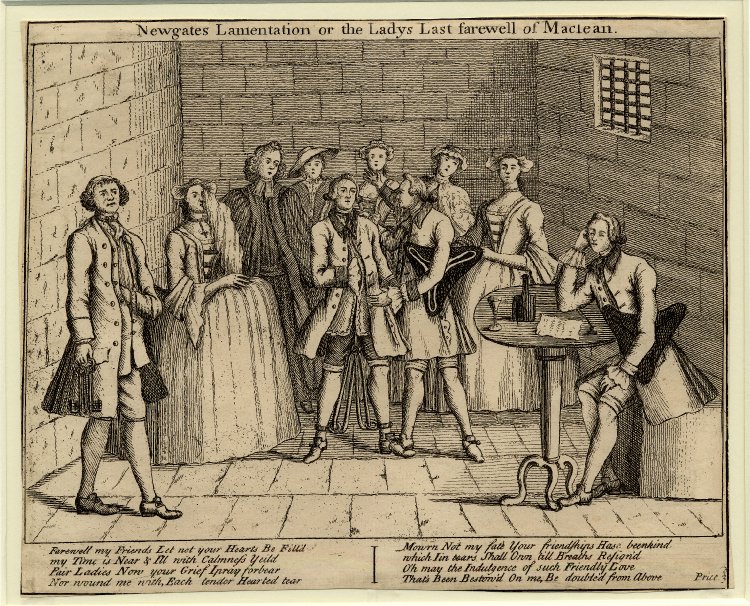
When caught** by mischance, the mannered† Maclaine became the object of public celebration, much to the bemusement of Walpole — who professed no ill will for his assailant but wondered that “there are as many prints and pamphlets about him as about the earthquake.”

Three thousand people are reported to have turned up on a sweltering summer Sunday to pay their admiration to the rogue, not excluding the very cream of society. Walpole teased his friends, court beauty Lady Caroline Fitzroy (wife of the Earl of Harrington) and her sidekick Miss Elizabeth Ashe, for presenting themselves among these masses to starfuck this latter-day Duval. “I call them Polly and Lucy,” he wrote, alluding to female conquests of the outlaw Macheath in The Beggar’s Opera, “and asked them if he did not sing,”

Thus I stand like the Turk with his doxies around.

Maclaine did not have to borrow Macheath’s ballads, for he was celebrated with verse dedicated all to him — like this “Jemmie Maclaine”, to the tune of Derry Down:

Ye Smarts and ye Jemmies, ye Ramillie Beaux,
With golden cocked hats, and with silver laced clothes,
Who by wit and invention your pockets maintain,
Come pity the fate of poor Jemmy Maclaine,

Derry down derry, etc.

He robb’d folks genteely, he robb’d with an air,
He robb’d them so well that he always took care
My lord was not hurt and my Lady not frighted,
And instead of being hanged he deserved to be knighted!

Derry down derry, etc.

William Hogarth‘s 1751 print cycle The Four Stages of Cruelty, one skeleton overseeing the operating theater where a hanged criminal is dissected is subtly labeled — Macleane.

* Walpole once remarked of the ubiquity of violent crime in London that “one is forced to travel, even at noon, as if one was going to battle.”

** Plunkett was never apprehended; it’s alleged that he ultimately escaped to North America.

† Although our man “has been called the gentleman highwayman,” the player-hating Ordinary of Newgate wrote, “and his dress and equipage very much affected the fine gentleman, yet to a man acquainted with good breeding, that can distinguish it from impudence and affectation, there was little in his address or behaviour, that could entitle him to that character.”

On this day..