1953: Dmytro Bilinchuk, Company 67 of the Ukrainian Insurgent Army

On this date in 1953, a guerrilla with the nom de guerre “Khmara” was shot in Kiev’s Lukianivka Prison for his involvement in a still-controversial resistance movement.

Dmytro Bilinchuk on the forest moon of Endor. UPA regs supposedly strictly prohibited photography; being rebels by nature, they snapped enough to fill up this page.

History is lived forward but understood backward. Therein lies the ambiguity of the Ukrainian Insurgent Army (UPA), a nationalist organization that operated in Galicia and environs after the Nazi invasion and persisted several years afterwards.

At its height, the UPA is said to have had up to 100,000 members, famously operating out of subterranean forest bunkers. This day’s victim was the captain of one of its companies; there is very little about him available online in English — principally his death date — but Ukrainian sites add the folklorish but poignant detail of his supposed adoption of an orphaned bear cub.

But about his organization, the name alone is sufficient to invite the most acrimonious debate:* were these partisans Nazi collaborators? Ukrainian patriots? Both?

Ukrainian nationalists, under the leadership of a man who had abandoned socialism for a fascist national ideology (everyone was doing it), entered the World War II era having conspicuously failed to grasp independence in a period when nationhood was being handed out like candy to small European states.

The specific kettle for Ukraine’s stewing ethnic aspirations was Galicia, the northeastern shoulder of the Carpathian mountains presently in western Ukraine. Galicia had been at the heart of both Polish and Ukrainian national movements, and they fought for it after World War I — a war won by Warsaw. (Meanwhile, Bolshevik victory in the Russian Civil War forestalled national ambtions further east.)

Brewed with the movement’s right-wing ideology, Ukrainian nationalism developed an anti-Polish, anti-Russian, anti-Communist programme, and it gazed around 1930’s Europe wondering if it couldn’t find an aggressive great power with a similar outlook that might take Ukraine under its wing.

Fast forward to the eve of World War II: by the terms of the Molotov-Ribbentrop Pact, Hitler and Stalin carved up the Ukrainians’ rival and thrust Galicia into Soviet hands, incidentally exposing its inhabitants to the pleasures of life under Stalin.

For Ukrainian nationalists, the altered situation of the Poland partition — followed shortly by Hitler’s initially successful invasion of Russia — offered an apparent opportunity to realize the dream of statehood under the patronage of a somewhat congenial Nazi government.

Though there’s a great deal of contention this author is not remotely qualified to referee about precisely which organs collaborated with or resisted the Nazis in precisely which ways, it seems fair summation to say that Ukraine’s nationalist movement was happy to treat with Berlin. Berlin being more reserved about a Slavic nationalist movement in its conquered territory, the UPA’s proposed institutional alliance with the Wehrmacht never quite came to pass as such, but that left many nationalists as freelance collaborators instead.** The hypothetical Ukrainian state in a Nazi-dominated Europe was not going to come about by sabotaging the Germans.

Instead, the UPA got busy laying the groundwork for an ethnically homogeneous Ukrainian homeland by fighting a reciprocal dirty war of ethnic cleansing against Poles in Galicia (most notoriously and emblematically, at Volhynia) — eventually developing into inter-partisan civil warfare against both Polish and Communist units (who had their own differences) with the odd brush with the Wehrmacht mixed in, and giving way to full concentration upon Soviet authorities as Red Army drove out the Germans.

The fact of having engaged German troops is a loudly bandied point in the UPA’s modern defense — the elevator pitch is that they “fought the Nazis and the Communists,” though it sure looks like they fought the one a lot harder than the other, and fought both less eagerly than they fought the Poles. There may be no cause to call UPA fighters other than sincere patriots of a nation whose aspirations were no less worthy than any other, who under beastly circumstances and for motives they believed noble committed sins no uglier than many other nationalists: even so, the thing separating that militia and its movement from, say, the Croatian Ustashi looks like opportunity rather than principle. Most perceived at the strategic plane a clear choice between Nazi victory with Ukrainian independence and Nazi defeat without, and most consciously preferred the former. No doubt the UPA would retort that its only other option was worse.

While Ukraine had a predictable exodus of anti-communist types as World War II drew to a close,† thousands of UPA guerrillas stuck around to keep up their fight (already underway) against the Soviets — including Dmytro Bilinchuk, whose biography can be enjoyed by readers of Ukrainian here.

It took a decade or more for Russia to extirpate this movement by hunting down its Bilinchuks. Buried in obscurity for the remainder of the Cold War, however, the martyrs of the OUN and UPA have pried open their tombs since Ukraine separated from the USSR in 1991 and become a contentious symbol in present-day Ukraine.

The OUN successor Congress of Ukrainian Nationalists has been part of Ukraine’s governing alliance since the Orange Revolution, and has pressed to treat its dead forebears as national heroes — renaming streets and attempting to rehabilitate UPA veterans into a class with those of the Red Army, a problematic enterprise since the two groups spent years killing one another. Old warriors may never reconcile, but the self-conscious reconstruction of the Ukrainian partisan movement in the service of shaping modern Ukrainians’ identity is a going concern:

Proving Faulkner’s old aphorism that the past isn’t dead and isn’t even past, this latter-day party and others of the Orange coalition remain electorally rooted in the UPA’s old western Ukraine stomping grounds, and tend to lean towards western Europe in outlook; eastern Ukraine remains more heavily Russian-oriented, and more inclined to the Russians’ distasteful view of the OUN and UPA.

* See, for instance, this Axis History thread, or the UPA’s Wikipedia discussion page.

** Late in the war, Germany would eventually form its own Galician SS Division. UPA proponents take pains to separate this German-officered formation from UPA guerrillas.

† Ironically, Ukrainians who bolted west — including the Galician SS division, which undertook a forced march to surrender in Italy rather than to the Soviets — profited greatly from having been “occupied” by Poland before the war, and from bloodily moving the border during the war. A refugee screening report (cited in Poland’s Holocaust — a source hostile to the UPA, as the title suggests) commented that Ukrainian detainees

are really having the best of both worlds. They do not qualify as Soviet citizens because their place of birth and/or habitual domicile on 1.9.39 were in Poland, and they therefore by our definition escape all punishment by the Russians for their having assisted the enemy; and they are not presumably eligible now for punishment by the Polish authorities because that part of the country from which they came is no longer part of Poland.

On this day..

1923: Albert Leo Schlageter, Nazi martyr

On this date in 1923, a German paramilitary was shot by a French firing squad near Dusseldorf for his anti-occupation sabotage efforts.

Albert Leo Schlageter, a World War I veteran and conservative Catholic who signed up with the right-wing Freikorps and tangled with communists after the war, joined the fledging Nazi party when it absorbed his Freikorps unit in 1922.

The next year, France occupied the Ruhr to secure war reparations payments then crippling Germany, which would do much to speed the rise of the Nazis in the years ahead.

Schlageter was nabbed sabotaging railroad lines in resistance, and Berlin’s protests didn’t help him much.

He became a Nazi martyr literally overnight, and as the nationalist right ascended, the place of his passion was marked with a 90-foot cross and used for party rallies. His name christened a naval vessel, a Luftwaffe fighter wing, two SA units, and several Nazi badges and decorations:

A 1923 NSDAP pin honoring Schlageter.

There was also a play about him, Schlageter, whose debut performance was for Hitler’s first birthday as Chancellor in 1933. The most famous work of Hanns Johst, it was notable for the line “Wenn ich ‘Kultur’ höre, entsichere ich meinen Browning!” — “When I hear the word ‘culture’, I reach for my gun!” — subsequently adopted by so many gun-reaching Nazi kulturkampfers that it is provenance is regularly misattributed.

Unsurprisingly, Schlageter’s cult has waned into obscurity since 1945. But one needs not endorse his philosophy or its horrifying posthumous expressions to appreciate the man’s struggle against foreign occupation and bravery in what he took to be the country’s interests.

For the Communist Karl Radek, this martyr of the right stood for many more whose sincere intentions had been bent against themselves — “those German Fascisti, who honestly thought to serve the German people.” Addressing the Communist International’s Executive Committee in the days after the officer’s execution, Radek anticipated Schlageter pointing the way to a future very different from that which came to pass:

Schlageter, a courageous soldier of the counter-revolution, deserves to be sincerely honoured by us, the soldiers of the revolution.

Schlageter went … to the Ruhr, not in the year 1923 but in the year 1920. Do you know what that meant? He took part in the attack of German capital upon the Ruhr workers; he fought in the ranks of the troops whose task it was to bring the miners of the Ruhr under the heel of the iron and coal kings. The troops of Waters, in whose ranks he fought, fired the same leaden bullets with which General Degoutte quelled the Ruhr workers. We have no reason to believe that it was from selfish motives that Schlageter helped to subdue the starving miners.

The way in which he risked his life speaks on his behalf, and proves that he was convinced he was serving the German people.

[The German Communist Party] believe[s] that the great majority of the nationalist-minded masses belong not to the camp of the capitalists but to the camp of the workers. We want to find, and we shall find, the path to these masses. We shall do all in our power to make men like Schlageter, who are prepared to go to their deaths for a common cause, not wanderers into the void, but wanderers into a better future for the whole of mankind; that they should not spill their hot, unselfish blood for the profit of the coal and iron barons, but in the cause of the great toiling German people, which is a member of the family of peoples fighting for their emancipation.

Schlageter himself cannot now hear this declaration, but we are convinced that there are hundreds of Schlageters who will hear it and understand it.

On this day..

1820: Karl Ludwig Sand, a curious strand of German history

Alexandre Dumas recognized the name of Karl Ludwig Sand, who lost his head on this date in 1820 in Mannheim, Germany, for the murder of the dramatist and humorist August von Kotzebue.

The assassination of von Kotzebue* worried the Prussian monarchy — then headed by Friederich Wilhelm III — and precipitated a series of proclamations, reforms, and internal struggles that finally led to a full-scale rebellion 30 years later.

A print showing Sand stabbing August von Koetzebue. Sand is reported to have shouted, “Here, you traitor to the fatherland!”

Sand was a member of a Burschenschaft,** a liberal student fraternity organization which appealed to nationalist Germans seeking a unified German nation-state, and he and others in his group regarded von Kotzebue as a plague on their cause. Von Kotzebue was then Councillor of the Russian Legation, the culmination of over a decade in the Russian civil service, and a spinmeister for the Russian regime. In 1816, while Sand was in college, von Kotzebue was tasked with managing the flow of information into the Prussian state in an effort to increase the monarch’s popularity in Germany.

At the very least, then, von Kotzebue had no love for the Burschenshaft movement from the start, which originated in the university town of Jena, and he did not hold back his criticisms in his weekly literature newpaper Literatische Wochenblatt. He casually disparaged the Burschenschaften, as this stab in the review of a novel in one of the earlier editions evidences:

Longing and love in the work is described in a way which, in the judgment of the Jenaer Recensenten, resembles a light Spring rain that is at least refreshing. That is more than one can say of the Jenaer Literature-Zeitung, which roughly resembles an autumnal rain that simply makes one wet without refreshing at all.

But the student organizations were on the rise during Sand’s time at university as a theology student, and the turbulent events in France during his final days in school were having ripple effects across the German populace. It was in this climate that a young man who was “distinguished at once by the gifts of the mind and the faculties of the soul” (as his Gymnasium rector put it) and who sought to become a pastor was drawn to the nationalistic movement. Sand’s opposition to the imperial rule of Prussia became increasingly more urgent after his studies, and he was determined to make a statement through action, eschewing what he called “simply writing and talking.” On March 23, 1819, the 22-year old found von Kotzebue in his house and stabbed him in front of several witnesses. Sand was quickly arrested and sentenced to death.†

A print depicting the Wartburg Festival of 1817, Burschenschaft colors prominently displayed. (Click for larger image.)

As a result of von Kotzebue’s murder, Prince Klemens Wenzel von Metternich set down a series of decrees, known as the Karlsbad Decrees, which sought to quell any thoughts of rebellion before they could fully ferment. The decrees limited both university activity and press activity, constraining the actions of university employees and setting down harsh restrictions on anyone who might dare question the monarch’s authority.

Sand’s contemporaries outside of Germany were hardly pleased with the death of von Kotzebue, which they saw as the precursor to a greater turmoil, and two decades of removal from the event proved a powerful force. By the time Dumas visited the site of Sand’s beheading and penned his own biography of the man, a thorough rendering of Sand’s brief life — much of it reconstructed from Sand’s writings and the memories of those who knew him — the rebellion of the Burschenschaften was once again afoot, this time with permanent consequences for the German people.

In the end, nationalism and constitutionalism were not the panaceas Sand and other Burschenschaefter may have liked. While Sand would hardly have counted as a Nazi (his Puritanical theology would have fallen on deaf ears in that regime), he would have recognized that group’s near-religious fervor of the public book burnings anti pro-German sentiments as a distant echo of the Burschenschaft’s Wartburg Festival.†† Indeed, the so-called Third Reich could never have existed without the Second Reich, whose seeds Sand and his fellow nationalists were sowing a half century early when his fateful date with the axe arrived.

* The name is also spelled “Kozebue” by some sources.

** The Burschenschaften were roughly based on the Lützow Free Corps, an academic paramilitary group which fought during the Napoleonic Wars. During their height of popularity, the Burschenschaften adopted the black-red-gold flag that was reclaimed by the Frankfurt Parliament in 1949 to be the official German flag.

† In the end, Sand and von Kotzebue were buried at the same cemetery.

†† The Wartburg Festival, held in 1817, was a celebration of Martin Luther’s proclamation against the church. An interesting discussion of the appeal of such festivals to the students of the day is given in The Course of German Nationalism: From Frederick the Great to Bismarck.

On this day..

1966: Christiaan Soumokil, South Moluccan President

On this date in 1966, an Indonesian firing squad on the island of Obira (or Obi) shot Chris Soumokil (the link is to his Dutch wikipedia page) for having styled himself the president of the Republic of the South Moluccas.

Soumokil’s fate underscores the many contradictory eddies of nationalism in the post-colonial age, and especially in that “imagined community” par excellence, the scattered archipelago of Indonesia.

Here is the background in outline, from a 2005 anti-terrorism text whose interest in the topic will soon become apparent:

The disintegration of the Dutch East Indies and the rapid dissolution of the federative state was anxiously watched in the Moluccas. … [Moluccans] were a privileged group and had favourable career opportunities … [they] were deeply concerned when Sukarno first proclaimed independence in 1945; indeed, many seemingly chose the side of the Dutch government and hoped for a return to colonial times, because they feared that a Java-dominated Indonesian state would significantly worsen their position. …

When Sukarno, in the spring of 1950, dissolved the state of East Indonesia, of which the Moluccas were a province, a group of Moluccans immediately responded by proclaiming and independent Republic of the South Moluccas (Republik Maluku Selatan) on 24 April. This, of course, was unacceptable for Sukarno. In November 1950, the Indonesian army occupied the island of Ambon, the cultural and political centre of the Moluccas. The RMS government and its sympathizers fled to the island of Ceram, where it started a guerrilla war against the Indonesian government. In the early 1960s it became clear that this struggle was utterly hopeless. In 1962, The Netherlands transferred New Guinea to the Republic of Indonesia, thereby depriving the RMS guerrillas of the safe haven where it [sic] had prepared its actions and found refuge.

Soumokil was captured in December 1962 and imprisoned; he was executed* just a month after the Indonesian government was seized by Suharto, on a programme of putting disorder to the sword.

Although politically moribund, the South Moluccan struggle to which Soumokil is a martyr is far from forgotten. And this is where the story of nationalism takes an unexpected turn.

Moluccan refugees in the Netherlands — a “temporarily” displaced population that became permanent, comprised largely out of ferociously anti-Indonesian former soldiers** among whom the RMS government-in-exile still maintains itself today — carried the memory of this struggle forward, far more so than it persisted in the Moluccas themselves.

For this Moluccan diaspora, already subject to all the strains of migration, the affair was a betrayal by their host country, which had failed to repay their ancestors’ loyalty to Holland during the colonial period by backing their people’s aspirations for independence — and had done this even while placing another colony, Suriname, on precisely the sort of stewardship-to-independence track the RMS had in mind for itself.

Soumokil’s execution (and his widow’s subsequent release to the Netherlands) helped (the link is Dutch) radicalize the next generation of Dutch Moluccans to the extent of carrying out some spectacular terrorist actions.

Though there haven’t been any bombs lately, there remains to this day enough currency in this cause to recommend it in the identity formation of the YouTube generation.

* An account of Soumokil’s last hours given by Soumokil’s widow posted here gives the particulars thus:

On April 11, 1966, Mrs. Soumokil and her son Tommie were given permission to pay a last visit to Mr. Dr. Soumokil from 08.00 AM to 11.30 AM to say good-bye to each other.

On April 12, 1966, at 01.00 AM Mr. Dr. Soumokil had been taken by the Indonesian Military from the condemned cell and transferred by motorboat to the island Obi in the archipelago Pulau Seribu … On April 12, 1966, one minute before 07.00am, Mr. Dr. Soumokil gave his last breath. He had been shot by the Indonesian firing-squad.

** Also generally Christian, vis-a-vis the predominantly Muslim Indonesia.

On this day..

1957: Evagoras Pallikarides, teenage guerrilla poet

On this date in 1957, Cypriot guerrilla Evagoras Pallikarides was hanged by British colonial authorities for gun possession.

As it was throughout the Empire in the middle 20th century, independence was the order of the day in Cyprus. But it was not simply whether there would be self-rule in Cyprus: the form and terms of independence were themselves hotly contested.

Cyprus would be a fresh battleground between those bitter rivals Turkey and Greece, each asserting an interest in their ethnic cousins on the island; overlapping that, it would be a battleground between the institutional Communist opposition AKEL, which opposed military action for separatism, and the nationalist EOKA, demanding not simply independence but enosis, union with Greece as part of the pan-Hellenic project so inflammatory to the Turks.

From 1955 to 1959, EOKA conducted a four-year campaign of bombing, assassinations and military engagements.

As a 17-year-old, Palikarides — already facing trial and likely prison time for his resistance activities — disappeared to join an EOKA guerrilla cell. A poetic young soul, he bid his classmates farewell with this note left to explain his absence on their first morning without him:

Old classmates. At this time, someone is missing from among you, someone who has left in search of freedom’s air, someone who you might not see alive again. Don’t cry at his graveside. It won’t do for you to cry. A few spring flowers scatter on his grave. This is enough for him …

I’ll take an uphill road
I’ll take the paths
To find the stairs
That lead to freedom

I’ll leave brothers, sisters
My mother, my father
In the valleys beyond
And the mountainsides

Searching for freedom
I’ll have as company
The white snow
Mountains and torrents

Even if it’s winter now
The summer will come
Bringing Freedom
To cities and villages

I’ll take an uphill road
I’ll take the paths
To find the stairs
That lead to freedom

I’ll climb the stairs
I’ll enter a palace
I know it will be an illusion
I know it won’t be real

I’ll wonder in the palace
Until I find the throne
Only a queen
Sitting on it

Beautiful daughter, I will say,
Open your wings
And take me in your embrace
That’s all I ask …

Pallikarides fought for a year before being apprehended with a gun illegally in his possession — a hanging crime under British anti-terrorism laws, but as Pallikarides was just the ninth (and last) EOKA man executed, it seems plain that law was not receiving draconian enforcement. At least one author claims that the authorities threw the book at him on the gun charge because of a murder they believed he committed as a guerrilla but could not prove.

The fact that he turned 19 a fortnight before his execution likewise did not avail him clemency — as the young rebel predicted in court:

I know you will hang me. Whatever I did, I did as a Cypriot Greek fighting for liberty.

As youthful martyrs to nationhood are wont to become, Pallikarides (along with his poetry) lives on as a potent symbol to Greek Cypriots. Shortly after Cyprus achieved independence in 1960, his name and visage were affiliated with a Cyprus football club, Evagoras (which later merged with another club to become AEP Paphos).

On this day..

1942: Avraham Stern, a strange bedfellow

On this date in 1942, Zionist freedom-fighter — or was he a terrorist? — Avraham Stern was captured by British colonial authorities and summarily executed.

Stern, as pictured on a 1978 Israeli stamp.

Born in 1907 in a part of eastern Poland then in Russian hands, Stern immigrated to British Palestine in 1925 and became an adherent of Revisionist Zionism — a maximalist strain of the fermenting Jewish homeland movement.

Various threads and factions within the Zionist movement pursued different territorial and political goals with different strategies; Stern was among the most militant foes of anything with the whiff of collaboration with the British. When the armed underground movement Irgun opted in 1940 to suspend attacks against British targets during World War II, Stern created a splinter organization with a programme of continuing anti-British violence.

The “Stern gang,” as imperial authorities knew it, had its reasons — controversial enough that some more moderate Jewish elements were happy to help the British hunt it, but reasons with their own logic, premised on the notion that London was the fundamental enemy of Jewish national interests while Berlin, for all its anti-Semitism, was not.

Between those two lay the room for wartime collaboration with Hitler against Britain with the object of establishing a Jewish state in the Levant open to unlimited immigration from a Reich eager to be rid of its Jews. In one fell swoop, it would solve Germany’s “Jewish question,”* realize Zionist state-building aspirations, and disrupt the Nazis’ wartime enemy. Stern, who had cultivated an affinity for fascism while studying in Italy and pitched a similar bargain to Mussolini, offered a pact with the devil: “the establishment of the historic Jewish state on a national and totalitarian basis, bound by a treaty with the German Reich.”

Berlin never took up the offer. Stern himself would have only a year to live, and his tiny splinter group didn’t get very far off the ground during it, carrying out a few murders and trying to raise money through crime. A high-profile bank robbery in January of 1942 that left several Brits and Jews dead brought down an intense manhunt that caught up with Stern on this day. He was handcuffed and shot on the spot.

His organization would come into its own after his death under leadership that included future Likud Prime Minister Yitzhak Shamir, carrying out a campaign of assassinations in the mid-40’s as Palestine slid towards the civil war that would give birth to Israel. In that incarnation, it valorized its creator:

He was a lion, and the cravings of the foxes were foreign to him. He was an eagle who did not know how to fly low … He was not of those who live and die, like all human beings. He was a Prometheus, one who appears but once over many generations. (Source)

That valorization has been contested but nonetheless lasting. The Knesset, just days ago as of this writing, voted laurels for Stern’s hundredth birthday. There’s almost no apolitical way to write his story, and given Israel’s persistence as a flashpoint — and its own ironic inheritance of a rebellious subject population reminiscent of pre-1948 Palestinian Jews — the radicalism of his words, deeds and persona invite debate.

Books about the Stern gang in the founding of Israel

There’s a fascinating first-person apologia from a former member of the Stern gang here.

Stern also dabbled as a poet, and wrote this anthem to the struggle with his wife:

Part of the Themed Set: Unruly Britannia.

* Germany itself was tarrying with “faraway Jewish homeland” plans at this time, specifically considering relocating European Jewry to Madagascar. The Final Solution would be implemented later, once these proved unavailing. Stern, for his part, also expected the Axis to win the war.

On this day..

838: Babak Khorramdin

On this date in 838, Babak Khorramdin was chopped to pieces for his 20-year rebellion against the Abbasid Caliphate.

A Zoroastrian son of northwest Iran’s Azerbaijan region, Babak rose to head a movement at once political and religious rooted in cultural preservation against the Arab-dominated caliphate.

Captured at last — he had spurned a guarantee of safety with that timeless insurrectionary sentiment, “Better to live for just a single day as a ruler than to live for forty years as an abject slave” — he had his hands and legs struck off in the presence of the caliph. It is said that Babak washed his face in the blood of these wounds to deprive his royal observer the pleasure of seeing his face fall pallid.

Babak remains an iconic figure in his homeland for his resistance to Arab domination, as evidenced by this Farsi-language vignette …

… and this performance of the Persian Ballet.

But he is not an unproblematic character for contemporary Iran, and not so much because of the anti-Islamic character of his revolt. Babak, whose personal ethnic composition seems to be a bone of historical contention, is also hailed an Azeri nationalist hero vis-a-vis Iran. His fortress is mountainous northern Iran still stands … and has latterly become a meeting-ground for advocates of “greater Azerbaijan” on the occasion of Babak’s birthday in July, much to the displeasure of Iranian authorities.

On this day..

1882: Guglielmo Oberdan

On this date in 1882, Italian nationalist Guglielmo Oberdan was hanged for attempting to assassinate Austrian Emperor Franz Joseph.

“I will throw my corpse between the emperor and Italy and Italian youth will at least have an example.” (quote)

A native of Trieste, a melting pot of Italian and Slovenian ethnicities, Oberdan was of mixed parentage but identified with an Italy coming of age just as he himself did.

Trieste was a treasured Habsburg jewel, the empire’s most consequential port. So Franz Joseph’s visit to celebrate the city’s 500th anniversary under the Austrian crown was undertaken with no less heartfelt sincerity than the enthusiastic student had in packing a suitcase full of explosives in greeting.

Police intercepted this memorable gift and young Oberdan as well, and in short order he swung from the gallows — thousands of worldwide petitioners, Victor Hugo among them, notwithstanding — still urging cocksure verses of national redemption.

As a handsome young martyr who had chosen his Italian identity, Oberdan’s name and face became fare for boulevards, piazzas and monuments … doubly so for the boy’s dispatch contemporaneous with Italy’s cynical Triple Alliance pact with Austria-Hungary that sternly apprenticed the infant nation’s irredentist spirit to realpolitik under the sway of the man now reviled as the “Emperor of the Hangmen.” Nor would it appear a fate unworthy of his deed that he should personify in death all the impulsive romanticism his country had not strength enough to effect.

Oberdan is the subject of a rousing (and murderous — the refrain is “Morte a Franz, viva Oberdan!”) patriotic song dating from the 1880’s:

On this day..

1948: Amir Sjarifuddin

On this date in 1948, leftist former Indonesian Prime Minister Amir Sjarifuddin was summarily executed by forces of the infant Indonesian Republic for his participation in an attempted coup d’etat three months before.

A Dutch-educated Communist politician who had adhered to an anti-fascist “common front” position, Sjarifuddin was a vigorous activist against the Japanese occupation during World War II — and lucky to avoid execution for it.

Indonesia’s declaration of independence following the war sparked the National Revolution, during which Sjarifuddin emerged a leading player of the left as rival factions maneuvered against each other within Indonesia under pressure from the Dutch colonial power looking to reassemble its old dominions.

Sjarifuddin briefly served as the fledgling state’s second prime minister, but resigned in January 1948 after an unpopular diplomatic foray to calm tensions with the Dutch. His support for a botched and premature revolt by Communist officers in September sealed his end as a political factor and eviscerated left influence in the revolution, confining the latter’s character to an essentially nationalist one.

The rising’s suggestion of internal division may also have encouraged the Dutch incursion into Java on this date. There was a touch of poetic justice if that was the case: Republican troops, melting away from superior firepower for an insurgency campaign, opted to execute Sjarifuddin and about 50 other captured leftists before retreating rather than free them.

According to George Kahin, Sjarifuddin rendered with his death one last service to his nationalist — if not his Communist — ambitions:

[O]nce the [Indonesian] government … had put down the [September] rebellion and shot its leaders, it was no longer possible for the Dutch to make American officials and the US Congress believe — as previously many of them had — that most leaders of the Republic were under strong Communist influence and that their government was providing a bridge to an ultimately Communist Indonesia.

Its Marshall Plan aid threatened, the Netherlands recognized Indonesian independence in 1949.

On this day..

1941: Zoya Kosmodemyanskaya

On this date in 1941, Soviet partisan Zoya Kosmodemyanskaya was hanged by the Wehrmacht for sabotaging buildings behind German lines near Moscow.

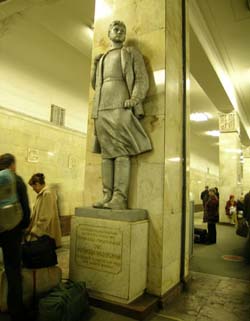
A statue of Zoya Kosmodemyanskaya stands vigil over Moscow’s World War II-era Partizanskaya metro station. Image used with permission.

One of the most famous Soviet war heroines and the first woman decorated as Hero of the Soviet Union during World War II, the 18-year-old had quit school to volunteer for a partisan unit only a few weeks before her hanging as Russia mobilized against Hitler’s race towards Moscow.

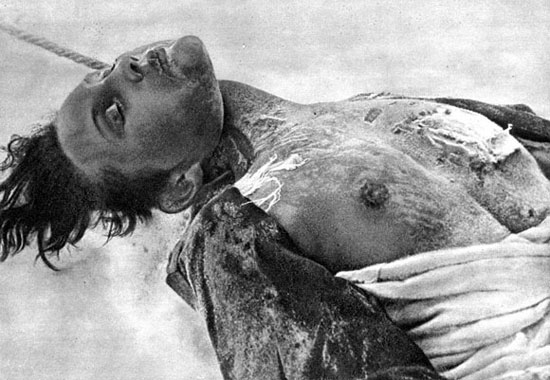
Known simply as “Tanya”, the nom de guerre which was the only information she volunteered during two days of torture, the power of the press offered her apotheosis into a propaganda coup for the Kremlin, and a symbol of courage that would long outlive Stalin. Before the public execution, the Nazis paused to photograph the scene; Kosmodemyanskaya availed the lull to harangue the Germans — “you can’t hang all 190 million of us!” — and call on the Russian villagers present to resist occupation.

Her bayoneted, mutilated body hung on the gibbet until the Red Army recaptured the village; witnesses related the tale of her dying heroism to a newsman.

It was only after the story of “Tanya” hit the press in January 1942 that her identity was established … and then promulgated widely. Anonymous and obscure in death, Zoya Kosmodemyanskaya would inspire millions and become the heroic emblem of other women partisans.


Soviet propaganda poster unabashedly modeled on the already-iconic image of Zoya Kosmodemyanskaya’s abused corpse.

Zoya, a 1944 Soviet film, was scored by Dmitri Shostakovich.

Part of the Themed Set: Women Against Fascism.

On this day..