1980: Islamic extremists for the Grand Mosque seizure

At dawn this date in 1980, the kingdom of Saudi Arabia publicly beheaded over 60 Islamic extremists who had seized Mecca’s holy Al-Masjid al-Haram the preceding November — one of the formative and strangely forgotten events in the birth of radical Islam.

Saudi Arabia’s uneven but unmistakable modernization generated friction extending to the royal family itself.

On November 20, 1979, with 100,000-plus pilgrims bustling in Islam’s holiest shrine on the hajj, a few hundred multinational messianic militants took it over with a cache of smuggled firearms.

For two embarrassing weeks, the Saudi government struggled to respond, bumbling a couple of military operations and delicately negotiating the ecclesiastical permission it would require to commit violence within the Grand Mosque. (Strict Moslim prohibitions against same had left the kingdom’s unarmed guards essentially defenseless against the initial takeover.)

In exchange for that fatwa, the House of Saud struck a Faustian bargain: agreeing to roll back secularization and impose strict Islamic law.

The balance of military materiel, of course, would prove to be no contest at all; Riyadh had troops, heavy armament, and now, permission to use them (and to damage the mosque … which they did). Most of the Mahdists were slain in the decisive assault; the survivors* (except for a few who were underage) were publicly beheaded in various cities around Saudi Arabia on this date, including the operation’s leader, Juhayman al-Otaibi.

But their deed — second-tier news at the time in a United States distracted by the Iranian Revolution — would have dramatic long-term repurcussions. Though intimations of deeper bin Laden family involvement** seem sketchy, it certainly appears to have inspired the 22-year-old Osama bin Laden; he soon made his way to fight the Soviets in Afghanistan, a war that began in earnest just days after the end of the siege and to whose prosecution Saudi Arabia and the west would gratefully direct Islamist energies.

Meanwhile, the Saudi government’s pact with the clergy that gained it permission to assail the Grand Mosque saw it subsequently bankroll Wahhabi religious instruction in Saudi Arabia and beyond … arguably the hand that rocked the cradle of present-day Islamic radical movements like al-Qaeda.

Much of what is latterly recalled about this affair by Anglophones comes courtesy of journalist Yaroslav Trofimov’s recent book The Siege of Mecca: The 1979 Uprising at Islam’s Holiest Shrine. (Review | Another | Book home page).

In this clip, the author discusses the legacy of the siege with Fareed Zakaria.

* The Saudi government put out the figure of 63 executions. Some sources now report 67.

On this day..

1976: Three terrorists in Syria

On this date in 1976, three Abu Nidal terrorists were hanged before the Hotel Semiramis in Damascus, barely 24 hours after they had entered it and taken 90 hostages in a bid to win release of Palestinian prisoners.

Palestinians Muhammad al-Barqawi and Mouatassem Jayyoushi and Iraqi Jabbar Darwish suffered Syria’s first public execution since an accused Israeli spy more than a decade before — and as the late Syrian strongman Hafez al-Assad had pledged, justice was swift and ruthless.

The security of the citizen is sacred. We shall not be soft in this matter. We shall hit back very hard and we denounce this criminal action committed by the gang, which acted as if it was in Israel.

They were the surviving 75% of a quartet of gunmen who early the previous morning had seized the hotel, barricaded themselves on the fifth floor, and attempted to make their trade. Plainly, it didn’t quite work out; the attempt precipitated a battle with Syrian troops which saw the fourth terrorist killed, along with four of the hostages. The Supreme State Security Court condemned the captured men to death overnight; the sentence was carried out between 6:00 and 6:30 the next morning.

New York Times coverage of the raid and the execution is unfortunately behind the paper’s paid-login firewall, but a photo of the execution shows onlookers ringing a single wooden frame for what must have been a short-drop hanging. An unused fourth noose, possibly symbolically present for the killed fourth terrorist (or possibly not; there’s no explicit comment on it), hangs beside the dead men.

So why the grievance? That June — “Black June,” to the Palestinians — Syria had bailed on hard-line Palestinians and entered the Lebanese Civil War on the side of Phalangist Christians,* just as they were on the verge of being overrun. It was the second time in six years that a neighboring Arab power had turned its guns on Palestinians. (In 1970, Jordan had expelled the Palestine Liberation Organization in “Black September.” Lots of black in the Palestinian annals.)

And why the Iraqi, among the hanged?

Palestinian terrormeister Abu Nidal had hung out his shingle in Iraq, then under the control of a rising young dictator destined for the gallows himself, but who grasped the opportunist potential of backing the Palestinian cause while states like Jordan and Syria visibly sold it out. Television crews had a few words in edgewise with the doomed men the evening before their hanging, and they claimed to have trained for their abortive mission in Iraq.

* This put Damascus on the same side as Israel.

Part of the Themed Set: Semiramis.

On this day..

2003: Paul Hill, anti-abortion martyr

Five years ago today, minister Paul Hill was put to death by lethal injection for murdering an abortion provider and a clinic escort nine years before.

Hill rose to prominence in the early 1990’s as a fire-eating abortion foe, who openly preached the righteousness of defending unborn life by force — a divisive position among anti-abortion activists that got him excommunicated from the Presbyterian church.

On July 29, 1994, in the abortion conflict’s ground-zero of Pensacola, Fla., Hill put his theology into action by gunning down Dr. John Britton and his septuagenarian escort, along with Britton’s wife (who survived the shooting).

Creepy. It sure looks like the song and image pairings were done in earnest, not in irony.

He never betrayed the least scruple about his act, hoping only to use his trial to present a “justifiable homicide” defense; the judge’s suppression of this line was and remains a grievance of Hill’s fellow-travelers against the judiciary.

Nor did Hill betray the least concern to die for his beliefs; if anything, in dropping appeals that would at the least have prolonged his life, he cut a figure thirsty for the martyrdom he attained this day.

To what end?

Hill left a plentiful documentary record — like this manifesto, among the pro-Hill documents collected on the Army of God website:

I knew that [killing an abortion provider] would uphold the truths of the gospel at the precise point of Satan’s current attack (the abortionist’s knife). While most Christians firmly profess the duty to defend born children with force (which is not yet being disputed by the government) most of these professors have neglected the duty to similarly defend the unborn. They are steady all along the battleline except at the point where the enemy has broken through. I was certain that if I took my stand at this point, others would join with me, and the Lord would eventually bring about a great victory.

One can question whether this proved to be the case or not. The infamy (in most circles) of the killing arguably dampened enthusiasm for the cause, at least as measured by the sulfur level on clinic sidewalks. At the same time, Hill’s was only the most spectacular instance of a campaign to terrorize abortion providers that drove many out of business and made some areas of the country virtual abortion-free zones.

Whatever may have surprised him about the way the issue played out over the 1990’s, he was serene about his choices when interviewed the day before his execution.

To some in the movement, he’s a holy martyr, the John Brown of slavery’s modern-day parallel.

And even if Paul Hill’s name is taboo in the respectable public discourse of abortion today, with four relatively young rock-ribbed anti-Roe v. Wade votes now entrenched at the Supreme Court, it’s far from obvious that Hill won’t get what he was after all along … even if he didn’t live to see it.

Part of the Themed Set: Judging Abortion.

On this day..

1822: The audacious Denmark Vesey

On this date in 1822, white South Carolinians hanged the most terrifying slave insurrectionary who never rose — and breathed a sigh of relief as they clamped the shackles ever tighter upon their groaning servile class.

Inspired by slave revolts shaking the Caribbean, the Denmark Vesey plot was the South’s worst nightmare: Nat Turner, multiplied by about nine thousand.

That’s the size of the slave and free black network Vesey is said to have recruited — ready to undertake a coordinated uprising to seize Charleston, slaughter the white populace, and possibly then to sail for a Haiti whose own slave revolt had recently established it a black-governed republic. The mind boggles at such a scheme’s bravado … but in an age when horseshoes and mizzenmasts could outrun information, Vesey’s plot could have been past any prospect of obstruction before anyone in a position to obstruct it even knew what happened. Had they not flown but defended Charleston, the event would have ignited a conflagration to outshine every other slave uprising.

The weak point, of course, were those 9,000 — or however many — slaves who had to act ruthlessly and in unison, and keep their peace until they struck. It is incredible enough that such a secret kept among so many for up to four years.

The plot finally leaked mere days before it was to have been attempted when a middling player attempted the unnecessary freelance recruitment of a house slave — a class Vesey had intentionally (and rightly, events would prove) excluded for dangerously excessive personal loyalty to their masters’ families.*

Melancholy Dane

A well-educated and well-traveled man on account of his years as the personal property of a slaver — Joseph Vesey, who bequeathed his purchase both a surname and the given name Telemaque, subsequently corrupted into “Denmark” by Charlestonians — the plot’s signature hero/villain had managed to purchase his freedom and establish himself in the anomalous position of free black artisan/entrepreneur in the slaveholding South.

His successful carpentry business (apt choice, for a martyr) had given him the prestige and the werewithal to start an independent African Methodist Episcopal church where he poured out a hatred of chattel slavery undiminished by his own liberty.

For several years before he disclosed his intentions to any one, he appears to have been constantly and assiduously engaged in endeavoring to imbitter [sic] the minds of the colored population against the whites. He rendered himself perfectly familiar with those parts of the Scriptures which he could use to show that slavery was contrary to the laws of God; that slaves were bound to attempt their emancipation, however shocking and bloody might be the consequences … (Source)

His judges were later incredulous that he’d be so hung up about it:

It is difficult to imagine, what infatuation could have prompted you to attempt an enterprise so wild and visionary. You were a free man, comely, wealthy, and enjoyed every comfort compatible with your situation. You had, therefore, much to risk and little to gain.

An American Spartacus?

Denmark Vesey blurs into myth as he approaches his end, together with lieutenants: among them, Peter Poyas, the organizational maven of the operation who was hanged along with Vesey and four others; and Gullah Jack, an African priest among the 29 more who would die in the weeks ahead.

Most of the principals held their tongues before interrogators; the tribunals were held secretly; their records were censored against the apprehension by other slaves of the potential for such designs as “a bottle with poison to put into my master’s pump & into as many pumps he could about town.”

But there was enough known to shatter forever any illusion of paternal congeniality more liberal masters might have fancied. One planter was incredulous that his agreeable charge might be involved in such nefarious doings until he asked the man directly and was astonished to hear from his trusted coachman’s lips the frank intention “to kill you, rip open your belly and throw your guts in your face.” (Both quotes are from this book review.)

Whites were scared. “I have never heard in my life, of more deep laid plots or plots more likely to succeed,” wrote Anna Haynes Johnson, niece to Gov. Thomas Bennett. (Source) Another concluded that “our NEGROES are truly the Jacobins of the country.” (Source)

But as initial panic (and federal troop deployments) gave way to a more pervasive undertow of security paranoia, the affair was self-consciously downplayed and records intentionally destroyed for fear that too-careful documentation of its particulars could map the way for a revival. An 1861 piece in The Atlantic — an excellent read on the progress of the conspiracy — grapples with what was even then a gaping evidentiary vacuum.

The intense avidity which at first grasped at every incident of the great insurrectionary plot was succeeded by a distaste for the memory of the tale; and the official reports which told what slaves had once planned and dared have now come to be among the rarest of American historical documents. In 1841, a friend of the writer, then visiting South Carolina, heard from her hostess for the first time the events which are recounted here. On asking to see the reports of the trials, she was cautiously told that the only copy in the house, after being carefully kept for years under lock and key, had been burnt at last, lest it should reach the dangerous eyes of the slaves. The same thing had happened, it was added, in many other families. This partially accounts for the great difficulty now to be found in obtaining a single copy of either publication; and this is why, to the readers of American history, Denmark Vesey and Peter Poyas have been heretofore but the shadows of names.

Antebellum September 11

Even as a nonstarter, the insurrection was an antebellum 9/11 that spurred a reactionary crackdown on perceived liberalities in the system — most vividly symbolized by the construction of the fortress that became the still-extant military academy The Citadel, but more systematically impinging blacks’ everyday freedom to assemble and worship, and even requiring (until the Supreme Court overruled the law) free black sailors be detained whenever a northern ship called at port. Pro-slavery southerners blamed open disapprobation for slavery voiced in Congress during the recent Missouri Compromise wrangling, and even similar sentiments expressed in the British parliament, for emboldening the terrorists.

All this yielded a rich political harvest from the fruit of the gallows — like Charleston mayor James “there is nothing they are bad enough to do, that we are not powerful enough to punish” Hamilton, who rode his timely suppression of the plot to Congress later that year.

Such political profiteering, combined with the sketchiness of primary sources, has licensed a revisionist take on the orthodox history — that there was never any conspiracy, but that reactionary white elites concocted the plot from a tissue of loose liberation talk, false confessions, and latent white fear in order to win political power. This contested minority interpretation has been a recent topic of academic dispute, since Michael P. Johnson floated it in 2001 (an account is required to read Johnson’s original essay; here’s a synoptic article that appeared subsequently in The Nation).

Markers of historiography around these competing versions of Vesey, bearing directly on the question current in today’s Charleston of whether and how to memorialize this episode, are ripe with controversial modern-day implications.

Consider: if Vesey is a rebel indeed, the silence of (most of) the plotters is a noble acceptance of torture to protect their confederates; if they’re framed, they’re silent because there’s nothing to confess. Either way, the modern reader’s sympathies are likely to lie with the blacks, but Johnson’s interpretation removes the locus of action from them to white elites. If he’s right, would that derogate an entire narrative of black resistance to slavery, drain the martyrdom from their deaths? Or would it correct an overstated romantic mythology of armed resistance, and color this day’s hanging with a different heroism: refusing to purchase their lives with a false accusation?

* For his timely betrayal, Peter Desverneys received his liberty and a state pension; he later became a slaveholder himself. See Black Slaveowners.

On this day..

2001: Timothy McVeigh, Oklahoma City bomber

At 7:14 a.m. on this date in 2001, Oklahoma City bomber Timothy McVeigh was executed at the federal penitentiary in Terre Haute, Ind.

More ink has been spilled about the 33-year-old Gulf War veteran and his infamous crime than this space can possibly hope to summarize. Books can be — and have been — written debating whence McVeigh sprang and whether he was rightly convicted.

McVeigh tended to keep coy about his version of his activities on April 19, 1995,* but he was never less than frank about his philosophy.

Though his avowed motive, the Waco slaughter that occurred two years to the day before Oklahoma City, has never exactly been secret, the way he’s connected those events has also never been particularly welcome. And McVeigh would say that the fact that he suffered execution while the only parties punished in the Waco siege were the survivors makes his point.

For all its moral monstrosity, the Gulf War veteran’s critique of his violent actions vis-a-vis those the state claims legitimacy for makes discomfiting reading, and is not always so easy to answer. From our distance of time, knowing that three months after McVeigh’s execution another terrorist act to beggar Oklahoma City would propel the United States back into Iraq, it strikes eerily prescient notes.

In a 1998 essay, McVeigh savaged the government for its hypocritical posture towards the country he had once fought, Iraq:

The administration has said that Iraq has no right to stockpile chemical or biological weapons (“weapons of mass destruction”) — mainly because they have used them in the past.

Well, if that’s the standard by which these matters are decided, then the U.S. is the nation that set the precedent. The U.S. has stockpiled these same weapons (and more) for over 40 years. The U.S. claims that this was done for deterrent purposes during the “Cold War” with the Soviet Union. Why, then is it invalid for Iraq to claim the same reason (deterrence) — with respect to Iraq’s (real) war with, and the continued threat of, its neighbor Iran?

If Saddam is such a demon, and people are calling for war crimes charges and trials against him and his nation, why do we not hear the same cry for blood directed at those responsible for even greater amounts of “mass destruction” — like those responsible and involved in dropping bombs on [Dresden, Hanoi, Tripoli, Baghdad, Hiroshima and Nagasaki]?

The truth is, the use of a truck, a plane, or a missile for the delivery of a weapon of mass destruction does not alter the nature of the act itself.

These are weapons of mass destruction — and the method of delivery matters little to those on the receiving end of such weapons.

Whether you wish to admit it or not, when you approve, morally, of the bombing of foreign targets by the U.S. military, you are approving of acts morally equivalent to the bombing in Oklahoma City. The only difference is that this nation is not going to see any foreign casualties appear on the cover of Newsweek magazine.

It seems ironic and hypocritical that an act viciously condemned in Oklahoma City is now a “justified” response to a problem in a foreign land.

Another note sent shortly before his execution to author Gore Vidal travestied government warmaking talking points:

[T]his bombing was also meant as a pre-emptive (or pro-active) strike against those forces and their command and control centers within the federal building. When an aggressor force continually launches attacks from a particular base of operations, it is sound military strategy to take the fight to the enemy. Additionally, borrowing a page from U.S. foreign policy, I decided to send a message to a government that was becoming increasingly hostile, by bombing a government building and the government employees within that building who represent that government. Bombing the Murrah Federal Building was morally and strategically equivalent to the U.S. hitting a government building in Serbia, Iraq, or other nations. Based on observations of the policies of my own government, I viewed this action as an acceptable option. From this perspective what occurred in Oklahoma City was no different than what Americans rain on the heads of others all the time, and, subsequently, my mindset was and is one of clinical detachment.

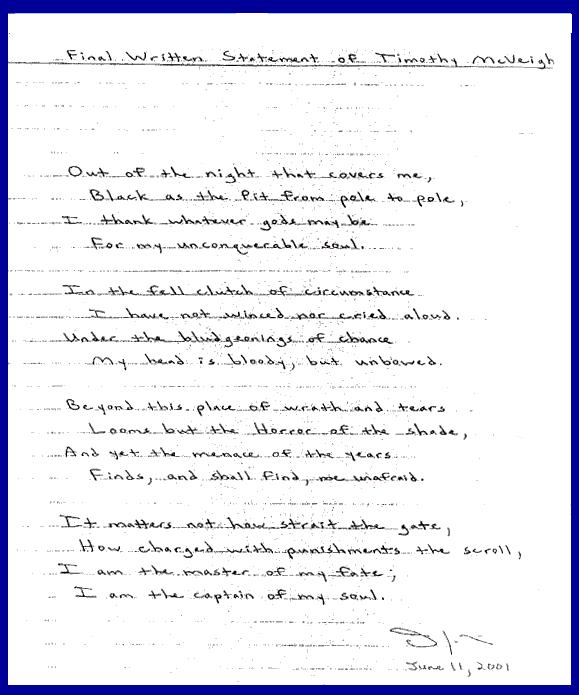
He broadcast clinical detachment in the execution itself — the first conducted by the federal government since 1963, technically imposed for the eight federal employees among his 168 victims — from his waiver of appeals to his unnervingly unblinking death mask to the stoic 19th century poem “Invictus” that formed his written (and only) final statement.

* Also — coincidentally or not — the execution date of Richard Snell in Arkansas, a militia man (and white supremacist, which McVeigh was not) who had once tried to blow up the Murrah building himself.

On this day..

1983: Simon Thelle Mogoerane, Jerry Mosololi and Marcus Motaung, anti-apartheid soldiers

This date at dawn in 1983, three African National Congress cadres were hanged — together with two unrelated common criminals — for attacks on apartheid-era South African police stations.

“Terrorists” in the eyes of the white government and “freedom fighters” in the eyes of many blacks, the “Moroka Three” — Simon Thelle Mogoerane, Jerry Mosololi and Marcus Motaung — bore arms against as part of the ANC’s military wing, Umkhonto we Sizwe (MK).

Their attacks in 1979 and 1981 had claimed the lives of four (black) policemen.

South African law until 1990 mandated hanging for a murder conviction without any extenuating circumstances — a “fact associated with the crime which serves in the mind of reasonable men to diminish morally, albeit not legally, the degree of the prisoner’s guilt.” The courtroom adjunct to MK’s guerrilla operations was establishing its position that its soldiers were prisoners of war under international law, and that that classification constituted an extenuating circumstance under South African law.

1977 protocols had extended the Geneva Conventions governing treatment of prisoners of war to explicitly cover anti-colonial and anti-racist insurgents. South Africa, unsurprisingly, did not ratify this amendment. The judge dismissed the argument that these protocols had acquired the binding force of customary international law — “we do not need to waste time.”

A decade or so later, in the waning years of apartheid, this sort of argument would find a toehold. But not in a defiantly “anti-terrorist” Pretoria of the early eighties.

The three were hanged in the face of worldwide appeals for clemency — such as this one from U.S. Congressmen and -women, and the pamphlet below by the British Anti-Apartheid Movement:

The entirety of this 24-page pamphlet is available free (at least for the remainder of this month) at the Aluka collection of digital Africa-related documents.

The executions likewise met outcry both domestic (South Africa banned public demonstrations) and international (like this U.N. resolution).

On this day..

1966: Christiaan Soumokil, South Moluccan President

On this date in 1966, an Indonesian firing squad on the island of Obira (or Obi) shot Chris Soumokil (the link is to his Dutch wikipedia page) for having styled himself the president of the Republic of the South Moluccas.

Soumokil’s fate underscores the many contradictory eddies of nationalism in the post-colonial age, and especially in that “imagined community” par excellence, the scattered archipelago of Indonesia.

Here is the background in outline, from a 2005 anti-terrorism text whose interest in the topic will soon become apparent:

The disintegration of the Dutch East Indies and the rapid dissolution of the federative state was anxiously watched in the Moluccas. … [Moluccans] were a privileged group and had favourable career opportunities … [they] were deeply concerned when Sukarno first proclaimed independence in 1945; indeed, many seemingly chose the side of the Dutch government and hoped for a return to colonial times, because they feared that a Java-dominated Indonesian state would significantly worsen their position. …

When Sukarno, in the spring of 1950, dissolved the state of East Indonesia, of which the Moluccas were a province, a group of Moluccans immediately responded by proclaiming and independent Republic of the South Moluccas (Republik Maluku Selatan) on 24 April. This, of course, was unacceptable for Sukarno. In November 1950, the Indonesian army occupied the island of Ambon, the cultural and political centre of the Moluccas. The RMS government and its sympathizers fled to the island of Ceram, where it started a guerrilla war against the Indonesian government. In the early 1960s it became clear that this struggle was utterly hopeless. In 1962, The Netherlands transferred New Guinea to the Republic of Indonesia, thereby depriving the RMS guerrillas of the safe haven where it [sic] had prepared its actions and found refuge.

Soumokil was captured in December 1962 and imprisoned; he was executed* just a month after the Indonesian government was seized by Suharto, on a programme of putting disorder to the sword.
Although politically moribund, the South Moluccan struggle to which Soumokil is a martyr is far from forgotten. And this is where the story of nationalism takes an unexpected turn.

Moluccan refugees in the Netherlands — a “temporarily” displaced population that became permanent, comprised largely out of ferociously anti-Indonesian former soldiers** among whom the RMS government-in-exile still maintains itself today — carried the memory of this struggle forward, far more so than it persisted in the Moluccas themselves.

For this Moluccan diaspora, already subject to all the strains of migration, the affair was a betrayal by their host country, which had failed to repay their ancestors’ loyalty to Holland during the colonial period by backing their people’s aspirations for independence — and had done this even while placing another colony, Suriname, on precisely the sort of stewardship-to-independence track the RMS had in mind for itself.

Soumokil’s execution (and his widow’s subsequent release to the Netherlands) helped (the link is Dutch) radicalize the next generation of Dutch Moluccans to the extent of carrying out some spectacular terrorist actions.

Though there haven’t been any bombs lately, there remains to this day enough currency in this cause to recommend it in the identity formation of the YouTube generation.

* An account of Soumokil’s last hours given by Soumokil’s widow posted here gives the particulars thus:

On April 11, 1966, Mrs. Soumokil and her son Tommie were given permission to pay a last visit to Mr. Dr. Soumokil from 08.00 AM to 11.30 AM to say good-bye to each other.

On April 12, 1966, at 01.00 AM Mr. Dr. Soumokil had been taken by the Indonesian Military from the condemned cell and transferred by motorboat to the island Obi in the archipelago Pulau Seribu … On April 12, 1966, one minute before 07.00am, Mr. Dr. Soumokil gave his last breath. He had been shot by the Indonesian firing-squad.

** Also generally Christian, vis-a-vis the predominantly Muslim Indonesia.

On this day..