2006: Two al-Qaeda militants for the murder of a U.S. diplomat

On this date in 2006, Jordan hanged Salem bin Suweid, a Libyan, and Yasser Freihat, a Jordanian, for the murder of an American diplomat.

USAID representative Laurence Foley was gunned down leaving for work at the American embassy in October of 2002.

Jordan, generally a staunch U.S. ally, was quick to downplay any wider significance. “We are fairly certain that we will catch the perpetrators and will [bring] them to justice,” said government spokesman Mohammed al-Adwan.

Bin Suweid and Freihat were convicted of the assassination as part of a cell allegedly run by Jordanian-born al-Qaeda terrorist Abu Musab al-Zarqawi, who would himself be assassinated in an American bombing later in 2006.

Jordan was no more eager to stir emotions over this day’s hangings than over the perpetrators’ crime. But one analyst noted to the Associated Press that it was an unusual foray into executing al-Qaeda operatives as against less augustly credentialed Islamic militants. Jordan’s Hashemite dynasty knows how to keep its head down in dangerous times.

“It shows that Jordan doesn’t want its territory to be a playground for terrorists and sets out a deterrent for the future that Jordanian society, as tolerant as it can be, is very strict regarding the rash wanton murder of innocent civilians.”

On this day..

1984: Maqbool Bhat, for Kashmir

On this date in 1984, India hanged Kashmiri nationalist Maqbool Bhat.

A terrorist to his enemies and a freedom fighter to his friends, Bhat was born in the Kashmir region back when it “was ruled by the Dogra Family and the entire Kashmiri nation was living a life of slavery.”

When Bhat was a nine-year-old child, the prince of Jammu and Kashmir inked a bitterly controversial accession of his domain to the foundling independent nation of India. Kashmir has been hitched to the adjective “troubled” ever since.

The broader Kashmir region remains a warren of competing claims among Pakistan, India, and China. Bhat operated not for any of these governments, but for Kashmiri independence … and since he came of age in the revolutionary twilight of colonialism, he did not shy from putting the fight in freedom fighter. Bhat was an early exponent of an armed independence struggle.

Both India and Pakistan proscribed as terrorist Bhat’s Jammu and Kashmir National Liberation Front (forerunner of the still-extant JKLF, which is the same acronym less the middle letter); both those longtime subcontinent antagonists arrested Bhat at different times for subversive activities. The most notable: Bhat engineered an airplane hijacking in 1971 to push his cause onto the world’s front pages.

But the hostage-taking game came a-cropper for the Kashmiri rebel.

Languishing under a dormant death sentence for the 1968 murder of an Indian policeman,* Bhat unexpectedly became the focus of his fellow-travelers’ revolutionary ardor: in Birmingham, England, Kashmiri activists kidnapped Indian diplomat Ravindra Mhatre in an attempt to force a hostage exchange.

When Delhi refused to deal, the captors executed Mhatre. Within days, India traded tit for tat by stringing up Bhat — a man who in life had been known for his boast that “nobody has the rope which can hang men.”

They may not have got their man, but they sure got a martyr.

Five years after Bhat’s execution, Kashmir finally broke into armed revolt — Bhat’s very own project, and one that has claimed tens of thousands of lives in the succeeding years.

That movement repeatedly demands the return of Bhat’s remains for burial. It annually marks this anniversary of his martyrdom with tributes and strikes.

* Bhat’s partisans insist that he was wrongly accused.

Update: Reprint of a 1984 article, “The last days of Maqbool Butt”

On this day..

1952: Yosef Basri and Shalom Salah, Jewish bombers?

On this date in 1952, Iraq hanged Yosef Basri and Shalom Salah for an alleged Zionist bombing campaign in Baghdad.

The most remarkable thing about this campaign is that it was perpetrated against Iraq’s Jews — and if these men’s conviction was rightly secured, it was conducted by other Jews for the purpose of driving those Iraqi Jews to emigrate to the still-tenuous new state of Israel.

As the 1940s closed, well over 100,000 Jews lived in Iraq, a populace legendarily* dating to the Biblical Babylonian exile.

While this community had at certain moments in centuries past been the very flower of the diaspora, it was justifiably nervous here in the perilous 20th century.

In 1950-51, the Iraqi government offered its Jewish citizens an emigration window from a homeland tense with anti-Jewish hostility — at the same time the Israeli government was practically begging them to come. (The cost: give up Iraqi citizenship permanently. Iraq seems to have expected only a few thousand to depart.)

Against the grain of this “monstrous” mutuality of interest stood the natural obstacles for any emigre: affection for the familiarity of one’s native lands, the trauma and uncertainty of uprooting … plus the specific problem that most stood to lose their illiquid wealth either by hasty firesale disposal or (as eventually happened) outright confiscation. Particularly pending clarity in property remuneration, many Iraqi Jews were initially wary about departing.

Iraqi Jews also dismayed Zionist recruiters with their “lack [of] a Zionist outlook and even a Zionist instinct.”**

But these stick-in-the-Mesopotamians would soon receive some explosive encouragement: a headline-grabbing series of attacks on Jews and Jewish establishments during the emigration window encouraged thousands to seize the moment.

“The pace of registration for the citizenship waiver was slow in the beginning, but it increased as tensions rose between Jews and their neighbors and after acts of terror were perpetrated against Jewish businesses and institutions – especially the Mas’uda Shem-Tov Synagogue [bombed January 14, 1951]”

-Sasson Somekh, Baghdad, Yesterday: The Making of an Arab Jew

Israel historian Benny Morris summarizes the situation in this Q&A from 2009:

Iraqi Jews being airlifted to Israel.

Ultimately, Israel’s Operation Ezra and Nehemiah, named for two Old Testament prophets who led the Biblical Israelites out of bondage, relocated virtually the whole of Iraqi Jewry to Israel — more than 120,000 people. Today, virtually no Iraqi Jews remain.

Morris’s conclusion that Israeli intelligence did not engineer the bombing campaign that so spectacularly served its statecraft is the subject of vociferous dispute. It’s also, perhaps, a bit finely cut: a handful of zealots in the local Zionist underground, sensitive to the local sentiment and keen on the urgency of the brief denaturalization opportunity, might have undertaken the project freelance without actual straight-from-Jerusalem coordination.

Amazingly, this notion that some species of Zionist agents bombed Iraqi synagogues (pdf) in the interests of the Levant’s demographic future was commonly believed not only by Iraqi Arabs but by emigre Iraqi Jews themselves. Their suspicions can hardly have been allayed when a similar misadventure went down in Egypt a couple years later.

The inevitable dispute over the factual question can’t help but roll over into everything else that’s disputatious about the Zionist Entity.

Like, to pick just one, can Iraq and other Arab states be said to have ethnically cleansed their Jewish populations in the same sense that Zionist militias ethnically cleansed Palestine?

An account already exists between us and the Arab world: the account of the compensation that accrues to the Arabs who left the territory of Israel and abandoned their property … The act that has now been perpetrated by the Kingdom of Iraq … forces us to link the two accounts . . . We will take into account the value of the Jewish property that has been frozen in Iraq when calculating the compensation that we have undertaken to pay the Arabs who abandoned property in Israel.

Moshe Sharett, Israeli Foreign Minister, March 1951**

This sort of opportunistic ethnic arithmetic obviously loses its limited suasion to the extent that Jews can be held to have driven Jews out of Iraq — which is not to say that goring this or that ox is necessarily the reason for any one scholar’s taking this or that position.

One might, however, be less inclined to extend that benefit of the doubt to the Kingdom of Iraq itself. That realm was very pleased to point the finger at its absconding Jewry.

Our Zionist cadres, Yosef Basri and Shalom Salah, were hanged by that Iraqi Entity for three grenade attacks in the bombing series. Basri repudiated his confession in court, plausibly claiming it had been tortured out of him. (A third Jew was also convicted but not executed: Yehuda Tajar is the man Morris refers to, who returned to Israel after spending the Fifties imprisoned in Iraq.)

“Long live the state of Israel,” were their last words.

But not all “beneficiaries” of their alleged efforts shared the sentiment.

“That is God’s revenge on the movement that brought us to such depths,” one Iraqi Jewish refugee in the Holy Land reportedly exclaimed.**

Just where guilt really lies in all of this has been contested (pdf) ever since, a matter that mere hooded functionaries such as your author can hardly address with authority.

Jews Done It …

… They Never Did

* Not necessarily literally; the Mongol invasions are supposed to have broken the cultural chain of Jewish habitation of Babylon, with the city re-populated later by other Jewish migrants not of a lineal connection back to Nebuchadnezzar‘s conquests.

** Quoted by Yehouda Shenhav in “The Jews of Iraq, Zionist Ideology, and the Property of the Palestinian Refugees of 1948: An Anomaly of National Accounting,” International Journal of Middle East Studies (Nov., 1999)

On this day..

2010: An al Shabaab rebel commander

According to a Reuters report, it was on this date last year that an al Shabaab militant was publicly shot in Somalia by a pro-government militia.

Al Shabaab — “the youth” — is an offshoot from the (now-history) Islamist alliance involved in that whole Black Hawk Down unpleasantness.

You might remember them from this summer’s World Cup: they’re the guys who bombed World Cup viewers in Uganda, killing 76. Al Shabaab (allegedly al Qaeda-linked) basically controls southern Somalia with its allies.

“We don’t normally kill al Shabaab members,” explained a spokesman for the Ahlu Sunna Waljama’a paramilitary, in cheerily chilling terms. “We arrest them and make them understand that Islam means peace.”

The unnamed character we notice this date apparently failed to “understand,” and was shot for not renouncing his affiliation.

“This commander insisted that all people were infidels except his group … We will execute al Shabaab members who insist that it can be right to kill the innocent. What else are we supposed to do to those who believe they will go to paradise for killing us and the whole human race?”

The execution nevertheless failed to quell the intractable Somali Civil War.

Part of the Themed Set: 2010.

On this day..

1603: The men of the Bye Plot, but not those of the Main Plot

On this date in 1603, priests William Watson and William Clark were executed for a dramatic (that is, harebrained) plot “to take away ‘the KINGE and all his cubbes.'”

The year was 1603, the first in the reign of James I. (However, he’d been James VI of Scotland since the tender age of 13 months, when his mother Mary, Queen of Scots had been forced to abdicate. He made himself quite a reputation for witch-hunting.)

With the death of the Protestant Queen Elizabeth and all her schismatic Anne Boleyn mojo, hard-pressed English Catholics greeted Jamie’s ascension hopeful of relief from official persecution. Although raised Protestant, both his parents had been Catholic.

Watson was one of these hopeful adherents, and hastened himself to Scotland as Queen Elizabeth lay ailing to extract from the future English monarch the soothing blandishments of good favor that future monarchs make.

When toleration was not extended to Catholics upon the new king’s elevation in late March 1603, the disenchanted Watson almost immediately embarked on a preposterous scheme to

assemble force and strengthe, and on Midsommer-day last, in the night, to come to the Parke pale at Grenewich, to enter in by the gardein with a key, that should be borowed; and when the numbers were come in, there should be a watche set at the dores of principall persons, and at the passages; and then to goe up to the KING’S loding. And when they cam to the KING, they should surprise his person, and carry him to the Tower, and they would move him for 3 things: — 1, for there pardon; 2, for tolleration of relligion; 3, for assuraunce thereof, to preferre Catholiques to places of credit, as WATZON the priest to be Lord Keper; GREY, Erle Marshall; GEORGE BROOKE, Lord Treasorer; and MARCAM, Secretary. They concluded to cutt of many of the Privy Councill, and to have made a Proclamation, purporting howe the KING had bene misled, and to have had many things reformed. They determined to have possessed the principall ports of the realme, and to have kept the KING in the Towre a quarter of a yeare.

The Bye Plot was ironically busted by other Catholics — Jesuits, as distinct from “secular clergy” (clergy not affiliated with an order) like Watson. Jesuits and secular clergy were at loggerheads in this period over tactics, church structure … more or less everything. The need to steal the thunder of whatever restore-the-Church scheme the Jesuits might be cooking up might have helped precipitate Watson into such immediate and desperate disaffection.

At any rate, these other more respectable fathers of the church blew the whistle on the Bye Plot lest it provoke anti-Catholic pogroms, and you’d have to concur with their estimate that taking the king hostage is the sort of thing that would have prompted some blowback.

In the course of rolling up the now-exposed Bye Plot, investigators also caught wind of the parallel Main Plot, courtesy of one conspirator who was involved in both and unable to hold his tongue under torture.

The Main Plot was a sketchier affair to a similar end, allegedly among Catholic-sympathizing nobles to depose James for his cousin. As befits its title, the Main Plot implicated much bluer blood than Watson’s: Lord Cobham,* Baron Grey, and the knighted soldier Griffin Markham.

Oh, and a guy you might have heard of by the name of Walter Raleigh.

All these Main Plot gentlemen were likewise condemned to death. December 9, 1603 was the date appointed for Watson and Clark to expiate the Bye Plot in the grisly manner that commoner priests were wont to suffer in that age — they as the undercard to the beheadings of Cobham, Grey, and Markham. (Raleigh was on deck for a later date.)

The drama that unfolded on the Winchester scaffold that day was wonderfully narrated in the correspondence of Sir Dudley Carleton and well worth extracting at length.

The two priests that led the way to the execution were very bloodily handled; for they were both cut down alive; and Clarke, to whom more favour was intended, had the worse luck; for he both strove to help himself, and spake after he was cut down. They died boldly both … Their quarters were set on Winchester gates, and their heads on the first Tower of the castle.

Warrants were signed, and sent to Sir Benjamin Tichborne, on Wednesday last at night, for Markham, Grey, and Cobham, woh in this order were to take their turns … A fouler day could hardly have been picked out, or fitter for such a tragedy. Markham being brought to the scaffold, was much dismayed, and complained much of his hard hap, to be deluded with hopes and brought to that place unprepared. One might see in his face the very picture of sorrow; but he seemed not to want resolution … [and] prepared himself to the block. The sheriff, in the mean time, was secretly withdrawn … whereupon the execution was stayed, and Markham left upon the scaffold to entertain his own thoughts, which, no doubt, were as melancholy as his countenance, sad and heavy. The sheriff, at his return, told him, that since he was so ill prepared, he should yet have two hours respite, so led him from the scaffold, without giving him any more comfort, and locked him into the great hall … The lord Grey, whose turn was next, was led to the scaffold by a troop of the young courtiers … and thereupon entered into a long prayer for the king’s good estate, which held us in the rain more than half an hour; but being come to a full point, the sheriff stayed him, and said, he had received orders from the king, to change the order of the execution, and that the lord Cobham was to go before him … he had no more hope given him, than of an hour’s respite; neither could any man yet dive into the mystery of this strange proceeding.

The lord Cobham, who was now to play his part, and by his former actions promised nothing but matiere pour rire, did much cozen the world; for he came to the scaffold with good assurance, and contempt of death. … [he] would have taken a short farewel of the world, with that constancy and boldness, that we might see by him, it is an easier matter to die well than live well.

He was stayed by the sheriff, and told, that there resteth yet somewhat else to be done; for that he was to be confronted with some other of the prisoners, but named none. So as Grey and Markham being brought back to the scaffold, as they then were, but nothing acquainted with what had passed, no more than the lookers-on with what should follow, looked strange one upon the other like men beheaded, and met again in the other world. Now all the actors being together on the stage (as use is at the end of a play,) the sheriff made a short speech unto them, by way of the interrogatory of the heinousness of their offences, the justness of their trials, their lawful condemnation, and due execution there to be performed; to all which they assented; then, saith the sheriff, see the mercy of your prince, who, of himself, hath sent hither to countermand, and given you your lives. There was then no need to beg a plaudite of the audience, for it was given with such hues and cries, that it went from the castle into the town, and there began afresh, as if there had been some such like accident. And this experience was made of the difference of examples of justice and mercy; that in this last, no man could cry loud enough, ‘God save the King;’ and at the holding up of [the previously executed] Brookes’s head, when the executioner began the same cry, he was not seconded by the voice of any one man, but the sheriff. You must think, if the spectators were so glad, the actors were not sorry; for even those that went best resolved to death, were glad of life … Raleigh, you must think (who had a window opened that way), had hammers working in his head, to beat out the meaning of this strategem. His turn was to come on Monday next; but the king has pardoned him with the rest, and confined him with the two lords to the Tower of London, there to remain during pleasure.

Turns out that James wanted to do only the minimum amount of butchery necessary to establish his bona fides, and it sure seems like the mercy play proved a public relations triumph.** Raleigh was left by this reprieve languishing in the Tower for years, before his own final adventure saw him to the block after all in 1618.

Would you like some bootless speculation that Raleigh’s being caught up in this mess led him to nurture during his imprisonment a decade-long grudge against William Shakespeare and eventually murder the playwright? Of course you would.

In the world of more demonstrable historical consequences, the failure of these plots and continuing frustration with Catholics’ lot under a new boss who seemed a lot like the old led two years later to the ne plus ultra of English sectarian terrorism, Guy Fawkes‘s Gunpowder Plot to blow King James and his court straight to kingdom come.

* Cobham was a descendant of John Oldcastle and is supposed to have forced Shakespeare to redact the family name in his Henry V plays — giving us, instead, the character of Falstaff.

** One is obliged to notice Carleton’s disquieting footnote indicating that the entire affair was staged so well that someone almost actually lost his head:

… there was another cross adventure; for John Gib could not get so near the scaffold, that he could speak to the sheriff, but was thrust out amongst the boys, and was fain to call out to sir James Hayes, or else Markham might have lost his neck.


Topical sourcing: Mark Nicholls, “Treason’s Reward: The Punishment of Conspirators in the Bye Plot of 1603” The Historical Journal, Vol. 38, No. 4 (Dec., 1995).

On this day..

1999: Zein al-Abidine al-Mihdar, Yemeni terrorist

On this date in 1999, Yemen executed (in its own inimitable style) terrorist Zein al-Abidine al-Mihdar, for orchestrating a kidnapping of western tourists.

A Xerox executive among the party of kidnapped tourists relates her post-captivity search to understand her ordeal.

The drama had unfolded in December of 1998, when a convoy of 16 (mostly British) foreign tourists spending the traditional Christmas in Yemen was seized by the Islamic terrorist group Islamic Army of Aden-Abyan.

The very next day, a massive Yemeni army raid busted up the kidnappers and freed the hostages — all, except for the four who were killed in the affray.

Tried for the kidnapping (a capital crime itself) and those resulting deaths — although some victims slated the army and its aggressive response for those lost souls — three men were condemned death.

“The only dialogue,” al-Mihdar told his judges, “should be with bullets.” And so for him, a bullet had the last word. (The other two condemned men drew commutations.)


Al-Mihdar’s followers promised revenge were he executed. Given that the Islamic Army of Aden claimed responsibility for the 2000 bombing of the American warship USS Cole while it refueled at Aden — Khalid Almihdhar, one of the 9/11 hijackers allegedly affiliated with the IAA, participated — it might well have done just that. (However, the IAA as a distinct terrorist entity petered out in the 2000s.)

By the by, the U.S. is basically at war in Yemen now. Better still: that tribal country is also a proving-grounds for brave new assertions of heretofore undiscovered American presidential prerogatives, like the right to assassinate other Americans.

On this day..

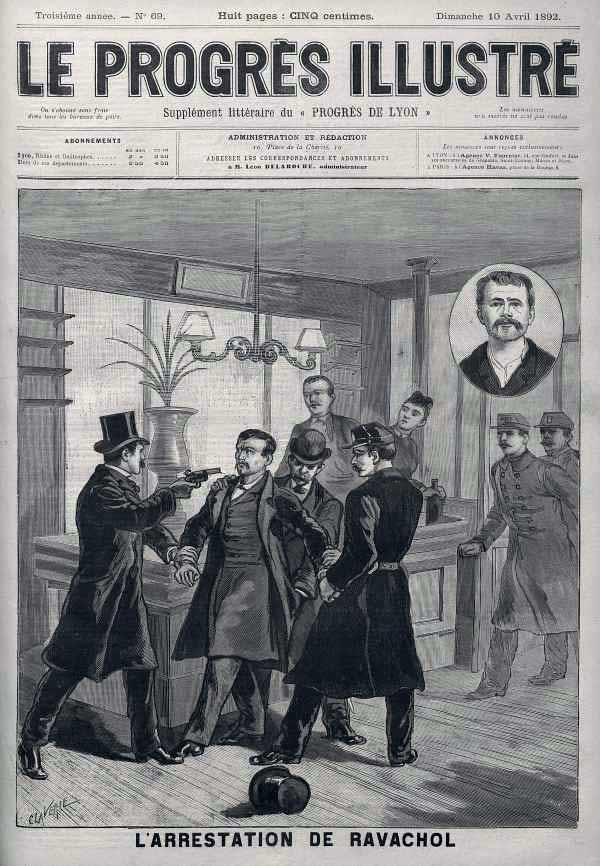
1892: Ravachol, anarchist terrorist

On this date in 1892, French anarchist François Claudius Koenigstein — better known as Ravachol — was guillotined at Montbrison for a series of bomb attacks on right-wing judges.

He took the name “Ravachol”, his mother’s, after his Dutch father ditched his mom, leaving the family in poverty.

Young Ravachol supported himself as best he could in proletarian labor and crime, as he attempted to observe* at his trial.

Ravachol, as painted by Charles Maurin.

There are many people who will feel sorry for the victims, but who’ll tell you they can’t do anything about it. Let everyone scrape by as he can! What can he who lacks the necessities when he’s working do when he loses his job? He has only to let himself die of hunger. Then they’ll throw a few pious words on his corpse. This is what I wanted to leave to others. I preferred to make of myself a trafficker in contraband, a counterfeiter, a murderer and assassin. I could have begged, but it’s degrading and cowardly and even punished by your laws, which make poverty a crime. If all those in need, instead of waiting took, wherever and by whatever means, the self-satisfied would understand perhaps a bit more quickly that it’s dangerous to want to consecrate the existing social state, where worry is permanent and life threatened at every moment.

Personal want segued into political conviction for Ravachol, whose crimes were justified by the principle of reprise individuelle.

And the political led him to reprisals of a less individual nature, when French state violence against radicals caused him to dynamite several magistrates’ homes.

He was caught in a restaurant,** brought to trial, and let off with penal servitude for life. Then another jury, intimidated by public outcry, reversed the decision and sent him to the guillotine.

The Banquet Years: The Origins of the Avant-Garde in France 1885 to World War I, which argues that anarchists “unsettle[d] the political smugness of the Third Republic … [and] challenge[d] any formulated aesthetic. The dynamism of prewar artistic activity ran a close parallel to anarchism; postwar Dada and surrealism look like its artistic parodies†.”

Anarchism, that revolutionary specter stalking fin-de-siecle Europe, burnt its fuse at both ends, but Ravachol’s falling head‡ left a legacy for his fellow-travelers. The next year, Auguste Vaillant tossed a bomb into the French Chamber of Deputies to avenge Ravachol. (Vaillant was himself guillotined, and himself avenged by Emile Henry and Sante Geronimo Caserio.)

Ravachol was also honored in a song, La Ravachole — set to the jauntily menacing tune of La Carmagnole, it cheers, “Long live the sound of the explosion!”

* This incendiary speech was cut off by the court.

** The table where the terrorist was nabbed got its own inscription: “Here ate Ravachol the day of his arrest.”

† e.g., Dadaist Marcel Janco‘s recollection:

We had lost confidence in our culture. Everything had to be demolished. We would begin again after the ‘tabula rasa’. At the Cabaret Voltaire we began by shocking common sense, public opinion, education, institutions, museums, good taste, in short, the whole prevailing order.

‡ Ravachol was guillotined midway through a parting exclamation, “Vive la Re-“. Initial newspaper reports implausibly rendered this as the patriotic classic “Vive la Republique!” rather than a much more in-character word like, oh, “Revolution”.

Weeks of controversy ensued over some witnesses’ claims that the head post-severing had actually completed the word “-publique”, a notion of a piece with the idea that the severed head survives decapitation by a few seconds. Scienticians countered that obviously excited witnesses were maybe hearing air escaping from the headless trunk and filling in the rest of the scene in their heads.

On this day..

1906: Ivan Kalyayev, moralistic assassin

On this date* in 1906, Ivan Kalyayev (also transliterated Kaliayev, or Kaliaev) was hanged by his own assent for assassinating Grand Duke Sergei Alexandrovich in Moscow.

The Warsaw-born Kalyayev tread the usual path of student radicals — expulsion, arrest, internal exile — into the camp of the Socialist-Revolutionary Party and the trendy propaganda-of-the-deed philosophy.

He was the very epitome there of what Chaliand and Blin call “the moralistic approach to terrorism”; he would slay, of course, from a profound sense of moral outrage, but contextualized that terrible act with a no less dramatic sense of personal moral responsibility.

Revolutionary fellow-traveler Boris Savinkov remembered** of our day’s principal that he

loved the revolution with the tender, profound love felt for it only by those who have made it an offering of the whole of their lives.

Kalyayev voluntarily aborted his first attempt to murder the Grand Duke when he beheld his target’s wife and child riding along in the carriage where he meant to toss his bomb. Upon successfully carrying out the hit two days later, he made no attempt to flee, and at trial requested the death sentence for himself.†

In this behavior, Kalyayev presents the fascinating specter of a terrorist whose certainty of the justice of his crime does not excuse himself from moral responsibility for the crime.

For Kalyayev, the murder itself and its mortal expiation completed its own redemptive cycle. As the murderer wrote to his mother,

I am happy to know I acted in obedience to the call of my duty … It would be ridiculous to think of saving my life now, when my end makes me so happy. I refused to sign the petition for pardon, and you know why. It was not because I have spent all my physical and mental powers; on the contrary, I have preserved all that life gave me for my last triumph in death … I could not accept pardon because it is against my convictions.

This striking attitude recommended him to Camus, who featured it in Les Justes (The Just Assassins), a 1949 play exploring the morality of terrorism.

The second act of the play features Kalyayev’s revolutionary cell disputing his decision not to follow through on his first opportunity to kill the Grand Duke. Ignacio Gotz describes our killer’s posture as, “kill only when absolutely necessary and then accept your own death as proof that murder is not permitted.”

That’s what love is — giving everything, sacrificing everything, without any hope of it being returned.

-The character Ivan Kalyayev, in Les Justes

This was not the only ethos competing for purchase on the story and the soul of Ivan Kalyayev.

The widowed Grand Duchess Elizabeth Fyodorovna visited her husband’s assassin in prison and unavailingly attempted to convert him to Orthodox Christianity. (The Grand Duchess would take her own solace in a religious life, ultimately being martyred by the Bolsheviks during the Russian Civil War; she has since been canonized.)

The Russian paper Novaya Gazeta published a fairly lengthy Russian-language biography of Kalyayev on the centennial of his entry into the executioner’s annals.

* May 23 was the Gregorian date of the execution; it was May 10 by the Julian calendar still in use in Russia at the time.

** Cited in The History of Terrorism: From Antiquity to Al Qaeda.

† With the requisite grandstanding, of course — a moral indictment given added depth by Kalyayev’s personal conduct.

We are separated by mountains of corpses, by hundreds of thousands of broken lives, by an ocean of tears and blood that is flooding the entire country in a torrent of outrage and horror. You have declared war on the people. We have taken up the challenge … You are prepared to say that there are two moralities, one for mere mortals, stating, “Thou shalt not kill; thou shalt not steal,” and another, political, morality for the rulers, for whom it permits everything.

On this day..

2003: Guillermo Gaviria Correa and nine other FARC hostages

On this date in 2003, the Colombian military mounted a raid in an attempt to free 13 hostages of the narco-trafficking guerrilla organization FARC — causing the rebels to summarily execute their hostages. (Three survived.)

Most notable among the victims of what Colombian President Alvaro Uribe called “another massacre” in that country’s long-running civil war were two men:
Scion of a political family, Gaviria had become a notable exponent of nonviolence; he and Echeverri had been captured leading an unarmed, 1,000-person solidarity march in April of 2002.

It was part of the governor’s visionary (or quixotic) bid to transform his society.

As time passes, my confidence about the benefits of spreading and promoting nonviolence in Antioquia grows stronger. It is not about using nonviolence as a tool to try to transform FARC-EP attitudes. Before we can aim that high, it is absolutely necessary for the people of Antioquia to familiarize themselves with the concept of nonviolence and to adopt it, to the best of their abilities, as their own. We need nonviolence as a society to overcome our mistakes and transform the cruel reality suffered by so many in Antioquia. Here I have pondered about what kind of message I could offer as a leader. I came to the conclusion that the only message I want and can give is about the transforming power of nonviolence, its tremendous capacity to bring out the best in human beings, even in the worst of circumstances.

Peace activist Glenn D. Paige paid Gaviria the tribute of comparing him to Mahatma Gandhi and Martin Luther King, and nominated the governor for a posthumous Nobel Peace Prize.

The diary Gaviria kept during his year’s captivity, reflecting on his “journey toward nonviolent transformation,” has been published.

On this day..

1894: Emile Henry, because there are no innocent bourgeois

On this date in 1894, Emile Henry was guillotined in Paris for bombing the Cafe Terminus three months before.

Yale history professor John Merriman (see him lecturing on the Paris Commune) explores how Henry’s bombing “ignited the age of modern terror.” (Review.) (Another.)

A bourgeois youth who, disgusted at the gross economic exploitation of the Gilded Age, had turned against his class with the fury only the apostate can command, Émile Henry had chucked a bomb into the chic cafe of the Parisian Gare Saint-Lazare a week after the execution of Auguste Vaillant.

Henry’s act killed only one, but electrified the country.

The Terminus bombing stood out in an era of violent anarchist ferment for its target selection: not a prince or president or parliamentarian, but the faceless multitudes of the bourgeoisie (formerly) secure in their metropolitan repose — who, in their indifference to the misery of workers assented to and profited from the more infamous repressions wrought by their plenipotentiaries.

Henry was completely explicit about his intent: “there are no innocent bourgeois.”

Recognizing the hopelessness of his legal position, he proudly admitted the charges against him and mounted an eloquent defense for the wider world of his version of anarchist terror.

I had returned to Paris at the time of the Vaillant affair, and I witnessed the frightful repression that followed the explosion at the Palais Bourbon. I saw the draconian measures which the government decided to take against the anarchists. Everywhere there were spies, and searches, and arrests. A crowd of individuals were indiscriminately rounded up, torn from their families, and thrown into prison. Nobody was concerned about what happened to the wives and children of these comrades while they remained in jail.

The anarchist was no longer regarded as a man, but as a wild beast to be hunted everywhere while the bourgeois Press, which is the vile slave of authority, loudly demands his extermination.

But, gentlemen of the bourgeoisie, you have reckoned a little too much without your host. You arrested hundreds of men and women, you violated scores of homes, but still outside the prison walls there were men unknown to you who watched from the shadows as you hunted the anarchists, and waited only for the moment that would be favourable for them in their turn to hunt the hunters.

… The bomb in the Cafe Terminus is the answer to all your violations of freedom, to your arrests, to your searches, to your laws against the Press, to your mass transportations, to your guillotinings. But why, you ask, attack these peaceful cafe guests, who sat listening to music and who, no doubt, were neither judges nor deputies nor bureaucrats? Why? It is very simple. The bourgeoisie did not distinguish among the anarchists. Vaillant, a man on his own, threw a bomb; nine-tenths of the comrades did not even know him. But that meant nothing; the persecution was a mass one, and anyone with the slightest anarchist links was hunted down. And since you hold a whole party responsible for the actions of a single man, and strike indiscriminately, we also strike indiscriminately.

Perhaps we should attack only the deputies who make laws against us, the judges who apply those laws, the police who arrest us? I do not agree. These men are only instruments. They do not act in their own name. Their functions were instituted by the bourgeoisie for its own defence. They are no more guilty than the rest of you. Those good bourgeois who hold no office but who reap their dividends and live idly on the profits of the workers’ toil, they also must take their share in the reprisals. And not only they, but all those who are satisfied with the existing order, who applaud the acts of the government and so become its accomplices, those clerks earning three or five hundred francs a month who hate the people even more violently than the rich, that stupid and pretentious mass of folk who always choose the strongest side — in other words, the daily clientele of Terminus and the other great cafés.

That is why I struck at random and did not choose my victims! The bourgeoisie must be brought to understand that those who have suffered are tired at last of their sufferings; they are showing their teeth and they will strike all the more brutally if you are brutal with them. …

We will not spare the women and children of the bourgeois, for the women and children of those we love have not been spared. Must we not count among the innocent victims those children who die slowly of anaemia in the slums because bread is scarce in their houses; those women who grow pale in your workshops, working to earn forty sous a day and fortunate when poverty does not force them into prostitution; those old men whom you have made production machines all their lives and whom you cast on to the waste heap or into the workhouse when their strength has worn away?

At least have the courage of your crimes, gentlemen of the bourgeoisie, and grant that our reprisals are completely legitimate.

In that pitiless war which we have declared on the bourgeoisie, we ask for no pity. We give death, and we know how to endure it. So it is with indifference that I await your verdict. I know that my head is not the last you will cut off; yet others will fall, for the starving are beginning to know the way to your great cafes and restaurants, to the Terminus and Foyot. You will add other names to the bloody list of our dead.

You have hanged in Chicago, decapitated in Germany, garotted in Jerez, shot in Barcelona, guillotined in Montbrison and Paris, but what you will never destroy is anarchy. Its roots are too deep. It is born in the heart of a society that is rotting and falling apart. It is a violent reaction against the established order. It represents all the egalitarian and libertarian aspirations that strike out against authority. It is everywhere, which makes it impossible to contain. It will end by killing you.

Clemenceau, who witnessed the beheading at the Place de la Roquette, saw in the ghastly white 21-year-old crying “long live anarchy!” in the predawn gloom this morning in 1894 “the face of a tormented Christ, terribly pale, implacable in expression, trying to impose his intellectual pride upon his child’s body … let those for the death penalty go, if they dare, to smell the blood of La Roquette.”

Five weeks later, the French president who had refused to spare Henry was himself assassinated by another anarchist.

The clip above uses an actual 1893 anarchist hymn to dynamite, that fruit of the chemical science whose pyrotechnics were held to catalyze social change. Henry, who probably hummed the song a few times in his life, must have approved the songwriter’s philosophy.

Tant mieux s’il éclate parfois en faisant beaucoup de victimes
Chez nos ennemis les bourgeois cela nous venge de leurs crimes

For more on Henry’s place in the era’s revolutionary ferment, enjoy this lecture by Dynamite Club author John Merriman as part of his course European Civilization, 1648-1945.

[audio:http://openmedia.yale.edu/projects/courses/fall08/hist202/mp3/hist202_14_102208.mp3]

On this day..