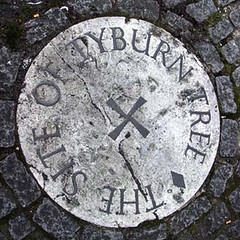
On this date in 1733, English highwayman William Gordon was hanged at Tyburn (along with three thieves unconnected to him) for stealing a hat, wig, watch and ring while “in a state of intoxication.”
Gordon is hardly notable as a criminal at a time and place hangings were ubiquitous. But the Newgate Calendar relates that he came within a whisker’s breadth of making himself very notable indeed in the history of hangings; indeed, since punching a hole in one’s own neck is far less desperate than the straits of a man expecting the rope, it’s a bit surprising that this relatively favorable experiment didn’t find more imitators.
Mr. Chovot, a surgeon, having, by frequent experiments on dogs, discovered, that opening the windpipe, would prevent the fatal consequences of being hanged by the neck, communicated it to Gordon, who consented to the experiment being made on him. Accordingly, pretending to take his last leave of him, the surgeon secretly made an incision in his windpipe; and the effect this produced on the malefactor was, that when he stopt his mouth, nostrils, and ears, air sufficient to prolong life, issued from the cavity. When he was hanged, he was observed to retain life, after the others executed with him were dead. His body, after hanging three quarters of an hour, was cut down, and carried to a house in Edgware road., where Chovot was in attendance, who immediately opened a vein, which bled freely, and soon after the culprit opened his mouth and groaned. He, however, died; but it was the opinion of those present at the experiment, that had he been cut down only five minutes sooner, life would have returned.
On this date in 1741,* at Tyburn‘s largest mass-execution of the mid-18th century, renowned cutpurse Jenny Diver was hanged along with 19 others.
Born Mary Young in Ireland around 1700, the girl was abandoned as a child but deserted a benefactor’s household to take passage to London where she meant to work as a seamstress.
What the Newgate Calendar reads as ingratitude, the modern reader might more sympathetically see as the allure of a burgeoning city for a teenager full of dreams.
Dreams may nurture the spirit, but flesh must have bread. Like countless others through time — indeed, like countless other clients of Tyburn — Jenny found metropolis less than convivial to aspirations of honest labor.
Unable to live on her stitching, Jenny found more lucrative employment for her manual dexterity in a sizable gang of thieves — of which her uncovered criminal puissance gave her mastery.
The Newgate Chronicle bursts with almost doting memoirs of her agile fingers, like this one:
[S]he procured a pair of false hands and arms to be made, and concealing her real ones under her clothes she repaired on a Sunday evening to the place of worship above mentioned in a sedan-chair, one of the gang going before to procure a seat among the more genteel part of the congregation, and another attending in the character of a footman.
Jenny being seated between two elderly ladies, each of whom had a gold watch by her side, she conducted herself with seeming great devotion; but when the service was nearly concluded she seized the opportunity, when the ladies were standing up, of stealing their watches, which she delivered to an accomplice in an adjoining pew.
Not neglecting also to celebrate the gang’s more Sting-like ruses, like this hilarious turn of the tables on a credulous cuckolder:
Jenny dressed herself in an elegant manner, and went to the theatre one evening when the king was to be present; and during the performance she attracted the particular attention of a young gentleman of fortune from Yorkshire, who declared, in the most passionate terms, that she had made an absolute conquest of his heart, and earnestly solicited the favour of attending her home. She at first declined a compliance, saying she was newly married, and that the appearance of a stranger might alarm her husband. At length she yielded to his entreaty, and they went together in a hackney-coach, which set the young gentleman down in the neighbourhood where Jenny lodged, after he had obtained an appointment to visit her in a few days, when she said her husband would be out of town.
…
The day of appointment being arrived, two of the gang appeared equipped in elegant liveries, and Anne Murphy [another thief] appeared as waiting-maid. The gentleman came in the evening, having a gold-headed cane in his hand, a sword with a gold hilt by his side, and wearing a gold watch in his pocket, and a diamond ring on his finger.
Being introduced to her bed-chamber, she contrived to steal her lover’s ring; and he had not been many minutes undressed before Anne Murphy rapped at the door, which being opened, she said, with an appearance of the utmost consternation, that her master was returned from the country. Jenny, affecting to be under a violent agitation of spirits, desired the gentleman to cover himself entirely with the bed-clothes, saying she would convey his apparel into another room, so that if her husband came there, nothing would appear to awaken his suspicion: adding that, under pretence of indisposition, she would prevail upon her husband to sleep in another bed, and then return to the arms of her lover.
The clothes being removed, a consultation was held, when it was agreed by the gang that they should immediately pack up all their moveables, and decamp with their booty, which, exclusive of the cane, watch, sword, and ring, amounted to an hundred guineas.
The amorous youth waited in a state of the utmost impatience till the morning, when he rang the bell, and brought the people of the house to the chamber-door, but they could not gain admittance, as the fair fugitive had turned the lock, and taken away the key; when the door was forced open the gentleman represented in what manner he had been treated; but the people of the house were deaf to his expostulations, and threatened to circulate the adventure throughout the town, unless he would indemnify them for the loss they had sustained. Rather than hazard the exposure of his character, he agreed to discharge the debt Jenny had contracted; and dispatched a messenger for clothes and money, that he might take leave of a house of which he had sufficient reason to regret having been an inhabitant.
Alas to say, they all can’t come off like clockwork. Jenny was caught a couple of times, dodging the noose in 1733 and 1738, sentenced on both occasions to transportation to the American colonies.
Finding little to recommend colonial Virginia, she returned illegally from both sentences at the risk of her life (she only survived her second arrest by passing herself off under an alias). The third time broke the charm, however: one is saddened to find her in her last adventure nabbed like a tyro trying to pick a younger woman’s pocket of a few shillings. The victim snatched Jenny’s wrist in the act: perhaps those nimble hands, now pushing 40, had finally slowed down.
Jenny Diver’s hands, in their time, had profited her far more than needlework could have; they had given her a life of some comfort to compensate its perils; and at the end, they afforded their owner the last indulgence of a “mourning coach,” an enclosed carriage separate from the carts that hauled this day’s other 19 (unrelated) victims.
It was a rowdy hanging day with an unusual guard detail of soldiery: one of the prisoners had reported a pending rescue attempt, and for her resources and gang affiliations, Jenny was thought to be its intended beneficiary. (If the stool pigeon was hoping his own tattling would reprieve him, he was disappointed.) For reasons related or not, the crowd was in an ugly mood, as reported by the Newgate Ordinary:
In this Manner were they convey’d through a vast Multitude of People to Tyburn, some of whom, notwithstanding the Guard of Soldiers, were very rude and noisy, hallooing, throwing Brickbats, Mud, &c. at the unhappy Prisoners, as they passed.
We also have a modern context** for the name “Jenny Diver” as one of several women mentioned in the song “Mack the Knife”:
This song is an English riff on a German tune from The Threepenny Opera, concerning its principal male character, the highwayman Macheath. (Possibly inspired by the recently-executed Jack Sheppard.)
The Threepenny Opera updated the 18th-century Beggar’s Opera, a satiric (and extraordinarily popular) production setting operatic tropes among society’s whores, criminals and castoffs.
The sequence of female names Bobby Darin rattles off in this version of “Mack the Knife” all draw from these operas: Suky (sometimes Sukey or Sukie) Tawdry and Jenny Diver are underworld women in The Beggar’s Opera who set Macheath up for arrest; Lucy Brown is The Threepenny Opera‘s version of the original character Lucy Lockit, who under either name is the daughter of a law enforcement officer in love with Macheath who helps him escape.†
One might suppose such a fortuitous connection of Jenny Divers was a calculated one, but it seems both the character’s name and the thief’s were independently and coevally drawn from the rich vein of English thieves’ cant.
Strictly coincidental.
“Diver” as street slang for a pickpocket dated back 150 years, according to Philip Rawlings, so it was a natural sobriquet for an expert thief … and for an author (whose script is chock full of suggestively-named characters — Wat Dreary, Molly Brazen, Jemmy Twitcher) conjuring such a character. There’s no direct evidence indicating that either the cutpurse or the dramatist knowingly cribbed from the other.
A pity it was for the real Jenny that art and life couldn’t imitate one another more strongly.
PLAYER. But, honest Friend, I hope you don’t intend that Macheath shall be really executed.
BEGGAR. Most certainly, Sir.—-To make the Piece perfect, I was for doing strict poetical Justice—-Macheath is to be hang’d; and for the other Personages of the Drama, the Audience must have suppos’d they were all hang’d or transported.
PLAYER. Why then Friend, this is a downright deep Tragedy. The Catastrophe is manifestly wrong, for an Opera must end happily.
BEGGAR. Your Objection, Sir, is very just, and is easily remov’d. For you must allow, that in this kind of Drama, ’tis no matter how absurdly things are brought about—-So—-you Rabble there—-run and cry, A Reprieve!—-let the Prisoner be brought back to his Wives in Triumph.
* 1740, according to the original documentation; 1741 by modern reckoning, since the new year’s onset was at the time not recognized on January 1.
† The fourth name of the sequence originally was Polly Peachum, Lucy’s rival for Macheath’s affections — but when Louis Armstrong made the first popular recording of Mack the Knife, he ad-libbed the line “Look out for Miss Lotte Lenya!” referring the actress who played PollyJenny in both the original German production and the then-current Broadway importation, and who also happened to be present at Armstrong’s recording. Darin’s subsequent (and eventually canonical) version followed that lead and replaced the original name outright.
On this date in 1388, royal retainer Thomas Usk was convicted in a one-day trial of treason and immediately drawn, hanged and beheaded at Tyburn.
The man’s end was savage: cut down alive to savor his beheading, which took nearly 30 strokes of the sword. And by all odds, this minor character’s demise would have had scant legacy as one more drop in the ocean of Albion’s blood long-ago spilt.
It was Usk’s misfortune to enter the political arena during a violently evolving political crisis in the 1380’s, when the boy-king Richard II and the English nobility struggled for power. A self-taught scrivener, Usk comes to posterity’s notice in the train of London mayor John Northampton. He was arrested for this association, and having no aspiration to become “a stinking martyr,” obligingly switched to the king’s side and informed on his former master.
This act of faithlessness made Usk (among many others) a marked man when the nobles’ faction gained a decisive upper hand after the Battle of Radcot Bridge and sat in what history records as the Merciless Parliament. Many were executed or forced into exile.
Usk would number among the victims, but before being launched into eternity — as the euphemism went — with the rope, he touched eternity from his prison cell by writing The Testament of Love (several versions linked here).
Long attributed wrongly to Usk’s contemporary Geoffrey Chaucer, the Testament — regrettably not available in anything like its original form — consists of the imprisoned author’s dialogue with Love, who descends as a spirit into his dungeon to counsel him as he pines for the affection of the (presumably) symbolic woman “Margaret”. The work is reminiscent in its dialectal style of that produced by another client of the executioner — Boethius‘ Consolation of Philosophy.
ALAS! Fortune! alas! I that som-tyme in delicious houres was wont to enjoye blisful stoundes, am now drive by unhappy hevinesse to bewaile my sondry yvels in tene! … witless, thoughtful, sightles lokinge, I endure my penaunce in this derke prison, caitived fro frendshippe and acquaintaunce, and forsaken of al that any word dare speke.
On this date in 1581, three English Catholic martyrs were hanged, drawn and quartered at Tyburn, casualties of the bloody confrontation between religious and secular power of the English Reformation.
Edmund Campion — later sainted — was the towering figure among them and the great attraction for those that thronged the Tyburn scaffold on a rain-drenched Friday.
A brilliant Oxford scholar once tipped as a possible future Archibishop of Canterbury, Campion abjured his Anglican holy orders in favor of Rome — a mortal peril in Elizabethan England.
He slipped away to Ireland, then to the continent and safety. But at age 40, after nearly a decade abroad, the missionary zeal of the converted called him back to Albion as part of a secret Jesuit mission. Hunted from the day he set foot back in Britain, he survived a year on the run, an underground minister to an illicit faith.
Though priestly investiture alone technically made him capitally liable, a government with millions of Catholic citizens grappled for some firmer ground upon which to condemn the renowned intellectual. Since Campion succumbed neither to torture nor to blandishments, nor to the surreal interludes when he was hauled out of his dungeon and made to debate with the Crown’s theologians, he was finally convicted on the strength of made-to-order witness testimony to the effect that his mission had some vague upshot of undermining Queen Elizabeth’s hold on her subjects.
In effect, it was very much like convicting him for his faith: the Anglican-Catholic conflict had crystallized, and dozens of priests would follow the route of Campion in the years to come. Between a mutually implacable state and church, either flesh or soul must burn.
Not a few of those who trod the martyr’s path would take inspiration from the beatific Jesuit — as young Henry Walpole, whose own route to Calvary is said to have begun when he was spattered by Campion’s blood this day and come full circle to his own execution 15 years later. Walpole’s embrace of martyrdom fairly glows from his proscribed tribute to Campion:
Hys fare was hard, yet mylde & sweete his cheere,
his pryson close, yet free & loose his mynde,
his torture great, yet small or none his feare,
his offers lardge, yet nothing coulde him blynde.
O constant man, oh mynde, oh vyrtue straunge,
whome want, nor woe, nor feare, nor hope coulde chaunge.
…
Yee thought perhapps, when learned Campion dyes,
his pen must cease, his sugred townge be still.
But yow forget how lowd his deathe yt cryes,
how farre beyond the sownd of tounge or quill.
yow did not know how rare and great a good
yt was to write those precious guiftes in bloode.
His best-know work was “Campion’s Brag”, the scornful nickname his foes gave to an apologia he produced while underground in England … and to whose steady words Edmund Campion proved true this day:
[B]e it known to you that we have made a league — all the Jesuits in the world, whose succession and multitude must overreach all the practices of England — cheerfully to carry the cross you shall lay upon us, and never to despair your recovery [to Catholicism], while we have a man left to enjoy your Tyburn, or to be racked with your torments, or consumed with your prisons. The expense is reckoned, the enterprise is begun; it is of God, it cannot be withstood. So the Faith was planted: so it must be restored.
But Protestant England did withstand the enterprise. The generation to come saw Catholic ideas and writing put to withering siege, Campion’s not least among them. For all the tribute of history to the man of Christlike fortitude, it is by no means apparent that the enjoyments of Tyburn and the kindred “practices of England” did not, after all, lay a cross heavier than English Catholics could bear.
On this date in 1740, five criminals were hanged at Tyburn.
Sixteen-year-old William Duell was among them. He was hanged — but he did not die. As recounted in The Newgate Calendar:
WILLIAM DUELL was convicted of occasioning the death of Sarah Griffin, at Acton, by robbing and ill-treating her. Having suffered, 24th of November, 1740, at Tyburn, with Thomas Clock, William Meers, Margery Stanton and Eleanor Munoman (who had been convicted of several burglaries and felonies), his body was brought to Surgeons’ Hall to be anatomised; but after it was stripped and laid on the board, and one of the servants was washing it, in order to be cut, he perceived life in him, and found his breath to come quicker and quicker, on which a surgeon took some ounces of blood from him; in two hours he was able to sit up in his chair, and in the evening was again committed to Newgate, and his sentence, which might be again inflicted, was changed to transportation.
On this date in 1755, a young soldier named Rowley Hanson was hanged at Tyburn.
Though the hanging, like many of its era, was for a trifling theft, the account of the Newgate ordinary (chaplain) did not dwell overmuch on the watch he stole from a London barrister.
What wrought his ruin was, the company he fell into, when a drummer [in the army]; and shocking delusion from the most abandoned, and unnatural crew of wretches, that ever the world knew, called Sodomites, first led him into that damnable violation of all laws, natural, civil, and religious.
…
all he had besides his pay arose from the advantages which he received from those worse than brutes, whom St. Paul has complimented with the name of men, who leaving the natural use of the woman, burned in their lust one towards another; men with men working that which is unseemly, and receiving in themselves that recompense of their error which was meet.
…
This unfortunate youth, who laid open the way to these short observations, declared himself much more affected with sorrow, for that he had been among so vile a set of wretches, than that he was to suffer death for the robbery … He thanked God, who had thus afflicted him, and given him time to repent; and generally when we conversed he wept very bitterly.
On this date in 1783, highwayman John Austin was hanged at Tyburn for robbing and murdering John Spicer on the road to London.
The village Tyburn on the outskirts of London had been used for public hangings dating to the 12th century. Though not the only site of executions in London, it was the iconic one. Situated at the modern intersection of Edgware and Bayswater Roads on the northeast corner of Hyde Park, the distinctive “Tyburn tree” — a triangular gallows capable of hanging over twenty prisoners simultaneously — made a foreboding landmark round which teemed thousands of spectators on execution days. Some 1,200 people were executed on this singular device.
Public executions typically began four kilometers away at Newgate Prison, where the condemned were loaded into ox carts for a two-to-three-hour procession through public streets now at the very core of London, perhaps including stops at public ale houses.
While Tyburn carved its niche during England’s age of religious bloodletting, its social role had changed significantly by the 18th century. Most of the doomed were offenders against property, often executed for stealing negligible sums or else reprieved for transport to the New World or, later, Australia. Peter Linebaugh’s The London Hanged intriguingly suggests that hangings of this era were an assertion of nascent capitalism, violently throwing off the remains of feudal labor relations. (Summarized more thoroughly in this friendly review.)
Austin was hanged, instead, on a portable gallows, a typical penitent imploring heavenly mercy and taking 10 minutes to strangle to death — the very last execution at that somber and storied crossroads.
Here’s the story of the Tyburn hangings from London writer Peter Ackroyd: