Posts filed under 'Pretenders to the Throne'

1402: False Olaf

Add comment September 28th, 2008 Headsman

On this date in 1402, a Prussian commoner was put to death on the road between Falsterbo and Skanor in Sweden for masquerading as the long-dead King Olaf IV.

The real Oluf IV Haakonsson — or Olav, or Olaf — had inherited the crowns of Denmark and Norway and a claim to that of Sweden’s but died at the age of 17 in 1387. His mother, Margaret I (or Margrethe I), the real power behind the teenager, ruled outright upon her son’s death.

She proved an able hand and far-sighted ruler, cautiously welding Denmark, Sweden and Norway into the Kalmar Union that would hold until the 16th century. They called her “the Semiramis of the North,” centuries before Catherine the Great nicked the nickname.

But her son’s youthful demise had set persistent rumors abroad — that he was poisoned, for instance, and more to the point for our purposes, that he wasn’t dead at all.

So when his spitting image was recognized, and hailed as the prince of the realm … well, back in the day, equally audacious identity theft was attempted for much smaller stakes than a throne.

Anyway, “Olaf” got some robes befitting Olaf’s station and banged out some letters to Margaret demanding his kingdom back, and Margaret said, come on down.

That goes to show how far looks will take you in life.

Unfortunately for Olaf, his regal jawline wasn’t capable of enunciating Danish speech … so the jig was up as soon as he got to Margaret. One hopes he got a good ride out of his brief masquerade, because he was burned to ashes — possibly after being broken on the wheel — along with those presumptuous letters.

The date of False Olaf’s death comes from Horace Marryat’s 19th century Scandinavian travelogues, One Year in Sweden; including a visit to the isle of Gotland and A Residence in Jutland, the Danish Isles, and Copenhagen (both free reads at Google Books). In both volumes, Marryat identifies the date as the morning before Michaelmas.

The traditional last day of the harvest season celebrated on September 29, Michaelmas was once a four-star holiday on the medieval calendar.

There’s a fair amount of commentary online saying that an “Old Michaelmas” used to be celebrated on October 10 or 11. But that looks to this writer like an interesting inversion stemming ultimately from the celebration’s fall into obscurity as the entity once known as Christendom has become more secular and less agrarian — although it’s admittedly nothing to do with the fate of False Olaf, or Semiramis for that matter.

In 1752, when England finally switched to the Gregorian Calendar, the switch took place in early September.*

For logistical pragmatism (the harvest wasn’t going to come in 11 days earlier just because the calendar changed), the then-imminent Michaelmas got pushed back 11 days to October 10. October 10 then became known as “Old Michaelmas,” no longer Michaelmas by the church calendar but the 365-day interval from when it used to be celebrated, and more importantly, the real end of the harvest season.**

In the next century, the difference between Julian and Gregorian calendars would have advanced to 12 days, placing Old Michaelmas on the 11th; by this present day, it’d be 13 days in principle, but the original meaning of the holiday and the host of cultural traditions associated with it have fallen away … so “Old Michaelmas” is a footnote still pinned to October 10th or 11th, and moderns rediscovering it suppose from the name that it’s the former date of the feast.

* People inclined to think of their death dates as foreordained in heaven’s celestial notebook protested the switch: “give us back our 11 days!” This reform, incidentally, also moved the official beginning of the New Year to January 1 from Michaelmas’ springtime “Quarter Day” counterpart, March 25; winter dates from years prior are often written with both years, e.g. 1738/9. “Old Lady Day“, April 6, is still the beginning of the fiscal year in England, and Thomas Hardy uses its traditional contractual character in Tess of the D’Urbervilles when the title character takes a farm job running through that date:

Tess was so wrapt up in this fanciful dream that she seemed not to know how the season was advancing; that the days had lengthened, that Lady-Day was at hand, and would soon be followed by Old Lady-Day, the end of her term …

At length it was the eve of Old Lady-Day, and the agricultural world was in a fever of mobility such as only occurs at that particular date of the year. It is a day of fulfilment; agreements for outdoor service during the ensuing year, entered into at Candlemas, are to be now carried out. The labourers — or “work-folk”, as they used to call themselves immemorially till the other word was introduced from without — who wish to remain no longer in old places are removing to the new farms.

… With the younger families it was a pleasant excitement which might possibly be an advantage. The Egypt of one family was the Land of Promise to the family who saw it from a distance, till by residence there it became it turn their Egypt also; and so they changed and changed.

** Residents of the former Soviet Republics who switched to the Gregorian calendar in the 20th century still celebrate both the familiar January 1 New Year’s and “Old New Year’s” 13 days later, and the same trick with the (lesser, there) holiday of Christmas too … packing four party occasions into a three-week span.

Part of the Themed Set: Semiramis.

Entry Filed under: 15th Century, 20th Century, Broken on the Wheel, Burned, Capital Punishment, Death Penalty, Denmark, Execution, Hanged, History, Known But To God, Murder, No Formal Charge, Power, Pretenders to the Throne, Prussia, Public Executions, Summary Executions, Sweden, Treason

408: Stilicho, whose execution let in the barbarians

Add comment August 22nd, 2008 Headsman

Sixteen hundred years ago today, the general whose talents were the last bulwark against barbarian conquest of the Western Roman Empire submitted for the sake of civil peace to execution at the hands of a callow boy-emperor.

The half-Vandal patrician Stilicho comes to the notice of posterity late in the reign of Theodosius the Great, the last Roman to rule both Eastern and Western Empires. At Theodosius’s death in 395, his two sons ascended the separate thrones.

Honorius, a 10-year-old child, took the purple in the west and somehow held it for 28 lackluster years that saw Rome’s long erosion finally set the realm on the slide into collapse.*

An apt commander, Stilicho had held Visigoth king Alaric at bay in two invasions of Italy (the crucial Battle of Pollentia stanched the first).


Stilicho and his wife Serena, with their child: two were executed, one was murdered.

Distrusted because of his part-barbarian parentage — and hated by the still-significant pagan community for burning the Sibylline Books — Stilicho’s service never made him popular. Because Alaric had escaped his battlefield defeats, it was whispered that Stilicho had connived with him … and Stilicho’s alliance of his legions with Alaric against other barbarians in Illyrium and Burgundy only heightened the suspicions.

We have little reliable basis to judge the possible truth of these accusations; the fundamental fact was that Rome no longer exercised its accustomed hegemony, and its principals needed to balance interests, cut deals and allocate scarce resources in ways that would have been unthinkable a century or two before.** The army itself was mostly barbarian; Alaric himself had once been a Roman officer.

In the story as related by Zosimus — a later Byzantine historian, a pagan famously abusive towards Christians and elsewhere critical of Stilicho, here softening his stance as he turns to savage his executioners — a wormtongued advisor got the ear of the still-youthful emperor and turned him against the general who was holding back the cataclysm.

Stilicho … was not conscious of any ill intention either against the emperor or the soldiers, [but] Olympius, a native of the vicinity of the Euxine sea, and an officer of rank in the court-guards, concealed under the disguise of the Christian religion the most atrocious designs in his heart. Being accustomed, because of his affected modesty and gentle demeanor, to converse frequently with the emperor, he used many bitter expressions against Stilicho, and stated that he was desirous to proceed into the east, from no other motive than to acquire an opportunity of … placing the empire in the hands of his own son, Eucherius. … Olympius, accustoming himself to visit the sick soldiers, which was the master-piece of his hypocrisy, dispersed among them, likewise, similar insinuations. … they were excited almost to madness … then dispersing themselves about the city, killed as many of the magistrates as they could lay hands on, tearing them out of the houses into which they had fled, and plundered all the town. … The tumult continued till late in the night, and the emperor fearing lest any violence should be committed against his own person also, for which reason he withdrew. … There likewise perished so great a number of promiscuous persons as is beyond all computation.

When intelligence of this reached Stilicho, who was then at Bononia, he was extremely disturbed by it. Summoning, therefore, all the commanders of his confederate Barbarians, who were with him, he proposed a consultation relative to what measures it would be most prudent to adopt. It was agreed with common consent, that if the emperor were killed, which was yet doubtful, all the confederated Barbarians should join together, and fall at once on the Roman soldiers, and by that means afford a warning to all others to use greater moderation and submissiveness. But if the emperor were safe, although the magistrates were cut off, the authors of the tumult were to be brought to condign punishment. Such was the result of the consultation held by Stilicho with his Barbarians. When they knew that no indignity had been offered to the person of the emperor, Stilicho resolved to proceed no further in punishing or correcting the soldiers, but to return to Ravenna. For he reflected both on the number of the soldiers, and that the emperor was not steadfastly his friend. Nor did he think it either honourable or safe to incite Barbarians against the Roman army.

It came to a bad end, Stilicho nobly refusing the prospect of his allies upholding his cause by arms:

Stilicho being therefore filled with anxiety concerning these circumstances, the Barbarians who were with him were very desirous of putting in force their former resolutions, and therefore endeavoured to dissuade him from the measures which he afterwards thought proper to be adopted. But being unable to prevail with him, they all determined to remain in some place until they should be better apprized of the emperor’s sentiments towards Stilicho, … In the meantime Olympius, who was now become master of the emperor’s inclination, sent the imperial mandate to the soldiers at Ravenna, ordering them immediately to apprehend Stilicho, and to detain him in prison without fetters. When Stilicho heard this, he took refuge in a Christian church that was near, while it was night. His Barbarians and his other familiars, who, with his servants, were all armed, upon seeing this expected what would ensue. When day appeared, the soldiers, entering the church, swore before the bishop that they were commanded by the emperor not to kill Stilicho, but to keep him in custody. Being brought out of the church, and in the custody of the soldiers, other letters were delivered by the person who brought the first, in which the punishment of death was denounced against Stilicho, for his crimes against the commonwealth. Thus, while Eucherius, his son, fled towards Rome, Stilicho was led to execution. The Barbarians who attended him, with his servants and other friends and relations, of whom there was a vast number, preparing and resolving to rescue him from the stroke, Stilicho deterred them from the attempt by all imaginable menaces, and calmly submitted his neck to the sword. He was the most moderate and just of all the men who possessed great authority in his time. … he never conferred military rank for money, or coverted the stipend of the soldiers to his own use. … In order that no studious person, or astrologers, may be ignorant of the time of his death, I shall relate that it happened in the consulship of Bassus and Philippus, during which the emperor Arcadius submitted to fate, on the twenty-second day of August.

This date is the end of the line for Stilicho, but hardly the end of the troubles that laid him low. A spasm of mob violence against barbarians on the peninsula ensued; the executed general’s son was among those murdered. Teutons, many of them Roman soldiers, in turn flocked to the banner of Alaric, who promptly swarmed into the enfeebled Italian lands and for the first time in 800 years sacked Rome.

Romans knew just who to blame: Stilicho’s widow, who was herself executed at the order of the Senate. In Gibbon’s relating:

The first emotions of the nobles, and of the people, were those of surprise and indignation, that a vile Barbarian should dare to insult the capital of the world: but their arrogance was soon humbled by misfortune; and their unmanly rage, instead of being directed against an enemy in arms, was meanly exercised on a defenceless and innocent victim. Perhaps in the person of Serena, the Romans might have respected the niece of Theodosius, the aunt, nay, even the adoptive mother, of the reigning emperor: but they abhorred the widow of Stilicho; and they listened with credulous passion to the tale of calumny, which accused her of maintaining a secret and criminal correspondence with the Gothic invader. Actuated, or overawed, by the same popular frenzy, the senate, without requiring any evidence of his guilt, pronounced the sentence of her death. Serena was ignominiously strangled; and the infatuated multitude were astonished to find, that this cruel act of injustice did not immediately produce the retreat of the Barbarians, and the deliverance of the city. That unfortunate city gradually experienced the distress of scarcity, and at length the horrid calamities of famine.

Alaric made out quite a lot better.

* Such, at least, is the conventional assessment of Honorius. For a take friendlier to the emperor (and less so to Stilicho), see here.

** Stilicho, incidentally, called home the second-last legion of Roman troops from Britain for use closer to home, and the island’s remaining Roman presence was cut off by barbarian incursions into Gaul during his lifetime … setting that island on its independent way (into, if you like, the Arthurian age); Honorius would later answer a plea for help from those lands with a note to the effect of, “good luck on your own.”

Entry Filed under: Ancient, Beheaded, Capital Punishment, Cycle of Violence, Death Penalty, Disfavored Minorities, Execution, History, Italy, Nobility, Power, Pretenders to the Throne, Racial and Ethnic Minorities, Roman Empire, Scandal, Soldiers, Treason, Volunteers, Wrongful Executions

1685: James Scott, Duke of Monmouth

Add comment July 15th, 2008 Headsman

On this date in 1685, the haughty Duke of Monmouth mounted the scaffold at London’s Tower Hill to suffer beheading for treason, and tipped the headsman with the words, “Here are six guineas for you and do not hack me as you did my Lord Russell. I have heard you struck him four or five times; If you strike me twice, I cannot promise you not to stir.”*

Upon this tart public reminder of his recent and infamous failure of craft, the eponymous executioner Jack Ketch quite came apart.

Monmouth, certainly, would have appreciated the advance that would bring the guillotine. Beheading by a free-swinging axe was a ghoulishly inexact procedure: bad aim, insufficient force, an untimely flinch, or the tough neck muscles of a grizzled campaigner regularly complicated the process. Jack Ketch is sometimes reported a sadist, and sometimes simply a professional hangman so rarely summoned to give a nobleman the chop that he simply lacked proficiency. Either way, he’d been on the job for a generation by this time: his reputation preceded him.

Historical fiction from the perspective of the Duke of Monmouth.

Monmouth, an illegitimate son of King Charles II, had cause to dread Ketch’s offices for the rebellious culmination of a long power struggle with his uncle, the future King James II.

The personal contest between these men for the throne of England was the echo of the decades-old struggles straining the English polity — the Reformation and the reach of royal authority.

As it became known that the king’s brother James had gone from Catholic sympathizer to Catholic convert, Protestants began maneuvering to keep him from inheriting the crown. For three years, Parliament pushed the Exclusion Bill, which would have excluded James from succession.**

Favor among the bill’s supporters settled on the Protestant playboy Monmouth — politically convenient rumors that he was actually a legitimate child began circulating. “Weak, bad, and beautiful,” this unfriendly-to-Monmouth free book has him; whatever he was, his allies in the House of Commons were handily outmaneuvered. The Exclusion measures failed, and in 1685, James II began his reign as England’s last Roman Catholic monarch.

Monmouth’s hopes had been raised, however, and he proceeded to invade England at Dorset with a somewhat ragtag army that was routed by the Protestant royal troops who remained loyal to James at the Battle of Sedgemoor — not quite the last battle fought on English soil, but the last consequential one (the last fought with pitchforks makes a livelier distinction). Monmouth was caught trying to get away in a shepherd’s disguise.

The defeated duke was reputedly not above begging the sovereign for his life; obviously, that didn’t work out. But his cause was a popular one, nearing reverence among some commoners. Jack Ketch may have had a case of the butterflies even before the duke undressed him … and as it turns out, Ketch almost left the scaffold worse than his victim.

Here is the scene in Macaulay’s words:

The hangman addressed himself to his office. But he had been disconcerted by what the Duke had said. The first blow inflicted only a slight wound. The Duke struggled, rose from the block, and looked reproachfully at the executioner. The head sank down once more. The stroke was repeated again and again; but still the neck was not severed, and the body continued to move. Yells of rage and horror rose from the crowd. Ketch flung down the axe with a curse. ‘I cannot do it,’ he said; ‘my heart fails me.’ ‘Take up the axe, man,’ cried the sheriff. ‘Fling him over the rails,’ roared the mob. At length the axe was taken up. Two more blows extinguished the last remains of life; but a knife was used to separate the head from the shoulders. The crowd was wrought up to such an ecstasy of rage that the executioner was in danger of being torn in pieces, and was conveyed away under a strong guard.

In the meantime many handkerchiefs were dipped in the Duke’s blood; for, by a large part of the multitude he was regarded as a martyr who had died for the Protestant religion.

Just the sort of soil for posthumous tall tales — that his execution was bogus and he was in hiding to return again, or had been packed off to France to become the Man in the Iron Mask. One possibly better-founded legend is that his head was set back upon its stump to sit him for what must have been a pungent portrait.

Protestant opponents of James were much thicker on the ground than the Duke’s own person, of course. They soon succeeded succeeded where Monmouth had failed.

* Slightly different versions of this address from the Duke to the executioner are recorded. Macaulay omits the “if you strike me twice” clause but adds “My servant will give you some more gold if you do the work well”; a more polite (barely) construction suggests “Do not serve me as you did my Lord Russell.”

** The factions in this dispute — the “Petitioners” (supporting the bill) and the “Abhorrers” (supporting the king) — evolved into the Whig and Tory political parties.

Part of the Themed Set: Embarrassed Executioners.

Entry Filed under: 17th Century, Beheaded, Botched Executions, Capital Punishment, Death Penalty, England, Execution, Famous Last Words, Gallows Humor, History, Nobility, Notable Participants, Pretenders to the Throne, Public Executions, Royalty, The Tower of London, Treason

1457: László Hunyadi, the death before Hungary’s rebirth

2 comments March 16th, 2008 Headsman

On this date in 1457, Hungary lost a young prospective statesman and gained a national martyr.

A tale of noble bloodshed begins as so many do with a contested succession, this one amid the confusing feudal geometry of central Europe in the shadow of the rising Ottoman Empire. The untimely (albeit unsurprising) death in battle of warlike Albert II of Germany put the crown in the hands of a son born four months after his demise — the memorably named Ladislaus the Posthumous.

Effective government, needless to say, was in the hands of more senior gentlemen: the ambitious Slovenian-Croatian count Ulrich II and the able Hungarian commander John Hunyadi.* With two strapping Hunyadi boys who were contemporaries with the nominal king, it was only a matter of time before someone wound up dead.

Hunyadi pere saw it all coming. On his deathbed in 1456, he warned his children never to find themselves both together with Ladislaus.

Events moved fast after John Hunyadi’s passing. The Posthumous, now a teenager, set Hunyadi’s longtime rival up against the boys’ claim, but Laszlo, the elder brother, killed Ulrich. Ladislaus — answering the exigencies of the moment but possibly also sincerely relieved to be rid of his overbearing uncle — immediately pardoned the killer and offered to have him over to court.

Dad would have said, “I told you so.”

Upon arrival, Laszlo was seized, sentenced to death by a kangaroo court, and summarily beheaded. The most melodramatic version has the beheading botched three times and Laszlo demanding a reprieve on the grounds that heaven had attested his innocence by preserving him. Ladislaus had his guys keep at it until heaven threw in the towel.

The Buried Lead

So, hard going for some noble tit in the borderlands 551 years ago. What’s the relevance? Why, when Hungarian artists of the 19th century groped for an expression of national identity did they hark back to unlucky Laszlo on canvas …

The Mourning of Laszlo Hunyadi (1859) by Viktor Madarász shows the pallid-faced mother and bride of the prince bewailing his body, the fatal wound unmistakably suggested while remaining artfully concealed. Painted in Paris, it won a French state medal. (Source)

… and in opera?

The answer is less to do with Laszlo’s own qualities, courageous though they may have been.

A few months after having the young man put to death, Ladislaus himself died suddenly. Contemporaries suspected poison; others thought cosmic justice punished him for breaking faith. Modern science — vulture, whose wings are dull realities! — fingers something as unromantic as a medical condition.

One way or another, Ladislaus really was Posthumous, and into the empty throne stepped Laszlo’s 15-year-old brother Matthias — who had been more judicious about his head than his brother. Matthias would reign for 32 years and enter Hungarian folklore as “Matthias the Just”.

The long and adroit span of Matthias’ career and his father’s combined to immortalize the Hunyadi name (which fell extinct after Matthias’ passing before it could produce any buzzkilling scions of more doubtful abilities) as synonymous with Hungary’s golden age.

Laszlo’s reputation mostly just comes along for the ride — had, say, Ladislaus enjoyed Matthias’ run, the elimination of a boyhood rival would have been chalked down to the regrettable griminess of the day’s political reality; had some other claimant followed him to the throne, the Hunyadi name would never have had the luster to make him an attractive operatic subject.

A Symbol of National Rebirth

But they’re called “counterfactuals” for a reason: it may have happened by chance, but it did happen that Laszlo Hunyadi’s martyrology, in the victim’s very name, conveniently totes to the present day a pleasing theme of national redemption and greatness.

As described in this (.pdf) introduction to the opera (part of an extensive collection of information about Ferenc Erkel’s operas, including a translated libretto of Hunyadi Laszlo):

In the national mythology the Hunyadi family’s descent into the underworld is symbolized by the fate of Laszlo Hunyadi, the firstborn of Janos Hunyadi who was 10 years Matyas’s senior. His life and death were preserved in the collective memory of the nation not as an independent legend but as the middle part of an imaginary trilogy about the Hunyadis. Laszlo Negyessy wrote that the opera Hunyadi Laszlo “has an air of incompleteness because the story is suspended at a point where all our senses appeal for continuation. However, this continuation and poetic justice is served in our national memory.”

Here is Erkel’s celebrated funeral march (”Gyaszindulo”) rendering the victim’s journey to his scaffold this day — the non-choral prelude to his mother’s dramatic plea for his life in the video above, and one of the signature compositions of Hungarian music**:

* John (Janos) Hunyadi wasn’t above meddling with the neighbors himself. Hungary figures as a bully of the kingdom of Wallachia (modern Romania) at this time; John Hunyadi deposed the father of, then (in the course of political alignment) helped raise to Wallachia’s throne, Vlad the Impaler, the historical model for Dracula. When Dracula was deposed in turn, he fled to the protection of Matthias Hunyadi.

** Erkel also wrote the Hungarian national anthem.

Entry Filed under: 15th Century, Arts and Literature, Beheaded, Botched Executions, Capital Punishment, Death Penalty, Execution, Famous, History, Hungary, Martyrs, Nobility, Notably Survived By, Popular Culture, Power, Pretenders to the Throne, Public Executions, Summary Executions, The Worm Turns, Treason, Wrongful Executions

532: Hypatius and Pompeius, for Byzantine sports riots

1 comment January 19th, 2008 Headsman

On this date in 532, the Byzantine Emperor Justinian I had two nephews of a former emperor executed for participating, however unwillingly, in the Nika riots.

Early in Justinian’s reign, chariot-racing factions comprised mobs unruly enough to put any modern football hooligan into traction. Riots were a periodic feature of the sport.

The historian Procopius, who is our guide to this day’s events, describes a type the modern reader will recognize:

The Empress Theodora’s cool head famously saved the day — and the empire — when her husband was ready to bolt. “May I never be separated from this purple, and may I not live that day on which those who meet me shall not address me as mistress. If, now, it is your wish to save yourself, O Emperor, there is no difficulty … as for myself, I approve a certain ancient saying that royalty is a good burial-shroud.”

They care neither for things divine nor human in comparison with conquering in these struggles; and it matters not whether a sacrilege is committed by anyone at all against God, or whether the laws and the constitution are violated by friend or by foe; nay even when they are perhaps ill supplied with the necessities of life, and when their fatherland is in the most pressing need and suffering unjustly, they pay no heed if only it is likely to go well with their “faction” …

When the clubs were pitted against each other, the civic disturbance rated a mere annoyance. But early in 532, they came into an unexpected allegiance — around, it should be said in this venue, hangings meted out to their respective partisans — and outright revolt erupted at a race on January 13. Instead of chanting their respective factional slogans, a common cry of Nika! — “Victory!” — heralded a week of mayhem that nearly ended the great Byzantine prince’s era when it had hardly begun.

This day’s victims were nephews of a former Byzantine emperor, and their lot in the affair was an unlucky one. The suspicious Justinian cast them out of the palace quite against their will, for they feared exactly what in fact came to pass: the mob proclaimed Hypatius emperor and thrust him involuntarily — he had to be physically pried from the desperate resistance of his wife — into treason.

It was an old vintage in the Roman tradition, as Edward Gibbon reflected in reviewing the perverse structural logic of civil war during an earlier era of the western empire:

[I]f we examine with candour the conduct of these usurpers, it will appear that they were much oftener driven into rebellion by their fears than urged to it by their ambition … If the dangerous favour of the army had imprudently declared them deserving of the purple, they were marked for sure destruction; and even prudence would counsel them to secure a short enjoyment of the empire, and rather to try the fortune of war than to expect the hand of an executioner.

For a few hours, the throne stood in danger. Justinian mulled flight; his remarkable wife held him steady — and on January 18, their generals trapped the rioters in the Hippodrome and slaughtered some 30,000 of them.

Back to Procopius:

[T]he populace, who were standing in a mass and not in order, at the sight of armoured soldiers who had a great reputation for bravery and experience in war, and seeing that they struck out with their swords unsparingly, beat a hasty retreat … the partisans of Hypatius were assailed with might and main and destroyed.

Hypatius and his brother were taken alive but disposed of on this day, by which time their deaths were but a drop in a bloodbath.

[T]he emperor commanded the two prisoners to be kept in severe confinement. Then, while Pompeius was weeping and uttering pitiable words (for the man was wholly inexperienced in such misfortunes), Hypatius reproached him at length and said that those who were about to die unjustly should not lament. For in the beginning they had been forced by the people against their will, and afterwards they had come to the hippodrome with no thought of harming the emperor. And the soldiers killed both of them on the following day and threw their bodies into the sea. The emperor confiscated all their property for the public treasury, and also that of all the other members of the senate who had sided with them. Later, however, he restored to the children of Hypatius and Pompeius and to all others the titles which they had formerly held, and as much of their property as he had not happened to bestow upon his friends. This was the end of the insurrection in Byzantium.

Bad luck for Hypatius and Pompeius proved a blessing for posterity (and Turkey’s contemporary tourist trade): riot-devastated space near the Hippodrome was appropriated by Justinian to build the magnificent Hagia Sophia basilica.

Entry Filed under: Ancient, Early Middle Ages, Hostages, Innocent Bystanders, No Formal Charge, Nobility, Politicians, Power, Pretenders to the Throne, Rioting, Summary Executions, Treason, Turkey

1775: Yemelyan Pugachev

3 comments January 10th, 2008 Headsman

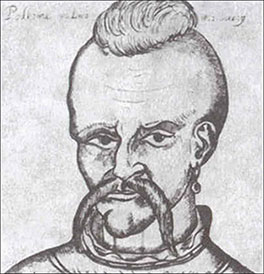
On this date in 1775, the Russian Empress Catherine the Great had Cossack rebel Yemelyan Pugachev chopped to pieces in Moscow for sustaining a major insurrection whose effects would haunt Russia for decades to come.

Pugachev’s Rebellion was the most spectacular specimen in populous family tree of 18th century peasant uprisings.

Most such disturbances were local and fundamentally unthreatening. Pugachev’s was neither.

The Cossack commander raised a revolt in the Urals in 1773, styling himself the long-lost tsar Catherine had overthrown a decade before.

Catherine was slow to see the import, but this hinterlands pretender set up a state-like bureaucracy and began issuing ukases as tsar — and one can readily discern from their content why he attracted a following:

We bestow on all those who formerly were peasants and in subjugation to the landowners, along with Our monarchic and paternal compassion … tenure of the land and the forests and the hay meadows and the fisheries and the salt lakes, without purchase and without obrok, and we liberate all the aforementioned from the villainous nobles and from the bribe takers in the city–the officials who imposed taxes and other burdens on the peasants and the whole people … [T]hose who formerly were nobles living on estates are enemies to Our power and disrupters of the empire and oppressors of the peasantry, and they should be caught, executed and hanged, they should be treated just as they, who have no Christianity, dealt with you peasants.

The insurrection speedily metastasized, and by the time a force sufficient to quash it was deployed, it had stretched itself from the Urals to the Volga.

Alexander Pushkin used the story of Pugachev’s rebellion for The Captain’s Daughter (text in English | Russian), which has been adapted to film several times — most recently in 2000.

Catherine the Great, for her part, was deeply shaken by the affair, and the “enlightened despot”, while maintaining traffic with the era’s liberal intellectual ferment, decisively turned against any reform to serfdom. Catherine’s choice, reinforced by her successors, to uphold their security with nothing but repression maintained Russian serfdom until 1861 on a staggering scale — an anchor dragging down the economy just as industrializing western Europe opened a development gap whose effects persist to this day.

Entry Filed under: 18th Century, Arts and Literature, Beheaded, Dismembered, Famous, Gruesome Methods, Popular Culture, Pretenders to the Throne, Public Executions, Revolutionaries, Russia, Soldiers, Treason


Calendar

October 2008
M T W T F S S
« Sep    
 12345
6789101112
13141516171819
20212223242526
2728293031  

Archives

Categories

Vote For This Blog

My site was nominated for Freakiest Blogger!

Recently Commented

  • ashley j: wow… i was always so interested in...
  • callie: Lol- Fiz, that is funny- sorry plenty of...
  • peter baxter: I learned about him in 1981 in college and...
  • Fiz (UK): Edith Thompson almost certainly miscarried as...
  • deadatom: hey jim…way to make light about heroes...