1865: Henry Wirz, for detainee abuse

On this date in 1865, Henry Wirz was hanged in Washington, D.C. for running a notorious Confederate prison camp.
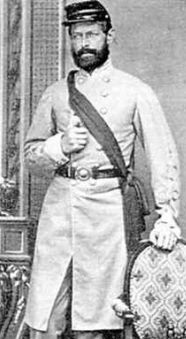
A Swiss-born doctor (“Henrich” was the real handle) whom time and tide found practicing in Louisiana at the onset of the Civil War, Wirz apparently got into the prison-guarding ranks when a war injury left him unfit for the front lines.

But it was front-line fitness in the northern army that would set the scene for his controversial hanging.

The North’s advantage in men and materiel shaped Union strategy as the war progressed, and it eventually caused the Union to halt prisoner exchanges. Exchanging casualty for casualty was a winning strategy on the battlefield, so why return to your enemy a man for a man? Besides,

[Grant] said that I would agree with him that by the exchange of prisoners we get no men fit to go into our army, and every soldier we gave the Confederates went immediately into theirs, so that the exchange was virtually so much aid to them and none to us.

Benjamin Butler (we’ve met him before)

As designed, then, the South began piling up more and more POWs to maintain with its ever-straitened resources late in the war. And if exchange was out, that really only left one form of “release”.


Andersonville Prison survivor John L. Ransom’s view of the prison, from the Library of Congress.

Andersonville — officially, Camp Sumter, located near the tiny Georgia town of Andersonville — was only established in 1864, but acquired considerable notoriety in northern propaganda for the year and change that Wirz ran it. The prisoners didn’t enjoy it much, either.

Wuld that I was an artist & had the material to paint this camp & all its horors or the tounge of some eloquent Statesman and had the privleage of expresing my mind to our hon. rulers at Washington, I should gloery to describe this hell on earth where it takes 7 of its ocupiants to make a shadow.

Union prisoner diary, July 1864. Note the prisoner’s anger at Washington — whose refusal to exchange naturally infuriated its stranded POWs

Out of some 45,000 prisoners held at Andersonville during its existence (not all at one time), nearly 13,000 succumbed to disease and malnutrition.* After the war, photos of wasted survivors inflamed (northern) public opinion, already tetchy over Abraham Lincoln’s assassination. Walt Whitman wrote of Andersonville,

There are deeds, crimes that may be forgiven but this is not among them. It steeps its perpetrators in blackest, escapeless, endless damnation.

Damnation is up to higher powers, of course, but the North wanted somebody to answer for Andersonville on this mortal coil. Lincoln’s successor Andrew Johnson overruled mooted charges against Confederate President Jefferson Davis and his Secretary of War James Seddon, leaving — in that great American tradition — Heinrich Wirz holding the bag.**

Shatner sighting!

The trial had an undeniable aspect of victor’s justice.† Even at the gallows, the Union guards chanted, “Wirz, remember Andersonville!” as the condemned man was readied for the noose, and then dropped. The hanging failed to break the man’s neck, and he strangled as the chant continued.

Southern efforts to reshape the story of Andersonville began in the lifetimes of Wirz’s contemporaries; this fulsome volume supporting the charges answered Jefferson Davis in terms that sound strikingly contemporary:

So long as Southern leaders continue to distort history (and rekindle embers in order to make the opportunity for distorting it), so long will there rise up defenders of the truth of history … To deny the horrors of Andersonville is to deny there was a rebellion. Both are historic facts placed beyond the realm of doubt.

But of course, it does not require denying the horrors of Andersonville to notice the circumstances — the privation of the entire South late in the war — and to wonder that Wirz and Wirz alone was held to account. Plenty of people think he got a bum rap.


Daughters of the Confederacy monument to Wirz. (cc) image from divemasterking2000.


Pro-Wirz marker in Andersonville, Ga. (Click for easier-on-the-eyes version, reading in part, “Had he been an angel from heaven, he could not have changed the pitiful tale of privation and hunger unless he had possessed the power to repeat the miracle of the loaves and fishes”). (cc) image from Mark D L.

Recommended for general reading: the UMKC Famous Trials page on this case, several of whose pages have been linked in this entry. A number of nineteenth-century texts by (or citing) Andersonville survivors are available from Google books, including:

Since this is a controversy of the Civil War — and one that can be engaged without having to get into that whole slavery thing — there have been thousands of published pages written about it, with many more sure to come in future years.

A few books about Henry Wirz and Andersonville

As an interesting aside, Civil War POW camps including Andersonville (but not only Andersonville) gave us the term “deadline,” which had a more startlingly literal definition in the 1860s — a perimeter beyond which prisoners would be shot on sight, which policy could make a handy stand-in for walls. Gratuitously killing an insane prisoner who crossed Camp Sumter’s “dead line” was one of the atrocities laid to Wirz, who we take it would not have been at home to the word’s decreasingly urgent appropriation in the wider culture.

* Wirz’s defense showed, to no avail, that the prisoners and the guards received the same rations, with similarly deleterious effects among both, and that the commandant was on record pleading with his superiors for more.

** Wirz’s attorney claimed that his man was offered (and refused to take) a last-minute pardon on November 9 in exchange for implicating Jefferson Davis.

† Wirz and borderlands guerrilla Champ Ferguson were the only Confederates executed for their “war crimes”. There was at least one other prison guard who faced similar charges of prisoner maltreatment, John Henry Gee; Gee was acquitted and released in 1866. (For more on the latter, see “A Little-known Case from the American Civil War: The War Crimes Trial of Major General John H. Gee” by Guénaël Mettraux in the Journal of International Criminal Justice, 2010.)

On this day..

1610: Blessed George Napier

On this date in 1610, the Catholic priest George Napier (or Napper, or Nappier) was hanged, drawn, and quartered at Oxford, having said Mass that very morning.

A son of Oxford himself who went abroad to France for ordination in his outlawed faith, Napier cut a fairly typical martyrology for the Catholic clergy. He was caught red-handed with the implements of the Roman church, refused to avow the supremacy of the English crown, and aggravated his offense by converting a fellow-prisoner to Catholicism.

This unfortunate has made headlines recently around the fourth centennial of his martyrdom, for which occasion a pilgrimage of Catholic faithful unveiled a plaque in Nappier’s honor at Oxford Castle.


Archbishop Bernard Longley blessing on Oct. 23, 2010 the marker honoring George Napier. Images on this page (cc) Joseph Shaw.

On this day..

1969: Nahashon Isaac Njenga Njoroge, assassin of Tom Mboya

At 3 a.m. this date in 1969 at a Nairobi prison that Nahashon Isaac Njenga Njoroge swung for assassinating Kenyan Luo politician Tom Mboya earlier that year … never clarifying the cryptic question he uttered to the authorities, “Why don’t you go after the big man?”

“No African leader has an abler brain or a stronger will,” wrote one Englishwoman who knew Mboya during his lifetime.*

A trade unionist during the waning days of British authority, the ethnically Luo Mboya had become a leading anti-colonial figure as the ethnically Kikuyu Mau Mau were suppressed.

During Kenya’s last years as a British possession, Mboya organized the African American Students Foundation, to provide scholarships for students from British East Africa to study in the United States.

(It was on Mboya’s AASF program — funded by John F. Kennedy — that a promising young Kenyan economics student named Barack Obama studied at the University of Hawaii in the 1960-61 academic year, and got an American girl pregnant. The reader will be familiar with those semesters’ legacy.)

Upon Kenyan independence, Mboya became a Member of Parliament and a cabinet officer, holding the Economic Planning and Development portfolio until he was gunned down on the streets outside a pharmacy on July 5, 1969.

Mboya’s murder by Njoroge,** a youth activist for the Kikuyu-dominated Kenya African National Union party (KANU) that Mboya himself had also joined, was widely read as President Jomo Kenyatta consolidating his own grip on the country and eliminating potential rivals.†

Mboya certainly had the talent and ambition to aspire to leadership in Kenya; little wonder that anger among his Luo people boiled over when Mboya was laid to rest.

Njoroge’s hanging during the pre-dawn hours this date — just days after Kenyatta banned the Luo-based opposition party, making Kenya into a one-party state — was conducted in secret; word only got out in late November, and even then it was not through an official announcement.

Njoroge remains the official lone gunman in this case, the only person ever held to judicial account for Tom Mboya’s convenient elimination. Decades later, however, many are still searching for the real story.

* From the London Times‘ unsigned July 7, 1969 obituary of Mboya.

** Allegedly by Njoroge; the assassin was not caught on the scene and Njoroge denied pulling the trigger, telling the court that Mboya was his longtime friend. (London Times, September 10, 1969) There are plenty who consider Njoroge a fall guy.

Pio Gama Pinto (1965) and Josiah Mwangi Kariuki (1975) were similar

On this day..

1817: The Pentrich Rebellion leaders

On this date in 1817, Jeremiah Brandreth, William Turner, and Isaac Ludlum or Ludlam were hanged and posthumously beheaded for the Pentrich Revolution or Pentrich Rising.


Retrace the “revolution” on a walking trail (pdf). Scenic!

The executions this day were an ugly consequence of government vigilance against subversives after the Napoleonic Wars.

There was plenty of “subversion” to spark vigilance: economic realignments of the early Industrial Revolution pushed workers into untenable positions, and a political system overgrown with archaic privileges and undemocratic veto points could not respond pending desperately needed reform.

Political Hampden clubs interested in parliamentary reform had cropped up all over England. The government viewed them as potential Robespierres.

So not only the Pentrich rising’s suppression but the rising itself were the product of the state security apparatus. A government spy named William Oliver, in the employ of Home Secretary Lord Sidmouth, infiltrated himself into radical circles in the Derbyshire village, and convinced the real radicals that nationwide protests were planned for June 9.

Expecting sympathetic labor actions in London and elsewhere, a few dozen Pentrich men assembled themselves — alone in the nation, drenched in a downpouring rain. They marched towards Nottingham, killed a man along the way, dissolved pathetically and were rounded up by soldiers in the days ahead. Forty-five stood trial for treason: three doomed to die this day, others sentenced to jail terms or transportation. It was a warning shot against airing grievances, a harbinger of more infamous top-down violence to come.


These hangings and the throwback chopping-off-heads bit succeeded by just a few hours the sudden death of the young Princess Charlotte, a sort of Princess Di moment for the Hanoverians.

Percy Bysshe Shelley, who knew from scaffold bathos, produced for the occasion a meditation on the contrasting characters of their deaths, and the incommensurate public mourning reserved for privileged royalty as against suffering subjects.

The execution of Brandreth, Ludlam, and Turner, is an event of quite a different character from the death of the Princess Charlotte. These men were shut up in a horrible dungeon, for many months, with the fear of a hideous death and of everlasting hell thrust before their eyes; and at last were brought to the scaffold and hung. They too had domestic affections, and were remarkable for the exercise of private virtues. Perhaps their low station permitted the growth of those affections in a degree not consistent with a more exalted rank. They had sons, and brothers, and sisters, and fathers, who loved them, it should seem, more than the Princess Charlotte could be loved by those whom the regulations of her rank had held in perpetual estrangement from her. Her husband was to her as father, mother, and brethren. Ludlam and Turner were men of mature years, and the affections were ripened and strengthened within them. What those sufferers felt shall not be said. But what must have been the lone and various agony of their kindred may be inferred from Edward Turner, who, when he saw his brother dragged along upon the hurdle, shrieked horribly and fell in a fit, and was carried away like a corpse by two men. How fearful must have been their agony, sitting in solitude on that day when the tempestuous voice of horror from the crowd, told them that the head so dear to them was severed from the body! Yes—they listened to the maddening shriek which burst from the multitude: they heard the rush of ten thousand terror-stricken feet, the groans and the hootings which told them that the mangled and distorted head was then lifted into the air. … When man sheds the blood of man, revenge, and hatred, and a long train of executions, and assassinations, and proscriptions, is perpetuated to remotest time. … Their death, by hanging and beheading, and the circumstances of which it is the characteristic and the consequence, constitute a calamity such as the English nation ought to mourn with an unassuageable grief. …

On the 7th of November, Brandreth, Turner, and Ludlam ascended the scaffold. We feel for Brandreth the less, because it seems he killed a man. But recollect who instigated him to the proceedings which led to murder. On the word of a dying man, Brandreth tells us, that “OLIVER brought him to this”—that, “but for OLIVER, he would not have been there.” See, too, Ludlam and Turner, with their sons and brothers, and sisters, how they kneel together in a dreadful agony of prayer. Hell is before their eyes, and they shudder and feel sick with fear, lest some unrepented or some wilful sin should seal their doom in everlasting fire. With that dreadful penalty before their eyes—with that tremendous sanction for the truth of all he spoke, Turner exclaimed loudly and distinctly, while the executioner was putting the rope round his neck, “THIS IS ALL OLIVER AND THE GOVERNMENT.” What more he might have said we know not, because the chaplain prevented any further observations. Troops of horse, with keen and glittering swords, hemmed in the multitudes collected to witness this abominable exhibition. “When the stroke of the axe was heard, there was a burst of horror from the crowd. The instant the head was exhibited, there was a tremendous shriek set up, and the multitude ran violently in all directions, as if under the impulse of sudden frenzy. Those who resumed their stations, groaned and hooted.” It is a national calamity, that we endure men to rule over us, who sanction for whatever ends a conspiracy which is to arrive at its purpose through such a frightful pouring forth of human blood and agony. But when that purpose is to trample upon our rights and liberties for ever, to present to us the alternatives of anarchy and oppression, and triumph when the astonished nation accepts the latter at their hands, to maintain a vast standing army, and add, year by year, to a public debt, which, already, they know, cannot be discharged; and which, when the delusion that supports it fails, will produce as much misery and confusion through all classes of society as it has continued to produce of famine and degradation to the undefended poor; to imprison and calumniate those who may offend them, at will; when this, if not the purpose, is the effect of that conspiracy, how ought we not to mourn?

Mourn then People of England. Clothe yourselves in solemn black. Let the bells be tolled. Think of mortality and change. Shroud yourselves in solitude and the gloom of sacred sorrow. Spare no symbol of universal grief. Weep-mourn—lament. Fill the great City—fill the boundless fields, with lamentation and the echo of groans. A beautiful Princess is dead:—she who should have been the Queen of her beloved nation, and whose posterity should have ruled it for ever. She loved the domestic affections, and cherished arts which adorn, and valour which defends. She was amiable and would have become wise, but she was young, and in the flower of youth the despoiler came. LIBERTY is dead. Slave! I charge thee disturb not the depth and solemnity of our grief by any meaner sorrow. If One has died who was like her that should have ruled over this land, like Liberty, young, innocent, and lovely, know that the power through which that one perished was God, and that it was a private grief. But man has murdered Liberty, and whilst the life was ebbing from its wound, there descended on the heads and on the hearts of every human thing, the sympathy of an universal blast and curse. Fetters heavier than iron weigh upon us, because they bind our souls. We move about in a dungeon more pestilential than damp and narrow walls, because the earth is its floor and the heavens are its roof. Let us follow the corpse of British Liberty slowly and reverentially to its tomb: and if some glorious Phantom should appear, and make its throne of broken swords and sceptres and royal crowns trampled in the dust, let us say that the Spirit of Liberty has arisen from its grave and left all that was gross and mortal there, and kneel down and worship it as our Queen.

On this day..

1793: Philippe Egalite, hoisted on his own petard

On this date in 1793, Philippe Egalite was hoisted on his own petard.

To hoist with one’s own petard actually has an older derivation, dating to siege warfare engineers whose primitive bombs, petards, were liable to detonate unexpectedly and gave their makers a “hoist.”

Still, the phrase sounds like something that ought to come right out of the French Revolution, redolent (as are petards themselves: the explosive word is from the French “to fart”) of angry mobs hoisting aristocrats, as was their wont, up on pikestaffs and lampposts and … petards. Whatever those are.

Philippe Egalite — the Duke of Orleans, as he was known for most of his life — was such an aristocrat: in fact he was royalty, the First Prince of the Blood and a cousin to Louis XVI.

And he was the member of the royal house who most vibed on the revolutionary spirit of the times, literally bankrolling the Jacobins before the Revolution. Hilary Mantel* notes that Orleans made the Palais Royal “into a sort of demagogue’s shopping centre — Paris’s most volatile public space, crammed with cafés and bookshops, a gathering place for the disaffected. In July 1789, three days of orchestrated violence began there, and culminated in the taking of the Bastille.”

Now that is a petard.

Philippe’s class-traitor politics obviously exposed him to the wrath of the monarchists — a particular irony since the man’s son Louis-Philippe, was France’s last king from 1830 to 1848 — but as usual in Paris during the Terror, it was the the Revolution devouring its children that did him in.

Despite taking up during the Revolution the very Republican name Egalite by which we know him, and despite Egalite‘s vote in the Convention in favor of guillotining Louis XVI (this is sometimes described with more melodrama than accuracy as the “decisive” vote), and despite his many years’ prior revolutionary sympathy, the Duke of Orleans was rounded up with the rest of the available Bourbons when the French General Dumouriez‘s spring 1793 defection prompted a panicky revolutionary purge in Paris. Philippe’s own son, the future king, had gone over with Dumouriez to the Austrians.

Rosebud

The Duc d’Orleans employed Choderlos de Laclos, author of the notoriously delicious Dangerous Liaisons.

As an individual citizen turned politician turned guillotinee, Egalite doesn’t much stand out in those perilous years: one more vulnerable Convention delegate outmaneuvered by Robespierre et al.

As the Daddy Warbucks of the Rights of Man, however, Egalite was a titanic figure for his contemporaries. Not many held him in high personal esteem, but movements need moneybags, and the Prince of the Blood bankrolled his from the bottomless revenues he earned on estates that would dwarf entire departements.

The Duke of Orleans and those around him, according to George Armstrong Kelly in “The Machine of the Duc D’Orléans and the New Politics” (The Journal of Modern History, Dec. 1979)

invented something novel in the history of French politics: the massive use of wealth, research, and propaganda** for the purpose of forming public opinion and swaying public policy. No doubt there are analogues among the Romans and the eighteenth-century English; but here we are almost reminded of the Rockefellers and Kennedys.

Orleans was accused of generating all this mayhem to make his own bid for the throne; those accusations may even hold a bit of truth. Such machinations remain for the conspiratorial among posterity a shadow-play upon the wall; one is left to guess at their potential dimensions from shreds of evidence and the vying vituperations of various contemporary revolutionary factions.

But if extant, such schemes were fatally compromised by the mediocrity of the figurehead who lost his head this day. Though a revolutionary in his philosophy, he was still a doughy Bourbon scion in his soul, and heir to the many shortcomings that characterized that dynasty in its decadence.

Dissolute in the enjoyment of privilege; irresolute in the conquest of power; blithely rearing wolves to his own destruction. That was some petard.


Philippe Egalite and his onetime lover Grace Elliott are the titular characters of the 2001 Eric Rohmer movie The Lady and the Duke.

* Hilary Mantel is the same author who penned the acclaimed historical novel Wolf Hall, about Thomas Cromwell.

** Kelly claims that Egalite funded Marat.

On this day..

555: Rusticus and John

On an uncertain date in the autumn of 555, a Byzantine commander and his brother were put to death for the treacherous murder of the vassal king of Lazica.

Rusticus, the commander, probably had good cause to be annoyed with Gubazes II, who ruled a borderlands realm on the eastern edge of the Black Sea, in modern-day Georgia.

Gubazes had gone from calling in Persian aid in 541 against Lazica’s Byzantine masters, to summoning Byzantine help against the Persians a few years later. Now, he was kvetching to Byzantine Emperor Justinian about the Byzantine generals he’d called for.

We’ll let J.B. Bury take it from here:

King Gubazes, who had been engaged in frequent quarrels with the Roman commanders, sent a complaint to Justinian accusing them of negligence in conducting the war. Bessas, Martin, and Rusticus were specially named. The Emperor deposed Bessas from his post, but assigned the chief command to martin and did not recall Rusticus. This Rusticus was the Emperor’s pursebearer who had been sent to bestow rewards on soldiers for special merit. He and Martin determined to remove Gubazes. To secure themselves from blame, they despatched John, brother of Rusticus, to Justinian with the false message that Gubazes was secretly favouring the Persians. Justinian was surprised, and determined to summon the king to Constantinople. “What,” asked John, “is to be done, if he refuses?” “Compel him,” said the Emperor; “he is our subject.” “But if he resist?” urged the conspirator. “Then treat him as a tyrant.” And will he who should slay him have naught to fear?” “Naught, if he act disobediently and be slain as an enemy.” Justinian signed a letter to this effect, and armed with it John returned to Colchis. The conspirators hastened to execute their treacherous design. Gubazes was invited to assist in an attack on the fortress of Onoguris, and with a few attendants he met the Roman army on the banks of the Chobus. An altercation arose between the king and Rusticus, and on the pretext that the gainsayer of a Roman general must necessarily be a friend of the enemy, John drew his dagger and plunged it in the royal breast. The wound was not mortal but it unhorsed the king, and when he attempted to rise from the ground, a blow from the squire of Rusticus killed him outright.

The Lazi silently buried their king according to their customs, and turned away in mute reproach from their Roman protectors. They no longer took part in the military operations, but hid themselves away as men who had lost their hereditary glory. The other commanders, Buzes and Justin the son of Germanus, concealed the indignation which they felt, supposing that the outrage had the Emperor’s authority. Some months later, when winter had begun, the Lazi met in secret council in some remote Caucasian ravine, and debated whether they should throw themselves on the protection of Chosroes. But their attachment to the Christian religion as well as their memory of Persian oppression forbade them to take this step, and they decided to appeal for justice and satisfaction to the Emperor, and at the same time to supplicate him to nominate Tzath, the younger brother of Gubazes, as their new king. Justinian promptly complied with both demands. Athanasius, a senator of high repute, was sent to investigate the circumstances of the assassination, and on his arrival he incarcerated Rusticus and John, pending a trial. In the spring (A.D. 555) Tzath arrived in royal state, and when the Lazi beheld the Roman army saluting him as he rode in royal apparel, a tunic embroidered with gold reaching to his feet, a white mantle with a gold stripe, red shoes, a turban adorned with gold and gems, and a crown, they forgot their sorrow and escorted him in a gay and brilliant procession. It was not till the ensuing autumn that the authors of the death of the late king were brought to justice, and the natives witnessed the solemn procedure of a Roman trial. Rusticus and John were executed. Martin’s complicity was not so clear, and the Emperor, to whom his case was referred, deposed him from his command in favour of his own cousin Justin, the son of Germanus. Martin perhaps would not have been acquitted if he had not been popular with the army and a highly competent general. (link)

“The historical importance of the Lazic War,” Bury says, “lay in the fact that if the Romans had not succeeded in holding the country and thwarting the design of Chosroes, the great Asiatic power would have had access to the Euxine and the Empire would have had a rival on the waters of that sea. The serious menace involved in this possibility was fully realised by the Imperial government and explains the comparative magnitude of the forces which were sent to the defence of the Lazic kingdom.”

On this day..

1778: Abraham Carlisle and John Roberts, triggering Benedict Arnold’s betrayal?

On this date in 1778, the hanging in Philadelphia of two elderly Quakers for treason perhaps set in motion Benedict Arnold’s notorious defection from the American Revolution.

Brotherly love was a little scarce on the ground in Philly after Gen. William Howe occupied it for the British in 1777-1778.*

British control of the cradle of liberty exacerbated the social tensions swirling around the revolution, most particularly between radical revolutionaries and those of a more go-along, get-along variety. Plenty of North Americans, after all, were British loyalists. Plenty of others were fine with political independence but horrified at the more radically democratic ideas of, say, Tom Paine.

Pennsylvania had proven a relative bastion for militants, who authored its progressive 1776 constitution and imposed loyalty tests to disenfranchise Tories and neutrals. When Howe withdrew from Philadelphia, these elements returned, loaded for bear. Or in this case, Quakers.

Members of this sect were suspect to begin with for pacifism, which is the sort of ideology that would fail a loyalty test. Spurning a Moravian pitch for exemption from the oath, the authorities complained of

persons among us, preferring a slavish dependence on the British King, from prejudice, expectation from lucrative offices, or the most unworthy motives, and screening themselves from the notice of Government, by a professed neutrality, have, nevertheless, as soon as opportunity offered declared themselves in favour of our Enemies, and became active against the Liberties of America

Abraham Carlisle and John Roberts, Quakers of an advanced age who had collaborated with the British, were thought to have done precisely this perfidious thing. In the sentence delivered to Roberts (the men had separate trials), the judge insisted his defendant was either with liberty, or against it.

Treason is a crime of the most dangerous and fatal consequence to society; it is of a most malignant nature; it is of a crimson colour and of a scarlet dye. Maliciously to deprive one man of life, merits the punishment of death, and blood for blood is a just restitution. What punishment, then, must he deserve, who joins the enemies of his country, and endeavours the total destruction of the lives, liberties, and property of all his fellow citizens; who wilfully aids and assists in so impious a cause; a cause which has been complicated with the horrid and crying sin of murdering thousands, who were not only innocent, but meritorious; and aggravated by burning some of them alive, and starving others to death. It is in vain to plead, that you have not personally acted in this wicked business; for all who countenance and assist, are partakers in the guilt.**

The wholesale purge such a logic would license was thankfully not forthcoming, because even revolutionary sentiment was uncomfortable with the treatment of these exemplars. Roberts’s own jury had to be cajoled into a conviction, and most of its members joined thousands of Philadelphians of different political stripes petitioning for mercy.

The post-Howe military governor of Philadelphia at this time was none other than Benedict Arnold, still an American general but putting himself ostentatiously into the tug-of-war over the proper revolutionary line with his profligate living and his courtship of a British-friendly merchant‘s daughter.

Arnold stuck his thumb in the radicals’ eye by hosting a party on the eve of this date’s hanging for society ladies of doubtful [revolutionary] virtue … prompting a fulsome protest by Joseph Reed

Treason, disaffection to the interests of America, and even assistance to the British interest, is called openly only error of judgment, which candour and liberality will overlook … it would astonish you to observe the weight of interest excited to pardon [Carlisle and Roberts] … will you not think it extraordinary that General Arnold made a public entertainment the night before last, of which not only common Tory ladies, but the wives and daughters of persons proscribed by the State, and now with the enemy at New York, formed a very considerable number. The fact is literally true.

Left- and right-wing factions of the revolution crystallized around Reed and Arnold, and the abuse of the more-patriotic-than-thou set soon wore on Gen. Arnold. The latter put his contacts with un-revolutionary Philadelphia to work — specifically, that merchant’s daughter’s former suitor, British Major John Andre. Arnold and Andre began their correspondence six months after Carlisle and Roberts hanged; little more than a year later, Arnold ditched the American revolution … and entered the American lexicon.

* This was the winter George Washington famously spent at Valley Forge, 20 miles from Philly.

** The sentence is as printed in in the Pennsylvania Evening Post, Nov. 6, 1778. The magistrate concludes the sentence by pointing out that in Pennsylvania’s “leniency,” treason was punished “only” with hanging … while in the mother country, it could still get you drawn and quartered.

On this day..

1991: Barrios Altos massacre

(Thanks to Michael Baney for the guest post. -ed.)

On this date in 1991, a Peruvian death squad showed up at the wrong party, and altered its country’s history.

In 1980 the Communist Party of Peru, better known as the Shining Path, launched its “People’s War,” which was never actually supported by the majority of Peruvians. Latin America had had its share of Marxist revolts, but this one was different from the others. There was nothing romantic about the revolutionaries, who wore plain clothes rather than uniforms, attacked the civilian population rather than invest significant capital to win them over to the Shining Path cause, and rose up in an effort to overthrow a democracy rather than a dictatorship.

The Shining Path was based mainly in Andean villages, but once they began to take serious losses in their own territory, they made a concerted effort to accelerate the war by pushing into the capital city, Lima. Both the Shining Path and the Peruvian military were committing deplorable human rights violations by the time Alberto Fujimori was elected president in 1990, although the vast majority of the violence had been confined to the hinterlands of the country up until then.

With Fujimori’s election, more urban-based death squad activities began. Perhaps the most famous was the November 3, 1991 massacre in the Barrios Altos neighborhood of Lima, a poor barrio only a few minutes’ drive away from the Congress and the Presidential Palace.

The murders are described in great detail in this old US government document (pdf) once classified as secret, but since declassified thanks to the efforts of expert Tamara Feinstein of the National Security Archive.

This date’s incident occurred when members of Grupo Colina (English Wikipedia entry | Spanish), a death squad that was part of the Army Intelligence Service, believed that they had identified a group of Shining Path militants having a pollada, which is a traditional fundraiser in Peru where a party is held so that chicken and beer can be sold to the neighbors. (Here’s a description, in Spanish)

A Grupo Colina squad drove to the building where this terrorist pollada was supposed to be taking place, lined the partygoers up, and extrajudicially executed them with submachine guns with silencers that the army had provided the group for the operation. Then the leader of the group, Santiago Martin Rivas, shot a young child who came running over to the body of his father. The troops got back into their vehicles, turned on their sirens to appear like they were the police in an effort to shift blame over the killings, and got drunk at the beach to celebrate.

Almost immediately it became clear that the death squad members had completely screwed up their hit.

The people who had been murdered were indeed having a pollada … not to fund the Shining Path’s Maoist agrarian war, but to fix the pipes in their building

And it transpired that that fateful night of Nov. 3, there was a different pollada being held on a different floor in the very same building. The participants of that other party fled the building, never to return. There were reports that upon searching the rooms of those who fled, police uncovered many issues of El Dario, the Shining Path newspaper.

If Grupo Colina indeed crashed the wrong party, then it not only slaughtered a bunch of innocent people — it helpfully tipped the Shining Path to the fact that the army was onto them.

In any event, the executions became a media spectacle and the police had to at least go through the motions of investigating them. At first, the government suggested that the murders might have been actually carried out by the Shining Path, and as evidence of this theory they showed that one of the people who had been killed was previously a member of a Ronda, which is a peasant patrol group that fought against cattle rustling and, in some cases, the Shining Path. But it later turned out that the man had been a member of the Rondas many years before and hundred of miles away from the killings, and it seemed extremely improbable that the Shining Path would even bother to target him.

By December 4, 1991, the US embassy in Lima was informing the Secretary of State that the Peruvian government lacked the political will to investigate the murders, and had lied about whether or not the guns used in the extrajudicial executions were equipped with silencers in “an apparently deliberate attempt to obfuscate the situation.”

The Congress created a committee to investigate the crimes, which was a real threat to the Fujimori government because the Fujimoristas did not have a majority in Congress.

This ceased to be a problem on April 5, 1992, when Fujimori suspended the Congress, permanently disbanded the Senate, and fired a good number of the judges in the country, all in total violation of the Constitution. That ended the investigation.

Under pressure from the international community, a new Congress stacked with Fujimoristas was convened to write a new Constitution, and the investigation of the Barrios Altos killing nominally restarted. When the Congress called Nicolas Hermoza Rios de Bari, the Chairman of the Joint Command of the Armed Forces to testify, he took the oppotunity to remind the Congress that the military would never tolerate being “insulted.” When hearings continued, Hermoza Rios held an impromptu tank parade directly in front of the Congress. The few brave Congressmen and women who actually desired to expose the truth about the killings got the message loud and clear: the case would never go anywhere as long as Fujimori remained president.

When it finally looked like the perpetrators might be punished, for example, Fujimori rammed a law through the Congress that provided a general amnesty to everyone who had violated human rights “in defense of the fatherland.” When a judge ruled the amnesty law unconstitutional, Fujimori’s Congress stripped the power of judicial review from the courts in cases of amnesty laws.

In a very real sense, the Peruvian government had legalized illegality. Fujimori created a system in which there was no way to punish — or even investigate — murder so long as someone, somewhere considered the crime to have been committed for patriotic reasons.

All that changed in 2000, however, when Fujimori’s government collapsed amid scandal.

An opposition figure who vowed to create a Truth and Reconciliation Commission was sworn in as into office, and Peru reaffirmed its commitment to the American Convention on Human Rights. In 2001, in a groundbreaking decision, the Inter-American Court of Human Rights ruled in its Barrios Altos case that countries cannot issue an amnesty for “serious human rights violations.” The amnesty was thrown out and Grupo Colina members were arrested.

In 2007, Alberto Fujimori was extradited from Chile, where he had traveled, to Peru. In 2009, the Peruvian courts convicted Fujimori of a number of human rights abuses, including ordering the Barrios Altos murders. Just last month, justice was finally served when the members of Grupo Colina were convicted of murder, kidnapping, forced disappearance, and conspiracy, and were given various sentences ranging up to 25 years of prison. After 19 years, the Peruvian government has finally acknowledged that the extrajudicial executions that took place during that country’s cold war were crimes that must not go unpunished.

On this day..

1920: James Daly, Connaught Rangers mutineer

The British Empire administered its last execution for mutiny on this date in 1920 — that of Irish Private James Daly of the Connaught Rangers.

A Dublin cemetery preserves a monument to Daly and his comrades.

You can take the Irishman out of Ireland, but not Ireland out of the Irishman. Something like that.

Daly was shot in Dagshai prison, India, but the reason for his death was that old familiar of his homeland’s history: nationalism.

Half a world away, London was playing the bad guys in the Irish War of Independence.

It was a conflict uniquely suited for dividing comrades; little wonder that it also divided comrades in arms.

Having lately bled for His Majesty in the War to End All Wars, plenty of Irish enlistees were nonplussed to see troops deployed to their own neighborhoods, Black and Tans shooting up their friends and family.*

From June 1920, a number of Irish Connaught Rangers “grounded arms” for their brethren in Eire, refusing to serve Britain while British troops occupied Ireland. One thing led to another, and a group (led by Daly, and his brother William) ended up trying to rush an armory to recover its weapons, opposed by other Rangers who remained loyal to the crown.

Fourteen death sentences were handed down for this show of indiscipline, but Daly’s was the only one actually carried out. The Rangers were disbanded two years later with the formation of the Irish Free State. And everyone lived happily ever after.

* Connaught Rangers had been used (without incident) to suppress the Easter Rising in 1916.

On this day..

1943: Six POWs, inscribed on a ouija board

Here lie the remains of 3529270 Pte T Jackson Manch Reg. CQMS C Anderson FMSVF, A S H Justice USS Houston. 33271– Pte Mar- … here the letters had been eaten away. At the bottom of the board there were several more words which it was not possible to decipher but still discernible were the words

Executed 1/11/43

The WW2 People’s War is an online archive of wartime memories contributed by members of the public and gathered by the BBC. The archive can be found at bbc.co.uk/ww2peopleswar.

This date’s execution — contributed to WW2 People’s War by Chris Comer of Stockport Libraries on behalf of Arthur Lane — concerns six Commonwealth POWs who were shot for attempting to escape at Thambazayat, a prison camp in Burma.

They’re remembered by a fellow-prisoner from their time at the Thailand prison camp Chungkai, where the prisoners pulled off a memorable caper with a ouija board and some of their guards.


Chungkai War Cemetery, on the site of camp’s POW burials. (From Australian War Memorial)

These executions did not reshape history. But this story of a few men under the shadow of a senseless death has the spark of humanity that animates these pages. Read it in its entirety here: part 1 | part 2.

On this day..