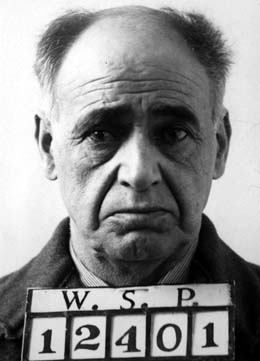
1975: Pierre Galopin, hostage of Hissene Habre

On this date in 1975, French Major Pierre Galopin was executed by Chad rebel Hissène Habré.

Galopin (English Wikipedia entry | French) had been dispatched to the former French colony to negotiate the release of two French nationals* seized as hostages by Habre’s Command Council of the Armed Forces of the North (CCFAN).

You’ll never guess it: CCFAN also took Galopin hostage.**

CCFAN tried to leverage its new captive into an arms trade. When France dragged its feet, the Chadians terminated the negotiation by having Galopin condemned by a “revolutionary tribunal” and hanged to a roadside tree.

Habre would eventually take power as President of Chad in 1982, and was subsequently welcomed on state visits to the former mother country — much to the disgust of those who remembered the Frenchman sacrificed to his ambitions. Galopin was hardly the last man to be so distinguished: as of this writing, Habre is serving an eternal prison sentence in neighboring Senegal for crimes against humanity committed during his eight years ruling Chad.

* Archaeologist Françoise Claustre and development worker Marc Combe. (A third hostage, West German doctor Christoph Staewen, had also been taken, but had quickly been ransomed by his government.) Combe escaped in 1975. Claustre was not released until 1977.

** CCFAN was also riven by a major internal division that by 1976 would split the movement into two rival organs. It has long been murky (French-language pdf here) just whose interest within CCFAN was best served by the hostile course of events.

On this day..

1946: Masaharu Homma, for the Bataan Death March

Laid down on the altar I am
Offered as a victim to God
For the sake of
My newly born country

-Verse written by Masaharu Homma awaiting execution (Source)

Imperial Japanese Lt. Gen. Masaharu Homma was shot by a firing squad outside Manila on this date in 1946 for the notorious Bataan Death March.

Homma commanded the 14th Area Army tasked with occupying the Philippines immediately after the attack on Pearl Harbor opened a Pacific War against the U.S.

Retreating from the Philippines in early 1942, U.S. Gen. Douglas MacArthur famously vowed, “I shall return.” To Homma’s grief, he did just that.

While MacArthur cogitated his revenge, Homma was finishing off the remnants of his last great stand in the Battle of Bataan. Bataan was a victory for Japan, but a bloody and protracted one; it cost the lives of some 7,000 Japanese, and the three-month battle has sometimes been credited with slowing the Japanese advance sufficiently to safeguard Australia; it also left the occupiers with an unexpectedly huge complement of POWs.

On April 9, 1942, the very day fighting ended at Bataan, transfers began for these prisoners, who would be driven by train and then marched overland some 60+ miles to Camp O’Donnell. More than 60,000 Filipinos and about 15,000 Americans endured this harrowing five- or six-day slog — the Bataan Death March.

A few books about the Bataah Death March

Early reports of the death march made grist for this wartime propaganda poster in the U.S.

This crucible of endurance, both physical and spiritual, came by its evil repute honestly; in the age of the Internet, numerous appalling testimonials are within easy reach of a web search. They recount battle-wearied men enervated by hunger and thirst, liable to be summarily shot or bayoneted for making themselves the least bit conspicuous to captors who already disdained them for having the weakness to surrender in the first place.

Some were murdered at the outset: having any Japanese “trophies” on one’s person when captured was liable to be worth a summary bullet, or a quick flash of an officer’s katana. An even more certain death sentence was falling behind on the march, and wounded prisoners could expect no quarter: they had to keep up with their compatriots or the Japanese “buzzard squad” trailing a few score meters behind every marching peloton would finish them off with any other stragglers. In different groups POWs might be thrashed or killed over any trifling annoyance; meanwhile, those suffered to live trudged under a wasting sun, nearly unnourished but for fetid handfuls scooped from mud puddles, dying on their feet hour by hour. Dehydrated to the point of madness, some snapped and ran suicidally for the tantalizing nearby village wells that marchers were prohibited from accessing.

Something like a quarter, and maybe nearer to a third, of the souls who set out on the Bataan Death March never reached Camp O’Donnell. Those who did entered new portals of torment: rent by dysentery and crowded cheek to sunken jowl, prisoners died off daily by the dozens until they were finally dispatched — often crammed like sardines into the bowels of “hell ships” — to different Japanese work camps.

The Bataan Death March was a no-question basket of war crimes, egregiously flouting existing POW treatment accords.* It’s far more questionable whether our man Gen. Homma was the right person to answer for it.

Homma had segued directly from the Battle of Bataan to the succeeding Battle of Corregidor after which he had been cashiered for a homeland desk job.

Ironically, it was an excess of leniency that helped earn Homma his enemies among the brass — the opposite of the thing that hanged him. For many who observed the postwar trial slating him with 48 war crimes violations related to the Death March, Homma was a figure more tragic than wicked, prey to returning victor MacArthur’s pique at the defeat Homma had once inflicted upon him.

Little reliable evidence could show that Homma blessed or even knew of the atrocities committed in the march, but he himself allowed during trial that “I am morally responsible for whatever happened in anything under my command.” According to Homma’s American defense attorney Robert Pelz — a biased source to be sure — the general slipped into genuine disgust and remorse during the trial as a parade of witnesses remembered their ordeals. “I am horrified to learn these things happened under my command,” Homma wrote in a note passed to Pelz at one point. “I am ashamed of our troops.”

The hanging verdict was controversial then and remains so now. “If the defendant does not deserve his judicial fate, none in jurisdictional history ever did,” MacArthur complained. He honored the mercy application of Homma’s wife Fujiko only insofar as to permit the general a more honorable execution by musketry, instead of hanging.

The bulk of the U.S. Supreme Court okayed the procedure by which the U.S. military brought that fate about, although Justice Frank Murphy issued a scorching dissent urging that in the haste and partiality of the proceedings against both Homma and General Tomoyuki Yamashita “we abandon all pretense to justice, let the ages slip away and descend to the level of revengeful blood purges.”

One who would share that sentiment was an 18-year-old Navy man who observed the trial, Bob Perske. Perske would remember this his experiences on the Philippines at the end of World War II “sharpened his sensitivies toward vulnerable persons” and influenced a subsequent career advocating for people with disabilities as well as those caught in the toils of the criminal justice system. Executed Today formerly interviewed Mr. Perske in connection with the wrongful execution of a mentally disabled man in Colorado, Joe Arridy.

* It’s worth noting that Japan was not party to the 1929 Geneva Convention on the Treatment of POWs.

On this day..

1464: Johann Breyde, via Schandbild

On April 1, 1464 mayor of Cologne Johann Breyde was chopped into quarters … with ink.

This startling image does not depict an actual flesh-and-blood execution. It is, instead, an outstanding (and conveniently for our purposes, dated) instance of an artifact from medieval Germany, the Schandbild. Such “defamatory pictures” often supplemented a Schmahbrief or “defamatory letter” — intended, as the names suggest, to impugn publicly the target over a debt, a broken promise, or some other private breach of faith.

Something like 100 of these defamations survive from late medieval and early modern Germany (approximately 1400 to 1600), many of them fantasizing about their debtors’ executions in bloodthirsty scenes that also gesture to the place that ritual, spectacle, and dishonor held on the real-life gallows. Here are a few of the more piquant examples; many more await at a wonderful Pinterest gallery here.

The purpose of defamatory letters and pictures was to bring low the reputation of their target in the eyes of a wider community — leveraging social pressure either for revenge, or to force the defamed to repair the breach.

Matthias Lentz, one of the (regrettably few) historians working on these underappreciated objects, notes* that there are even surviving contracts from Germany, Bohemia and Poland enumerating an “explicit understand about injuring a person’s reputation and bringing dishonour upon a defaulting individual … a clause called Scheltklausel that laid down the practice of publicly scolding a defaulter.” For every Schandbild or Schmähbrief there must have been a dozen other potential swindlers quietly forced by the threat of public infamy to make good their contracts.

Per Lentz, the earliest known instance of an explicit contract dates to 1379, “wherein a ducal councillor accorded a nobleman, in eventuality of the former violating the terms of the contract, the right to denounce him as a fraud by ‘posting his name on the pillory [of the councillor’s home town], or wherever he likes'” — again, linking the “mere” text to the instruments of official corporal punishment.

Nor was it uncommon for the Schmähbrief, if things got to that point, to fantasize about the debtor’s bodily suffering in brutal terms that would like invite an investigation for terroristic threats were the modern debt collection call center to deploy them in its harangue. One quoted by Lentz captioned his illustration thus:

It is customary to judge thieves and traitors according to their offences, the first is sent to the gallows, the second broken on the wheel. As I have not got power to carry out the above-mentioned acts, it is my intention to use the painter to have them painted hanging from the gallows and being tortured on the wheel.

Still, Schandbilder und Schmähbriefe meant to intimidate not physically, but socially.** It was in this capacity that the iconography of the pillory and the scaffold entered the frame: ’twas an infamy to be exposed upon them for a public crime — serving as “an indictment of those who knew the criminal … [and] a punitive stigma over his or her relatives and friends.”† Posting a slur on the repute of a prominent person — for the targets were most always people of rank, who would feel an injury to their status — taxed this same, essential, civic currency.

This is why we should let his shameful picture hang here with his coat of arms, until he has given me compensation recognized by respectable people for those unwarranted things that he and his people did … and ask all those who seek charity, who see him painted hanging, that they let him hang. (Source)

By consequence the execution imagery was strictly optional, one iconographic choice among many. From the too-few examples that survive to us it is plain that creditors delighted in their symbolic chastisement, issuing all the obloquies a grievance could devise, untethered from the confines of possible or the … sanitary.


The Schandbild frequently evinced a scatological fixation.

* Quotes form Lentz’s “Defamatory Pictures and Letters in Late Medieval Germany: The Visualisation of Disorder and Infamy” in The Medieval History Journal, vol. 3, no. 1 (2000). Lentz also has several German-language journal titles on the same topic.

** Not necessarily true of their Italian cousins, pitture infamanti. These were a similar sort of thing, but were issued not privately but by the city-states themselves against absconded offenders — a sort of quasi-execution by effigy. Many of these were painted for public spaces and removed with the passage of time so we have lost exemplars, including the products of masters — the Medici, for example, commissioned Botticelli to grace Florence with pitture infamanti of the Pazzi conspirators, which were whitewashed in 1494.

A characteristic pose for these pictures, also used in Germany, had the “victim” hanging upside-down by one foot, conjoining “metaphors of inversion” (as Robert Mills puts it) to the disgrace of the gallows. This posture is commonly thought to have inspired the “Hanged Man” tarot card.


Left: a pittura infamante study by Florentine Renaissance artist Andrea del Sarto; right: the “hanged man” card from a tarot pack.

*† Maria Boes, “Public Appearance and Criminal Judicial Practices in Early Modern Germany,” Social Science History, Vol. 20, No. 2 (Summer, 1996)

On this day..

1832: James Lea and Joseph Grindley, arsonists

The London Times of April 7, 1832 brings us this arson double hanging evidencing the extension of the rural Swing Riots labor rebellion from its southern heartland up to the West Midlands.

CONFESSION OF LEA AND GRINDLEY.

(From the Salopian Journal.)

After their trial and condemnation Lea evinced much anxiety, and expressed a wish to disburden his mind by stating all that he knew of the transactions in which he had been so deeply implicated; and he observed that he would freely do so, but that he had acted under the encouragement of certain abettors, who had bound him under the obligation of a horrible oath not to divulge the counsels and purposes in which they had engaged his assistance.

However, on Wednesday last, having, from the instruction and advice to which he was submitted, in preparation for that state to which he was so shortly to remove, satisfied himself that no compact such as we have described could be binding upon him, but, on the contrary, was in itself most iniquitous, he made a full and complete confession as to all the parties implicated in the atrocious conspiracy to which he had been a ready instrument, and in furtherance of which, it appeared, his department was to set Grindley at work under the instructions that he himself received from the prime members of the conspiracy.

Who the parties implicated are, and what Lea stated, cannot of course be here more particularly alluded to; it is, however, a striking circumstance that he again affirmed the truth of Wednesday’s confession just previous to his ascending the scaffold.

The sacrament having been administered to the unhappy men in the chapel of the jail, they were pinioned and at 12 o’clock the procession commenced moving from the chapel to the lodge, where the convicts spent a few minutes in prayer with the Chaplain, and were then conducted to the platform.

Grindley ascended first, and the rope, &c., having been adjusted, he continued to pray to Heaven for mercy until the fatal bolt was drawn. Lea ascended the steps of the scaffold apparently with more difficulty than Grindley, though both met their fate with much firmness, and with a demeanor becoming their awful situation.

Richard Whitfield, convicted at our late Assizes for writing threatening letters, and now under sentence of transportation for life, was among the convicts brought out into the yard to witness the execution; and as soon as the culprits ascended the scaffold a striking and most ominous change was apparent in his countenance. His intimate connexion with these wretched men, as already known to the public, would of itself be sufficient to account for this, if no other circumstances were within the knowledge of himself and those whose awful exit he was fated to witness; but, if the statement made on Wednesday by Lea be correct, not only Richard Whitfield, but several other parties not in custody, have an account to give, either in this world or the next, the very recollection of which might well make a man of the stoutest nerves tremble.

(An 1830s publication on the fires in Shropshire, which also summarizes the trials Lea, Grindley, and Whitfield, can be read here. -ed.)

On this day..

1702: Not Nicholas Bayard, anti-Leislerian

March 30, 1702 was the date colonial New York spared Col. Nicholas Bayard from undergoing a hanging scheduled later that same day.

A “puzzling affair, made so by frustratingly incomplete documentation,” in the estimate of Adrian Howe, whose William and Mary Quarterly article (January 1990) “The Bayard Treason Trial: Dramatizing Anglo-Dutch Politics in Early Eighteenth-Century New York City” is a key source for this post: it was certainly blowback for the execution a decade earlier of the Dutch merchant Jacob Leisler who seized control of New York in a populist rising to cement its adherence to the Glorious Revolution. Bayard, a colonial elite related to Peter Stuyvesant himself, was Leisler’s superior in the militia but abhorred the Leislerian intervention on behalf of the usurping Dutch king William III.

Bayard got his by helping to manage Leisler’s prosecution all the way to the gallows, even reputedly hosting the new royal governor at his own house while his party plied him with alcohol in a (successful) bid to overcome his reluctance to sign Leisler’s death warrant — a triumph Bayard celebrated by gaily hanging a flag from his window on the day Leisler hanged.

Unchastened by having found it necessary to flee the city for his own safety during Leisler’s hour, Bayard did not refrain from provoking a foe that grew to hate him. Anglican clergyman John Miller surveyed the city during the intervening years and noticed that team Leisler “have vowed revenge & Some Say want but an opportunity to effect their purpose.”

As the 18th century dawned, the Leislerian party — think artisans, against the magnates — was back in control of the New York’s Provincial Council, and could finally see a way to that purpose. It seized on an intemperate petition that Bayard had drawn up against the late, pro-Leislerian governor Bellomont* and turned a 1691 anti-Leisler law-and-order statue against it.

The resulting eight-day trial in early March was a nakedly political operation although New York’s Dutchmen fell a bit short of the Robespierrian standard: it’s not clear whether they really meant to hound Bayard all the way to death or whether the last-minute pardon was the plan from day one. To get it, Bayard had to submit himself as far a very grudging apology for the offense — “which by the said sentence he finds and is convinced he has committed.” Apparently this sullen abasement was enough to satisfy Team Leisler, who cut here a picture of moderation and restraint that would do their countrymen’s latter-day stereotypes proud; when a new governor arrived, Bayard’s condemnation was fully reversed and expunged, “as if no such trial had been.”

This escape and restoration left Leisler to publish a pamphlet against his treatment, An Account of the illegal prosecution and tryal of Coll. Nicholas Bayard, in the province of New-York, for supposed high-treason, in the year 1701.

* Among other things in his venturesome life, Bellomont sponsored William Kidd when he was a somewhat legitimate privateer, but eventually orchestrated Kidd’s capture as a pirate.

On this day..

1929: Luther Baker, moonshine bootlegger

On this date in 1929, Washington state hanged bootlegger Luther Baker for murdering Clark County Sheriff Lester Wood during a Prohibition moonshine raid.

The rare Democrat office-holder in heavily Republican Clark County — which faces Portland, Ore., across the Columbia River — Sheriff Wood favored his dry constituents with “a ruthless war on liquor violators.” (Oregonian, May 23, 1927)

On May 22, 1927, Wood and two deputies found and destroyed an illegal 125-gallon still operated by Baker and his brothers “in the roughest and wildest part of Clark County,” Dole Valley — when the Bakers, alert to the lawmen’s presence, ambushed them. Wood was the only fatality of the wilderness shootout. Well, Wood and Luther Baker.

Luther, aged around 59, was arrested for this along with his brother Ellis and Ellis’s 21-year-old son Ted. Young Ted’s life sentence would be overturned on appeal, but Ellis spent 30 years locked up at Walla Walla and for 28 of those years he had to bear the memory of his older brother’s walk to the gallows* — for, according to the Seattle Daily Times same-day report of the morning hanging, Ellis “was awake in his cell” just “a few yards from the gallows” during the execution and seemed “more shaken than the man who climbed the thirteen steps.”**

* And the fact that Ted, despite his exoneration, succumbed to tuberculosis a few months after Luther Baker hanged. I haven’t been able to establish whether the condition related to his stint in prison.

** Luther and Ellis were allowed a half-hour together during Luther’s last night on earth.

On this day..

1741: Henry Smith, cad

On this date in 1741 ended at Dorchester “a young Man of great Hope, who was of a proper Stature, and of a handsome Personage, of a gentle and winning Disposition, chearful in his Temper, of a noble Nature, a kind and benevolent Mind; he had a pleasant Wit, speaking very gracefully and pertinently that made him pleasant to all Company; of an Industry in Business not to be tired; and what is remarkable, tho’ he spent his Youth among Seafaring People, yet he seldom drank any Thing else but Water of Small Beer, he abhorr’d Drunkenness in others, and could not endure any light or prophane Words, with whatever Sharpness of Wit it was cover’d; in his Engagements in Trade he was regular; in his Promises punctual; to his Servants he was kind; to his Wife very loving, and so courteous and affable to all Men, that he had many Friends, and few Enemies; he preserved a Reputation in his Neighbourhood, and was esteem’d and beloved through the Circle of his Acquaintance.”

Seems like a pretty great guy, except for the part where, concealing his marriage, he debauched and impregnated a serving-girl with the unrealizable promise of wedlock — a promise poor Jane Mew was disabused of by accidentally meeting his wife.

What occurred next is only to be inferred, for the very respectable Smith (or Smythee, as the pamphlet attached to this post has it) denied the circumstantial case against him to the last. Smith directed his lover to a lying-in place to give birth in secret but Jane Mew turned up in a field with her throat slashed en route. Perhaps Smith would have stood a better chance of convincing people that she had fallen as prey to some random highway robber or a desperate suicide had he not taken flight upon the discovery of her incriminating corpse.

On this day..

1437: Walter Stewart, Earl of Atholl

On this date in 1437, the Earl of Atholl finally reached the end of a three-day carnival of public tortures and lost bowels, heart, and head for assassinating the King of Scotland.

When Atholl’s grandson Robert exploited the family’s familiar proximity to the king to admit a team of assassins on the night of Feb. 20-21 1437, it ended a strange run for James I.* James had been melodramatically kidnapped by pirates at age 12 and sold to the English — who held the Scottish king** for ransom for 18 years.

By the time James returned to native soil in 1424, he had had quite enough of being some other lord’s shuttlecock and irritated Scotch magnates — who had formerly enjoyed the run of the place and therefore dragged their feet when it came to repatriating their hostage king — by his overweening grabs at land, money, and power. One prime example that would come back to haunt him in the events of this post was the 1425 destruction of the Albany Stewarts, which netted the crown the forfeiture of three earldoms. Clients of the Albany Stewarts, like Sir Robert Graham, delivered a fair fraction of the 28 stab wounds that shuffled King James off this mortal coil.

But even James’s allies had to look sharp when it came to any demesnes not nailed down.

Our principal for today’s post, Walter Stewart by name, was one of these. James’s uncle and supporter, and the son of King Robert II, Stewart/Atholl had pushed for the magnates to ransom James.

Putatively seen as the king’s ally, Atholl’s complicity in regicide made him a byword for treachery to outraged Scottish chroniclers; the apparent grab for the throne led his captors to put a “corone of papir … upon his hed, the which was all abowte depaynetid with jubettes, and for the more dispite and shame to hym was writyne with thes wordes, TRAITOUR, TRAITOUR, TRAITOUR,” according to The Dethe and False Murdure of James Stewarde, Kyng of Scotys.

In a 1992 article on events† historian Michael Brown noted that what Atholl had added to his holdings through his nephew the king was the earldom of Strathearn, and it was but tentatively held: granted for Walter Stewart’s lifetime only, it would revert to the king with the septaugenarian’s death, leaving his heirs no better off than Walter’s own efforts had made them circa 30 years before.

Brown depicts the aging lord as a savvy operator who “would increasingly have despaired of keeping the earldom of Strathearn in his family … [as] a consequence of James’s general opportunism when it came to increasing the revenues of the crown.” A couple of specific adverse interventions that trimmed Atholl’s estates might have presaged — in the earl’s mind, at least — a potential royal move against his position, a move that Atholl would be best advised to check preemptively or never at all. Who could say in February of 1437 whether the Stewarts would by March or April still be royal confidantes in any position to have “left the Kynges chamburs doore opyne; and … brussed and blundird the lokes of hem, yn such wise that no man myght shute hem”?

If we’re not sure of exactly why they did it, we do know very clearly that the plot failed as a coup attempt. Both the queen and the six-year-old heir James II survived that evil night, and James’s violent deposition met not support, but horror. Within weeks the conspirators were hunted to ground. Atholl, for his part, protested his innocence of the regicide all the way to the end, a protest that neither contemporaries nor historians have much credited.

And his death declar’d that there is nothing more popular than justice, for they who were wont to detract from him whilst he was alive, now he as dead had most flagrant desires after him, insomuch that the Nobles, as soon as they heard he was murder’d, came in of their own accord from their respective countries and before a tryal was appointed they voluntarily sent out into all parts to apprehend the murderers and bring them to justice.

Very many of them were taken. The principal of them was put to new and exquisite kinds of death. The rest were hang’d. The chief heads in perpetrating the wickedness were reckon’d to be Walter Earl of Athole, Robert his nephew by his son, and their kinsman Robert Graham.

The punishment of Walter (because he was the chief author and instigator of the whole plot) was divided into three days suffering. In the 1st he was put on a cart wherein a stork-like swipe [crane] or engine was erected, and by ropes let through pullies was hoisted up on high and then, the ropes being suddainly loos’d, he was let down again almost to the ground with grievous pains by reason of the luxation [stretching] of the joints of his body. Then he was set on a pillory that all might see him, and a red-hot iron crown set on his head with this inscription, that he should be called King of all Traitors. They say the cause of this punishment was that Walter had been sometimes told by some female witches (as Athole was always noted to have such) that he should be crown’d king in a mighty concourse of people. For by this means that prophecy was either fulfill’d or eluded, as indeed such kind of predictions do commonly meet with no other events. The day after, he was bound upon a hurdle and drawn at an horse-tail thro’ the greatest street in Edinburgh. The 3rd day he was laid along upon a plank in a conspicuous place and his bowels were cut out whilst he was alive, cast into the fire, and burnt before his face. Afterwards his heart was pulled out and cast into the same fire. Then his head was cut off and expos’d to the view of all, being set upon a poll in the highest place of the city. His body was divided into four quarters and sent to be hang’d up in the most noted places of the best cities of the kingdom.

After him, his nephew was brought forth to suffer, but because of his age they would not put him to so much pain; and besides, he was not the author, but only an accomplice in another man’s wicked design, as having obey’d his grandfather therein, so that he was only hang’d and quarter’d.

But Robert Graham, who did the deed with his own hand, was carried in a cart thro’ the city, and his right hand was nail’d to a gallows which was set up in the cart, and then came executioners which did continually run red-hot iron spikes into his thighs, shoulders, and those parts of his body which were most remote from the vitals, and then he was quarter’d, as the former. After this manner was the death of James vindicated.

‘Tis true, ’twas a cruel one, but ’twas reveng’d by punishments so cruel that they seem’d to exceed the very bounds of humanity. For such extreme kinds of punishment do not so much restrain the minds of the vulgar by the severity as they do make them wild to do or suffer any thing; neither do they so much deter wicked men from committing offences by their acerbity as they lessen their terror by often beholding them, especially if the spirits of the criminals be so hardened that they flinch not at their punishment. For among the unskilful vulgar a stubborn confidence is sometimes prais’d for a firm and stable constancy.

–Rerum Scoticarum Historia (1582)

* James’s successors handed down the throne, father James to son James, right down into the Stuart dynasty that came to rule England as well. This makes our James I an ancestor of such scaffold worthies as Mary Queen of Scots and Charles I.

** James was kidnapped in March 1406. His father Robert III died in April of the same year.

† “‘That Old Serpent and Ancient of Evil Days’: Walter, Earl of Atholl and the Death of James I,” The Scottish Historical Review, Vol. 71, No. 191/192, Parts 1 & 2 (Apr. – Oct., 1992).

On this day..

1823: John Newton, wife-beater

From the Hampshire Telegraph and Sussex Chronicle, March 31, 1823.

SHOCKING MURDER — At Shrewsbury Assizes, on Saturday, John Newton, a Farmer, living at Severn-Hall, near Bridgenorth, was tried for the Wilful Murder of his wife, Sarah Newton, by violently beating and striking her, by throwing her down on a sledge, and by kicking her, (she being five months gone with child), in consequence of which she languished three hours and then expired.

The provocation on her part was — having misapplied the trifling sum of three shillings.

Her children stood by at the time (the eldest not more than eight years of age) and exclaimed — “O dear! do not dad!”

The evidence clearly proved the initial act of the prisoner.

Mr. Justice Best, in passing sentence, spoke to the following effect: —

John Newton, you have been convicted, upon the clearest and most satisfactory evidence, of the dreadful crime of murder — a crime upon which Heaven has imposed a sentence. It was recorded in Holy Writ, that, “Whosoever shed a man’s blood, by man his blood should be shed.” You have deprived of life one whom it was your duty to protect and cherish: and for what cause? Why, because your wife had misapplied the trifling sum of three shillings.

Your humane and kind-hearted creditor had endeavoured to prevent you exercising your brutal chastisement upon your wife, and he told you he would rather lose this trifling sum than you should punish your wife. You promised him that you would not beat her. Notwithstanding this promise, notwithstanding she was in a state that not even a monster would have laid violent hands upon her, the dreadful threat you had uttered four hours before was put into execution.

You beat her to the ground; you kicked her on a part of her body which might almost in all cases have caused death, but especially in the state she was in. You acted as a most inhuman father, destroying that life which owed its origin to you; and you killed your wife at a time when it might be thought that the most savage, the most ferocious of mankind would be disarmed.

When she was lying in an alarming state from the bruises she had received at your hands, you refused to send for medical advice, and when she was lying on the floor you abused her in addition to your cruel conduct.

After thirty years’ experience in Courts of Justice, I confess I have never witnessed such savage conduct as yours. I hope to God you will obtain that mercy you were not disposed to show here. May you apply to him with a contrite and repentant heart, who is the distributor of all mercy, during the very short time you have to live; for no mercy can you obtain on this side the grave. You will have the assistance of a clergyman, who is better qualified than I am to teach you true repentance: and may God of his infinite mercy, so dispose your heart that it may be better fitted for another world.

There now remains for me only the painful duty of passing the sentence of the law — which is, that you be taken hence to the place whence you came, and thence to the place of execution, on Monday next, where you shall be hanged by the neck until you are dead, and your body shall then be given to the surgeons for dissection, and may God have mercy on your soul!

The prisoner, who is a robust-looking man of forty, showed little emotion during the trial, or when the verdict was given: but while the Judge was addressing him he seemed bewildered — looking wildly about him — moved, as if involuntarily, up and down as sick and once or twice attempted to turn away. He once put his handkerchief to his face, but did not want to shed tears.

On this day..

1945: Eliyahu Bet-Zuri and Eliyahu Hakim, Lord Moyne’s assassins

British-occupied Egypt on this date in 1945 hanged two young Jewish assassins for slaying the British plenipotentiary to the Middle East.

Walter Edward Guinness was heir to the barley beer fortune and a Tory politician of near 40 years’ standing. “Lord Moyne”, to call him (as history does, and as we will henceforward) by his aristocratic honorific, allied with his former rival Winston Churchill in the 1930s as a staunch foe of placating Hitler, eventually serving several roles in Churchill’s wartime government.*

The last and perforce most famous was Resident Minister of State in Cairo from January 1944, where he directed British affairs in North Africa, Persia, and the Middle East, crucially including Mandatory Palestine.

Such a figure must necessarily represent many things to different subjects, but to Zionists he represented the hostility to their project of both his own person and (more importantly) of London. While there is endless nitpicking about the man’s precise degree of disfavor for Jewish people or interests, “Lord Moyne was the highest British official in the Middle East,” in the words of Yitzhak Shamir, the emigre terrorist who orchestrated the hit and would one day become Prime Minister of Israel. “Because we fought against the British in this area, we took him for a target. This was the main reason for his assassination.” Nothing personal. (Maybe a little personal.)

On November 6, 1944, two of Shamir’s young cadres in the late Avraham Stern‘s militantly anti-British Lehi network, Eliyahu Bet-Zuri (Ben Suri) and Eliyahu Hakim, ambushed Moyne as his limousine pulled up at his villa, and shot him dead with pistols. (They also killed Moyne’s driver, a Lance Corporal named Arthur Fuller.) Once their affiliations became apparent it was Jewry’s turn to bask in the collective censorious scowl that minorities everywhere can anticipate given any perceived ethnic affinity to the latest atrocity’s author. These sortings-out from the London Times would do almost word for word for whatever horror tomorrow’s news might bring.


London Times, Nov. 10, 1944


London Times, Jan. 29, 1945

Similarly, Lord Moyne’s killers took every pain to link their martyrdom to Jewish/Zionist patriotism, no matter any moderate rabbi’s attempt to wash his hands of it.

Raised in Mandatory Palestine, both Bet-Zuri and Hakim spoke Arabic but insisted on speaking only Hebrew in the Cairo court. They went to the gallows singing the hymn “Hatikvah” — later to become Israel’s national anthem.

In the near term, their deed hardened hearts: “If our dreams for Zionism are to end in the smoke of an assassin’s pistol, and the labors for its future produce a new set of gangsters worthy of Nazi Germany, then many like myself will have to reconsider the position we have maintained so consistently and so long in the past,” Churchill snarled to Parliament.

But in fact the British reconsideration was soon seen to run counter to the dangerous meddling policing these “gangsters” would have demanded. Within only a few years London struck its colors in the Levant. Bet-Zuri’s and Hakim’s cause triumphed, and they too with it: as Prime Minister, Yitzhak Shamir arranged for the hanged men’s remains to be repatriated from Egypt; today, both rest in honor at Mount Herzl.

* There was a personal side to Lord Moyne’s anti-Naziism: his son, Bryan, had been abandoned by his socialite wife Diana Mitford … who became Diana Mosley in 1936 when she married British Union of Fascists chief Oswald Mosley, in a ceremony held at Joseph Goebbels‘ home no less.

On this day..