1917: Private Joseph Bateman, shot at dawn

On this date in 1917, Black Country volunteer Joseph Bateman was shot for desertion.

The 2nd Battalion South Staffordshire Regiment private was among the earliest wave of young Britons to sign up, in late 1914 — but his three years of service were marked by intermittent AWOL episodes, including when the unit was on home soil, far from the front lines. It’s not clear the reason for this eventually fatal pattern.

For ninety years, Bateman was, like most “shot at dawn” soldiers, persona non grata for official war commemorations. His name was finally added to Wordsley‘s Great War cenotaph in 2007, thanks to the tireless campaigning of an interested teacher/historian named Graham Hodgson.*

Press reporting on Hodgson’s campaign subsequently turned up Bateman’s relations, including a grateful granddaughter whose only photo of Joseph Bateman was “marked by lipstick where her grandmother kissed it after learning of his death.” (BBC)

He’s buried at Rocquigny-Equancourt British Cemetery in the Somme.

* Unfortunately, Mr. Hodgson was killed in a car accident on Cyprus shortly afterwards. At the time he apparently had a historical novel about Private Bateman in progress, but I can find no indication that it’s been posthumously published; however, Bateman does figure in To War with God: The Army Chaplain who Lost his Faith by Peter Fiennes. Fiennes’s grandfather, the titular army chaplain, stayed up all night consoling Joseph Bateman in the hours ahead of his execution.

On this day..

1958: Sass Kalman and Istvan Hollos

Ethnic Hungarians Sass Kálmán and Istvan Hollos were shot in Romania on this date in 1958. Links in this post are in Hungarian.

Both were condemned — along with a third man, Vilmos Balasko, his sentence subsequently commuted — as the result of a mass trial earlier that year of alleged traitors and saboteurs.

The trial targeted the large ethnic Hungarian population in Transylvania, bordering Hungary, in the aftermath of the 1956 Hungarian Revolution. There the feared Romanian secret police rolled up culprits for offenses ranging from subversive leaflets in simpatico with failed revolution, to a general penumbra of perceived unreliable loyalty.

Istvan Hollos, a lawyer and teacher, had fought in the German-allied Hungarian army during World War II and unsuccessfully attempted to flee to Switzerland afterwards. Sass Kálmán was a Calvinist pastor once close to anticommunist peasant party leader Ferenc Nagy; a previous brush with political scrutiny had been shielded by towering general Pal Maleter, but Maleter’s participation in (and execution for) the 1956 revolution played against Kálmán too. (A third man, pastor Vilmos Balasko, was condemned to death in the same mass trial but he received clemency and was released a few years later in a general amnesty. He lived until 2004 and published a memoir after the fall of the Iron Curtain.)

Kálmán’s Reformed Church, whose adherents are predominantly ethnic Hungarians in Transylvania, treat Kálmán as a martyr and have pressed hard for his official rehabilitation — thus far, to no avail.

On this day..

1892: Jozef Lippens and Henri De Bruyne, Congo Free State hostages

On this date in 1892,* Belgian colonial agents Jozef Lippens and Henri De Bruyne were executed by the rebelling native king who had taken them hostage.

The gentlemen were a lieutenant (Lippens) and sergeant (De Bruyne) of the Force Publique colonial deployment in Belgian Congo.

Their misfortune was proximity when in 1892, rivalry over control of the eastern Congo ivory trade brought the European power into war with its erstwhile Zanzibar “Arab”** allies. (The Arabs were slave-traders, affording a classic humanitarian intervention pretext … which obviously is pretty rich coming from Belgium.)

The Congo-Arab War — which in practice was fought on both sides mostly by black Congolese troops — saw in its opening months the defection of one of the Arabs’ best commanders, Gongo Lutete,† a manumitted former slave who had risen to leadership of the Batetela and Bakussu tribes. In revenge when he switched sides to join the Europeans, the Arab leader Sefu bin Hamid seized Lippens, Belgium’s representative Resident at Kasongo, and De Bruyne, Lippens’s aide — demanding the return of his disloyal general and a settlement of hostilities as the price for these European envoys’ lives.

In fact, it was De Bruyne himself who had the honor of delivering the demand. Escorted by his captors to the eastern bank of the Lomami River on November 15, the emaciated De Bruyne shouted across to Belgian officers on the western side the terms of his captivity. The Belgians, who had the river covered by gunners, urged their countryman to leap into the water and swim for it; De Bruyne declined to abandon his comrade. “By this act of self-abnegation he was to go down in the Belgian folklore as a national hero.” (European Atrocity, African Catastrophe: Leopold II, the Congo Free State and its Aftermath)

His flight would have meant certain death for Lippens; instead, both paid the forfeit together after the Belgian commander Francis Dhanis repelled Sefu bin Hamid’s attack and smashed across the Lomani. According to the account of the war by Sidney Langford Hinde, one of many British officers employed by the Force Publique,

News also reached us here of the murder of Lippens and Debruyne, two officers representing the Free State Government, resident at Sefu’s court in Kasongo. We found out later that, after the defeat of Sefu on the Lomami (which resulted in the death of his cousin and several other noted chiefs), an advance party of the retreating Arabs arrived at Kasongo, and, by way of individual revenge, murdered the two Residents. It is probable, since we have no actual proof to the contrary, that this was done without Sefu’s orders. Twelve of these people, armed with knives hidden in their clothing, made some trivial pretext for visiting Lippens at the Residency, who, however, refused to come out and interview them. They then said that news of a big battle had come to them from Sefu; on hearing which Lippens came out, and, while talking in the verandah, was promptly and silently stabbed. Some of the murderers entering the adjoining room, found Debruyne writing, and killed him before he had learned the fate of his chief. When Sefu returned to Kasongo, a day or two afterwards, he gave orders that the pieces of Debruyne’s body should be collected and buried with Lippens, whose body, with the exception of the hands (which had been sent to Sefu and Mohara of Nyangwe as tokens), was otherwise unmutilated. The strong innate respect for a chief had protected Lippens’ body, while that of his subordinate had been hacked to pieces.

A curious fatality followed these twelve murderers. The chief of the band, Kabwarri by name, was killed by us in the battle of the 26th of February with Lippens’ Martini express in his hand. Of the others — all of whom were the sons of chiefs, and some of them important men on their own account — four died of smallpox, one was killed at Nyangwe, one in the storming of Kasongo, and the remaining six we took prisoners at Kasongo. During the trial they one day, though in a chained gang, succeeded in overpowering the sentry, and thus escaped. One was drowned in crossing a river; three more were killed, either fighting or by accident, within a month or two of their escape; and the two remaining we retook and hanged; — which brings to me a curious point. Of the many men I have seen hanged nearly all died by strangulation, and not by having the neck broken. As compared with shooting, hanging seems to me the less painful death; the wretched being becomes insensible in a very few seconds, whereas a man shot will often require a coup de grace, no matter how carefully the firing party is placed.


Monument to De Bruyne and Lippens in Blankenberge. (cc) image from Zeisterre.

* December 1 is the commonly attributed date for the hostages’ butchery but it can’t be documented with certainty.

** As we’ve noted elsewhere, the term “Arabs” as used for eastern Congo by European sources in this period denotes Muslim bantus. We’re following the prevailing term here, whatever its imprecision.

† As a reward for his services, Gongo Lutete was spuriously accused of treason by a Belgian officer in September 1893 and speedily executed without any form of superior approval.

On this day..

1903: Phil Davis, Walter Carter and Clint Thomas, multiracial lynching

From the Dec. 1, 1903 Augusta (Ga.) Chronicle:

On this day..

1881: Percy Lefroy Mapleton, police sketch milestone

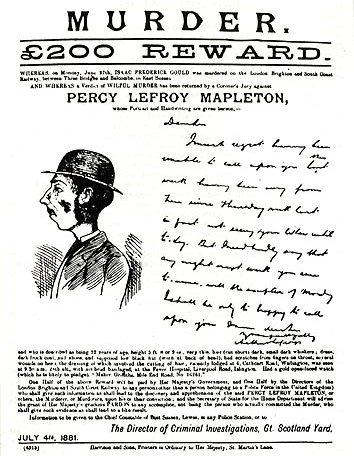
When Percy Lefroy Mapleton plunged through the gallows-trap at Lewes Prison on this date in 1881 for robbing and murdering a train passenger, he had the consolation of a minor milestone in policing history: he was the bobble-headed subject of the first published police sketch.

Mapleton (he gave his name initially as Percy Mapleton Lefroy) entered the annals of crime lore at Brighton‘s Preston Park railway station on the 27th of June, a mere five months before his execution. On that occasion, he presented himself, bloodied and bedraggled, to a ticket agent with a complaint that he’d been assaulted on the train by two unknown men.

Maybe it was the gold watch chain dangling out of his boot (the man said he’d stashed it there for safekeeping) or an unexplained couple of Hanoverian medals he possessed (the man didn’t know anything about those!), or his keen desire to ditch the investigators and return immediately to London for some business (so why take the train to Brighton in the first place?). There wasn’t quite sufficient reason to hold him, but there was ample cause to give him a minder for his ride back to London.

Apparently Sgt. George Holmes hadn’t been fully briefed on suspect escort protocol.

During their ride, police searching the rail line by which the strange bloodied man had arrived turned up the body of an elderly coin dealer named Isaac Gold, the sort of character who would have pocket watches and Hanoverian medals to steal. A telegraph sent from the nearest station arrived ahead of Mapleton’s train, reading

Man found dead this afternoon in tunnel here. Name on papers “I Gold”. He is now lying here. Reply quick.

At this point, explicit instructions to keep eagle eyes on Percy Mapleton would hardly seem to be required — yet they were indeed forthcoming. Despite what headquarters and common sense were telling him, however, Sgt. Holmes allowed the murder suspect to talk him into letting him “change clothes” unsupervised in a house. And so began a nationwide manhunt.

This manhunt would be distinguished by a police sketch of the fugitive created with the help of Mapleton’s acquaintances. London Metropolitan Police’s (then-newborn) Criminal Investigation Department appealed to the press for help and the Telegraph made history by printing the man’s profile, first time such a drawing had hit newsprint for this purpose.

Age 22, middle height, very thin, sickly appearance, scratches on throat, wounds on head, probably clean shaved, low felt hat, black coat, teeth much discoloured … He is very round shouldered, and his thin overcoat hangs in awkward folds about his spare figure. His forehead and chin are both receding. He has a slight moustache, and very small dark whiskers. His jawbones are prominent, his cheeks sunken and sallow, and his teeth fully exposed when laughing. His upper lip is thin and drawn inwards. His eyes are grey and large. His gait is singular; he is inclined to slouch and when not carrying a bag, his left hand is usually in his pocket. He generally carries a crutch stick.

The publicity blitz generated dozens of erroneous reported sightings throughout the country, but successfully put the screws to the wanted man who was hemmed into an untenable boarding house bolt-hole with an increasingly suspicious landlady and a dwindling pool of money. At last he was

apprehended on Friday evening, July 8, at 32, Smith-street, Stepney, where he took lodgings two days after his disappearance from Wallington … He went out very little, and chiefly at night … He described himself as an engraver, and as one who needed quietness. A telegram sent by Lefroy from 32, Smith-street, to his friend Seele was the cause of his arrest. It appears that the suspicions of his landlady, Mrs. Bickers, being aroused by his peculiar mode of living, she sent her daughter to the address indicated on the telegram, which ran as follows: —

From G. Clark, 32, Smith-street, Stepney, to S. Seele, at J.T. Hutchinson’s, 56, Gresham-street, London, E.C. — Please bring me my wages this evening, about eight, without fail. Flour to-morrow. Not 33.

This telegram led some unknown person, it is said, to call at Scotland-yard, and give information.

On this day..

1499: Edward, Earl of Warwick, the last Plantagenet claimant

On this date in 1499, the Plantagenet prince Edward, Earl of Warwick lost his head — and his once-mighty house lost its last direct male successor to its claim upon kingship.

A lagging casualty of the Wars of the Roses, little Ted was only three when he lost his old man to a treason charge and a butt of malmsey. The same blade dangled close to Edward’s neck throughout his few years, for he became a potential royal claimant after his young cousins, the Princes in the Tower, were killed off in 1483.

Warwick was all of eight years old at that moment. When he was 10, he was shut up in the Tower of London by Henry VII, never really to leave it again.* “Being kept in the Tower from his tender age, that is to say from his first year of the king [i.e., of Henry VII’s reign] to this fifteenth year, out of all company of men and sight of beasts, in so much that he could not discern a goose from a capon,” in the words of chronicler Edward Hall. Some historians have taken that to mean that Edward was was mentally disabled, but under the circumstances, who wouldn’t be?*

It was cold and eminently practical mistreatment, for this boy however innocent in his own person was the potential champion of the Yorkists. In 1487, an abortive rebellion arose in Warwick’s name, with a 10-year-old kid named Lambert Simnel presented as a faux-Edward. Henry crushed the rebellion and was obliged to make his proofs to the populace by parading the real Edward around London which was at least a rare excursion outside the Tower walls for the tween hostage.**

Pretenders tossed the boy prisoner hither and yon on the currents of fortune. The next one to have a go at Henry, a Low Countries twerp named Perkin Warbeck who claimed to be one of the lost Princes in the Tower, mounted landings in the mid-1490s, vainly hoping to spark a general revolt. After he was finally captured in 1497, he wound up in the Tower with poor Warwick. Warbeck persuaded the desperate youth upon a desperate course — or was it by the intentional policy of that scheming king to dispose of a threat and thereby cinch that famously ill-fated Spanish marriage so productive of clientele for our grim annals? A century-plus later, Francis Bacon described in History of the Reign of King Henry VII the popular suspicion that had attached to this convenient tying up of loose ends:

it was ordained, that this winding-ivy of a Plantagenet should kill the true tree itself. For Perkin, after he had been a while in the Tower, began to insinuate himself into the favour and kindness of his keepers, servants to the lieutenant of the Tower Sir John Digby, being four in number; Strangeways, Blewet, Astwood, and Long Roger. These varlets, with mountains of promises, he sought to corrupt, to obtain his escape; but knowing well, that his own fortunes were made so contemptible, as he could feed no man’s hopes, and by hopes he must work, for rewards he had none, he had contrived with himself a vast and tragical plot; which was, to draw into his company Edward Plantagenet earl of Warwick, then prisoner in the Tower; whom the weary life of a long imprisonment, and the often and renewing fears of being put to death, had softened to take any impression of counsel for his liberty. This young Prince he thought these servants would look upon, though not upon himself: and therefore, after that by some message by one or two of them, he had tasted of the earl’s consent; it was agreed that these four should murder their master the lieutenant secretly in the night, and make their best of such money and portable goods of his, as they should find ready at hand, and get the keys of the Tower, and presently let forth Perkin and the earl. But this conspiracy was revealed in time, before it could be executed. And in this again the opinion of the King’s great wisdom did surcharge him with a sinister fame, that Perkin was but his bait, to entrap the earl of Warwick.

… Howsoever it were, hereupon Perkin, that had offended against grace now the third time, was at the last proceeded with, and by commissioners of oyer and terminer arraigned at Westminster, upon divers treasons committed and perpetrated after his coming on land within this kingdom, for so the judges advised, for that he was a foreigner, and condemned, and a few days after executed at Tyburn; where he did again openly read his confession, and take it upon his death to be true. This was the end of this little cockatrice of a King, that was able to destroy those that did not espy him first. It was one of the longest plays of that kind that hath been in memory, and might perhaps have had another end, if he had not met with a King both wise, stout, and fortunate.

And immediately after was arraigned before the Earl of Oxford, then for the time high steward of England, the poor Prince, the Earl of Warwick; not for the attempt to escape simply, for that was not acted; and besides, the imprisonment not being for treason, the escape by law could not be treason, but for conspiring with Perkin to raise sedition, and to destroy the King: and the earl confessing the indictment, had judgment, and was shortly after beheaded on Tower-hill.

This was also the end, not only of this noble and commiserable person Edward the earl of Warwick, eldest son to the duke of Clarence: but likewise of the line male of the Plantagenets, which had flourished in great royalty and renown, from the time of the famous King of England, King Henry the second. Howbeit it was a race often dipped in their own blood. It hath remained since only transplanted into other names, as well of the imperial line, as of other noble houses. But it was neither guilt of crime, nor treason of state, that could quench the envy that was upon the King for this execution: so that he thought good to export it out of the land, and to lay it upon his new ally, Ferdinando King of Spain. For these two Kings understanding one another at half a word, so it was that there were letters shewed out of Spain, whereby in the passages concerning the treaty of marriage, Ferdinando had written to the King in plain terms, that he saw no assurance of his succession, as long as the earl of Warwick lived; and that he was loth to send his daughter to troubles and dangers. But hereby, as the King did in some part remove the envy from himself; so he did not observe, that he did withal bring a kind of malediction and infausting upon the marriage, as an ill prognostic: which in event so far proved true, as both Prince Arthur enjoyed a very small time after the marriage, and the lady Catharine herself, a sad and a religious woman, long after, when King Henry the eighth his resolution of a divorce from her was first made known to her, used some words, that she had not offended, but it was a judgment of God, for that her former marriage was made in blood; meaning that of the earl of Warwick.

* The situation reminds of little Tsar Ivan VI in the 18th century, although that Russian prince was held from an even younger age, under even more oppressive conditions.

** Being only a figurehead, the pretend Warwick ironically enjoyed great mercy compared to the real one. Simnel was installed in Henry’s kitchens instead and lived out a comfortable life in the royal household.

On this day..

1620: Michal Piekarski, warhammer wielder

Calvinist nobleman Michal Piekarski was spectacularly executed in Warsaw on this date in 1620 for attempting the life of the Polish-Lithuanian king.

The lengthy reign of Sigismund III Vasa marks Poland’s downward slide out of her golden age, although how much of this trendline is personally attributable to Sigismund embarks scholarly debates well beyond this writer’s ken.

Sigismund III Vasa held both the Polish-Lithuanian and the Swedish thrones in a personal union but he lost the latter realm to rebellion; he meddled unsuccessfully in Russia’s Time of Troubles interregnum; and he faced a rebellion of nobility in 1606-1608 that, although it failed to overthrow him, permanently curtailed the power Polish monarchy.

That conflict with the aristocracy overlapped with a sectarian schism common throughout Europe in the train of the Protestant Reformation — for Sigismund was very Catholic and his nobility divided.

It’s the latter fissure that’s thought to have supplied the proximate motivation for our date’s principal. Piekarski (English Wikipedia entry | Polish), a petty noble, had long been noted as a moody, melancholic man too unstable even to be entrusted with the management of his own estates — the consequence of a childhood head injury.

He was also a staunch Calvinist, but broad-minded enough to find virtue in his opponents’ tactics. In 1610, Catholic ultra Francois Ravaillac had assassinated France’s Henri IV, and it’s thought that Ravaillac’s boldness put the bee into Piekarski’s bonnet.

A decade later, the Pole stung with cinematic flair: he jumped Sigismund in a narrow corridor while the latter was en route to Mass and dealt 1d8 bludgeoning damage by thumping the king in the back with a warhammer; after a second attempted blow only grazed the sovereign’s cheek, the royal entourage subdued Piekarski and started looking up chiropractors.


It’s only a model: replica of the would-be assassin’s instrument on display in Warsaw.

Torture failed to elucidate a coherent motivation from a muddled mind. Reports had him only babbling nonsense, so attribution of the attack to religious grievance remains no more than partially satisfying; there were rumors of other more determined instigators to steer Piekarski’s mind towards regicide for their own ends. (Although he didn’t get the king, he did confer upon the Polish tongue the idiom “plesc jak Piekarski na mekach” — “to mumble like Piekarski under torture”.)

In the end, for Ravaillac’s crime, he took Ravaillac’s suffering: the Sejm condemned him to an elaborate public execution which comprised having his flesh torn by red-hot pincers as he was carted around Warsaw, until reaching a place called Piekielko (“Devil’s Den”) where the hand he had dared to raise against the king was struck off, and then what was left of his ruined flesh was torn into quarters with the aid of four straining horses.

On this day..

1954: Jonas Žemaitis, Lithuanian Forest Brother

Lithuanian anti-Soviet partisan Jonas Žemaitis was shot in Moscow’s Butyrka prison on this date in 1954. He’s one of the big names in the Forest Brothers movement that kept up a hopeless fight against Moscow from 1944 into the 1950s.

An artillerist of Polish ancestry who deserted the retreating Red Army and surrendered himself the Wehrmacht arriving in the summer 1941, Žemaitis is breezily credited in state histories (and as of this writing, both English and Lithuanian Wikipedia pages) of essentially taking the war years off because “he did not want to serve the Nazis.” That was sure considerate of the Nazis! Instead the fellow just mined peat since he preferred not to get involved.
Now, peat production was and is an important economic sector in Lithuania; indeed, even this seemingly innocuous activity hints at exploitation of Jewish slave labor. But there is circumstantial and even eyewitness evidence that Žemaitis’s participation in one of the Reich’s most thorough exterminations was quite a bit more nefarious than vegetation management.

One could turn here to Joseph Melamed, a survivor of the Kovno Ghetto who collected witness testimonies and published thousands of names of alleged Lithuanian “Jew-Shooters” (zydsaudys). Melamed has charged that Žemaitis put his Polish fluency to use facilitating genocide and “having proved his efficiency and diligence in murdering Jews, was rewarded by the SS and promoted to the rank of Colonel” in the Police Battalions, Lithuanian paramilitaries that worked hand in glove with Nazi executioners.*

Or alternatively, one could rely on the plain fact that Žemaitis was a trained, early-30s officer in a desperate war zone where everyone was being pressed into action, and that anti-Soviet fighters afterwards treated him as a General. That’s not the profile of a figure who simply kept his head down while the Great War raged past him.

The post-USSR independent state of Lithuania, which has not been shy about whitewashing Holocaust collaborators, absolutely rejects such inferences and has retroactively elevated Žemaitis to its officially recognized head of state during his postwar resistance; there’s a Vilnius military academy that’s named for him.

* Melamed is now deceased but during his latter years Vilnius accused him of slander. Modern Lithuania is ferociously determined about apotheosizing the Forest Brothers; officially, the Venn diagram between wartime genocidaires and the postwar anti-Soviet resistance consists of two different shapes on two different planets.

On this day..

1939: Manuel Molina, Valencia socialist

Spanish trade unionist Manuel Molina Conejero was shot in Paterna on this date in 1939. Expect Spanish-language links throughout this post.

A longtime labor activist and (in 1910) co-founder of the mechanical sawmills union, Molina won election as a deputy of the Spanish Socialist Workers Party (PSOE) in 1936 — the left-wing electoral victory that triggered General Francisco Franco’s rebellion and the start of the Spanish Civil War.

Molina was part of PSOE’s moderate faction, led by Indalecio Prieto, and was appointed civil governor of Valencia when Prieto’s rival Francisco Largo Caballero was forced to resign the presidency during the chaotic Barcelona May Days.

He was arrested by the Francoists upon their victory in the civil war.

There’s a street named for him in his home city.

On this day..

851: Saints Flora and Maria of Cordoba, militants

November 24, 851 was distinguished by the beheadings of Saints Flora and Maria of Cordoba.

These Christian denizens of Muslim Spain embraced their own martyrdoms by purposefully denouncing Islam before a Qadi. In Flora’s case, she qualified as an apostate by virtue of her Muslim father.

While in Cordoban prison being entreated by Islamic scholars to reconsider their path, they were admonished to militancy by another inmate, St. Eulogius, himself a future martyr in a like cause. Citing the example of courageous Biblical heroes like Esther, Elogius’s Exhortation to Martyrdom calls on the virgins not to shrink in the face of of their impending tribulations, even if they were to be threatened with rape.

Unfortunately we don’t have the voice of Flora and Maria, even at second-hand. Their actions certainly announce that they like Eulogius were not ecumenical where Islam was concerned. As Charles Tieszen notes in Christian Identity amid Islam in Medieval Spain Eulogius’s language in his confrontational epistle is determinedly martial, with much about arming oneself for battle with the enemy while calling Muhammad

“forerunner of the … possessed man, servant of Satan, full of lies and son of death and perpetual ruin.” Eulogius goes further, coupling his criticism of Islam and its Prophet with a condemnation of the wider Cordovan Christian community (nostra ecclesia), which in his opinion, approved of Islam by its silence. Accordingly, Flora and Maria must not recant upon their previous insults of Muhammad when they faced the qadi again. If they did, their recantations were to be equated with telling outright lies.

Likewise, any retreat by Flora and Maria was to be equated with Christians who remained silent when it came to passing judgment on Islam. In the end, Flora and Maria could do nothing but uphold their public decrials of Muhammad, for if they “… den[ied] having cursed their prophet, [they] will be cursed; and if [they] have not rejected what the Lord rejects, [they] will be guilty of double sin … And surely whomever we do not curse, on the contrary we bless, and whoever we do not reject, we admit in our fellowship as if we were befriending him.” Threats like these, as we have noted, were commonplace in martyrologies, especially texts that exhorted Christians to stay the course towards martyrdom. In the context of Muslim Cordova, it is difficult not to read the threats as a means for equating recanters with the enemy.

Eulogius lamented those Christians that so willingly accepted the presence of Muslims, their leadership, and their customs:

But we wretches, delighting in [Muslims’] crimes, rightfully condemn ourselves by the prophecies of the psalmist who says: “but they mingled with the gentiles and learned their works, they served their idols, and a scandal took place among them.” Oh, what agony, that we consider it a pleasure to be submitted to gentiles and we do not oppose carrying our yoke with the unfaithful. And thus, in our daily business, we participate in their sacrileges and desire their company more than, according to the example of Lot the patriarch, fleeing the territory of Sodom in order to save ourselves in the mountains.

The mid-9th century was an apogee of such militancy with a number of martyrs into the bargain … but the Christian community of Cordoba nevertheless remained submitted to the gentiles (pleasurably or otherwise) until 1236.

If a ready translation of the prelate’s text into English exists online I have not located it; flex your classical learning and peruse Documentum martyriale in Latin here or (adjacent a Danish translation) here.

On this day..