On this date in 1901, unemployed (and seemingly unbalanced) steelworker Leon Czolgosz rode the lightning at New York’s Auburn Prison for inducting the late U.S. President William McKinley into the club.
It hadn’t even been eight weeks since Czolgosz met McKinley gladhanding a receiving line at the Pan-American Exposition in Buffalo, and fatally (though it took the victim a week to succumb) shot the second-term Republican president.
Matters progressed from there as one might expect.
In a one-day trial that lasted 8 hours from jury selection to sentence, Czolgosz was condemned to die in New York’s electric chair. He went to his death unapologetic, but also alone; most anarchists disavowed him for hurting the cause.**
Here’s the New York Times account of the assassin’s final moments.
As he was being seated [in the electric chair] he looked about at the assembled witnesses with quite a steady stare and said:
“I killed the President because he was an enemy of the good people — of the working people.”
His voice trembled slightly at first, but gained strength with each word, and he spoke perfect English.
“I am not sorry for my crime,” he said loudly, just as the guard pushed his head back on the rubber headrest and drew the strap across his forehead and chin. As the pressure on the straps tightened and bound the jaw slightly he mumbled: “I’m awfully sorry I could not see my father.”
It was just exactly 7:11 o’clock when he crossed the threshold [into the execution chamber], but a minute had elapsed and he just had finished the last statement when the strapping was completed, and the guards stepped back from the man. Warden Mead raised his hand, and at 7:12:30 Electrician Davis turned the switch that threw 1,700 volts of electricity into the living body.
The rush of the immense current threw the body so hard against the straps that they creaked perceptibly. The hands clinched suddenly, and the whole attitude was one of extreme tension. For forty-five seconds the full current was kept on, and then slowly the electrician threw the switch back, reducing the current volt by volt until it was cut off entirely.
They made good and sure by dissolving the body in sulfuric acid.
Thomas Edison made a video recreation of the scene — not to be confused with actual film of the execution, though some sites present it as such — shortly after. Whether its creation was influenced by Edison’s now-doomed project of discrediting Alternating Current, a business rivalry that had helped introduce the electric chair in the first place, I have been unable to determine; the Edison labs produced a number of silent films exploiting “a whole string of news events surrounding the Pan-American Exposition in Buffalo … both through a monumental display of lights (including test bulbs on the reproduction of the electric chair) and by a booming output of scenics, actualities, and even a historical topical.”
Glum.
More lighthearted (and more audible) is “The Ballad of Leon Czolgosz,” from Stephen Sondheim’s offbeat Broadway hit Assassins, here presented with liberal use of the Edison labs’ Pan-Am Expo footage.
… it’s not the first pop culture ephemera generated by McKinley’s martyrdom; folk ballad variations under different titles (“The White House Blues,” “McKinley,” “McKinley’s Rag,” or this version, “Zolgotz”) were in circulation in the early 20th century. Other variations and some background can be had here.
[audio:Zolgotz.mp3]
This third assassination of an American chief executive in the span of 36 years (with similar fates for James Garfield’s killer and the Lincoln conspirators) led the Secret Service, originally a Treasury Department anti-counterfeiting unit, to assume responsibility for bodily safeguarding the President in 1902.
** Anarchist titan Emma Goldman was blamed for inciting the murder and initially arrested; she was also one of the few anarchists to defend Czolgosz: “He had committed the act for no personal reasons or gain. He did it for what is his ideal: the good of the people. That is why my sympathies are with him.”
On this date in 2008, during a record-setting year for executions, Japan hanged Michitoshi Kuma, 70, and Masahiro Takashio, 55.
Michitoshi Kuma attracts our notice in particular not simply because he insisted throughout his trial and appeal that he was innocent of abducting and murdering two seven-year-olds in 1992 … but because the circumstantial evidence that convicted him was buttressed by a DNA testing regime that has fallen into disrepute.
One crucial piece of evidence against Kuma was the DNA samples taken from blood near the victims’ bodies. The samples were tested with DNA typing of the MCT118 locus.
The same method of testing was used in the case of the murder of a young girl in Ashikaga, Tochigi Prefecture, in 1990, known as the Ashikaga case. The test result was seen as crucial evidence in supporting the life sentence handed down to the accused, Toshikazu Sugaya.
However, the result was overturned when the DNA was tested again as part of the immediate appeal filed by Sugaya’s defense counsel after his request for a retrial was dismissed.
Sugaya, 62, was freed from prison on June 4, 17 years after police had arrested him.
“At first glance, DNA tests look scientific. That’s why it’s dangerous to have complete faith in them,” Iwata said.
“The tests were carried out in a particularly sloppy way in the early 1990s, when the Iizuka and Ashikaga cases occurred,” he said, adding that the Iizuka case likely was another example of a wrongful conviction.
“It can’t be undone now,” one of the defense lawyers lamented upon hearing of the hanging — conducted, as per usual in Japan, in secret and without prior notice to either the inmate or his attorneys.
The Ashikaga case, in which another prisoner convicted about the same time as Kuma and with the same DNA technology was exonerated and released a few months after Kuma’s hanging, embarrassingly reversed what had once been a signal judicial triumph for early DNA testing.
“The media treated the science as if it were invincible, like Atom Boy,” [one of Toshikazu Sugaya’s attorneys] said sarcastically. “They just kept admiring the DNA judgment without reservations.”
The objections Sugaya’s exoneration prompted about Kuma’s conviction, of course, arrived a bit too late.
On this date in 1666, a hapless French watchmaker was hanged at Tyburn for starting the Great Fire of London — his obstinate confession in the face of all other evidence making him the convenient fall guy for an accidental cataclysm.
though the Chief Justice told the King, ‘that all his discourse was so disjointed that he did not believe him guilty;’ nor was there one man who prosecuted or accused him: yet upon his own confession … the jury found him guilty, and he was executed accordingly. And though no man could imagine any reason why a man should so desperately throw away his life, which he might have saved, though he had been guilty, since he was only accused upon his own confession; yet neither the judges, nor any present at the trial, did believe him guilty, but that he was a poor distracted wretch weary of his life, and chose to part with it this way. Certain it is, that upon the strictest examination that could be afterwards made by the King’s command, and then by the diligence of Parliament, that upon the jealousy and rumour made a Committee, who were very diligent and solicitous to make that discovery, there was never any probable evidence, (that poor creature’s only excepted,) that there was any other cause of that woeful Fire, than the displeasure of God Almighty.
More Great Fire images, including a map of the destroyed area, here.
Was London lucky to have the Great Fire?
Yes, I suppose so. Lots of people have sort of argued that London missed an opportunity to make more changes, but they just didn’t have the money to do them at the time.
There were a lot of improvements made. They widened the streets. The city was rebuilt in brick instead of wood, although that rule was in place from before 1666. The regulations were restated and extra ones were added in; a lot of people think that it was because of the Great Fire that people started building in brick, but that regulation already existed from earlier in the 17th century.
You’ve got acres and acres and acres of land that have been reduced to rubble during the Great Fire, and en masse, all these new buildings are going up. But yes, it made life more healthy & more pleasant in the city. You had pavement put in for the first time. All these little things you wouldn’t think of, like the houses had to have gassers for the first time, as opposed to just spouts that would spray water on you if you walked down the street. The Great Fire gave people the opportunity to get rid of all those inconveniences.
And they were able to do other things, like the slope down to the River Thames was quite steep, and they were able because of all the rubble to ease the slope.
How did it reshape London? What might have been different about the subsequent life of the city if it had never occurred?
Within days of the fire going out, various architects like Christopher Wren were supplying architectural plans to rebuild London, perhaps around an American grid plan, or European-looking piazzas.
What they really wanted to do was get people moving back into London and rebuilding their houses as quickly as possible, so they kept the medieval street plan and instituted new regulations, like the streets had to be widened, and they could no longer build the houses hanging into the street. The size of the house you could build was proportional to the size of the street you were on, so if you lived on a main boulevard instead of a small lane
Where’s the best place in London to catch a glimpse of that world, as it looked then?
It’s kind of a hidden thing because of course we were bombed in the Second World War, but there are places, like behind St. Paul’s Cathedral, in Amen Court.
So who is Robert Hubert?
He’s a French watchmaker from Rouen, and he was seized in Essex apparently attempting to flee the country. There were various other foreign people who were seized as well, but Hubert confessed to starting the fire.
But his evidence* was very conflicting; he kept changing his mind of what he’d done. He said he’d been part of 23 conspirators and put a fireball through the window of the bakery where the fire started. The baker himself said there wasn’t a window there.
The jury really thought that Robert Hubert was mad, but he was so insistent that he’d done it.
The following year, they discovered that he hadn’t actually arrived in London until two days after the fire started.
Lucky for the baker! He didn’t end up catching any blame for burning down the city?
Hubert was a very convenient scapegoat, and Thomas Farynor** of the bakery was incredibly relieved. Right from the start, Farynor had said “I put my oven out that night, it can’t possibly be me, it must be arson.”
I’ve had a little look at the records of Pudding Lane to see whether he rebuilt his house, and he did.
One of the interesting resources on your site deals with the going fear of “Catholic incendiarism” (pdf), and the use of the Great Fire as a touchstone for the succession conflicts of the 1680’s. Would it have been conventional wisdom by that time, a generation or so after the event, that the Great Fire was a Catholic plot?
It becomes all caught up in the contemporary politics of the time, so it’s really got nothing to do with the fire. It’s people not liking James II for being a Catholic. It’s the fictional Popish Plot, completely fabricated. It’s probably not a coincidence that at the height of the Popish plot that they put up the plaque on the side of the bakery saying that the Fire came from “the malicious hearts of barbarous Papists.”†
Given the combustible material all about, why wasn’t something like the Great Fire a more regular occurrence?
There were six serious fires in the 17th century before the Great Fire happened; one of them was a great explosion of gunpowder.
Fires were sort of a common hazard. The thing about the Great Fire was that there was sort of a whole load of circumstances. There was a drought, so it was dry; there were storm winds coming in from the east, so it blew the fire on faster than it would have; it started at 1 o’clock in the morning, so people were in bed. I think the problem is that it’s all these circumstances combining together. Maybe if it happened at 3 o’clock on Monday when it was raining, it wouldn’t have gone beyond the block.
Logistically, how did the society and the state handle the mass homelessness and unemployment that followed? Where did all these people live right after the fire, and how smoothly were they reintegrated?
People were camping out in the fields outside of London; others were moving into areas that were unburnt but having to pay hugely inflated rents. Some people had to move into other towns. There was evidence that people were still living in shantytown tented accommodations up to eight years after the fire, because there’s another rebuilding regulation in the 1670s that addresses that.
In the first year after the fire, only 150 houses are rebuilt; the rebuilding happens over 10 years, though some houses took up to 30 years. Some people were in very desperate circumstances, so formerly very wealthy people who had lived off their rents might now be working as servants. People coped, a lot of times in reduced circumstances from what they were used to.
There was a particular man you can read about in Samuel Pepys’ diary, and he threw himself into a pond in an attempt to commit suicide because he was so indebted.‡
As curator of an exhibit, what do you hope visitors take away from London’s Burning?
One thing that I really wanted people to understand as they go around the exhibition is the effect on people. You learn about it at school, but you don’t really focus on how people cope and how they rebuild.
There’s also a lot of urban myths about the Great Fire, like the ‘fact’ that the fire is supposed to have ended the Great Plague, which is not the case (pdf); those are things we wanted to dispel.
* There’s some original documentation from the examination of Hubert and others after the Fire here.
** Also spelled Thomas Farriner — or Faryner, or Farryner.
Christopher Wren’s monument to the Great Fire of London.
† An inscription on the base of the Great Fire monument itself (only chiseled out in 1830), once read:
This pillar was set up in perpetual remembrance of the most dreadful burning of this protestant city, begun and carried on by the treachery and malice of the popish faction, in the beginning of September, in the year of our Lord, 1666, in order to the carrying on their horrid plot for extirpating the protestant religion, and old English liberty, and introducing popery and slavery. (Source)
Alexander Pope savaged this civic pamphleteering with the couplet,
Where London’s column, pointing at the skies,
Like a tall bully, lifts the head and lies.
Poets and elites might think what they like, but Lord Clarendon recorded a popular anti-foreigner freakout as England reached
a universal conclusion, that this Fire came not by chance … the wicked authors … were concluded to be all the Dutch and all the French in the town, though they had inhabited the same places above twenty years. All of that kind, or, if they were strangers, of what nation soever, were laid hold of; and after all the ill usage that can consist in words, and some blows and kicks, they were thrown into prison. And shortly after, the same conclusion comprehended all the Roman Catholics, who were in the same predicament of guilt and danger … In the mean time, even they [the King’s Privy Councilors], or any other person, thought it not safe to declare ‘that they believed that the Fire came by accident, or that it was not a plot of the Dutch and the French and Papists, to burn the City;’ which was so generally believed, and in the best company, that he who said the contrary was suspected for a conspirator, or at best a favourer of them. (Source)
the story is that it seems on Thursday last he went sober and quiet out of doors in the morning to Islington, and behind one of the inns, the White Lion, did fling himself into a pond, was spied by a poor woman and got out by some people binding up hay in a barn there, and set on his head and got to life, and known by a woman coming that way; and so his wife and friends sent for. He confessed his doing the thing, being led by the Devil; and do declare his reason to be, his trouble that he found in having forgot to serve God as he ought, since he come to this new employment: and I believe that, and the sense of his great loss by the fire, did bring him to it, and so everybody concludes.
Although the man survived the drowning, he caught his death from the attempt and died in bed; Pepys intervened to see that the desperate suicide’s remaining estate would not be confiscated from his widow for his “self-murder.”
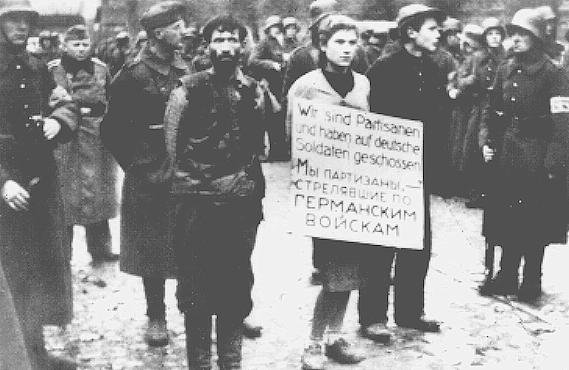
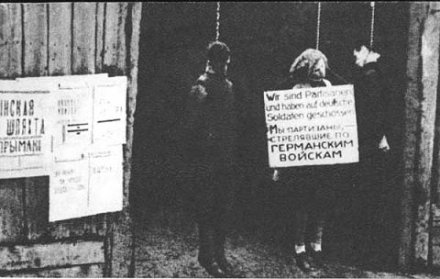
On this date in 1941, the German occupiers of Minsk conducted an infamous public hanging of partisans — perhaps the first such salutary public execution of resistance members of the war.
Jewish* 17-year-old Maria (Masha) Bruskina was the central figure of the grim tableau, and wore the placard announcing “We are partisans and have shot at German soldiers.” Evidently, she also attracted the most attention** from the onlookers to whom the scene was addressed.
Before noon, I saw the armed German and Lithuanian soldiers appear on the street. From over the bridge they escorted three people with their arms tied behind their backs. In the middle there was a girl with a sign-board on her chest. They were led up to the yeast factory gate. I noticed how calmly these people walked. The girl did not look around … The first one led to the gallows was the girl.
She was hanged with bewhiskered World War I vet Kiril Trus and the 16-year-old Volodia Shcherbatsevich. The men were members of a partisan cell organizing anti-fascist resistance; Masha Bruskina was a nurse who had been caught aiding the partisans by providing civilian clothes and papers for wounded Red Army soldiers under her care to smuggle them back to the resistance.
The scene of their deaths was captured in a series of powerful photographs taken by one of the Lithuanian Wehrmacht collaborators.
* Phototextualities: Intersections of Photography and Narrative claims that Bruskina lightened her hair and changed her name to prevent her Jewishness affecting her resistance work; even though she was a Minsk native, her initial identification didn’t happen until 1968. The men who suffered with her were named almost immediately after the war.
** Despite the eye-catching place of the girl, she was officially unidentified for decades even after the name Masha Bruskina surfaced. In “A Historical Injustice: The Case of Masha Bruskina,” (Holocaust Genocide Studies 1997, 11:3) Nechama Tec and Daniel Weiss argued that Soviet authorities, and later Belarusian ones, found her Jewishness problematic and resisted identifying her because of it — while an ethnically Russian female partisan like Zoya Kosmodemyanskaya could be more conveniently accepted as a heroine. Maybe, but bureaucratic inertia and simple precedence (since Zoya Kosmodemyanskaya was known immediately while Masha Bruskina was not) are also plausible contributing factors.
A plaque unveiled at the Minsk yeast factory in 2009 finally called her Maria Bruskina.
On this date in 1415, on the eve of the Battle of Agincourt, the young English King Henry V approved the execution of his onetime boon companion Bardolph in William Shakespeare’s Henry V.
The fictional Bardolph had been the ruddy-nosed friend of Henry’s in the Henry IV plays (Part 1, Part 2), where the hard-drinking, rabble-rousing young prince is a disappointment to the father who fears his heir will never merit the throne.
By Henry V, the boy has become the ruler, and launched an audacious incursion into France during the Hundred Years’ War.
Hal’s willingness to own the rough decisions of statecraft — in this case having his friend put to death further to his win-French-hearts-and-minds policy — is part of his coming of age as Henry V.
Whether that means Hal’s maturation into regal dignity or the corruption of his humanity by power is up to the reader.
KING
How now Fluellen, cam’st thou from the Bridge?
FLUELLEN
I, so please your Maiestie: The Duke of Exeter
ha’s very gallantly maintain’d the Pridge; the French is
gone off, looke you, and there is gallant and most praue
passages: marry, th’ athuersarie was haue possession of
the Pridge, but he is enforced to retyre, and the Duke of
Exeter is Master of the Pridge: I can tell your Maiestie,
the Duke is a praue man
KING
What men haue you lost, Fluellen?
FLUELLEN
The perdition of th’ athuersarie hath beene very
great, reasonnable great: marry for my part, I thinke the
Duke hath lost neuer a man, but one that is like to be executed
for robbing a Church, one Bardolph, if your Maiestie
know the man: his face is all bubukles and whelkes,
and knobs, and flames a fire, and his lippes blowes at his
nose, and it is like a coale of fire, sometimes plew, and
sometimes red, but his nose is executed, and his fire’s
out
KING
Wee would haue all such offendors so cut off:
and we giue expresse charge, that in our Marches through
the Countrey, there be nothing compell’d from the Villages;
nothing taken, but pay’d for: none of the French
vpbrayded or abused in disdainefull Language; for when
Leuitie and Crueltie play for a Kingdome, the gentler
Gamester is the soonest winner.
This is Laurence Olivier’s 1944 version of the scene, with the commoner Bardolph well off-camera:
… and Kenneth Branagh’s more pathos-laden 1989 interpretation, with the king wavering a moment as he locks eyes with his doomed subject, and flashing back to bygone scenes of conviviality before delivering his troop the stern lesson of his friend’s strangling:
Although Bardolph himself and his prior relationship with his sovereign are fiction, the action of the scene actually proceeds from reality. Shakespeare has (as is his wont) cribbed Holinshed, who relates that Henry’s army was under strict orders not to pillage the countryside, and observed that discipline to a man —
except one, which was, that a souldiour tooke a pix out of a church, for which he was apprehended, and the king not once remooved [i.e., he halted] till the box was restored, and the offendor strangled. The people of the countries thereabout, hearing of such zeale in him, to the maintenance of justice, ministered to his armie victuals, and other necessaries, although by open proclamation so to doo they were prohibited.*
* As quoted in the very apt 1992 “Shakespeare’s Henry the Fifth and the Law of War” by Theodor Meron, American Journal of International Law, vol. 86, no. 1.
No medieval* battle in Christendom is better-known to the present-day hoi polloi than the Battle of Agincourt, that signal upset victory when young King Henry V and his invading English yeoman archers stunned a seemingly unbeatable force of French knights by outsmarting them like Belichik versus Martz.
This battle’s interpretive palimpsest — is it a parable of nascent capitalism? of national character? of technology? — has been much-bandied in the centuries since (and must weigh against England’s subsequent reversals in the Hundred Years’ War). This site’s interest is more parochial: the presence among the casualties of those who died by execution.
On this date in 1971, Romania’s most notorious serial killer was dragged to the stake at Jilava Prison — fighting all the way, and shrieking “Call my father, so he can see what’s happening to me! Make him come! He’s the only guilty one!” — and shot to death for a rape-murder spree that had terrorized Bucharest for more than a year.
Ion Rîmaru (or Ion Râmaru), an emotionally stunted, sexually perverted veterinary school dropout, began in 1970 preying on lone women perambulating the Romanian capital late at night.
Though a number of Rimaru’s targets escaped with their lives,* his attacks were noted for their bestial ferocity: biting into, perhaps cannibalizing, his victims’ sex organs; necrophiliac rapes; blood-drinking (hence the nickname). Authorities loathe to cop to a serial killer were initially tight-lipped about the monster in their midst, only heightening public terror, until a very visible May 1971 dragnet finally caught the Vampire.
Though he surely met someone’s definition of nuts, his attempt to claim insanity at trial was a predictable nonstarter, leading to this day’s scene on the execution grounds. Rimaru actually got himself turned all the way round, and took the firing squad’s barrage in his back. Unseemly, all in all.
But all that carrying on about his father? Evidently it was more than just unresolved Oedipal stuff.
The next year, his father fatally “fell” (read: was pushed by police) from a train. Forensic evidence taken from the body of Florea Rîmaru (Romanian link) implicated the Vampire’s dad in four unsolved 1944 murders in wartime Bucharest.
* His infamous spree’s official tally was four killed, plus six attempted murders, five rapes, one attempted rape, one robbery and three thefts. (Romanian source)
On this date in 1789, two working stiffs literally became stiffs for a noteworthy bread riot during the French Revolution’s early days.
Ah, 1789.
It was the best of times, it was the worst of times … it was the season of Light, it was the season of Darkness; it was the spring of hope, it was the winter of despair. And we know how all that ends.
Just three months after the Bastille was stormed, France was merely pregnant with its coming Terrors. The Revolution was in its “moderate stage”.
Some moderation.
“Events of the 22nd of October, 1789: The hanging of a man named Francois, a baker”. Despite the title, sources (like this French-language study in the Annales historiques de la Revolution francaise, overwhelmingly date the baker’s murder to the 21st.
The tumbrils may not have been running (actually, the Revolution’s iconic execution device had not yet even been created), but the “October Days” had enough to scare you, especially if you were a sensible constitutionalist type like the Marquis de Lafayette.*
Like a mob dragging the King back to Paris from Versailles, with the heads of his royal guards on pikestaffs.
A drought had created a calamitous bread shortage, which in turn helped stir the Revolutionary pot. The mob that invaded Louis XVI‘s palace a couple of weeks before had celebrated his return to Paris singing “We Have the Baker, the Baker’s Wife, and the Baker’s Son. We Shall Have Bread.” When the king’s presence failed to ease the shortage, fresh disturbances followed.
On October 21, 1789,** the baker Denis Francois became the unfortunate focus of one such, when a famished woman spuriously denounced him a monopolist. A frenzied crowd lynched the hapless boulanger before he could get a word in edgewise.
This event occasioned the Constituent Assembly to pass a martial law decree, permitting a municipality to signal martial law by raising a red flag, whereupon anyone failing to disperse made him- or herself liable to summary military execution.
During the disturbance stirred up against the baker Francois, another one broke out in the Faubourg Saint-Antoine, the object of which was to unite with the Faubourg Saint-Marcel for purposes of reducing the price of bread, and for getting into the convents under the pretext of taking the muskets stored there. The National Guard, in breaking up these seditions, arrested the assassin of the baker [a dock porter named Blin] and the principal instigator of the faubourg [i.e., the Faubourg Saint-Antoine, namely a laborer named Michel Adrien†]. Both were judged and hanged the next day.
* We meet Lafayette here as captain of the National Guard; in a few years, the progress of the Revolution that he struggled to contain and direct will make him persona non grata in his country.
** Six Thousand Years of Bread: Its Holy and Unholy History gives the date as Oct. 20, though it’s not clear upon what authority. Archibald Alison placed it on the 19th. Whenever the murder of Francois occurred, the martial law decree’s passage on the 21st appears to be firmly dependable, which would mean the supposed malefactors’ deaths on this date should be as well.
† Revolutionary propagandist Camille Desmoulins later seized on the very skimpily justified Adrien execution — he “was judged and hanged in twenty-four hours for circulating a seditious flyer, although he didn’t know how to read” — to contrast with the outsized tenderheartedness shown for aristocrats who have “different weights on the scales of justice.” (Revolutionary Justice in Paris: 1789-1790)
On this date in 1865, two Republican generals, four colonels, and various other officers captured earlier in the month were executed on the authority of Mexico’s notorious Bando Negro — the “Black Decree.”
Halfway into his ill-fated three-year reign as “Emperor,” Maximilian I was in a bad way against Mexican president-turned-guerrilla Benito Juarez.
On October 3, 1865, he authorized summary execution for captured Republicans … and for anyone else who ran afoul of a nearby military official without having speedy proof of his or her political bona fides.
All individuals forming a part of armed bands or bodies existing without legal authority, whether or not proclaiming a political pretext, whatever the number of those forming such band, or its organization, character, and denomination, shall be judged militarily by the courts martial. If found guilty, even though only of the fact of belonging to an armed band, they shall be condemned to capital punishment, and the sentence shall be executed within twenty-four hours.*
But more immediately, of course, he signed a lot of other people’s death warrants.
Republican General José María Arteaga Magallanes (Spanish link), a man of famous chivalry (once, recovering the body of the Belgian Foreign Minister’s son, he returned the boy’s watch home to dad), and fellow General Carlos Salazar Ruiz (Spanish again) were the biggest fish; they and the others are honored today as the Martyrs of Uruapan. (Spanish yet again)
The square in Uruapan where this day’s victims were shot … now known as Plaza Mártires.
* The excerpted text is Article I of the Black Decree, whose entire (taken from here) follows:
THE BANDO NEGRO (BLACK DECREE) PROCLAMATION
OF EMPEROR MAXIMILIAN, OCTOBER 3, 1865
MEXICANS: The cause sustained by D. Benito Juarez with so much valor and constancy had already succumbed, not only before the national will, but before the very law invoked by him in support of his claims. To-day this cause, having degenerated into a faction, is abandoned by the fact of the removal of its leaders from the country’s territory.
The national government has long been indulgent, and has lavished its clemency in order that men led astray or ignorant of the true condition of things might still unite with the majority of the nation and return to the path of duty. The desired result has been obtained. Men of honor have rallied around the flag and have accepted the just and liberal principles which guide its policy. Disorder is now only kept up by a few leaders swayed by their unpatriotic passions, by demoralized individuals unable to rise to the height of political principle, and by an unruly soldiery such as ever remains the last and sad vestige of civil wars.
Henceforth the struggle must be between the honorable men of the nation and bands of brigands and evil-doers. The time for indulgence has gone by: it would only encourage the despotism of bands of incendiaries, of thieves, of highwaymen, and of murderers of old men and defenseless women.
The government, strong in its power, will henceforth be inflexible in meting ont punishment when the laws of civilization, humanity, or morality demand it.
Mexico, October 2, 1865.
Maximilian, Emperor Of Mexico : Our Council of Ministers and our Council of State having been heard, we decree:
Article I. All individuals forming a part of armed bands or bodies existing without legal authority, whether or not proclaiming a political pretext, whatever the number of those forming such band, or its organization, character, and denomination, shall be judged militarily by the courts martial. If found guilty, even though only of the fact of belonging to an armed band, they shall be condemned to capital punishment, and the sentence shall be executed within twenty-four hours.
Article II. Those who, forming part of the bands mentioned in the above article, shall have been taken prisoners in combat shall be judged by the officer commanding the force into the power of which they have fallen. It shall become the duty of said officer within the twenty-four hours following to institute an inquest, hearing the accused in his own behalf. Upon this inquest a report shall be drawn and sentence shall be passed. The pain of death shall be pronounced against offenders even if only found guilty of belonging to an armed band. The chief shall have the sentence carried into execution within twenty-four hours,—being careful to secure to the condemned spiritual aid,—after which he will address the report to the Minister of War.
Article III. Sentence of death shall not be imposed upon those who, although forming part of a band, can prove that they were coerced into its ranks, or upon those who, without belonging to a band, are accidentally found there.
Article IV. If from the inquest mentioned in Article II facts should appear calculated to induce the chief to believe that the accused has been enrolled by force, or that, although forming part of the band, he was there accidentally, he shall abstain from pronouncing a sentence, and will consign the prisoner, with the corresponding report, to the court martial, to be judged in accordance with Article I.
Article V. There shall be judged and sentenced under the terms of Article I of the present law:
I. All individuals who voluntarily have procured money or any other succor to guerrilleros.
II. Those who have given them advice, news, or counsel.
III. Those who voluntarily and with knowledge of the position of said guerrilleros have sold them or procured for them arms, horses, ammunition, provisions, or any other materials of war.
Article VI. There shall be judged and sentenced in accordance with Article I:
I. Those who have entertained with guerrilleros relations constituting the fact of connivance.
II. Those who of their own free will and knowingly have given them shelter in their houses or on their estate.
III. Those who have spread orally or in writing false or alarming news calculated to disturb order, or who have made any demonstration against the public peace.
IV. The owners or agents of rural property who have not at once given notice to the nearest authority of the passage of a band upon their estate.
The persons included in the first and second sections of this article shall be liable to an imprisonment of from six months to two years, or from one to three years’ hard labor, according to the gravity of the offense.
Those who, placed in the second category, are connected with the individual concealed by them by ties of relationship, whether as parents, consorts, or brothers, shall not be liable to the penalty above prescribed, but they shall be subject to surveillance by the authorities during such time as may be prescribed by the court martial.
Those included in the third category shall be sentenced to a fine of from twenty-five to one thousand piasters or to one year’s imprisonment, according to the gravity of the offense.
Article VII. When the authorities have not given notice to their immediate superior of the passage of an armed force in their locality, the superior authority shall inflict a fine of from two hundred to two thousand piasters or from three months’ to two years’ imprisonment.
Article VIII. Every inhabitant who, having knowledge of the passage of an armed band in a village or of its approach, has not notified the authorities shall be liable to a fine of from five to five hundred piasters.
Article IX. All inhabitants between the ages of eighteen and fifty-five years of age not physically incapacitated shall, when the locality inhabited by them is threatened by a band, take part in the defense of the place, under penalty of a fine of from five to two hundred piasters or of from fifteen days’ to four months’ imprisonment. If the authorities deem it proper to punish the village for nonresistance, they may impose a fine of from two hundred to two thousand piasters, which shall be payable by all those who have not taken part in the defense.
Article X. The owners or agents of country property who, being able to defend themselves, have not kept guerrillas and other evil-doers away from their estates or have not notified the nearest military authority of their presence, or who have received the tired or wounded horses of the guerrillas without advising the said authority, shall be punished by said authority by a fine of from one hundred to two thousand piasters, according to the gravity of the offense. In cases of extreme gravity they shall be arrested and brought before the court martial, to be judged in conformity with the rules laid down by the present law. The fine shall be paid to the principal administrator of the revenue of the district where the estate is situated. The provisions of the first part of the present article are applicable to the populations.
Article XI. All authorities, whether political, military, or municipal, who have not acted in accordance with the provisions of the present law against those who are suspected of or recognized as being guilty of the offenses with which it deals, shall be liable to a fine of from fifty to one thousand piasters; and when the omission implies acquaintance with the guilty, the delinquent shall be brought before the court martial, who shall judge him and inflict a penalty in proportion to the offense.
Article XTT. Plagiarios [kidnappers] shall be judged and sentenced under the provisions of Article I of the present law, without regard to the circumstances under which the abduction shall have been committed.
Article XIII. Sentence of death passed upon those guilty of the offenses enumerated by the present law shall be executed in the time fixed, and the benefit of appeal for mercy shall be refused to the condemned. When the accused has not been condemned to death, and is a stranger, the government, after he shall have undergone punishment, may make use with regard to him of its right to expel from its territory pernicious strangers.
i Kidnappers. The Minister of Foreign Affairs, intrusted with the Department
Article XIV. Amnesty is proclaimed in favor of all who, having belonged or still belonging to armed bands and having committed no other offense, shall present themselves to the authorities before the 15th of next November. The authorities shall take possession of the arms of those so surrendering themselves.
Akticle XV. The government reserves unto itself the right to fix the time when the provisions of the present law shall cease to be enforced. Each of our ministers is bound, as far as his department is concerned, to enforce the present law and to issue such orders as will secure its strict observance.
I did not kill your loved one, but I hope that one day you find out who did. I wish I could tell you the reason why, or give some kind of solace; you lost someone you love very much. The same as my family and friends are going to lose in a few minutes. I am sure he died unjustly, just like I am.
Contrary to the widespread misapprehension that DNA and other forensic evidence are rendering criminology a perfect science, the majority of criminal procedures make do without them — consequently depending on the more impressionistic and time-honored pillars of jurisprudence: a weighing of circumstantial evidence; an estimate of the credibility of competing witnesses; the structural advantage of the well-resourced prosecutor’s office against its typical adversaries.
There may never be an answer to Luis Ramirez’s last statement, simply because there’s no obvious prospect of a dramatic forensic science reveal.
Wherever Ramirez’s soul might truly stand on the matter of capital murder, he left behind this interesting portrait of human connection on death row.
I’m about the share with you a story who’s telling is long past due. It’s a familiar story to most of you reading this from death row. And now it’s one that all of you in “free world ” may benefit from. This is the story of my first day on the row.
I came here in May of 1999. The exact date is something that I can’t recall. I do remember arriving in the afternoon. I was placed in a cell on H-20 wing over at the Ellis Unit in Huntsville, TX. A tsunami of emotions and thoughts were going through my mind at the time. I remember the only things in the cell were a mattress, pillow, a couple of sheets, a pillow case, a roll of toilet paper, and a blanket. I remember sitting there, utterly lost.
The first person I met there was Napoleon Beazley. Back then, death row prisoners still worked. His job at the time was to clean up the wing and help serve during meal times. He was walking around sweeping the pod in these ridiculous looking rubber boots. He came up to the bars on my cell and asked me if I was new. I told him that I had just arrived on death row. He asked what my name is. I told him, not seeing any harm in it. He then stepped back where he could see all three tiers. He hollered at everyone, “There’s a new man here. He just drove up. His name is Luis Ramirez.” When he did that, I didn’t know what to make of it at first. I thought I had made some kind of mistake. You see, like most of you, I was of the impression that everyone on death row was evil. I thought I would find hundreds of “Hannibal Lecters” in here. And now, they all knew my name. I thought “Oh well,” that’s strike one. I was sure that they would soon begin harassing me. This is what happens in the movies after all.
Well, that’s not what happened . After supper was served, Napoleon was once again sweeping the floors. As he passed my cell, He swept a brown paper bag into it. I asked him “What’s this?” He said for me to look inside and continued on his way. Man, I didn’t know what to expect. I was certain it was something bad. Curiosity did get the best of me though. I carefully opened the bag. What I found was the last thing I ever expected to find on death row, and everything I needed. The bag contained some stamps, envelopes, notepad, pen, soap, shampoo, toothpaste, tooth brush, a pastry, a soda, and a couple of Ramen noodles. I remember asking Napoleon where this came from.
He told me that everyone had pitched in. That they knew that I didn’t have anything and that it may be a while before I could get them. I asked him to find out who had contributed. I wanted to pay them back. He said, “It’s not like that. Just remember the next time you see someone come here like you. You pitch in something.”
I sat there on my bunk with my brown paper bag of goodies, and thought about what had just happened to me. The last things I expected to find on death row was kindness and generosity. They knew what I needed and they took it upon themselves to meet those needs. They did this without any expectation of reimbursement or compensation. They did this for a stranger, not a known friend. I don’t know what they felt when they committed this act of incredible kindness. I only know that like them, twelve “good people” had deemed me beyond redemption. The only remedy that these “good people” could offer us is death. Somehow what these “good people” saw and what I was seeing didn’t add up. How could these men, who just showed me so much humanity, be considered the “worst of the worst.”
Ever since Napoleon was executed, for a crime he committed as a teen, I’ve wanted to share this story with his family. I would like for them to know that their son was a good man. One who I will never forget. I want for them to know how sorry I am that we as a society failed them and him. I still find it ridiculous that we as a people feel that we cannot teach or love our young properly. I’m appalled at the idea that a teen is beyond redemption, that the only solution that we can offer is death. It’s tragic that this is being pointed out to the “good people” by one of the “worst of the worst”. God help us all.
What’s in the brown paper bag? I found caring, kindness, love, humanity, and compassion of a scale that I’ve never seen the “good people” in the free world show towards one another.


 So who is Robert Hubert?






 Ramirez went to his death still