1928: William Edward Hickman, Randian superhero?

On this date in 1928, William Edward Hickman was hanged at California’s San Quentin prison for what the Los Angeles Times was still calling a decade later* “the most horrible crime of the 1920’s.”

Eighteen- or nineteen-year-old Hickman kidnapped the 12-year-old daughter of a Los Angeles banker, extracted a $1,500 ransom from said banker for her return, then delivered up the girl’s horribly mutilated corpse.

A nationwide manhunt immediately ensued, with Hickman soon captured in Oregon.

Pretty white girls abducted have been media catnip for many a livelong year. In this case, the dastardly deed induced the Los Angeles Times to editorially demand (Dec. 21, 1927) an automatic death penalty for murder in a manifesto that reads like it was written yesterday for whatever the outrageous crime du jour might be.

LET MURDERERS HANG

The sickly sentimentality which wars upon capital punishment for murder and insists upon the coddling of convicts will have a hard time to justify itself in the case of the slayer of Marian Parker, who, if police theories are correct, is William Edward Hickman, a criminal on probation. Had Hickman been serving the prison term which he deserved for his forgeries, he could not have committed the series of crimes which culminated in one of the most atrocious murders of which there is any record. He was free through the lenity of the California law to take his revenge in the most horrible fashion, against a man who had done him no injury that could be considered such by anyone with a spark of moral sense.

Not for vengeance, but for its own protection, both through example and through the eradication of a rotten and depraved individual, society should put the Parker case slayer out of life as quickly as the formalities of law permit. His continued existence is a reproach to all humanity.

A clash of conflicting theories of the best methods of dealing with criminals has brought society to a condition of hesitation. This condition is highly favorable to criminal operations of all sorts, while justice and the law seem to stand by, bewildered and helpless. The logical way to meet this situation is to take practical steps which society knows will protect it, and let penologists and psychiatrists conduct their debate over the ideal system, entirely to one side.

There can be no question that men in jail, while in jail, are no particular menace to society, and that men who have been hanged do not commit further murders. Upon these two solid facts let society base its actions, unless and until something better has been devised and proved. The semi-punishment, semi-reformatory scheme at present in force is obviously a failure.

Its greatest error is that it considers the interest of the criminal rather than those of his victim, or rather the interest of the class to which his victim belongs. This class is made up of the honest, the law-abiding, the God-fearing, the hard-working, the solid and substantial; in other words, of all individuals who are resolved to live in peace and harmony with their neighbors,. respecting others’ rights as courtesouly as they expect their own to be respected. Against this class, the great majority, another class, a minority, is waging war. It consists of the vicious, the depraved, the degenerate; nonproducers and parasites. At best this class is a drag upon progress, at worst it is a menace to civilization. Yet the law as it stands at present regards the rights of the individuals of the class as paramount. The machinery of the courts is strained at every point to aid them.

It is not necessary to inquire why a rattlesnake strikes, or if it is likely to strike again. His motives may be interesting, but they are not important. It is sufficient to recognize the danger and to deal with it appropriately.

It does not matter whether anti-social individuals are all insane, as some criminologists assert, whether they are economic misfits, as other theorists declare, or whether they are in the main ordinary persons gone wrong, as still another school insists. There has been too much consideration for them and not enough for those they prey upon and injure. It is time the emphasis was shifted.

It is time to face the facts, before the criminal class succeeds entirely in getting the upper hand. It is time to place every proved criminal where he can do no more harm. It is time for society to take the certainty of protection; it is time to stop giving the criminal “another chance.”

It is time to hang every murderer.

Lack of firmness in dealing with the criminal problem is due largely to the sob-sister and the sentimentalist. At the other extreme stands the mob spirit and lynch law, equally destructive of the foundations of society. Criminals should be judged without passion, bias or prejudice, and this is possible only in a court of law. No matter how heinous the crime, it is a matter for the courts to deal with. Good citizens will insist that proper punishment be dealt out in accordance with the provisions of law and order. For men to take the law into their own hands is to place themselves on a plane with the criminals, and to give away the immense moral advantage of being right.

Sensational crime + ill-considered policy response = a California tradition. (There wasn’t actually a change of the law in 1927-28, though.)

Perhaps recoiling from the self-righteous public baying after Hickman’s blood, a young Ayn Rand took such a shine to Hickman as to base upon him a murderous protagonist in a 1928 work, The Little Street. The budding apostle of selfishness decried in her journals

[a]verage, everyday, rather stupid looking citizens. Shabbily dressed, dried, worn looking little men. Fat, overdressed, very average, ‘dignified’ housewives … How can they decide the fate of that boy? Or anyone’s fate?

Though The Little Street never saw print, the hero disdainful of the petty bonds of moral hypocrisy is the go-to trope of Rand’s later novels. If you can bear them, you’ll find Rand speaking of “nonproducers and parasites” who are “a drag upon progress … a menace to civilization” in much the way the Times speaks of Hickman.

Rand wrote that “other people do not exist for [Hickman], and he does not see why they should … He has the true, innate psychology of a Superman. He can never realize and feel ‘other people.'” It’s a pretty near definition of sociopathy likewise imputed to the hero of her later novel The Fountainhead: “He was born without the ability to consider others.”

“She had a crush on him [Hickman],” says Lisa Duggan, author of a study of Rand’s thought, in this podcast.

Indeed, Hickman was a very strange choice for Rand’s affection, quite apart from the obvious: other than the derring-do to bluff school administrators into letting him take away a child on his own say-so, he didn’t really exhibit the magnificent contempt for his many lessers one would expect from a Howard Roark.


From the Los Angeles Times, Dec. 25, 1927.

Hickman broke down and confessed, not in pride but in panic, and signed a simpering “warning” to young men of the classic gallows-speech variety on Christmas Eve 1927:

Crime in its simplest definition is to have without work and enjoy the same place in society as other people and still show no honest effort or intention to go right.

Young men, when crime has once overcome your will power to be honest and straight you are a menace to society. …

Think it over, see my mistake. Be honest and upright. Respect the law. If you do these things you’ll be happier in the end. (Source: Los Angeles Times, Dec. 24, 1927)

Over the ten ensuing months, the teen had the opportunity to recover his wits and play a more manful part, but that didn’t happen either. A week before execution, when any hope of reprieve was gone and there was little percentage left in playing the supplicant, Hickman sent the Associated Press this bit of self-flagellation.

I know very well that I have been a most guilty sinner … I am sorry for having offended God and man … Please ask the people in the name of God to pray for us condemned men here at San Quentin prison.

(To top it off, he wilted climbing the scaffold and had to be helped up the last few steps.)

The miscreant unequal to the weight of his crime-slash-sin, thirsting for the redemptive chalice of heaven … as a criminals go, that’s more Dostoyevsky than Rand.

* Mar. 27, 1938. The context was a roundup of the gallows highlights of San Quentin’s history on the occasion of its switch from hanging to lethal gas.

On this day..

1672: Thomas Rood, the only incest execution in America

On this date in 1672, Thomas Rood (or Rhood, or Roode, or even Rude) achieved in Norwich, Conn., the distinction of being the only person executed in the future United States of America for incest.

The native of Glastonbury, England got in a bad way for, in the words of the indictment,

not haveing the feare of God before thine eyes thou hast committed that abominable sin of incest haveing carnall copulation with Sarah Rhood thy reputed daughter for which according to the law of God & the law of this colony thou deservest to dye …

Actually, the laws of the colony said nothing about incest, requiring the Hartford Court of Assistants to ask around the local clergy whether this sort of thing should be a hanging offense.

Hey, what do you think they’re going to say? Antonin Scalia would call this originalism.

Thomas Rhood thou art to goe from here to the place from whence thou camest & in due time to be carryed from thence to the place of execution & there to be hanged by the neck till thou art dead & then cut down & buried.

Of course, it takes two to make the beast with two backs; daughter/lover Sarah was in some fear for her neck as well, until the court took

notice of a great appearance of force layd up upon her spirit by her father overaweing & Tiranical abuse of his parentall authority besides his bodily striveings which not onely at first brought her into the snare but allso in after yeilding to his Temptation.

Having seemingly found her to be a rape victim, the court extended leniency.

[T]he sentence of the court is that shee be severly whipt on the naked body once at Hartford & once at Norwich that others may heare & fear & do no more such abominable wickednesse.

17th century texts from this pdf on a site selling an 820-page genealogy of the Rood lineage in America … to which the randy old man contributed to the tune of at least nine children.

On this day..

1409: Jean de Montagu

Six hundred years ago today, onetime royal favorite Jean de Montagu* was, at the instigation of his powerful noble rival, beheaded in Paris and his body hung up at Montfaucon.

Montagu (French link) was the 50-something scion of an ennobled notary — or else the illegitimate produce of King Charles V, whose ennobled notary had been induced to claim him. Regardless his blood, the lad made himself quite wealthy with a virtuous cycle of administrative acumen and political connection, winning a variety of honorary posts and riches aplenty he did not shy from displaying. Typical “New Money” type.

Sadly for Montagu, this cycle crested during the reign of Charles VI, also known as Charles the Mad for his bouts of illucidity.

“History,” wrote Barbara Tuchman, “never more cruelly demonstrated the vulnerability of a nation to the person of its chief of state than in the affliction of France beginning [with Charles’ first spell of insanity] in 1392.”

Charles the Mad’s erratic tenure would help bring French fortunes to the low ebb from which Joan of Arc would retrieve them.

Montagu’s period sob story was that his wealth earned him the enmity of nasty Duke of Burgundy John the Fearless,** who induced King Charles during one of the latter’s episodes to affix on Montagu responsibility for the crown’s financial shortfalls. Our day’s victim was arrested on October 7, 1409, tortured into a confession, and beheaded in Paris October 17.

Montagu’s surviving family had the verdict reversed within three years, which would have been a better deal for them had the family’s main branch not been wiped out three years after that at the Battle of Agincourt.

For the wider benefit of posterity, the beheaded lord also left a fair collection of endowed building projects in his lands in Marcoussis, including (French links all): the usual village church; a Celestine monastery; and a picturesque castle unfortunately devastated during the French Revolution but once resembling this:


Atmospheric old sketch from here; others here.

* Not to be confused with his (likewise beheaded) contemporary across the channel, John Montagu, Earl of Salisbury.

** John the Fearless had most recently been seen engineering the infamous murder of the king’s brother, and surviving by dint of his ransom potential the hecatomb of the last crusade.

On this day..

1946: The Nuremberg Trial War Criminals

Victor’s justice was never better served than this date in 1946, when the brass of Third Reich hung for crimes against humanity during the late World War II.

[audio:http://www.stelzriede.com/ms/mus/nuremexe.mp3]

(From this page of original period audio files.)

The landmark legal proceeding* is covered well enough in many other sources for this humble venue to break new ground.

Apart from trailblazing international law, the trial was notable for the gut-punching film of German atrocities; this relatively novel piece of evidence is available for perusal thanks to the magic of the Internet. Caution: Strong stuff. An hour’s worth of Nazi atrocities.The climactic hangings in the predawn hours this day in Nuremberg were conducted by an American hangman who used the American standard drop rather than the British table calibrated for efficacious neck-snapping. As a result, at least some hangings were botched strangulation jobs, a circumstance which has occasionally attracted charges of intentional barbarism.

Media eyewitness Kingsbury Smith’s taut report of the night’s executions (well worth the full read) described just such an ugly end for propagandist Julius Streicher.

At that instant the trap opened with a loud bang. He went down kicking. When the rope snapped taut with the body swinging wildly, groans could be heard from within the concealed interior of the scaffold. Finally, the hangman, who had descended from the gallows platform, lifted the black canvas curtain and went inside. Something happened that put a stop to the groans and brought the rope to a standstill. After it was over I was not in the mood to ask what he did, but I assume that he grabbed the swinging body of and pulled down on it. We were all of the opinion that Streicher had strangled.

There were in all 12 condemned to death at Nuremberg; all hanged this day except Martin Bormann (condemned in absentia; it was only years later that his death during the Nazi regime’s 1945 Gotterdammerung was established) and Hermann Goering (who cheated the executioner with a cyanide capsule two hours before hanging). The ten to die this day were:

* Its resultant Nuremberg Principles comprise a lofty articulation of principles whose actual application, as Noam Chomsky has observed, would have meant that “every post-war American president would have been hanged.”

On this day..

1896: Rainandriamampandry and Prince Ratsimamanga

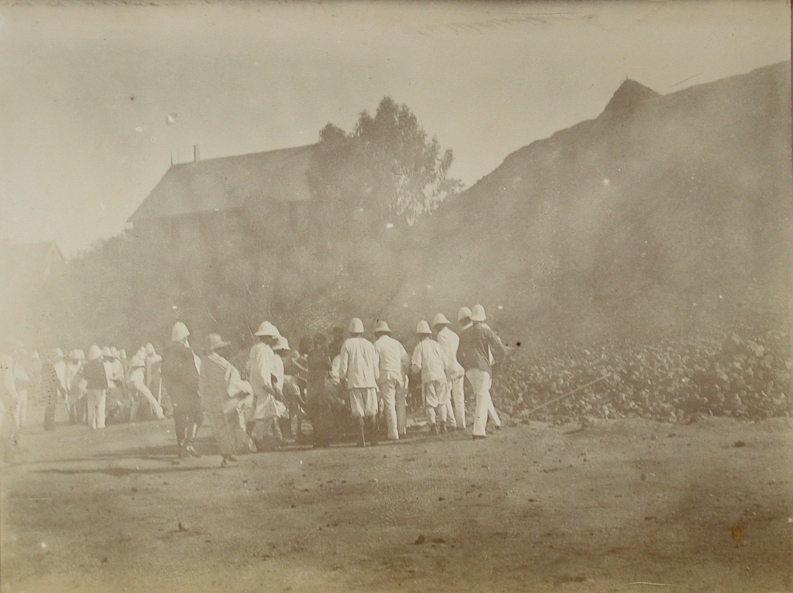
On this date in 1896, two Malagasy movers and shakers were shot to help cement French colonial control of Madagascar.

Interior Minister Rainandriamampandry

Having conquered the island militarily by 1895, France immediately faced indigenous resistance.

According to Stephen Ellis*

One of the most puzzling and fascinating of all resistance movements is that known as the revolt of the menalamba. It occurred over a wide area of central Madagascar, mostly in the kingdom of Imerina, in the two years following the French invasion of Madagascar in 1895. The most mysterious aspect of the rising has always been the question of who, if anyone, was its leader. The official version, that reported by the French government in Madagascar, was that the movement was inspired or directed by a number of magnates at the old Merina court. The published evidence is so ambiguous as to have obliged every subsequent author to accept this version, although there was considerable doubt expressed as to its truth at that time.

Managing this drumhead tribunal was just-arrived “Resident-General” Joseph Simon Gallieni, who seems to have alit (fresh from an assignment in Indochina) with the certain conviction that examples must be made.

While more wholesale bloodletting was deployed in the field, Gallieni selected some suitably high-profile exemplars from the supine state’s ruling elite — “Ratsimamanga, a nobleman who had been unpopular for many years because of his financial extortions,” says Ellis, and “Rainandriamampandry because … he had no close political friends and might therefore be considered dispensable.”

The convenient loss of the tribunal paperwork, which renders evaluation impossible and colonial motivation suspect, hardly would have been well beside the point. As one periodical in Paris (where Gallieni’s pacification project received enthusiastic greeting) approvingly put it,

As a lesson to the rebels, two great figures who had sided with them, Prince Ratsimamanga and Minister of the Interior Rainandriamampandry have both been tried, convicted and shot, all with such rapidity as to inspire their accomplices to salutary reflections.

Below: Selected photographs of the execution from the University of Southern California Digital Library. Click for larger images.

An aside: Madagascar was also the scene of intensely sectarian competition in the soul-saving business, resulting in an execution-day travesty reported in An Empire Divided: Religion, Republicanism, and the Making of French Colonialism, 1880-1914:

Gallieni gave permission to both the cure of the Antananarivo cathedral and a local French pastor to be with [Rainandriamampandry] during his last hours. But … the two started quarreling almost at once. Gallieni was deeply disturbed by the image of two religious men fighting during “the final minutes of a condemned man.”

* “The Political Elite of Imerina and the Revolt of the Menalamba. The Creation of a Colonial Myth in Madagascar, 1895-1898,” The Journal of African History, vol. 21, no. 2 (1980).

On this day..

39: Gnaeus Cornelius Lentulus Gaetulicus, erotic poet

On an uncertain date likely around early October* in 39 A.D., former Roman Consul Gnaeus Cornelius Lentulus Gaetulicus (not to be confused with Publius Cornelius Lentulus) was executed at the order of Caligula for his part in some sort of plot long lost to history.

In his public life, Gaetulicus was a Machiavellian politician connected to the fallen Praetorian Guard captain Sejanus (their kids were at one point engaged to be married). He evidently survived the post-Sejanus purge with an adroit bit of written diplomacy to the Praetorian’s patron-cum-executioner the Emperor Tiberius, tactfully pointing out that the Emperor had made the same errant choice of alliance. Thus did Gaetulicus retain both his head and his career.

After a decade milking his German province, and Tiberius shuffled off the mortal coil and young Caligula now ruling the empire, Gaetulicus seemingly** involved himself in something treasonable with Marcus Aemilius Lepidus, the latter a recent fave of Caligula and briefly his designated heir.

Or, if you credit scandal-mongering Roman historian Cassius Dio‘s description of the Emperor’s deadly northward road trip, he did it out of some whim of rivalry or opportunity for pecuniary advantage.

Gaius had now spent practically all the money in Rome and the rest of Italy, gathered from every source from which he could in any way get it, and as no source of revenue in considerable amount or practicable to collect could be found there, and his expenses were pressing him hard, he set out for Gaul, ostensibly because the hostile Germans were stirring up trouble, but in reality with the purpose of exploiting both Gaul with its abounding wealth and Spain also. However, he did not openly announce his expedition beforehand, but went first to one of the suburbs and then suddenly set out on the journey, taking with him many actors, many gladiators, horses, women, and all the other trappings of luxury. When he reached his destination, he did no harm to any of the enemy — in fact, as soon as he had proceeded a short distance beyond the Rhine, he returned, and then set out as if to conduct a campaign against Britain, but turned back from the ocean’s edge, showing no little vexation at his lieutenants who won some slight success — but upon the subject peoples, the allies, and the citizens he inflicted vast and innumerable ills. In the first place, he despoiled those who possessed anything, on any and every excuse; and secondly, both private citizens and cities brought him large gifts voluntarily, as it was made to appear. He murdered some men on the ground that they were rebelling, and others on the ground that they were conspiring against him; but the real complaint was one and the same for the whole people — the fact that they were rich. By selling their possessions himself, he realized far greater sums than would otherwise have been the case; for everybody was compelled to buy them at any price and for much more than their value, for the reasons I have mentioned. Accordingly, he sent also for the finest and most precious heirlooms of the monarchy and sold them off by auction, selling with them the fame of the persons who had once used them. Thus he would make some comment on each one, such as, “this belonged to my father,” “this to my mother,” “this to my grandfather,”, “this to my great-grandfather,” “this Egyptian piece was Antony’s, the prize of victory for Augustus.” At the same time he also explained the necessity of selling them, so that no one could persist in pretending to be poor; and thus he made them buy the reputation of each article along with the thing itself.

In spite of all this he did not secure any surplus, but kept up his customary expenditures, not only for other objects that interested him — exhibiting, for example, some games at Lugdunum — but especially for the legions. For he had gathered together two hundred thousand troops, or, as some say, two hundred and fifty thousand. He was acclaimed imperator by them seven times, as his whim directed, though he had won no battle and slain no enemy. To be sure, he did once by a ruse seize and bind a few of the foe, whereas he used up a large part of his own force, striking some of them down one at a time and butchering others then masse. Thus, on one occasion, when he saw a crowd of prisoners or some other persons, he gave orders in the famous phrase, that they should all be slain “from baldhead to baldhead.” At another time he was playing at dice, and finding that he had no money, he called for the census lists of the Gauls and ordered the wealthiest of them to be put to death; then, returning to his fellow-gamesters, he said: “Here you are playing for a few denarii, while I have taken in a good one hundred and fifty millions.” So these men perished without any consideration. Indeed, one of them, Julius Sacerdos, who was fairly well off, yet not so extremely wealthy as to become the object of attack on that account, was slain simply because of a similarity of names. This shows how carelessly everything was done. As for the others who perished, there is no need of my naming over most of them, but I will mention those of whom history requires some record. In the first place, then, he put to death Lentulus Gaetulicus, who had an excellent reputation in every way and had been governor of Germany for ten years, for the reason that he was endeared to the soldiers. Another of his victims was Lepidus, that lover and favourite of his, the husband of Drusilla, the man who had together with Gaius maintained improper relations with the emperor’s other sisters, Agrippina and Julia, the man whom he had allowed to stand for office five years earlier than was permitted by law and whom he kept declaring he would leave as his successor to the throne. To celebrate this man’s death he gave the soldiers money, as though he had defeated some enemies, and sent three daggers to Mars Ultor in Rome. He deported his sisters to the Pontian Islands because of their relations with Lepidus, having first accused them in a communication to the senate of many impious and immoral actions. Agrippina was given Lepidus’ bones in an urn and bidden to carry it back to Rome, keeping it in her bosom during the whole journey.

It’s a pity that the details of this affair, whatever they were, have been lost to history. The History of Rome podcast treats this episode among a review of Caligula’s gnarly reign

According to Post-Augustan Poetry, Gaetulicus

was consul in 26 A.D., and for ten years was legatus in Upper Germany, where his combination of firmness and clemency won him great popularity. He conspired against Caligula while holding this command, and was put to death. Pliny the younger speaks of him as the writer of sportive and lascivious erotic verse, and Martial writes of him in very similar terms. His mistress was named Caesennia, and was herself a poetess.

Only a fragment (which I have not been able to locate online) of a Latin verse describing Britain remains affirmatively attributed to this poet, though he is sometimes speculatively identified with the “Gaetulicus” to whom some epigrams in the Greek Anthology (or “Palatine Anthology”) are attributed e.g.

TO APHRODITE EUPLOIA

Guardian of the seabeach, to thee I send these cakes, and the gifts of
a scanty sacrifice; for to-morrow I shall cross the broad wave of the
Ionian sea, hastening to our Eidothea’s arms. But shine thou
favourably on my love as on my mast, O Cyprian, mistress of the bride-
chamber and the beach.

* Date ballparked by public sacrifices offered in Rome on October 27 “to mark the exposure of the evil plots of Gnaeus Lentulus Gaetulicus against Gaius Germanicus.” (Agrippina: Sex, Power, and Politics in the Early Empire, which speculates at some length on what the dimensions of a Gaetulicus plot might have been.)

** Though Lepidus was executed at about the same time, and Cassius Dio suggests a connection, it’s not completely clear that they conspired together. Since Cassius Dio (and Suetonius, who also connects them in Life of Claudius), wrote generations after the events themselves, we want for dependable information.

On this day..

1815: Joachim Murat, Napoleonic Marshal

On this date in 1815, French Marshal-cum-Neapolitan King Joachim Murat was shot in Pizzo, Italy, for a failed attempt to regain his throne.

The charismatic cavalryman cuts a snazzy figure in the Napoleonic era, from its very infancy: it was Murat who secured for the 26-year-old Bonaparte the cannon used to deliver the “whiff of grapeshot” whose odor set Napoleon on the path to becoming Emperor.

Murat knew a good thing when he had it, and thereafter zipped around with the peripatetic conqueror, finding time between dashing mounted charges to marry Napoleon’s sister Caroline.

Murat’s honors multiplied with his commander’s victories: “First Horseman of Europe” (whatever that means); Grand Duke of Berg and Cleves; at last, in 1808, he was appointed King of Naples and Sicily, beneficiary via Caroline of the Corsican’s policy of installing family members to helm his satellite kingdoms.

Still, that elevation didn’t mean Murat would just retire to his Mediterranean villa and his mistresses: he was on call when Bonaparte went to invade Russia.

Leo Tolstoy, undoubtedly a hostile witness in his epic War and Peace, renders Murat as something of an oblivious dunderhead:

Though it was quite incomprehensible why he should be King of Naples, he was called so, and was himself convinced that he was so, and therefore assumed a more solemn and important air than formerly. He was so sure that he really was the King of Naples that when, on the eve of his departure from that city, while walking through the streets with his wife, some Italians called out to him: “Viva il re!” he turned to his wife with a pensive smile and said: “Poor fellows, they don’t know that I am leaving them tomorrow!”

But though he firmly believed himself to be King of Naples and pitied the grief felt by the subjects he was abandoning, latterly, after he had been ordered to return to military service — and especially since his last interview with Napoleon in Danzig, when his august brother-in-law had told him: “I made you King that you should reign in my way, but not in yours!” — he had cheerfully taken up his familiar business, and — like a well-fed but not overfat horse that feels himself in harness and grows skittish between the shafts — he dressed up in clothes as variegated and expensive as possible, and gaily and contentedly galloped along the roads of Poland, without himself knowing why or whither.

Like his fellow-Marshal Michel Ney, Murat nevertheless had the realpolitik chops to get on after their thrust to Moscow had so calamitously reversed — in Murat’s case, by cutting a deal with the Austrian Empire to retain his kingship.

But also like Ney, he couldn’t resist joining Napoleon’s ill-fated 1815 reunion tour. Murat could have survived the consequent loss of his throne, but made a quixotic bid to invade with only a handful of men the former possession whose people he quite wrongly imagined would rally to his cause.

Not the realization of the day-dreams of the most dreaming youth, not the visible acting of the strangest visions which the dramatist and romance-writer have conceived, could strike us with more wonder than the simple narration of that which befel the son of the baker of Cahors in his passage from the ranks of the French army to the throne and sceptre of Naples; and, alas! one step farther, an unquiet and a mournful one, to that small court in the castle of Pizzo, where the hero of a hundred fights, — the Achilles of the chivalrous French, — gazed for a second, with uncovered eye and serene brow on the party drawn out to send the death-volley home to his heart.

Well, this depiction of Murat’s end is plainly of more sympathetic character than Tolstoy would have done.

… the disgraceful tribunal, after consultation, declared, “That Joachim Murat, having by the fate of arms returned to the private station whence he sprung, had rashly landed in the Neapolitan dominions with twenty-eight followers, no longer relying upon war, but upon tumults and rioting; that he had excited the people to rebellion; that he had offended the rightful King; that he had attempted to throw the kingdom of Naples and the whole of Italy into confusion; and that therefore, as a public enemy, he was condemned to die, by authority of the law of the Decennium, which was still in vigour.” This very law, by a strange caprice of fortune, was one which Joachim himself had passed seven years before. He had, however, humanely suspended its operations many times, at particular seasons of his rule; and yet this very law, so passed, and so suspended by him, was made the instrument of his death.

The prisoner listened to his sentence with coolness and contempt. He was then led into a little court of the castle, where he found a party of soldiers drawn up in two files. Upon these preparations he looked calmly, and refused to permit his eyes to be covered. Then advancing in front of the party, and, placing himself in an attitude to meet the bullets, he called out to the soldiers, “Spare my face — aim at the heart.” No sooner had he uttered these words than the party fired, and he, who had been so lately King of the Two Sicilies, fell dead, holding fast with his hands the portraits of his family …

* More evidence that blood is thicker than water, since Napoleon and Murat were not chummy. According to Memoirs of Napoleon, His Court and Family, by the wife of another Napoleonic general,

The Emperor did not cherish for Murat the sincere friendship which he entertained for the other officers of the army of Italy. He used frequently to make him the subject of derision; and many of us have heard him laugh at the King of Naples, whom he used to call a Franconi King.

On this day..

1888: Pauline McCoy

The Daily Picayune, October 13, 1888 (page 3).

ALABAMA.

MONTGOMERY.

Execution of Pauline McCoy, the First Woman Hanged in Alabama Since the War — She Murdered a Little Girl for Her Clothes.

MONTGOMERY, Oct. 12 — [Special.] — Pauline McCoy, colored, who was hanged at Union Springs at 1 o’clock for the murder of Annie Jordan, white, last February, was the third woman hanged in Alabama since its incorporation as a state and the first since the war.

On the scaffold the woman broke down completely and had to be supported on the trap by two deputy sheriffs. She had not eaten anything for a day or two and was kept up by the use of stimulants. She admitted having killed the girl in her last speech, but denied that her motive was robbery.

The crime for which the woman was hanged had not its equal in the whole criminal history of Alabama. Her victim had strayed away from her home in this city, being demented, and meeting Pauline down the railroad asked her to accompany her.

That was the last seen of Annie, the 14-year-old child, until her dead body was discovered in a plum thicket near the roadside several days after. Pauline was seen in Union Springs a few days later wearing the shoes, hat and jacket belonging to her victim. She was arrested and said under oath that her father, Jake McCoy, killed the girl and brought the clothes home. At the preliminary trial Jake was discharged and Pauline committed. On her third trial in August she was found guilty and sentenced to be hung, which sentence was faithfully carried out to-day.

Indefatigable crime blogger Laura James has some unanswered — unanswerable — questions about the case. The Daily Picayune had supplied a scanty few additional details from Pauline’s supposed jailhouse confession a few weeks before (September 5, 1888):

Pauline McCoy, the young negro woman who was recently convicted in the circuit court of Bullock county of the murder of Miss Annie Jordan, a demented young white woman who wandered from her home in Montgomery county last spring, has made a full confession of the crime to the jail physician at Union Springs. The murder was committed near [indistinguishable]. Pauline says she and Annie Jordan had a quarrel, and that she choked the young woman to death and concealed the dead body in the bushes. The murderess is sentenced to death on the scaffold on the 18th [sic?] of October.

According to the Espy file (pdf) of American historical executions, Alabama had last executed a woman in 1864 — she was a slave — and would not do so again until Silena Gilmore rode the lightning for murder on January 24, 1930. Over 250 men were put to death during the 41-year span between the two milestone murderesses.

(Only three additional women have been executed in the Yellowhammer State since Gilmore.)

On this day..

1870: Margaret Waters, baby farmer

On this date in 1870, Margaret Waters became the first woman in England to hang for baby-farming.

Waters was condemned for murdering an infant she had taken in as a contractual temporary adoption; there is the matter in the dry language of the law.

But Waters’ import — and in fact, since press outrage that her ward’s death had initially been ruled only manslaughter by the coroner, the extremity of her legal straits as well — derived from her milestone symbolism in a burgeoning Victorian-era moral panic.


Margaret Waters’ case dominates the cover of the Oct. 15, 1870 Illustrated Police News, with a central illustration of Margaret Waters hanged … surrounded, appropriately, by men.

“Baby farming” hit the papers in the 1860’s with sensational exposes of a gray market business whose model was:

  1. Relieve unwilling mother of her newborn infant for a fee
  2. ???
  3. Profit!

It’s the “???” that’s up for grabs.

To the newspapermen, and the day’s elite crusaders for reform, and especially to the nascent medical industry whose British Medical Journal was instrumental in fomenting public alarm,* it signified nothing short of infanticide, a sort of post-partum abortion.

Thus, the Times of London’s sermonizing post-hanging editorial (Oct. 12, 1870):

A most just sentence has thus been executed, and the law has conspicuously fulfilled its appointed office of being a terror to evil-doers. A more terrible case, with respect both to the heinousness of the offence and to the unexpected vengeance which has overtaken it, has never occurred … The wretched woman and her sister were proved to have systematically published advertisements offering to “adopt” children for a remuneration which no one in his senses could believe to be adequate. In other words, they offered to the parents of illegitimate children a means of getting rid of charges at once burdensome and shameful to them … For the sake of a paltry and precarious gain MARGARET WATERS and her sister had the heart to make away with the helpless little creatures … nothing can palliate the hideous spectacle thus brought to light. A murder in hot blood, the deliberate gratification of revenge, or even a premeditated act of violence in the pursuit of some selfish object, fall short in some respects to the heinousness of this offence. The deepest instincts of a woman’s heart must have been deadened, and the most ordinary feelings of human nature extinguished, before such slow murder could be perpetrated upon piteous little innocents.

… MARGARET WATERS confesses to receiving children for purposes of profit, whom she, at least, knew she could not support. She confesses to receiving them for 5 l. or 10 l., and finding other people who would receive them for a fortnight’s expenses paid in advance, and would then let her hear no more of them. She confesses to taking them into the streets, placing them in the hands of children, and then running away and leaving them to their fate. She confessed to all this, and yet she professed to see in it nothing but “falsehood and deceit.” It was not murder, and nothing seems to have astonished her so much as the sudden vengeance which overtook her … while admitting the most damning facts, she extenuates their criminality. It is well that the stern sentence of the law has pronounced a terrible condemnation of these heartless excuses. “Baby Farming” as practiced by MARGARET WATERS was ruthless and systematic murder, and her doom will indelibly stamp this brand upon her infamous trade.

We wish it could be thought this unhappy woman was a solitary instance of such wilful blindness. It is to be feared she has expiated the sins of others who have actually perpetrated similar crimes, and it is certain there are many who are direct accomplices in her guilt. When she says that “the parents of illegitimate children who seek to get rid of them are more culpable than persons like herself, and that if there were no such parents there would be no ‘Baby Farmers,'” she does but exaggerate a just charge. When MARGARET WATERS abandoned children in the streets to the casual care of passers-by, she did but repeat what had been done by those who had first abandoned them to her in the dark of the night at obscure railway stations. It cannot be too strongly asserted that this execution reflects more or less the brand of murder upon all who contributed to the offence — upon the parents who only sought to get rid of their children, and upon those who allowed their journals to be the instruments of what they might have known to be an infamous traffic. It must be acknowledged that the justice of the law is but brought justice, and spares many who deserve punishment. That is inevitable. But one of the great uses of the law is to depict in true colours the real meaning of common offences. Selfish and licentious men and women will know for the future what is the natural issue of the offences against morality and society which they lightly commit. It is murder, and nothing less, that is the ultimate meaning of these social evils, and this is the contamination incurred by those who facilitate such offences.

Sounds pretty bad.

But then … all those other “selfish and licentious men and women”: had Waters somehow been the bad apple to spoil an entire bushel? (Reformers of the time write often of illicit behavior as a contagion whose example inspires a wider moral deadening.) Or was there something else going on?

Even the Times agrees that our culprit “never entertained the intention of becoming a ‘Baby Farmer’ and a Murderess. She drifted into it under the pressure of want and temptation. … It is, according to her statement, only six years since she was a married woman in good circumstances.”

According to Waters’ own account, summarized third-hand in the Times a few days prior to the hanging, (Oct. 7, 1870) her fall from respectable wedlock to public enemy number one began with the 1864 death of her husband, leaving the woman

with 300 l. in her possession. Intending to turn her capital to account, she took a house in Addington-square, Camberwell, and put into it a number of sewing-machines. Her plan was to make collars and other such articles, and sell them to the city houses. She knew little or nothing of the business, however, and, partly owing to that circumstance and partly to the miserable prices which were paid for such goods, she was at the end of the year a loser of 250 l. She then resolved to save herself by letting lodgings, and that step led her imperceptibly into her career of baby farming. … she was steadily going down-hill, and she found herself obliged to leave Addington-square and go to Bournemouth-terrace, Peckham, where she commenced baby farming as a system. She advertised for children, and she had answers from persons in all stations … She drifted along in this course, getting from bad to worse. But she protested that she had no idea of injuring the children, though she did some things she was very sorry for, owing to the difficulties of her position … She took the Clerkenwell News, and there she used to find a whole string of advertisements — three of them were put in for a shilling — from women who wanted children to nurse. She advertised herself for children to adopt, and she generally got 10 l. with one. When she got the child and the money she went to one of the other advertisers in the Clerkenwell News and arranged to put the baby out to nurse. Upon paying two weeks in advance she was hardly ever asked even for her address, and when she went away of course she never heard anything more of the child. She gained the difference between the 10 l. given her for adopting the child and the fortnight’s payment for nursing it. This was, after all, a very precarious resource, and she fell into great distress … The time came soon when she was unable to pay the money-lender his instalments, and he threatened to strip her of everything under her bill of sale … When she went to Brixton five children died, some from diarrhoea and wasting, and others from convulsions. She was very poor, and determined to save the price of burial by leaving them about. She wrapped the bodies in brown paper and took them out at night, and left them where they were found by people afterwards. She maintains that she did what she could for these children, and attended to them to the best of her power. There were also four other children whom she got rid of in a way for which she is now very sorry. She took them, one at a time, into the streets, and when she saw little boys and girls at play she called one of them and said, “Oh, I am so tired! Here, hold my baby, and here is sixpence for you to go into the sweetstuff-shop and get something nice.” While the boy or girl went into the shop she made off. The babies, she believes, were generally taken to the workhouse.

The slide into the vast but shadow world of poverty, in short … a timeless story.

While intentional infanticide undoubtedly formed some part of the baby farming picture, its nature and extent is also nothing to presume. In an era of staggering child mortality, dead infants were a norm, sometimes the norm. In the context of desperate penury, it was all the more likely. Middle-class authorities who raided Waters’ “farm” saw (and testified to) a slum purposely structured to kill off children. They may simply have beheld indigence.

Waters herself always rejected any notion that she had intentionally killed any of her charges.

Summing up the doomed woman’s testimonial, the doctor who took it underscored the point with an entirely plausible counter-narrative.

Dr. Edmunds, in concluding the recital of the remarkable and instructive statement Margaret Waters made to him a few hours before, said that when children, even under the best conditions, were taken from the breast and brought up by hand, the chances were all against them. What, then, was the chance of infants taken out in the open air the moment they were born and brought up with only such appliances as Mrs. Waters, at her wits’ end for money, flying from money-lenders and dodging landlords, had at her disposal? From what he could judge she had no intention of murdering any of the children, but they died off, as they might have been expected to die off, from diarrhoea, thrush, and convulsions, and when they died she callously got rid of their bodies as best she could when she became poor.

If Waters’ story holds water, her fees so inadequate to the long-term maintenance of children represent much the same calculated gamble involved in insurance: foul play or no, she had no reason to expect to maintain children long-term.** Cold … but hardly incomprehensible.

(It should also be observed babies to adopt actually were in demand.)

Interestingly, one of the key antecedents of the baby farming scandals in the 1860s and 70s was the codification of prim sexual mores for which the Victorian era is a byword.

Earlier in the 19th century, financial responsibility for illegitimate children had shifted from the (putative) father to the mother, and government Poor Relief to single mothers had been slashed — a bit of abstinence-only social engineering meant to stigmatize single motherhood to the greater good of the softer sex: “We trust that as soon as it has become … burdensome and disgraceful, it will soon become … rare.”

Surprisingly, welfare reform did not stop Victorians having sex. Given a milieu where birth control and abortion are illicit and single motherhood severely stigmatized, the policy implied a swath of single mothers powerfully incentivized to have burdensome and death-prone children taken off their hands … and an industry of entrepreneurs ready to meet the demand.

Waters was the first of eight women in England, Scotland and Wales hanged as baby farmers from 1870 to 1909. Her execution would help lead to the 1872 adoption of the Infant Life Protection Act, which introduced a regimen of license and registration in the heretofore libertarian economy of freelance child-brokering.

Books about Baby Farming and its Context

* In “Wolves in Women’s Clothing: Baby-Farming and the British Medical Journal, 1860-1872” (Journal of Family History, vol. 26, no. 3, July 2001), Ruth Ellen Homrighaus argues that

[b]y using their ‘expertise’ to stake a claim on infanticide and to relegate female reformers to the ranks of amateurs, writers for the BMJ made one of many moves to professionalize medicine … [and] establish a monopoly over health care by improving and standardizing medical education and restricting competition from untrained ‘charlatans.’

Infanticide writ large being a complex social problem, it found in baby farming a specific target amenable to outraged public mobilization, with a “subtext … [that] denied that working-class women were fit to manage childbirth and infant care.”

Margaret Waters had the ill luck to be discovered just as this campaign was in need of a potent emblematic villain. Despite the pestering of the moralistic set, police interest in hounding the persons who attended England’s considerable produce of disposable children rapidly waned in the 1870’s.

** Reviewing the still-lively baby farming scene in early 20th century America, Lawrence Friedman notes that

baby farms made a profit from a “grisly calculus”: most babies, in the days before reliable bottle-feeding, simply died when separated from their mothers. Add to this filthy conditions and poor care, and it is no surprise that most babies in baby farms did not survive. Allegedly, up to 80 percent of all babies admitted to one Baltimore baby farm died within weeks.

Part of the Themed Set: Women Who Kill.

On this day..

1923: Susan Newell, the last woman hanged in Scotland

On this date in 1923, Susan Newell achieved footnote status by hanging for the murder of her 13-year-old paperboy … the last Scottish woman to die on the gallows, and the only one in the 20th century.

Newell was nabbed by nosy neighbors who noticed her dumping John Johnson’s body a few blocks away from prison* where she would ultimately expiate the crime.

Newell pointed the finger at her husband (she never admitted guilt), but John Newell produced a fistful of alibi witnesses to the effect that he was staying with relatives after a couple of nasty domestic fights.

Susan — so the jury believed — had worked off the stress solo by throttling the newsboy when he’d had the temerity to ask her to pay him. Paid content: the hidden killer.

Well, sometimes, you can only take so much.

Despite the guilty verdict, the jury entertained her insanity defense and plumped for mercy when it convicted her. But the crown was having none of it, in part because the murderess wouldn’t admit her crime in her clemency petitions, and perhaps also because “the application of the law in Scotland had to be seen to be in line with that in England where Edith Thompson had been hanged for what most of us would regard as a much less serious crime only 10 months earlier.”

Thompson’s same executioner, John Ellis, unhappily handled the Newell job just 20 days after her conviction. The condemned woman managed to wriggle her hands out of their bonds while her legs were being pinioned, and she ripped the hood off her face with the words “don’t put that thing over me!”

Wanting to get the distasteful procedure over with, Ellis obligingly dropped her barefaced.

* She was also the only woman ever executed at Glasgow’s Duke Street Prison.

Part of the Themed Set: Women Who Kill.

On this day..