1845: Lavinia Burnett and Crawford Burnett

On this date in 1845, husband-and-wife murderers Crawford and Lavinia Burnett (nee Sharp) danced a gallows jig built for two in Fayetteville, Arkansas.

The duo contrived with their son, John, to rob and murder a nearby recluse, Jonathan Selby, for the money he was thought to be hoarding.

The family the slays together, pays together.

Alas for mom, dad, and big brother, 15-year-old daughter Minerva shopped them.

John-boy was still on the lam at this time — he’d be caught soon, and hanged December 26 — but Lavinia and Crawford hanged together before a large crowd in the vicinity of the present-day Fayetteville National Cemetery.

It was the first recorded execution of a woman in Arkansas history, and would be the only such until the year 2000.

Among the ranks of the Burnetts’ illustrious if unsuccessful defense team was Isaac Murphy, who would go on to become a notable pro-Union pol during the Civil War (with a murky part in an infamous massacre of Confederate sympathizers), and subsequently became governor of the state during Reconstruction.

On this day..

1550: Jon Arason, the last Catholic bishop of Iceland

At dawn this date in 1550, two sons* of Jon Arason were beheaded at Skalholt, followed by the energetic sextegenerian prelate himself — cementing Lutheranism in Iceland.

As bishop of the northern diocese of Holar and one of the most powerful pols in Iceland, Arason did what he could to maintain papal authority when the Danish King Christian III began pushing Protestantism.

Arason was a practical guy; remote from any prospect of aid, he was content to maintain a cordial balance between his diocese and the southern one of Skalholt. (The two sees were political rivals of long standing; Skalholt’s previous Catholic representative, Ogmundur, had at one point many years before our narrative excommunicated Arason and forced the latter to flee to Denmark.)

Whether driven by the prince or the bishop within,** Arason took advantage of his Protestant opposite number’s timely passing in 1548 to make a play for power in the south as well. Early returns augured well; Arason arrested the Lutheran replacement, got the Icelandic parliament to throw in with him, and captured key points in the Holar diocese, reconsecrating ecclesiastical properties as Catholic.†

But his rival Dadi Gudmundsson turned the tables on the man who was becoming the de facto ruler of the island by ambushing him at a parley. The cleric and the two sons, having been declared outlaws months before by Danish decree, were executed on that basis without trial, lest holding them for the planned hearing the following spring enable their supporters to rally. Arason’s beheading was reportedly botched.

Legally doubtful but practically effectual, the axe that (eventually) decapitated the divine did likewise to his flock. Lutheranism thereafter settled comfortably into the ascendancy: Iceland would not have another Catholic bishop for nearly four centuries, by which time its Catholic population had shrunk near the vanishing point.

Although his faith didn’t have legs on the island, Arason reads very easily as a proto-nationalist figure and political actor; he’s been well-loved by Protestant, Catholic, and irreligious posterity alike.

He also gave Icelandic a bit of vernacular on his way to shuffling off this mortal coil. When a priest named Sveinn proffered the solace, “There is a life after this one!” as the last bishop approached the block, he replied, “Veit ég það, Sveinki!” — “This I know, Sveinki!”

In everyday conversation in Iceland, that phrase is still used to tease someone who has just stated the obvious.

* Although this is well into the period when Catholic clergy were supposed to be practicing celibacy, Arason’s indifference to this particular mortification of the flesh is just another bit of his charm. With his mistress Helga Sigurdardottir, he sired nine sons and daughters, marrying them into politically advantageous allegiances where possible. At least eight subsequent Lutheran bishops sprang from his seed; by the present, “virtually all Icelanders can validly claim direct descent” from Jon Arason, according to Iceland, the First New Society.

** Jon Arason was also a notable poet. Ljomur, whose attribution to Arason is speculative, can be enjoyed for free here.

† More particulars about the Icelandic political chessboard are available in this 19th century text (the pdf is easier on the eyes than the text), or in “An Icelandic Martyr: Jón Arason,” by Thomas Buck, in the Jesuit publication Studies: An Irish Quarterly Review, Vol. 46, No. 182 (Summer, 1957), pp. 213-222.

On this day..

2003: Four for the oil of Chad

On this date in 2003, seven Chadians were shot in the capital of N’Djamena, with an eighth in the eastern city of Abeche. (A ninth would be executed three days later.)

Chad’s first known judicial executions since 1991 came as a shock to observers; the country had publicly mooted death penalty abolition earlier that very year.

It also seems to have come as a shock for its subjects.

Four of those executed this date — the four that concern us here — were ranking power-brokers in President Idriss Deby’s regime convicted of bumping off the head of the Chad Petroleum Company, one Sheik Ibn Oumar Idriss Youssouf.

Mahamat Adam Issa, Adouma Ali Ahmat, Abderamane Hamid Haroun and Moubarack Bakhit Abderamane had been condemned on Oct. 25, just a month after the Sheikh was assassinated outside the Foreign Ministry. Less than two weeks later, the perps were shot when Deby denied them clemency even with their Supreme Court appeal still pending (pdf). (The Chadian judiciary seems a rickety thing (pdf).)

The murder, for its part, came just a month after Chad christened a $3.7 billion pipeline project.

It’s often called the “Adouma affair” after its principal defendant, which helpfully suggests the murky oil politics surrounding the speedy execution.

Ali Adouma was a former Deby advisor; both Adouma and the victim were from Darfur, in neighboring Sudan, whose conflict has spilled into Chad (pdf).

The Sudanese government had at times sought Adouma’s extradition for financing anti-govenrment Zaghawa forces across the border; while the Zaghawa ethnic minority (whose ranks include President Deby) dominates Chad, its Darfurian brethren have had the worst of their conflict with the Sudanese government.

So even if the convicts’ torture-adduced confessions resembled the truth of the murder, it can be safely inferred that the fact and the haste of their executions were matters of state. (Adouma’s confidence that there would not actually be an execution was reportedly shaken only in the last hours of his life.)

What matter of state is a different, uncertain matter: to calm potential foreign investors who’d be understandably nervous about seeing a petroleum kingpin pinched on the streets without consequence? A sop to Khartoum in Deby’s ongoing diplomatic efforts to limit the knock-on from Darfur to Chad? Or a warning to Deby’s own base? (pdf)

The vague attempts at conciliation by the Chadian President do not please his entourage which almost sees it as treason. Last May, 80 soldiers tried to overthrow Deby and would have assassinated him …

President Idriss Deby, according to observers with knowledge of Chadian politics, would be in a “precarious” situation. The Chad regime, undermined by corruption and ever on the brink of a chronic socio-economic crisis … may become even “tougher”. In N’Djamena, the hasty conviction and execution of Ali Adouma are seen as a sign from the President to his inner circle, even the ones in charge of the national economy, that he is ready to use coercion, even against his own clan.

These pictures of the execution were published in a Chadian paper. In image three, the circled figure is one of the firing squad members, who was himself bizarrely reported fatally shot during the execution. (Whispers continue to circulate that the unlucky executioner had in fact been intentionally eliminated after receiving some sensitive parting confidence from the well-placed condemned.)

“Chad,” said Interior Minister Routouang Yoma Golom, “has given a wonderful example to wrong-doers.”

On this day..

1793: The smitten Adam Lux

Among all the strange and pathetic love-stories of the Revolution, when hearts were won within prison walls and wedded by the guillotine, is there another as fantastic and wonderful as that of Adam Luchs? (Source)

Adam Lux (as he’s better known, and a fitter name to his character could hardly be invented), German Republican turned French Revolution representative, was so lovestruck by the arresting figure of Charlotte Corday that it was downright … mortifying.

Many were men to whom the Norman maid played muse, like the poet Andre Chenier.

But Lux was something else.

Thrilled by this chaste heroine’s sacrificial blow against the Revolution’s monster, Lux was supposed to have fallen madly in love with the murderess the one time he actually saw her, on her serene way to the scaffold.

Eros thus yoked to Thanatos, the besotted fellow promptly hurled himself after the exaltation of death. Imitation, after all, is the sincerest form of flattery.

Certainly knowing it to be fatal, Adam Lux published under his own name a vindication of Ms. Public Enemy #1 and her “tyrannicide,” and generally went extravagantly mooning about in this sort of vein as he prepared to get his head cut off this date in 1793:

The guillotine is no longer a disgrace. It has become a sacred altar, from which every taint has been removed by the innocent blood shed there on the 17th of July. Forgive me, my divine Charlotte, if I find it impossible at the last moment to show the courage and the gentleness that were yours! I glory because you are superior to me, for it is right that she who is adored should be higher and more glorious than her adorer!

Adam came off a little needy, you’d have to say.

Not surprisingly, he didn’t get the girl in the end.

Adam Lux to Charlotte Corday
by William James Dawson

Red is the garb thou wearest, red is the deed thou hast done,
And red on a land of blood rises the morning sun.
Kings have ridden this road, conquerors mailed in gold,
But none in such red triumph as this that we behold.

Rose, thro’ a rose-red dawn, go to thy valourous fate,
Queen of all roses thou, splendid and passionate.
And lo ! at thy feet I fling, here, in the gallows-cart,
Passionate even as thine, the rose-flower of my heart.

Turn but a moment toward me, stoop in thy raiment red,
I answer thee look for look, I am warmed and comforted.
Twins are we of one womb, fated sister and brother,
Nursed on the bare bruised breasts of Freedom our great Mother!

Thou, whom none could master, proud and glorious head,
Come, O Rose, to my bosom, come when thou art dead!
They have shorn the beautiful hair, they have bound the strong fair hands,
Signal me with your eyes that love still understands!

Signal, and I will follow : I dwell where thou must dwell,
I shall know thy blood-red raiment either in heaven or hell!
Lo! at thy feet I fling, here, in the gallows-cart,
Passionate even as thine, the red rose of my heart!

On this day..

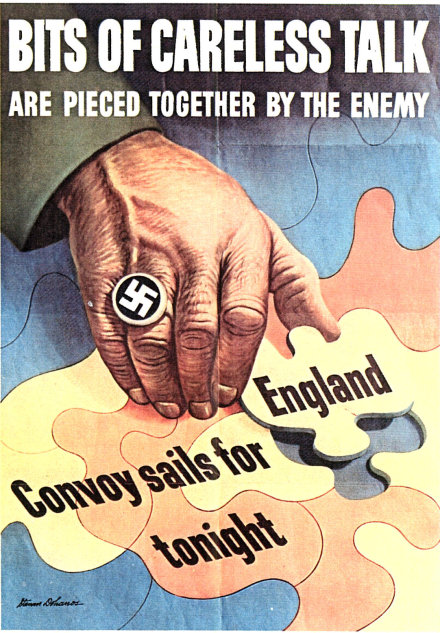
1942: Duncan Scott-Ford, because loose lips sink ships

On this date in 1942, British merchant sailor Duncan Scott-Ford was hanged at London’s Wandsworth Prison for giving German agents sensitive information about ship movements.

This, of course, was just the sort of thing everyone was trying to discourage.

… and a version to keep young soldiers on the pull Mata Hari-conscious:

For a case that so handily underscored the posters, the Scott-Ford affair made great copy … but not until a day after the hanging itself. Having kept everything secret, the papers were finally allowed on Nov. 4 to announce

that a British subject was executed for treachery at Wandsworth Prison yesterday morning.

…

Scott-Ford was paid 1,800 escudos by the enemy. This sum, which in English currency is equivalent only to about £18, was all that Scott-Ford in fact received from the enemy, though promises were held out to him which lured him deeper and deeper into the blackmailing clutches of the enemy. Thus when Scott-Ford returned on his second visit to Lisbon with the information which he had collected the Germans, instead of honouring their promises, threatened that they would expose him to the British authorities unless he continued to perform further services, to collect more valuable information and to undergo greater risks in their interest.

Some of the information which Scott-Ford gave to the enemy related to his own ship, and thus imperilled the lives of his own shipmates.

…

The moral to be drawn from this case is that British and allied seamen when visiting neutral ports should be constantly on their guard against strangers who may frequently approach them for apparently innocent purposes. Such strangers are apt to be enemy agents … (London Times, Nov. 4, 1942)

Shhhhh!

On this day..

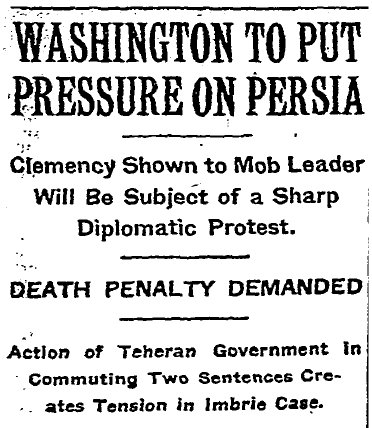
1924: Ali Reshti and Sayyid Husain, to placate America

On this date in 1924, diplomatic maneuvering, oil patch politics, and a dead American consul put two Iranian teenagers in front of a firing squad.

Largely forgotten today, the affair which prompted their execution helped Cossack commander Reza Khan‘s ongoing consolidation of power, culminating in another year’s time with his conquest of the Persian throne itself.

By the summer of 1924, he was by title Prime Minister and his domestic opponents could read the writing on the wall: he had made a premature bid for formal executive authority in 1923 only to be rebuffed.* At the same time, he was engaged in the perilous oil game with an attempt to use American companies to break a British oil monopoly.

On July 18, 1924, American Vice Consul Maj. Robert Imbrie and his civilian countryman Melvin Seymour were attacked by a Tehran mob while photographing a well which had become a Moslem devotional site for purported miraculous healings. Imbrie was beaten to death; Seymour was lucky to survive … and it soon emerged that soldiers from the nearby barracks had not only failed to protect the Americans but actually taken part in the assault.

Iran’s emerging strongman lost no time in making the most of it.

The event gave [Reza Khan] … the excuse for declaring martial law and a censorship of the Press … Numerous arrests have been made, chiefly of political opponents of the Prime Minister. (British military attache Col. W.A.K. Fraser)

It’s like Lenin said, you look for the person who will benefit and, uh, you know, uh, you know, you’ll, uh, you know what I’m trying to say …

Assuming one discerns some measure of design in the Imbrie murder, and the convenient outburst of anti-Baha’i paranoia that sparked the fatal incident, one can go a couple of different directions at this point.

  1. That the Prime Minister’s foes, allied with British oil interests (the British angle was so widely believed in Iran at the time that press censorship forbade the incendiary charge), were firing up the rowdies in an attempt to shake his power. This 1924 American cable makes that case:

    “It had the earmarks from the beginning of an artificially inspired movement, of which the organized powers of evil were quick to take advantage in order to create disorder for the Government … Reza Khan found himself faced with a situation before which he was powerless. The fanaticism of the crowd was so incited by the continuous preaching of the Mullahs that any act on his part would have been interpreted as treason to Islam and prima facie evidence that he was a Bahai; hence his unfortunate orders to the military and the police not to intervene under any circumstances in religious demonstrations and under no circumstances to fire.”

  2. That Pahlavi’s own agents fomented the disorder. According to Michael Zirinsky‘s review of the case, another American official speculated that Reza Khan himself hoped a foreigner would die “so that he could declare martial law and check the power of the Mullahs.”

Which, in the event, is exactly what happened.

The U.S. made a great show of demanding exemplary justice, and it had the leverage to do so: Iran (how times change!) wanted American support and American oil exploitation.

Three were condemned to death for their parts in the riot, and after the first, a young soldier named Morteza said to have incited the mob, was shot on Oct. 2, the government announced leniency for the other two.

Not good enough.


“When you are dealing with a government like Persia … if you ask them to execute a Moslem for the death of a Christian … if they do it, you accomplish more for the prestige of your country than if they paid a million.” -a young Allen Dulles, in 1926 testimony to the U.S. House of Representatives.

At American insistence, those other two were recalled to death after all: 17-year-old mullah Sayyid Husain (various alternate transliterations – e.g., Seyid Hussein), who was supposed to have raised the riot-triggering “Baha’i well-poisoner” accusation in the first place, and 14-year-old camel driver Ali Reshti.

Zirinsky once again:

With the ending of the Iran-U.S. dispute by the execution of Ali and Husain on November 2, 1924, Reza was free to leave the capital city. He had support from the foreign legations, he had secured financing for the army, he had reestablished discipline in the Cossack Brigade, and by executing Sayyid Husain — a mullah — he had demonstrated his domination over the clergy … in the course of the next months’ campaign, he completed the unification of Iran and ensured that his government would get all the [Anglo-Persian Oil Company] royalties…

While the Imbrie affair was not the only critical event of Reza’s seizure of total power in Iran, it came at a critical moment in his rise … he used the murder to his best advantage.

And they all lived happily ever after.

* The future Shah’s future rival Mohammed Mossadegh was among the Iranian Majlis members who blocked Reza Khan’s attempt to rule Iran as a republic in 1923.

** “Blood, Power, and Hypocrisy: The Murder of Robert Imbrie and American Relations with Pahlavi Iran, 1924,” International Journal of Middle East Studies, vol. 18, no. 3 (Aug. 1986). Zirinsky quotes an American diplomat who believed Reza Khan was actually intentionally trying to create a situation where a foreigner would be killed, to give him a pretext for bringing his nation to heel with foreign support.

On this day..

1463: David of Trebizond and his heirs

On this date in 1463, the last regal claimants of Byzantium’s last successor state were executed in Constantinople.

They were, by this time, two years deposed from actual power. David of Trebizond (aka David Comnenos) had inherited the enclave“empire” clinging to the Black Sea coast in 1459, and proved himself “a fit agent for consummating the ruin of an empire.”

Specifically, he cleverly set about needling the overwhelming Turkish power on his borders by vainly attempting to stir up another Crusade, and refused to pay the Mohammedan tribute.

Having recently reduced the impregnable fastness of Constantinople, Mehmed the Conqueror handily availed this provocation to overrun Trebizond.

David and kin made out okay by this calamitous extinction of the Byzantine candle, negotiating in the summer of 1461 an arrangement to settle in Adrianople under the sultan’s protection (and monitoring).

Two years later, David was reportedly caught plotting against the keeper of his gilded cage once more, and Mehmed had the former Emperor, his sons, a nephew and a brother-in-law beheaded, neatly extinguishing the last people with any lineal claim the late Greek imperium.

Theodore Spandounes, a Venetian of Byzantine refugee stock writing in the early 16th century,* claims this was a set-up by Mehmet, “ravenously thirsting for Christian blood,” and that the Komnenoi were given the chance to convert to Islam and atoned their poor statecraft with holy martyrdom.

Furthermore,

Mehmed confiscated all the property of the imperial family of Trebizond and condemned the Empress [Helen Kantakouzene or Cantacuzene] to pay 15,000 ducats within three days or be executed. Her servants, who were Mehmed’s prisoners in Constantinople, worked from dawn to dusk to raise the money and paid it … [but] she had no desire to remain in this world; and, clad in sackcloth, she who had been accustomed to regal finery, refused to eat meat any more and built herself a hovel covered in straw in which she slept rough. Mehmed had decreed that no one was to bury the bodies under pain of death. They were to be left for the dogs and ravens to devour. But the sainted Empress secretly acquired a spade and with her own delicate hands as best she could dug a trench in her hut. All day long she defended the corpses against the animals and at night she took them one by one and gave them burial. Thus did God give her the grace to bury her husband and her sons; and a few days later she too died.

* And writing, it should be observed, with the polemical intent of persuading western powers to go fight the Ottomans.

On this day..

1938: The terrified John Deering

We meet people in these pages who go to the scaffold joking, or sarcastic, or cocksure.

Humans bear up to proximity of death with every psychological defense in the book, but even if surprisingly few die in naked terror, make no mistake this Halloween: there’s a reason the executioner is scary.

Shot Through the Heart

Habitual criminal John Deering had a date with a Salt Lake City firing squad this date in 1938.

If anyone should be nonchalant about being ripped open by bullets, it’s a guy who eschewed a prison sentence in Michigan and confessed to murder to get himself extradited to Utah to face capital murder charges — saying that he and the world would both be better off with him dead.

The 39-year-old put on a cool front, but how steady was he, really? In a weird experiment, Deering agreed to be hooked to an electrocardiogram that measured his heart rate during his last moments.

Here comes the science!

The heart of John W. Deering, holdup murderer, beat three times faster than normal just before he was put to death today by a firing squad in the state prison here. The unprecedented recording was termed valuable to heart disease specialists as it showed clearly the effect of fear.

An electro-cardiograph film, recorded with the condemned man’s permission, showed that Deering’s heart beat jumped from normal 72 to 180, although he appeared outwardly calm. It maintained that rate for the several minutes required to complete preliminaries for the execution.

When the doomed man was asked for a last statement his heart beat fluttered wildly, then calmed after he spoke until bullets ended his life. The heart beat stopped 15.6 seconds after the bullets struck, but he was not pronounced dead until two and a half minutes after the five shots rang out. (Chicago Tribune, Nov. 1, 1938)

Still no cure for cancer.

This guy is obviously not to be confused with his tragic Hollywood contemporary of the same name.

On this day..

Executed Today’s Second Annual Report: Once Bitten, Twice Die

Here at Executed Today, we know where the bodies are buried. As of today, we’ve buried two years’ worth in daily death-blogging since our auspiciously topical launch two Halloweens ago.

As you sow … so shall you reap.


The Triumph of Death (topically detail view; click for the full canvas of wholesale grim reaping), by Pieter Brueghel the Elder, c. 1562.

Where Are You?

The 15 leading domiciles of Executed Today visitors are:

United States (just over half)
United Kingdom (1/8th)
Canada (a bit over 5%)
Germany
Australia
France
Philippines
Netherlands
Italy
Poland
Spain
Ireland
Sweden
Belgium
India

At this point, we’re dropping into a long slope of closely clustered countries with tiny individual footprints.

It’s always interesting to notice the differing behavior of site visitors. The overall average for visitors was to spend 2:29 on the site and visit 2.1 pages, with 70% of visitors “bouncing” or leaving after seeing just one page. But that average conceals many variations.

Loved It

  • Visitors from Kuwait and the United Arab Emirates each had about 3.3 pageviews and over 5 minutes on the site per visit, though similar numbers were not recorded elsewhere in the Middle East. Kuwaitis, remarkably, were more than 50% likely to visit a second page on the site.
  • The Dutch spent over 3 minutes on the site per visit, bounced only 65% of the time, and viewed 2.85 pages apiece.
  • New Zealand had site-average bounce rates, but Kiwis who stuck, really stuck. They spent more than 4 minutes on the site on average.
  • Relative to the averages, Estonians stuck around 20% more often, viewed 20% more pages, and spent 50% more time on the site.

Hated It

  • Only 28 visitors were recorded from Mongolia, but every single one of them left the site without clicking another link.
  • I got nearly 1,000 visits from Vietnam, but they averaged barely 30 seconds on the site and only 1.3 pages per visitors. (The Vietnamese showed similar disinterest last year, too.)
  • Iranians bounced 87.9% of the time.
  • Although in the top 10 for traffic, the Philippines had less than 1.5 pageviews per visitor and a bounce rate approaching 80%.

How’d You Get Here?

Searches accounted for nearly 60% of all traffic to Executed Today (another 30% came from referral links, and just over 10% from direct lookups, e.g., a browser bookmark).

As was the case last year, “executed today” was the most popular search lookup, and “executedtoday.com” was also in the top 10. Let’s set those aside.

The #1 search term besides “executed today” was “colonel claus von stauffenberg” — courtesy of the movie Valkyrie. “claus schenk graf von stauffenberg” and “col. claus von stauffenberg” also both placed in the top 20 and “col stauffenberg” in the top 50, so clearly Tom Cruise wins the year’s search battle. (Interestingly, people who arrived on these searches tended to browse the site less, with only about 1.5 pageviews per visitor. Search visitors in general perform a bit less well than other visitors, but the difference was really pronounced with Valkyrie-generated visitors.)

Excluding Stauffenberg-related searches, the top 15 search terms generating traffic to Executed Today since last Halloween were:

samuel doe
lingchi
samuel doe execution video
albert pierrepoint
arsinoe
amon goth
broken on the wheel
ling chi
ricky lee green
hamida djandoubi
charles starkweather
sidney reilly
jenny wanda barkmann
michael x
botched executions

… I noticed last year that searches on individually named executed women drove more traffic than those on individually named men. That seemed to be somewhat less true this year, even leaving Col. Stauffenberg aside; Jenny Wanda Barkmann is the only woman in the top 15. However, if we extend the table to the top 20, we would add:

rosalie gicanda
edith thompson
john spenkelink
william chaloner
princess mishaal bint fahd

Other women such as Sue Logue, Lois Nadean Smith, Ruth Snyder, Karla Faye Tucker, Hannah Ocuish and Ethel Rosenberg are also among the top 50. It’s still probably the case that women’s executions attract interest and searches disproportionate to their frequency, just as they’ve attracted our eye for a couple of thematic collections (1, 2).


What’d You See When You Got Here?

As of the end of year two, the most popular posts in Executed Today’s history are …

1. January 24, 1989: Ted Bundy, psycho killer

No contest, really.

The runaway number one, more than 25% ahead of its closest competition for pageviews. For such an infamous killer of such recent vintage, I was doubtful about finding something new to contribute on the subject.

Fortunately, author Kevin M. Sullivan, whose new book The Bundy Murders: A Comprehensive History published earlier this year, took care of it by turning the post’s discussion thread into a conversational salon for far-flung folks interested in the killer’s career. As of this writing, the Bundy comment thread is pushing 1,200 entries and still consistently among the most popular posts on the site every single day.

2. July 21, 1944: Col. Claus Schenk Graf von Stauffenberg, for the plot to kill Hitler

Ah, the power of a multimillion-dollar Hollywood ad campaign. Thanks, Tom.

The Valkyrie traffic graph shows a spike in the winter of 2008-09 when the film released on the silver screen, and an aftershock bump in the spring when it went out on DVD.

Although I didn’t “earn” the big traffic by anything other than timeliness, this post also happens to be one of the better ones on the site.

3. September 9, 1990: Samuel K. Doe

A monument to human morbidity, the post about the deposed former President of Liberia is not particularly high-quality, was not blessed with any high-profile links, and has never been especially promoted.

However:

Samuel K. Doe’s pre-execution torture was filmed.

People go Googling for that film.

I’m on the first page of hits, with an embed of as much film as I’ve ever been able to locate.

Voila: traffic.

If anyone out there has the Doe video in its entirety, send it to me and this post will give Ted Bundy a run for his money in no time.

4. August 14, 1936: Rainey Bethea, America’s last public hanging

A stats accumulator type rather than a Hall of Famer, this post benefits from favorable search engine placement for a variety of oft-searched phrases about America’s last public execution, and has been up for 14+ months.

I liked unearthing the local newspaper’s angry response to big-city interlopers portraying them as a mob of bloodthirsty yokels … and I definitely enjoy going back to this bit of warm fuzz from the comments section:

I have enjoyed your work, and would like to thank you for your effort. I particularly like how you avoid the easy, sensationalist macabre approach for something more sombre and cerebral, supported by generous hyperlinks.

5. July 4, 1946: Eleven from the Stutthof concentration camp

This post features images of a few of the Third Reich’s cutest concentration camp guards strangling to death. As you might imagine, there’s a steady market of search hits for that sort of thing. (One of the most popular metadata pages on the site is the tag for Jenny Wanda Barkmann, the foxiest hanged Stutthof guard of them all.)

6. June 6, 1997: Henry Francis Hays, whose crime cost the Klan

Hays was the first white person executed for murdering a black person in Alabama in 84 years — specifically, for lynching young Michael Donald.

The shocking photo of Michael Donald’s body that my post contains has much exercised contributors to the Michael Donald Wikipedia entry, and for a time the article “compromised” on the subject of including it with page versions that linked my humble post from this banner phrase:

WARNING GRAPHIC PICTURE MICHAEL DONALD

Obviously, that generated plenty of clicks.

Alas, more sober-minded editors have not only toned down the article, but removed any link at all to Executed Today. Look for Henry Francis Hays to sink in the rankings in the year ahead if that situation isn’t rectified.

(Note: I don’t insinuate my links into Wikipedia and had nothing to do with this article in any version.)

7. December 11, 1962: Arthur Lucas and Ronald Turpin

This post dates all the way back to the blog’s second month of existence.

It’s an interview with the author of a book about these two unconnected criminals who became the last to hang in Canada, and it was for a short while early in Executed Today’s history the most popular post on the site.

It’s continued since that time to build up almost two years’ worth of unspectacular but steady daily traffic on search hits by people trying to find out … well, who the last people hanged in Canada were.

8. June 19, 1953: Julius and Ethel Rosenberg, “the first victims of American fascism”

It’s interesting to me that few of my top posts are of the household-name execution victims — the Robespierres, the Anne Boleyns, the Tsar Nicholases — which I generally attribute to the competitive search market. There are a lot of pages about Joan of Arc on the Internet, and only so much real estate on search engine results.

Though I’m only on Google’s third page when searching a phrase like (julius and ethel rosenberg), this post is one of the top results when using variants that include the word “execution” (e.g., ethel rosenberg execution) — I presume because of the blog’s name.

Between the minority of people who search this way and the minority of people who wade all the way to the third page of Google hits, this post gets a small-but-just-big-enough slice of an enormous pie.

9. May 15, 1916: Jesse Washington lynched after conviction

The dramatic photographs of the charred body (and celebratory crowd) at one of America’s most infamous lynchings have generated steady traffic with a handful of one- or two-day spikes from minor newsquakes, like this passing reference in the New York Times that quintupled the post’s traffic for a single day.

10. November 29, 1941: Zoya Kosmodemyanskaya

The teenage partisan martyred by the Nazis isn’t exactly a household name worldwide, but she’s searched more often than you might think; these searches don’t skew disproportionately to the former Soviet Union, either.

Gratifyingly, hits to this page come overwhelmingly from searches on Zoya’s name, as opposed to pervy variations on the “women hanging” theme.

This post’s traffic was at a trickle level for its first year, but bumped up to a higher level around the end of 2008 without ever having a clear single spike, giving its traffic graph an odd stair-step look. I’ve never been able to explain this; my two unsatisfying working theories are:

  1. that Executed Today crossed some ranking threshold in the likes of Google pagerank that catapulted the post onto the first page of search results, meaning I started capturing a larger share of traffic that was always there;
  2. that exiled Burmese activist Zoya Phan, who was named for Kosmodemyanskaya, crossed a threshold of public prominence sufficient to increase the frequency with which the name was searched.

… And Others

The remainder of the top 25:

11. September 10, 1977: Hamida Djandoubi – The last man guillotined, and as noted above, one of the top search hits for the site.
12. February 17, 2004: Cameron Todd Willingham – Long-neglected but suddenly popular guest post about a possible wrongful execution that’s been front-page news for the past two months.
13. August 8, 1944: Eight July 20 plotters – A second beneficiary of Valkyrie search traffic.
14. July 8, 1999: Allen Lee “Tiny” Davis – Gruesome bloody photos of the Florida electric chair’s last client.
15. April 10, 1905: Fou Tchou Li – Lingchi or “slow slicing” death “by a thousand cuts” that inspired Georges Bataille.
16. January 9, 1923: Edith Thompson and Frederick Bywaters – A deadly love triangle turned enduring cause celebre.
17. August 12, 1833: Captain Henry Nicholas Nicholls – The #1 post this time last year, thanks to a link from Andrew Sullivan, but scant ongoing traffic promises further sinkage in the year ahead.
18. December 13, 1945: The Belsen war criminals – Featuring Irma Grese, the “Beast of Belsen”.
19. June 25, 1959: Charles Starkweather – The spree killer who embodied the underbelly of the American dream to the likes of Stephen King and Bruce Springsteen.
20. October 9, 1967: Ernesto “Che” Guevara – One of the posts most frequently sought out by visitors viewing a second or third page. Play the mp3, and be sure to join the comment thread’s ideological pissing match!
21. November 28, 1950: James Corbitt – This post is really about prolific British hangman Albert Pierrepoint, on the occasion of his hanging a man he actually knew.
22. December 26, 1862: 38 Sioux – The largest mass execution in U.S. history.
23. January 15, 1943: Sue Logue, Geoge Logue and Clarence Bagwell – Randy young Strom Thurmond made Sue “the only person seduced on the way to the electric chair.”
24. April 7, 2007: Du’a Khalil Aswad – Features a horrificially graphic video of a Yazidi honor killing victim being stoned to death.
25. Uncertain date in 41 B.C.E.: Arsinoe IV – Cleopatra’s sister, who got search traffic earlier this year when scientists claimed to have reconstructed her appearance.

Noticing a pattern? Of the top 25 posts, 22 concern executions that occurred in the 20th or 21st century … and two of the exceptions (#17 and #25) are on the chart solely because of freak, one-time external events (an A-list blog link and an unpredictable news cycle, respectively). In fact, if you throw out those two anomalies and keep going down the list, 29 of the top 30 posts on Executed Today are about 20th or 21st-century affairs, and 26 of those are executions that took place within the past 75 years. (Slightly over half the total posts on this site overall concern pre-20th century executions.)

The list of most popular posts for only Executed Today’s second year (as opposed to all time) is very nearly the same: Arthur Lucas and Ronald Turpin no longer make the top 10, but Cameron Todd Willingham does, a bit of minor shuffling occurs in a few other places … the similarity is no surprise, since nearly 900,000 of the site’s 1.1 million pageviews occurred during its second year.

Noted in passing: the highest-ranking meta-content on the site by a country mile is Seven Generic Halloween Costumes You Can Spice Up With an Execution Story, which dates to last year but has experienced a massive traffic surge this October for obvious reasons. It’s actually pushed its way into the top 20 posts. A heavy preponderance of hits come from searches, especially image searches, for costumes (“pirate costume” being the most frequent); as a result, this post about more generalized Halloween fare is much more popular than its sister offering Nine Executed People Who Make Great Halloween Costumes.

Most Popular Posts by Month

October 2009: Masha Bruskina, Kiril Trus, and Volodia Shcherbatsevich, though only five days old, it outdraws the month’s preceding content on the discomfiting appeal of a comely girl hanged
September 2009: Dr. Mohammad Najibullah, deposed Afghan president notable for the gory photos of his body hanging from a traffic pylon
August 2009: Bronislav Kaminski, Waffen SS collaborator
July 2009: Princess Misha’al bint Fahd al Saud, a disobedient Saudi princess
June 2009: The village of Lidice, for the assassination of Reinhard Heydrich
May 2009: Karl Hermann Frank, who helped engineer the aforementioned Lidice operation
April 2009: Rwandan Queen Dowager Rosalie Gicanda, a prominent genocide victim whose killer was recently arrested
March 2009: William Chaloner, a counterfeiter captured by Isaac Newton which was guest-blogged by the author of a recent book about the case
February 2009: Nguyen Van Lem, the Viet Cong summarily executed in a famous Vietnam War photo and newsreel
January 2009: Ted Bundy, psycho killer
December 2008: The Belsen war criminals
November 2008: James Corbitt, the hangman’s mate
October 2008: Ernesto “Che” Guevara, iconic revolutionary
September 2008: Samuel K. Doe, deposed Liberian president
August 2008: Rainey Bethea, America’s last public hanging
July 2008: Col. Claus Schenk Graf von Stauffenberg, tried to assassinate Hitler
June 2008: Henry Francis Hays, for a racial murder
May 2008: Jesse Washington lynched
April 2008: Fou Tchou-Li, by a thousand cuts
March 2008: Robert-Francois Damiens, disciplined and punished
February 2008: Cameron Todd Willingham, wrongful arson execution?
January 2008: Edith Thompson and Frederick Bywaters, adulterous lovers
December 2007: Arthur Lucas and Ronald Turpin, the last hanged in Canada
November 2007: Zoya Kosmodemyanskaya, Russian partisan
October 2007: Peter Stubbe, werewolf?


Guest Content

Once again, the site relied on the kindness of strangers to make it through another year. Thanks to the following guest posters for pulling through with a month’s worth of content (the second straight year I’ve enjoyed that kind of support) in these fantastic guest posts:

Alexandre Dumas, pere

Anthony Vaver

Caitlin GD Hopkins

dogboy

Gilbert King

James Durney

Jeff Matthews

Jonathan Shipley

Kristin Houlé

Lara Eakins

Laura James

Louise Yeoman

Mark Davis

Richard Clark

Rob

Royelen

Sarah Owocki

Thomas Levenson

Expert interviews also shed some light on these subjects:


Miscellaneous Indicators

Feed subscriptions. This highly volatile and undependable figure has been solidly in the high 400s for a while now, sometimes giving a prairie dog peek up above 500. Just short of half those subscribers are in the U.S.; South Africa (!) is the runaway #2, with Canada third. After those three, it’s a plateau of high-income countries who are all essentially tied. Russia and the United Arab Emirates are in that group among the top feed subscribers despite not being among the high-traffic web browsing sources; conversely, Italy and the Netherlands send plenty of web visitors but have few feed subscribers.

Twitter. I can’t say this is my favorite medium, but yes … Executed Today tweets and twats. 180-some followers get regular blurbs about ongoing death penalty news, much of it from the far-flung network of informants and search feeds that keep the site stocked with future content.

Random acts of violence. I have to credit sometime guest blogger and translator Sonechka for the idea to add one of the most popular features on the site:


I started routing that through bit.ly since local stats were having trouble with it — probably hurting my bounce rate and average page counts in the process, but gaining the url shortening service’s click stats. And bit.ly says the Random Execution button has been pushed 20,000 times in the past 22 weeks.

Editor’s Picks. In the daily blog business, some posts hit and some don’t, and one really never knows what to expect from any given day. Cameron Todd Willingham didn’t get any particular buzz, traffic, or link love when it went up, but it became the site’s starring content 18 months later when The New Yorker caught on to the story.

Having enumerated all the traffic-getters and guest posts above, I thought I’d spare a thought for a few of the in-house posts that aren’t on those lists and might have slipped through the cracks … but that were fun to research, or to write, or (hopefully) to read. While the most-trafficked posts tend to skew towards executions within someone’s living memory, you’ll notice that the author has had the most fun with some older fare.

Presented in no particular order:

… and, of course, our Year 2 wrap couldn’t be complete without:

On this day..

1796: Lesurques, wrongly, and Couriol, rightly, for robbing the Lyons Mail

On this date* in 1796, France enacted what was long held to be one of its most notorious miscarriages of criminal justice by cutting off the head of Joseph Lesurques.

Lesurques was taken for the one of a gang who had sensationally robbed and murdered a mail courier early in 1796, and on the basis of slight eyewitness testimony condemned to die. The only reason he was associated with the crime in the first place was because his friend had been mistakenly accused, and then released, and Lesurques accompanied him to the court to retrieve the friend’s papers where he was “recognized.”

Eyewitness testimony having juridical pull far in excess of its dependability,** this “recognition” was worth the man’s life.

The famous French Revolution executioner Sanson was still in the game at this point, and his grandson (not yet born at this time) used the family notes to pull together this quasi-firsthand account in Memoirs of the Sansons. It’s a tale familiar to any present-day wrongful conviction scenario, of bad evidence snowballing, a blinkered prosecutor intent on conviction, pettifogging appellate authorities, and grim, relentless bureaucratic momentum.

(The names the Memoirs render as “Courriol” and “Dubosc” are also given as “Couriol” and “Dubosc” in other sources.)

the instructing magistrate … instead of imitating the prudence of his Parisian colleague and trying to discover the truth, applied himself to the collection of proofs of the guilt of the prisoners …

Fifteen witnesses on behalf of the defence proved an alibi in favour of Lesurques, eighty-three others spoke highly of his well-known respectability; but their evidence went for nothing in opposition to those who, with singular pertinacity, maintained that Lesurques was one of those who had been seen lurking near the scene of the murder on the night when it was committed …

On hearing his condemnation, Lesurques, who had been firm and collected throughout the trial, lost his self-possession, and raising his hands to heaven he exclaimed:

“The crime which is imputed to me is indeed atrocious and deserves death; but if it is horrible to murder on the high road it is not less so to abuse the law and convict an innocent man. A day will come when my innocence will be recognised, and then may my blood fall upon the jurors who have so lightly convicted me, and on the judges who have influenced their decision!”

…

On the 9th of Brumaire, year 5 (October 30, 1796), my grandfather and father proceeded to the Conciergerie, and found the convicts in the hall, through which so many had passed during the Reign of Terror. David Bernard† was in a state of utter prostration; Courriol, on the contrary, was excited. As to Lesurques, he was as calm and fearless as ever. When he saw my grandfather, whose white hair sufficiently designated him as the chief executioner, he stepped up to him, and said, holding out a sealed letter:

“Citizen, I hope for the honour of human justice that your functions do not often compel you to shed the blood of a guiltless man; I hope, therefore, that you will grant the last request of a man who is about to suffer for what he has not done. Be good enough to keep this letter, which may hereafter contribute to the restoration of the honour of my wife and poor children, whereof they have been so unjustly deprived.”

While one of his assistants was cutting the unfortunate man’s hair, my grandfather read the paper Lesurques had just given him. It was a letter addressed to Dubosc, the man in whose place he was condemned. It ran as follows:

“To Citizen Dubosc.

“Citizen Dubosc, — I do not even know you, and I am going to suffer the death which was reserved for you. Be satisfied with the sacrifice of my life. Should you ever be brought to account, remember my three children and their mother, who are disgraced for ever, and do not prolong their agony. Confess that you are the man.”

…

All preparations were now concluded. Lesurques, of his own choice, was dressed in spotless white, symbol of his innocence. He was the first to take his place in the cart; Courriol followed him, and Bernard, who had fainted, was deposited on the straw. Then began the most dismal and extraordinary journey that ever was made from the Conciergerie to the Place de Greve. Lesurques and Courriol stood in front. At every turn of the wheel, Courriol exclaimed in a piercing voice:

“I am guilty! Lesurques is innocent!”

And for twenty minutes, that is during the whole way to the guillotine, he perseveringly repeated his awful protest against justice. The crowd was horrified, and there were few who did not believe the murderer who confessed his crime, but who proclaimed his companion’s innocence. Courriol again repeated his words at the foot of the scaffold with extraordinary energy and vehemence, and the thump of the knife but just covered his supreme shriek:

“Lesurques is innocent!”

…

The judicial authorities have perseveringly refused to recognise this flagrant miscarriage of justice. And yet the innocence of Lesurques was amply demonstrated a short time after his execution: all the real murderers of the courier of Lyons designated by Courriol were captured; Dubosc himself, whose fatal resemblance to Lesurques was the cause of the latter’s death, was taken and tried … he was executed just four years after Lesurques …

The Lesurques heirs were left paupers by the state’s punitive confiscation of the “bandit’s” effects; after a quarter-century (during which the widow died in a madhouse), they were at least able to recoup their material loss, but although repeatedly challenged, the conviction itself was never reversed.

Judicial and literary skirmishing over the Lesurques matter continued for decades, gradually forming into a general consensus (whatever the courts might admit) that the man was wrongly accused.

As a result, Lesurques remained a potent symbol of capricious criminal justice overreach throughout the 19th century and into the 20th: this 1874 reader, Famous Cases of Circumstantial Evidence, has a full chapter on the case; a popular Victorian play titled The Lyons Mail was translated into a now-lost 1915 silent film and a 1931 talkie … albeit with a happy ending.

To a certain, inevitably well-represented, authoritarian demographic, any credence given to the self-evident proposition that wrongful convictions happen smacks of effrontery towards betters, and the Lesurques case was no exception … especially when paired with the coincident low ebb of public esteem for Power during the Dreyfus affair, which hit while The Lyons Mail was in vogue.


An advert insert in an unrelated 1903 book plumps a “Lesurques was guilty” position, riffing on the then-current Dreyfus controversy (“recent efforts in France to bring about the revision of a celebrated case”). This book is listed, but unavailable, on Amazon.com.

L’ affaire Lesurques never (so far as I can determine) reached a resolution; it simply faded away, 140 years or so after its namesake lost his head.

A late (1930) review of its particulars in the Journal of the American Institute of Criminal Law and Criminology (“The Moving Story of the Lyons Stage,” by Max Radin of UC-Berkeley, May 1930) proceeds with ingenuousness embarrassingly unbecoming a professor of the law.

Judicial errors do not occur in the United States. [!!!] Under these circumstances, we can look with some satisfaction on times and places in which this happy condition did not prevail. If in the cycle of existences our perfection should ever become visibly tainted, it may happen that we shall hang men or electrocute them and subsequently regret the fact. Perhaps some one will then recall the moving story of the Lyons stage.

Sounds like it’s ready for a revival.

* A few sources say March 10, 1797, but the most and best clearly lean to October 30, 1796.

** “Juries have an unfortunate faith in the accuracy of eyewitnesses,” William Davis Gross observes. “The propensity for blunder is so great that it is nearly equal to all other forms of error combined.” (“The Unfortunate Faith: A Solution to the Unwarranted Reliance Upon Eyewitness Testimony,” Texas Wesleyan Law Review, spring 1999)

† Bernard is a footnote in the story, but he seems to have received a raw deal himself: he was the liveryman who procured the horses for the highwaymen, but did not participate in the crime. Sanson passingly refers to Bernard as “but slightly guilty.”

On this day..