On this date in 1915, a quintet of African Americans died in South Carolina’s electric chair during a 70-minute span.
Joe Malloy was put to death for killing two white men four years before; the other four executed on this date were convicted together of murdering 73-year-old Confederate veteran John Q. Lewis. They were John Crosby, Nelse Brice, and — our principal concern today — Thomas and Meeks Griffin.
In this case, and even though public opinion was predictably inflamed at the aged veteran, the Griffins weren’t lynched: indeed, prominent white people in the community, such as the mayor and the sheriff, rose to the Griffins’ defense to the extent of signing a petition for executive clemency. They didn’t believe then that the thief whose accusation condemned the brothers was credible.
More than likely they suspected Lewis’s 22-year-old black mistress, Anna Davis, and/or her husband — and undoubtedly, they would have known exactly why this scandalous angle was not pursued in court.
Still, South Carolina’s governor reckoned that they’d had their day in court, the victims deserved closure, and whatever other equivalents of the familiar modern-day rationales one might care to name.
Almost surely, this distant injustice would be lost to time were it not for the Griffins’ famous great-nephew, the radio host Tom Joyner.
Joyner only recently discovered (via Henry Louis Gates Jr.‘s research for a PBS documentary*) his kinship with these executed men; his grandmother had moved away to Florida to bury the family tragedy.
But the broadcaster exhumed it with gusto, and, two years ago, was able to secure a posthumous pardon from South Carolina based on the weakness of the original case. It’s thought to be the first official posthumous pardon the state has granted to any executed persons.
But we do want to extend the Palmetto State the credit due to all its sons whose signatures graced the disregarded clemency petition way back when. More than that: The State editorialized, confusedly but forcefully, against the manifest racial discrepancies in capital sentencing on the occasion of this quintuple-execution. (Oct. 1, 1915) These questions, ever present, are more sincerely grappled with in this column than we can manage today.
* You can watch the big reveal when a flabbergasted Joyner first hears about his ancestors: it’s quite a moment.
On this date in 1906, Adolph Weber hanged in California for “one of the most revolting [crimes] in the annals of criminal history”:* the slaughter of his entire family.
On the night of Nov. 10, 1904, a fire at the Auburn mansion of Julius Weber, the onetime owner of the (still-extant) Auburn Alehouse, raised the town’s alarm. Firemen responding discovered four bodies within: Julius, his wife, and two of the couple’s three children. The coroner’s inquest soon determined that all four victims had met a violent death (three by shooting, one by beating) prior to the conflagration, and suspicion naturally fell on the one kid who survived and now stood to inherit the boodle.
(And, it transpired, had robbed a bank earlier that year.)
“Young Weber,” as the papers began to call him, soon became the object of widespread public opprobrium; the case against him was circumstantial but, with the addition of a man who claimed to have sold Weber the very make and model of a pistol found hidden some days after the crime, more than compelling enough for the judiciary. (The text of an appellate decision here outlines the case in greater detail.)
Meanwhile, the legislative branch got busy on a new 1905 Patricide Law to disinherit any homicide beer baron scions of the future. Since the previous statutes had not bothered to anticipate the present circumstance, Adolph Weber inherited all his purported victim’s money (after all, the other potential heirs were also now dead): he promptly blew through most of it on his legal expenses.
Weber’s phenomenal sangfroid from the moment of his arrest up to that of his noosing was his outstanding characteristic. Considered horrifying “vanity” and coldness while his guilt was adjudicated —
The life and character of Adolph WEBER have come under more notice than those of perhaps any other California criminal, unless DURRANT was the exception. And he is more of an enigma than DURRANT. The latter was industrious in protesting his innocence, while WEBER has never deigned to aver his, except when the direst question of his guilt or innocence was put to him at the trial, and even then his answers were in monosylables.
— it had become by the time the doomed Weber coolly ran out the clock to execution “the nerve which has characterized him as one of the most remarkable criminals of the century.”
“Never,” the Los Angeles Times wrote on the morrow of Weber’s execution, “did an assassin meet death with firmer step, or cooler nerve, than did the boy murderer of Auburn.”
Twenty years ago today, Warren McCleskey died in Georgia’s electric chair for the murder of a police officer.
Yet the “question reverberates: Did Warren McCleskey deserve the chair? For the question to outlive him is a damning commentary on capital punishment in the United States.”
The most reverberating commentary on this case was the 1987 Supreme Court decision McCleskey v. Kemp — a landmark 5-4 ruling that still shapes the way judges handle purported racial discrimination in the criminal justice system.
McCleskey (the decision, not the man) “marked the end of an era in death penalty jurisprudence … reject[ing] the last major challenge to the death penalty in America” from the generation of legal tinkering reaching back to the 1960s.
McCleskey v. Kemp was decided on April 22, 1987, at which time just 70 humans had been executed since the “modern” era of capital punishment began in the 1970s. (Today, the count is well beyond 1,200.)
The victims attributed to those 70 were 83% white (77 of 93),* even though blacks and whites are murder victims in roughly equal numbers — suggesting on its face that white victims are treated as disproportionately “valuable” by prosecutors, juries, and/or judges. This was, prospectively, the case with Warren McCleskey himself, an African American who in the course of an armed robbery had gunned down (or maybe not: see below) a white off-duty policeman.
McCleskey’s appellate team marshaled a statistical study by Iowa Prof. David Baldus indicating that black murderers (to a small extent) and killers of white victims (to a greater extent) were indeed more likely to receive a death sentence in Georgia, even when controlling for dozens of other variables. “According to this model,” wrote Justice Lewis Powell for the majority, “black defendants, such as McCleskey, who kill white victims have the greatest likelihood of receiving the death penalty.”
Though it accepted evidence of a discriminatory pattern,** the high court nevertheless ruled that McCleskey was not entitled to appellate relief unless he could demonstrate that that it was at work in his specific case.
And with some reason: the import of granting constitutional relief to a claim of “endemic racism in the system” would open a Pandora’s box of appeals from America’s burgeoning carceral state.
McCleskey’s claim, taken to its logical conclusion, throws into serious question the principles that underlie our entire criminal justice system … if we accepted McCleskey’s claim that racial bias has impermissibly tainted the capital sentencing decision, we could soon be faced with similar claims as to other types of penalty.
This reasoning too backtracked from equal protection concerns that had helped lead a similarly bare 5-4 majority to strike down then-existing capital statutes 15 years before in an appeal originating from the same state — Furman v. Georgia. That old regime had then been replaced with a death penalty system supposedly capable of minimizing arbitrariness. McCleskey served notice that justices wouldn’t be going out of their way to hunt arbitrariness any time soon.
The Court’s remaining liberal lions — it still had such a thing in 1987 — dissented furiously from McCleskey. William Brennan replied to the majority:
Warren McCleskey’s evidence confronts us with the subtle and persistent influence of the past. His message is a disturbing one to a society that has formally repudiated racism, and a frustrating one to a Nation accustomed to regarding its destiny as the product of its own will. Nonetheless, we ignore him at our peril, for we remain imprisoned by the past as long as we deny its influence in the present.
He also found “fear that recognition of McCleskey’s claim would open the door to widespread challenges … seems to suggest a fear of too much justice.”
Brennan was on the losing side of this judgment in a larger historical sense as well — at least, the brief span of history to unfold since Warren McCleskey sat in the electric chair.
McCleskey author Lewis Powell retired a few weeks after issuing it, and not long thereafter expressed regret for the McCleskey decision.‡ Relentless death penalty foes Brennan and Thurgood Marshall would hang up the spurs within a few years. (The circus Senate hearing to place Clarence Thomas in Thurgood Marshall’s seat was ongoing when Warren McCleskey finally died.)
But the deciding vote in McCleskey was cast by freshman Reagan-appointed justice Antonin Scalia, and he’s still going strong.
Scalia was then the Court’s emerging conservative paladin, though he was so new to the Court that McCleskey’s litigators hoped he might be amenable to their suit as a swing vote. Far from it: after Thurgood Marshall’s death in the early 1990s, his donated papers were found to contain a Scalia memo that rubbished the McCleskey majority’s mere consideration of the Baldus study.
I disagree with the argument that the inferences that can be drawn from the Baldus study are weakened by the fact that each jury and each trial is unique, or by the large number of variables at issue. And I do not share the view, implicit in [Powell’s draft opinion], that an effect of racial factors upon sentencing, if it could be shown by sufficiently strong statistical evidence, would require reversal.
Since it is my view that the unconscious operation of irrational sympathies and antipathies, including racial, upon jury decisions and (hence) prosecutorial [ones], is real, acknowledged by the [cases] of this court and ineradicable, I cannot honestly say that all I need is more proof.
Shorter Scalia: racism happens, so what?§ (Ultimately, Scalia opted not to file a separate opinion explicitly making this case; he just signed on to the majority opinion.)
As one might imagine, death penalty jurisprudence at One First Street NE in these latter days has become correspondingly rougher — and the problems raised by McCleskey have scarcely abated.
Although the McCleskey case is what our day’s principal is best known for, he was also caught up in one of the more everyday — but not the less disreputable — toils of the system: the phony jailhouse informant. Very late in the appeals process, McCleskey’s lawyers were finally able to show that the fellow-prisoner who testified that McCleskey admitted the shooting to him was in fact a police plant operating on a quid pro quo to reduce his own sentence. (It’s amazing how often defendants spontaneously confess to these guys; the Troy Davis case which climaxed last week also featured a jailhouse snitch.) Somehow, prosecutors forgot all along to mention that arrangement even when directly asked.
The Supremes ruled, Kafkaesquely, that this issue was procedurally out of order because McCleskey hadn’t raised it earlier, neatly ignoring that the reason he hadn’t raised it was that prosecutors were actively concealing the fact. That’s the subject of the other SCOTUS case under our man’s name, McCleskey v. Zant.
(At issue was whether McCleskey was himself the triggerman. Since he was part of the robbery gang, he was legally on the hook for capital murder whether or not he personally fired the shot; but, his death sentence turned in reality on the jury’s belief that McCleskey was the individual killer — a detail supplied by the suspect police informant. None of McCleskey’s confederates faced execution.)
The final drama this date was a “chaotic” mess of last-minute legal maneuverings, with McCleskey strapped into the chair at one point, then interrupted from his last statement to be returned to his cell, then finally hauled back to the lethal device after an early-morning telephone poll of Supreme Court justices.
* Execution demographic counts via the Death Penalty Information Center’s executions database.
** While the McCleskey court accepted Prof. Baldus’s statistical interpretations even while rejecting their constitutional import, a vigorous pro-death penalty case is made here against the reading that the modern American death penalty is racially discriminatory to any great extent.
† This Latin phrase — fiat justitia ruat caelum — is actually engraved above the sitting justices at the Georgia Supreme Court.
‡ The regret was about more than Warren McCleskey; Powell’s biographer described a complete change of heart in the June 23, 1994 New York Times:
when the retired Justice Powell said he had changed his mind about the McCleskey case, I thought he meant that he would now accept the [Baldus] statistical argument.
“No,” he replied, “I would vote the other way in any capital case … I have come to think that capital punishment should be abolished.” …
Justice Powell’s experience taught him that the death penalty cannot be decently administered. As actually enforced, capital punishment brings the law itself into disrepute.
§ See Dennis Dorin, “Far Right of the Mainstream: Racism, Rights, and Remedies from the Perspective of Justice Antonin Scalia’s McCleskey Memorandum,” Mercer Law Review, 1994.
One needn’t look to far to find venom and cruelty around the institution of capital punishment.
But the human potential is wonderfully plastic, and without unduly romanticizing the act of strangling on a hemp rope a fellow who has committed homicide, even this extremity carries the potential for catalyzing reconciliation across the threshold of death itself.
This date’s public hanging in Crestview, Florida of Jake Martin and Putnam Ponsell was marked by a remarkable display of contrition and forgiveness that symbolically brought the hanged men back into the community they had wronged even as they were dropped to their deaths.
Martin and Ponsell had hitched a ride with a local and then beaten him to death and rifled the body — that was on July 4, less than 12 weeks before execution.
We will venture to impute to these fellows genuine repentance. At court, Ponsell confessed to the crime without any guarantee from the state. He then testified against Martin, who denied the charge and then “broke down and made a full confession.” (Macon Telegraph, Sep. 8, 1921)
(Martin, granted, broke down only after conviction. Ponsell’s firm and open-hearted embrace of responsibility was openly admired by observers.)
This human sentiment would be reciprocated. Here’s the remarkable newspaper report from execution date (a wire story run in a number of papers, this version from the Augusta Chronicle, Sep. 24, 1921).
Murderers Pay Death Penalty While Crowd Boosts Collection.
Crestvew, Fla., Sept. 23 — A double execution took place here today when Putman[sic] Ponsell and Jake Martin, paid the death penalty for the murder of John Tuggle on July 4th, near this place. The trap was sprung at 19 minutes past 12 and the men were pronounced dead in 18 minutes.
A crowd estimated at 10,000 persons had gathered to witness the hanging which was a public one.
Both Ponsell and Martin admited their guilt just before the execution and a letter from the mother of John Tuggle was read to the men in which she said that she had forgiven them.
A collection was taken up in the rod for the benefit of the wife and two children of Ponsell and he wife and one child of Martin who are destitute and more than a thousand dollars was contributed.
(No doubt this touching reconciliation with the gallows crowd was greatly aided by the circumstance of Martin and Ponsell’s whiteness.)
According to this recent news story, our quiescent bludgeoner Ponsell left behind a letter addressed “To Young Mankind.” The actual contents of this straighten-up-and-fly-right manifesto do not appear to be available online, unfortunately.
Martin and Ponsell didn’t save their lives. But maybe a Dostoyevsky might have hoped that they saved their souls.
On this date in 1902, a hanging in Alaska capped a gold rush story fit for Jack London.
“A leetle favor … I gif my husky-dog, Diable, to de devil. De leetle favor? Firs’ you hang heem, an’ den you hang me.” Illustration from Jack London’s short story “Diable” (or “Batard”).
Actually, this tale is set not in London’s characteristic Klondike gold rush, but a subsequent one centered on remote Nome. There, in the words of the Rex Beach novel The Spoilers, “a frenzied horde of gold-seekers paused in their rush to the new El Dorado. They had come like a locust cloud, thousands strong, settling on the edge of the Smoky Sea, waiting the going of the ice that barred them from their Golden Fleece — from Nome the new, where men found fortune in a night.”
The victims in this case of mercenary arctic brutality were a party of four who set up prospecting camp on Unimak Island, in the Aleutians. Their impression that they were safely alone on this large territory was refuted with the inexorable cruelty of a slasher flick.
After being caught out by the elements in a secondary camp, the party returned to its unsecured main base to discover “that their tent had been torn down in their absence and their stores taken away.”
Here the ominous overture fades in, and by the time it hits crescendo the mysterious robbers will have visited a cold-blooded massacre on our quartet of prospectors.
“Suddenly a man, who had been hid by the tall coarse grass, jumped up several hundred yards away, and took aim with a rifle at Florence. He fired and Florence fell with a scream. ‘Con’ and I ran for the boat, jumped in, and Rooney started to shove her off. The next moment a shot came from somewhere in the cliff above our heads.
“Rooney grabbed hold of his right knee, cried ‘They’ve got me too,’ and sank into the surf. Con and I saw that there was no use trying to get away in the boat, and so took it on the run for the shelter of the cliffs. We hadn’t gone twenty steps when another shot rang out; Con threw up his hands and fell headlong upon the beach, stone dead, with a shot between the shoulders. I kept on running, hearing shot after shot fired at me and striking about me with dull thumps like pieces of heavy hail.”
That’s from the riveting account of the lone survivor, one Jackson, who managed to escape into the island’s interior and after tramping about for two weeks, near to starvation and in continual terror of his stalkers, was finally found at death’s door by a friendly hunter.
Jackson’s information was able to tip off an investigation that led to the capture of two suspects. By the time Fred Hardy and George Aston were nabbed, they had “taken possession of” a fishing village and “kept [the fishers] in a terrified state.” They also happened to have the late prospectors’ booty, including personal items like an inscribed watch.
Aston wisely turned on his confederate, saving his own neck at the cost of stretching Hardy’s.
Hardy, a veteran of America’s colonial adventure in the Philippines and a nephew (so he said) of department store magnate John Wanamaker, denied guilt all the way to the scaffold but got no help from appellate courts or from President Teddy Roosevelt. (Since Alaska was still a territory, executive clemency was up to the White House.) He was put to death “in an addition built to the ice-house on the lot opposite the jail” (according to Washington state’s Morning Olympian, Oct. 3, 1902) at Nome City itself.
It wasn’t actually the first execution in Alaska, or even American-run Alaska, but Hardy’s hanging was a significant milestone. Prior to 1900, the vast territory was next door to lawless, order enforced in the interior by miner’s meetings or not at all, while a smattering of coastal military and customs outposts projected vague federal authority. Data on executions from this period is sketchy and incomplete.
In 1900, with the Alaskan population booming from that locust cloud of gold-hunters, promulgation of a civil code set Alaska on the way to something resembling normal government. Hardy’s execution was the first under legal judicial authority — the first of eight in the first half of the 20th century. Alaska abolished capital punishment shortly before attaining statehood in 1959.
On this date in 1912, a prolific Springfield thief died in the electric chair.
No, not Snake.
This fellow was Bertram G. Spencer, whose Boston Brahmin name belied a deceptively modest station.
A brakeman by day, Spencer lived a double life as Massacusetts’ boldest burglar in the evenings, when he would raid homes around Springfield at times when he was likely to be caught. (Hey, he did have a day job.) He frequently was intercepted, but for two years nobody ever got the drop on him and the numerous conversations he had with his victims were not enough to crack the case.
This villain comes up short of positively Moriartyesque by virtue of his amateurish chops in acquisition; one of the mystery burglar’s noted characteristics was the frequency with which he passed over the most valuable booty in the house in favor of some inconsequential bauble.
With his penchant for brandishing a weapon at the folks he bumped into, it was only a matter of time before somebody died for one of those inconsequential baubles. On March 31, 1910, schoolteacher Martha A. Blackstone became that somebody when in a panicking reaction to Spencer’s home invasion she failed to pipe down and let him rob — and he shot her dead.
Forensics then languishing in a primitive state, Spencer kept getting away with his larcenous (and then murderous) spree with little more than the expedient of wearing a kerchief and hat to hide his face. How were they ever going to find the guy — unless he did something ridiculous like drop a monogrammed locket on the scene?
Period postcard shows images connected to the Spencer crimes centered around the “B.G.S.” locket he dropped at one site, leading to his detection. Just to really make sure he hung himself, the locket contained pictures of his mother and sister.
Upon arrest, police tossed his home and discovered (quoth the New York Times) “black masks, slouch hats,” and “a big revolver, fully loaded” under his pillow. No word on whether he was twirling his mustache, too.
Where the relieved well-to-do of Springfield perhaps saw only a somewhat preposterous villain — inspired, according to the Springfield Republican, by “a daredevil bravado, a love of the spectacular and a lack of pecuniary calculation which strongly suggested either the monomania of an unbalanced mind or a romantic vanity fed on by penny dreadfuls” — other practitioners in the emerging field of psychiatry saw a systemic breakdown.
Indeed, Spencer became the topic of an open tug-of-war over handling defendants with putative mental disorders in the criminal justice system. The district attorney at the time had Spencer committed without trial, and his doing so — rather than contesting Spencer’s sanity in court — contributed to his loss at the polls in 1910. (The new guy, in his remarks on the case, reclassified Spencer from “insane” to the more prosecutable “moral imbecile.”)
If the public was certain enough about Bertram Spencer’s sanity to elect a guy just to try him, it will come as no surprise that the testimony about Spencer’s abusive childhood and manic-depression cut no ice with a jury of his peers.
While our burglar went to his juridical death (last words: “good night”), a Massachusetts psychologist named Lloyd Vernon Briggs took up the man (alongside more luminous criminals like presidential assassin Leon Czolgosz) as one of his case studies for a 1914 book, The Manner of Man That Kills. A lengthy pdf of the Spencer material — it’s all public domain — is available here.
Briggs viewed mentally disordered prisoners as people who were ill-served by the criminal justice system: more than that, as instances where a society failed itself by failing to recognize potentially criminal mental illness before it metastasized into actual crime, and the adversarial judiciary as a factor in that dysfunction.
Dr. L. Vernon Briggs … made it his goal to end the courtroom spectacle of dueling psychiatrists. …
Briggs was an indefatigable advocate of the psychological links between mental illness and murder. He believed that mental illness and moral degradation were the root causes of crime and violence. … Briggs insisted that the “real offender is society and not the children in the form of men, not the mentally diseased” who commit violent crime.
…
When mentally ill people landed in court, Briggs believed that the law’s adversary procedures undermined scientific truth and the legal protection provided a defendant. He wanted to bridge the gulf between law and psychiatry by intervening in the process before a mentally ill defendant appeared in court. He was especially critical of the “spectacle in our courts of two or more physicians pitted against one another, testifying to diametrically opposite opinions as to the mental condition and responsibility” of the defendant. Such a procedure, he said, not only humiliates the mentally ill defendant but increases the likelihood that a mentally ill capital defendant will be sentenced to death and executed … Briggs lobbied the public and the legislature for a law that required all capital defendants to undergo a psychiatric examination by neutral experts as son as they were taken into police custody.
…
Briggs was appalled [at Spencer’s case]. He contended that all of the psychiatrists who examined Spencer knew he was insane at the time of the murder and at the trial. Some thought he was medically insane but not legally insane. Briggs denounced the distinction between medical insanity and legal insanity as without a difference. The awful result of the confusion between psychiatry and the law was the unnecessary execution of an insane person. “The whole legal machinery of the State,” he wrote angrily, “had been put in motin to crush this defective and uphold the Majesty ofthe Law and so it came about that Bertram G. Spencer, a defective from birth, with the mind of a child, was tried for his life and sentenced to death and executed with a smile upon his lips.”
On this date in 1938, Albert Dyer hanged at California’s San Quentin prison for a triple rape-murder.
Dyer is a very modern bugbear, a monster right out of cable news and amber alerts and stranger danger.
As often with those, his path to infamy began with disappeared white girls — Jeanette Stephens, Melba Everett, and Madeline Everett, all ages 7 to 9 — who went to picnic at an Inglewood park one summer afternoon and never came home.
The police set about hunting for any known sex offenders in the area, but the offense would ultimately be attributed to a neighbor who was active with the concerned search parties that scoured the area.
Induced by a police threat to deliver him into the hands of a lynch mob, Dyer admitted to having lured the girls off on the pretext of catching rabbits, then strangling them to death and raping their corpses.
(Here’s a disturbing set of photos of the girls’ bodies.)
Dyer attempted to repudiate these confessions, which you’d have to say were obtained under a bit of duress. The case against him apart from self-incrimination was a tissue of meager circumstantial evidence; Dyer’s persona smacks of mental deficiency that might have left him easy prey for manipulation by his captors.
Newspapers described Dyer as “dull” and “stupid”, and in fact the defense attempted to cast doubt on the prisoner’s mental competence and the reliability of his confessions. The jury took agonizing days to reach a consensus, and the last man holding out against conviction would later say that he finally gave in after being led to believe that the judge considered Dyer guilty. (This revelation was among the defense’s last arguments for executive clemency, at the end of the process.)
In short, for all the horror of the crime, the case was not cut and dried in 1938. The passage of time — with our latter-day awareness of false confessions and developmental disability — will hardly make it more so, unless some forgotten crime locker still preserves a testable genetic sample. But no surprise, the popular press had a different take. The Los Angeles Times editorialized (Aug. 27, 1937) anticipating that
[t]he verdict of a jury that Albert Dyer must die for the murder of three Inglewood children is a long step toward the eradication of sex crime in California. It is the only outcome of the case that public opinion could afford to sanction.
The evidence against Dyer was overwhelming; and there could be no mitigating circumstance which could justify this State in letting such a miscreant go on living.
Even if Dyer is mentally defective, there is no reason for his continued existence. He could never be safe to have at large. Legally, his condition is not insanity; he knew what he was doing and that it was wrong. Eradication of such types is necessary for public safety.
And the death penalty is the best deterrent. If others have this criminal tendency, his fate may cause them to repress it. Dyer, hanged, may save the lives of countless California innocents. In any scale, the safety of children must weigh more heavily than his forfeited right to live.
Dyer was the second-last person hanged by the Golden State before the gas chamber came online to replace the gallows. His legacy was California’s 1939 passage of a law governing (pdf) the handling of “Sexual Psychopaths”. (This site suggests he was also posthumously exploited for the cause of marijuana criminalization.)
“Minister-Sheriff Hangs Iowa Murderer, Resigning Des Moines Pastorate to Do So” read the New York Times headline for the execution this date of Eugene Weeks.
Our interest here is not drawn by Weeks, who hanged for the forgettable murder of a grocer, but by his executioner, a truly American character running a truly American grift.
Winfred E. Robb parlayed decorated service as a World War I chaplain into a postwar book paying sentimental martial tribute to “young men … [and] their glorious death” the better to inspire “a greater patriotism and the dedication of himself to the common good of his fellows.”
Robb had returned from the European theater to his prewar gig as pastor of Des Moines independent evangelical congregation, the First Federated Church. (It still exists, nearing its centennial in the guise of a megachurch preaching “triumphalist, Americanized Christianity”.)
Our pastor proved amenable to exchanging this ministry of God for that of a more temporal power, and was elected Sheriff of Polk County in 1920 on an anti-corruption platform. The New York Times reported that his “campaign pledges of ‘cleaning up’ Des Moines have been followed by vigorous efforts against bootleggers and disorderly places.”
Among these edifying duties was another that some of his congregation found less tasteful: while Iowa had centralized its hangings at the penitentiary in Fort Madison, each execution remained the responsibility of the local sheriff in the county which sent the man to death row. That meant Pastor Robb.
Evidently some members of Robb’s congregation objected to this office, but where theology (potentially) clashed with politics, our man was prepared to render unto Caesar.
Brainless people who have no ability to think … will condemn and rave and shout as usual. Unthinking religious fanatics will plead and pray and forget that God is a God of justice and mercy, and that judgment is as much a duty of love as mercy is the delight of love.
America is cursed today with a lot of spineless reformers. They think of a minister as a sissy, sexless, spineless creature with lily white hands who spends his time attending ladies’ societies and pink teas.
Tough love, baby. This was an apostle of muscular Christianity.
So Weeks resigned his ministerial commission, and on this date he skipped the ladies’ societies and put Eugene Weeks to death for murder.
By the end of the year, our hammer of the Lord had found himself on the anvil side of the law, and maybe rethinking those duties of love. Prohibition was Sheriff Robb’s milieu and the cause of his fall, as told by this Associated Press wire story printed in the New Year’s Eve Miami Herald:
IOWA PARSON-SHERIFF HELD FOR BOOTLEGGING
Jailer, Whose Sons He Arrested, Accuses Preacher Who Presided at Hanging.
DES MOINES, Ia., Dec. 30. — Sheriff Robb, Polk county’s preacher-sheriff, who gained nation-wide prominence last fall through officiating at the hanging of two murderers at Fort Madison penitentiary, was arrested here today charged with unlawfully disposing of liquors as the sensational backfire action on the part of his jailer, William McMurray, whose own sons had been arrested by the sheriff for alleged complicity in the theft of $30,000 worth of bonded whiskey from the county jail Wednesday night. The sheriff’s bond was fixed at $1,000 which he furnished and the hearing set for January 3.
John Robb, brother of the sheriff, and himself a minister, who has been acting as a deputy for his brother, also was arrested charged with larceny, on information sworn out by Jailer McMurray and released on $500 bond. Neither charge was made in connection with the theft of the 47 cases from the jail Wednesday night.
Later additional charges were filed against Sheriff Robb by McMurray which alleged the sheriff had illegally sold cider presses and other paraphernalia used in making liquors, which had been seized in raids.
Charges that Sheriff Robb personally sold 35 quarts and 75 pints of whiskey to L.S. Hill, president of the American Lithographing company, a month ago, and has given away and sold seized liquors to other persons, furnished the basis for the charges which McMurray filed. Mr. Hill denied he bought liquor from the sheriff.
Greater patriotism hath no man than this, than to peddle seized drug contraband to local oligarchs under guise of law enforcement. At least you could never accuse the guy of keeping those hands lily-white.
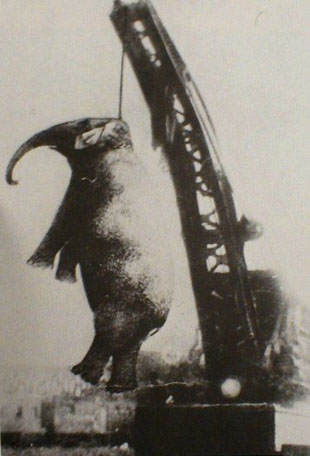
On this date in 1916 — true story — this happened.
Five-ton circus elephant Mary (yes, she has her own Wikipedia page) was in Kingsport, Tennessee on the chintzy fairgrounds touring circuit with Sparks World Famous Circus.
Billed as as “The Largest Living Land Animal on Earth,”* this exotic creature was a prime draw for the circus — and also a beloved pet of the Sparks family.
Unfortunately, this valuable asset was placed in the temporary stewardship of an inexperienced “under keeper” whom the circus had had to scoop up at a recent stop to cover staff turnover. Between shows on September 12, that fellow somehow (accounts conflict) enraged Mary, and (again according to one version among several) she
“collided its trunk vice-like [sic] about [the under keeper’s] body, lifted him 10 feet in the air, then dashed him with fury to the ground … and with the full force of her biestly [sic] fury is said to have sunk her giant tusks entirely through his body. The animal then trampled the dying form of Eldridge as if seeking a murderous triumph, then with a sudden … swing of her massive foot hurled his body into the crowd.”
It’s apparent in this report that the facts of an already-sensational event almost instantly began disappearing into its spectacle. See the largest land animal on earth! See it maul its handler to death! But what happened next lifted Mary all the way to legend.
The owners knew they had to euthanize the “mankiller,” or if they didn’t know they were soon persuaded by mushrooming press attention and towns threatening to ban the Sparks circus.
But how? They couldn’t shoot Mary to death — she apparently survived gunshots from the vengeful crowd in the immediate aftermath of the trampling; firearms just didn’t pack the wallop to put down a pachyderm in 1916. The area didn’t have the sort of electrical juice available that Thomas Edison had once used to drop a circus elephant during his weird campaign for the electric chair.
The choice for the baleful logistical task of killing a 10,000-pound evildoer was hanging, selected over “crushing it between railroad cars.”
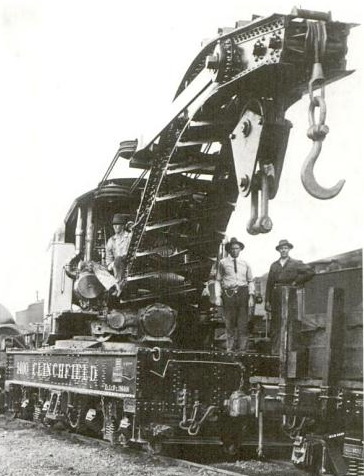
And for stringing up “Murderous Mary”, you need no ordinary gallows. No, for this job, you’re using the hoist on a train derrick and an industrial-strength chain for a noose.
The actual train derrick that hanged Mary the elephant. The leftmost man, seated on the machine, is the “executioner” who worked the controls, according toThe Day They Hung the Elephant.
The railroad was game for the operation, provided the circus would come to it. So on this date, the circus train cars loaded up for the nearest usable train derrickscaffold at Erwin, Tennessee.
There, a procession of all five Sparks elephants — the routine was supposed to keep Mary compliant, and it did the trick even though some observers later remembered the condemned creature behaving unusually skittishly — marched to the railyard.
There Mary was noosed with a 7/8″ chain and hoisted up. The chain broke, and the animal shattered its hip crashing to the ground; another, still larger, chain, did the trick on the second try.
There’s something about this event abidingly piteous, even shameful. It may be for that reason that it’s also abidingly mysterious. The particulars about what happened on the day they hanged the elephant and what became of the body (a steamshovel dug a grave, but the exact location was never marked and there’s a wild story that it was dug up later for ivory) are the topics of conflicting, nth-hand rumors. Some in Erwin don’t to this day want to discuss the matter. Others, just the opposite.
Image (c) John Pugh of SourceToSea.net and used with permission.
* Sparks evidently kept the “largest living land animal” marquee in use for Mary’s successor, as indicated by this 1919 poster (pdf) for the show.
On this date in 1941, the U.S. state of Louisiana joined the 20th century (or at least the late 19th) with its first electrocution.
Louisiana’s electric chair did debut very late in the game. The great surge of adoption for this uniquely American way of death was the 1910s and 1920s. Louisiana was the last state to begin electrocuting prisoners save one — West Virginia.
But in 1940, the state legislature had finally joined the trend sweeping the South and voted for voltage.
Eugene Johnson, the next to die, has no purchase on death penalty annals but his accidental milestone as the first to die seated: a black man condemned for killing a white farmer is just about your standard-issue condemned man in the interwar South. (The more things change …)
Johnson’s death this date would inaugurate the nickel-and-dime execution solution that Baton Rouge came up with to keep its various parishes right in the thick of the retribution business: the portable electric chair soon christened Gruesome Gertie, which trucked around to the local jails and courthouses meting out motorized justice.
This particular chair, though a latecomer and a modest overall contributor by the standards of Louisiana’s neighbors, would make itself the subject of highest jurisprudence a few years later by not merely botching but failing the execution of one Willie Francis — and then again in the 1980s as the subject of another man’s near-miss legal challenge to the constitutionality of electrocution.
Having always found five friends on the high court, the illustrious furniture retired in 1991 with 87 souls to its electrodes (including that of Willie Francis the second time around: he lost his appeal). Gertie lives on adorning the set of the Angola Prison Museum — and the Academy Award-winning film Monster’s Ball.


 This fellow was Bertram G. Spencer, whose Boston Brahmin name belied a deceptively modest station.