1960: Caryl Chessman

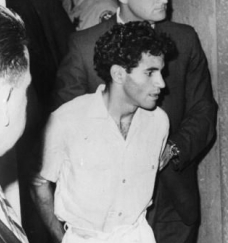
On this date fifty years ago, death row author and celebrity Caryl Chessman choked to death in San Quentin Prison’s gas chamber while the phone outside rang, too late, with his stay.

During his abnormally protracted* (for the times) 12 years fighting death, Chessman became the poster child for the anti-capital punishment cause and the most recognizable face on death row.

He was condemned as the “Red Light Bandit,” a Los Angeles criminal who would waylay cars in lovers’ lanes with police-like flashing red lights, then rob and, for some female victims, rape them. A career felon, Chessman denied his guilt to his death (he insisted that his signed confession was beaten out of him by the LAPD, which would not exactly have been out of character).

The prickly Chessman — “not generally regarded as a pleasant or socially minded fellow,” he conceded about himself — unwisely represented himself at trial, where the confession plus eyewitness testimony of Bandit victims were enough to convict him.

Not, however, of murder.

Instead, Chessman drew two death sentences under one of the country’s several draconian “Little Lindbergh” anti-kidnapping statutes, on the intriguing jurisprudential theory that the Red Light Bandit’s having dragged a rape victim several feet from her car constituted “kidnapping.”**

This astonishingly expansive reading only became more controversial when California repealed the kidnapping law in question in the 1950s. But the repeal was not retroactive.

That left Chessman to fight his sentence with a terrifyingly iron willpower, fending off eight execution dates in the process. The last of them came in February 1960, an 11th-hour reprieve as had been several others, when a two-month stay was granted ostensibly to protect the traveling President Eisenhower from some act of vengeful local retaliation from one of Chessman’s legions of international supporters.

A cat, I am told, has nine lives. If that is true, I know how a cat feels when, under the most hair-raising conditions, it has been obliged to expend the first eight of those lives in a chamber-of-horrors battle for survival, and the Grim Reaper gets it into his head that it will be great sport to try to bag the ninth. All pussy can do is spit. Homo sapiens can write books.

-Caryl Chessman

So Chessman wrote.

Fiction and nonfiction books, numerous articles — copping to a criminal life but insistently denying his involvement in the crimes that would doom him. For a time, prison officials seized his work and forbade his writing, and Chessman resorted to sacrificing his sleep to write illicitly by night and encode his work in putative “legal documents”. Bandit or not, the man had an indomitable spirit, and it won him worldwide attention and support.

Books by and about Caryl Chessman

And bandit or not, the Grim Reaper had a mind to take that ninth life.

One might have thought that for such a lightning-rod anti-death penalty case, the election of anti-death penalty Gov. Edmund “Pat” Brown in 1958 would spell good news.

But “public opinion mobilized against Chessman,” writes Theodore Hamm in Rebel and a Cause: Caryl Chessman and the Politics of the Death Penalty in Postwar California, 1948-1974. That mobilization “marked the beginning of a larger popular backlash by the New Right against an essentially technocratic campaign to eliminate capital punishment in California.”

According to Hamm, Pat Brown claimed he would have been “impeached” if he had granted clemency to his uppity prisoner, leaving Chessman and his lefty backers† expediently triangulated by a Democratic governor. It’s a timeless story.

With executive clemency off the table, Chessman’s lawyer Rosalie Ashler was scrambling on the morning of the 10 a.m. execution to interest a judge in an appeal claiming that one Charles Terranova was the actual Red Light Bandit. The judge took his time reading the brief, and by the time his secretary placed a call to the death house (legend says, after once misdialing it), the cyanide pellets had already dropped.

Too late.

Which didn’t mean that Chessman was already dead — not by a long shot.

A reporter described what was transpiring inside the state’s killing chamber while Law and Ma Bell transacted their tardy business outside.

I thought Chessman must be dead but no, there was another agonizing period during which he choked on the gas. And again. And then again. There was a long period, another deep gasp. At the fourth such straining, Chessman’s head lolled in a half circle, coming forward so that he faced downward with his chin almost touching his chest. This must be the end. But the dying went on.

A deep gasp, his head came up for an instant, dropped forward again. After two or three deep breaths, which seemed something like sobs, a trembling set up throughout the body. Along the line of his broad shoulders, down the arms to his fingers, I could see the tremor run.

Then I saw his pale face grow suddenly paler, though I had not thought that it could be after his 12 years in prison. A little saliva came from his lips, spotted the white shirt that a condemned man wears for his last appearance. Even more color drained from his face and the furrows in his head smoothed out a little. And I knew he was dead.

Chessman would persist as a cultural touchstone for the issue of capital punishment for a generation.

Jim Minor, “Death Row” (1960)

Ronnie Hawkins, “The Ballad of Caryl Chessman” (1960)

Merle Haggard, “Sing Me Back Home” (1968)

(Though this tune about watching men taken to the gas chamber doesn’t explicitly reference Caryl Chessman, it was inspired by Haggard’s own prison stint where he met Chessman and experienced a “scared straight” moment.)

Neil Diamond, “Done Too Soon” (1970)

The Hates, “Do the Caryl Chessman” (1980)

In view of Chessman’s onetime celebrity, he’s an oddly forgotten character today: too strange an individual for easy approachability; too ethically indeterminate for convenient demagoguery; not sufficiently emblematic of any larger cause or community that would tend to his memory. His non-murder death sentence and method of execution seem anachronistic, no longer relevant.

Chessman surely was an avatar of the end to capital punishment that unfolded in the 1960s and 1970s, but as it went with his own case, so it went with his legacy: the simultaneous right-wing backlash ultimately rewrote the story. After all, the “liberal” governor too chicken to spare Chessman would go on to lose his office to Ronald Reagan.

Our day’s protagonist might have had a different place in the national consciousness, in stories with the phrase “as late as 1960,” had that interregnum of “abolition” Chessman presaged not turned out to be a false start.

I am not guilty. I am sure a future generation will listen.

-Caryl Chessman

* While 12 years between sentence and execution wouldn’t raise an eyebrow today (especially in California), Chessman at the time was thought to have set a record for the longest stint on death row in U.S. history.

** The legal weirdness didn’t stop with the kidnapping law. The official court reporter in Chessman’s case actually died with his trial transcription still in semi-legible shorthand. It was partially reconstructed (by a relative of prosecuting attorney J. Miller Leavy, who also won the death sentence against Barbara “I Want to Live!” Graham), but portions that could not be read were ballparked by the recollections of … prosecutor Leavy.

Appeals courts, of course, frequently have recourse to the original trial record to make various legal determinations; the evidentiary gap left by this second-hand-abridged-by-the-DA transcript was frequently protested by Chessman’s camp on appeal.

A cache of primary records from the case and its many appeals is lodged at this FBI Freedom of Information Act page.

† They weren’t exclusively leftists. William Buckley and Billy Graham both supported clemency for Chessman. Nor were they all political: the directors of the schlocky cult horror flick The Hypnotic Eye crassly pitched the headline-grabbing condemned con on a hypnotism promotional stunt, and ended up themselves being drawn into the case and believing Chessman was innocent.

On this day..

1968: Lin Zhao, martyr poet

On this date in 1968, a “rightist” student whose critique of the Cultural Revolution was not blunted by the rigors of imprisonment was informed that her jail sentence had been changed to execution — which was immediately imposed at Shanghai’s Longhua Airport.

Utterly obscure at her death, Lin Zhao’s memory was tended by those closest to her, passed down like samizdat to latterly emerge out of Mao’s shadow.

An impassioned young intellectual at Peking University and a dedicated Communist with an irrepressible sense of justice, Lin Zhao once called Mao the “red star in my heart” and actually supervised the execution of a landlord during the country’s land reform push in the early 1950s.

But she also refused to temper or retract her criticisms of China’s path when the government abruptly reversed its brief flirtation with pluralism.

In 1960, after circulating a petition for fallen Communist (but not orthodox Maoist) Marshal Peng Dehuai, Lin was arrested, and eventually sentenced to a 20-year term.

It is here that the judicious person discovers the error of her ways, and accepts such terms as she can make for herself.

Not Lin Zhao.

Lin kept writing. Poetry, political manifestos, letters to the newspaper — hundreds of thousands of “reactionary” words. When they took away her ink, she opened her veins and wrote in blood.

By the end, official maltreatment and Lin’s own hunger strikes had wasted her away to less than 70 pounds. She was literally plucked from her prison hospital bed on this date by soldiers who drug her (gagged) to a show trial and execution. But like Marshal Peng, she never bent.

“Better to be destroyed,” she told her doctor, “than give up one’s principles.” (He’s quoted in Out of Mao’s Shadow: The Struggle for the Soul of a New China.)

Somehow, many of her hematic scribblings (saved by the prison, for possible use against her down the road) were smuggled out to her loved ones.* Somehow, they made their way to filmmaker Hu Jie, who put Lin Zhao back on the cultural map with the banned but well-received 2004 documentary Searching for Lin Zhao’s Soul (or In Search of Lin Zhao’s Soul).

This movie can actually be seen in its entirety in 10-minute installments on YouTube as of this writing.

Lin Zhao was posthumously exonerated by a Shanghai court in 1981. Despite Hu Jie’s efforts, she is still little known in her country, or abroad.

Phosphorescent green light never goes out
And lighting up souls every night
Preserving the soul
Letting go the crippled body
Burning into ashes in misfortune
Someday with a red flower on the head
Recognizing the blood stains
Just as copying a bright red flower
Impossible to paint the real color

–One of Lin Zhao’s poems, inscribed on her tomb

* Stanford’s Hoover Institution also holds a collection of Lin Zhao papers.

On this day..

1901: “Black Jack” Tom Ketchum, who was left in three pieces

On this date in 1901, a two-bit outlaw from a vanishing frontier made his reservations for hell.

Tom Ketchum — who had become known as “Black Jack” when misidentified with another hombre he resembled — was the last man to hang in America for attempting to rob a train. Given the way the authorities in Clayton, N.M., conducted the job, that’s probably for the best.

This Texas-born outlaw enjoyed a colorful career in the 1890s Southwest plundering trains, killing folk, and other distinctively American pastimes. His name attaches to the [in]famous Hole in the Wall Gang.

He was finally caught attempting a dangerous one-man train robbery, when a conductor (taking part in his third stickup, and tired of being on the wrong end of the gunbarrel) got the drop on Ketchum and winged him with a shotgun. Too weakened by his injury to escape, Ketchum surrendered himself to the law, and his wounded arm to the surgeons.

The un-amputated remainder belonged to Clayton, N.M. — New Mexico Territory, that is, which was not yet a state at this time, but was keen on making an example to stanch the tide of train robberies.

(Formally, the charge that hung Ketchum was “felonious assault upon a railway train”; he was the only person executed for this offense before the Supreme Court decided that a hanging crime needed more victims than just an iron horse. This jurisprudential advance might not have done Black Jack very much good anyway, since neighboring Arizona had also put in an extradition request for murder.)

So far, so good.

Then, they actually dropped him.

When the body dropped through the trap the half-inch rope severed the head as cleanly as if a knife had cut it. The body pitched forward with blood spurting from the headless trunk. The head remained in the black sack and flew down into the pit.

SOME MEN GROANED.

Some men groaned and others turned away, unable to endure the sight. For a few seconds the body was allowed to lie there half-doubled up on its right side, with the blood issuing in an intermittent stream from the severed neck as the heart kept on with its mechanical beating. Then with cries of consternation the officers rushed down from the scaffold and lifted the body from the ground. It was only then apparent exactly what happened.

The drop of the body was seven feet and the noose was made so it slipped easily. Ketchum was a heavy man, and the weight of the body, with the easy-running noose, caused the rope to cut the head cleanly off. Dr. Slack pronounced life extinct a little over five minutes from the time the body dropped through the trap. It is stated too much of a drop was given for so heavy a man.

Just so we’re clear: a seven-foot drop is much, much too far for a man of Ketchum’s 190-plus pounds. Maybe they were distracted by rumors of an escape attempt.

The newspaper account above cites much more forgettable scaffold-talk from Ketchum, but we can’t help but find charm (and obviously, black humor) in his alleged last words,

I’ll be in hell before you start breakfast, boys! Let her rip!

Fictional? If so, they’re more like what Ketchum’s last words ought to be. Although let St. Peter‘s ledger reflect that Ketchum was a decent enough chap to post a letter to President McKinley on the morning of his own execution copping to several robberies for which other people were imprisoned.

Initially buried — naturally — at Clayton’s Boot Hill, this infernal denizen’s grave can now be found (and more than a century on, tourists and admirers do find it) at Clayton Memorial Cemetery.

On this day..

1969: Sirhan Sirhan condemned

On this date in 1969, Sirhan Sirhan was condemned to the California gas chamber for assassinating Robert F. Kennedy.

The aggrieved Palestinian was not marked by fate to suffer that last extremity of the law, however; instead, his sentence was commuted to life imprisonment when all existing death penalty statutes were invalidated in 1972.*

As a result, Sirhan Sirhan remains alive as of this writing, serving that sentence in the Golden State’s Pleasant Valley State Prison. He’ll be next up for parole in 2011.

(In a parole appeal back in 1982 — he’s been on a bit of a losing streak — the convicted assassin had the chutzpah to complain that “if Robert Kennedy were alive today, I believe he would not countenance singling me out for this kind of treatment.”)

Although the guy was seen in a crowded room pulling the trigger (onlookers tackled him) and he subsequently confessed to the deed, there has long been a conspiratorial counternarrative suggesting that other shooters were there, too. It’s pretty hard to say that the guy who emptied his chamber in front of dozens of witnesses wasn’t involved, but there are versions of this where he’s a Manchurian Candidate-style hypnotized patsy.

Politics: much more interesting in the 1960s.

Precisely because that is so, this particular man’s crime attracts retrospective interest for what followed: the charismatic Democratic frontrunner from Camelot cut down; the sinister Richard Nixon arising in his place to bomb Cambodia, burgle Watergate, and create the Environmental Protection Agency. Sirhan Sirhan “assassinated modern U.S. history.”

That really seems a bit much.

Sirhan Sirhan himself has contributed to the trippy theorizing about his case by being all over the map on it. At one point, he attempted to plead guilty and draw the death penalty; the trial judge forced him to go through with a defense. Subsequently, as noted, he’s whinged for an early release. He’s claimed to have had no memory of the attack, which certainly isn’t what he said after he got arrested.

Ultimately, the most self-evident explanation has always been the first one that he offered: “I did it for my country.”

Sirhan was a Jerusalem-born Palestinian dismayed by Israel’s success in the Six-Day War, and by America’s concomitant foreign policy tilt towards Israel.

Kennedy was a strong advocate of that policy, and his death happened to coincide with the anniversary of war.

Maybe that’s just what they want you to think. But it has to be allowed that the cause in question has claimed more lives than just RFK’s.

* People v. Anderson, decided by the California Supreme Court. Later that same year, the U.S. Supreme Court would issue Furman v. Georgia, which would have had the same effect for Sirhan Sirhan.

On this day..

1925: Fritz Haarmann, Hanover vampire

On this date in 1925, German serial killer Fritz Haarmann dropped his head in a basket in Hanover.

One of the most iconic and most terrifying among Weimar Germany’s ample crop of mass murderers, Haarmann is thought to have slain dozens of boys and young men from 1918 to 1924. (He was charged with 27 murders and convicted in 24 of them; Haarmann himself suggested the true number might be north of 50.)

Such gaudy statistics require teamwork.

This predatory pedophile partnered with one Hans Grans, a younger lover-slash-confederate; together they would lure fresh “game” (Haarmann’s word) for a meal and more.

Everyone dined well — Haarmann especially. Notorious as one of the most prolific “vampire” killers (the press also favored him with this moniker its its search for some epithet equal to the offenses; “werewolf” and “butcher” were also current), Haarmann liked to gnaw through his victims’ throats.

A chilling ditty paid tribute to the unsubstantiated rumor that Haarmann would even butcher the human flesh and sell it as “pork” on the black market. (He was known to trade in black-market meat.)

Just you wait ’til it’s your time,
Haarmann will come after you,
With his chopper, oh so fine,
He’ll make mincemeat out of you.

In the 1931 Fritz Lang classic M, for which Haarmann is one of several influences on the fictional serial killer at the center of the action, this rhyme appears with the name “Haarmann” replaced by “black man”.

Much deeper delves into the mind of this particular madman are to be had here, here and here.

And here:

That accomplice of his, Hans Grans, drew a death sentence too, but Haarmann somehow exculpated him successfully. Not only did Grans get out of prison, the once-notorious homosexual killer lived out the Nazi regime in Hanover un-tortured.

On this day..

1965: Perry Smith and Dick Hickock, In Cold Blood subjects

This date in 1965 saw the end of the road (and the end of the rope) for Dick Hickock and Perry Smith, the drifters who slaughtered the Clutter family in Holcomb, Kansas, and inspired Truman Capote’s magnum opus In Cold Blood.


Hickock (left) and Smith.

These ex-cons — Smith, the smart Korean War veteran; Hickock, the fallen high school jock turned small-time hood — got a tip from a fellow jailbird that Herbert Clutter’s farm had a well-stocked safe.

On November 15, 1959, they raided the farm, tied up and shotgunned the family of four, and made off with … 40 bucks. Alas: no safe.

The horrific, out-of-nowhere brutality of the crime — “apparently the work of a psychopathic killer” — made national headlines and drew Manhattanite Truman Capote out to small town Kansas (along with novelist Harper Lee, whom Capote used to gain the confidence of locals).

The killers were caught on the lam in Nevada, and as the case unfolded,* Capote’s sympathy for Smith unlocked a spellbinding book that put this day’s murderers in the literary canon.

I really admired Mr. Clutter, right up until the moment I slit his throat.”

– Perry Smith

(Perry Smith was first protrayed on celluloid by actor Robert Blake, who would one day stand trial himself for arranging the 2001 murder of his wife. Blake was acquitted.)

In Cold Blood has drawn criticism from the outset: for its accuracy, or for its problematic relationship between author and subject, or for its pride of place in the true crime genre. (Or the “nonfiction novel” genre Capote claimed it created.)

But as literary milestone, its place is secure.

In Cold Blood, in multiple media

* More detail about Smith and Hickock and Capote and the Clutters in this trutv article.

On this day..

1919: Mehmed Kemal, for the Armenian genocide

Ninety-one years ago today,* the tottering Ottoman Empire hanged one of its officials in Istanbul for his role in the mass slaughter of its Armenian minority during the First World War.

Kemal Bey’s hanging in Bayezid Square occurred in the immediate aftermath of the Great War. Here, on its last legs, the remains of a sultanate splintered apart in the war instituted tribunals for wartime offenses by the Young Turks who had run the government during the war — a sop to the British occupying forces making worrying noises about international trials for much bigger fish.

Much testimony at the trial pointed to the governor’s fervor for massacres; an Armenian priest who survived the slaughter later wrote that a Turkish officer had told him that Kemal “made a vow on the honor of the Prophet: I shall not leave a single Armenian alive in the sanjak of Yozgat.”

A response to the New York Times‘ report of the hanging noted that “his part was that of an executioner. The originators of the plan to exterminate the Armenians were primarily Enver, Tallat, and Djemal.”

These “Three Pashas” who had driven Ottoman policy during the war had fled abroad. They would be condemned to death in absentia, and though none would hang, neither would they outlive Mehmed Kemal by as much as four years.

They were among the many unpunished perpetrators of the slaughter hunted down by Armenian assassins. The latter two were avenged by Operation Nemesis; Enver Pasha died in battle in Tajikistan during the Russian Civil War.

Though overshadowed in historical import by those three, our day’s principal is distinguished as the first person executed for “crimes against humanity.”

This novelty, combined with the trial’s victor’s-justice character, were immediately controversial, and remain so in the fraught politicking around the genocide. (This genocide-denialist paper describes, on page 13, the rowdy funeral scene that erupted the next day, also attested** by annoyed British officials.)

Events would soon outstrip these tribunals and lay waste to all parties’ plans for the Ottoman carcass, incidentally leaving the Armenian issue permanently unresolved.

The month after Mehmed Kemal swung, western allies went one dismemberment too far by backing the irredentist Greek state’s landing at Smyrna — an intervention that was to backfire catastrophically for the Greeks, and help birth the Turkish Republic.

* A few secondary sources say April 12 rather than April 10, but the earlier date appears much better attested.

** e.g., a diplomatic note cited in The Burning Tigris, p. 337: “Not one Turk in a thousand will think that any other Turk deserves to be hanged for massacring Christians.”

On this day..

1984: Elmo Patrick Sonnier, Dead Man Walking

On this date in 1984, Elmo Patrick Sonnier was electrocuted in Louisiana’s Angola Prison for abducting and murdering two teens in St. Martin Parish.*

Elmo and his brother Eddie posed as police officers and handcuffed two high schoolers parked at a local makeout point. Then they raped the girl, and shot both of them dead.

Both were given death sentences for the crime.

Eddie managed, as he said, to “give it back” on the grounds that Patrick was the one who did the shooting.

Once Eddie was clear of the death penalty, he tried to cop to the shooting after all, in order to save his little brother.

The appellate life of this case involved unedifying revisions of the “who shot whom” story. Ultimately, Eddie’s later claim to have been the triggerman, though quite possibly true, is not likely to win very much sympathy for his brother. It didn’t help him in the courts, either.

Just the 17th person executed since reinstatement of the death penalty, Sonnier learned that his longshot bid for clemency had been denied straight from the man who denied it — colorful, corrupt Louisiana Gov. Edwin Edwards, who personally phoned Sonnier to give him the bad news.

Little did Sonnier know that he had equally famous company meeting him in his cell.

Sonnier was the first condemned inmate to receive the spiritual ministration of Sister Helen Prejean.

The then-obscure Louisiana nun would later write the bestseller Dead Man Walking about her experiences with Sonnier and a second death row prisoner, Robert Lee Willie. Prejean remains among the most well-known death penalty opponents in the world today.

While the book Dead Man Walking treats Sonnier and Willie in a nonfiction vein, the film adaptation (review) amalgamated those people into a single character, the fictional “Matthew Poncelet”. It’s apparent from the flashbacks in Dead Man Walking‘s execution scene, however, that Sonnier is the predominant influence on “Poncelet”.

Dead Man Walking is an interesting movie. Though its principals were all vocal death penalty opponents, the film itself is much better art than propaganda. Arguably, the doomed criminal attains a sort of personal redemption — finally admitting responsibility for a crime he had denied for much of the film; seeking the forgiveness of his victims’ surviving family — only because the death penalty awaits him.

The real-life Sister Helen. Her most recent book is The Death of Innocents:An Eyewitness Account of Wrongful Executions.

Susan Sarandon won an Oscar for Best Actress for her turn as Sister Helen. Note that while Sonnier was in fact put to death in the electric chair (as was Robert Lee Willie), director Tim Robbins opted to portray a lethal injection because, as Helen Prejean herself put it,

we don’t want to give people the moral out whereby people could say ‘oh well, we used to do electrocution but that’s too barbaric so now we are humane and inject them’

* The murder that led to this date’s execution took place in the same area where Willie Francis survived a trip to the electric chair: the very chair that killed Patrick Sonnier.

On this day..

1965: John Harris, white anti-apartheid martyr

On this date in 1965, John Harris hanged in Pretoria Central Prison for an anti-apartheid bombing: the first and only white person put to death for political crimes in apartheid South Africa.

An idealistic young teacher, Harris planted a bomb in a whites-only section of Johannesburg’s Park Station, intending to demonstrate that whites, too, opposed racial segregation. But the bomb threat he phoned in was not acted upon, and the symbolic device killed a 77-year-old woman and badly burned many others.

5.30 am was the time set for the execution. We were all awake, thinking of John. Not long afterwards the phone rang. Ad Hain answered. The voice said: “Your John is dead.” She recognised the voice as one of the Special Branch men’s.

-John Harris’s widow’s testimony to the post-apartheid Truth and Reconciliation Commission

His death (reportedly with “We Shall Overcome” on his lips) earned affecting tribute and flattering comparisons from his black countrymen.

Mr. Harris, a teacher and a member of the Liberal Party since 1960, is one of those few courageous White men in South Africa who believed passionately in racial equality, identified himself with the oppressed people and suffered persecution. His passport was seized in 1963. He was served with banning orders in February 1964 preventing him from continuing his work with the Liberal Party and the Non-racial Olympic Committee.

Like many others, he became convinced that there was no way left to influence the situation except by clandestine activity. When most of his colleagues in the underground organization, the African Resistance Movement, were jailed or fled the country, he tried to plan a spectacular demonstration. He placed a bomb in the Johannesburg station and telephoned the police so that the area would be cleared. The police did not act promptly and an elderly lady lost her life as a result of the explosion.

Under the prevailing circumstances in South Africa, the means of struggle are for the liberation movement to decide in the light of the conditions in the country.

The responsibility for the consequences lies very much on the rulers of Pretoria who, in defiance of the world and all sense of decency, created a situation which left no other alternative to decent people than to engage in violence.

In mourning the execution of Mr. Frederick John Harris, let me say that it will not be forgotten that in the struggle of the South African people this man, a member of the privileged group, gave his life because of his passionate belief in racial equality. This will serve to strengthen the faith of all those who fight against the danger of a “race war” and retain their faith that all human beings can live together in dignity irrespective of the colour of their skin.

I have recently received a message sent by him from his death cell in Pretoria Central Prison in January. He wrote:

“The support and warm sympathy of friends has been and is among my basic reinforcements. I daily appreciate the accuracy of the observation that when one really has to endure one relies ultimately on Reason and Courage. I’ve been fortunate in that the first has stood up — my ideals and beliefs have never faltered. As for the second, well, I’m not ashamed — I know I’ve shown at least a modicum of the second. ”

When I think of John Harris, the first White martyr in the cause of equality in South Africa, I am reminded powerfully of a great White American, a man who gave his life over a century ago — on December 2, 1859, to be exact — because of his passionate hatred of slavery: I mean John Brown.

People said then that John Brown was eccentric, that he was unwise in attacking the arsenal at Harper’s Ferry, Virginia, and that his act would only strengthen the slave lords.

History has made a very different judgement. Whether the particular act of John Brown was right or wrong, wise or unwise, his cause was right and invincible.

-1965 statement on this date’s hanging by Achkar Marof

Harris’s conviction was secured with the states-evidence turn of one of his compatriots in the white anti-apartheid African Resistance Movement. For this betrayal, John Lloyd earned his freedom and had already moved to England by the time Harris was executed.

Lloyd built a public service life of his own in the UK. However, his bid for parliament on the Labour ticket in the 1990s was scotched when public exposure of his past (as (a) a leftist terrorist; and (b) a betrayer of his fellow-leftists) brought him more baggage than one man can tote in a general election.

Harris’s rough treatment under arrest also continues to haunt his former interrogators in South Africa.

On this day..

1938: Arkadi Berdichevsky, Jon Utley’s father

On this date in 1938, Arkadi (or Arcadi) Berdichevsky, a Russian Jew run afoul of the (pre-KGB) NKVD, was executed in the Arctic Circle prison town of Vorkuta for leading a prisoners’ hunger strike.

Though the powerful whom Stalin purged are well-known to the student of Russian history, Berdichevsky is just one of the countless obscure Soviet citizens who disappeared into the gulag never to emerge again.

Berdichevsky had something most of his fellow-victims did not: an English wife.

Freda Utley and her son Jon Utley — the couple cannily gave the boy his mother’s foreign last name to make it easier to emigrate if it should come to that, as indeed it did — left the USSR and Freda’s communist youth for fame as (paleo)conservative giants.

While young Jon — just two years old when his father was whisked out of their Moscow flat by the spooks — came of age, Freda Utley naturalized as an American and turned against her former ideology with the zeal of the converted.

Berdichevsky’s widow, Freda Utley, published this book in 1940 about her disillusionment with communism. This work and many others by Utley are also available as free pdfs from FredaUtley.com.

She savaged the U.S. government officials who “lost China”, and testified at Sen. Joseph McCarthy’s behest in the latter’s 1950’s red-hunt. (Utley also supplied McCarthy some research. She defended Tailgunner Joe until her death in 1978.)

Along the way, Freda Utley learned the date of her husband’s death, but never the circumstances.

That discovery fell to Jon Utley, who made his own fortune in business and became a conservative activist/intellectual himself, notable for his anti-imperialist position. (Utley writes regularly for antiwar.com, and opposed the recent Iraq blunder.)

In 2004, Jon Utley finally obtained the remarkably detailed records revealing that it was a firing squad rather than cold or malnutrition that took his father’s life. Utley then personally visited the sites of that Calvary in the Komi region of Russia.

Jon Utley gives a video interview about the experience and about his own path as an anti-communist here, but most especially recommended for our purposes is his written account of finding his father: HTML form here; pdf here.

On this day..