1911: Ah Q

On this date in 1911, the fictional title character of Lu Xun’s The True Story of Ah Q was shot in “Weichuang village,” China.

Ah Q wins another victory. Image from the Marxist Internet Archive.

A modern masterpiece that remains standard reading in China, The True Story of Ah Q was also one of the first literary pieces in the vernacular. Published in 1921 and set in the events of the Xinhai Revolution ten years prior, the novella/short story acidly satirizes China through the biography of the absurdly hapless Ah Q.

Lu Xun (or Lu Hsun) presents the reader a peasant whose real name is literally unknown — an everyman, and no man at all — and proceeds to characterize this discomfiting allegory: a weakling, a bully, a chauvinist, a fool, whose pluck is all folly born of a bottomless capacity for convincing himself that each new failure and humiliation of his abject life is a victory. (In 1933, the American journalist Edgar Snow asked Lu Xun if there were still manh Ah Qs in China. “It’s worse now,” Lu Xun replied. “Now it’s Ah Qs who are running the country.”)

The second and third chapters detail many such “victories.” Through them, the Chinese tongue gained the phrase “the spirit of Ah Q” to indicate determined self-deception.

This story is well worth reading, which can be done for free here.

Though specific calendar dates are scarcely at all alluded to in the narrative itself, the timing of the “climactic” execution — it is an empty death tragic only in its dearth of tragedy, for a revolution that from the author’s standpoint of hindsight was still struggling with the country’s colonial legacy of weakness and backwardness — can be deduced from the text.

Its action takes place in the confused days immediately following the town’s going over to the revolution, which swept through the Chinese provinces in late October and early November of 1911.*

The robbery that precipitates Ah Q’s execution takes place on a night with “no moon”; according to the year’s lunar chart, there was a new moon on the night of Nov. 20. (The December new moon is much too late to make sense.) In the story, it is “four days later” that Ah Q is arrested at night, then drug out for interrogation the next morning (the 25th); returned to his cell and recalled the morning after (the 26th) to sign a confession;** and after one more night in custody,&dagger hauled to an execution he does not even realize is taking place until the last moment.

Suddenly it occurred to him — “Can I be going to have my head cut off?” Panic seized him and everything turned dark before his eyes, while there was a humming in his ears as if he had fainted. But he did not really faint. Although he felt frightened some of the time, the rest of the time he was quite calm. It seemed to him that in this world probably it was the fate of everybody at some time to have his head cut off.

He still recognized the road and felt rather surprised: why were they not going to the execution ground? He did not know that he was being paraded round the streets as a public example. But if he had known, it would have been the same; he would only have thought that in this world probably it was the fate of everybody at some time to be made a public example of.

…

Ah Q suddenly became ashamed of his lack of spirit, because he had not sung any lines from an opera. His thoughts revolved like a whirlwind: The Young Widow at Her Husband’s Grave was not heroic enough. The words of “I regret to have killed” in The Battle of Dragon and Tiger were too poor. I’ll thrash you with a steel mace was still the best. But when he wanted to raise his hands, he remembered that they were bound together; so he did not sing I’ll thrash you either.

“In twenty years I shall be another …”‡ In his agitation Ah Q uttered half a saying which he had picked up himself but never used before. The crowd’s roar “Good!!!” sounded like the growl of a wolf.

…

At that instant his thoughts revolved again like a whirlwind. Four years before, at the foot of the mountain, he had met a hungry wolf which had followed him at a set distance, wanting to eat him. He had nearly died of fright, but luckily he happened to have an axe in his hand, which gave him the courage to get back to Weichuang. He had never forgotten that wolf’s eyes, fierce yet cowardly, gleaming like two will-o’-the-wisps, as if boring into him from a distance. Now he saw eyes more terrible even than the wolf’s: dull yet penetrating eyes that, having devoured his words, still seemed eager to devour something beyond his flesh and blood. And these eyes kept following him at a set distance.

These eyes seemed to have merged into one, biting into his soul.

“Help, help!”

But Ah Q never uttered these words. All had turned black before his eyes, there was a buzzing in his ears, and he felt as if his whole body were being scattered like so much light dust.

…

As for any discussion of the event, no question was raised in Weichuang. Naturally all agreed that Ah Q had been a bad man, the proof being that he had been shot; for if he had not been bad, how could he have been shot? But the consensus of opinion in town was unfavourable. Most people were dissatisfied, because a shooting was not such a fine spectacle as a decapitation; and what a ridiculous culprit he had been too, to pass through so many streets without singing a single line from an opera. They had followed him for nothing.

* According to this footnote, it can be more specifically dated to the fall of Shaoxing, which would have been early November.

** Ah Q has no idea he is signing a confession; an illiterate, he makes his mark with a circle — fixated only on making it a perfect circle, at which endeavor he naturally fails “victoriously.”

† During Ah Q’s last night on earth, the scene cuts to two local officials arguing about the prisoner’s fate, where the man’s life is forfeit in some other mean contest of the municipal pecking order — “Punish one to awe one hundred! See now, I have been a member of the revolutionary party for less than twenty days, but there have been a dozen cases of robbery, none of them solved yet; and think how badly that reflects on me. Now this one has been solved, you come and argue like a pedant. It won’t do!”

‡ According to this footnote, “‘In twenty years I shall be another stout young fellow’ was a phrase often used by criminals before execution, to show their scorn of death.”

On this day..

1974: Black Saturday in Ethiopia

November 23, 1974 was “Bloody Saturday” in Ethiopia for that day’s* surprise purge of some threescore politicians and soldiers by the ruling Derg.

It was barely ten weeks since the Derg — an Amharic word meaning “committee”, in this case a leftist military junta — had formally overthrown Emperor Haile Selassie, so ancient that he was already middle-aged back when he’d been leading Ethiopia’s resistance against Mussolini.

It’s strange to say in retrospect, but having spent the best part of a year systematically supplanting the political authority of the decrepit ancien regime with widespread public support, the Derg had engendered hope that its revolution would be accomplished without slaughter.

“Ityopiya tikdem/yala mimin dem” — “Let Ethiopia progress/Without any bloodshed” — became the popular slogan of that heady time. (pdf source)

Black Saturday turned the leaf on all that, and opened the sanguinary chapter of Ethiopian history today evoked by the name of the Derg.

What went wrong with Ethiopia's bloodless revolution?
“The prospect,” concluded the analysis that appeared under this headline in the Nov. 29, 1974 London Times, “is that the mass executions will be followed by further drastic action aimed at consolidating the control of the new military rulers.” The same author, Michael Knipe, had written on Nov. 16 that “the firmness of [the military’s] control appears to be matched by an overall moderation of approach, which holds promise for Ethiopia’s future.”

The Derg long remained a shadowy body, its members largely unknown and its internecine factional politics only guessed-at. The executions this date are generally read as the consolidation of the coup’s “radical” elements as against its “moderates” and the first signal event in Derg member Mengistu Haile Mariam‘s eventual conquest of supreme authority.

The crucial issue that separated radicals from moderates at the revolution’s early stage appears to be their approach to the ongoing struggle of coastal Eritrea — then still a province of Ethiopia.

Ethnically Eritrean officer Aman Michael Andom, the first titular head of the Derg who had been deposed from his position only a week ago, was a noteworthy advocate of negotiating a peacable settlement with Eritrean agitators. He was among the casualties of Black Saturday. (Aman was later reported to have been killed resisting arrest, rather than actually executed; many of the available accounts of this massacre have slightly varying numbers and particulars.) Henceforth, military force would be Addis Ababa’s only approach to the Eritrean problem.

A few other Aman supporters in the Derg shared his fate in a political wipeout. But more numerous among the 29 civilian and 31 military men announced as casualties the next morning — and there had been no prior warning that executions were imminent — were aristocrats and officials of the Haile Selassie government, including:

  • Two former Prime Ministers, Endelkachew Makonnen and Aklilu Habte-Wold (or Aklilou Wold), both of whom had been slated for trial for the recent famine in Wollo (London Times, Nov. 14, 1974);**
  • Solomon Abrahami, the former governor of Wollo;
  • Selassie’s own grandsom, Rear Adm. Iskender (Alexander) Desta;
  • 16 generals, including Selassie’s son-in-law (and former Defense Minister) Abiye Abebe.

(This Nov. 25, 1974 New York Times article — behind the paper’s pay wall — lists all 60 vicitms.)

These were a selection of some 200 political prisoners held by the Derg; how hard to come down on these officials was another point of contention between radicals and moderates. It emerged later that the Derg had met earlier on the 23rd to vote, name by name, which among its prisoners deserved execution.

So if you look at it right, summarily machine-gunning only 30% of your political prisoners is a moderate policy. Alas: these would hardly be the last.

After the Derg government was itself finally overthrown in 1991 — and the troubled province of Eritrea finally won its independence from Ethiopia — some of the perpetrators of its genocidal atrocities were themselves put on trial.

* It’s obscure — perhaps permanently so — whether the nighttime killings transpired before or after the end of the day, and both the 23rd and 24th are variously cited as the date of death. “Reliable sources said the executions were by machine gun at midnight,” the unhelpfully breezy New York Times reported on Nov. 25. This account (pdf) has the shootings occupying several batches with midnight passing during the process. We give precedence to Saturday the 23rd here because that’s the day that earned the “Bloody” appellation.

** According to Marxist Modern: An Ethnographic History of the Ethiopian Revolution, Mengistu was rumored to have disposed of Aklilu personally.

On this day..

1909: Leonard Groce and Lee Roy Cannon, American mercenaries in Nicaragua

In few countries is it possible to trace the development of anti-American sentiment as clearly as in Nicaragua. A century of trouble between the two nations, which led to the death of thousands and great suffering for generations of Nicaraguans, began when the United States deposed President Zelaya in 1909. Benjamin Zeledon [Spanish link -ed.] took up arms to avenge him. Zeledon’s death inspired the young Sandino, who, in turn, inspired the modern Sandinista Front.

For all his faults, Zelaya was the greatest statesman Nicaragua ever produced. If the United States had found a way to deal with him, it might have avoided the disasters that followed. Instead, it crushed a leader who embraced capitalist principles more fully than any other Central American of his era.

-Steven Kinzer, Overthrow: America’s Century of Regime Change from Hawaii to Iraq

It was a century ago today* that the execution of two American soldiers of fortune set all that strife in motion.

Leonard Groce, a mining supervisor, and Lee Roy Cannon, a rubber planter, were among those hired out by the U.S.-backed rebellion of Juan Jose Estrada. Dictatorial Nicaraguan President Jose Santos Zelaya — no known relationship to his namesake bookend at the other end of that century, the recently deposed leftist Honduran President Manuel Zelaya — had earned Washington’s ire by attempting to carve out an excessively independent sphere of action for his country. Most notably, he courted European investment, and mooted funding a possible Nicaraguan competitor to the U.S.-controlled Panama Canal.

Though the Estrada insurrection was spinning its wheels militarily, Groce and Cannon would give it legs diplomatically, and afford the Yankees sufficient pretext to overthrow Zelaya directly.

These two U.S. nationals were caught mining the San Juan River in an admitted attempt to sink a Nicaraguan troop transport, and shot in El Castillo a few days later. (Here‘s Groce’s final letter to his mum — a Spanish translation; I have not been able to find the English original.)

When word reached U.S. Secretary of State Philander Knox about the shootings, he “saw an opportunity to intervene directly.”**

Knox dashed off a bellicose note to the Nicaraguan charge d’affaires calling his

regime … a blot upon the history of Nicaragua …

From every point of view it has evidently become difficult for the United States further to delay more active response to the appeals so long made, to its duty to its citizens, to its dignity, to Central America, and to civilization.

The Government of the United States is convinced that the revolution represents the ideals and the will of a majority of the Nicaraguan people more faithfully than does the Government of President Zelaya.

“Then,” says Steven Kinzer, “he issued an official legal opinion holding that because Estrada’s rebellion had given his men the ‘stature’ of belligerents, Cannon and Groce had been entitled to prisoner-of-war status. That made Zelaya a war criminal.”

Maybe Zelaya mistook the foreign bombers for “unlawful combatants.”


Groce and Cannon temporarily became a media cause celebre in the U.S. This article is from the Nov. 21, 1909 edition of the Salt Lake Herald-Republican.

By late December, with marines† landing, Zelaya bowed to the inevitable and resigned, and Nicaragua began a generation under more-or-less overt U.S. control.

That terrible miscalculation drew the United States into a century of interventions in Nicaragua. They took a heavy toll in blood and treasure, profoundly damaged America’s image in the world, and helped keep generations of Nicaraguans in misery. Nicaragua still competes with Haiti to lead the Western Hemisphere in much that is undesirable, including rates of poverty, unemployment, infant mortality, and deaths from curable diseases.

– Kinzer

There’s more coverage of this episode and America’s early 20th century Nicaraguan policy in The Banana Men: American Mercenaries and Entrepreneurs in Central America, 1880-1930 and Beneath the United States: A History of U.S. Policy toward Latin America.

* A few sources give the date as the 16th, and the situation was confused and uncertain enough on the ground that early press reports elide the execution date altogether. The 17th tracks with The Banana Men, Overthrow, and the U.S. diplomatic correspondence.

** Knox, a plutocrats’ attorney from Pennsylvania and certifiable bastard, was also personally connected with Pittsburgh-based mining interests Zelaya was threatening to expropriate. Groce worked for the firm.

† Marine Corps Major (later General) Smedley Butler mounted three different expeditions to Nicaragua during the civil war following Zelaya’s departure. He would later remember of his service in America’s southerly “Banana Wars” interventions, “I spent most of my time being a high class muscle-man for Big Business, for Wall Street and for the Bankers. In short, I was a racketeer, a gangster for capitalism.”

On this day..

1539: Richard Whiting, the last Abbot of Glastonbury

Letter to Thomas Cromwell from his man in Somerset,* Richard Pollard, a local gentry type making out well under the Dissolution of the Monasteries:

Pleaseth it your lordship to be advertised, that … the same 15th day [of November] the late abbot of Glastonbury went from Wells to Glastonbury, and there was drawn through the town upon a hurdle to the hill called the Torre, where he was put to execution; at which time he asked God mercy and the king for his great offences towards his highness, and also desired my servants then being there present to see the execution done, that they would be meane [communicate] to my lord president and to me that we should desire the king’s highness of his merciful goodness and in the way of charity to forgive him his great offences by him committed and done against his grace, and thereupon took his death very patiently, and his head and body bestowed in like manner as I certified your lordship in my last letter. And likewise the other two monks [John Thorne and Roger James, executed with Richard Whiting] desired like forgiveness, and took their death very patiently, whose souls God pardon.

And whereas I at my last being with your lordship at London moved your lordship for my brother Paulett, desiring your lordship to be a mean that he might have the surveyorship of Glastonbury, which I doubt not but he will use and exercise the said office to the king’s most profit and advantage, and your lordship’s goodness herein to him to be shown he shall recompense to his little power, I assure your lordship he hath been very diligent, and divers others by his means, to serve the king at this time, according to his duty and right…

the late abbot of Glastonbury, afore his execution, was examined upon divers articles and interrogatories to him ministered by me, but he could accuse no man but himself of any offence against the king’s highness, nor he would confess no more gold nor silver nor any other thing more than he did before your lordship in the Tower …

From Wells, the 16th day of November.

Your assured to command,

Rychard Pollard

Once one of the greatest religious houses in England (and the legendary burial place of King Arthur), Glastonbury Abbey today is a picturesque ruin. Cornell University has published some 19th century photos of the abbey’s remains in a less manicured, more gorgeously overgrown situation.

Pollard had just a few weeks before exonerated the monastery of any profligacy, and the abbot seems perhaps not to have even been properly charged or attainted … but as one can discern in Pollard’s cloying appeal to keep the surveying position in the family, the practical henchman had no qualms as events unfolded about taking a commercial position on the end of the Abbot of Glastonbury.

For your public domain perusing pleasure: The last abbot of Glastonbury: and other essays, by Cardinal Francis Aidan Gasquet.

* Pollard had been in the thick of the destruction of Henry Courtenay, Marquess of Exeter just the year before.

On this day..

1909: Will James, “the Froggie”, lynched in Cairo

One hundred years ago today, Will James was lynched as a murderer in Cairo, Illinois.

“The Frog” or “The Froggie” was a black man implicated in the murder of a white girl, captured in nearby Belknap and

taken to the most prominent square in the city and strung up. The rope broke and the man was riddled with bullets. The body was then dragged by the rope for a mile to the scene of the crime and burned in the presence of at least 10,000 rejoicing persons. Many women were in the crowd, and some helped to hang the negro and to drag the body.

Part of the mob then sought other negroes. Another part, at 11:15 o’clock, after battering down a steel cell in the county jail, took out Henry Salzner, a white man charged with the murder of his wife last August, and lynched him.* (New York Times, Nov. 12, 1912)


Other pictures related to the Will James lynching are at the Without Sanctuary site here (images 41 through 47).

The grey lady’s dim view of this jubilant scene prompted a letter to the editor in defense — the author’s disclaimer notwithstanding — of the lynching, which paints a grim and striking portrait of the town where it occurred.

CAIRO’S NEGROES.

Former Resident Says They Are Spoiled by Coddling and Are a Menace.

As a former resident of Cairo, Ill., where I was the editor of a daily newspaper for three years, I crave a word, not in defense of the double lynching which occurred there a few days ago, but in explanation of it. Cairo, at the extreme southern point of Illinois, at the junction of the Ohio and Mississippi Rivers, is peculiarly located. Across one river is Missouri; across the other is Kentucky, and Tennessee is only fifty miles away. Cairo thus becomes a buffer between the North and the South. It is probably the only town in the North which has a true race problem to deal with. … Out of a population of 13,000 in 1900, 5,000 of the inhabitants of Cairo were negroes. Of the 100,000 negroes in the State of Illinois 5 per cent are massed in this one little town. Aside from this, the floating colored population is unusually large, and Cairo, at some time or other, harbors most of the “bad niggers” from St. Louis, Cincinnati, Louisville, Memphis, Vicksburg, and New Orleans. It is these whom citizens fear the most, and for whom the police are constantly alert. Murders by negroes either of white men or negroes are alarmingly frequent, but the murderer usually escapes either to Kentucky or Missouri, and is never heard of again. Thus crime after crime is recorded against the name of Cairo, with no recompense in the name of the law. On the other hand, there is hardly a time when there are not forty or fifty Cairo negroes in the Southern Illinois Penitentiary, all convicted of theft or burglary.

The white people of Cairo have always dealt indulgently with the negro. For years it has been the policy to keep two negroes on the small police force, and there have been negro Justices of the Peace. A negro physician once came near being elected a member of the Board of Education. While they pay but little taxes, the negroes are provided with three public schools. The Sumner was the first colored High School ever established in the United States. Yet this negro population, coddled as it is, is a constant menace to the town. No white woman dare venture outside of the house at night alone for fear of assault. Many outrages of which the world has never heard have been attempted. This is why, as Mayor Parsons says, the effect of the recent lynching will be “salutary.”

Altogether it is not surprising that a lynching took place in Cairo. The only wonder is that one did not take place long ago.

W.L. CLANAHAN
New York, Nov. 14, 1909

That electric arch and celebratory mob are now long gone from Cairo: in the century since Will James was butchered, Cairo, Ill., has withered — striken in part by its own poisonous legacy of racism. (Also by flooding from the adjacent rivers, the routing of transportation corridors elsewhere, and the general deindustrialization of the heartland.)

During the civil rights struggle as played out in Cairo in the 1960’s and 1970’s (more in this pdf), the town’s white business owners made a name for themselves by refusing to integrate their workforces in response to black boycotts … preferring to go out of business and/or leave town.

Cairo today is a near ghost town at one-quarter of its previous population, and generally appalling quality-of-life indicators.

* Salzner’s lynching occurred after midnight, according to the same article; hence, his absence from this article’s marquee.

On this day..

1944: Georges Suarez, collaborationist editor

On this date in 1944, the restored French Republic shot the editor of the collaborationist newspaper Aujourd’hui (Today).

Suarez‘s (linked page in French) writings (French again) had endorsed the German occupation and called for steps even beyond what the Germans were prepared to take: the wholesale taking of Anglo hostages as proof against Allied bombing raids, for instance.

His trial and execution were the first of many suffered by pro-Vichy writers and journalists condemned by the vengeful free French courts for their part in the Nazi occupation, especially in the first months after liberation. The public intellectuals of the wartime government were, as a matter of fact, in the dock faster than the government itself.

Alice Kaplan, writing of the more infamous collaborationist writer Robert Brasillach who would follow Suarez’ footsteps in a few weeks, observes:

Writers were easy to try. Their files, crumbling now, are rather thin: clippings of their articles from the collaborationist press, underlined in red and blue ink with an occasional commentary; a report by the prefecture of police outlining their political affiliations and behavior during the Occupation; a list of witnesses called by the defense and the prosecution; interviews of the accused, before the trial, going over the charges against him; letters from friends — and enemies — sent to the judge before the trial. It was easier to organize a case against a journalist than a case against a common-law criminal or a financial collaborator. The bulk of the evidence was in newspaper clippings, quickly compiled.

“Treason is a matter of dates,” Suarez’ lawyer averred, channeling Talleyrand. But at this early date of freedom, not six months after Omaha Beach had been wrenched from German hands, there was much less sympathy for the philosophic vagaries of history than some subsequent writers would enjoy — and there was a good deal of indictable behavior:

Whether they faced the charge of treason or of national indignity, the writers were accused of having espoused numerous elements of Nazi ideology: anti-communism; anti-Semitism; support for the releve (the system designed to send French workers to Germany in exchange for French POWs); support for the Milice (Vichy’s police force); support for the German and French troops fighting the Soviets on the Eastern front; attacks against de Gaulle and the Resistance; participation in collaborationist organizations; trips to Germany during the Occupation, in particular to the International Writers’ Congress at Weimar in 1941.

–Philip Watts, Allegories of the Purge

In addition to its noteworthy history in the postwar purge of journalists, Kaplan reports that Suarez’s trial may also have been the first in French history for which women were eligible to serve as jurors — although none of the women in the jury pool were ultimately seated, and the milestone seems not to have been widely noticed even at the time.

The execution itself was badly botched: Suarez is said to have survived both the initial fusillade and a second barrage from the firing squad before a third round finished him off.

On this day..

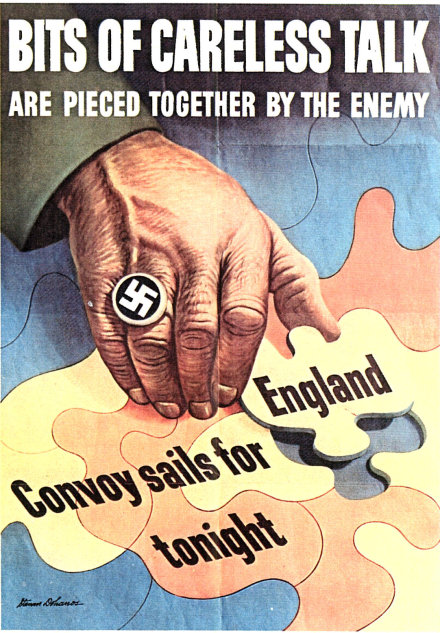
1942: Duncan Scott-Ford, because loose lips sink ships

On this date in 1942, British merchant sailor Duncan Scott-Ford was hanged at London’s Wandsworth Prison for giving German agents sensitive information about ship movements.

This, of course, was just the sort of thing everyone was trying to discourage.

… and a version to keep young soldiers on the pull Mata Hari-conscious:

For a case that so handily underscored the posters, the Scott-Ford affair made great copy … but not until a day after the hanging itself. Having kept everything secret, the papers were finally allowed on Nov. 4 to announce

that a British subject was executed for treachery at Wandsworth Prison yesterday morning.

…

Scott-Ford was paid 1,800 escudos by the enemy. This sum, which in English currency is equivalent only to about £18, was all that Scott-Ford in fact received from the enemy, though promises were held out to him which lured him deeper and deeper into the blackmailing clutches of the enemy. Thus when Scott-Ford returned on his second visit to Lisbon with the information which he had collected the Germans, instead of honouring their promises, threatened that they would expose him to the British authorities unless he continued to perform further services, to collect more valuable information and to undergo greater risks in their interest.

Some of the information which Scott-Ford gave to the enemy related to his own ship, and thus imperilled the lives of his own shipmates.

…

The moral to be drawn from this case is that British and allied seamen when visiting neutral ports should be constantly on their guard against strangers who may frequently approach them for apparently innocent purposes. Such strangers are apt to be enemy agents … (London Times, Nov. 4, 1942)

Shhhhh!

On this day..

1924: Ali Reshti and Sayyid Husain, to placate America

On this date in 1924, diplomatic maneuvering, oil patch politics, and a dead American consul put two Iranian teenagers in front of a firing squad.

Largely forgotten today, the affair which prompted their execution helped Cossack commander Reza Khan‘s ongoing consolidation of power, culminating in another year’s time with his conquest of the Persian throne itself.

By the summer of 1924, he was by title Prime Minister and his domestic opponents could read the writing on the wall: he had made a premature bid for formal executive authority in 1923 only to be rebuffed.* At the same time, he was engaged in the perilous oil game with an attempt to use American companies to break a British oil monopoly.

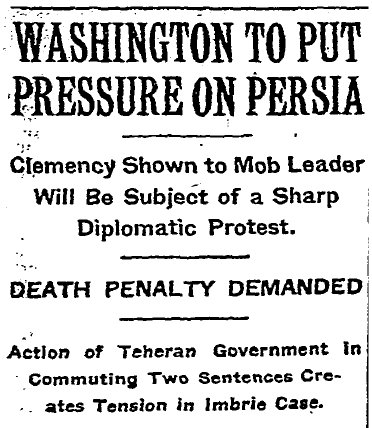
On July 18, 1924, American Vice Consul Maj. Robert Imbrie and his civilian countryman Melvin Seymour were attacked by a Tehran mob while photographing a well which had become a Moslem devotional site for purported miraculous healings. Imbrie was beaten to death; Seymour was lucky to survive … and it soon emerged that soldiers from the nearby barracks had not only failed to protect the Americans but actually taken part in the assault.

Iran’s emerging strongman lost no time in making the most of it.

The event gave [Reza Khan] … the excuse for declaring martial law and a censorship of the Press … Numerous arrests have been made, chiefly of political opponents of the Prime Minister. (British military attache Col. W.A.K. Fraser)

It’s like Lenin said, you look for the person who will benefit and, uh, you know, uh, you know, you’ll, uh, you know what I’m trying to say …

Assuming one discerns some measure of design in the Imbrie murder, and the convenient outburst of anti-Baha’i paranoia that sparked the fatal incident, one can go a couple of different directions at this point.

  1. That the Prime Minister’s foes, allied with British oil interests (the British angle was so widely believed in Iran at the time that press censorship forbade the incendiary charge), were firing up the rowdies in an attempt to shake his power. This 1924 American cable makes that case:

    “It had the earmarks from the beginning of an artificially inspired movement, of which the organized powers of evil were quick to take advantage in order to create disorder for the Government … Reza Khan found himself faced with a situation before which he was powerless. The fanaticism of the crowd was so incited by the continuous preaching of the Mullahs that any act on his part would have been interpreted as treason to Islam and prima facie evidence that he was a Bahai; hence his unfortunate orders to the military and the police not to intervene under any circumstances in religious demonstrations and under no circumstances to fire.”

  2. That Pahlavi’s own agents fomented the disorder. According to Michael Zirinsky‘s review of the case, another American official speculated that Reza Khan himself hoped a foreigner would die “so that he could declare martial law and check the power of the Mullahs.”

Which, in the event, is exactly what happened.

The U.S. made a great show of demanding exemplary justice, and it had the leverage to do so: Iran (how times change!) wanted American support and American oil exploitation.

Three were condemned to death for their parts in the riot, and after the first, a young soldier named Morteza said to have incited the mob, was shot on Oct. 2, the government announced leniency for the other two.

Not good enough.


“When you are dealing with a government like Persia … if you ask them to execute a Moslem for the death of a Christian … if they do it, you accomplish more for the prestige of your country than if they paid a million.” -a young Allen Dulles, in 1926 testimony to the U.S. House of Representatives.

At American insistence, those other two were recalled to death after all: 17-year-old mullah Sayyid Husain (various alternate transliterations – e.g., Seyid Hussein), who was supposed to have raised the riot-triggering “Baha’i well-poisoner” accusation in the first place, and 14-year-old camel driver Ali Reshti.

Zirinsky once again:

With the ending of the Iran-U.S. dispute by the execution of Ali and Husain on November 2, 1924, Reza was free to leave the capital city. He had support from the foreign legations, he had secured financing for the army, he had reestablished discipline in the Cossack Brigade, and by executing Sayyid Husain — a mullah — he had demonstrated his domination over the clergy … in the course of the next months’ campaign, he completed the unification of Iran and ensured that his government would get all the [Anglo-Persian Oil Company] royalties…

While the Imbrie affair was not the only critical event of Reza’s seizure of total power in Iran, it came at a critical moment in his rise … he used the murder to his best advantage.

And they all lived happily ever after.

* The future Shah’s future rival Mohammed Mossadegh was among the Iranian Majlis members who blocked Reza Khan’s attempt to rule Iran as a republic in 1923.

** “Blood, Power, and Hypocrisy: The Murder of Robert Imbrie and American Relations with Pahlavi Iran, 1924,” International Journal of Middle East Studies, vol. 18, no. 3 (Aug. 1986). Zirinsky quotes an American diplomat who believed Reza Khan was actually intentionally trying to create a situation where a foreigner would be killed, to give him a pretext for bringing his nation to heel with foreign support.

On this day..

1938: The terrified John Deering

We meet people in these pages who go to the scaffold joking, or sarcastic, or cocksure.

Humans bear up to proximity of death with every psychological defense in the book, but even if surprisingly few die in naked terror, make no mistake this Halloween: there’s a reason the executioner is scary.

Shot Through the Heart

Habitual criminal John Deering had a date with a Salt Lake City firing squad this date in 1938.

If anyone should be nonchalant about being ripped open by bullets, it’s a guy who eschewed a prison sentence in Michigan and confessed to murder to get himself extradited to Utah to face capital murder charges — saying that he and the world would both be better off with him dead.

The 39-year-old put on a cool front, but how steady was he, really? In a weird experiment, Deering agreed to be hooked to an electrocardiogram that measured his heart rate during his last moments.

Here comes the science!

The heart of John W. Deering, holdup murderer, beat three times faster than normal just before he was put to death today by a firing squad in the state prison here. The unprecedented recording was termed valuable to heart disease specialists as it showed clearly the effect of fear.

An electro-cardiograph film, recorded with the condemned man’s permission, showed that Deering’s heart beat jumped from normal 72 to 180, although he appeared outwardly calm. It maintained that rate for the several minutes required to complete preliminaries for the execution.

When the doomed man was asked for a last statement his heart beat fluttered wildly, then calmed after he spoke until bullets ended his life. The heart beat stopped 15.6 seconds after the bullets struck, but he was not pronounced dead until two and a half minutes after the five shots rang out. (Chicago Tribune, Nov. 1, 1938)

Still no cure for cancer.

This guy is obviously not to be confused with his tragic Hollywood contemporary of the same name.

On this day..

1901: Leon Czolgosz, William McKinley’s assassin

Back ’round the fin de siècle, everybody who was anybody* was being whacked by anarchists.

On this date in 1901, unemployed (and seemingly unbalanced) steelworker Leon Czolgosz rode the lightning at New York’s Auburn Prison for inducting the late U.S. President William McKinley into the club.

It hadn’t even been eight weeks since Czolgosz met McKinley gladhanding a receiving line at the Pan-American Exposition in Buffalo, and fatally (though it took the victim a week to succumb) shot the second-term Republican president.

Matters progressed from there as one might expect.

In a one-day trial that lasted 8 hours from jury selection to sentence, Czolgosz was condemned to die in New York’s electric chair. He went to his death unapologetic, but also alone; most anarchists disavowed him for hurting the cause.**

Here’s the New York Times account of the assassin’s final moments.

As he was being seated [in the electric chair] he looked about at the assembled witnesses with quite a steady stare and said:

“I killed the President because he was an enemy of the good people — of the working people.”

His voice trembled slightly at first, but gained strength with each word, and he spoke perfect English.

“I am not sorry for my crime,” he said loudly, just as the guard pushed his head back on the rubber headrest and drew the strap across his forehead and chin. As the pressure on the straps tightened and bound the jaw slightly he mumbled: “I’m awfully sorry I could not see my father.”

It was just exactly 7:11 o’clock when he crossed the threshold [into the execution chamber], but a minute had elapsed and he just had finished the last statement when the strapping was completed, and the guards stepped back from the man. Warden Mead raised his hand, and at 7:12:30 Electrician Davis turned the switch that threw 1,700 volts of electricity into the living body.

The rush of the immense current threw the body so hard against the straps that they creaked perceptibly. The hands clinched suddenly, and the whole attitude was one of extreme tension. For forty-five seconds the full current was kept on, and then slowly the electrician threw the switch back, reducing the current volt by volt until it was cut off entirely.

They made good and sure by dissolving the body in sulfuric acid.

Thomas Edison made a video recreation of the scene — not to be confused with actual film of the execution, though some sites present it as such — shortly after. Whether its creation was influenced by Edison’s now-doomed project of discrediting Alternating Current, a business rivalry that had helped introduce the electric chair in the first place, I have been unable to determine; the Edison labs produced a number of silent films exploiting “a whole string of news events surrounding the Pan-American Exposition in Buffalo … both through a monumental display of lights (including test bulbs on the reproduction of the electric chair) and by a booming output of scenics, actualities, and even a historical topical.”

Glum.

More lighthearted (and more audible) is “The Ballad of Leon Czolgosz,” from Stephen Sondheim’s offbeat Broadway hit Assassins, here presented with liberal use of the Edison labs’ Pan-Am Expo footage.

… it’s not the first pop culture ephemera generated by McKinley’s martyrdom; folk ballad variations under different titles (“The White House Blues,” “McKinley,” “McKinley’s Rag,” or this version, “Zolgotz”) were in circulation in the early 20th century. Other variations and some background can be had here.

[audio:Zolgotz.mp3]

This third assassination of an American chief executive in the span of 36 years (with similar fates for James Garfield’s killer and the Lincoln conspirators) led the Secret Service, originally a Treasury Department anti-counterfeiting unit, to assume responsibility for bodily safeguarding the President in 1902.

* We’ve met a few of anarchism’s greatest hits in these pages … as well as their greatest martyrs.

** Anarchist titan Emma Goldman was blamed for inciting the murder and initially arrested; she was also one of the few anarchists to defend Czolgosz: “He had committed the act for no personal reasons or gain. He did it for what is his ideal: the good of the people. That is why my sympathies are with him.”

On this day..