1941: Masha Bruskina, Kiril Trus, and Volodia Shcherbatsevich, partisans

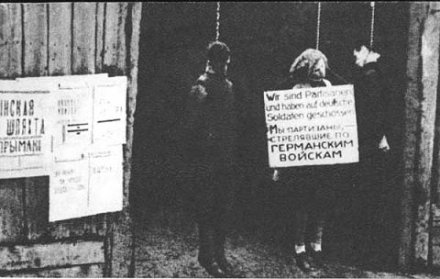
On this date in 1941, the German occupiers of Minsk conducted an infamous public hanging of partisans — perhaps the first such salutary public execution of resistance members of the war.

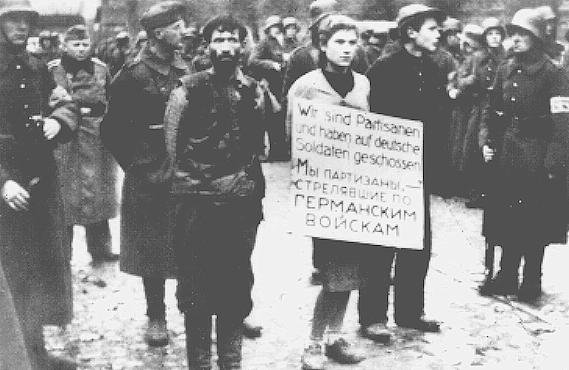
Jewish* 17-year-old Maria (Masha) Bruskina was the central figure of the grim tableau, and wore the placard announcing “We are partisans and have shot at German soldiers.” Evidently, she also attracted the most attention** from the onlookers to whom the scene was addressed.

Before noon, I saw the armed German and Lithuanian soldiers appear on the street. From over the bridge they escorted three people with their arms tied behind their backs. In the middle there was a girl with a sign-board on her chest. They were led up to the yeast factory gate. I noticed how calmly these people walked. The girl did not look around … The first one led to the gallows was the girl.

She was hanged with bewhiskered World War I vet Kiril Trus and the 16-year-old Volodia Shcherbatsevich. The men were members of a partisan cell organizing anti-fascist resistance; Masha Bruskina was a nurse who had been caught aiding the partisans by providing civilian clothes and papers for wounded Red Army soldiers under her care to smuggle them back to the resistance.

The scene of their deaths was captured in a series of powerful photographs taken by one of the Lithuanian Wehrmacht collaborators.

(More images here and here.)

* Phototextualities: Intersections of Photography and Narrative claims that Bruskina lightened her hair and changed her name to prevent her Jewishness affecting her resistance work; even though she was a Minsk native, her initial identification didn’t happen until 1968. The men who suffered with her were named almost immediately after the war.

** Despite the eye-catching place of the girl, she was officially unidentified for decades even after the name Masha Bruskina surfaced. In “A Historical Injustice: The Case of Masha Bruskina,” (Holocaust Genocide Studies 1997, 11:3) Nechama Tec and Daniel Weiss argued that Soviet authorities, and later Belarusian ones, found her Jewishness problematic and resisted identifying her because of it — while an ethnically Russian female partisan like Zoya Kosmodemyanskaya could be more conveniently accepted as a heroine. Maybe, but bureaucratic inertia and simple precedence (since Zoya Kosmodemyanskaya was known immediately while Masha Bruskina was not) are also plausible contributing factors.

A plaque unveiled at the Minsk yeast factory in 2009 finally called her Maria Bruskina.

On this day..

1971: Ion Rimaru, the Vampire of Bucharest

On this date in 1971, Romania’s most notorious serial killer was dragged to the stake at Jilava Prison — fighting all the way, and shrieking “Call my father, so he can see what’s happening to me! Make him come! He’s the only guilty one!” — and shot to death for a rape-murder spree that had terrorized Bucharest for more than a year.

Ion Rîmaru (or Ion Râmaru), an emotionally stunted, sexually perverted veterinary school dropout, began in 1970 preying on lone women perambulating the Romanian capital late at night.

Though a number of Rimaru’s targets escaped with their lives,* his attacks were noted for their bestial ferocity: biting into, perhaps cannibalizing, his victims’ sex organs; necrophiliac rapes; blood-drinking (hence the nickname). Authorities loathe to cop to a serial killer were initially tight-lipped about the monster in their midst, only heightening public terror, until a very visible May 1971 dragnet finally caught the Vampire.

Though he surely met someone’s definition of nuts, his attempt to claim insanity at trial was a predictable nonstarter, leading to this day’s scene on the execution grounds. Rimaru actually got himself turned all the way round, and took the firing squad’s barrage in his back. Unseemly, all in all.

But all that carrying on about his father? Evidently it was more than just unresolved Oedipal stuff.

The next year, his father fatally “fell” (read: was pushed by police) from a train. Forensic evidence taken from the body of Florea Rîmaru (Romanian link) implicated the Vampire’s dad in four unsolved 1944 murders in wartime Bucharest.

* His infamous spree’s official tally was four killed, plus six attempted murders, five rapes, one attempted rape, one robbery and three thefts. (Romanian source)

On this day..

1928: William Edward Hickman, Randian superhero?

On this date in 1928, William Edward Hickman was hanged at California’s San Quentin prison for what the Los Angeles Times was still calling a decade later* “the most horrible crime of the 1920’s.”

Eighteen- or nineteen-year-old Hickman kidnapped the 12-year-old daughter of a Los Angeles banker, extracted a $1,500 ransom from said banker for her return, then delivered up the girl’s horribly mutilated corpse.

A nationwide manhunt immediately ensued, with Hickman soon captured in Oregon.

Pretty white girls abducted have been media catnip for many a livelong year. In this case, the dastardly deed induced the Los Angeles Times to editorially demand (Dec. 21, 1927) an automatic death penalty for murder in a manifesto that reads like it was written yesterday for whatever the outrageous crime du jour might be.

LET MURDERERS HANG

The sickly sentimentality which wars upon capital punishment for murder and insists upon the coddling of convicts will have a hard time to justify itself in the case of the slayer of Marian Parker, who, if police theories are correct, is William Edward Hickman, a criminal on probation. Had Hickman been serving the prison term which he deserved for his forgeries, he could not have committed the series of crimes which culminated in one of the most atrocious murders of which there is any record. He was free through the lenity of the California law to take his revenge in the most horrible fashion, against a man who had done him no injury that could be considered such by anyone with a spark of moral sense.

Not for vengeance, but for its own protection, both through example and through the eradication of a rotten and depraved individual, society should put the Parker case slayer out of life as quickly as the formalities of law permit. His continued existence is a reproach to all humanity.

A clash of conflicting theories of the best methods of dealing with criminals has brought society to a condition of hesitation. This condition is highly favorable to criminal operations of all sorts, while justice and the law seem to stand by, bewildered and helpless. The logical way to meet this situation is to take practical steps which society knows will protect it, and let penologists and psychiatrists conduct their debate over the ideal system, entirely to one side.

There can be no question that men in jail, while in jail, are no particular menace to society, and that men who have been hanged do not commit further murders. Upon these two solid facts let society base its actions, unless and until something better has been devised and proved. The semi-punishment, semi-reformatory scheme at present in force is obviously a failure.

Its greatest error is that it considers the interest of the criminal rather than those of his victim, or rather the interest of the class to which his victim belongs. This class is made up of the honest, the law-abiding, the God-fearing, the hard-working, the solid and substantial; in other words, of all individuals who are resolved to live in peace and harmony with their neighbors,. respecting others’ rights as courtesouly as they expect their own to be respected. Against this class, the great majority, another class, a minority, is waging war. It consists of the vicious, the depraved, the degenerate; nonproducers and parasites. At best this class is a drag upon progress, at worst it is a menace to civilization. Yet the law as it stands at present regards the rights of the individuals of the class as paramount. The machinery of the courts is strained at every point to aid them.

It is not necessary to inquire why a rattlesnake strikes, or if it is likely to strike again. His motives may be interesting, but they are not important. It is sufficient to recognize the danger and to deal with it appropriately.

It does not matter whether anti-social individuals are all insane, as some criminologists assert, whether they are economic misfits, as other theorists declare, or whether they are in the main ordinary persons gone wrong, as still another school insists. There has been too much consideration for them and not enough for those they prey upon and injure. It is time the emphasis was shifted.

It is time to face the facts, before the criminal class succeeds entirely in getting the upper hand. It is time to place every proved criminal where he can do no more harm. It is time for society to take the certainty of protection; it is time to stop giving the criminal “another chance.”

It is time to hang every murderer.

Lack of firmness in dealing with the criminal problem is due largely to the sob-sister and the sentimentalist. At the other extreme stands the mob spirit and lynch law, equally destructive of the foundations of society. Criminals should be judged without passion, bias or prejudice, and this is possible only in a court of law. No matter how heinous the crime, it is a matter for the courts to deal with. Good citizens will insist that proper punishment be dealt out in accordance with the provisions of law and order. For men to take the law into their own hands is to place themselves on a plane with the criminals, and to give away the immense moral advantage of being right.

Sensational crime + ill-considered policy response = a California tradition. (There wasn’t actually a change of the law in 1927-28, though.)

Perhaps recoiling from the self-righteous public baying after Hickman’s blood, a young Ayn Rand took such a shine to Hickman as to base upon him a murderous protagonist in a 1928 work, The Little Street. The budding apostle of selfishness decried in her journals

[a]verage, everyday, rather stupid looking citizens. Shabbily dressed, dried, worn looking little men. Fat, overdressed, very average, ‘dignified’ housewives … How can they decide the fate of that boy? Or anyone’s fate?

Though The Little Street never saw print, the hero disdainful of the petty bonds of moral hypocrisy is the go-to trope of Rand’s later novels. If you can bear them, you’ll find Rand speaking of “nonproducers and parasites” who are “a drag upon progress … a menace to civilization” in much the way the Times speaks of Hickman.

Rand wrote that “other people do not exist for [Hickman], and he does not see why they should … He has the true, innate psychology of a Superman. He can never realize and feel ‘other people.'” It’s a pretty near definition of sociopathy likewise imputed to the hero of her later novel The Fountainhead: “He was born without the ability to consider others.”

“She had a crush on him [Hickman],” says Lisa Duggan, author of a study of Rand’s thought, in this podcast.

Indeed, Hickman was a very strange choice for Rand’s affection, quite apart from the obvious: other than the derring-do to bluff school administrators into letting him take away a child on his own say-so, he didn’t really exhibit the magnificent contempt for his many lessers one would expect from a Howard Roark.


From the Los Angeles Times, Dec. 25, 1927.

Hickman broke down and confessed, not in pride but in panic, and signed a simpering “warning” to young men of the classic gallows-speech variety on Christmas Eve 1927:

Crime in its simplest definition is to have without work and enjoy the same place in society as other people and still show no honest effort or intention to go right.

Young men, when crime has once overcome your will power to be honest and straight you are a menace to society. …

Think it over, see my mistake. Be honest and upright. Respect the law. If you do these things you’ll be happier in the end. (Source: Los Angeles Times, Dec. 24, 1927)

Over the ten ensuing months, the teen had the opportunity to recover his wits and play a more manful part, but that didn’t happen either. A week before execution, when any hope of reprieve was gone and there was little percentage left in playing the supplicant, Hickman sent the Associated Press this bit of self-flagellation.

I know very well that I have been a most guilty sinner … I am sorry for having offended God and man … Please ask the people in the name of God to pray for us condemned men here at San Quentin prison.

(To top it off, he wilted climbing the scaffold and had to be helped up the last few steps.)

The miscreant unequal to the weight of his crime-slash-sin, thirsting for the redemptive chalice of heaven … as a criminals go, that’s more Dostoyevsky than Rand.

* Mar. 27, 1938. The context was a roundup of the gallows highlights of San Quentin’s history on the occasion of its switch from hanging to lethal gas.

On this day..

1946: The Nuremberg Trial War Criminals

Victor’s justice was never better served than this date in 1946, when the brass of Third Reich hung for crimes against humanity during the late World War II.

[audio:http://www.stelzriede.com/ms/mus/nuremexe.mp3]

(From this page of original period audio files.)

The landmark legal proceeding* is covered well enough in many other sources for this humble venue to break new ground.

Apart from trailblazing international law, the trial was notable for the gut-punching film of German atrocities; this relatively novel piece of evidence is available for perusal thanks to the magic of the Internet. Caution: Strong stuff. An hour’s worth of Nazi atrocities.The climactic hangings in the predawn hours this day in Nuremberg were conducted by an American hangman who used the American standard drop rather than the British table calibrated for efficacious neck-snapping. As a result, at least some hangings were botched strangulation jobs, a circumstance which has occasionally attracted charges of intentional barbarism.

Media eyewitness Kingsbury Smith’s taut report of the night’s executions (well worth the full read) described just such an ugly end for propagandist Julius Streicher.

At that instant the trap opened with a loud bang. He went down kicking. When the rope snapped taut with the body swinging wildly, groans could be heard from within the concealed interior of the scaffold. Finally, the hangman, who had descended from the gallows platform, lifted the black canvas curtain and went inside. Something happened that put a stop to the groans and brought the rope to a standstill. After it was over I was not in the mood to ask what he did, but I assume that he grabbed the swinging body of and pulled down on it. We were all of the opinion that Streicher had strangled.

There were in all 12 condemned to death at Nuremberg; all hanged this day except Martin Bormann (condemned in absentia; it was only years later that his death during the Nazi regime’s 1945 Gotterdammerung was established) and Hermann Goering (who cheated the executioner with a cyanide capsule two hours before hanging). The ten to die this day were:

* Its resultant Nuremberg Principles comprise a lofty articulation of principles whose actual application, as Noam Chomsky has observed, would have meant that “every post-war American president would have been hanged.”

On this day..

1923: Susan Newell, the last woman hanged in Scotland

On this date in 1923, Susan Newell achieved footnote status by hanging for the murder of her 13-year-old paperboy … the last Scottish woman to die on the gallows, and the only one in the 20th century.

Newell was nabbed by nosy neighbors who noticed her dumping John Johnson’s body a few blocks away from prison* where she would ultimately expiate the crime.

Newell pointed the finger at her husband (she never admitted guilt), but John Newell produced a fistful of alibi witnesses to the effect that he was staying with relatives after a couple of nasty domestic fights.

Susan — so the jury believed — had worked off the stress solo by throttling the newsboy when he’d had the temerity to ask her to pay him. Paid content: the hidden killer.

Well, sometimes, you can only take so much.

Despite the guilty verdict, the jury entertained her insanity defense and plumped for mercy when it convicted her. But the crown was having none of it, in part because the murderess wouldn’t admit her crime in her clemency petitions, and perhaps also because “the application of the law in Scotland had to be seen to be in line with that in England where Edith Thompson had been hanged for what most of us would regard as a much less serious crime only 10 months earlier.”

Thompson’s same executioner, John Ellis, unhappily handled the Newell job just 20 days after her conviction. The condemned woman managed to wriggle her hands out of their bonds while her legs were being pinioned, and she ripped the hood off her face with the words “don’t put that thing over me!”

Wanting to get the distasteful procedure over with, Ellis obligingly dropped her barefaced.

* She was also the only woman ever executed at Glasgow’s Duke Street Prison.

Part of the Themed Set: Women Who Kill.

On this day..

2002: Aileen Wuornos, Monster

“Thanks a lot, society, for railroading my ass!”
-Aileen Wuornos

On this date in 2002, the tragically, horrifically iconic serial killer Aileen Wuornos checked out at Florida’s Starke Prison (and into an afterlife as an Academy Award-winning role) with the appropriately bizarre last words,

“I’d just like to say I’m sailing with the rock, and I’ll be back like Independence Day, with Jesus June 6. Like the movie, big mother ship and all, I’ll be back.”

Her sensational FBI-bestowed reputation as America’s “first” female serial killer rests on exaggeration,* but there’s something of the larger-than-life about prostitute/manslayer Aileen Carol Wuornos.

Heck, Aileen herself sold rights to her story within weeks of her arrest. So did investigators who worked the case. A year before our day’s perp faced lethal injection, her surname titled “the world’s first opera about a lesbian prostitute serial killer survivor of child abuse who is now on death row.” (Here’s the opera’s home page.)

That’s not the sort of legacy usual for a seven-time murderer. But there wasn’t much usual about Aileen Wuornos.

Wuornos — “Lee,” to her friends — projects for all her trail of bodies an irrepressibly humanity; Charlize Theron played her in Monster as the most sympathetic serial killer ever put to celluloid, her crime spree a desperate and impossible cry after human love that her life’s many travails had warped but never drained.

Still professing love for the lover who had sold her out and thereby ducked prosecution, Wuornos resigned her appeals and went her own way out this date in 2002.

Books and Films about Aileen Wuornos

* Or, if you like, a precision of definition not likely shared by the majority of her headline-reading public. What made Wuornos distinctive was killing strangers in a pattern over time; the stereotypical female multiple-murderer kills in a single spree, and/or for distinct pecuniary motives, and/or kills family members or other intimates.

Part of the Themed Set: Women Who Kill.

On this day..

1949: Yoshio Kodaira, soldier turned serial killer

Sixty years ago today, Yoshio Kodaira counted himself “fortunate to be able to die on such a calm and peaceful day.”

For the year after Japan’s wartime surrender to the World War II Allied powers (beginning slightly before that surrender), former Imperial Navy soldier Yoshio Kodaira terrorized Tochigi and Tokyo with a rape-murder binge believed to have claimed ten victims.

Even our monsters — especially our monsters — are creatures of their own milieu.

For Kodaira, that was the Japanese occupation of China, where he slew an unknown number of Chinese soldiers and civilians in his official capacity under the banner of the rising sun … followed by the “anarchy of the postwar years.”

(In between the two, he served a jail term in the 1930’s for killing his father-in-law in a berserk rage when his wife left him.)

Expat author David Peace novelized the 1945-46 Kodaira crime spree in Tokyo: Year Zero, musing (in the voice of the killer),

You know, none of it makes much sense to me … they give us a big medal over there for all the things we did, but then we come back here and all we get is a long rope.

(Here’s an interview with the author.)

On this day..

1917: Jesse Robart Short, Etaples mutineer

On this date in 1917, Jesse Robart Short was shot in Etaples, France, for mutiny.


Jesse Robart Short’s sentence, as confirmed by General Haig, from the UK National Archives. (Transcribed more legibly.)

The fraught relationship between the enlisted and the officers had boiled over in the Etaples Mutiny just a few weeks before, which saw military police fire into a crowd of troops protesting the heavy-handed arrest of a fellow for slipping into the town of Etaples for a little (unauthorized, but widely practiced) R&R.

The shooting left a man dead and the camp in an uproar for several days, with some enraged rank-and-file men trying to break into army facilities hunting for MPs.

The excellent, but now defunct, site Shot At Dawn had a thorough recounting of the Etaples mutiny, still archived at the Wayback Machine.

Short, whose disciplinary record was otherwise clean, was picked out seemingly more or less arbitrarily to be the demonstration execution for this affair. He was doomed for an (unsuccessful) incident of incitement to mutiny, described by the officer thus:

“The picket was armed as regards 150 & the remainder were unarmed. At about 9.10 pm a lot of men, about 70 or 80 with notice boards torn away from the camps and waving flags which were handkerchiefs of all colours including red attached to sticks approached me. These men pushed through, the picket practically standing on one side … officers who stood out were also pushed aside. The picquet was absolutely unreliable at that moment so I called the officers together & made them fall their men in by Regts. I then addressed the picket & whilst doing so … [Short] came back from the crowd of men who had just broken through & told the men they were not to listen to men. ‘What you want to do to the Bugger is to put a stone round his neck & throw him into the river’… he told the men to fall out & join the mob who had just broken through.”

On this day..

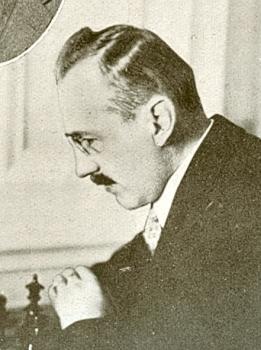
1941: Karel Treybal, Grand Master

On this date in 1941, chess grand master Karel Treybal was shot in occupied Czechoslovakia as a suspected subversive for illegally stockpiling weapons.

The Bohemia-born Treybal was one of the great Czech players from the turn of the century.

Competing as an amateur — his day job was as a barrister — his attacking play made him one of the world’s best for most of his adult life. (Chess aficionados can browse his big matches here and here, or take in some Treybal chess puzzles. It says here that Treybal once played countryman Franz Kafka.)

Like everyone else standing between the great imperial powers come wartime, grand masters were just so many pawns.

The particulars of Treybal’s death seem murky: whether or not he received a nominal Nazi trial before his execution; whether there was anything to the weapons charges against him. Word, nonetheless, got right around.

According to a UP report datelined this very day that ran in the New York Times on Oct. 3,

German occupation forces have executed nearly 1,000 persons in Europe, in some cases shooting them by the carloads, in reprisal for a mounting tide of violence in the occupied countries, a compilation showed tonight.

German dispatches said eighteen persons were executed in Bohemia-Moravia today [Thursday, Oct. 2 -ed.], and thirty-nine yesterday. Six were executed Sunday, twenty Monday and fifty-eight Tuesday, according to earlier German announcements, making the total so far this week 141.

Those executed today were said to include Josef Benes, manager of the Farmers’ Association at Raudnitz; Anton Kvarda, manager of the trades school at Rakonitz; Karel Treybal, salesman; Josef Smrkovsky, business man, and Manzel Svoboda, former Czech Army lieutenant.

From Norway to Greece the executions have been Germany’s answer to all forms of opposition — sabotage, espionage, armed resistance, murder, treason, arson, aiding the enemy, listening to the foreign radio, operating illegal markets, dynamiting and the ill-inclusive “Communist” activity.

A postwar tournament was played in tribute of Treybal and the great Czech women’s champion Vera Menchik.

On this day..

1996: Dr. Mohammad Najibullah

On this date in 1996, the man who once ruled ruled Afghanistan under the aegis of a superpower succumbed to the tender mercies of his country’s fundamentalist insurgency.

Mohammad Najibullah was the last president of the Soviet-backed Democratic Republic of Afghanistan. Unfortunately for Najibullah, he was on the job when Moscow decided to throw in the towel on the Soviet-Afghan War.

After losing the subsequent civil war, the former President was trapped for a nervous few years in Kabul — blocked from joining his family in flight to India by the offices of former Soviet client and present-day American client Abdul Rashid Dostum.

When Kabul finally surrendered to the Taliban in 1996, the hated onetime Communist viceroy — whose stepping-stone to that post was heading the hated Afghan secret police — had a problem.

At the instigation of future Taliban second-in-command Mohammad Rabbani, Najibullah and his brother were hauled out of the U.N. compound where they had taken refuge, publicly beaten, tortured and castrated, and strung up on a traffic barricade.

There was a new sheriff in town.


On this day..