1950: Col. Choi Chang-Shik, military engineer

On this date in 1950, an unfortunate military engineer was shot by the South Korean government for trying to obey his orders.

As North Korea overran South Korea in the opening months of the Korean War, it put the government in Seoul to flight. A predictably chaotic situation attended South Korea’s evacuation of its capital in the summer of 1950, with Korean and American agents frantically destroying anything of potential value to the invading army.

Among the things mooted for destruction were the bridges crossing the Han River south of Seoul, and in the confusion of the evacuation, some bridges were indeed blown early on June 28 — killing hundreds of civilians and soldiers who were trying to escape over them.

All hands on this unpleasant affair quickly scrubbed themselves clean; James Hausman, the (underappreciated*) American military advisor who was instrumental in creating the South Korean military, denied it but seems to have given the order by way of his Korean collaborator Chae Byong-deok.

Choi, the luckless military engineer who carried out the operation, was left holding the bag and drew a death sentence for gross misconduct on September 15, the same date the Americans counterattacked by landing at Inchon.

After the 1961 coup led by Park Chung-hee — a gentleman we’ve met in these pages — Choi’s conviction was reversed upon an appeal from his widow.

[I]n accordance with operational orders from a superior officer. Choi tried to stop people and cars approaching the bridge by firing over people’s heads and delaying the explosion for forty minutes. His behavior was according to military behavior.

* See “Captain James H. Hausman and the Formation of the Korean Army, 1945-1950,” Armed Forces & Society, Summer 1997, Vol. 23, Issue 4.

On this day..

1918: The 26 Baku Commissars

On this date in 1918, 26 Bolsheviks and Left SRs were shot in what is now Turkmenistan, their bid to establish Soviet power in Baku defeated — temporarily.


The Execution of the Twenty-Six Baku Commissars, by Isaak Brodsky (1925)

The 26 Baku Commissars were the men of the Baku Commune, a short-lived Communist government in 1918 led by the “Caucasian Lenin,” Stepan Shahumyan. (He was a good buddy of the Russian Lenin, Vladimir Ilyich Ulyanov.)

In a cauldron of ethnic violence and against the military interventions of Turkey and Britain, these worthies were tasked with extending Soviet writ to the stupendous Azerbaijani oil fields* — the predominant source of tsarist Russia’s oil, and destined to be the engine of Soviet industry as well.

The Baku Soviet was expelled by the British, who inherited the bloody fight against an advancing Ottoman army.

Shahumyan and his fellow commissars, meanwhile, fled by ship across the Caspian Sea to Krasnovodsk (now Turkmenbashi, Turkmenistan), where they fell into the hands of a the anti-Soviet factions — backed, once again, by the British — of a brand new locale’s incarnation of civil war.

The commissars’ “presence in Krasnovodsk was a matter of great concern to the [anti-Bolshevik] Ashkhabad Committee, the members of which were seriously alarmed that opposition elements in Transcaspia might take advantage of the presence of the Commissars to stage a revolt against the government.” Said concern was relieved by the expedient of escorting the Baku Soviet to the desert and shooting them en masse.

The Red Army recaptured Baku in 1920, this time for good, and Shahumyan and friends were raised to the firmament of Communist martyrology, and not only in the Azerbaijan Soviet Socialist Republic. Streets and schools throughout the USSR bore their names.

As with many Soviet icons, the commissars had a rough come-down after the Iron Curtain fell. Their monument in Baku stood untended for many years, its eternal flame extinguished … until it was finally (and somewhat controversially) torn down earlier this year.


The Baku Commissars’ monument and its dead eternal flame, prior to its early 2009 demolition. Image (c) denn22 and used with permission.

* The Nobel family, which established the Nobel Prize, had a significant presence in the Baku petrol industry.

On this day..

1989: Henri Zongo and Jean-Baptiste Boukary Lengani

This evening in 1989, the number two and three men in Burkina Faso’s military government were seized and summarily executed for allegedly plotting a coup of their own.


Lengani and Zongo

Henri Zongo and Jean-Baptiste Boukary Lengani certainly had the pedigree for it; they’d conspired along with Blaise Compaore in the 1983 putsch that brought Thomas Sankara to power … and then Zongo, Lengani and Compaore had overthrown Sankara four years later.

On this date, a triumvirate increasingly strained by personal rivalries and economic disagreements was unilaterally dissolved.

According to the official announcement, Zongo and Lengani planned to seize the airport while President Compaore was out of the country, shooting down his returning plane if necessary.

Whether accurate or pretext, their elimination (along with two other conspirators) helped Compaore consolidate his hold on Burkina Faso — a country he still governs to this day.

On this day..

1961: Adnan Menderes

On this date in 1961, the Turkish Prime Minister deposed in the previous year’s military coup was hanged at the island of Imrali.

Condemned at the same trial as his comrades in government,* Adnan Menderes delayed his execution with an unsuccessful suicide bid. Revived from a sleeping pill-induced coma, the gag about Istanbul was that he would soon be fit enough to hang.

Twenty-four hours and one involuntary stomach-pumping later, and he was.

The 62-year-old Smyrna/Izmir native had had a memorable run. He served in Ataturk’s army, then toppled Ataturk’s political party: Menderes won the first three free elections in Turkey in 1950, 1954, and 1957, a feat never since replicated. He was notorious for his temper and sensitivity to criticism, reportedly given to smashing things in his office and demonstrably given to firing ministers and aides for even trifling differences of opinion. Just months before his ouster, he’d survived a plane crash in England — “the former Premier,” observed the New York Times,** “might have gone down in Turkish history as a great patriot and champion of the people” if he had died in it.

His ignominious end didn’t blacken his name to posterity. Years later, he (and the officials who preceded him to the gallows) was posthumously pardoned and reburied in an Istanbul mausoleum. Today, he’s so far from public opprobrium that his name can be found on public accommodations like airports and ferries

There’s more information about Menderes available online in Turkish, including this biography and this film:

* Among the co-defendants also condemned but reprieved was Mahmut Celal Bayar, President of the Republic of Turkey. Bayar died in 1986 at age 103, supposedly the longest-lived head of state or head of government in all of history.

** September 17, 1961.

Part of the Daily Double: Turkey’s “Left-Wing Coup”.

On this day..

1961: Fatin Rustu Zorlu and Hasan Polatkan

On this date in 1961, two former Turkish ministers of state were hanged together on the island of Imrali.*

A ten-month trial on the island of Yassiada had ended just the previous day, condemning 15 to death; 12 sentences were commuted, leaving only the biggest fish to fry.
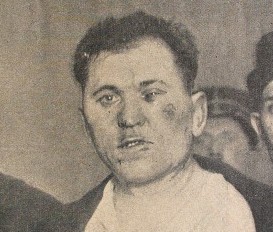
Zorlu, the former Foreign Minister, and Polatkan, late the Finance Minister, were both implicated in the financial crimes often characteristic of high office. Zorlu was also condemned for helping instigate a notorious 1955 anti-Greek riot. The two were helicoptered to Imrali for a pre-dawn hanging.

Zorlu, at least, was reported to have died game. He helped slip the noose over his own neck, and at his hanging “asked that he be allowed to kick away the chair himself. Permission was granted.” (Los Angeles Times, September 18, 1961)

* Tangentially, the prison on Imrali is the one American drug-smuggler Billy Hayes subsequently escaped from. Hayes went on to write Midnight Express, later adapted for the silver screen by Oliver Stone.

Part of the Daily Double: Turkey’s “Left-Wing Coup”.

On this day..

1932: Paul Gorguloff, who assassinated the French President

On this date in 1932, deranged Russian emigre Paul Gorguloff was guillotined for murdering President Paul Doumer four months before.


The forgettable Paul Doumer — distinguished for reasons quite beyond his control as the penultimate President of the Third Republic — was a week short of his one-year anniversary in office when the nutbar gunned him down at a Parisian book fair.

Disturbed 37-year-old Gorguloff had some impenetrably incoherent justification for the murder having to do with some “Idea” formed in a trance-like state.

From the moment of my arrival in Paris, and even in the train, I had a sort of hypnotic obsession that I must kill the President. I went and prayed in Notre Dame; then I drank heavily, and gradually decided to kill myself, the idea almost supplanting that of assassination. After drinking I conceived the idea of getting arrested to prevent me from committing the crime, so I asked a policeman on the Boulevard Saint-Michel a lot of stupid questions, hoping that he would ask for my papers and, finding them not to be in order, arrest me. All the time the Devil was saying: “Kill yourself, if you like, but only after you have killed the President.” Until 2 o’clock in the afternoon on the day of the crime I drank in a bar, emptying a bottle of cognac in the hope that I would get too drunk to do anything. Nevertheless I finally went to the book exhibition in the Rue Berryer, where the President was expected. After I had spoken with M. Farrere [he was later shot in the arm by Gorguloff] and looked at a few books, the President arrived. I was in a kind of hypnotic sleep, and fired without really knowing what I was doing. (The Times of London, May 18, 1932)

Whatever this daemon may have amounted to in Gorguloff’s mind, he cherished it; the brief trial was punctuated by repeated invocation of the never-explicated “Idea”:

France, listen to me! I am the apostle of my Idea. My crime was a great protest in the name of the miserable ones who wait ‘over there’ [in Russia] … My Idea is more precious than my life. Take my life, but save my Idea. (The Times of London, July 26, 1932)

The “idea” may have been fame. Gorguloff’s defense counsel — understandably pinning its hopes on an insanity defense (French link) — entered into the record a request the assassin had forwarded Czech authorities to be launched in a rocket to the moon; a correspondent for Le Matin discovered that the killer had nursed similarly half-baked plots to do in Hindenburg, Lenin, and Czech President Thomas Masaryk instead/as well.

Gorguloff was beheaded just before 6 a.m. outside La Sante Prison in Paris.

On this day..

1914: A French soldier, “yours also is a way of dying for France”

12 September, 1914.

General de Maud’huy had just been roused from sleep on the straw of a shed and was standing in the street when a little group of unmistakable purport came round the corner. Twelve soldiers and an NCO, a firing party, a couple of gendarmes, and between them an unarmed soldier. My heart sank and a feeling of horror overcame me. General de Maud’huy gave a look, then held up his hand so that the party halted, and with his characteristic quick step went up to the doomed man.

He asked what he had been condemned for. It was for abandoning his post. The General then began to talk to the man. Quite simply, he explained discipline to him. Abandoning your post was letting down your pals, more it was letting down your country that looked to you to defend her. He spoke of the necessity of example, how some could do their duty without prompting but others, less strong, had to know and understand the supreme cost of failure. He told the condemned man that his crime was not venial, not low, and that he must die as an example, so that others should not fail. Surprisingly, the wretch agreed, nodding his head. He saw a glimmer of something, redemption in his own eyes, a real hope, though he knew he was about to die. Maud’huy went on, carrying the man with him to comprehension that any sacrifice was worthwhile while it helped France ever so little. What did anything matter if he knew this? Finally, de Maud’huy held out his hand: ‘Yours also is a way of dying for France,’ he said.

The procession started again, but now the victim was a willing one. The sound of a volley in the distance announced that all was over. The general wiped the beads of perspiration from his brow, and for the first time perhaps his hand trembled as he lit his pipe.

–Excerpt from the diary of Sir Edward Louis Spears

On this day..

1941: Olga Kameneva, Christian Rakovsky, Maria Spiridonova and many others by the NKVD

On this date in 1941, as Nazi armies surged into the USSR, the Soviet NKVD summarily executed a reported 157 prisoners held in the soon-to-be-Nazi-occupied city of Oryol (Orel).


Kameneva (top), Rakovsky (middle) and Spiridonova.

Most prominent among them were:

  • Olga Kameneva, a pol in the 1920’s, she was the sister of recently-murdered Communist heretic/Stalin gadfly Leon Trotsky, and she was the widow of executed Old Bolshevik Lev Kamenev.
  • Christian Rakovsky, internationalist Bulgarian revolutionary turned Soviet diplomat. Rakovsky, Dmitry Pletnyov and Sergei Bessonov had been the only three to avoid execution at the Trial of the 21, one of Stalin’s red-letter purges. But all three were shot together this day.
  • Prominent Left SR Maria Spiridonova, a revolutionary who had taken four decades of beatings from tsarist and Bolshevik alike, and who Emma Goldman saluted as “one of the most sincere, well-poised, and convincing” opponents of the Soviet regime.

Many other political transgressors less memorable than these went along with them, leftover targets of opportunity from a generation’s internecine purges and counterpurges.

Why bother to spend the resources evacuating an enemy of the people? By this time, Operation Barbarossa was nearly three months old, and mass prisoner executions ahead of the advancing Germans were a practiced art. One difference this day: this hecatomb was not in the western Soviet Republics, but in Russia proper.

In the autumn of 1941, the Left SRs Spiridonov, Izmailovich, and Mayorov, the Maximalist Nestroyev, and the SR Timofeyev were among the 157 prisoners shot in the Medvedevsky woods. (A Century of Violence in Soviet Russia

As many of them might have been denounced as “fascist” in their time for not hewing the correct revolutionary line, one doubts they would have enjoyed any more comfortable treatment at the hands of the Wehrmacht, which overran Oryol on Oct. 3.

On this day..

1986: Andrew Sibusiso Zondo and two other ANC cadres

On this date in 1986, African National Congress cadre Andrew Sibusiso Zondo was hanged in Pretoria nine months after bombing a shopping center near Durban, with five white fatalities.

Zondo claimed he had intended to non-fatally target the South African Airways office at Amanzimtoti’s Sanlam Centre, but couldn’t find a functioning, available telephone in time to phone in his attempted bomb warning. Did we mention that he was 19?

Zondo, it turned out, had been radicalized by South African security forces’ indiscriminate violence against claimed ANC “strongholds” — and specifically by a still-infamous attack, the “Matola raids,” on neighboring Mozambique.

The apartheid regime wasn’t out to win hearts and minds. And it didn’t.

[T]here have never been any ANC bases or camps in Mozambique. There are residences … and if the qualification to make a home a base is only that the people in it can use a gun, then let us be told now: because every white man in South Africa can use a gun and there are weapons in every white household. Are these bases too? (ANC Acting President Oliver Tambo)

The bomb (actually a mine) was planted three days after a South African raid on Lesotho. One of Zondo’s accomplices later turned state’s evidence in exchange for immunity.

Both the ANC, which had an official policy of avoiding civilian casualties, and Zondo himself portrayed the affair as a regrettable rogue operation carried out unofficially by an understandably frustrated cadre.

It was not the last word in the bloody tit-for-tat

Two other persons suspected of being involved in the Amanzimtoti blast, Mr Phumezo Nxiweni and Mr Stanley Sipho Bhila, were [extrajudicially] executed by Security Branch members after they were acquitted in court … At Andrew Zondo’s memorial service, his brother was so severely assaulted that he developed epilepsy, which subsequently killed him. Two mourners were shot dead leaving his parents’ home after the memorial service. Lembede, one of the security policemen involved in the killing of Zondo’s alleged accomplice, was himself later killed, allegedly by members of MK.


Hanged along with Zondo were two unrelated ANC cadres, plus three unrelated common criminals.

I have no information about the criminals, but the other revolutionaries to swing were Clarence Lucky Payi and Sipho Brigitte Xulu (or Sipho Bridget Xulu — but a guy, by either name).

Payi and Xulu assassinated another ANC agent, Benjamin Langa, the brother of present-day South African Chief Jutsice Pius Langa.

South Africa’s post-apartheid Truth and Reconciliation Commission has officially attributed the murder to a false flag operation conducted by Pretoria — whereby a mole in the ANC ordered the killing and, with its perpetrators’ subsequent execution, achieved for the white government “a triple murder … without firing a single shot themselves.”

A murky affair by any standard, and one that may not be entirely buried. There’s been some attempt (hotly disputed) to establish a sinister (if vague) alternate hypothesis linking current South African President Jacob Zuma himself to the Langa murder.

On this day..

1984: Ernest Dobbert, child abuser

At 10:09 a.m. this morning in Starke Prison, 46-year-old Ernest Dobbert threw a wink to his minister and was electrocuted for torturing his nine-year-old daughter to death.

The gist of the offense is described by the Gainesville Sun:

He was a child abuser, dating back to 1969. With his wife in prison for kiting paper, his four children obviously got on his nerves. His daughter, age 9, he tortured by beating with boards and belts, by kicking, by poking in her eyes, and by holding her head underwater in the toilet. He celebrated New Year’s Eve of 1971 by dressing her poor abused body in the finest garb on hand, placing it in a garbage bag and concealing it in the attic.

No chauvinist, he. Within weeks, he had done much the same with his son, aged 7. With the help of another terrorized son, age 12, he buried them both out in the scrub somewhere, with their bodies not yet found.

An unsympathetic character deservedly forgotten a quarter-century later, Dobbert interestingly illustrates some of the wide legal and ethical gray area in the real-life application of the death penalty for the many prisoners who are guilty yet not the like of Ted Bundy.

The Sun editorial cited urges Dobbert’s commitment to a mental institution on the nicely circular grounds that “no person is truly sane who tortures — much less kills — the fruit of his own loins.” This might bespeak an impoverished appreciation of human psychology’s potential.

More legally serious is the matter of intent and premeditation, ambiguous here as it so frequently is in life. Dobbert was convicted of only second-degree murder for killing his son; for slaying his daughter, the jury convicted him of capital murder but recommended only a life sentence, unsure of his degree of calculation.

But Ernest Dobbert is on this blog because Florida law allowed a judge to overrule the jury’s recommendation, opining,

this murder of a helpless, defenseless and innocent child is the most cruel, atrocious and heinous crime I have ever personally known of — and it is deserving of no sentence but death.

Maybe so … maybe no. In a 2000 paper* that undoubtedly plays better for an academic audience than a popular one, death penalty expert (and opponent) Michael Radelet points out that if one does suppose Dobbert’s intent to be less than fully formed, a case like his could be held to constitute a species of “wrongful execution” notwithstanding his guilt for the crime.**

The cases of those wrongly sentenced to death and who were totally uninvolved in the crime constitute only one type of miscarriage of justice. Another (and more frequent) blunder arises in the cases of the condemned who, with a more perfect justice system, would have been convicted of second-degree murder or manslaughter, making them innocent of first degree murder. For example, consider the case of Ernest Dobbert, executed in Florida in 1984 for killing his daughter. The key witness at trial was Dobbert’s 13-year-old son, who testified that he saw his father kick the victim (this testimony was later recanted). In a dissent from the Supreme Court’s denial of certiorari written just hours before Dobbert’s execution, Justice Thurgood Marshall argued that while there was no question that Dobbert abused his children, there was substantial doubt about the existence of sufficient premeditation to sustain the conviction for first-degree murder. “That may well make Dobbert guilty of second-degree murder in Florida, but it cannot make him guilty of first-degree murder there. Nor can it subject him to the death penalty in that State” (Dobbert v. Wainwright, 468 U.S. 1231, 1246 (1984)). If Justice Marshall’s assessment was correct, then Dobbert was not guilty of a capital offense, and—in this qualified sense—Florida executed an innocent man.

For Justice Marshall, of course, all executions are wrongful.

For those otherwise inclined, like Joshua Marquis, an Oregon district attorney with a dim view of overhyped innocence claims, Marshall’s interpretation figures to look downright “startling”.

Florida Governor Bob Graham agreed.

Ernest Dobbert has been executed because of his brutal actions toward his own children. I hope that this indication of the seriousness of child abuse will be an example of the value which the people of Florida place upon the lives of infants and young people in our state, and a measure of the lengths the people of Florida are prepared to go to prevent and punish such crimes.

* “The Changing Nature of Death Penalty Debates,” Annual Review of Sociology, vol. 26, August 2000.

** Fellow anti-death penalty academic Hugo Bedau on people whose murders are “arguably not … capital murder”:

We rarely think about this category when discussing innocence and the death penalty, but it is relevant and extremely important. The problem has been with us for at least two centuries, ever since the invention of the distinction between first-degree (capital) murder and second-degree (noncapital) murder.

On this day..