1986: The Stoning of Soraya M

It was on this date, according to French-Iranian journalist Freidoune Sahebjam’s The Stoning of Soraya M, that 35-year-old mother Soraya Manutchehri was stoned to death in an Iranian village.


In a scene from The Stoning of Soraya M, the titular character awaits her titular fate.

In Sahebjam’s telling, a journalistic trip to the Islamic Republic chances upon a mountain village with a terrible secret.

The story he uncovers features one Ghorban-Ali, nasty husband par excellence who grows tired of the arranged wife he’s spent 22 years beating and (falsely) accuses her of adultery in order to put her out of the way so that he can remarry a younger bride.

With the complicity of the local mullah, the impolitic silence of the accused, and the structural misogyny of the law, Soraya Manutchehri quickly finds herself condemned to death on this date, and stoned within hours — Soraya’s own father casting the first stones.

This powerful story, officially denied by Tehran, has just been released in cinematic form. The Stoning of Soraya M. (movie homepage) features an unsubtle dramatic tableau, a stomach-churning 20-minute stoning sequence, and Iranian-American actress Shohreh Aghdashloo as Soraya’s aunt Zahra Kahnum, fearlessly giving the foreign journalist this explosive story

As it happened, this cinematic condemnation of the reduced status of women in the Ayatollah’s Iran made its American debut the same week that cell phone footage of Neda Agha-Soltan, bleeding to death after being shot dead during protests against Iran’s recent election results, became an Internet sensation.

On this day..

1952: Night of the Murdered Poets

As night fell this evening in Moscow, 13 prominent Soviet Jews were shot in Lubyanka Prison on trumped-up charges of treason and espionage.

“The Night of the Murdered Poets”, as it’s come to be remembered, wasn’t so much about the poetry; “only” five of the victims fit that description.

But as Joshua Rubenstein put it, “only the martyred Yiddish writers are mentioned at August 12 commemorations; the other defendants who lost their lives, as well as the sole survivor Lina Shtern, are rarely if ever remembered, perhaps because their careers as loyal Soviet citizens do not fit comfortably into an easy category for Westerners to honor … Stalin repaid their loyalty by destroying them.”

Falling victim to Stalin was such a particularly tragic fate because they were, in the main, good Communists:* good enough to have been part of the Jewish Anti-Fascist Committee, a World War II organ dedicated to rallying support for the Soviet Union against Nazi Germany.

Such national particularism — any port in a storm! — was all well and good when Moscow had the Wehrmacht at its gates and a short supply of friends, but it increasingly ran dangerously afoul Soviet officialdom as the 1940’s progressed. It was a bastion of sectarian identity rather than socialist universalism; its celebration of the Jewish soldier and of Jewish wartime travails cut against the narrative of Soviet sacrifice and heroism; its overseas links to the United States (where it toured in wartime) and the new state of Israel made it suspect, or at least vulnerable.

Thin excuse for mass execution, to be sure, but in a structure of generalized antisemitism run by a trigger-happy dictator …

In 1948-49, fifteen JAC members were arrested. One would die in prison; the aforementioned Lina Stern, a scientist, would receive a term of exile and return to Moscow when this purge’s victims were rehabilitated after Stalin’s death.

The thirteen others were tortured and condemned by a rigged (but secret, since many of the accused wouldn’t cop to public self-denunciations) trial

Years before his arrest, Markish would write words to make a eulogy for many a disillusioned Soviet citizen … and literally so in his case, since the verse was cited at his trial as evidence of his “pessimism”:

Now, when my vision turns in on itself,
My shocked eyes open, all their members see
My heart has fallen like a mirror on
A stone and shatters, ringing, into splinters.

…

Piece by piece I’ll try to gather them
To make them whole with stabbed and bleeding fingers.
And yet, however skillfully they’re glued,
My crippled, broken image will be seen.

* Naturally, being a good Communist did not keep one safe from Uncle Joe.

On this day..

1997: Zoleykhah Kadkhoda survives stoning

On this date in 1997, Zoleykhah Kadkhoda was tried, condemned, and immediately stoned in the West Azerbaijan (Iran) city of Bukan.

Less commonly used but still to this day among the execution methods in Iran, stoning involves burying the victim in a hole — a man to his waist, a woman to her chest — and pelting him or her with rocks until dead. Plainly a horrible way to go, stoning is typically associated with adultery, which was Kadkhoda’s crime.

Kadkhoda made international headlines by surviving her attempted execution, either (accounts differ) because of popular intervention in the heavily Kurdish town, or by reviving at the morgue after being taken for dead.

International pressure caused the death sentence to be lifted; Kadkhoda was released later in that year.

On this day..

1922: Joseph O’Sullivan and Reginald Dunne, helping spark the Irish Civil War

(Thanks to Rob at Another Nickel In The Machine, a delectable blog about 20th century London, for this post. It originally ran on Another Nickel October 4, 2008.)

“I do not approve, but I must not pretend to misunderstand” – Eamon de Valera

The arrest of Reginald Dunne and “James Connolly” (Joseph O’Sullivan) in 1922

On December 1921 at 22 Hans Place in Knightsbridge, a treaty was signed between a provisional Irish Government and the British to create what was called the Irish Free State. However only six months later, a few hundred yards away in Eaton Place, an assassination occurred, the reverberations of which could be said to have helped start the Irish Civil War in 1922.

Sir Henry Hughes Wilson in 1918

Sir Henry Hughes Wilson in 1921

At around midday of 22 June 1922, Field-Marshall Sir Henry Wilson unveiled a war memorial at Liverpool Street Station. He made a speech, quoted some relevant Kipling poetry and soon after returned by taxi to his home at 15 Eaton Place in Knightsbridge. Two 24 year old men, Reginald Dunne and Joseph O’Sullivan, were surreptitiously waiting for his arrival. They watched while Wilson paid for his taxi before running up to him and killing him in cold blood on the footsteps leading up to his front door. In Dunne’s words:

I fired three shots rapidly, the last one from the hip, as I took a step forward. Wilson was now uttering short cries and in a doubled up position staggered towards the edge of the pavement. At this point Joe fired once again and the last I saw of him he (Wilson) had collapsed.

Joseph O’Sullivan

Reginald Dunne

The Field Marshall had half withdrawn his sword in a futile effort to protect himself but after being shot seven times he fell face first on to the pavement with blood running profusely from his body and mouth. Dunne and O’Sullivan started to run but O’Sullivan had been seriously wounded at Ypres during WW1 (both men had fought for the British) and his wooden leg severely hindered their escape. Dunne and O’Sullivan both attempted to shoot their way out of trouble and shot and injured two policemen and a civilian in the process but were soon surrounded by an angry and hostile crowd and the two men were quickly arrested. They actually had to be protected by the police from a mob who wanted instant revenge for Wilson’s death.

The steps of 36 Eaton Place where the Field Marshall fell fatally wounded.

The killing of Field-Marshall Wilson in Eaton Place turned out to be pivotal in an extraordinarily complex political period of Ireland’s history when a national liberation struggle turned into a civil war. However much of Britain was outraged with the murder and The Times wrote:

Field-Marshall Sir Henry Wilson, the famous and gallant soldier, was murdered yesterday upon the threshold of his London home. The murderers were Irishmen. Their deed must rank among the foulest in the foul category of Irish political crimes.

Six months earlier at 2.20 am 6th December 1921 the Anglo-Irish Treaty was signed between an Irish delegation, led by Michael Collins, and the British Government at 22 Hans Place. Incidentally, there is nothing on the outside of the building commemorating the historical event and today, in what is probably one of the most expensive property areas of London, seems to be unused and empty with security boards up in the windows.

22 Hans Place in Knightsbridge and where the Anglo-Irish Treaty was negotiated

Signing the Anglo-Irish treaty in 1922

Michael Collins in London October 1921

11th October 1921

Collins outside Downing Street 1921

The treaty envisaged an independent Ireland that would be known as the Irish Free State but the agreement was hugely controversial, especially back in Ireland. For a start, de Valera, the President of the Irish Republic and who had a difficult relationship with Collins at the best of times, was angry that the treaty was signed without his authorisation (although it was at his insistence that Collins went, with de Valera considering it wrong to be involved in the negotiations if Britain’s King George V wasn’t either). Also controversial was both the British insistence that they continued to control a number of ports, known as the Treaty Ports, for the Royal Navy and that Northern Ireland (which had been created in the Government of Ireland Act 1920) was able to leave the Irish Free State within one month, which of course it duly did.

In April 1922 a group of 200 anti-treaty IRA men had occupied the Four Courts in Dublin in defiance of their Government. Collins, wanting to avoid Civil War at all costs, decided to leave them alone. However after the Field Marshall’s assassination and the subsequent Fleet Street outrage this all changed. It was assumed by the British that Dunne and O’Sullivan were anti-treaty IRA men and after the shock of the Field Marshall’s murder Winston Churchill wrote to Collins threatening that unless he moved against the Four Courts anti-treaty garrison he (Churchill) would use British troops to do so for him. After a final attempt to persuade the men to leave the Courts, Collins borrowed two 18 pounder Artillery guns from the British and bombarded the Four Courts until it’s garrison surrendered. A surrender which almost immediately led to the Irish Civil War with fighting breaking out over Dublin and subsequently the rest of the country.

The Four Courts siege, Dublin 1922

Sackville Street, Dublin 1922

Meanwhile back in London at the Old Bailey, and before Mr Justice Shearman, Dunne and O’Sullivan were both tried together for the murder of Sir Henry Wilson on 2 July 1922. Dunne stood with his arms folded while the charge was being read while O’Sullivan stood stiffly at attention. When Dunne was asked, “Are you guilty or not guilty?” he replied “I admit shooting Sir Henry Wilson.” “Are you guilty or not guilty of the murder?” the Clerk of Arraigns repeated. “That is the only statement I can make,” was the response. O’Sullivan made a similar reply and after some discussion the plea was treated as one of “Not guilty.”

Towards the end of the trial, which lasted just three hours, the defence Counsel handed the judge a double sheet of blue official paper given to him by Dunne. After perusing the contents Mr Justice Shearman said – “I cannot allow this to be read. It is not a defence to the jury at all. It is a political manifesto…I say clearly, openly, and manifestly it is a justification of the right to kill.”*

Dunne’s hand written statement

Dunne and O’Sullivan were sentenced to death by hanging and sent to Wandsworth gaol where they were both hanged together by the executioner John Ellis on the 10th August 1922.

Less than two weeks later Michael Collins was ambushed and shot dead in his home county of Cork by anti-treaty IRA members.
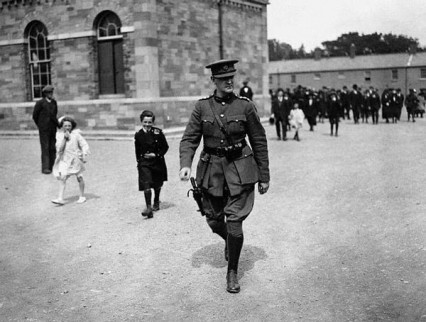
Commander in Chief Michael Collins in July 1922, two or three weeks before he was assassinated in Cork.

Michael Collins' funeral, O'Connell Street August 1922
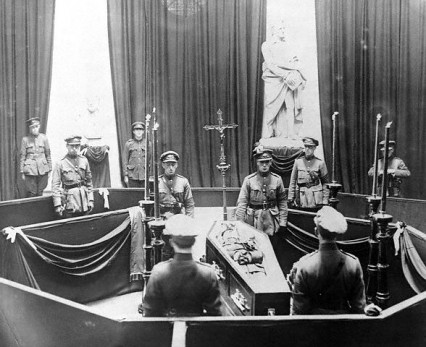
The coffin bearing the body of Michael Collins lying in state in the City Hall, Dublin. September 2, 1922 Dublin, Ireland

Michael’s brother Sean Collins

It was never really established whether Dunne and O’Sullivan acted on their own (the assassination seemed pretty badly organised for an official assassination so this was likely) or with the approval and help of Michael Collins. Collins had been a friend of Dunne’s while Sir Henry Wilson was responsible for establishing the Cairo Gang (a group of experienced British Intelligence agents who met frequently at Dublin’s Cairo Cafe) twelve of whom were murdered by the IRA acting under Collins command in 1920. The Cairo Gang killings provoked the British Auxiliaries in Dublin to shoot trapped innocent civilians at Croke Park in not the bloodiest but perhaps the nastiest of the various historical Bloody Sundays.

The infamous Cairo gang

Perhaps the ironic aspect to the story of the murder of Sir Henry Hughes Wilson was that Reginald Dunne and Joseph O’Sullivan were both born and bred in London, whereas Field-Marshall Wilson was born smack bang in the middle of Ireland at Ballinalee in County Longford.

A letter sent to O'Sullivan while waiting for his execution

Sinéad O’Connor – She Moves Through The Fair

* The text of Dunne’s intended last statement, as transcribed from the images in this post.

Lord and Members of the Jury. My friend and I stand here before you today charged with the offense of murder; and I have no doubt that, from the evidence placed before you by the prosecution, you will find us both guilty. With respect to the charges of attempted murder, we merely tried, as everyone must know, to try and escape arrest.

The offence of murder is a very serious matter; so much so, that any act which results in loss of human life requires very grave and substantial reason. We have never until now been charged with any crime. As you have heard from the Police Officer, who gave evidence as to our character and our previous records, we have both been in the British Army. We both joined voluntarily, for the purpose of [making Europe safe?] in order that the principles for which this country stood, should be upheld and preserved. These principles, we were told, were Self-Determination and Freedom for Small Nations. We both, as I have said, fought for these principles, and were commended for doing so; and I imagine that several of you gentlemen of this jury did likewise. We came back from France to find that Self-Determination had been given to some Nations we had never heard of, but that it had been denied to Ireland, We found, on the contrary that our Country was being divided into two Countries; that a Government had been set up for the Belfast district, and that under that Government outrages were being perpetrated, that are a disgrace to civilization — many of the outrages being committed by men in uniform and in the pay of the Belfast Government. We took our part in supporting the aspiration of our fellow Countrymen, in the same way as we took part in supporting the nations of the world who fought for the right of small nationalities.

Who was Sir Henry Wilson? What was his policy? And what did he stand for? You have all read in the newspapers lately, and been told, that he was a great British Field Marshal; but his activities in other fields are unknown to the men of the British public. The nation to which we have the honour to belong, the Irish nation, knows him, not so much as the British Field Marshal, but as the man behind what is known in Ireland as the Orange Terror. He was at the time of his death the Military Advisor to what is colloquially called the Ulster Government, and as Military Advisor he raised and organized a body of men known as the Ulster Special Constabulary, who are the principle agents in his campaign of terrorism.

My Lord and Members of the Jury, I do not propose to go into details of the horrible outrages committed on men, women and children of my race in Belfast and other places under the jurisdiction of the Ulster Government. Among Irishment it is well known that about 500 men, women and children have been killed within the past few months, nearly two thousand wounded, and not one offender brought to justice. More than 9000 persons have been expelled from their employment; and 23,000 men, women, and children driven from their homes. All the big cities of this country and even those of Northern France are now receiving these refugees. Sir Henry Wilson was the representative figure and the organiser of the system that made these things possible.

At his suggestion and advice the Ulster Parliament passed an Act authorising the [purging?] of political opponents and this power is now exercised and enforced by the Courts in Ulster.

There is and can be no political liberty in a country where one political party outrages, oppresses, and intimidates not only its political opponents, but persons whose religious opinion differ from those of the party in power. The same principle for which we shed our blood on the Battle Field of Europe led us to commit the act we are charged with.

My Lord and Members of the Jury, you can condemn us to death today, but you cannot deprive us of the belief that what we have done was necessary to preserve the lives, the homes, and the happiness of our countrymen in Ireland. You may by your verdict find us guilty, but we will go [to] the scaffold justified by the verdict of our own Conscience.

Dunne truncated his statement to “cut out the patriotic adjectives I feel inclined to use under the present circumstances” (as well as his specific delineation of the atrocities of Henry Wilson and the Ulster government). -ed.

On this day..

1943: Blessed Franz Jagerstatter, conscientious objector

On this date in 1943, an Austrian farmer was beheaded in Berlin’s Plotzensee Prison for refusing to fight for the Third Reich.

Franz Jägerstätter, who lost his own father in World War I, was anschlussed right into the Third Reich when Germany absorbed Austria in 1938.

In Solitary Witness is the aptly-titled biography of the man; though his fatal refusal of mandatory military service (and his critique of Nazi Germany) sprang from his deep-rooted Catholicism, it was far from the norm for his German-Catholic neighbors.

“We must go courageously on the way of suffering,” he wrote, “whether we begin sooner or later.” Somewhat oddly neglected as a martyr figure in the immediate postwar period, Jagerstatter was recently beatified by Pope Benedict XVI — a German himself, of course, who did not refuse his tiny measure of youthful service to the Wehrmacht in those years, and who assuredly grasps the untapped public relations potential of this compelling figure.


An icon of Franz Jagerstatter, and a naked Nazi imp.

Jagerstatter’s widow is still alive; she and her children movingly keep Franz’s memory to this day — and his example continues to inspire Catholics who go the way of suffering today against war and injustice.

On this day..

1904: Heinrich, a Herero

The Times of London reported thus, on Aug. 30, 1904:

GERMAN SOUTH-WEST AFRICA.

(FROM OUR OWN CORRESPONDENT.)

BERLIN, AUG. 29.

It is intended to hold Courts-martial in German South-West Africa for the trial of natives who have been implicated in the massacre of German colonists or who have rendered assistance to the insurgents. The first of these trials resulted in the condemnation of a Herero named Heinrich, alias Egbert, who had been concerned in the murder of a German farmer, and who had also acted as a spy in the interest of the rebels. Heinrich, who is described as “a schoolmaster and Evangelist,” was sentenced to death, and, according to intelligence just received, was hanged at Swakopmund on August 2. This case will produce a painful impression in German missionary circles, which have lately been in bad odour with the Government owing to the criticisms they had passed upon the conduct of some of the whites.

This “Heinrich” was thereby the first judicial execution for the January 1904 Herero raid that touched off the Herero genocide. Germany would secure the military scene just nine days later by routing Herero warriors at the Battle of Waterberg … and then proceed to drive almost the whole of the Herero nation into the deserts on pain of instant execution. (Jolly postcards were made of such scenes.)

Estimated body count: tens of thousands. Germans feel just awful about it.

On this day..

1997: Norio Nagayama, spree killer and author

On this date in 1997, the wait was over for a writer who had spent his entire adult life awaiting the noose.

Norio Nagayama witnessed another (eventually executed) murderer‘s Tokyo shooting spree in 1965, and three years later popped four people (two security guards and two cabbies) himself. The killing spree shocked Japan.

Only 19 at the time, which made him a juvenile by Japanese law, Nagayama was sentenced, unsentenced, re-sentenced. Twenty-eight years he spent from his arrest until his execution, not necessarily an atypical span for Japan.

It’s what Nagayama did with those years that makes him so remarkable: entering the criminal justice system from an impoverished background, Nagayama became a literary figure and a prominent public spokesman for social justice. He’s still commemorated years after his death.

Nagayama is credited with nine works, the first (Tears of Ignorance) about the poverty he blamed for his murders; the last (Hana) published posthumously from his manuscripts; he donated proceeds to victims’ families and poor children, especially in Peru. In fact, all these years dead, he’s still raising money for children.

Some books by Norio Nagayama
(all in untranslated Japanese)

Nagayama’s death was triggered, at last, by apprehension of a 14-year-old for a sensational crime barely a month prior to this date; in hanging Nagayama, the government aimed “to foster support for legislation that would ‘get tougher’ on juvenile offenders. Indeed, in 2000 Japan’s Juvenile Law was revised to make it easier to transfer minors to adult court.”

Nagayama was hanged in Tokyo with another murderer, Hideki Kanda; a husband-wife convict couple were executed the same day in Sapporo.

On this day..

1959: Cho Pong-am, Presidential runner-up

A half-century ago today, South Korean strongman Syngman Rhee, winner of that country’s 1956 presidential election, had the runner-up hanged for treason.

Cho Pong-am (or Cho Bong-am), who cut his teeth as a young Communist in the 1920’s and 30’s but had become an independent socialist since, won over 2.1 million votes as the Progressive Party candidate in 1956, on a platform of peaceful reunification with North Korea — the outstanding political issue in South Korea at the time.

The position had some popularity as against Rhee’s “march North” policy of conquering North Korea by force. Peaceful unification and support for the Progressive Party continued to grow after 1956, to Rhee’s fury.

Probably in fear of the increase in popular sentiment favourable to ‘peaceful unification’, the Rhee regime was determined to destroy the Progressive Party. On 13 January 1958, Cho Pong-am was arrested, together with other party officials, on charges of espionage and violation of the National Security Act … Given the fact that the government had suspected Cho’s ideological orientation, and that Communist infiltration of the South was increasing at that time … the arrest of the progressive leader might have been caused partly by the government’s genuine fear of Communist subversion. Cho’s trial, however, clearly indicated that the main purpose of Rhee’s action was to suppress political opposition, and especially to control the idea of ‘peaceful unification’.

Cho Pong-am was indicted on charges that his advocacy of ‘peaceful unification’ by elections in North and South Korea denied the sovereignty of the ROK and consequently was subversive in nature, and that he had been in secret contact with North Korean agents. … police and prosecution officials admitted that the espionage case against Cho was ‘very weak’, and indicated that they were expending considerable effort on analysing his concept of ‘peaceful unification’ in order to classify it as a crime against the ROK.

… Seoul district court, in July, sentenced him to five years’ imprisonment … [and] found that the Progressive Party’s platform did not violate the National Security Law. Three months later, however, the appellate court, reversing the decision of the district court, sentenced Cho to death … [and] ruled that his unification formula represented a plan to overthrow the ROK government.

Cho was hanged just one day after the Supreme Court rejected his appeal — “sudden and highly questionable,” to the American embassy that hurriedly attempted to impress Rhee’s Foreign Minister with the damage this execution could do to South Korea internationally. Cognizant, perhaps, of such concerns, Seoul imposed press censorship from August 1 on further reporting about the case.

Rhee himself would be forced from office by popular outcry the following year after attempting to steal the 1960 election, but “the tragic end of Cho Pong-am and his Progressive Party made it unequivocally clear that a serious leftist movement could not be openly promoted in South Korea without falling victim to violent suppression by the Government.” (Source)

Update: He was posthumously rehabilitated in 2011.

On this day..

1915: 167 Haitian political prisoners

On this date in 1915, Haitian President Jean Vilbrun Guillaume Sam had his predecessor* Oreste Zamor, and 160 or so of his closest proximity, executed in Port-au-Prince.

Within hours, Sam himself was dead at the hands of an outraged mob — and Haiti on its way to 19 years of American military occupation.

Haiti in the 1910s was a dangerous place to aspire to political authority; Sam was the 7th different man to hold the presidency since 1911. Like many others, he gained it by force, and held it tenuously against rivals who planned to do likewise.

The hecatomb that did in Sam, who had been head of state for less than five months, was seemingly intended to shore himself up in the face of an advance upon Port-au-Prince by one Rosalvo Bobo — or else just done for the principle of the thing. Either way, it left a mess.

A few minutes after 4 a.m., Charles Oscar Etienne, the chief military officer of the Haitian government and a close friend of the President, hurried to the national prison, where ensued the bloody massacre of some 167 prisoners who were held only as political suspects without being even charged with any crime. Among the victims were members of the most prominent families of Haiti …

Stephen Alexis, one of the political prisoners who escaped death in the massacre, has testified before the claims commission that on the morning of the twenty-eighth [sic] of July he has awakened by the prisoner who shared his cell and told that there was firing in town. He heard shots being fired with increasing intensity, and at twenty minutes past four the sound of voices in the conciergerie and the order, “To arms, sound the bugle, prepare for action; fifteen men, forward march.” As the firing squad reached the first cell, Alexis heard Chocotte, the adjutant of the prison, say, “Fire close to the ground; a bullet in the head for each man,” and when the second cell was reached a loud voice cried, “Every one of the political prisoners must die. The arrondissement’s orders are that not one be left standing” …

Except for the very few who escaped by a miracle, the political prisoners were all slaughtered like cattle, their bodies slashed and horribly mutilated, limbs hacked off, the skulls of some of the corpses smashed in, and the bodies of others disembowelled …

The report of the claims commission says: “The barbarous act perpetrated in the prison in Port-au-Prince is all the more inexplicable in that it had no act of war for excuse. There had been no revolt in the interior of the prison. The prisoners were locked into their cells. The prison had not been attacked. The bureau of the arrondissement, which adjoined the prison, had not had to repulse any offensive on the part of the revolutionists. It was with appalling cold-bloodedness that Haitian officers, in whom military authority had been vested, to whom the care and security of the prisoners had been entrusted, perpetrated, with the assistance of their subordinates, the wholesale slaughter of July 27.”

An incensed mob invaded the French embassy (where Sam had taken refuge) and literally tore apart the president.

On July 28, marines from the American ship USS Washington landed in Port-au-Prince to do the usual restore-peace-and-freedom thing. (Greeted as liberators? Surprisingly, “Haitians Dislike[d] Landing of Marines”.)

As a happy side effect, the American occupation froze out French and German commercial interests who had made Haitian inroads, secured debt repayment from the bankrupt country, and allowed Washington to reorder its neighbor to its liking.

From 1915 to 1929 U.S. military tribunals made rulings on political cases. A treaty that provided for American control of customs and construction of roads, as well as supervision of schools and the constabulary, was approved by the Haitian legislature under threat that American troops would remain in the country. American officials dissolved the Haitian legislature when it refused to approve a new American-sponsored constitution, which was then ratified by a referendum supervised by the U.S. military.**

* Zamor was not Sam’s immediate predecessor; rather, Sam had deposed the man who had deposed Zamor.

** Filed under “everything old is new again,” here‘s the American chattering class circa 1921 making a familiar-sounding case for giving the occupation a few more Friedman units on behalf of the Haitian

people, all of whom, less the native ruling class, a small group, recognize the benefits of the American occupation and are grateful for the peace and security they now enjoy … The United States, [Admiral Knapp] says, has only made a start for the good of Haiti, and five years of healing occupation would be lost if the Americans withdrew.

On this day..

1941: Paul Ogorzow, the S-Bahn Murderer

On this date in 1941, Nazi Berlin disposed of its railway killer.

Roger Moorhouse, author of a forthcoming book about Ogorzow, tells the story of this unjustly neglected homicidal maniac on his blog, and in a BBC History Magazine interview:

[audio:http://content.bbcmagazinesbristol.com/bbchistory/audio/BBC_History_May09_Pt2.mp3]

Paul Ogorzow (German link) plied his trade in a city blacked-out against British bombing, but he provides an illuminating glimpse at criminal investigation.

While Ogorzow benefited from Berlin’s preternatural darkness, he didn’t go greatly out of his way to cover his tracks otherwise. At least four of his eight murders were within a mile of his house; one woman who survived his attack reported the assailant was wearing German Railways kit.

The police, prone then as now to (sometimes hastily) settle on a theory and seek evidence to confirm it, remained blind to the seemingly obvious possibility that a railway worker was the culprit … even if he also happened to be a Nazi party member in good standing.

The official fixation on Untermenschen may not be surprising given the ideological climate, but Germany had had its share of noteworthy murderers in the interwar years who were neither Jews nor foreign laborers nor British agents — the suspect profiles favored by German investigators while Ogorzow continued his killing spree.

With the slightest measure of care, the S-Bahn Murderer might have plied his hobby unmolested until the wartime manpower shortages started making him look like an attractive bit of cannon-fodder for the eastern front. Alas for him, his voracious appetite for murder — eight victims with similar m.o. in just a few months — eventually made him so obvious that even the police could no longer overlook him.

Although the government kept the crime and its unedifying investigation fairly quiet, it was known. There was even a 1944 true crime potboiler by Wilhelm Ihde (pseudonymously writing as “Axel Alt”), Der Tod fuhr im Zug (Death Rode the Train). According to Todd Herzog,

Alt’s novel is representative of the dominant tendency of the period to celebrate the work of the criminal police while avoiding any portrayal of the totalitarian apparatus that surrounded criminal politics in the Third Reich.

Little surprise there.

Alt’s novel ultimately aligns itself with [Fritz] Lang’s film [M] in showing the methodical work of professional detectives to be ineffective in capturing the modern killer and explicitly calling for … recruitment of the public to aid the police in fighting crime.

On this day..