Apartheid South Africa had long been one of the world’s most prolific users of capital punishment. According to Wikipedia it had logged nearly 3,000 executions over the 30 years previous, including a one-year count of 164 as recently as 1987.
But the policy was about to see a sudden reversal — along with the policy of apartheid itself.
Earlier that same year, the South African presidency had been assumed by F.W. de Klerk. Much to everyone’s surprise, the copper-bottomed Nationalist Party conservative set about dismantling the entire white-rule infrastructure. Once he’d secured his term de Klerk moved with alacrity, immediately permitting some anti-apartheid marches that his security services wanted to shut down and proceeding apace to more dramatic reforms that within a few years saw off apartheid altogether.
Shuttering the Pretoria Central Prison gallows was one early gesture in this same campaign, considering the manymartyrs that platform had made of regimeopponents down the years. In 1990, de Klerk pronounced a formal moratorium on executions and he never lifted it; in 1995, the first politically weighty ruling of the post-apartheid Constitutional Court abolished capital punishment.
However, Ngobeni has no assurance of maintaining his milestone distinction in perpetuity. In present-day South Africa, blighted by a great deal of violent crime, reinstatement of capital punishment enjoys the support of several political parties and a sizable majority of the public.
On this date in 1951, Marcel Ythier lost his head as France gained a headsman.
Ythier escaped a life sentence at hard labor and fled to Aix-en-Provence to build a burglary career, which improved to a murder career when he shot dead the constable who surprised him in the act in May 1950.
Ythier’s was the first execution conducted by Andre Obrecht, nephew to the great head-chopper Anatole Deibler and the latter’s heir as France’s chief executioner. Indeed, Obrecht would be the last chief executioner in every sense but literally, carrying the title from 1951 to 1976, when he beheaded Christian Ranucci, the third-last fall of the guillotine. (Francophone specialists might go for Obrecht’s memoirs.)
Obrecht resigned the post a few weeks after Ranucci’s controversial death, leaving his own nephew (and longtime assistant executioner) Marcel Chevalier to write the illustriousprofession‘s Gallic finale with the two last executions in French history.
Not to worry: the classic bourreau lives on as one of the jokers in Executed Today’s pack of custom playing cards.
A century ago today, an Armistice Day parade turned the Pacific Northwest logging town of Centralia, Washington into a battlefield. By the time night fell on the Centralia Massacre* four American Legionnaires had been shot dead … and then the cover of darkness was used to revenge them with the lynching that evening of Wobbly labor agitator Wesley Everest.
Before Amazon and Starbucks and Microsoft and even before Boeing, the economic engine of early Washington state consisted of cutting down its mighty ancient trees.
The spruce and fir trees were torn from the verdant Northwest by rough men working dangerous jobs in brutally exploitive conditions. “Loggers dealt with adulterated food, fleas and other vermin in their overcrowded housing, straw for bedding, the smell of disgusting wet socks drying near the bunkhouse’s one heater, latrines located directly next to the dining hall so that they could smell feces when they sat down to eat, etc.,” writes labor historian Erik Loomis. “They were paid next to nothing for their work and frequently ripped off by a collusion of timber operators and employment agencies.”
Small wonder that this part of the world yielded ready soil for radical labor organizers. The syndicalist labor union Industrial Workers of the World (IWW, familiarly nicknamed “Wobblies”) made notable inroads there.
Section of the map of the Northern Pacific rail network (rail lines in red), circa 1900.
In the town of Centralia, inland and convenient to the continent-straddling Northern Pacific Railway which whisked away the produce of her logging camps, Wobblies’ presence dated back at least as far as 1914.
They’d been the locus of violence previous to the events in this post: in 1918, a Red Cross parade addled on wartime jingoism turned into the sack of the IWW’s union hall. Vowing that they’d not suffer invasion again the Wobblies armed themselves, and they were on guard for the large parade Centralia had scheduled for the first anniversary of the Great War’s end — suspiciously routed to pass right in front of the new IWW hall.
Every history of the Centralia Massacre says at this point that the facts are in dispute as to who started what on that day, but it can be fairly said that a deliberate provocation deliberately provoked and before you knew it war veterans of the then-newformed American Legion were storming the Wobblies, under gunfire.
Ere the hive of radicalism was overrun, three Legionnaires had been shot dead.
Meanwhile, fleeing via an adjacent alley as he reloaded his .44 pistol went one of the hall’s armed defenders, Wesley Everest. The enraged mob pursued him, and as the IWW’s (obviously partisan) official site observes, this fact likely saved other Wobblies in the hall from summary execution. Instead they were bundled into jail where they’d soon be joined by Mr. Everest.
Running pell-mell down the alley the mob gave a shout of exaltation as Everest slowed his pace and turned to face them. They stopped cold, however, as a number of quick shots rang out and bullets whistled and zipped around them. Everest turned in his tracks and was off again like a flash, reloading his pistol as he ran. The mob again resumed the pursuit. The logger ran through an open gateway, paused to turn and again fire at his pursuers; then he ran between two frame dwellings to the open street. When the mob again caught the trail they were evidently under the impression that the logger’s ammunition was exhausted. At all events they took up the chase with redoubled energy. Some men in the mob had rifles and now and then a pot-shot would be taken at the fleeing figure. The marksmanship of both sides seems to have been poor for no one appears to have been injured.
DALE HUBBARD
This kind of running fight was kept up until Everest reached the river. Having kept off his pursuers thus far the boy started boldly for the comparative security of the opposite shore, splashing the water violently as he waded out into the stream. The mob was getting closer all the time. Suddenly Everest seemed to change his mind and began to retrace his steps to the shore. Here he stood dripping wet in the tangled grasses to await the arrival of the mob bent on his destruction. Everest had lost his hat and his wet hair stuck to his forehead. His gun was now so hot he could hardly hold it and the last of his ammunition was in the magazine. Eye witnesses declare his face still wore a quizzical, half bantering smile when the mob overtook him. With the pistol held loosely in his rough hand Everest stood at bay, ready to make a last stand for his life. Seeing him thus, and no doubt thinking his last bullet had been expended, the mob made a rush for its quarry.
“Stand back!” he shouted. “If there are ‘bulls’ in the crowd, I’ll submit to arrest; otherwise lay off of me.”
No attention was paid to his words. Everest shot from the hip four times, — then his gun stalled. A group of soldiers started to run in his direction. Everest was tugging at the gun with both hands. Raising it suddenly he took careful aim and fired. All the soldiers but one wavered and stopped. Everest fired twice, both bullets taking effect. Two more shots were fired almost point blank before the logger dropped his assailant at his feet. Then he tossed away the empty gun and the mob surged upon him.
The legionaire who had been shot was Dale Hubbard, a nephew of F.B. Hubbard, the lumber baron. He was a strong, brave and misguided young man — worthy of a nobler death.
“LET’S FINISH THE JOB!”
Everest attempted a fight with his fists but was overpowered and severely beaten. A number of men clamoured for immediate lynching, but saner council prevailed for the time and he was dragged through the streets towards the city jail. When the mob was half a block from this place the “hot heads” made another attempt to cheat the state executioner. A wave of fury seemed here to sweep the crowd. Men fought with one another for a chance to strike, kick or spit in the face of their victim. It was an orgy of hatred and blood-lust. Everest’s arms were pinioned, blows, kicks and curses rained upon him from every side. One business man clawed strips of bleeding flesh from his face. A woman slapped his battered cheek with a well groomed hand. A soldier tried to lunge a hunting rifle at the helpless logger; the crowd was too thick. He bumped them aside with the butt of the gun to get room. Then he crashed the muzzle with full force into Everest’s mouth. Teeth were broken and blood flowed profusely.
A rope appeared from somewhere. “Let’s finish the job!” cried a voice. The rope was placed about the neck of the logger. “You haven’t got guts enough to lynch a man in the daytime,” was all he said.
At this juncture a woman brushed through the crowd and took the rope from Everest’s neck. Looking into the distorted faces of the mob she cried indignantly, “You are curs and cowards to treat a man like that!”
There may be human beings in Centralia after all.
Wesley Everest was taken to the city jail and thrown without ceremony upon the cement floor of the “bull pen.” In the surrounding cells were his comrades who had been arrested in the union hall. Here he lay in a wet heap, twitching with agony. A tiny bright stream of blood gathered at his side and trailed slowly along the floor. Only an occasional quivering moan escaped his torn lips as the hours slowly passed by.
Dead in the fray outside the union hall were three World War I soldiers: Arthur McElfresh, Ben Cassagranda, and Warren Grimm, the last of whom had the distinction of participating in the unsuccessful American invasion of Bolshevik Russia — plus Dale Hubbard, the man shot dead while attempting to apprehend Everest. All four were Legionnaires who have been honored as martyrs by that organ ever since.**
The IWW, conversely, says the same for Everest, for once night fell he was hauled from his cell and lynched to Mellen Street Bridge: “Hangman’s Bridge” as it was later known — although the present-day bridge dates only to 1958, replacing Everest’s gallows.
And even though anyone involved is long dead by now the affair has remained a charged topic for the hundred years from that day to this; a local newspaper marked the centennial by noting that memorial events by the respective factions’ descendants brought “confrontation even now, even about how to memorialize the dead and imprisoned.” (Although Everest was the only Wobbly lynched, a number of his comrades tossed into prison for years on trumped-up charges, prey to the Red Scare run amok in those years; even the union’s lawyer was prosecuted, albeit unsuccessfully. It goes without saying that nobody ever answered for the lynching.)
There has been for many decades a memorial in Centralia’s George Washington Park commemorating the dead Legionnaires; more recently, Centralia’s cityscape was also enhanced by a rival mural celebrating Everest.
“The Resurrection of Wesley Everest” by activist muralist Mike Alewitz (1997). (cc) image by Richard Colt.
* Also sometimes called the “Centralia Tragedy”. It’s not to be confused with the U.S. Civil War’s Centralia Massacre — which occurred in 1864 in a town of the same name in the bloody border state of Missouri. North America has numerous settlements called Centralia including several with no massacre at all, yet.
** Four Legionnaires plus Wesley Everest make five victims for Armistice Day. There’s a sixth man whose death can be attributed to the affair: a sheriff’s deputy who was mistakenly shot dead a couple of days later when he was unable to give the countersign to a paranoid posse.
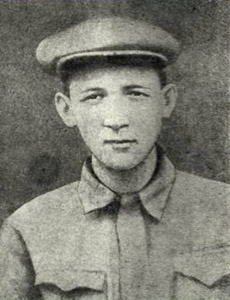
Sixteen-year-old partisan Alexander Chekalin earned his martyrs’ crown as a Hero of the Soviet Union when he was executed by the occupying Third Reich on this date in 1941.
The city of Tula, a transport hub 200 kilometers south of Moscow, was a key target for the German drive on the Soviet capital in those pivotal months; the Wehrmacht’s eventual inability to take it from determined defenders was crucial to thrwarting the attack on Moscow by protecting her from the southern tong of the intended pincer maneuver.*
Chekalin didn’t live long enough to see any of this come to fruition but in his moment he did what any one man could do: ambushes, mining, and other harassment of the occupation army in the Tula oblast (region) with his comrade irregulars. Our principal was found out by the Germans recuperating from illness in a town called Likhvin — see him defending his house of refuge against hopeless odds in the commemorative USSR stamp below — and then suffered the usual tortures and interrogations before he was publicly strung up on November 6. He hung there for 20 days before the Red Army took the town back and buried him with honors
In 1944, the tiny town of Likhvin was renamed in his honor: to this day, it’s still called Chekalin.
* Tula was recognized as a Hero City of the USSR for the importance of its defence.
The last man hanged in Cambridgeshire was Frederick Seekings on this date in 1913, for the drunken murder of his lover.
“Of limited intellect and a demon in drink,”* this Brampton laborer staggered out of Bell Inn on the 28th of July, 1913 with his eventual victim, Martha Beeby.** Both were deep in cups and argument, stumbling drunkenly to the ground as they vociferated until the innkeeper’s son helped steady them on their way.
Later that night, both were found sprawled out together alongside that same road: Frederick splayed over Martha, and Martha dead of a slashed throat. Frederick’s unconvincing claim that she’d done it to herself only confirmed his own guilty conscience; only the fact that he’d been drunk himself presented itself as a mitigating circumstance, but the Crown disputed his true degree of intoxication and the defence failed to persuade the jury to settle on mere manslaughter.
He was hanged by Thomas Pierrepoint in an execution shed at Cambridge County Gaol† in the city of Cambridge November 4, 1913, with little fanfare. There’s been no fanfare at all for 106 subsequent years, for neither city nor shire have since returned to the gallows in any capacity.
According to the Capital Punishment UK Facebook page (corroborated by its commenters), “The gallows from Cambridge was displayed in Madame Tussaud’s wax works in Blackpool in the 1980’s and consisted of two uprights with a crossbeam, bearing the Royal Coat of Arms, set over the double leaf trapdoors.” If there’s a photo of this relic available online, I have not been able to locate it.
* Quote is from the scholarly annotations to Malcolm Lowry‘s lost-then-rediscovered novel of Cambridge, In Ballast to the White Sea, which passingly alludes to the hanging.
** Frederick and Martha cohabited and she commonly went by his surname, Seekings — but they never married, and Martha actually had a never-annulled marriage to a different man.
† Tangentially, Cambridge-curious readers might enjoy this tour of the prison’s early 19th century executions.
On this date in 1929, the Punjabi Muslim youth Ilm Deen was hanged for murdering a blasphemous publisher.
The Rangila Rasul is a pamphlet-length send-up satirizing the “widely experienced”, chortle chortle, Prophet Muhammad for his many wives; Muslim fury at its publication brought the Raj to legislate against “outraging the religious feelings of any class” — a law that’s still on the books in India.
However, there was no such law at the time of the naughty screed’s publication, and as a result the Hindu publisher, Mahashe Rajpal of Lahore, was acquitted of any charge in 1929.
‘Twas a temporary exoneration, for Ilm Deen (or Ilm-ud-din, or Ilmuddin), a 20-year-old carpenter, delivered his verdict extrajudicially by daggering Rajpal in the chest in a Lahore bazaar on April 6, 1929.
The assassin’s speedy trip to the Raj’s gallows thereafter only cinched his place as a sectarian, and later (for Pakistan) national, martyr; the poet Allama Iqbal exclaimed at the young man’s funeral that “this uneducated young man has surpassed us, the educated ones!” To this day, Ilm Deen’s solemn tomb is a place of pilgrimage and veneration.
Christian villages, traditionally friendly or not unfriendly towards the Yishuv, were generally left in peace. An exception was ‘Eilabun, a mainly Maronite community, which fell to Golani‘s 12th Battalion on 30 October after a battle on its outskirts with the ALA [Arab Liberation Army], in which the Israelis suffered six injured and four armoured cars knocked out. The villagers hung out white flags and the Israelis were welcomed by four priests. The inhabitants huddled inside the churches while the priests surrendered the village. But the troops were angered by the battle just concluded and by reports of a procession in the village, a month before, in which a large number of inhabitants had participated, in which the heads of two IDF soldiers who had gone missing after the attack on 12 September on a nearby hilltop — ‘Outpost 213’ — were carried through the streets, or by the actual discovery in a house of one of the rotting heads. What happened next is described in a letter from the village elders to [Israeli Minister of Police Bechor-Shalom] Shitrit: The villagers were ordered to assemble in the square. While assembling, one villager was killed and another wounded by IDF fire.
Then the commander selected 12 young men and sent them to another place, then he ordered that the assembled inhabitants be led to [the neighbouring village of] Maghar and the priest asked him to leave the women and babies and to take only the men, but he refused, and led the assembled inhabitants — some 800 in number — to Maghar preceded by military vehicles … He himself stayed on with another two soldiers until they killed the 12 young men in the streets of the village and then they joined the army going to Maghar … He led them to Farradiya. When they reached Kafr‘Inan they were joined by an armoured car that fired upon them … killing one of the old men, Sam‘an ash Shoufani, 60 years old, and injuring three women … At Farradiya [the soldiers] robbed the inhabitants of I£500 and the women of their jewelry, and took 42 youngsters and sent them to a detention camp, and the rest the next day were led to Meirun, and afterwards to the Lebanese border. During this whole time they were given food only once. Imagine then how the babies screamed and the cries of the pregnant and weaning mothers.
Subsequently, troops looted ‘Eilabun.
Not all the villagers were taken on the trek to Lebanon. The four priests were allowed to stay. Hundreds fled to nearby gullies, caves and villages, and during the following days and weeks infiltrated back. The affair exercised the various Israeli bureaucracies for months, partly because the ‘Eilabun case was taken up and pleaded persistently by Israeli and Lebanese Christian clergymen. The villagers asked to be allowed back and receive Israeli citizenship. They denied responsibility for severing the soldiers’ heads, blaming one Fawzi al Mansur of Jenin, a sergeant in Qawuqji‘s army [i.e., the ALA].
The affair sparked a guilty conscience and sympathy within the Israeli establishment. Shitrit ruled that former inhabitants still living within Israeli-held territory must be allowed back to the village. But Major Sulz, Military Governor of the Nazareth District, responded that the army would not allow them back. He asserted, ambiguously, that ‘Eilabun had been ‘evacuated either voluntarily or with a measure of compulsion’. A fortnight later, he elaborated, mendaciously: ‘The village was captured after a fierce fight and its inhabitants had fled.’ The Foreign Ministry opined that even if an ‘injustice’ had been committed, ‘injustices of war cannot be put right during the war itself’.
However, Shitrit, supported by Mapam’s leaders and egged on by the village notables and priests, persisted. Cisling suggested that the matter be discussed in Cabinet. Shitrit requested that the villagers be granted citizenship (relieving them of the fear of deportation as illegal infiltrees), that the ‘Eilabun detainees be released and that the villagers be supplied with provisions. Within weeks, Shitrit was supported by General Carmel, who wrote that ‘in light of the arguments [about their mistreatment]’ and of the fact that the area was not earmarked for Jewish settlement, the inhabitants should be left in place ‘and accepted as citizens’. Within weeks, the inhabitants received citizenship and provisions, and the detainees were released. At the same time, Shitrit, as Minister of Police, persuaded Yadin, to initiate an investigation of the massacre. During the summer of 1949, the ‘Eilabun exiles in Lebanon who wished to return were allowed to do so, as part of an agreement between Palmon, head of the Arab Section of the Political Department of the Foreign Ministry, and Archbishop Hakim, concerning the return of several thousand Galilee Christians in exchange for that cleric’s future goodwill towards the Jewish State. Hundreds returned to ‘Eilabun.
The abortive attack on ‘Outpost 213’, bizarrely enough, triggered a second atrocity four days after the first massacre. On 2 November,vtwo squads of the 103rd Battalion were sent on a search operation to Khirbet Wa‘ra as Sauda, a village inhabited by the ‘Arab al Mawasi beduins, three kilometres east of the outpost. While one squad kept guard over the villagers, the other — led by Lt. Haim Hayun, veteran of the September assault — climbed up to the outpost, where it discovered ‘the bones of the soldiers lost in the previous action’. The bodies were ‘headless’. The troops then torched the village (and presumably expelled the inhabitants), taking with them to their HQ in Maghar 19 adult males. There, the prisoners were sorted out and 14 were determined to have ‘taken part in enemy activity against our army’. They were taken away and ‘liquidated’ (huslu). The remaining five were transferred to a POW camp.
‘Eilabun and ‘Arab al Mawasi were only two of the atrocities committed by the IDF during Hiram, which saw the biggest concentration of atrocities of the 1948 war. Some served to precipitate and enhance flight; some, as in ‘Eilabun, were part and parcel of an expulsion operation; but in other places, the population remained in situ and expulsion did not follow atrocities.
Details about most the atrocities remain sketchy; most of the relevant IDF and Israel Justice Ministry documentation — including the reports of various committees of inquiry — remain classified. But there is some accessible, civilian documentation — and a few military documents have escaped the censorial sieve. It emerges that the main massacres occurred in Saliha, Safsaf, Jish and the (Lebanese) village of Hule, between 30 October and 2 November. In the first three villages, Seventh Brigade troops were responsible. At Saliha it appears that troops blew up a house, possibly the village mosque, killing 60–94 persons who had been crowded into it. In Safsaf, troops shot and then dumped into a well 50–70 villagers and POWs. In Jish, the troops apparently murdered about 10 Moroccan POWs (who had served with the Syrian Army) and a number of civilians, including, apparently, four Maronite Christians, and a woman and her baby. In Hule, just west of the Galilee Panhandle, a company commander and a sergeant of the Carmeli Brigade’s 22nd Battalion shot some three dozen captured Lebanese soldiers and peasants and then demolished a house on top of them, killing all. Civilians appear to have been murdered in Sa‘saas well.
Polish serial killer Joachim Knychala, colorfully known as “The Vampire of Bytom” or “Frankenstein”, was hanged in Krakow just in time for Halloween on this date in 1985.
Knychala (English Wikipedia entry | the far more informative Polish) was a married miner of mixed German-Polish heritage — a fact which reportedly drew him considerable childhood abuse — who committed five sex-murders in Upper Silesia from 1975 to 1982.
He inherited his appellation from a different Silesian mass murderer, Zdzislaw Marchwicki, the “Vampire of Zaglebie,” with whom he eerily shared a victim: Miroslawa Sarnowska, who survived an attack by the earlier Vampire and gave crucial evidence against him, was Knychala’s third homicide.
Our guy’s m.o. was to surprise his prey with a bludgeon about the head, sometimes killing outright and other times incapacitating; despite his savagery, several women and girls survived his assaults. He did most of his evil work over the late 1970s; arrested as a suspect in such an attack in September 1979, he had a strong alibi* for the occasion at hand and then had the half-discipline to lay low for a few years after his fortuitous release.
But he could not conceal his fangs forever. In May 1982, he reported the death of his 17-year-old sister-in-law in a “fall in the woods.” Examination of the body told a more sinister tale: she’d been done in by a blunt force near the top of the skull (improbable for a mere accidental fall), and she’d had recent intercourse. Knychala was dramatically arrested at the girl’s very funeral, eventually copping to his spree and comforting himself with the hopes of a better afterlife … of pop culture notoriety. He has thus far somewhat maintained his recognizable infamy in a Poland that no longer produces death sentences.
* Seemingly strong: his work card proved his attendance at the mine at the time of the attack. Only later, during the decisive trial, was it realized that his foreman routinely registered leave time earned by Knychala’s overtime work with the state’s official youth organization by simply punching the vampire’s card as if he’d been present on such a leave day.
October 27, 1959 headline of the Palm Springs, Calif., Desert Sun.
Connecticut reluctantly electrocuted paraplegic murderer Frank Wojculewicz on this date in 1959.
A lifetime crook, Wojculewicz was surprised by two patrolmen in the course of robbing the AYO Meat Packing Company of New Britain, way back in 1951. In the gun battle that ensued, Wojculewicz shot dead Sgt. William Grabeck, as well as a bystander named William Otipka — but Wojculewicz was also struck in the spine by a police bullet.
That left the robber alive — and it left Connecticut a very uncomfortable case.
His guilt was in no question whatever and the death sentence for his two murder convictions was mandated by law. But the prospect of putting a permanently paralyzed man into the state’s electric chair was so aesthetically discomfiting that his legal odyssey dragged on for nearly 8 years at a time when the median death penalty case resulted in execution in 15 months. He had to be tried in a prison hospital bed.
As this retrospective from the New York Daily News observes, slow-walking Connecticut officials were likely hoping that the killer’s injuries would take his life “naturally” before it came to that. But the tough bastard kept hanging on, and not only that, but fighting for his own life both in the courts (where State v. Wojculewicz cases reached the Connecticut Supreme Court in both 1953 and 1956) and the court of public opinion. Wojculewicz passed his time “feeding pigeons through barred windows. He lobbied for life, arguing in letters to supporters that his paralysis was ‘a greater punishment than death’ and calling state execution ‘the evil of evils.'”
In the end, though, Wojculewicz was a fully competent, fully guilty criminal asking an exemption from the law based on an injury that he’d suffered in the course of committing the crime. Nobody really wanted to put an invalid in the electric chair but neither did anybody have a proper reason not to do so.
Time ran out for Frank Wojculewicz on the frosty night of October 26, 1959. Death row guards found him lying face-down as usual. They gently lifted the helpless man from his mattress and placed him in a wheelchair. Then began a slow procession. One by one the other condemned men called their farewells to Wojculewicz as he was wheeled past their cells. The scene was extremely affecting. When the procession entered the execution chamber it was greeted by the warden. He then asked Wojculewicz if he had a last request. Bitter to the end, the doomed man asked that the prison chaplain not be allowed near him. He said that he neither wanted nor needed any pious prepping for what he was about to face. The warden was displeased but he granted the request. Guards then wheeled Wojculewicz to the middle of the chamber. There they carefully lifted him from the wheelchair and put him in the electric chair. A wooden box was used as a stool to support his paralyzed legs. When the guards completed the task of affixing the electrodes and adjusting the straps they signaled that all was ready. Then the executioner turned on the current and Frank Wojculewicz was no more.
Walkiria (or Walquiria) Afonso Costa was summarily executed on this date in 1974.
Sickly and emaciated, the 27-year-old was the last guerrilla left in the field after the two-year campaign of the Brazilian dictatorship to suppress the Communist insurgency in Araguaia — or at least she was the last who was taken into custody.
A pedagogy student at the University of Minas Gerais, she had learned to shoot on forest rambles with her father and so perhaps came better prepared for the wilderness life than some comrades.
According to her sister, the sociology professor Valéria Costa Couto, the military had all but wiped out the guerrillas in a Christmas 1973 ambush, with only Walkiria and a couple of others managing to escape and hold out a few months longer.
There is a street named for her in her home city of Belo Horizonte, and an epigraph from her deceased father awaits if her remains are ever located for proper burial: “Do you think they killed me? They raised an ideal. Do you think they buried me? They planted a seed.”


 “Shura” (
 The
The  Knychala (

 Sickly and emaciated, the 27-year-old was the last guerrilla left in the field after the