1942: Six aspiring escapees from Dulag-205

On about the 18th December 1942 a group of about 6 prisoners intended to escape but were betrayed by somebody. All six prisoners were led out ofthe camp beyond the wire, taken about 20 metres to a pit and shot without any hearing. Before the execution the interpreter told the prisoners that the 6 men had wanted to escape from the camp and for that they would be executed. This would happen to anyone who tried to escape from the camp. The surnames of those who died are not known to me.

This is the testimony of Konstantin Krupachenko, a Red Army prisoner-of-war retrieved from the Germans’ “Dulag-205” camp — a transit facility behind German lines at Stalingrad which was liberated as the Soviets overran the encircled German position.

Krupachenko’s testimony was part of the evidence prepared against six Wehrmacht officers taken prisoner at that camp and ultimately executed, men whose case we have previously detailed.

Though not well-known and hardly by scale a major contributor to the ghastly death toll among Soviet POWs, Dulag-205 was horror aplenty for those who survived it. Starvation rations gave way to no rations at all in the dead of winter, and the skeletal inmates cannibalized the dead. Harassment by guard-dogs, capricious beatings, and the usual regimen of dawn-to-dusk forced labor were the lot of the lucky ones.

The less fortunate, well …

On about the 25th November 1942 while working on a road which led to Gumrak three kilometres from the camp a group of prisoners of about 50-60 was levelling and clearing the road. One prisoner whose name I don’t know collapsed from tiredness and exhaustion and couldn’t work. The guard tried to force the exhausted man to stand and work but the prisoner couldn’t get up. Then the guard shot the prisoner dead with a sub-machine gun and ordered that he be buried in a ditch at the side ofthe road. (Krupachenko again)


There were public executions in the camp. In January 1943 on about the lOth-llth a former senior Lieutenant of the Red Army, his surname I don’t know, was executed for allegedly organising an escape attempt. (Anatoly Alexeev)


In all cases the Germans would shoot prisoners without any warnings at all. In the month of October 1942 I personally saw up to 30 prisoners shot. They shot people every day for falling behind to and from work, and sometimes for breaking ranks. I am unable to give the surnames of the prisoners shot by the Germans. Moreover, when we were herded from the Alekseevka camp to the area of Karpovka village, then several prisoners were shot dead by German officers for the fact that when we were working we were bombarded by Soviet troops and several prisoners took cover. After the firing had stopped the officers came out of their trench dug-outs and shot them on the spot. Three prisoners were shot dead for taking some tobacco while working on a dump. (Ivan Kosinov)


As one of the Germans on trial for these abuses agreed (Otto Mäder was trying to throw blame onto the camp commanders),

[t]here was no trial of any kind, they [prisoners] were shot without any trial on the order of [Dulag-205 commandant] Colonel Korpert. I am a lawyer by education and I understand perfectly that this these shootings were illegal, simply murder in fact.

All these quotations are via Frank Ellis’s “Dulag-205: The German Army’s Death Camp for Soviet Prisoners at Stalingrad” (Journal of Slavic Military Studies, March 2006),

On this day..

1946: Sulaiman Murshid, Alawite prophet

On this date in 1946, Alawite prophet Sulaiman Murshid (German Wikipedia) was hanged by the newly independent state of Syria as a traitor and a blasphemer.

In the mid-1920s, this shepherd turned demigod* on the coast of French Mandate Syria began reporting mystical visions, and soon gathered a following — and then, a larger and larger following.

Shia Alawites are a small minority in Syria, maybe 12% of the present-day population, so it might have been key to Murshid’s success that he so happened to begin his mission in a short-lived Alawite State created within the French Mandate. (Neither keen on his movement nor inspired to arrest it, the colonial French dismissed him as la Thaumaturge de Jobet Burghal.) It was a cradle in which a peasant obscurity grew into a political as well as a prophetic power — a tribal chief who could command armed men and rents.

Come 1936, the Alawite State folded into the Syrian Republic, and by that time Murshid’s adherents were so numerous that they promptly elected him to parliament.

Although this arrangement offered Murshid new vectors of ascent, the environment turned speedily hostile after France withdrew and Syria gained independence in 1946. Murshid’s entity was intrinsically inimical to a centralizing nation-state, and his lowly origins, suspect ethnicity, and half-heretical messianism all tended to set him at odds with Damascus. He was arrested for subversion by Syria’s nationalist first president Shukri al-Quwatli and hanged on Merdsche Square.

Murshid’s sons carried on the movement, whose followers, the al-Murshidun, were persecuted in the years after his death until fellow Alawite Hafez al-Assad ascended to the presidency in 1970. Today their sect numbers in the six figures.

* For more on Murshid’s background and the initial growth of his movement, see “Suleiman al-Murshid: Beginnings of an Alawi Leader” by Gitta Yaffe and Uriel Dann in Middle Eastern Studies, Vol. 29, No. 4 (Oct., 1993).

On this day..

1943: The Massacre of Kalavryta

On this date in 1943, German troops occupying Greece massacred the entire male population of the town Kalavryta.


Memorial to the December 13, 1943 massacre.

Weeks earlier, resistance partisans had waylaid a German patrol in the vicinity, taking about 80 German soldiers prisoner and subsequently executing them.

A bestial Lidice-like mass reprisal, Unternehmen Kalavryta, commenced in December with German columns descending on the small Peloponnesian town — murdering civilians at nearby towns and firing the historic Agia Lavra monastery in the process.

Once they reached their target, the women and children of Kalavryta were locked in a school that was put to the torch, while men and older boys were marched to the outskirts and machine-gunned en masse, killing at least 500. (About thirteen are known to have survived this mitraillade and its ensuing finishing-off with axes.) The total death toll in Kalavryta was near 700, significantly mitigated by the women eventually forcing their way out of their burning tomb. Those survivors faced immediate winter privation to go with the horror of the massacre, for the Germans also destroyed homes and drove off the livestock.

A memorial at Kalavryta today* records some 1,300 names including villagers from the surrounding towns slain during the course of the operation — and the church clock is permanently fixed to 14.34, the moment on that awful December 13 that the massacre in Kalavryta began.

* The city also has a museum dedicated to the event.

On this day..

1924: A day in the death penalty around the U.S.

From the New Orleans Times-Picayune, Dec. 13, 1924:

Shreveport, La., Dec. 12 — Alfred Sharpe, about 25 years old, a negro, was hanged here today at 12:16 p.m. for the murder of Tom Askew, a white man, veteran of the World war and manager of a plantation near Keithville, which occurred last September 9.

Sharpe, in a statement just before going to the gallows blamed liquor for his trouble. He admitted since his captured two days after the killing that he was guilty.

The negro, who was unable to read or write, and did noot know his exact age, said as he mounted the scaffld: “I know I violated the law and that the law must be fulfilled.”

From the Cleveland Plain Dealer, Dec. 11, 1924:

COUMBUS, O., Dec. 11. — Alexander Kuszik, 20, of Akron, must die in the electric chair at the state penitentiary shortly after 1 a.m. tomorrow for the murder of his thirteen-year-old cousin, Elizabeth Nagy, who spurned his proffered love.

Gov. A.V. Donahey late today denied a last minute appeal by Kuszi’s counsel that the death sentence be commuted to life imprisonment. This plea, supplemented by the testimony of three alienists [psychologists — ed.] to the effect that Kuszik was not mentally responsible for his acts at the time of the crime’s commission, failed to convince the governor, however, that he should exercise his powers to extend clemency

Even Kuszik’s counsel, C.G. Roetzel, former prosecutor of Summit county, admitted the crime for which Kuszik was convicted was one of the most brutal on record, and made no claim the prisoner was insane. Roetzel based his plea for clemency on the theory, supported by alienists, that Kuszik was mentally irresponsible although he did know the difference between right and wrong.

Theory of Alienists.

The alienists advancing this theory were Dr. J.C. Hassall, superintendent of Fair aks sanitorium, Cuyahoga Falls; Dr. Arthur G. Hyde, superintendent of the Massillon State hospital, and Dr. D.H. Morgan of Akron.

Drs. Hassall and Hyde had made their observations of Kuszik within twenty-four hours after the crime had been committed. Dr. Morgan made his observations about a month later.

These specialists made their examinations at the request of Prosecutor Arthur W. Doyle, but their testimny was not used at the time of the trial, Dr. Doyle explained, because he reached his own conclusion that Kuszik was responsible for his acts.

Countering the views of this group of alienists was the testimony of three others who, after making an examination of Kuszik at the governor’s request, reported that the youth not only was not insane but that he was mentally responsible.

Mentality Subnormal.

These alienists were Dr. Charles F. Clark, superintendent of the Lima State hospital; Dr. H.H. Pritchard, superintendent of the Columbus State hospital, and Dr. Guy Williams, superintendent of the Cleveland State hospital. They all said Kuszik had no mental disorders. All the alienists had agreed that Kuszik’s mentality was sub-normal — that it represented the mentality of a child of about 11.

Prosecutor Doyle told the governor that, in his opinion, so long as the state recognizes capital punishment Kuszik’s case was one in which it should be used.

Kuszik exhibited no concern when told his appeal had been denied and that he was to die.

In complete control of his faculties, he walked even jauntily to the death cell to spend his few remaining hours.

“The youth has shown more spirit today than at any time since confined,” Warden P.E. Thomas said.

Two consecutive stories from the Portland (Ore.) Oregonian, Dec. 13, 1924:

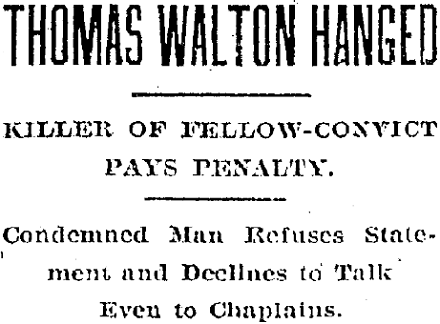
WALLA WALLA, Wash., Dec. 12. — Thomas Walton, convicted of the murder of S.P. Burt, a fellow convict, in the state penitentiary here October 7, 1923, was hanged at the penitentiary this morning. The trap was sprung at 5:06 A.M. and the prison physicians pronounced him dead 10 minutes later.

Walking to his death with the same fearlessness that he has displayed since the beginning of his prison career, Walton refused to make any final statement and even declined to talk with Rev. A.R. Liverett, prison chaplain, or Father Buckley, Catholic priest, in his cell prior to the execution.

His body will be sent to relatives in Montague, Cal.

Although Walton paid the penalty for killing Burt, he has of official record killed two other men. The first was in 1915 in California, for which he was sentenced to life imprisonment in San Quentin prison. The other was that of George McDonald, cellmate of Burt, whom he stabbed following his attack on Burt.

Walton and Burt were life termers in San Quentin and made their escape together in a prison automobile in January, 1923.

FOLSOM, Cal., Dec. 12 — Robert Matthews, negro, convicted of the murder of Coleman Stone, a grocer near Los Angeles, was hanged at the state prison here this morning. [Joe] Sinuel will be hanged next Friday.

On this day..

1981: El Mozote Massacre

On this date in 1981, the El Salvador military perpetrated the El Mozote massacre.

It was conducted by the U.S.-trained and -armed death squad, the Atlacatl Battalion, which on December 10 of that year entered the northern village of El Mozote in search of FMLN* guerrillas.

There weren’t any there — just townsfolk whose numbers were swollen by peasant refugees from the brutal civil war. After ransacking the town and interrogating and robbing the residents, the Atlacatl Battalion sent everyone home and bivouaced down for the night in the town square.

Dawn’s light the next morning would bring the unspeakable horror.

The battalion forced the entire population to the town square, divided men from women, and set about murdering men with gunshot, machetes, and worse — and raping and murdering the women — and then slaughtering all the children, too.

More than 800 civilians died. The next month, a Washington Post journalist described “dozens of decomposing bodies still seen beneath the rubble and lying in nearby fields, despite the month that has passed since the incident … countless bits of bones — skulls, rib cages, femurs, a spinal column — poked out of the rubble.”

A few survivors did manage to reach neighboring villages and the story of what had occurred at El Mozote worked its way out to the wider world over the days and weeks to come. It made little matter to the government in San Salvador where bloodbath was policy, openly espoused by the likes of the man who was about to be elected president of the Constituent Assembly.

In Washington, where the checks were written, destroying Latin American peasant guerrilla movements was a Cold War lodestar and so Orwellian denial of this atrocity soon became the virtual law of the land. After heroically risking his life venturing into the conflict zone to collect evidence, the New York Times reporter Raymond Bonner was tarred and feathered by America’s foreign policy apparatchiks and eventually driven off the Times foreign policy beat while the U.S. continued pumping money to the murderers. The Atlacatl Battalion in particular would author several more notorious atrocities in the course of the 1980s dirty war.

A U.N.-backed Truth Commission convened after the conflict finally ended in 1992, investigated the affair and agreed that

There is full proof that on December 11, 1981, in the village of El Mozote, units of the Atlacatl Battalion deliberately and systematically killed a group of more than 200 men, women and children, constituting the entire civilian population that they had found there the previous day and had since been holding prisoner… there is [also] sufficient evidence that in the days preceding and following the El Mozote massacre, troops participating in “Operation Rescue” massacred the non-combatant civilian population in La Joya canton, in the villages of La Rancheria, Jocote Amatillo y Los Toriles, and in Cerro Pando canton.

The El Salvador government officially apologized in 2011. Nobody has ever been prosecuted for the slaughter.


Memorial to the massacre. (cc) image by Amber.

* The Frente Farabundo Marti para la Liberacion Nacional, named for a famous executed Salvadoran peasant rebel.

On this day..

1916: Eric Poole, the first British officer shot at dawn during World War I

A century ago today in the Great War, Second Lieutenant Eric Poole laid down his life at the city hall of a Belgian border town.

As it was put by the sadly defunct Shot At Dawn site (still preserved at the Wayback Machine), “The cemetery register of Poperinghe New Military Cemetery states that Lt. Eric Skeffington Poole died of wounds on 10 December 1916. Tactfully, it omits to record also that his death was caused by a British Army firing squad.”

A Canadian-born engineer, Poole had enlisted in the very first weeks of the war and been commissioned an officer by May 1915.

In July of 1916, a falling artillery shell struck so close that its concussion knocked Poole down, spattering him with earth. He was hospitalized for shellshock but returned to duty in September — still complaining of rheumatism and feeling “damned bad.”

One night in October as his unit moved up to a forward trench, Poole disappeared from it — nobody knows how or when, but he wasn’t there when it mustered at its new position at midnight. He was detained two days later, wandering well west of the trenches, a leather jacket hiding his private’s tunic … “in a very dazed condition,” an officer who interviewed him would later remember. “From conversation which I had with him I came to the conclusion he was not responsible for his actions. He was very confused indeed.”

Evidence collected in Poole’s desertion trial pointed to a man taxed beyond his capacities by command responsibility and the strain of two years at war. His division commander recommended against the court martial, for Poole was “not really accountable for his actions. He is of nervous temperament, useless in action, and dangerous as an example to the men” — but still “could [be] usefully employed at home in instructional duties or in any minor administrative work, not involving severe strain of the nerves.” Another captain in his battalion described him as “somewhat eccentric, and markedly lacking in decision” and liable under pressure to “become so mentally confused that he would not be responsible for his actions.”

By the book the man’s irresolute midnight ramble was a clear instance of abdicating duty, but Poole’s weakness was apparent enough to trouble the court that tried him for desertion — not only to solicit this and other testimony from his comrades about the lieutenant’s state of mind but even to remark from its own observation that his “mental powers [were] less than average. He appears dull under cross examination, and his perception is slow.” Perhaps this was fellow-feeling by other officers that would not have been extended to a mere grunt; if so, what was a mitigating consideration for the court made Poole’s execution a in the eyes of Field Marshal Haig: “Such a case is more serious in the case of an officer than a man, and it is also highly important that all ranks should realise the law is the same for an officer as a private.” Two years in, and somehow not one officer had suffered such a punishment; Shot At Dawn speculated that military courts’ recent shocking verdict excusing Captain John Bowen-Colthurst on grounds of insanity for an atrocity in Ireland had also raised pressure on the armed forces to show that British officers stood not above the law.*

The British army executed 306 of its own soldiers during World War I. Among them, Poole was the first of only three officers.

* The War Office’s decision not to publicize his fate (and the euphemistic reference in the cemetery register) would seem sharply at odds with any intended demonstrative effect.

On this day..

2014: Robert Wayne Holsey, despite a drunk lawyer

On this date in 2014, Georgia executed a contrite Robert Wayne Holsey.

Out on probation for an armed robbery conviction, this avatar of the classic middle name robbed a convenience store at gunpoint, then shot and killed a deputy who pursued him.

Georgia somehow didn’t have a state public defender system until 2003, a system presenting to the counties who were supposed to appoint indigent defense counsel on a local and ad hoc basis a fine opportunity for callous graft dovetailing the interests of the prosecutor’s office in winning its cases with court’s interest in pinching its pennies.

Accordingly, Baldwin County stuck Holsey with a man to test appellate courts’ standards for minimal representation, an alcoholic attorney named Andy Prince* who was rock-bottoming during the trial to the gobsmacking reported tune of a quart of vodka every night. Prince was disbarred shortly after Holsey’s conviction for robbing another client of $100,000.

According to a tragic Mother Jones profile, Prince, who was white, also happened to get in a dispute around this same time with a black neighbor and hurled some racist invective, which doesn’t seem ideal when your day job consists of trying to keep a black defendant off death row.

The late Prince — he died in 2011 — told an appeals court in 2006 that he “shouldn’t have been representing anyone,” but appeals courts, which must generally find that such “shoulds” clearly “would” have changed the trial outcome, have much less scope to act on the determination.

It’s a massive systemic cheat still in widespread use, albeit not always in such egregious fashion: use some underhanded means to get a death sentence on the books, then argue to every higher court that the deficiency can’t be proven certainly decisive vis-a-vis what might have happened in a fair fight. Do you know Holsey wouldn’t have received a death sentence? He did shoot a cop in the course of committing a violent felony, after all.

There are many general reasons why a robust defense might mitigate a sentence, but the specific reason of interest in Holsey’s case — a reason not litigated by Prince, an omission that likewise foreclosed appeals avenues — was that Holsey was severely mentally disabled.

With a testing IQ around 70, just at the border of the conventional definition for so-called “mental retardation,” Holsey had at the minimum a very strong card for the mitigation phase of the trial — if not an outright bar to execution.** Prince failed to play that card … and as of this date in 2014, American jurisprudence and the state of Georgia determined themselves content to leave it permanently face-down.

There’s a WNYC podcast about this case here.

* The Guardian article cited in this post calls him Andy Price. As all other media citations I find call him Prince, I’m going with that — but as it’s likely that everyone is copying from the last story instead of doing original reportage, I’m not completely confident that it isn’t Price after all.

** Georgia was actually among the first states to bar the execution of mentally disabled prisoners — although paradoxically its early standard thereafter became one of the nation’s weakest as other states implemented their own over the years. The Supreme Court theoretically bars executing the mentally disabled, but as it has enforced no coherent standard the executing states themselves generally get to decide who qualifies.

On this day..

1915: Cordella Stevenson lynched

(Thanks to Meaghan Good of the Charley Project for the guest post. -ed.)

On this date in 1915, a mob visited Cordella Stevenson’s cabin, dragged her out, and lynched her.

The good citizens of Columbus, Mississippi, found her body the next day, hanging from a tree limb. The site of her lynching was only 50 yards north of the Mobile and Ohio Railroad, and rail passengers who came in and out of the city that day saw her corpse thus displayed. She had been “maltreated” (that is, raped) and stripped naked before being strung up.

Several months before, Gabe Frank, a local white man, lost his barn to fire. Although there was no direct evidence to implicate him and he had not been seen in the area for months prior to the fire, Cordella and Arch Stevenson’s son came under suspicion of arson.

The parents were respectable people who had worked for the same white employer for over a decade, but the son had a “worthless” reputation. Frank tried tracking the young man with bloodhounds, but was unsuccessful. The local police arrested Cordella and kept her locked up for several days, hoping she might know something of her son’s whereabouts, but they eventually released her without charge.

The Stevensons thought or hoped that would be the end of the matter.

Arch and Cordella had already gone to bed that Wednesday night in December when, at about 10:00 p.m., they heard someone pounding on their door. Before they could get to the door to answer it, the vigilantes had broken it down. They seized Cordella, pointed their rifles at Arch, and threatened to shoot him if he moved. At some point he managed to flee, bullets whizzing miraculously past him in the dark, and he ran to town for help. Arch knew what was good for him; after reporting what happened to the authorities, he fled the area for parts unknown. Meanwhile, somewhere out there in the night, the mob fell on his wife.

Kerry Segrave recorded in his book Lynching of Women in the United States: Recorded Cases, 1851-1946:

Sheriff Bell telephoned to Justice of the Peace McKellar to hold an inquest. He was out of town and did not return until Thursday night. As a result, the naked body was left hanging in view of the “morbid” crowd that came to see it until Friday morning when it was cut down and the inquest was held. That inquest jury returned a verdict that Cordella Stevenson came to her death at the hands of persons unknown.

The Chicago Defender, a (still-extant) black newspaper noted for its accurate reporting of Jim Crow era violence, bitterly editorialized, “This these southern culprits did. No law below the Mason and Dixon line that would cause them to fear. No officer in the police department that would dare to do his duty. No man in the government circles in Washington that has enough backbone to enforce the Constitution of the United States. This mob knew and they went on with their ghastly work.”

A century later, Cordella Stevenson’s ghastly death has still not been forgotten. In 2013, a poem for her, titled “What the Dark Said”, was published in the collection Ain’t No Grave, by Tennessee poet TJ Jarrett.

On this day..

1998: Cheung Tze-keung, Hong Kong kidnapper

Hong Kong gangster Cheung Tze-keung was shot with four accomplices on this date in 1998.

Unsubtly nicknamed “Big Spender”, Cheung financed his bankbusting lifestyle with big-ticket heists and elite kidnappings, even threatening the Guinness world record by “earning” a $138 million ransom for the son of tycoon Li Ka-shing. (Cheung had the chutzpah to then solicit Li’s investment advice.)

After a (different) failed kidnapping, Cheung ducked into mainland China to lay low for a spell; he was arrested there in early 1998, months after his Hong Kong stomping-grounds had been transferred to Chinese sovereignty.

Although the man’s guilt was not merely plain but legend, his case was a controversial one when it became an early bellwether for Hong Kong’s judicial independence. Cheung was put on trial for his Hong Kong robbery and kidnapping spree not in Hong Kong but in Guangzhou, the neighboring mainland city — seemingly in order to subject him China’s harsher criminal justice system. (Among other differences, Hong Kong does not have the death penalty.)

“A crime — that of kidnapping certain Hong Kong tycoons — allegedly committed in Hong Kong by some Hong Kong residents [was] tried in the Guangzhou court,” one prominent Hong Kong lawyer explained. “Is it surprising that Hong Kong people are alarmed and ask how is this permissible?”

But if possession is nine-tenths of the law, the Guangzhou authorities had all the permission they could need — the criminal’s own person.

On this day..

1914: The six martyrs of Vingre

On this date in 1914, a France consumed by the First World War made martyrs of six at Vingre.


The men in this post were rehabilitated in 1921, and this marker dedicated to their memory in 1925. Flickr users have posted some striking photos of the memorial site.

An event horribly underscoring the heartlessness of the brass against frail flesh in their ghastly war of machines, this shooting succeeded a surprise German attack on November 27 whose short-lived push into the French line momentarily drove part of the 298th Regiment to fall back out of their forward trench, before the French rallied and retook their own position to restore the status quo ante. The whole back-and-forth spanned mere minutes — just another snapshot of the trench war stalemate that would become so grindingly familiar to all belligerents in the years ahead.

French commanders in the earliest months of the war had shown a notable lack of empathy for any vexation of plans arising from the fog of war; indeed, exemplary executions became policy for enforcing military discipline to an unrealistic expectation. So, as punishment for their units’ “unauthorized* retreat,” six were selected for execution as an example to their fellows.

Some heartbreaking (or blood-boiling) last letters of the doomed survive.

Corporal Henri Floch (to his wife)

My darling Lucie,

By the time you receive this letter I shall be dead by firing squad. This is why: on 27th November, around 5pm, after 2 hours of heavy shelling in a trench on the front line, just as we were finishing our supper, Germans got into the trench. They captured me and two others. In the confusion I was able to escape from the Germans. I followed my comrades and then I was accused of dereliction of duty in the face of the enemy.

Twenty-four of us went before the War Council last night. Six were condemned to death and one of them was me. I am no more guilty than the others, but they want to make an example of us. My wallet will be sent home to you along with its contents.

In haste I say my last farewell to you, with tears in my eyes and a heavy heart. I humbly beg your forgiveness for all the grief that I will cause you and the difficulties that you will have to face because of me.

My dear Lucie, again, please forgive me. I’m going to Confession now and I hope to see you again in a better place. I die innocent of the crime of desertion of which I stand accused. If, instead of escaping from the Germans, I had remained a prisoner, my life would have been spared. It must be fate.

My last thoughts are for you, right to the end.

Henri Floch

Jean Quinault (to his wife)

I am writing to you my latest news. It’s over for me. I do not have the courage. We had a story in the company. We went to the court martial. We are 6 condemned to death. I am in the six and I am no more guilty than the comrades, but our life is sacrificed for others. Last farewell, dear little woman. It’s over for me. Last letter from me, deceased for a reason of which I do not know well the reason. The officers are all wrong and we are condemned to pay for them. I should never have thought of finishing my days at Vingre, and especially of being shot for so little and not guilty. It never happened, a case like this. I am buried in Vingré

Jean Blanchard (to his wife)

3 December 1914, 11.30 pm

My dear Beloved, it is in great distress that I begin to write to you and if God and the Blessed Virgin do not come to my aid it is for the last time …

I will try in a few words to tell you my situation but I do not know if I can, I do not feel the courage. On November 27, at night, as we occupied a trench facing the enemy, the Germans surprised us, and panicked us, in our trench, we retreated into a trench behind, and we returned to resume our places almost immediately, with this result: a dozen prisoners in the company of which one was in my squad, for this fault our squad (twenty-four men) spent today before the council of war and alas! We are six to pay for all, I can not explain it further to you, my dear friend, I suffer too much; friend Darlet will be able to explain to you better, I have a calm conscience, and submit entirely to the will of God who wants it so; It is this which gives me strength to be able to write to you these words, my dear beloved, who have made me so happy the time that I spent with you and of which I had so much hope to find. December 1 morning we were deposed on what had happened, and when I saw the charge that was brought against us and which no one could suspect, I cried a part of the day and have not had the strength to write to you …

Oh! Blessed be my parents! My poor parents, my poor mother, my poor father, what will become of them when they learn what I have become? O my beloved, my dear Michelle, take good care of my poor parents so long as they are of this world, be their consolation and support in their grief, I leave them to your good care, tell them I have not deserved this hard punishment and we will all find each other in the other world, assist them in their last moments and God will reward you for it, beg my forgiveness of your good parents for the punishment that they will experience by me, tell them well that I loved them very much and that they do not forget me in their prayers, that I was happy to have become their son and to be able to support and care for them their old days but since God has judged otherwise, that His will be done and not mine. Goodbye up there, my dear wife.

Jean


(cc) image from Soissonnais 14-18.

* The “cowards” contended that a falling-back had been ordered by a lieutenant who no doubt was as war-befogged as everyone else. Since this order could have set up Lt. Paulaud himself to be the guy shot for example, he naturally denied issuing it; when the six were exonerated after the war, Paulaud was indicted for perjury, but acquitted.

On this day..