1932: Asbury Respus, North Carolina serial killer

(Thanks to Meaghan Good of the Charley Project for the guest post. -ed.)

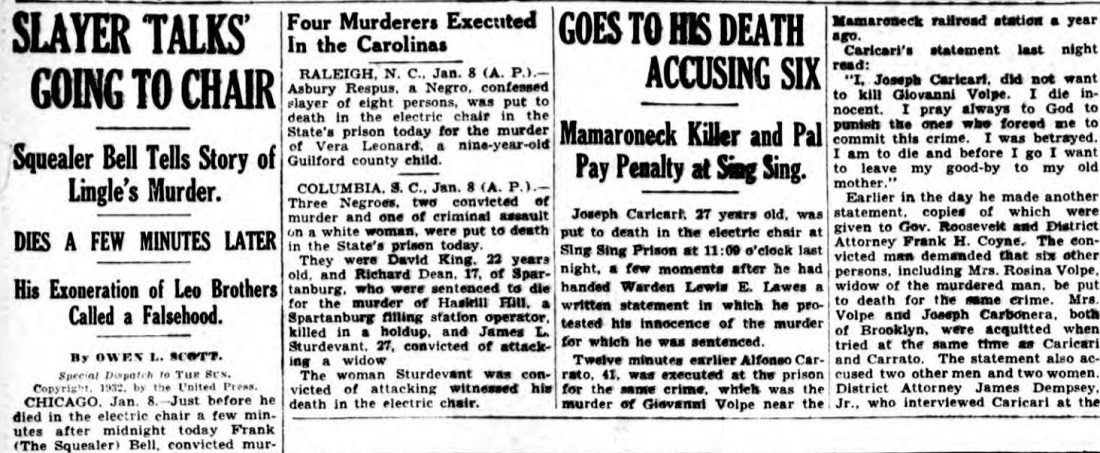
On this date in North Carolina, a middle-aged man named Asbury Respus was executed for the murder of nine-year-old Vera DeWitt Leonard.

And that wasn’t all: though virtually forgotten today, Respus was a serial killer with eight confessed murders to his name.

He claimed that he fell from a barn rafter as a youth and was never quite the same after that, being prone to “spells” of homicidal rage. This story may well have been true; he had a noticeable indentation in his skull.

According to Respus’s confession, he killed his first and second victims in Northampton County in the early 1900s. Their names were Lizzie Banks, whom he shot, and Zenie Britt, whom he beat to death with a stick. The third victim was Becky Storr, killed in Boydton, Virginia around 1910; she too had been bludgeoned with a stick.

These early murders are attested only by Respus’s own confession; the first verifiable homicide by his hand took place in 1912. Sentenced to 15 years for manslaughter in the shooting death of a Northampton County man named Ed D. Wynne, Respus escaped from a road gang in 1916 and began life as a drifter.

They can’t have hunted this fugitive very hard. He never went far, always staying in the vicinity of Greensboro, North Carolina.

All four victims prior to his incarceration had been African Americans, as was Respus himself. On January 14, 1918, Respus crossed the color line to axe to death a 56-year-old white woman named Jennie Brown in her home, which he then burned to the ground. So thoroughly did his arson consume the premises that no evidence of a crime remained … leaving Respus free to continue his murder spree. From here on out, by whatever happenstance, all victims were white.

On July 22, 1920, he came across a little boy named Robert Neal Osborne and drowned him in a stream, just for kicks. Again he got lucky: little Robert’s death was recorded as accidental. On July 17, 1925, he murdered 80-year-old widow Eunice Stephenson by striking her on the head and hanging her body from a ceiling beam. This homicide was recognized as such but went unsolved for years.

Vera Leonard was Respus’s youngest female victim and his undoing. Respus may have killed her with rape on his mind. As it was, he went with his old standby, a blunt instrument to the head; afterwards, he burned her body “to a char.” He did not blame his “homicidal spells” for Vera’s murder but instead said he’d been out of his mind on drugs.

Respus expressed gratitude that he was going to his death. “I’d rather he dead and in heaven,” he said, “than here on earth being tormented to death.”


It was a busy day for U.S. executioners. Headlines from the Jan. 8, 1932 edition of the New York Sun.

On this day..

1927: Robert Greene Elliott conducts six electrocutions in one day

On this date in 1927, Robert Greene Elliott — the “state electrician” who wired the majesty of the law to condemned men and women from Rockview, Pa. to Windsor, Vt. — had the busiest day of his illustrious career.

Once just a regular prison electrician, Elliott graduated himself to the euphemism in 1926 and was soon the go-to angel of electric death throughout the northeast. He pulled the lever a reported 387 times for men and women who sat in the new killing device in New York, New Jersey, Pennsylvania, Massachusetts, Connecticut and (just one time) Vermont; when John Dos Passos wrote that “they have built the electricchair and hired the executioner to throw the switch,” well, he could have been talking about Elliott’s $150-per-head bounty.

January 6, 1927 was a full and lucrative day for Elliott.

He started the day off with a triple execution in Boston’s Charleston Prison — the first triple electrocution in Massachusetts history.* Then he took a train to New York — relaxed with family — took in a picture — and then conducted the Empire State’s triple execution in the evening. (All six of his luckless subjects in either state had been sentenced for various robbery-murders.) His $900 in wages between the two occasions would be the equivalent of a $12,000+ payday today.

Friend of the site Robert Walsh has a wonderful post detailing this character’s remarkable career; venture if you dare into the world of a prolific killer of the Prohibition and Depression eras, here.

Elliott also wrote an autobiography, Agent of Death, which is out of print and difficult to come by.

* Elliot would return there a few months later for a more famous trio: Sacco and Vanzetti, along with their accomplice Celestino Madeiros. Some other noteworthy clients of Elliott: alleged Lindbergh baby kidnapper Bruno Richard Hauptmann and illicitly photographed femme fatale Ruth Snyder.

On this day..

1945: Robert E. Folkes, the first condemned man to see the Oregon gas chamber

(Thanks to Robert Elder of Last Words of the Executed — the blog, and the book — for the guest post. Fans of this here site are highly likely to enjoy following Elder’s own pithy, almanac-style collection of last words on the scaffold. -ed.)

“I have nothing to say except that I am innocent. It’s easier to convict a Negro than a white person. So long everybody.”

Robert E. Folkes, convicted of murder, gas chamber, Oregon.
Executed January 5, 1945

Folkes, age twenty-three, was convicted of slashing a woman’s throat on a Southern Pacific train while working as a cook. The Associated Press described him as “the first condemned man to see the chamber,” as Folkes was the first prisoner to ever walk into the Oregon gas chamber without a blindfold on.

On this day..

1948: Arthur George Osborne, as per Harry Allen’s journal

On this date in 1948, Arthur George Osborne hanged at Armley Gaol in Leeds for murdering 70-year-old Ernest Westwood in the course of a robbery.

Osborne’s execution date was also his 28th birthday.

Mustachioed assistant executioner Harry Allen kept a handwritten journal of the executions he officiated in his 23-year career — a journal recently sold at auction. From it we have notes on each prisoner’s height (5 feet, 6.5 inches in Osborne’s case), weight (188138 pounds) and the consequent length of the rope’s drop (8 feet).


Very good job? but not expected to be so. Was hung on his 28th birthday at HMP Leeds by S. Wade got highly complimented on the speed of the job.

Harry Allen was eventually promoted to a chief executioner, in which guise he became Britain’s Last Executioner: he carried out one of the two simultaneous last hangings in England, as well as the last in Scotland and the last in Northern Ireland.

On this day..

1946: Gen. Leopold Okulicki murdered in Soviet prison

The fate of the last Commander in Chief of Home Army General Leopold Okulicki “Niedzwiadka”, imprisoned in Moscow and murdered there, symbolize the postwar fate of the Home Army and of Poland.

-2012 resolution of the Polish parliament

On this date in 1946, Polish Home Army General Leopold Okulicki was murdered by the NKVD in a Moscow prison.

Okulicki (English Wikipedia entry | the much more detailed Polish) embarked his military career at the tender age of 16, when he ditched school in favor of an Austrian legion on the eastern front of World War I — then segued directly into newly independent Poland‘s subsequent war against the Soviets.

Already a veteran soldier, Okulicki proceeded to the Warsaw military academy and made soldiering his career. He had advanced to the brass by the time Hitler and Stalin destroyed Poland in 1939. Okulicki had the tragic honor to maintain the hopeless defense of Warsaw, but went underground thereafter with the remains of the Polish state — hunted by Germans and Soviets alike.

The NKVD caught him in January 1941, but his residence in the discomfiting environs of Lubyanka prison was ended by the Soviet Union’s arrangement with Poland following Operation Barbarossa. Paroled back into the field, he played a leading part for the Polish Home Army for the balance of the war — finally becoming its supreme commander in the last weeks of the war.

Now that the Nazis were no longer knocking on the gates of Moscow, the Soviets renewed their interest in detaining Okulicki, which was again effected with relative ease. (Comparing German and Soviet secret police, Okulicki would say that the NKVD made the Gestapo look like child’s play.) Sentenced “only” to a 10-year prison term at the Russians’ postwar show trial of Polish leadership, Okulicki disappeared into Soviet detention and was never seen again.

In the Khrushchev era, the USSR revealed that Okulicki had died on Christmas eve of 1946 at Butyrka prison; subsequent revelations of the medical records there revealed that he had succumbed to organ damage suggestive of having been beaten to death — perhaps as punishment for hunger-striking.

The post-Communist Russian state has posthumously exonerated Okulicki of his show-trial conviction; he is, of course, an honored figure in post-Communist Poland where many streets and squares bear his name.


Plaque honoring Gen. Okulicki in Warsaw. (cc) image from Tadeusz Rudzki.

On this day..

1946: One sex killer and four POW camp murderers

This date in 1946 saw the largest mass execution in Alberta: five men all hanged for murder.

One of these, Donald Sherman Staley, was a hated sex-murderer who had raped and killed boys in Calgary and Alberta that summer. But he is the undercard in this event.*

The remaining four were all German prisoners of war from the lately concluded world war. They did not, as their onetime commanders in Europe, face judgment for war crimes: no, Bruno Perzonowsky, Walter Wolf, Heinrich Busch and Willi Mueller had while marking time in the Medicine Hat POW camp contrived to execute a fellow-prisoner as a subversive.

Naturally this camp “execution” was rank murder from a legal perspective. But the day-to-day reality of the Medicine Hat camp was that the few Canadian officials banked on the 12,000 or so German detainees to run the place themselves.**

Medicine Hat’s German leadership consisted of Nazi ideologues, but the politics and life experiences of its inmates, regular grunts snatched from various battlefields, deviated widely from the Reich’s ideal. In 1943, convinced that the less fascist elements in camp were cogitating a plot to displace the Nazi silverbacks in camp, that clique convened a drumhead trial and hanged August Plaszek, a Catholic and former French Foreign Legionnaire.

After the war ended, this murder too resulted in a hanging — but as of the second killing that is the focus of this post, the Canadian investigation was being stonewalled and the true believer types still bossed Medicine Hat with near-impunity.

The second murder was triggered by a threat not to Nazi authority in Medicine Hat — but in Berlin.

After the shock of the Valkyrie plot that came within a whisker of assassinating Hitler, the Fuhrer publicly demanded a purge of traitors, anywhere and everywhere.

The POW Karl Lehmann was just such a one, to Hitlerian eyes. Another Catholic — a dubious class for sure — Lehmann was a husky former languages professor who had been dragooned into the military and subsequently captured in Tunisia.† He had been in Medicine Hat for two years when Col. Stauffenberg’s bomb went off in Wolfsschanze, growing ever bolder vilifying the Third Reich and anticipating its approaching defeat.

In September 1944, our quartet of future gallows-fodder lured Lehmann to a room where he sometimes gave lectures, and there began browbeating him about communists in camp. As Lehmann vainly denied any such connection, his assailants got a noose around him and hoisted him to his death.

Having now had two political assassinations on their watch, Canada finally got serious and threatened the entire population of prisoners with the prospect of being punished as murderers were they merely to fail to report a murder plot to which they had become privy. They also started reshuffling the prisoner population in an effort to break up the Nazi prison gang. Both measures worked — aided, of course, by the advance of Allied armies in the European theater — and nobody had the ill fortune to follow Karl Lehmann’s fate.

Lethbridge Gaol had to be outfitted with a whole new condemned bloc just to hold the prisoners bound for their end this date. (Its existing capacity was only two.)

* Staley’s desperate argument for clemency was that he was a “sexual insane” who could not govern his compulsions: “I must have been born this way and should not be held responsible for what I done, but should receive treatment of some kind instead of being condemned to die for something I can’t help.” “Merciful” proposals ran towards employing him as a guinea pig for mental health hospitals’ experiments with, e.g., lobotomy.

** Canada’s deference to German detainees also made it party to a scandalous execution of Wehrmacht deserters conducted by a surrendered German army in Canadian custody in 1945. (Canada helpfully supplied their prisoners the necessary guns.)

† Under Field Marshal Rommel‘s command, no less: though he was perhaps Hitler’s ablest general, the Desert Fox all but openly disdained national socialism. He was himself implicated in the July 20 plot, and made to commit suicide.

On this day..

1919: Not Joseph Cohen

This day in 1919 was the closest Joseph Cohen came to the electric chair in Sing Sing. His walk may have been 7 minutes, or possibly 11 minutes, away, but Cohen was not to die this day at the hands of the State of New York, nor at the hands of any state on any day. Instead, he would be gunned down 13 years later as a free man.

Cohen was a wealthy, influential poultry merchant in New York City, and he had a bone to pick with fellow poultryman Barnet Baff, also known as the “Poultry King”. Baff had repeatedly rebuffed other poultry merchants in their efforts to fix prices and charge an exorbitant per-truck fee for poultry handling. That was probably because Baff was making this kind of bonus cash by feeding starving chickens sand and gravel immediately before slaughter. His shady practice was great for sale and terrible for resale.

This did him no favors among other poulters of the city.

By 1913, Baff had become the target of the collective ire of several people in the poultry industry, including Cohen, Ippolito Greco, Tony Zaffarano, and Antonio Cardinale — and possibly still more rivals in the New York Live Poultry Dealers’ Association. That year, a cadre of poultry merchants took up a collection to either frighten or kill Baff.*

Initially, a bomb was placed at his home, allegedly only to “frighten” him. In August of the following year, with Baff insufficiently frightened, the group actively sought to kill their target. At least one attempt was foiled, but on November 24, Baff was gunned down at the West Washington Market in Harlem.**

(c.f. this book for information.)

The murder nearly ended in a trio of executions and several long prison sentences. Instead, it cost just two men modest prison terms and uncovered the sordid underbelly of New York poultry sales.

Details about what actually happened are muddled significantly by various parties coaching witnesses in testimony.† As the story unfolded in the press, several investigators were accused of trying to push blame from Italians to Jews. Ultimately, the New York Attorney General managed to build up a case against several major players in the New York poultry scene and the then-lightweight New York mob scene.

The first break came in 1916 when Carmine diPaolo was arrested for an assault in the Bronx. He mentioned to police that he had been approached by Greco about carrying out the murder, but had backed out before it could be finished. DiPaolo then saw Giuseppe Archiello get paid by Greco after the killing. Archiello’s interrogation implicated Frank Ferrara, Cardinale, Zaffarano, Greco, and Greco’s brother, but it did not point to a source of the estimated $4,500 that was dispersed among the participants in the murder. Archiello was tagged as one of the gunmen and sentenced to death.

Ferrara was next on the docket, charged with driving the getaway car for the two killers. This was when Gaetano Reina was fingered as the other gunman. Ferrara’s story changed repeatedly and significantly, though, and he later insisted that Reina’s name had been fed to him. Ferrara’s conviction led to a death sentence that the state hoped to use to get Ferrara to name names at the top of the food chain.

The breakthrough witness was Cardinale, who had joined the Italian Army during World War I but was involved in the plots against Baff from the start. He was taken to New York by way of a somewhat shaky international agreement that circumvented the American/Italian extradition treaty, and his lawyer — not coincidentally the same as the lawyer for Ferrara and Archiello — convinced him to give up the big names: Joseph D. Cohen, brother of Chief Chicken Inspector Harry Cohen (aka “Kid Griffo”); his brother Jacob Cohen; Moses “Chicken Moe” Rosenstein; David Jacobs; William Simon; and Abe Graff. (Cardinale smartly moved back to Italy after giving testimony.)

Ferrara also decided to “come clean”, telling investigators that Ignazio “Jack” Dragna and Ben “Tita” Rizzotta were in his getaway vehicle. He also noted that he had left this duo out of his original story for fear of reprisal, going with the state-fed names of the gunmen instead.

The six conspirators were brought into court, with the court leaning on testimony of Cardinale, Ferrara, and Joseph Sorro, whom Cardinale said was also involved in several attempts to intimidate Baff. Simon’s indictment was thrown out, while Jacob Cohen and Jacobs were acquitted. Rosenstein pled guilty and helped New York gain a death sentence for Cohen and 10-20 years for Graff.

The convicted Cohen went after the state repeatedly, pointing out the massive inconsistencies in the witness testimony that led to his indictment and conviction. Indeed, Cardinale — who dragged Cohen into this in the first place — claimed two gunmen, neither of whom was currently in Sing Sing. Sorro, meanwhile, was brought up on multiple perjury charges.

Cohen’s execution was postponed seven times, then commuted to life in prison on February 4, 1920, by Governor Al Smith. Cohen was released on November 24, 1921. Officially, he could have been retried, but the state refused.

Archiello’s lawyer‡ insisted that, thanks to Sorro’s perjury, it was no longer clear that Archiello was a gunman. The court agreed to a second trial, and Archiello — who had significant connections in the Harlem mob — pled guilty to manslaughter, receiving a suspended sentence instead of death.

Meawhile, Dragna, Rizzotta, and Reina all walked. Dragna moved to Los Angeles and headed the Los Angeles crime family until the 1950s; he may have had a hand in former leader Joseph Ardizzone’s disappearance. Reina became kingpin of the Lucchese crime family in Brooklyn, and got killed by Lucky Luciano.

The Baff murder was atypical in the mob world, in that it featured Italian families doing their dirty work in the traditionally non-Italian field of poultry. The unusual arrangement made the murder an awkward affair that uncomfortably exposed a lot of powerful people. Organized crime was significantly more, well, organized by the time that Prohibition rolled around, and future gangland business murders were handled with a more diligent eye toward shielding bankrollers from blame.

Cohen and Jacob opened up a tailor shop in Manhattan, which put them right in the Italian mafia’s business wheelhouse. He and brother Barney were both shot to death in 1932, and their killers have never been identified.

* In an unusual twist to this already twisted case, Baff may have even partially paid for his own murder.

** Baff was killed just weeks after 18 members of Cohen’s Live Poultry Dealers’ Protective Association were indicted on fraud and racketeering charges.

† The state even employed one Philip Musica, a sort of proto-Barry Minkow with his own zany criminal story. His first foray into business was attempting to sell $250 of human hair to the tune of some $370,000. It’s not clear what the link between “Step 1: Get Hair” and “Step 3: Profit” was, but his misrepresentation of the goods was enough to earn him a federal sentence. Musica spent little time in prison, turning instead into a paid investigator in New York State’s employ during the Baff affair.

He jumped straight to Step 3 for his services and retired around 1916. Musica changed his name to Frank Donald Coster and in 1920 started Girard & Co. — a hair tonic company that was likely a front for a bootlegging operation. Right around the time the old Musica was indicted for perjury in the Baff case, F. Donald Coster bought the pharmaceutical company McKesson & Robbins. Musica expanded its drug enterprise but also did side business of building up paper assets and phantom sales to bolster the company’s apparent value by about $18m. It came crashing down when the company’s treasurer tried to find out why McKesson & Robbins didn’t insure their drug warehouse (turns out “it doesn’t exist” isn’t a good reason to give your accountant).

Musica committed suicide in 1938 as federal agents closed in, and the episode spawned new accounting regulations. McKesson is now the 14th-largest business in the U.S.

‡ The lawyer for Archiello and Cardinale, Walter Rogers Deuel, was brought up by the New York State Bar Association for suborning perjury, but he continued to practice law. And Deputy Attorney General Alfred Becker, who, according to one article, “was conspicuous during the war for uncovering German and Red plots,” was also accused of misconduct, though nothing appears to have come of that charge.

On this day..

1938: Anna Marie Hahn, serial poisoner

On this date in 1938, serial poisoner Anna Marie Hahn was electrocuted in Ohio.

The Bavarian-born immigrant had arrived to Cincinnati espoused to a young telegraph operator. Hahn herself tried her hand at a bakery but soon tired of the tedium of honest work and set herself up better in the lucrative business of elder abuse.

Using an ancient ploy still effective to this day, the “plump and pretty” young woman flitted about the German emigre circles of Cincinnati advertising herself as a live-in caretaker for senior citizens. Once retained, she was in a position to price-gouge for her “services”, pilfer from the estate, and even to so insiniuate herself into her clients’ good graces as to enter their wills. Her first victim, Ernest Kohler, actually left her a boarding house: pretty good work compared to rolling out dough before the sun came up.

Using a variety of poisons,** Hahn killed off five known victims during the Great Depression, making off with tens of thousands of dollars in the process that she largely squandered on gambling.*

The first woman to die in Ohio’s electric chair, Hahn was reportedly stoic until her last hours. Then, overcome by desperation, she slid into a state of collapse and even at the last moments of life bawled “incoherent” pleas to a warden who of course had no authority to help her. Robert Elder of Last Words of the Executed (both blog and book) — quotes her frightful last words thus:

Good-bye all of you and God bless you … Mr. Woodard [the warden], don’t do this to me. Think of my boy. Can’t you think of my baby? Isn’t there anybody who will help me? Is nobody going to help me?

* One clever fellow, George Heiss, escaped her clutches when he grew suspicious of a mug of beer she presented him; when Hahn refused to sample it herself, he sacked her — but he did not report her.

** Her husband tipped police off by reporting that she had a bottle in the house literally labeled “poison”. (It was croton oil.)

On this day..

1948: Sam Shockley and Miran Thompson, for the Battle of Alcatraz

On this date in 1948, Sam Shockley and Miran Edgar Thompson were gassed at San Quentin Prison for the failed prison break that led to the Battle of Alcatraz.

One of the bloodiest events to mar the history of that storied penal island, the “battle” began as an attempt by prisoners to break out of C and D Blocks and seize an an imminent afternoon prison ferry.

And like many prison breaks, preparations at once diligent, desperate, and ingenious were foiled by mischance … leaving only a hopeless, deadly shootout.

The revolt, which is narrated blow by blow here, began on May 2, 1946 in C Block, when two prisoners overpowered a guard. One of them, Bernard Coy — destined to die in the following days’ siege — had spent his last weeks on this earth fasting for this very moment: now, he disrobed and, with the help of a contraband bar-spreading gadget, squeezed his emaciated frame through some bars to gain access to a gallery connecting to D Block. The prisoners had the patrol patterns of the guards in the vicinity down to a “T”; the man walking this gallery was in his turn surprised and disarmed by Bernard Coy, who proceeded to lower the guard’s keys and a number of weapons to his accomplices.

Now armed, Coy was able to force his way into D Block where he released more prisoners from locked cells, including accomplices — and the eventual subjects of this day’s post — Shockley and Thompson.

So far, things couldn’t have gone much better. Only one obstacle remained: a locked door to access the yard that would take them to the Alcatraz launch and a rendezvous with their unsuspecting ride to freedom. And this, of course, is where it all went wrong.

Despite capturing a number of guards during the course of their progress, the aspiring escapees realized that they didn’t have the key for the cell house door. The escape siren went up while they were still stuck.

Having taken the trouble to come this far, the inmates did not abandon the enterprise but devolved it into futile violence, firing out of their locked-up redoubt for no better reason than that they had the guns. Patrol boats began to arrive; word soon got around the city — the gunfire was audible to Golden Gate Bridge motorists — and ordinary San Franciscans congregated near the shore to watch while “thousands of rounds of ammunition and tracer bullets split the night sky as thousands watched from hilltops and piers on both sides of the bay.” (From the San Francisco Chronicle‘s coverage; after an initial fusillade, prison officials waited until dark fell on the evening of May 2 to resume the attack.)


Press get as close as they can to the riots.

For Thompson, at least, this was familiar territory: he’d wound up in Alcatraz because, while being transported to jail on a federal kidnapping charge, he had slain an Amarillo, Texas officer making an unsuccessful bid for freedom.

Marines recently hardened in the Pacific theater helped orchestrate the plan of attack: after re-taking the cell blocks — which were found, contrary to worst fears — in relative calm, the trapped escapees were driven by grenades into a corridor where troopers could fire at them. By the morning of May 4, the lifeless bodies of Coy and two others were stretched out in that hall.


From left: Clarence Carnes, Sam Shockley, and Miran Thompson.

Shockley, Thompson, and a 19-year-old Choctaw named Clarence Carnes survived to face capital charges for the two guards killed in the fray. Carnes, already serving a life sentence for murder, enjoyed the mercy of an additional life sentence in this case, owing to his youth, and to testimony that he had disobeyed the orders of his confederates to execute captured guards.* Shockley and Thompson were not so fortunate.

This affair is dramatized in the 1987 TV movie Six Against the Rock.

* Carnes’s burial on Choctaw land after he died in Massachusetts of AIDS in 1988 was financed by crime lord Whitey Bulger, who served time in Alcatraz from 1959 and grew close to Carnes.

On this day..

1986: The Moiwana Massacre

On this date in 1986, during the opening months of a guerrilla war that would last until 1992, a 70-man detachment of Suriname soldiers raided the village of Moiwana, home of the rebel leader Ronnie Brunswijk, and massacred dozens of people.


Drawing made c. 1990 by an eight-year-old refugee of Moiwana. Image from Richard Price’s “The Killings in Suriname”, Cultural Anthropology, November 1995.

Sealing the roads, the team went house to house for four hours, torching houses and slaughtering any of the Ndyuka civilians who couldn’t escape into the surrounding jungle.

“Everyone was shot — the unarmed women, pregnant women, a baby barely seven months old,” goes the account in Memre Moiwana, a publication of the NGO Moiwana ’86. “No distinctions were made.” Some were mowed down with automatic weapons; others slashed to death with machetes. At least 38 people died, though various sources posit estimates running to upwards of 50.

In the weeks following, nearby Ndjuka villages in eastern Suriname shared a like fate, often bombarded by helicopters and finished off with bulldozers while death squads hunted suspected guerrillas. The U.S. State Department reported 244 Ndyuka people killed that December. A United Nations investigator entering the area months later reported that “no human being or living creature was seen apart from starving dogs in [one such town] Albina. The jungle vegetation had taken over the destroyed buildings.”

A police inspector named Herman Eddy Gooding who had the temerity to investigate these massacres while the guerrilla war was still ongoing was found mysteriously shot dead in 1990. (See Rainforest Warriors: Human Rights on Trial) In 2005, however, survivors of Moiwana won a suit against the army of Suriname before the Inter American Court of Human Rights.

On this day..