1985: Vladimir Vetrov, Farewell

This date in 1985 spelled farewell for the KGB agent Vladimir Vetrov … code-named Farewell by the western handlers to whom he passed Soviet secrets.

Vladimir Vetrov was a career officer in Soviet intelligence who grew disgruntled* and in 1980 went to work for the West.

And he was no ordinary spy. Think Aldrich Ames, to the power of ten.

Vladimir Vetrov oversaw the entire KGB directorate charged with a critical program: Line X, which surveilled western R&D and passed its fruits back to Mother Russia. In the 1960s and 1970s, Line X stole jaw-dropping volumes of military, computer, and industrial advances.

And by 1980, all that information passed through Vetrov’s hands for distribution within the USSR. His betrayal blew the entire thing to smithereens.

When he turned, Vetrov gave 3,000 pages of top-secret documents to his French handlers, information which also made its way to the CIA. “The Soviet military and civil sectors were in large measure running their research on that of the West, particularly the United States,” recalls the gobsmacked American defense advisor who reviewed the file. “Our science was supporting their national defense.”

Book CoverSergei Kostin calls his book about the man Farewell: The Greatest Spy Story of the Twentieth Century, and Vetrov has surely got a claim on that title. (It’s either Vetrov or Sorge when it comes to the annals of Soviet espionage.)

The Farewell dossier exposed the entirety of the Soviet technology-stealing infrastructure, with a couple of enormous consequences.

One, it influenced Cold War strategy in the West, supporting the Reagan administration’s view that the Soviet economy (absent its stolen technological advances) could be pushed into collapse.

And two, it facilitated Langley’s most spectacular counterespionage coup, brainchild of Gus Weiss. Rather than smashing up the Line X network, the CIA turned the enormous (and in Moscow, trusted) apparatus against its creators.

By feeding Soviet agents promising but subtly flawed technology, the Americans infiltrated sabotage points into the USSR — a Trojan Horse for the information age. In 1982, software running the Soviet Trans-Siberian Pipeline allegedly escalated gas pressure fatally on the Urengoy-Surgut-Chelyabinsk pipeline, triggering an explosion so large (three kilotons) that some foreign monitoring stations initially suspected a nuclear detonation. Weiss just told them not to worry.

Meanwhile, goes the story (and one must discount appropriately here for triumphalist spin), other crapware started failing elsewhere in the Soviet Union. “Pseudo-software disrupted factory output. Flawed but convincing ideas on stealth, attack aircraft and space defense made their way into Soviet ministries.” Suddenly, the Russians couldn’t know which Line X acquisitions were dependable and which were time bombs.


From Farewell, a 2009 film.

Vetrov’s candle burned bright, but brief: he stabbed his mistress (non-fatally) during a drunken argument in 1982, then stabbed to death the man who knocked on his window to intervene. Vetrov got a trip to Siberia, but while serving his time, he casually revealed that he’d authored maybe the most spectacular inside betrayal of Russian intelligence in the 20th century. He was duly recalled for a new trial and, eventually, a bullet in the head in Moscow’s Lefortovo Prison. Even in the post-communist state, he’s still considered a villain in his homeland.

More about Vladimir Vetrov and the Farewell dossier in this BBC Witness podcast.

[audio:http://downloads.bbc.co.uk/podcasts/worldservice/witness/witness_20120726-0900a.mp3]

* Vetrov didn’t betray the Kremlin for money. Sergei Kostin believes it was professional frustration — the revenge of the underappreciated nebbish whose merits couldn’t break through the nepotism ceiling at the clubby KGB. However — though the explanations are not necessarily inconsistent — Vetrov also wrote a pre-execution “Confession of a Traitor” savaging the Soviet system: “My only regret is that I was not able to cause more damage to the Soviet Union and render more service to France.”

On this day..

1912: Four blacks lynched in Hamilton, Georgia

By dint of the grueling publishing schedule, this site is rarely equipped to follow as deeply into the wilderness as one might like the trailheads uncovered day by day.

Today is 101 years since a lynching in Hamilton, Georgia that made national news and is just pregnant with curious little details that seem like they ought to attract an enterprising researcher.

The four, whose names are conflictingly reported, were tenant farmers of Norman Hadley, described as “a well-to-do unmarried farmer.” Some days before, Hadley was killed with a few .32 and .38 caliber gunshots through a window while sitting home alone.

Why were these four promptly arrested? What was known or believed about their probable grievance against Hadley — especially given the inclusion of a woman? We know that some topics of race relations were taboo at this period, and the bare facts seem suggestive of a much richer background where the nearby Columbus Enquirer-Sun only murmurs that “it was known that he [Hadley] had had some trouble with these negroes.”

Professing himself ignorant of any stirring popular violence — even though the superior court had only just announced a hurried special sitting so that it could try the case with speed lest vigilantes do what they ultimately did — the local sheriff blithely absented himself from town on the night of the 22nd. Would he have done that were he not Norman Hadley’s uncle? Late that evening,

[The crowd] advanced on the jail and throwing [the jailer] to one side broke the doors down. The terrified negroes were hustled out at the point of guns and marched outside the town. There they were quickly strung up. Immediately their writhing bdies became silhouetted against the sky, revolvers and rifles blazed forth and fully 300 shots were fired before the mob dispersed and left its prey to the winds.

The “prey” — all four of the prey — protested innocence every step of the way.

Whatever was abroad in the town, the wire stories that carried this lynching into press runs around the country found “no motive for the killing of Hadley” that “can be advanced by people here.” But they were absolutely certain: the sheriff had said during the preceding week that the accused were all trying to put the blame on one another, but that “it is not known why the negroes, or whoever killed him did so.” (Columbus Ledger, Jan. 18, 1912) So the interrogation never got around to why?

Whatever skeletons were in Harris County closets, the story’s national import was helped along by the near-simultaneous release of a study indicating that the state of Georgia had contributed a quarter (19 out of 71) of the previous year’s lynchings. It fit the narrative, as they say.

The African-American Savannah Tribune, as one might imagine, editorialized indignantly (Jan. 27, 1912):

The lynching of the four Negroes, one woman and three men, at Hamilton, Ga., on Monday night to avenge the death of a prominent white farmer, which was supposedly committed by the victims, was one of the most brutal and wanton crimes ever perpetrated in this state. There was not even the usual confessions of the unfortunate victims given out, in fact they professed their innocence to the end, but the mob was bent on taking their lives and therefore carried out their murderous intentions. The case was as follows: On last Sunday afternoon the man, who was murdered, was sitting in his home alone, a shot was fired through he window and he fell dead. That afternoon four Negro tenants were arrested charged with the murder and the next night they were taken out and lynched. The sheriff, who was uncle of the dead man feared no lynching and took a trip to Columbus, Ga., and in the mean time the Negroes were seized and put to death. Even circumstancial evidence against the Negroes was slight but they had to die to appease the wrath of the mob. Surely such crimes cannot much longer continue without some effort being put forth on the part of the law abiding citizens to stop them. Such dastardly crimes as this are indicative of the low value which is placed upon human life, especially if the life be that of a Negro.

The tone of moral outrage contrasts rather markedly with the Columbus Ledger‘s “let the law take its course” demand for a more orderly hanging scene.

The Hamilton Lynching

Law abiding citizens of Harris county have doubtless been made to blush with shame at the result of last night’s lynching, which cannot but be condemned by all lovers of good government.

Residents of that county were justly wrought-up over the killing of one of their prominent young citizens and punishment for the guilty party or parties could not have been too severe. But the law should have been allowed to take its course.

Judge Gilbert of the Chattahoochee circuit had, upon urgent request of the citizens of Harris, called a special term of the superior court of that county to investigate the case and give the four negroes a speedy trial, that justice might be meted out witout delay, and it appears that everything possible had been done to bring about the apprehension and speedy punishment of the blacks who murdered young Hadley.

Therefore, it seems to the Ledger that there was absolutely no excuse for the acts of last night.

These men may have put to death the guilty parties, or they may have lynched several innocent blacks. They doubtless feel confident that they got the right negro, but have they assurance of this fact?

Law-abiding citizens cannot endorse the acts of this mob, and we must condemn the incident, or any other which tends to disregard law and disrupt government.

Less sentimental still — the heartless progressivism of economy — was the Ledger‘s reasoning on Jan. 26.

Lynching and Business

Lynching has a business side. Most of us have considered more or less the other aspects of it — the breaking of law, creation and increase of a spirit of lawlessness, the turning back of civilization and the taking of human life, without warrant or justification, which is plain murder.

But, lynching has a business side, which is worth consideration at this time.

…

In other sections the South is regarded by literally hundreds of thousands of otherwise well-informed people as a country of miasma, fever, laziness and lynching …

Day after day, wee after week and year after year, Southern newspapers and other influences that are devoted to the best interests of the South hammer away at this misinformation about our section in efforts to dissipate it. bout the time they seem to be making some headway along comes a lynching or a massacre, like that in Harris county, and the people of other sections believe that their first opinions and ideas were right and have been confirmed. And most assuredly they hae a reason for thinking so.

Just now the South has opportunities that it has never had before. For many years the tide of home-seekers and the trend of capital seeking investment has been westward … [but they are now] turning to the South — and it should be remembered that there are more homeseekers and investors in this country than ever before.

But mob rule, lawlessness, ruffianism and murder will not attract them. Even the leader of a mob would hardly want to move to a lawless section of some other part of the [coun]try. No man who has sense enough to make money to invest would buy property in a section in which the law is so disregarded, for robbery is a lesser crime than murder.

If Harris county alone should suffer for the massacre that has been permitted in the shadow of its courthouse, the balance of us would have little to say. But Harris county will not be the only one to suffer. Muscogee will suffer and so will every county in Georgia and so will the whole South.

It is about time for people in this part of the country to look the matter squarely in the face from a business view point.

On this day..

1964: Preap In, Khmer Serei operative

“It was at that point that I began to hate Sihanouk.”

-Khmer writer Soth Polin on Preap In’s treatment

On this date in 1964, Cambodian dissident Preap In was shot in Trapeang Kraleung … an execution so public that every cinema-goer in the country would witness it.

This is the Cambodia of Narodom Sihanouk — “a libertine and a francophile, a filmmaker and a painter, a serial husband and father and philanderer, a cherubic but ruthless god-king,” in the words of one obituary when he died late last year.

Plucked from the distant branches of the royal family tree and set up on the throne as an 18-year-old French puppet in 1941, Sihanouk cast a long shadow over his country for the balance of his long life. He surprised his colonial overseers by agitating, successfully, for independence, adding to his regal stature the laurels of national patrimony.

He would in 1955 abdicate the throne — settling for “Prince Sihanouk” — to operate as a conventional politician. One who was the father of his country and the shadow-king. Needless to say, Sihanouk dominated the ensuing era of Cambodian politics.

That politics makes for dizzying reading. At one level, Sihanouk was basically an autocrat with a fairly corrupt developing state. But his statecrafting finesse elevated him far above the bog-standard Cold War dictator. Sihanouk dextrously played the French off against the Americans, East off against West, and shifted the tone of his domestic governance from socialism to Buddhism to nationalism with everything in between. He was a consummate survivor steering a small state on an independent course through the dangers of Cold War ideologies and allegiances.

In 1963-64, Sihanouk’s relations with the United States were on the outs.* Although Sihanouk was also a rival of the late Vietnamese ruler Ngo Dinh Diem, he can’t have welcomed that man’s ouster and execution with the blessing of the superpower sitting right next door with so much megatonnage.

A natural suspicion, only heightened by known CIA patronage of the Khmer Serei (“Free Khmer”), right-wing but anti-monarchist guerrillas led by a longtime Sihanouk foe named Son Ngoc Thanh.

Long story short, Sihanouk as part of his geopolitical machinations had been firing demands at the Americans that they prevail upon their Southeast Asian clientele to put the screws to the Khmer Serei — who used extraterritorial bases to send radio broadcasts into Cambodia. In late 1963, the young engineering student Preap In, who had become a Khmer Serei operative, slipped back into Cambodia with a safe conduct from his uncle In Tam.

Though he would later help to overthrow it, In Tam was a powerful political figure in Sihanouk’s state, at this time governor of Takeo. But he was setting up his nephew or else someone else was, and the “safe conduct” proved an utter sham.

On November 19, at a special national congress, Sihanouk announced the arrest of the two Khmer Serei operatives, Saing San and Preap In … After several conversations with officials in Takeo, In and Saing San had been arrested peremptorily, brought to Phnom Penh under guard, and put on display in cages at the national congress. Facing the prisoners and surrounded by thousands of supporters, Sihanouk denied making any special arrangements with them, and the congress soon became an impromptu judicial hearing. Sihanouk asked both men to admit that the Americans were aiding Son Ngoc Thanh and providing the Khmer Serei with radio transmitters. Saing San said yes to both questions and was immediately released. Preap In, apparently in shock, stared straight to the front, refusing to answer. Sihanouk then demanded that he be subjected to the “will of the congress.” Hundreds of spectators stormed the cage where Preap In stood in silence, bombarding him with rubber sandals, debris, and abuse until he was hustled away to face trial at the hands of a military court. (Source)

Sihanouk’s official version: Preap In “spontaneously confessed” to treason.

Sihanouk not only advanced the public shooting of the young Khmer Serei, but he ordered it filmed; the graphic 15-minute newsreel was played before feature attractions in cinemas throughout Cambodia for weeks to come, while still shots of the execution were distributed on propaganda posters.

Authoritarian Sihanouk may have been, but theatrical bloodletting wasn’t otherwise known as his style. Preap In’s lasciviously rough treatment stood out for its novelty and revolted many Cambodians; David Chandler would remark that this event “frequently surfaced in the 1980s when informants sought to date the beginning of Sihanouk’s decline.” Despite that onetime multimedia exposure, if the video or still images from it are accessible online I have not found them. This still image from a (I believe) Sihanouk-era firing squad execution is the best I’ve got, but as my Khmer is a little rusty, I’m at a loss to identify the unfortunate fellow on the post.

* For the view from Washington, see this contemporaneous CIA analysis, a FOIA’ed pdf.

On this day..

1907: Three “terrorists” in an Odessa public garden

Chicago Daily Tribune Jan 18, 1907

Hang Terrorists in Public Gardens.

ODESSA, Jan. 17. — The public gardens was the scene of a triple execution today. Three terrorists were hanged in a row after having been condemned to death for the armed robbery of a shop. Their trial took place before a drumhead court martial.


New York Times Jan 18, 1907

ODESSA, Jan. 17. — The public gardens here to-day were the scene of a triple execution. Three Terrorists condemned to death for the armed robbery of a shop were hanged in a row. They obtained only $3.50 from the store they robbed.


This atrocity (derogated as “Field Courts Martial which endeavor to confuse ordinary civil offenses with revolutionary acts leading to the almost daily execution of offenders, who in civilized lands would receive only the most trivial sentences.”) appeared in a petition for the U.S. Congress to condemn the Russian crackdown against agitators in the waning 1905 revolution.

Mark Twain was among the worthies* who lent their name to the appeal:

We, the undersigned, believe that it is time for civilized nations to protest against the atrocities practiced by the Russian Government in its prolonged warfare against its own people.

The subject is one which interests all nations, as a matter of common humanity. On more than one occasion governments have taken action for the amelioration of termination of abhorrent conditions existing in foreign countries. Many instances might be cited, but we content ourselves, as sufficient for our present purposes in citing the case of the Bulgarian atrocities in 1877, when Russia, in taking advantage of the general horror excited by the inhumanities of the Turkish forces within the dominions of the Sultan, intervened in the name of humanity, to rescue the inhabitants of Bulgaria from their deplorable condition. Fifty years before, various European powers, of whom Russia was one, intervened to redeem the Greek inhabitants of the Sultan’s dominions from barbarities and oppression. In seeking now some entirely pacific means of inducing the Russian Government to ameliorate the condition of its subjects, we are asking for nothing which the Russian Government has not itself in times past afforded a good precedent.

This petition and protest rest solely and entirely upon the instances wherein the Russian Government is disregardful of the usual customs of civilized nations; and wherein it is guilty within its borders of flagrant violation of the terms of agreement of the Geneva Treaty of 1864 and 1868 between the Nations, and also the Second Convention of the Peace Conference at the Hague in 1902.

One notices that among the behaviors viewed by this petition’s congressional sponsors as “disregardful of the usual customs of civilized nations” when conducted by tsarist Russia were acts that in other times members of that august body would rise to defend: “Tortures are applied to prisoners within fortresses and prisons to elicit information.”

* Signers also included: New York judge Samuel Greenbaum; “Battle Hymn of the Republic” author Julia Ward Howe; explorer George Kennan (cousin of the famous American diplomat of that name); future Supreme Court Justice Louis Brandeis; and others.

On this day..

1979: Pin Peungyard, Gasem Singhara, and (twice) Ginggaew Lorsoungnern

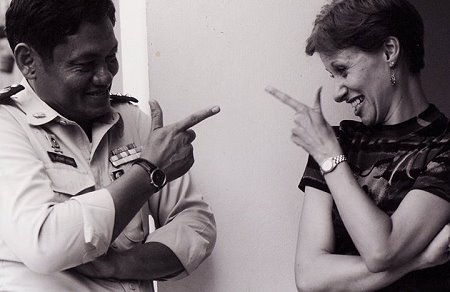
For this date’s entry we turn to The Last Executioner — the memoirs of Chavoret Jaruboon, who was the last prison executioner in Thailand.


Bang. The late (he died in 2012) Chavoret Jaruboon, on the left.

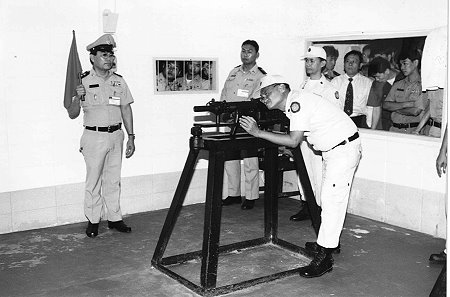
Thailand uses lethal injection today, but our narrator here was the last to conduct executions by that country’s previous execution method, a unique shooting arrangement that prevailed through 2002.*

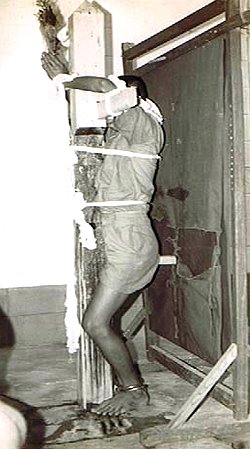
The prisoner to be executed was tied to a wooden cross, hands pinned in a prayerful position (wai), and facing a wall; behind him (or occasionally, as in today’s post, her), a screen; behind the screen, Chavoret Jaruboon with a mounted automatic rifle that would discharge a burst of up to 15 bullets into the vicinity of the heart, generally terminating life immediately.

The clientele this date were three members of a kidnap gang. Ginggaew Lorsoungnern, a former domestic for a Pathumwan, Bangkok family, had picked up from school the six-year-old child who was her former charge and delivered her to a bunch of toughs. When the ransom delivery went awry — the parents were supposed to toss the money out of a moving train at the spot of a flag, but missed the flag owing to darkness — the enraged kidnappers stabbed the little boy to death. Ginggaew allegedly flung herself over the child in a vain effort to protect him.

Inasmuch as her inside position was the lynchpin for the whole operation, however, these hystrionics would not save her from reprisal. (It wasn’t quite judicial reprisal since the execution was carried out by executive decree: not uncommon in dictatorial 1970s Thailand.) It probably didn’t help that coroners discovered soil in the victim’s lungs … meaning that when they’d dumped his body into its grave, he wasn’t yet dead.

The case was a media sensation. The late executioner’s 21st century book (copyright date: 2006) says that he was even then still “constantly asked about Ginggaew.” For what it’s worth, he thought the sentence was too harsh for her part in the crime. But executioners don’t get to make these decisions.

Ginggaew was the first woman shot in Thailand since 1942, and the first that Chavoret Jaruboon ever saw executed. In his time, he shot three women; Ginggaew is not among their number because in 1979, he was only a member of the execution team, not the man with his finger on the trigger. He was an “escort”, part of the team that brought the doomed from their cell to the execution chamber and then removed the corpse.

Escort duty was “one of the most emotional roles in the whole process of execution,” he writes. “Even the executioner does not have to see the body after he has done his job.”

And on January 13, 1979, the day Ginggaew died followed by two of her collaborators, the escorts had especially unpleasant duty.

While the men died stoic, Ginggaew was frantic, and fainted repeatedly over the hours before execution. “I didn’t do it, I didn’t kill the boy,” she pleaded. “Please don’t kill me, I didn’t kill him.”

Worse was to come.

At 5pm Ginggaew was selected to be brought to the execution room first. The escorts helped her to her feet but she immediately crumpled to the ground. She sobbed that she felt too weak to stand … As she approached the room she had to be revived from another faint.

I found this very difficult to deal with. Between us [escorts on the execution team] we finally got the stricken woman to the cross. She cried while they bound her at the waist, shoulders, and elbows. Her arms were brought up over the beam in a position of prayer. Still, she struggled and tried vainly to break free. The escorts pulled across the screen and fixed it so that the white square indicated where her heart was. Then they stepped out of range. I walked to the gun to load it and aim it at the target on the screen. I was aware that Ginggaew was still struggling. Normally once the prisoner was fixed to the cross they gave up fighting, but this was not the case with her. I secured the gun over her stifled sobs, locking it into position. When I was satisfied, I nodded at Prathom to take over. He took his position and at 5.40pm exactly he released ten bullets into Ginggaew’s body.

Doctor Porngul went up to her and checked for the pulse and retina response. As expected, he confirmed her dead. The escorts quickly untied her body, which was bleeding profusely from the chest, and laid her face down on the floor. She jerked and twitched a little. This wasn’t out of the ordinary but was distressing to witness. Her chest burst open and the blood looked like it would never stop flowing. They carried her into the morgue, the tiny room that we used just off the execution hall. I followed them just to make sure everything was alright. They placed her gently on the bed and we went out to prepare for the next one. What happened then will never leave me.

As the second prisoner, Gasem, was brought into the execution room, there was a sound from the morgue. I could see everything from where I was standing as the door was wide open — Ginggaew was trying to get up. The shocked escorts and I ran back to her. There was blood everywhere. One of the escorts rolled her over and pressed down on her back to accelerate the bleeding and help her die. Another escort, a real hard man, tried to strangle her to finish her off but I swept his arms away in disgust. We stood there watching her gasp for breath for I don’t know how long, but it could only have been a minute or two. I was filled with pity for her. I couldn’t help thinking that she was dying the way that little boy had died — except suffocating from blood instead of earth.

Meanwhile, Gasem had been shot. He died instantly from ten bullets. He had not resisted his death in any way, and spoke to nobody on the way to the cross. After the doctor confirmed that Gasem was definitely dead he checked on Ginggaew. Amazingly she was still breathing. It was a horrible, horrible situation. He told the escorts to put her back on the cross. The men complied, somewhat relieved to be able to just follow orders. It was a grim, nauseating job and they were covered in her blood when they turned to pull the screen across. This time the full quota of 15 bullets were used, and finally, she was dead.

You might wonder why we didn’t just shoot her where she lay, but it would have been against the regulations. Also, I don’t know that any of us could have stood so close to the young girl and pulled the trigger. As it was, the escorts moved as quickly as possible, each of us was concerned that her suffering should not be prolonged.

Pin had had to wait outside for ten minutes until Ginggaew was carried to the morgue for the second time. He was then brought in and tied to the cross. At 6.05pm Prathom pulled the trigger, sending 13 bullets into his back. The doctor went to check on him and discovered that he too was still alive, only just, but still breathing all the same. I loaded the gun again and Prathom shot a further ten bullets, this time killing him instantly. We were all in need of more than one stiff drink that evening.

…

There are a couple of reasons why Ginggaew had such a terrible death. Firstly her heart wasn’t on the left side as with most people. She most probably had Kartagener’s Syndrome, which is when a person is born with their heart on the right-hand side instead of the left. And even if it was she wasn’t secured firmly enough to the cross so she was able to move around, therefore the bullets would miss their target. It showed the importance of binding the prisoner as tightly as possible, for their own sake. I had my doubts when she was first pronounced dead. I thought I could detect some strain in her neck, and maybe that’s why I followed the escorts to the morgue. The head should normally flop backwards with the cross being the only support for the limp body.


Ginggaew, Gasem, Pin, and all others who were executed by shooting entered the execution building through this red door … now disused and overgrown since Thailand scrapped shooting. Pic from this Norwegian Amnesty International page.

After Thailand switched to lethal injection, Chavoret Jaruboon retired to a monastery. His books show no disquiet about his career. He explicitly supported the death penalty.

“What I do is empty this story (the executions) from my mind. If I don’t do that I don’t know what (the executions) will do to me.”

-Chavoret Jaruboon

* We’ve previously written about a 2001 execution by gunfire in Thailand.

On this day..

1951: Harley LaMarr, dutiful son

On February 12, 1950, Buffalo socialite Marion Little Frisbee* was discovered in a frozen ditch in a suburb 12 miles outside the city, a .32-20 rifle bullet through her left temple.

Within 24 hours, a 19-year-old Native American** youth named Harley LaMarr had been caught at a boarding-house and copped to the crime.

While the coroner did report an “attempt at criminal assault,” the motive for Frisbee’s abduction/murder had been robbery. Harley LaMarr needed money because his mother, Amelia Palwodzinski, had had a fight with her second husband the month before. In the course of that fight, she planted a butcher’s knife in the man’s chest.

As Amelia went off to serve a 30-year stretch for manslaughter, she made her boy Harley promise to give the victim a decent burial. Harley had no money: he did have a .32-20. He took it to a tony part of town and waited for an opportunity.

Marion Frisbee’s purse netted him about $6. He didn’t bother taking her diamond ring because, he said, he just wanted cash for the funeral. Harley insisted the gun went off by accident: the jury in a four-day trial that April didn’t buy it.

The day before Harley LaMarr’s electrocution at Sing Sing on January 11, 1951, the Empire State’s prison officers brought his mother from Bedford Hills a few miles down the road to death row for one last goodbye with her tragically dutiful son.

The youth met with his mother for 20 minutes after authorities brought her from Bedford Hills.

They spoke together in low tones. The woman took a long last look at her son and walked away from the visiting cage dry-eyed.

“Thank you for coming, ma,” the youth called after her. (Source (pdf))

* No relation to the flying-disc fortune; that “Frisbee” was only trademarked in 1958. Marion Frisbee was just the wife of a local salesman with the Queen City Pure Water Company.

** Amelia was white; Harley’s father was Native American.

On this day..

1946: Franz Strasser

On this date in 1946, former Nazi Kreisleiter Franz Strasser was hanged at Landsberg Prison for war crimes.

Strasser was condemned for shooting five downed American airmen in Czechoslovakia in December 1944, an American tribunal dismissing the defense: “There is not a scintilla of evidence to support STRASSER’s contention that he shot the prisoners to prevent their escape.” (A pdf scan of the entire verdict is here.)

On this day..

1987: Seven Suriname Maroons

This New Year’s Eve, we pay a visit to a notorious atrocity* 25 years ago today during Suriname’s Guerrilla War (Binnenlandse Oorlog).

The full judgment of the Inter-American Court of Human Rights on this matter is available in pdf form here. (There’s more analysis of the reparations awarded by the court in the August 1995 Human Rights Quarterly.)

Inter-American Court of Human Rights
Case of Aloeboetoe et al. v. Suriname
Judgment of September 10, 1993

…

1. The instant case was brought to the Inter-American Court of Human Rights (hereinafter “the Court”) by the Commission on August 27, 1990 … the Commission asserted that “the Government of Suriname violated Articles 1, 2, 4(1), 5(1), 5(2), 7(1), 7(2), 7(3), 25(1) and 25(2) of the American Convention on Human Rights” …

2. … The events that gave rise to the petition apparently occurred on December 31, 1987, in Atjoni (village of Pokigron, District of Sipaliwini) and in Tjongalangapassi, District of Brokopondo. In Atjoni, more than 20 male, unarmed Bushnegroes (Maroons) had been attacked, abused and beaten with riflebutts by a group of soldiers. A number of them had been wounded with bayonets and knives and were detained on suspicion of belonging to the Jungle Commando, a subversive group. Some 50 persons witnessed these occurrences.

3. According to the petition, the Maroons all denied that they were members of the Jungle Commando. The Captain of the village of Gujaba made a point of informing the commander in charge of the soldiers that the persons in question were civilians from various different villages. The commander disregarded this information.

4. The petition asserts that the soldiers allowed some of the Maroons to continue on their way, but that seven of them, including a 15-year old boy, were dragged, blindfolded, into a military vehicle and taken through Tjongalangapassi in the direction of Paramaribo. The names of the persons taken by the soldiers, their place and date of birth, insofar as is known, are as follows: Daison Aloeboetoe, of Gujaba, born June 7, 1960; Dedemanu Aloeboetoe, of Gujaba; Mikuwendje Aloeboetoe, of Gujaba, born February 4, 1973; John Amoida, of Asindonhopo (resident of Gujaba); Richenel Voola, alias Aside or Ameikanbuka, of Grantatai (found alive); Martin Indisie Banai, of Gujaba, born June 3, 1955; and, Beri Tiopo, of Gujaba (cf. infra, paras. 65 and 66).

5. The petition goes on to state that the vehicle stopped when it came to Kilometer 30. The soldiers ordered the victims to get out or forcibly dragged them out of the vehicle. They were given a spade and ordered to start digging. Aside [Richenel Voola] was injured while trying to escape, but was not followed. The other six Maroons were killed.

6. The petition states that on Saturday, January 2, 1988, a number of men from Gujaba and Grantatai set out for Paramaribo to seek information on the seven victims from the authorities. They called on the Coordinator of the Interior at Volksmobilisatie and on the Military Police at Fort Zeeland, where they tried to see the Head of S-2. Without obtaining any information regarding the whereabouts of the victims, they returned to Tjongalangapassi on Monday, January 4. At Kilometer 30 they came across Aside, who was seriously wounded and in critical condition, and the bodies of the other victims. Aside, who had a bullet in his right thigh, pointed out that he was the sole survivor of the massacre, the victims of which had already been partially devoured by vultures. Aside’s wound was infested with maggots and his right shoulder blade bore an X-shaped cut. The group returned to Paramaribo with the information. After 24 hours of negotiations with the authorities, the representative of the International Red Cross obtained permission to evacuate Mr. Aside. He was admitted to the Academic Hospital of Paramaribo on January 6, 1988, but died despite the care provided. The Military Police prevented his relatives from visiting him in the hospital. It was not until January 6, that the next of kin of the other victims were granted permission to bury them.

* But scarcely the only atrocity among Maroons during those years.

On this day..

1934: Leonid Nikolaev, Kirov’s assassin

On this date in 1934, Leonid Nikolaev was convicted and (an hour later) shot for the murder of Leningrad communist leader Sergei Kirov.

Nikolaev was a disaffected young man who’d come of age during the Revolution and latterly been expelled from the Party for his bad attitude. He took his frustration out on December 1, 1934, when he stalked into the (suspiciously unguarded) office of Kirov and shot him dead.

The victim was much the more consequential figure in this transaction — both in life, and in death. Kirov’s murder would stand as a Reichstag fire moment unleashing the darkest years of Stalinist purges.

Kirov was an old Bolshevik agitator from way back. Widely respected, he’d been the party boss of Leningrad for nearly a decade, and a few months before his murder was overwhelmingly elected to the Communist Party’s Central Committee at the party Congress.

He was also, perhaps, seen by anti-Stalin factions within the party as a potential pole of resistance to Stalin* — though his weight as an “opposition” figure has also grown with the hindsight knowledge of what came next.

Kirov’s assassination was a double gift to the Kremlin, for not only did it remove the impediment himself, it licensed a furious security crackdown against the “terrorists” who orchestrated it. Said terrorists conveniently turned out to be dozens upon dozens (and indirectly, thousands upon thousands) of officials whom Stalin found convenient to destroy. “Kirov was killed in Leningrad,” Bukharin remarked upon hearing the news. “Now Koba [Stalin] will shoot us all.”

Within weeks of the murder, the exiled Trotsky was coming to the same conclusion, and charged that the Kirov investigation’s purposes was

to terrorize completely all critics and oppositionists, and this time not by expulsion from the party, nor by depriving them of their daily bread, nor even by imprisonment or exile, but by the firing squad. To the terrorist act of Nikolaev, Stalin replies by redoubling the terror against the party.

Stalin personally oversaw the investigation, even personally interrogated Nikolaev. And no surprise: the investigation’s casualties multiplied with alacrity.

The first commissar who made it to the murder scene “fell out of a truck” the very next day. Nikolaev’s mother, wife, siblings, and other associates were all disappeared and executed. 104 prisoners already under lock and key at the time of Kirov’s murder were judged guilty of conspiring with the assassin and shot out of hand. (Source)

In January 1935, Stalin had his long-neutered old rivals Zinoviev and Kamenev** preposterously convicted for “moral responsibility” for Kirov’s murder. Though they weren’t death-sentenced directly for this “responsibility” their condemnation set them up for their fatal show trial the following year. (Which included public confessions of involvement in the Kirov affair.) Guilt in Kirov’s death would be routinely bolted onto the show trials of political opponents for the remainder of the 1930s.

Stalin mined this terrorism panic so nakedly and purged so widely that the belief that Stalin himself ordered Kirov’s murder has long predominated. This theory of Stalin’s master orchestration also happened to be very convenient (pdf) for the post-Stalin party; Khrushchev directly hinted at his predecessor’s complicity in the secret speech.

That theory remains highly contestable. Matthew Lenoe in particular has vigorously disputed the idea that Stalin ordered everything in his acclaimed The Kirov Murder and Soviet History; there’s an informative Q&A with Lenoe on the invaluable Sean’s Russia Blog here, and a podcast interview on the New Books Network here. For a bit of background on Lenoe’s research, click here.

* Foreshadowing the unwelcome independence Leningraders enjoyed post-World War II … until Stalin smashed it.

** Nikolaev, the disaffected party member, was a Leningrader himself. That meant that when he was still in the party, it was in Zinoviev’s Leningrad party, since that city happened to be Zinoviev’s base and stomping-ground. And that meant that he must ipso facto have been part of the “Zinovievite Opposition”.

On this day..

1942: Fernand Bonnier de La Chapelle, Darlan’s assassin

On this date in 1942, just two days after he had assassinated Admiral Francois Darlan, Fernand Bonnier de La Chapelle was shot by the Vichy army in Algiers.

Despite its shorthand reputation as a Nazi puppet, Vichy France — especially in 1940-42 — was a more nuanced animal that’s enjoyed increased study of late. Vichy controlled southern France under the obvious pressure of the next-door German occupation and effected state collaboration with Berlin including deportations, but it also maintained diplomatic relations with the U.S. Vichy France even shot German spies.

Vichy was one contender among several for political legitimacy in the aftermath of France’s disastrous 1940 defeat at German hands. The most obvious (and here, topical) rival was de Gaulle’s Free French.


Appropriately, the classic film Casablanca premiered in November 1942, featuring Claude Rains as the unprincipled Vichy Captain Renault. The film’s pro-Free French, anti-Vichy slant was not, however, representative of American foreign policy at the time.

This was the background when, in 1942, the US spearheaded Operation Torch to invade Vichy-controlled French North Africa. “This is not the end,” Churchill epigrammed of the Torch landings. “It is not even the beginning of the end. But it is, perhaps, the end of the beginning.”* (Correction: Churchill actually said this in reference to the November 1942 Battle of El Alamein, as a very gracious comment observes.)

At the time of that operation, Admiral Darlan happened to be in Algiers. He was the former number two man in the Vichy government, but also a guy whose cooperation with the Nazis had been half-hearted … which is the reason he was the former number two man.

Darlan nevertheless remained the chief of the Vichy armed forces, which meant that it was worth the Torch commanders’ while to come to an arrangement with him when Darlan proved amenable to cooperation.

They cut that deal. Darlan shut down armed resistance and took Vichy North Africa over to the Allies’ side. (He had, indeed, hinted previously to American diplomats that he was prepared to switch sides; see Arthur Funk, “Negotiating the ‘Deal with Darlan'” in Journal of Contemporary History, April 1973.) In exchange, the Allies installed him as High Commissioner of France for North and West Africa — big man on campus for French North Africa.

Like all good compromises, it satisfied nobody.

De Gaulle was enraged: a Vichy official remained in charge of a Vichy state now under Allied auspices. Would Allied recognition set Darlan up to direct France’s postwar direction?

Equally pissed by the defection, Hitler triggered the German contingency plan to occupy Vichy France.† This is why the “especially in 1940-1942” proviso above: after Operation Torch, Vichy France had no independent military muscle, and was significantly more beholden to Nazi Germany.

Back in North Africa, we finally come to our date’s principal.

A 20-year-old student of monarchist and anti-fascist political proclivities, Fernand Bonnier de La Chapelle (English Wikipedia entry | French) decided with a couple of friends to cut the Gordian political knot that Darlan’s adoption had created.

Bonnier de La Chapelle drew the short straw (literally, they drew straws) for the privilege/responsibility of murdering the Vichy admiral.

Officially, the young man acted alone. Unofficially, there’s been no end of speculation as to the secret intrigues at work. Nobody’s really clear on exactly how murdering Darlan was supposed to advance the gunman’s supposed agenda. And the Vichy French disposed of the killer with suspicious haste.

Just after lunch on December 24, Fernand Bonnier de La Chapelle surprised Darlan upon the latter’s return to his study and shot him through the mouth and torso at point-blank range. He was arrested attempting to flee.

The very next evening, he was condemned by a tribunal at Algiers. There was already a coffin on order before that body gaveled into session.

For some reason, the condemned thought his perceived service to the nation would out. “They will not shoot me. I have liberated France,” he assured his confessor. “The bullets will be blank cartridges.” They weren’t. Churchill recorded that Bonnier de La Chapelle was “surprised to be shot.”

Darlan was laid to rest later that morning at a dry-eyed requiem service. One British intelligence officer remembered that Darlan’s “murder fell like a stone into a small pond and the ripples were only brief. It was as if Darlan had never been.” (Source for the quotes in the last two paragraphs)

Henri Giraud, a French general who escaped German custody and took refuge in Vichy France — Vichy refusing to return him to the Germans, who openly intended to kill him — succeeded Darlan’s command of the now-Allied-aligned French North African forces and maintained the objectionable Vichy institutions. He joined the Allied Casablanca Conference a few weeks later. Giraud had already secretly arranged with the Allies to take exactly this position and had repaired to North Africa in anticipation of the invasion before being aced out by Darlan.

Giraud’s Vichy North African government gradually increased cooperation with de Gaulle’s Free French; the two eventually co-founded the French Committee of National Liberation, which de Gaulle, of course, eventually took control of.

In 1945, a postwar appeals court posthumously reversed Bonnier de La Chapelle’s conviction — on the grounds that he’d pulled the trigger “in the interest of liberation of France.”

* Stalin, whose Red Army was then fighting the Wehrmacht tooth and claw at Stalingrad, begged to differ. He’d been imploring the western allies to open a second front, and was none too impressed with their calculation that they weren’t ready to invade continental Europe in 1942. “A man who was not prepared to take risks could not win a war,” Stalin griped to Churchill.

** One knock-on effect of Operation Torch: the Germans reinforced North Africa against the Allies’ imminent push. It was in this campaign that future Hitler almost-assassin Claus von Stauffenberg lost a hand and an eye, leading to his transfer back to the Berlin desk job that would give him his opportunity to try to kill the Fuhrer.

† This resulted in Vichy France’s gesture of resistance, scuttling the Toulon fleet to keep it out of German hands … although this also irritated de Gaulle, who wanted the fleet to defect to North Africa instead.

On this day..