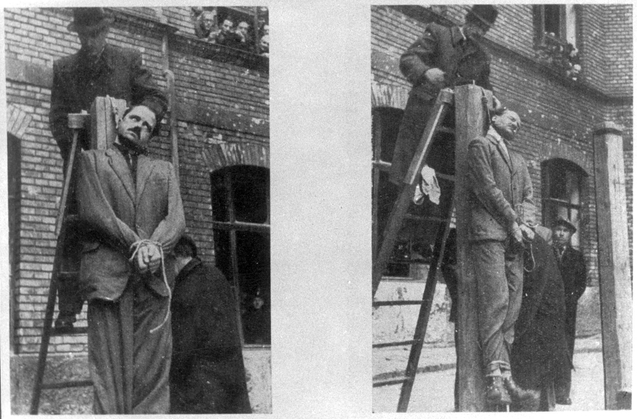
On this date in 1961, Czechoslovakian maternity ward nurse Marie Fikackova was hanged at Prague’s Pankrac Prison for murdering newborns in her care.
Fickakova, nee Schmidlova, was a well-liked 24-year-old with a failed marriage already at her back when she was arrested in February 1960 after two infants died of brain injuries the same night during her shift at the Sušice hospital.
Under lengthy interrogation, Fikackova finally confessed to having developed the habit of relieving the agitation of her menses (her story, not mine!) by permanently silencing newborns who bawled too much. We all have our personality quirks, but if hers was “homicidally enraged by crying babies” then it’s safe to say she was in the wrong line of work.
“When I was pressing little Prosserová’s head, I could feel my fingers sinking into it,” she described. “I did not feel any skull cracking at that time. I was just pressing the little head and my fingers got deeper and deeper. My anger faded away after a while and I could continue working.”
Fikackova proceeded to cop to ten-plus additional therapeutic attacks on children, but police had a very difficult time substantiating them relative to documented injuries and the nurses’ shift calendar. In the end, the courts hung her with the original two.
We have seen, in these pages, better-balanced subjects issue more outlandish auto-denunciations under less police pressure, so while we’re in no position to assert anything with certainty, we’re inclined to take the absence of corroborating evidence from an institution that ought to have plenty of it for the asking to suggest the strong possibility that Fikackova’s confessions tended to the fantastical.
Nevertheless, the public has been inclined to take the woman at her claim of double-digit homicides, and magnified Fikackova into a legendary mass murderer and the authoress of every neonatal abnormality in town. Even now she’s sometimes mentioned as Czechoslovakia’s most prolific serial killer, or blamed for the infirmities of any and all folks born in late-Fifties Sušice. (Both links in this paragraph are in Czech.)
For this staged demonstration of her baby-slaying technique, authorities even let Marie Fikackova put on the nurse outfit. (Source of the images)
The appeals court that considered his case found it “perfectly clear that Leonard killed the victim in an attempt to perpetrate a robbery or a rape,” during a heist committed jointly with Leonard’s older brother.
On that basis, young Shockley achieved the distinction of being the second-last person ever put to death for a crime committed as a 16-year-old. For a very long while, it really looked like he might be the last, but Oklahoma’s 1999 execution of Sean Sellers usurped the claim.
While it makes little ethical difference, from the standpoint of attributing criminal culpability, whether a 16-year-old offender is executed promptly at age 16 or held for a lifetime in prison and executed in his eighties, Shockley may also be the last human put to death on American soil before he had attained his own majority. Shockley’s birthdate invariably reports as “1941 or 1942”,* and in the absence of the sort of primary research a blogger is naturally loath to conduct, we’re left with conflicting sources on the subject.
The Washington Post‘s headline the following day annonced, “Slayer, 18, Dies In Gas Chamber”. (Surmounting the text of the perfunctory Associated Press story it ran.)
Whereas the Baltimore Sun reported, “Youth, 17 Dies in Gas Chamber: Shockley Executed for Slaying of Shore Mother”. (Alas, no screenshot: it’s cited by Victor Streib, an anti-death penalty academic.)
So it’s not completely clear whether Shockley enjoys this particular claim to fame. Well, not enjoy it exactly. Of course not that. And poor Sarah Hearne didn’t enjoy being slashed to death; this is also understood. Let’s just say, a sad affair and a minor milestone, and leave it at that.
* The crime was in January 1958, 15 months before the execution. It’s simple enough to work out when Shockley’s birthday would have to fall for the various scenarios.
On this date in 1945, in the dying days of the Third Reich, 42-year-old Johann Georg Elser was executed by gunshot in the German concentration camp Dachau. He died for a failed attempt on Adolf Hitler’s life more than five years before.
It goes without saying that, had he been successful, he would have changed history immeasurably.
Elser, who went by his middle name, didn’t fit the profile of someone who would try to kill Hitler.
He wasn’t a Jew, a Communist or a member of any of the other minority groups the Nazis persecuted. He wasn’t political at all, in fact.
A carpenter by trade, with one illegitimate son, his hobbies included playing the zither and the double bass.
He was the kind of ordinary, working-class German the National Socialists tried to reach out to. But from the very start, he made it clear how much he despised them and all that they stood for.
He was a practical man at heart and was not interested in political discussions. He had no desire to change other people’s minds, but he steadfastly refused to make any accommodation to the new regime. When Hitler’s speeches were broadcast, he would silently leave the room… In May 1938, a Nazi parade threaded its way through his hometown of Königsbronn. Elser, like many others, turned out to watch, but as those around him gave the Hitler salute, he refused to do likewise. When a colleague reminded him that it might be sensible to conform, he replied curtly, “You can kiss my ass.” He then ostentatiously turned about and started whistling to himself.
How Elser’s silent, passive resistance turned into action is unclear, but by the autumn of 1938 he had made up his mind to kill the Führer.
Unsure how to accomplish this, he traveled to Munich to get some ideas. Every year on “Die Neunte Elfte”, the November 8-9 anniversary of the Beer Hall Putsch, Hitler came to the Bürgerbräukeller and gave a speech to the old guard.
That day in 1938, actually just hours before another would-be assassin tried to kill Hitler, Elser slipped into the beer hall pretending to be an ordinary customer and “noted the layout of the room, the position of the lectern and the patent lack of effective security measures.”
He had found his place and his time: he decided that the following year, he would plant a bomb in the Bürgerbräukeller, timed to go off right in the middle of Hitler’s big anniversary speech and kill him and as many Nazis as possble.
Elser’s meticulous planning and preparations over the next twelve months were nothing short of amazing. He stole a fuse and some gunpowder, and got a job at a quarry specifically so he could acquire some explosives. Knowing nothing about bombs, he made countless prototypes and tested them in empty fields in the countryside.
In the spring of 1939, he went back to Munich and the Bürgerbräukeller to make some detailed sketches of the building and find an appropriate place to hide the bomb. He chose a thick stone pillar behind the lectern, which supported a balcony. In August, he brought his tools and bomb-making materals to Munich to set about with his final phase of the plan.
The fastidious assassin’s modus operandi was shockingly simple, and shockingly bold.
He would visit the Bürgerbräukeller every night at around 9:00 to take his evening meal. An hour or so later, he would sneak up to the gallery of the function room, where he would hide in a storeroom until the bar closed and the building was locked.
Thereafter, he was free to work by flashlight until the bar staff returned at around 7:30 a.m., when he could sneak out of a back entrance.
His first priority was to chip out a cavity in the stone pillar to hold the bomb. But, finding the pillar was now dressed with wooden cladding, Elser was forced to spend three nights sawing a hole in the wooden surround.
Every sound had to be muffled, every speck of sawdust collected and disposed of: he could afford to leave no evidence of his presence. Even the sawn wooden panel was fashioned into a flush-fitting secret door.
Good thing he was a carpenter.
Having accessed the pillar, he could now begin to dig out a recess for the bomb. Using a hand drill and a hammer and chisel, he spent most of the following month loosening mortar and prising out bricks — all of which, of course, had to be meticulously tied and removed from the scene in a cloth sack.
Progress was painfully slow.
In the cavernous hall, every hammer blow he struck echoed like a gunshot, and to escape detection he had to time his blows to coincide with external sounds, such as the passing of a tram or the automatic flush of toilets. Working by night preparing the pillar in the Bürgerbräukeller, he labored by day putting the finishing touches to his bomb and, of course, the elaborate timing mechanism.
It all took two months.
On November 2, six days before the Big Day, Elser finally concealed his bomb, which had been put in a wooden box lined with cork to muffle the ticking sound of the timing mechanism, in its hidey-hole. Hitler’s speech was scheduled to start at 9:00 p.m. on November 8 and would last for an hour. The bomb was set to go off at 9:20.
It did so, right on time, with a spectacular explosion that smashed the stone pillar, brought down the overhead balcony and ceiling, shattered windows, blasted out doors, killed eight people and injured 67 more.
The only problem was, Hitler wasn’t among the dead or wounded. In fact, he wasn’t even there.
He had pressing business in Berlin and wanted to get back that same night, so he had rescheduled his speech for 8:00 p.m. instead of nine. He finished and left the building at 9:07, thirteen minutes before the big reception Elser had prepared for him. By the time the bomb went off, Hitler was already on the train back to Berlin.
That Elser failed was through no fault of his own: it was just sheer, terrible, rotten luck.
British Prime Minister Benjamin Disraeli once said, “Assassination has never changed the history of the world.” Perhaps he is right in most cases, but it’s hard to believe that statement is true when it comes to Hitler. In this case, thirteen minutes substantially altered the history of Europe for the rest of the century.
Getting back to Elser: ever the careful planner, he knew what to do to protect himself once the bomb went off. He was miles away from Munich at the time, trying to sneak over the border into Switzerland. Unfortunately, he was caught by German border guards.
At first they thought it was a routine arrest, but then they saw the contents of his pockets, which included a postcard of the Bürgerbräukeller and sketches of his bomb design. The guards didn’t yet know about the assassination attempt, of course, but what they saw made them suspicious and they turned him over to the Gestapo.
On November 13, Elser confessed everything. When a flabbergasted Hitler read the preliminary investigative report which supported Elser’s lone-bomber story, he demanded, “What idiot conducted this investigation?”
He couldn’t wrap his mind around it, and neither could anyone else.
In the wake of the assassination, mass arrests were made: anyone who seemed unusually interested in the Munich speech, or didn’t express sufficient enthusiasm for the Nazi Party, could fall under suspicion of being part of the plot.
At Munich’s Feldherrnhalle on Nov. 11, Hitler conducts a memorial ceremony for the victims of Elser’s assassination bid.
As Moorhouse explains,
To many Nazis, Elser was simply an enigma. He was an ordinary German. He exhibited none of the typical signs of “degeneracy” that they claimed to be combating: apart from his brief flirtation with Communism, he was a virtual teetotaler, not promiscuous, did not consort with Jews, and was not close to the Church. In fact, he was exactly the sort of solid, upstanding, working-class German that they thought they had won over — and, indeed, that had become the backbone of the Nazi Party.
Unable to believe Elser’s claims of full responsibility, the Nazis concluded he must have been “led astray” at the very least, perhaps by agents of British intelligence. In spite of beatings, torture, and other coercion, however, Elser stuck to his story, even building another bomb, identical to the first, right in front of his interrogators to prove he could do it by himself.
He never managed to fully convince them; in fact, for decades after the war, historians and other scholars theorized about who else was in on his plan. Some speculated that the attack was even engineered by Hitler himself, to gain support for his cause and to create an excuse to crack down on dissidents.
It wasn’t until 1970 that two German historians who studied the matter announced there was no evidence that Elser had acted in concert with anyone else or even told anyone about his plans.
It may seem surprising that Elser managed to live for four and a half years after his attempt on Hitler’s life, but there was a explanation perfectly reasonable from the standpoint of a totalitarian bureaucracy.
After his confession, Elser was sent to the the Sachsenhausen Concentration Camp. He was given enough to eat, and two rooms, and even allowed to play the zither again, but he was kept in solitary confinement all those years. The Nazis — still operating on the theory that the British were ultimately behind the assassination attempt — stashed Elser away as a witness in a show trial against British leaders after the German invasion of the British Isles. Talk about hubris.
Of course, this invasion never happened, and as the tide of war turned against the Germans it became clear that Elser had outlived whatever usefulness he might have had. In February 1945, he was transferred from Sachsenhausen to Dachau.
He met his end quietly, taken outside his cell by a young SS officer and shot in the back of the neck. A week later, it was reported that he had been killed in an Allied bombing. By the end of the month, Dachau was in Allied hands.
At least six cities in Germany, including Königsbronn and Stuttgart, have places named after him, or monuments or plaques erected in his memory.
On this date in 1903, the wife-poisoner George Chapman was hanged at Wandsworth Prison in the United Kingdom.
He had at least three deaths on his record … and, if you fancy, possibly quite a few more.
Chapman was born Severin Antoniovich Klosowski in the village of Nargornak, Poland on December 14, 1865, the son of a carpenter. At the age of fifteen he was apprenticed to a surgeon, and five years later he ended his medical studies in Warsaw. Just how much medical training he actually had is hard to determine, but the fact is that after he moved to the UK in 1887 or 1888, he worked not in the medical field but as a hairdresser’s assistant and later in his own barbershop.
In 1890, Chapman (still going by his birth name) married Lucy Baderski, having conveniently forgotten all about the wife he’d left back in Poland. His Polish wife found out about Lucy, however, and went to Britain to settle things. Bizarrely, for a short time the three of them all lived together, before Klosowski’s first wife threw up her hands and returned to Poland.
Klosowski’s relationship with Lucy Baderski was very troubled, and Klosowski was abusive. In one incident, he attacked her with a knife and threatened to cut her head off. Lucy was saved only because a customer suddenly came into the barbershop and Klosowski had to tend to him.
In 1892 she left him, although she was pregnant; they had emigrated to New Jersey by this time, and the beleaguered wife returned to England, where she had his daughter in May of that year.
Klosowski followed her back to England a few weeks later, but they separated for a final time not long afterward.
The following year, Klosowski took up with an Englishwoman named Annie Chapman. This, too, ran aground on Kloslowski’s violence and unfaithfulness, but he left her with daughter (whom he refused to support) and she left him with a surname (probably to assimilate and to escape his previous relationship entanglements).
From here on in, he goes by George Chapman.
Sometime after Annie left him, Chapman took up with Mary Isabella Spink, a woman who lived in the same boardinghouse. She was married and had a son, but her husband had deserted her.
They entered into a false marriage, like Chapman had done before with Lucy, and set up a successful barbershop with “musical shaves.” Mary would play the piano while Chapman did the barbering. For awhile they got a lot of money from the shop, but that didn’t stop Chapman from brutally beating Mary on a regular basis and even trying to strangle her. Eventually their barbershop failed and Chapman became a pub manager, living in the apartment upstairs.
Late in the year in 1897, Mary began suffering nausea and crippling stomach pains. Her husband stayed at her side constantly, tending to her needs and paying for a doctor, but Mary just got worse and worse and wasted to a skeleton. She finally died on Christmas Day. That morning Chapman found her dead, cried a little and went downstairs to open the pub.
The cause of death was listed as phthisis, or pulmonary tuberculosis. A few months later, Chapman sent Mary’s orphaned son to the workhouse.
Chapman needed help with the pub, so he hired Bessie Taylor, a former restaurant manager. What follows is familiar: a love affair, a fake marriage, and domestic violence. Then Bessie became sick, showing the same symptoms Mary Spink had. To avoid curious stares, Chapman moved them into London and leased another pub. Bessie was operated on but her condition didn’t improve.
Like Mary, she died on a holiday: Valentine’s Day in 1901. The cause of death was exhaustion from diarrhea and vomiting, secondary to an intestinal obstruction. Chapman made Bessie’s family pay for the funeral.
In August 1901, he hired the teenage Maud Eliza Marsh for a barmaid. They had another bogus marriage, but Chapman quickly grew tired of her. Maud got sick the same way his previous two wives had. Chapman got a doctor for her and mixed her medication himself. Her parents insisted that she be hospitalized.
Maud showed great improvement there and was released after a few weeks, only to become sick again once back at home with Chapman.
Her father, who had gotten suspicious, called in another doctor for a second opinion, but then Maud died quite suddenly. The doctor insisted on an autopsy, and found 693 milligrams of antimony in her body. The doctor determined that the final dose of poison had been more than 600 milligrams, an enormous amount — evidently Chapman had panicked when he realized Maud’s family suspected him.
Chapman was arrested and charged with murder.
Antimony is an almost perfect poison: odorless, colorless and nearly tasteless. However, it also acts as a preservative. When the authorities exhumed Mary Spink and Bessie Taylor, they saw both bodies were in much better condition than they ought to have been.
Mary had been in the ground five years, but one witness said her face was “perfect” and it looked like she’d been dead for less than a year. Bessie looked positively fresh.
Chapman was convicted of Maud Marsh’s murder in March 1903; the jury deliberated only eleven minutes.
He died without ever admitting his guilt. He never even admitted to being Severin Klosowski, although Lucy Baderski visited him after the trial.
There have been many poisoners, but most of the time the murderer has some tangible gain in mind, such as an inheritance or insurance policy. This doesn’t appear to have been the case with Chapman.
He liked money as much as anyone else, it’s true, and would stoop to crime to get it. (Once he torched his pub for the insurance money, but the police became suspicious when they found out all the furniture had been removed from the premises before the fire started. The insurance company refused to pay, and Chapman had to move, but for some reason he was not prosecuted.)
Still, he really didn’t gain financially from his wives’ deaths. Mary Spink gave him £500, but he let her live for a few years after that. Maud Marsh and Bessie Taylor left him nothing.
Chapman may simply have wanted the women out of the way so he could take up with someone else.
But in that case, he could have chosen better for a quick, clean murder. When a person is given antimony in a single large dose, they usually to expel it by vomiting, and are left relatively unharmed.
The way to murder someone using antimony is give it to them slowly and patiently in small doses over a period of weeks or months. It is a lingering, painful death — but it also taxes the discipline of the poisoner. Chapman wasn’t the slow-and-steady type.
Public interest in Chapman didn’t die with him and remains alive and well, because of the Jack the Ripper case.
This infamous and never-identified killer strangled and mutilated five prostitutes in London’s East End during 1888, and many hobbyists think Chapman and the Ripper may have been the same man.
Frederick George Abberline, who headed the Ripper investigation, had strong suspicions against him, summarized in an interview with the Pall Mall Gazette:
As I say, there are a score of things which make one believe that Chapman is the man; and you must understand that we have never believed all those stories about Jack the Ripper being dead, or that he was a lunatic, or anything of that kind. For instance, the date of the arrival in England coincides with the beginning of the series of murders in Whitechapel; there is a coincidence also in the fact that the murders ceased in London when Chapman went to America, while similar murders began to be perpetrated in America after he landed there.* The fact that he studied medicine and surgery in Russia before he came over here is well established, and it is curious to note that the first series of murders was the work of an expert surgeon, while the recent poisoning cases were proved to be done by a man with more than an elementary knowledge of medicine. The story told by Chapman’s wife of the attempt to murder her with a long knife while in America is not to be ignored.
Chapman was definitely living in London during the time of the Ripper killings, which cannot be said of other suspects such as Frederick Deeming or Michael Ostrog.
Chapman’s youthful medical apprenticeship would seem to supply him with the grisly surgical expertise the Ripper displayed.
Chapman approximately matched witness descriptions of the Whitechapel fiend.
Also, curiously enough, one of the Ripper victims was named Annie Chapman — the same name as his estranged lover.
Perhaps most importantly, Sugden points out, Chapman was not only violent and a misogynist but also a known killer: “There must have been few men, even in late Victorian London, capable of multiple murder. The Ripper was one. Chapman was another.”
Sugden thought Chapman was a much better Ripper candidate than any of the other suspects he discussed in his book, but that didn’t mean he was definitely or even probably the real Ripper: “That Chapman committed crimes of which we have no present knowledge I can well believe. That he was Jack the Ripper is another matter.”
The main problem with the Chapman-Ripper theory is the fact that he poisoned his wives, rather than use some more demonstratively violent method of homicide.
Serial killers’ methods do evolve and adapt, but rarely change that drastically. “To exchange knife for hammer, gun or rope, weapons of violence all, is one thing,” Sugden observes. “To forsake violence in favor of subterfuge, as is alleged of Chapman, is quite another.”
It is for that reason that John Douglas, when he talks about the Ripper murders in his book The Cases That Haunt Us, rules out Chapman as a suspect.
Whether Chapman was Jack the Ripper or not, he certainly was an evil, vicious bastard in his own right.
* This is not strictly accurate. There was one Ripper-type murder, of a prostitute named Carrie Brown, in a New Jersey hotel in 1891. Whether the Ripper actually committed the crime is open to speculation.
“Mr Joseph Hani was hanged for treason in the Burj at 5 a.m. At 8 a.m. 40 families deported.
-Diary of Mrs. Harry Dorman, April 5, 1916*
The unfortunate Joseph Hani — Yusuf al-Hani — was among the worthies of Beirut’s Maronite Christian community to petition the French consulate for western aid in detaching Lebanon from the Ottoman Empire.
With the development of World War I, the French ambassador Francois Georges-Picot abandoned the embassy … without removing or destroying this sort of incriminating correspondence. As a result, the Turks ransacked the embassy and identified several dozen of reproachable loyalty to the Porte to put to death.
May 6 — Martyrs’ Day — honors these victims, but Hani was among the very first of them.
While most of the other Maronite signers were able to fly, Hani stuck around to face the music. A British agent was able to contact the implicated characters in Aley Prison, and received the plaintive answer,
‘Where are the English? Where are the French? Why are we left like this?’
* I believe an ancestor of the current president of the American University of Beirut, Peter Dorman. The source of the diary citation is Nicholas Z. Ajay Jr.’s “Political Intrigue and Suppression in Lebanon during World War I” in International Journal of Middle East Studies, Apr., 1974.
Fifty years ago today, still insisting that he had “a clean conscience,” James Hanratty was hanged at Bedford Prison for the murder of Michael Gregsten and the rape-shooting of his mistress Valerie Storie.
Hanratty, a petty criminal with no history of violence — “I try to live a respectable life, except for my housebreaking” he testified* — fell into a web of questionable circumstantial evidence, plus the (also questionable**) eyewitness identification of the surviving Ms. Storie.
This was a bizarre and shocking crime, and the investigation led back to Hanratty only via a winding, almost accidental trail.
The murder weapon materialized on a bus, wiped clean of fingerprints; later, cartridges to match it materialized at a boarding house, and a confused reconstruction of whose aliases were occupying which rooms there uncertainly suggested Hanratty as a suspect.
The case, checking in at a then-record 21 trial days, featured 70 witnesses battling over inconclusive data points like the doubtful relationship between autobiographical remarks made by the killer and Hanratty’s actual biography, and Hanratty’s want of an apparent motive for an act so foreign to his previous m.o. On the other hand, some witnesses put him in incriminating places, and Hanratty damningly lied about and changed his alibi.
What to do? A jury mired in hours of inconclusive deliberation at one point sent back to the court to clarify the concept of “reasonable doubt.” In the end, it decided its doubts weren’t reasonable enough to spare James Hanratty the noose.
Meanwhile, another suspect from the same boarding-house, Peter Alphon, behaved extremely erratically in the run-up to Hanratty’s hanging, hounded Hanratty’s friend until the latter committed suicide, and then eventually (after the hanging) confessed outright. For Hanratty’s many advocates, Alphon looked an awful lot like reasonable doubt … or more.
This case was long a cause celebre for death penalty foes in the U.K. owing to its evidentiary shakiness; none of the other seven put to death in Great Britain after Hanratty were plausible innocents.
John Lennon and Yoko Ono commiserate with James Hanratty’s parents in 1969. (Photo by Express/Express/Getty Images, via here.)
In 2000, DNA tests conducted on Valerie Storie’s underwear and the handkerchief which wrapped the recovered gun finally offered the prospect of more certain forensic identification than had been available at the time of the trial. Those tests matched (pdf) James Hanratty’s DNA … and nobody else’s.
* Feb. 8, 1962 testimony, as reported in the next day’s London Times.
** Aside from the inherent unreliability eyewitness testimony, Valerie Storie at one point picked an airman stand-in in a lineup; when she later identified Hanratty, it was not by his appearance but by his cockney accent.
On this date in 1911, Joseph Christock — a “loose-jawed, low-browed fellow, a brother to the ox, under the fine-spun skin of the human” — was hanged for murder.
The last person executed in Schuylkill County, Pennsylvania had, a mere five months before, been a hired farmhand … until he drank himself stupid on cider and proceeded to rape the lady of the farm and murder both her and her 65-year-old mother.
The crime was a straightforward one, even if the prisoner was determined to run out the clock making what reads like a rather self-conscious display of bravado. (He wrote his own death-date into his Bible and coolly showed it off to a reporter; he also attempted suicide several times.)
my grandfather, charles reigle was a asst. warden at this time and joesph christock made an astrological drawing the night before the hanging which i possess along with a photo of my grandfather,joesph christock and the warden which i also posses.
I took the liberty of following up this comment, and Mr. Ron Young generously sent me copies of the images below, along with the following explanation.
The one is a photo of my grandfather, Charles Riegle, and the other is a drawing cristock made for my grandmother, Sarah Riegle. They,along with my mother, Dora and i don`t remember how many more of 13 children they had were living in a house right outside of the prison walls. The drawing always intrigued me because it looks astological, but could mean a number of things. My grandfather passed aroung 1938, so a lot of the stories, i heard were at a young age.
We don’t have any special research to add on this occasion, but submit them here with great gratitude to Mr. Young, and in the spirit of the uncanny. These small artifacts, from the doomed flesh of a long-dead murderer via two generations of a warden’s family, across a random meeting on the Internet and thence to points unknown.
On this date in 1946, fascist Hungarian politicians Laszlo Baky and Laszlo Endre were executed by hanging in Budapest for their role in the decimation of Hungarian Jewry.
These two charmers were major figures in Hungary’s horrible final months of World War II.
This occupation lifted the virulent anti-semites Baky and Endre into national power, because along with keeping Hungary in the Axis coalition, the Nazis also forcibly overcame its junior partner’s former reticence about Jewish genocide.
Adolf Eichmann arrived into Nazified Hungary and used our day’s two principals (along with another executed collaborator, Andor Jaross, they’re known as the “deportation trio”) as his instruments. Within months, hundreds of thousands of Hungarian Jews were being shipped to the gas chambers. This period is one of the waypoints of pernicious Nazi race theory, when the collapsing German regime spent military resources urgently needed at the front to organize the mass slaughter of Jews.*
And they had to work fast, because by that next winter the Red Army was seizing Budapest. These enthusiastic fascist operators did not fare well by the postwar government.
* To do justice to the breadth of the human capacity, this is also the time and place where we find Raoul Wallenberg minting lifesaving Swedish passports by the thousands.
On this date in 1947, Hisakazu (or Hisaichi) Tanaka was shot by the Chinese Koumintang for war crimes committed during the Japanese occupation of China.
Captured in Canton at the end of the war, Tanaka was tried by the Allied occupiers for permitting the execution of a downed American airman on April 6, 1945. That unnamed airman had been tried in wartime Japan for targeting civilians during his bombing raid, a judgment that Tanaka’s tribunal vociferously disputed.
Though he drew a hanging sentence for that offense, it was not carried out: instead, the doomed general was handed over to the Chinese nationalists to answer for the depredations of his 23rd army.
No surprise, the outcome there was pretty much the same.
On this date in 1915, “the sentences of the court-martial on a batch of 45 mutineers of the 5th Light Infantry were promulgated in public” — as the Straits Times reported — “and, in the case of 22 who were condemned to death, the sentences were executed on the spot.”
A crowd of fifteen thousand watched the spirited Indian sepoys shot dead for revolting the previous month.
This demoralized 800-strong garrison of Punjabi Muslims — who had, it need hardly be added, a noble history of insurrection to think upon — was already deployed far from home to look after the imperial interests of the London gentry while British lads mustered for bayonet charges in No Man’s Lands.
The last straw for these sepoys was a rumor that they were to be shipped to the European theater and made to turn their weapons against the Turkish sultan, their Muslim coreligionist.*
On February 15, 1915, helpfully covered by the celebratory fireworks of the Chinese New Year, about half the garrison left its barracks, attacked its British officers, and started killing any European they came across. (Many British familes took refuge in jail cells.)
Around 40 died in a few days before a mixed British-French-Russian-Japanese force arrived to crush the revolt. It was just one among a number of insurrectionary outbreaks during the war to rattle Britain’s possessions in Asia and elsewhere.
Punishments meted out this day were not the end of it at all; the court of inquiry sat until May, sentencing several dozen to death and many others to prison terms or penal transportation.
And if the mutiny never really threatened British control of Singapore, the ethnic and religious fissures it exposed in the imperial order have obvious resonances (pdf) for our present day.
In order to distinguish mutineers from peaceable citizens, all Indian residents were required to register and obtain passes. This aroused considerable anger, which was exacerbated by the cavalier attitude of some registration officers, who acted as if all Indians were to blame.
* The Ottomans had also issued a call to jihad with the onset of war, hoping to drive just this sort of wedge among Britain’s colonies.

 Fickakova, nee Schmidlova, was a well-liked 24-year-old with a failed marriage already at her back when she was arrested in February 1960 after two infants died of brain injuries the same night during her shift at the Sušice hospital.


 It goes without saying that, had he been successful, he would have changed history immeasurably.


 Chapman was born Severin Antoniovich Klosowski in the village of Nargornak, Poland on December 14, 1865, the son of a carpenter. At the age of fifteen he was apprenticed to a surgeon, and five years later he ended his medical studies in Warsaw. Just how much medical training he actually had is hard to determine, but the fact is that after he moved to the UK in 1887 or 1888, he worked not in the medical field but as a hairdresser’s assistant and later in his own barbershop.