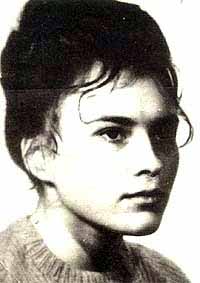
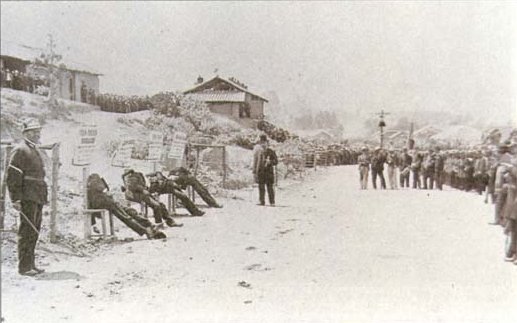
1931: Bhagat Singh

I am full of ambition and hope and of full charm of life. But I can renounce all at the time of need, and that is the real sacrifice. These things can never be hinderance in the way of man, provided he be a man. You will have the practical proof in the near future.

–Bhagat Singh

On this date in 1931,* India revolutionary Bhagat Singh was hanged by the British in Lahore, together with Shivaram Rajguru and Sukhdev Thapar. The hanging was surreptitiously done, on the evening before it was officially scheduled, with the men’s cremated ashes scattered into the nearby Satluj River.


Statue of the three March 23 martyrs near Amritsar, Punjab, close to the Pakistani border. (cc) image from Alicia Nijdam.

Though only 23 years of age when he hanged, Singh’s renown as a nationalist freedom-fighter was already considerable. It has not lessened in the intervening decades.

The teenage Singh had participated in Gandhi‘s nonviolent Non-Cooperation Movement, but violent British suppression of independence demonstrations soon had Singh looking for a more energetic response.

Till that time I was only a romantic revolutionary, just a follower of our leaders. Then came the time to shoulder the whole responsibility. … I began to study in a serious manner. My previous beliefs and convictions underwent a radical change. The romance of militancy dominated our predecessors; now serious ideas ousted this way of thinking. No more mysticism! No more blind faith! Now realism was our mode of thinking.

-Singh, from “Why I am an atheist”

Singh issued his definitive reply to British violence in 1929 by exploding a couple of bombs in the subcontinent’s legislative building.**

“It takes a loud noise to make the deaf hear,” read their leaflet, vindicating the (non-lethal) ordnance.

Singh’s arrest, along with a fellow bomb-tosser, was an intended consequence, but the official pursuit of the case against him also led back to Singh’s fellow-revolutionaries and bomb-manufacturers. Some of these were induced to inculpate Singh, Rajguru, and Thapar to the theretofore-unsolved murder of Lahore policeman John Saunders in December 28.

Saunders had been mistakenly assassinated: Singh et al took him for John Scott, a police superintendent who ordered a baton charge against protesters and personally helped beat to death one of the independence movement’s revered fathers.

While the law wrapped its coils about him, Singh led a successful hunger strike for better prison conditions, and kept churning out writing.

His example of sacrificial revolutionary ardor — not to mention his leftist politics — kept him a popular martyr figure for years after his death, all the way down to the present day.


Climactic execution scene from the 2002 Hindi flm The Legend of Bhagat Singh — one of many different cinematic adaptations of his story.

The Shaheedi Mela (Martyrdom Fair) is observed across Punjab each March 23 in honor of these men.

* Not on Valentine’s Day, as a 2011 Twitter hoax claimed.

** Shades of Auguste Vaillant.

On this day..

1995: Flor Contemplacion, OFW

On this date in 1995, Filipina maid Flor Contemplacion was hanged for murder in Singapore.

Contemplacion had, four years before, strangled a fellow-maid and drowned that maid’s four-year-old charge.

That’s what she confessed to, at least. Even though Contemplacion’s camp would eventually argue that the confession had been coerced, or that she’d been possessed by a strange epileptic, Contemplacion herself never really walked back that admission.

Still, Flor Contemplacion the cause celebre and Flor Contemplacion the cultural phenomenon was never only about the woman’s innocence, even if many do still believe she was framed.

By whatever happenstance of timing and circumstance, widespread publicity of her case in the Philippines during the months leading up to her hanging tapped a national discontent among her countrymen and -women about “OFWs” — overseas Filipino workers.

This economic sector — exported labor — had been intentionally nurtured (pdf) by Manila beginning with a 1974 labor code, and over the ensuing generation ballooned twentyfold into a positively enormous phenomenon.* By the time Flor Contemplacion hanged, everybody in the Philippines knew people who had worked overseas, and whose wage remittances were indispensable (pdf) for supporting their families in the Philippines. (And increasingly, the entire national economy.)


Boom of the overseas Filipino workers sector, 1975 – 2000 (1975 = 1). Source of figures; there are more official OFW stats here.

Ascendance of the OFW industry brought with it the discontents attendant with scattering wholesale quantities of the populace to unfamiliar corners of the globe, many of them to confront the timeless varieties of workplace abuse from positions of special vulnerability: “The dark reality,” one organization says this year, of “low wages, horrid working conditions, little protection for human rights, exploitation, harassment, threats, illegal arrests, imprisonment, criminalization, and deportation.”

To say nothing of the political discontents raised by such a discomfiting abdication of autarky, and the “domestic anxieties” (pdf) of developing “the embarrassing reputation that we are a country of DHs [domestic helpers], entertainers, and even prostitutes.” This is, truly, a rich and complex tapestry.

Flor Contemplacion is practically the patron saint of the indicted Filipino/a abroad, and her fruitless clemency appeal the political breakout of OFWs and their allies as a constituency to reckon with.

The effect was immediate. Contemplacion hadn’t had any great level of consular support early in her criminal process — the time when it might have made the most difference. (The Philippines embassy in Singapore later took considerable heat for this fact.)

But as the story made headlines and some sketchy witnesses accused the victim’s widower husband of being the real perpetrator, the case became a national sensation. Recently-elected president Fidel Ramos, who campaigned on restoring the previously-abolished death penalty in the Philippines, not only had to put on the full-court press for this condemned woman but incongruously declared her a “national hero”; his wife personally received Contemplacion’s remains at the airport. Leaders and ordinary people from Catholics to Communists rallied (sometimes rioted) in anger.

(Singapore was just at this time establishing its own reputation as the place that never gives diplomatically expedient clemencies. Never.)

Whatever the domestic controversies, the labor-export business has only continued to grow in the generation since Contemplacion’s hanging. To this day, the Filipino public has shown great sympathy with OFWs entangled in alien criminal justice systems, and demanded diplomatic support — regardless of particular individuals’ putative guilt.

Regrettably, it is often called to do so: from Saudi Arabia to China, the plight of Filipinos executed abroad remains a recurrent and emotionally charged theme in the country.

Flor Contemplacion’s name, well-known still anywhere in the archipelago, was back in the news last year … when her three sons all drew lifetime prison sentences for drug-smuggling.

On this day..

1956: Jesus Maria de Galindez

(Thanks to Meaghan Good of the Charley Project for the guest post. -ed.)

On this date in 1956 or very shortly thereafter, Jesus Maria de Galindez was probably executed in the Dominican Republic.

Jesus Maria de Galindez

The previous day, he had vanished without a trace from New York City. According to unconfirmed but highly credible accounts, he was killed on orders from — and in the presence of — Dominican dictator Rafael Leonidas Trujillo.

Galindez’s disappearance caused an international incident. It was covered in numerous newspapers and periodicals, including Time and Life, and was the subject of much speculation and many conspiracy theories. In spite of an extensive search, his body has never been found. The case has remained in memory into the 21st century, however, as this 2001 New York Press article demonstrates.

Who was Galindez?

Born in Spain in 1915, he was a political activist, a committed anti-fascist and Basque nationalist. As a result, he ran into trouble with Spain’s dictator, Francisco Franco, and had to run for his life.

In 1939, Galindez set up shop in the Dominican Republic, only to find fascism polluting this country as well. He had to run again in 1946, this time to New York City.

While working on his Ph.D in political science from Columbia University, Galindez found the time to teach college classes, write a newspaper column which was syndicated throughout Latin America, and represent the Basque government-in-exile. He was a busy man.

He was also very afraid, and with good reason. Like most despots, Rafael Trujillo held grudges for a long, long time, and his henchmen kidnapped and/or killed many of his enemies, even those outside the country. One of Galindez’s friends was killed by Trujillo’s agents in Manhattan in 1952.

Galindez then wrote a letter to be opened in the event of his death or disappearance, stating that if he should come to harm, Trujillo was surely behind it.

On March 12, 1956, Galindez taught a class at Columbia and a student gave him a lift to the subway. This was the last time he was seen alive. When he was reported missing five days later, all his belongings were found undisturbed in his apartment. The FBI and the New York Police Department searched for him without result.

According to an investigation by Life magazine, which published its conclusions in 1957, Trujillo’s agents forcibly abducted Galindez on March 12, drugged him and bundled him aboard a small private plane piloted by an American, Gerald Murphy.

Early in the morning on March 13, Murphy stopped in Miami for fuel, then continued southward, stopping at Monte Cristi in the Dominican Republic. From there another pilot, Octavio de la Maza, took over. De la Maza was a tough character who had already committed one murder, in England. He flew Galindez to Ciudad Trujillo. Galindez was then shot to death in Rafael Trujillo’s presence and buried.

The Dominican government tried to buy off Murphy with a plum job as a flight captain, but pretty soon he started blabbing about his mysterious plane trip and its passenger, whom he’d at first thought was a wealthy invalid.

Pilot Octavio de la Maza: mopped up.

Thus was a second assassination necessary to cover the first: in December 1956, Murphy vanished without a trace in the Dominican Republic, only days before he was due to fly home to America. His body was never found. Now, his co-pilot had to be silenced, and a very neat job it was too: Octavio de la Maza was arrested and charged with Murphy’s murder. He had just enough time to get his parents out of the country before the ax fell, but never came to trial because he was found hanged in his cell in January … conveniently leaving a full confession in writing: Murphy had hit on him, and De la Maza lost his temper and pushed him off a cliff.

The world smelled a rat. Trujillo, of course, denied everything and went so far as to hire an American lawyer, Morris Ernst, to conduct his own investigation into Galindez’s disappearance. After ten months, Ernst issued a report predictably exonerating his employer. He claimed Galindez had stolen money earmarked for the cause of Basque Nationalism and simply walked out of his life.

And there the matter rests.

No charges were brought against anyone in Galindez’s disappearance. Columbia awarded him his Ph.D in absentia and his thesis, published as The Era of Trujillo, became a bestseller throughout Latin America.

What goes around comes around: Trujillo was himself assassinated in 1961. One of the men who plotted his murder was Antonio de la Maza, Octavio’s brother.

On this day..

1975: Olga Hepnarova, tram spotter

On this date in 1975, 23-year-old Olga Hepnarova was hanged at Prague’s Pankrac Prison.

On July 19, 1973, a splenetic Hepnarova had lived out the road rager’s fantasy by barreling her three-ton Praga RN lorry into a tram stop* — killing eight elderly commuters.

Caught on the scene where her Truck of Death came to rest, Hepnarova’s authorship was not in question — only her culpability.

Three days after the bloodbath, she was telling police about her hatred of and alienation from her “brutal” fellow-beings, of beatings from her father and every form of humiliation and disrespect among her peers. This had been a lifelong theme with Hepnarova; the wounds of the world pierced her deeply, and she had spent time in a psychiatric institution after a teenage suicide attempt. In her short working life, she’d been unable to hold down any job for long. Truck-driving, tragically, was only her latest (and last) gig.

About the same time the tormented Hepnarova was owning her actions to the authorities, editors at two newspapers received nearly-identical letters she had posted before she made herself famous, touching much the same themes.

I am a loner. A destroyed person. A person destroyed by people… I therefore have a choice – to kill myself or to kill others. I choose – TO AVENGE MY PERSECUTORS. It would be too easy to leave this world as an unknown suicide. Society is too indifferent, rightly so. My verdict is: I, Olga Hepnarová, the victim of your bestiality, sentence you to the death penalty.

Doctors who examined her did not find her sufficiently off her rocker to have not known what she was doing, and the remorseless Hepnarova accepted the court’s verdict and sentence with equanimity. There are reports, however, that by the last day her placidity had crumbled and that she fought the execution team and had to be dragged, swooning, to the noose.

For this documentary, have your Czech handy. (And the same — or the online translator of your choice — for this Czech website about Olga Hepnarova’s life and legal case.)

Hepnarova was the last woman ever hanged in Czechoslovakia. (Or either of its death penalty-less successor states, if you want to count it that way.)

* The street where this shocking scene was enacted is today named for Milada Horakova, who preceded Hepnarova on Pankrac’s gallows.

On this day..

1997: The last execution in Ukraine

The last execution in Ukraine apparently took place on this date in 1997 — and bizarrely, nobody even seems sure of exactly who enjoyed this unwelcome distinction.

This was post-Soviet Ukraine under Leonid Kuchma, a man in no way renowned for his excessive regard for human dignity.

But Kuchma was keen on integrating with Europe, and that meant appeasing western Europe’s human rights sensibilities.

Ukraine joined the Council of Europe in 1995, a move that required it to abolish the death penalty. But executions — by means of the old Soviet method, a single gunshot to the back of the head — were ragingly popular during a decade of economic collapse and spiraling crime.

According to When the State No Longer Kills, which has an entire chapter devoted to the Ukrainian abolition experience, Ukraine’s annual count of reported murders shot up from 2,016 in 1988 to 4,896 by 1996, with 4,000-plus per annum every year from 1993 on.

“The country’s crime rate does not allow for cancelling the death penalty,” Ukraine’s Parliamentary chair told COE observers in November 1996.

He was in for a surprise.

To Europe’s chagrin, some 167 people were indeed put to death in 1996 alone. The Council Of Europe pointedly threatened sanctions against the Ukrainian delegation in January 1997 … and Kiev chickened out.

Its last executions were thirteen conducted in the first 70 days of 1997 — executions which were not announced publicly beforehand or even afterwards, and only wrung as admissions out of the government months afterward when the prisoners’ respective contacts realized they hadn’t heard from them in a suspiciously long period of time. Between this up-front secrecy and Ukraine’s practice of dumping its executed bodies in unmarked graves, nobody ever seems to have been able to document who exactly died when, and who really was last. (We assume the incriminating paper does exist somewhere in the bowels of the bureaucracy.)

By the same token, there was no public indication when the sun came up on March 12 that anything had changed. Ukraine kept information about its death row prisoners close to the vest; the Council of Europe continued to press it for a moratorium until very late in 1997, when Kiev announced that it had in fact been observing a de facto moratorium since March 11. I guess we have no choice but to take their word for it.

Just like that, this impossible dream had been accomplished.

Two years later, the country’s high court barred the death penalty, followed quickly by parliamentary action to remove it from the statutes full stop.

The nameless dead man or woman of this date is actually not only the last executed in Ukraine, but the last in the entire 47 countries of the Council of Europe — a zone that still excludes Ukraine’s neighbor Belarus, which as of writing is the last redoubt of capital punishment in Europe.

On this day..

1905: Two murderers beheaded in French Indochina

On this date in 1905, this happened in French Indochina:

“Annamites” — a term that will not get you a warm welcome in Southeast Asia today — were residents of the French protectorate of Annam. It, along with Tonkin to its north and Cochinchina to its south, comprise present-day Vietnam: “Annamite” was also sometimes generalized as a colonialist synonym for all Vietnamese. (Here’s a 1947 Life magazine article by William Bullitt that does just that in its warning about the burgeoning war wherein “Annamites — half starved and weakened by malaria, gentle by nature but courageous” had started “kill[ing] every Frenchman they can.”)

Postcard pictures on this post via BeheadedArt.com, which delivers what it promises. (Clicker beware.)

On this day..

1906: The would-be assassins of General Rafael Reyes

BOGOTA, Colombia, Tuesday, March 6. — The three men who on Feb. 10 attempted to assassinate Gen. Reyes, the President of the Republic of Colombia, were shot to-day at the spot where the attack took place.

-New York Times, March 8

Reyes had parlayed a successful military career into politics (Spanish link), and was the elected-ish but also dictatorial president of Colombia.

He had the misfortune to ascend to this illustrious post on the heels of a bitter civil war that had seen its Panama department break clean away. To Reyes’ administration would fall a variety of civil society infrastructure projects (more Spanish): constitutional reform, military modernization, a central bank, reconciliation with the Liberal party.

Marco Salgar (left) and Roberto Gonzalez, two of the failed assassins.

He couldn’t make these omelets without breaking a few eggs and his authoritarian power was challenged with at least two coup attempts and multiple assassination plots, as well as a bid by other Colombian territories to break away and join up with Panama.

But the most notorious angry-with-Reyes event was the 10th of February 1906 — also the title (Spanish again) of a book of photographs documenting the incident — when three gunmen ambushed Reyes on the outskirts of Bogota and somehow all managed to miss both the president and his daughter.

Reyes’ vengeance was extrajudicially old-school: the executions he arranged were not permitted under Colombian law at all, and by having them publicly shot at the scene of the crime, he added a downright medieval twist of lese-majeste.


Images from here. These are the three shooters mentioned by the Times, as well as a fourth accomplice.

However rough his methods, Reyes did accomplish some important reforms for his country, and he did have the grace to resign his position in 1909 under fire for financial and diplomatic mismangement. (The man’s five-year administration has its own periodization in Colombian historiography: the quinquenio.) There have been worse entries in the annals of dictatorship.

On this day..

1945: Lena Baker

What I done, I did in self-defense, or I would have been killed myself. Where I was I could not overcome it.

-Lena Baker’s final statement

The state of Georgia has only ever electrocuted a single woman: African-American maid Lena Baker, put to death on this date in 1945 for murdering her abusive employer.


Baker was a sharecropper and a former sex worker hired to care for white mill owner Ernest Knight as he recuperated from a broken leg. This, as Baker’s biographer Lela Bond Phillips puts it, “developed into a sexual relationship.”

A twisted, sometimes-violent relationship.

Both Knight and Baker were alcoholics, and the Knight liked to keep his domestic in the gristmill for days on end.*

As an interracial liason, it was also entirely taboo; Knight’s son tried everything to separate his dad from this scandalous arrangement, including moving the family and beating up Baker.

Knight pere was even more committed to keeping her.

On the night of April 29-30, 1944, the elder Knight locked Baker up in the mill, after she’d attempted to flee him. Baker testified that after Knight got back from church — it was Sunday, after all — Baker tried to leave over Knight’s threats. The two fought over Knight’s pistol, and the fight ended when the pistol discharged through Knight’s head. As to how it went off or who pulled the trigger, Baker said she didn’t know.

Although the irascible, hard-drinking Knight wouldn’t have won any popularity contests among his white neighbors, this breach of the color line was prosecuted both vigorously and speedily: a one-day trial that August (the all-white, all-male jury goes without saying, right?) sufficed to send the maid to her death.**

She’s (obviously) the subject of the 2008 film Hope & Redemption: The Lena Baker Story.

* Virtual imprisonment of domestic labor: not a thing of the past.

** In 2005, the Georgia Board of Pardons and Paroles — which turned down Baker’s clemency application in early 1945 — issued a posthumous pardon suggesting that a non-death penalty manslaughter charge would have been the more appropriate conviction. Baker’s family and defenders read that as vindication; there’s a detailed NPR story about it here.

On this day..

1942: Jakub Lemberg and family

(Thanks to Meaghan Good of the Charley Project for the guest post. -ed.)

On this date in 1942, on the first day of Purim, Jakub Lemberg was executed together with his family in the Nazi ghetto in Zdunska Wola, Poland.

Lemburg, a 43-year-old internist and pediatrician, was head of the Judenrat in Zdunska Wola and thus it was his task to do the Nazis’ dirty work, such as putting together lists of his fellow-Jews for deportation.

He revealed himself to be a man of exceptional character and courage, and the circumstances of his death, as recorded in Louis Falstein’s The Martyrdom of Jewish Physicians in Poland, should not be forgotten:

The Gestapo chief ordered Dr. Lemberg to deliver ten Jews to be hanged for the ten hanged sons of Haman. Dr. Lemberg replied that he could deliver only four Jews: himself, his wife and their two children. Hans Biebow, “the Butcher of Lodz,” seized Dr. Lemberg and turned him over to the executioners, who killed him in the cemetery.

The Zdunska Wola ghetto was liquidated five months later. And in 1947, Biebow got his.

Here’s an image of Lemberg testimony (in Hebrew) from the Yad Vashem database.

On this day..

1942: Five Jews in Sokal

(Thanks to Meaghan Good of the Charley Project for the guest post. -ed.)

The synagogue at Sokal.

On this day in 1942, the Nazis shot five Jewish men from Sokal, which was then part of Poland and now belongs to the Ukraine.

During the first years of the war, the Germans had designated Sokal as a Judenstadt (literally “Jew-town”), a central destination point for all Jews expelled from nearby towns and villages. Or, as diarist Moshe Maltz put it, “A solitary island in a sea of blood.”

It was Maltz, an Orthodox Jew and native of Sokal, who recorded the executions described in this entry. He kept regular notes throughout the war about the plight of Sokal’s Jews — not a diary exactly, but a chronicle, meant for the benefit of history.

On February 24, five Jews from Sokal were taken to a place somewhere on the outskirts of town and shot. One of them was Yeshaye, son of Yankel the coachman. In 1940, during the period of Soviet occupation, Yeshaye had been a coachman working for the NKVD. Now the Gestapo called him and ordered him to turn over to them the reins of his horses. They said to him, “We’ll give you three days to deliver those reins to us. If we don’t get them by that time, we’ll have you shot.” Yeshaye thought that the Gestapo must be joking. How could he go on working as a coachman without his reins? Unfortunately for Yeshaye, the Gestapo men were in dead earnest.

Also among the five shot was Dr. Knopf, a lawyer who had converted to Christianity. The Germans had ordered him to dismiss his Gentile maid so that she could be sent to work in Germany. Knopf petitioned the Gestapo to let him have his maid back. That’s why the Germans shot him. Despite his baptism, he was simply not an Aryan. The third victim was blind Yankel, who was found guilty of buying and slaughtering a calf. Under German occupation regulations, cattle can be slaughtered only by officially approved butchers.

In October 1942, the Jews of Sokal were confined to a ghetto. The following month Maltz wrote, with the same dispassionate tone, of the murder of his fourteen-month-old daughter at the hands of the Nazis.

Later in November he escaped from the ghetto with his wife and surviving son. They had made an arrangement with a Polish woman who lived nearby, and moved into her hayloft, above the pigsty.

Eventually fourteen people from three families in all would come to live in the hayloft. All of them survived except Maltz’s sister, who died of fever while in hiding. The others staggered out into daylight, barely able to walk, when the Russians liberated the area in July 1944.

Maltz and his entire family eventually emigrated to the USA.

After his death in 1993, his diary was translated and published under the title Years of Horror, Glimpse of Hope: The Diary of a Family in Hiding. In 2009, a Pennsylvania State University professor made a prize-winning documentary based on the book, called No. 4 Street of Our Lady. You can watch it on Netflix or read an article about it here.

On this day..