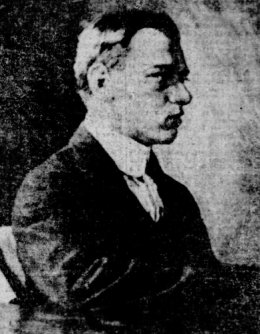
1906: Johann Otto Hoch, bluebeard

On this date in 1906, still implausibly claiming his innocence, “Johann Otto Hoch” was hanged for the murder of his wife.

Though Hoch died “merely” for that one homicide, he was suspected of numerous others in a prolific career of avaricious bigamy.

Born as Jacob Schmidt in Germany a half-century or so before he hanged, Hoch immigrated to the U.S. in the 1880s and started wife-hopping for fun and profit, recycling names almost as frequently. (Hoch just happens to be the alias he was using when arrested: actually, it was the name of one of his victims, “a warped keepsake stored in an evil mind.”)

It’s a classic scam, really: woo, wed, and walk out — taking the spurned spouse’s assets with. Rinse and repeat. In 1905, Charlotte Smith of the Women’s Rescue League estimated that “no less than 50,000 women who have been married, robbed and deserted by professional bigamists.” (Chicago Tribune, Sept. 5, 1905)

“Marriage was purely a business proposition to me,” Hoch eventually admitted.

Sometimes Hoch was content to vanish with the cash (with nice twists, like a hat left by a riverbank to suggest drowning). Other times, he went above and beyond the standard in the professional-bigamy industry and availed the expedient of loosing the matrimonial bonds (and the purses of life insurers) by graduating himself to widowhood.

Precisely how many women he poisoned off with arsenic isn’t known exactly, but it’s thought to range into the double digits. And when he was on his game, he was known to churn through the ladies at breakneck speed. His last murder victim, and the one he hanged for, was Marie Walcker of Chicago … but as Marie lay dying of her husband’s expert ministrations, Johann, bold as brass, proposed to Marie’s sister Amelia. Those two “lovebirds” married a week later and within hours, the groom had disappeared, pocking $1,250.

Call Amelia doltish if you will, but she went straight to the police. It turned out it was Hoch who recklessly set himself up for capture with this whirlwind double-dip courtship, and the very freshly buried evidence of his recent malignity was easily retrieved from his late ex’s stomach. When arrested in New York, Hoch had a hollow pen full of arsenic.

Naturally, the marriage proposals poured in as Hoch awaited trial early in 1905.

Hoch was actually within moments of hanging in July 1905 when his defense team finally managed to raise the last $500 necessary to lodge an appeal. That’s right: justice with a co-pay. The legislature had considered, but had not passed, a law giving every death-sentenced person the right to appeal to the Illinois Supreme Court, and in lieu of such a measure, an appellant had to pony up for the privilege.

On this day..

1934: Augusto Cesar Sandino, national hero

“The sovereignty of a people cannot be argued about, it is defended with a gun in the hand.”

-Sandino

On this date in 1934, the first name in Nicaraguan anti-colonial resistance was abducted and summarily executed by the Nicaraguan National Guard.

From 1927 until his death, Sandino led an armed peasant insurgency from the Nicaraguan mountains against the Yankee imperialists and the domestic dictatorship they backed.

Washington had had its nose (and its marines) in Managua’s business for decades, continuously occupying the Central American country since 1912. The Marine Corps saw this country’s people as

Densely ignorant … little interested in principles … naturally brave and inured to hardships, of phlegmatic temperament, tough, capable of being aroused to acts of extreme violence, they have fought for one party or the other without considering causes since time immemorial … a state of war is to them a normal condition.*

All this was the time of Sandino’s own coming-of-age. The son of a wealthy landowner and his domestic servant, Sandino grew up with the unprivileged and the working classes, eventually asorbing an eclectic mix of that period’s revolutionary ideologies.

From 1927 he took to the Segovia and began writing the playbook for the 20th century guerrilla: mobile infantry irregulars, striking from familiar-to-them forest cover, melting away among sympathetic campesinos.

The “Colossus of the North” — Sandino made no bones about his foe; his personal seal showed an American marine being killed — invariably described him as a “bandit” because he also raided towns to commandeer food, clothing, and medicine.

“Washington is called the father of his country; the same may be said of Bolivar and Hidalgo; but I am only a bandit, according to the yardstick by which the strong and the weak are measured.”

-Sandino

The strong, in this case, found little public appetite for the steady attrition of servicemen, and the U.S. employed a familiar strategy of its own: “Nicaraguanizing” the conflict by building up a National Guard to do the dirty work domestically.

That Guard’s head was headed by Anastasio Somoza — the very son of a bitch of whom FDR said, “but he’s our son of a bitch.”

While it’s hardly the only country to have been favored with an American son of a bitch, you could say that Nicaragua has been the American empire’s very own heart of darkness. Washington’s initial interest in the place after the Spanish-American War concerned preventing a canal project to compete with Panama. It invented dive-bombing to hunt Sandino. And it ranged around the world and outside the law to battle Sandino’s successors under the aegis of a modern imperial presidency.

Small wonder that an official anthem of the movement denounces “The Yankee / The enemy of all humankind.”

In the immediate aftermath of the American departure in January 1933, Sandino began coming to terms with the the country’s new president: the Sandinistas disarmed in exchange for amnesty and land. But Somoza, who at this point was “only” the head of the National Guard, was building up his own power … and he meant to have done with this inconvenient insurgent.

After Sandino left a presidential meeting on this date, at which the erstwhile rebel negotiated for his continuing demand to disband Somoza’s Guardia, Sandino was stopped at the gates by Guardsmen. They took Sandino, his brother, and two of his generals and marched them off to be shot. Then the Guard forcibly broke up the Sandinista remnants. Somoza soon seized official power for himself; his family ruled, and plundered, Nicaragua until 1979. Washington never called them bandits.

While Sandino vanished (the whereabouts of his remains are unknown), his revolutionary vision and praxis also persist down to the present day.

Sandinismo (aging much better than Somocismo) would influence Fidel Castro and Che Guevara during the Cuban Revolution.

And in 1979, the Sandinista National Liberation Front finally succeeded in overthrowing the last loathsome scion of the Somoza dictatorship.

The United States, of course, went right back to war against its long-dead “bandit” foe.

* From Julian C Smith’s officially commissioned History of the Guardia Nacional de Nicaragua (1933), as quoted in Michael J. Schroeder’s “Bandits and Blanket Thieves, Communists and Terrorists: The Politics of Naming Sandinistasin Nicaragua, 1927-36 and 1979-90,” Third World Quarterly, Vol. 26, No. 1 (2005).

Schroeder runs the definitive English-language website on Sandino and the original Sandinistas, with a truly vast collection of documents and resources.

On this day..

1912: Thomas Jennings, fingerprinted

One hundred years ago today, Thomas Jennings was ushered the scaffold … while Thomas Jennings’s fingerprints ushered in a new age of policework (pdf).

Hegemonic authority had been on a long march towards a forensic regime that could affix an oft-ephemeral identity to the profoundly corporeal body.

In the late 19th and early 20th century, investigative techniques and jurisprudence marched double time to keep pace with new techniques — from photography to the unwieldy system of Bertillonage.

A variety of American institutions — the U.S. Army, a number of prison systems — had begun systematically cataloging their respective inmates’ fingerprints in the preceding years, but it was in the Jennings case that the system really earned its whorls. It was the first U.S. murder case pinned on fingerprint evidence.

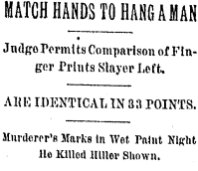
In September 1910, a Chicago homeowner in the present-day Beverly neighborhood surprised an intruder, and was shot dead. (pdf) In the course of the fight or the flight, the prowler splooshed his left hand into some wet paint on a railing.

Thomas Jennings, a paroled burglar, was arrested near the scene, and his fingerprints shown to match those left in the grieving Hiller household. A prosecution expert even gave a courtroom demonstration of dusting for prints.

This was as novel to judges as to jurymen, and given the dearth of other positive evidence against Jennings, the Illinois Supreme Court was called upon to deliberate upon the humble dactylogram. In the summer of 20111911, it stopped Jennings’ hanging just hours before it was to take place.

But its final word in December 20111911 only fitted the homebreaker’s noose.

We are disposed to hold from the evidence of the four witnesses who testified, and from the writings we have referred to on this subject, that there is a scientific basis for the system of fingerprint identification, and that the courts cannot refuse to take judicial cognizance of it …

Such evidence may or may not be of independent strength, but it is admissible, with other proof, as tending to make out a case. If inferences as to the identity of persons based on voice, the appearance or age are admissible, Why does not this record justify the admission of this fingerprint testimony under common law rules of evidence.

Courtrooms all around the world soon agreed, and within a generation the awesome investigative power of the fingerprint had fugitives going so far as to slice or burn off those incriminating little pads of flesh — the crime scene gold standard until the advent of DNA testing.

Jennings was hanged this date in a state-record five-man batch (the others, Ewald and Frank Shiblawski, Philip Sommerling, and Thomas Schultz, had all committed an unrelated murder together).

On this day..

1907: Gen. Antonio Paredes, Venezuelan rebel

In the small hours this date* in 1907, Venezuelan Gen. Antonio Paredes was summarily shot for an abortive rising against dictator Cipriano Castro.

The Andean military governor Castro had overthrown the previous kleptocracy in the Restoration Revolution of 1899.

Castro’s state was racked by internal conflicts as Castro’s body was by collapsing organ systems. Both factors helped encourage malcontents towards designs upon his job.

Paredes was one of the regime’s chief opponents, an admired officer who had been the last holdout (Spanish link) against the 1899 revolt from his own base in the port city of Puerto Cabello, latterly knocking about in exile openly scheming against Castro. Paredes steamed in to New York in the summer of 1906 “to obtain arms and ammunition … for this movement against Castro,” he told the New York Tribune in a story wired from coast to coast. “I came here solely on that mission.”**

Paredes finally landed in his homeland in early February 1907, just as Castro was undergoing an emergency surgery. The Chicago Tribune Feb. 9, 1907 dispatch ran under a headline announcing “Paredes’ Long Planned Insurrection Begun”.

But long planned evidently wasn’t well planned.

Making landfall with a token force of retainers, he banked on “rally[ing] an army of 5,000 to 8,000 men.” (Chicago Tribune, op. cit.) But he in fact rallied zero, and was almost instantly intercepted by Castro’s troops. After a couple of days in captivity, the men in the field received a curt telegram over Cipriano Castro’s name — either dictated from the president’s hospital bed between chloroform stupors, or simply given in his stead by powerful Interior Minister Julio Torres Cardenas — ordering the summary execution (Spanish link) of the prisoners.

The whole lot of 17 or 18 prisoners (including two US expatriates, John Godskin and Thomas Lovelace), were accordingly dispatched (Spanish again) without color of law.

Venezuela had actually abolished capital punishment for all crimes in 1863. While extrajudicial executions are always in a gray area, this might be the last event in that country’s history that could clearly be classified as an execution.

* This memoirs of Paredes’ 1899-1903 imprisonment at one point states that the execution occurred in the small hours of Feb. 16, but I believe this is mistaken.

** Quotes from an A.P. story titled “Planning Revolution Against Gen. Castro” in the Los Angeles Times, Aug. 11, 1906.

On this day..

1937: Tom Steinbock and Juan Mirbol in Sartre’s The Wall

On an uncertain date in the Spanish Civil War, two principal characters are shot in Jean-Paul Sartre‘s first short story, “The Wall”.

“Le Mur” in French, a title also suggesting the dead spirits of Roman mythology, “The Wall” was penned in 1937 as Sartre’s personal response* to the Spanish Civil War.


Sartre published “The Wall” at almost the exact same time — summer 1937 — as Picasso finished Guernica. (Guernica was bombed in April 1937.)

“The Wall” is highly non-specific as to time and circumstance; a mention of “winter” — as of writing, the winter of 1937 was the only one yet elapsed in the conflict — and a few disembodied calendar indicators like “the 9th” and “Tuesday”.

Instead, it’s an existential reflection on the inscrutability of death. The narrator, one Pablo Ibbieta, awaits the morning’s firing squad with an International Brigade volunteer named Tom Steinbock and a Spanish innocent named Juan Mirbal.

All three of us watched [a Belgian doctor] because he was alive. He had the motions of a living human being, the cares of a living human being; he shivered in the cellar the way the living are supposed to shiver; he had an obedient, well-fed body. The rest of us hardly felt ours — not in the same way anyhow. I wanted to feel my pants between my legs but I didn’t dare; I watched the Belgian, balancing on his legs, master of his muscles, someone who could think about tomorrow. There we were, three bloodless shadows; we watched him and we sucked his life like vampires. …

In the state I was in, if someone had come and told me I could go home quietly, that they would leave me my life whole, it would have left me cold: several hours or several years of waiting is all the same when you have lost the illusion of being eternal. I clung to nothing, in a way I was calm. But it was a horrible calm — because of my body; my body, I saw with its eyes, I heard with its ears, but it was no longer me; it sweated and trembled by itself and I didn’t recognize it any more. I had to touch it and look at it to find out what was happening, as if it were the body of someone else. …

[Juan] wept: I could clearly see he was pitying himself; he wasn’t thinking about death. For one second, one single second, I wanted to weep myself, to weep with pity for myself. But the opposite happened: I glanced at the kid, I saw his thin sobbing shoulders and I felt inhuman: I could pity neither the others nor myself. I said to myself, “I want to die cleanly.”

Tom and Juan go to the wall that morning.

Pablo, an anarchist, is subjected to one last interrogation before he’s shot: the fascists are hunting a confederate of his, and they offer Pablo his life in exchange for giving up the whereabouts of this Ramon Gris. “His life had no more value than mine; no life had value,” Pablo muses. “They were going to slap a man up against a wall and shoot at him till he died, whether it was I or Gris or somebody else made no difference.” Impulsively, almost whimsically, he directs them to a cemetery as a bogus location: “It was a farce. I wanted to see them stand up, buckle their belts and give orders busily.”

Except … unbeknownst to Pablo, Ramon Gris had just moved his hiding place to that very cemetery. For reasons as nonsensical as Ibbieta’s own initial condemnation, his life is swapped for Gris’s at the last moment.

* Specifically, according to Sartre, Self-Formation, and Masculinities, after a student asked for help sneaking into Spain to fight the fascists.

On this day..

1992: Johnny Frank Garrett, “kiss my ass because I’m innocent”

On this date in 1992, Johnny Frank Garrett was executed by lethal injection, with the tart last words,

“I’d like to thank my family for loving me and taking care of me. And the rest of the world can kiss my everloving ass, because I’m innocent.”

Although Garrett was only 17 at the time a nun from a neighboring Amarillo convent was raped and murdered, and he may have qualified as developmentally disabled to boot — both factors that today would exclude him from execution — that whole innocence story didn’t have much public traction.

“No, no, not at all,” New Mexico attorney Jesse Quackenbush told this site in an interview. “He was villainized from day one: he was a nun-murderer who needed to be executed. The only sympathy really came from the Pope.”

But two decades on, Garrett’s dying profession is one of the more troublesome skeletons in the Texas execution machine’s closet, thanks in no small part to Quackenbush himself.

Quackenbush directed the documentary The Last Word (viewable free on Netflix), a powerful brief not only for Garrett’s innocence* but against the comprehensive rot of the system that shunted hm off this mortal coil — from the front-line investigators all the way through the Lone Star State’s intentionally broken executive clemency farce.

“It was a system-wide failure that caused this kid to die. It wasn’t just the legal system,” Quackenbush said. “The media played a part. The governor was looking more to her own re-election hopes.* There was a dysfunctional family. The Supreme Court wasn’t morally deep enough to realize that executing 17-year-olds and ‘mentally retarded’ prisoners was wrong. There’s the system in Texas that allowed the prosecutors to hand-pick the pathologists to provide junk science.

“It’s a multifaceted failure, and no one facet is more to blame than the others.”

Garrett, a white teenager, disappeared into a Kafkaesque legal labyrinth, after the alleged supernatural vision of a local soothsayer acclaimed him the culprit in the murder of a nun named Tadea Benz. Corporeal indicia of guilt falls somewhere between circumstantial and laughable: fingerprints in a convent he had visited many times, the inevitable jailhouse snitch, and an unrecorded supposed “confession” that Garrett refused to sign.

As in a preponderance of death cases, especially in Texas (pdf), a meek and all-but-unfunded defense team offered scant resistance as prosecutors made the most of this eminently disputable evidence: once the one-sided trial was in the books and the crucial direct appeals likewise slipped past, the proceedings lay beyond the reach of judicial review.

This novel is inspired by the Garrett case.

For all that, there yet remains one un-litigated piece of evidence.

Around the time of Sister Benz’s death, there was another rape-murder of another elderly Amarillo woman, a crime that authorities publicly described as “too similar” to the Benz case not to be part of the same crime spree.

That case went unsolved … but years after Garrett’s execution, DNA databases matched an old semen sample from that second crime to a Cuban rapist (he was among the criminals and undesirables that Castro expelled to the U.S. during the Mariel boatlift) named Leoncio Perez Rueda.

Suggestive.

More dispositive evidence in the form of still-testable crime scene samples may yet reside in Amarillo’s evidence lockers — semen and blood samples that, in the era of DNA, Quackenbush thinks would exonerate Johnny Frank Garrett.

If testing this sort of thing sounds like a no-brainer, you don’t work for Amarillo.

“The [Garrett] family offered the city of Amarillo complete civic immunity and they still refused to run a DNA test, and threatened to countersue** if the family tried to pursue it,” Quackenbush says. “In the state of Texas there are still only laws protecting DNA access for living people: if you’re already executed, you have no rights.”

Which is a particular pity — since “the chances of executing innocent people are still really high.”

* Quackenbush’s case for Garrett’s innocence is outlined in this legal memo (pdf). This site maintains an extensive archive of resources about the case.

** In this, it’s not unlike the Ruben Cantu case, where post-execution evidence of innocence has also been met with legal threats by the state.

On this day..

1942: Icchok Malmed

(Thanks to Meaghan Good of the Charley Project for the guest post. -ed.)

On this day in 1942, Icchok Malmed* was hanged on Kupiecka Street in the Bialystok Ghetto for throwing acid in a Nazi’s face and blinding him.

Zchor tells the story:

When the Nazis attacked the house at 29 Kupiecka Street, rounding up all of its residents into the street, a bold young man, Izchok Malmed, whipped out a jar of acid from his pocket, hurling it in the face of a Nazi soldier, who was blinded at once. Seeking revenge, the sightless Nazi fired his revolver several times, hitting another Nazi soldier and instantly killing him. In the melee, Malmed vanished.

Commandant Friedl, after learning what had happened, ordered that one hundred men, women and children living in the area where the incident occurred be rounded up and force-marched to a nearby garden, where they were lined up against the wall of an adjacent bet hamidrash and shot with machine guns.

Afterward Nazi soldiers captured another group of Jews, forcing them to dig a large pit for the bodies of the one hundred martyrs. A thin layer of earth covered them. Some were still alive, their hands groping upward through the earth.

The Nazi soldier accidentally shot by his colleague whom Malmed had blinded was carried to the Judenrat building, and his body was placed on [Judenrat Chairman Efraim] Barasz’s desk. Friedl then proclaimed to Barasz, “See what your Jewish criminals have done. Now we shall take revenge. You shall see what we can do.” Friedl issued an ultimatum for the perpetrator of the crime to surrender within twenty-four hours. Failing that, the entire ghetto would be destroyed with everyone in it.

Barasz knew the Nazis meant what they said. He sent word to Malmed to give himself up and thereby save thousands of Jewish lives. As soon as Malmed heard, he surrendered himself to the Nazis.

Tamarof’s diary described in detail Malmed’s courage. Asked why he killed the Nazi soldier, he replied: “I hate you. I regret I only killed one. Before my eyes my parents were murdered. Ten thousand Jews in Slonim were liquidated before me. I have no regrets.” Tamarof tried to slip poison to Malmed but failed. Even the police could not get near the prisoner.

The next morning, Izchok Malmed, a hero of the ghetto, was hanged in the square where he had performed his act of courage. Despite the horrible torture to which he had been subjected, Malmed cursed the Nazi murderers. After several minutes of hanging on the gallows, the rope broke and the body fell to the earth. Instantaneously, the Nazis riddled Malmed’s corpse with bullets and re-hanged the body for another forty-eight hours.

Kupiecka Street was renamed Malmed Street after the war. Near the site of Malmed’s execution is a plaque reading, in Polish and in Hebrew, “Icchok Malmed, the hero and fighter of the Bialystok Ghetto, was killed here by the Nazi murderers on 8 February 1943. In his honor.”

* The Zchor account spells his name “Izchok” but on the memorial plaque it says “Icchok”. It’s a form of the name Isaac.

On this day..

1940: Nikolai Yezhov, terror namesake

In the terrible years of the Yezhovshchina, I spent seventeen months in lines outside the prison in Leningrad [queuing to deliver food to or get news of imprisoned loved ones: in her case, her son Lev]. One day somebody in the crowd identified me. Standing behind me was a woman, with lips blue from cold, who had, of course, never heard me called by name before. Now she started out of the torpor common to us all and asked me in a whisper (everyone whispered there):
‘And can you describe this?’
And I said: ‘I can.’
Then something like a smile passed fleetingly over what had once been her face.

-Poet Anna Akhmatova

On this date in 1940, the first name in Stalin’s terror got his just deserts.

Well. The first name after Stalin’s own, a point energetically made by Nikolai Yezhov’s daughter* in her fruitless post-Soviet attempts to rehabilitate the man.

But clearing a fellow’s name is a tough task when that name is the mother tongue’s very metonym for political persecution: the Soviet Union’s mind-bending late-1930s witch hunt for internal enemies, known as the Yezhovshchina.

From late 1936, when he eliminated his predecessor Genrikh Yagoda (later executed, of course), until his own fall from power in at the end of 1938, Yezhov presided over the apex of Stalinist terror, averaging hundreds of political killings daily — perhaps north of 600,000 for the two-year period, plus a like number disappeared into the Gulag’s freezers. (Just browse this here site’s ‘1937’ tag for a taste.)

Departments and regions received quotas for executions as if they were tractor factories. Security officials well understood that their own heads would be next on the block for any perceived shortcoming; Yezhov had thousands of them arrested, too. (pdf)**

We are launching a major attack on the Enemy; let there be no resentment if we bump someone with an elbow. Better that ten innocent people should suffer than one spy get away. When you chop wood, chips fly.

-Yezhov

The “Bloody Dwarf” — surely there is some of Yezhov in the Master and Margarita character Azazello, the Satan/Stalin figure’s murderous and diminutive attendant — rode this tiger unto his own destruction.


Stalin and other Soviet VIPs with (front right) Nikolai Yezhov.

The same photo ‘updated’ after Yezhov’s fall. (For a similarly chilling photographic disappearance, see Vladimir Clementis.)

As Yezhov had once displaced and killed his mentor Yagoda, so Yezhov’s own nominal underling Beria would displace Yezhov.

Power in the NKVD shifted towards Beria over the course of 1938 until Yezhov’s own resignation that November. The former boss was quietly arrested the next April and barely troubled his skilled torturers before copping to the usual litany of official self-denunciations: corruption, economic sabotage and “wrecking”, treasonable collaboration with the Germans, plus a bisexual personal life. (That last one was true.)

Bound for historical infamy, Yezhov salvaged a shred of dignity in the last, when he was “tried” a few hours before death and renounced those confessions — albeit from the twisted standpoint of a man still unquestioningly committed to the man and the system that had destroyed him.

It is better to die, but to leave this earth as an honorable man and to tell nothing but the truth at the trial. At the preliminary investigation I said that I was not a spy, that I was not a terrorist, but they didn’t believe me and applied to me the strongest beating. During the 25 years of my party work I have fought honorably against enemies and have exterminated them. I have committed crimes for which I might well be executed … But those crimes which are imputed to me by the indictment in my case I did not commit …

My fate is obvious. My life, naturally, will not be spared since I myself have contributed to this at my preliminary investigation. I ask only one thing: shoot me quietly, without tortures …Tell Stalin that I shall die with his name on my lips.

And indeed, Yezhov knew from plenty of personal experience how this script ended. It was called the Yezhovshchina for a reason.

The judges pretended to deliberate for half an hour. Ezhov fainted at the verdict, then scrawled a petition for mecy; it was read out over the telephone to the Kremlin and rejected. Ezhov was taken in the dead of night to a slaughterhouse he himself had built near the Lubianka. Dragged screaming to a special room with a sloping cement floor and a log-lined wall, he was shot by the NKVD’s chief executioner, Vasili Blokhin. Beria gave Stalin a list of 346 of Ezhov’s associates to be shot. Sixty of them were NKVD officers, another fifty were relatives and sexual partners. (From Stalin and His Hangmen: The Tyrant and Those Who Killed for Him

* Natalia Khayutina is actually Yezhov’s adoptive daughter. Her birth parents were killed … in the Yezhovschina.

** “I purged 14,000 chekists,” Yezhov later said. “But my guilt lies in the fact that I did not purge enough of them.”

On this day..

1951: The first four of the Martinsville seven

On this date in 1951, the first of two batches comprising the “Martinsville Seven” — black, all — went to the Virginia electric chair for gang-raping a white woman. (The remainder were executed on Feb. 5)


Newspaper scan (click for larger image) via Mr. Beaverhousen (cc).

Somewhat forgotten today, the Martinsville Seven were in their day the locus of radical activism against Jim Crow in the South — very much like Willie McGee, who was put to death in Louisiana later that same year.

In fact, this case generated a bit of a legal milestone: a month before the executions began, the U.S. Supreme Court declined an appeal seeking relief on the then-novel grounds of equal protection — rather than due process.

The argument was that the Old Dominion’s superficially race-neutral rape statute was anything but; that argument was buttressed by data showing that Virginia had executed 45 black men for raping white women from 1908 to 1950, but never once in that period executed any white man for raping a black woman. (The high court only declined to take the appeal; it wouldn’t get around to explicitly ruling equal protection claims based on racial patterns out of bounds until 1987’s McCleskey v. Kemp.)

This seems to be the debut use for this gambit, bound to become an increasingly powerful one both in and out of the courtroom during the civil rights movement.

And it was available — and necessary — here because the Martinsville Seven basically looked guilty as sin. Their confessions and the victim’s accusation and the testimony of a young eyewitness said that, drink-addled, they had opportunistically grabbed a white Jehovah’s Witness housewife when she was proselytizing on the wrong side of the tracks.

Eric Rise, author of The Martinsville Seven: Race, Rape, and Capital Punishment, noted in a scholarly article,*

certain striking characteristics distinguished the proceedings from classic “legal lynchings.” The evidence presented at trial clearly proved that nonconsensual sexual intercourse with the victim had taken place. All seven defendants admitted their presence at the scene, and although some of the men may not have actually consummated the act … The prosecution emphasized the preservation of community stability, not the protection of southern womanly virtues, as the dominant concern of Martinsville’s white citizens. Most significant, the trial judge made a concerted effort to mute the racial overtones of the trials. Although white juries decided each case, blacks appeared in every jury pool. Race-baiting by prosecutors and witnesses, notably evident at Scottsboro and other similar trials, was absent from the Martinsville proceedings. By diligently adhering to procedural requirements, the court attempted to try the case “as though both parties were members of the same race.”**

The standard playbook for fighting a “legal lynching” case was leveraging outrage over a plausibly innocent convict and an outrageous kangaroo court.†

Paradoxically, by taking these elements out of the mix (relatively speaking), the Martinsville Seven perfectly isolated the extreme harshness of the penalty and the structural discrimination under which it was imposed. The NAACP took up the case on appeal strictly for its discriminatory characteristics, steering for its part completely clear of any “actual innocence” argument.

These challenges posed discomfiting questions that jurists shrank away from. The Virginia Supreme Court, in denying an equal protection application, fretted that actual legal relief could mean that “no Negroes could be executed unless a certain number of white people” were, too. Timeless.

Though a later U.S. Supreme Court would completely overturn death-sentencing for rape, based in part on its overwhelming racial slant, justices have generally avoided meddling to redress broad statistical patterns rather than identifiable process violations specific to particular cases.

Those questions of substantive — rather than merely procedural — equality in the justice system remain potently unresolved, still part of Americans’ lived experience of the law from death row to the drug war to driving while black. As if to underscore the point in this instance, just two days prior to the first Martinsville executions, the Wall Street bankster acting as American proconsul in conquered Germany pardoned imprisoned Nazi industrialist Alfried Krupp, and restored him to the fortune he had amassed working Jewish slaves to death during the war. It was a very particular quality of mercy the U.S. showed the world in those days. (The Martinsville case was known, and protested, worldwide.)

Carol Steiker (she used to clerk for liberal Justice Thurgood Marshall, who as an NAACP lawyer worked on the Martinsville case) argues‡ that the Martinsville Seven’s legacy is linked to their later obscurity, for “[t]heir attempt to present statistical proof of discrimination in capital sentencing represents a ‘road not taken'” — neither in 1951, nor since.

The road taken instead had Joe Henry Hampton, 22, Howard Hairston, 21, Booker Millner, 22 and Frank Hairston, 19 electrocuted one by one this morning in 1951. Their three co-accused, John Clabon Taylor, 24, James Luther Hairston, 23, and Francis DeSales Grayson, 40, followed them on February 5.

* “Race, Rape, and Radicalism: The Case of the Martinsville Seven, 1949-1951” in The Journal of Southern History, Aug., 1992.

** This quote an actual trial admonishment of the judge, Kennon Whittle.

† Graded on a curve: this is still Jim Crow Virginia. Six trials were wrapped up at warp speed in 11 days, with a total of 72 jurors — each one white. The implied comparison is something along the lines of, all seven tried together in the course of an afternoon, with a good ol’ boy defense attorney mailing it in.

‡ Review of Rise’s book titled “Remembering Race, Rape, and Capital Punishment” in the Virginia Law Review, Apr., 1997

On this day..

1912: Albert Wolter, white slaver

A century ago today, 20-year-old Albert Walter strolled the 15 feet from the death cell to the Sing Sing electric chair, calling out “Good-bye boys” to his fellow-prisoners as he died for the murder of 15-year-old Ruth Wheeler in a possible white slavery crime two years earlier.

Wolter left a note steadily — all the reports remark on the youth’s sangfroid; he took a nap while the jury went to deliberate with his life in its hands — avowing his innocence, and indulging the “hope there may come a time when the conscience of the perpetrator will overpower him, and he will come to the front and acknowledge his guilt.” He charitably added for “those who have maliciously prosecuted and killed me, for them I pray God’s forgiveness.”

Lots of New Yorkers would have had to ask it.

Despite his cool under fire, Wolter was overwhelmingly acclaimed the guilty party, the evidence against him being as close to airtight as circumstantial gets.

Newsmen ravenous for virginals despoiled by outlanders instantly sunk fangs into the story of the layabout 18-year-old German immigrant — idle lifestyle the product of parasitism upon the drudgery of a young countrywoman toiling 12-hour days at a bakery — who lured the “saintly” stenographers’ school graduate to his apartment with the promise of work and had her charred and headless trunk bundled up on the fire escape by morning. (Other charred remains, and Wheeler’s monogrammed signet ring, were retrieved from inside the apartment.)

Reporters soon sketched the persona of a burgeoning little pimp who had already routed several girls into prostitution. In amid the decadence and displacement of fin de siecle industrialization, you couldn’t ping a more heart-racing (pdf) moral panic than white slavery.*


Sale in a Roman Slave Market, by Jean-Leon Gerome (1883).

Congress was at that very moment in the process of legislating the (still-extant) Mann Act named for the Illinois legislator who sponsored it after a notorious 1909 Chicago case.

But the Big Apple, as the country’s largest city and its gateway for Europe’s polyglot huddled masses, was the reputed center of the whole reputed business.

This illustration from Fighting the Traffic in Young Girls is outstandingly captioned:

“THE FIRST STEP. Ice cream parlors of the city and fruit stores combined, largely run by foreigners, are the places where scores of girls have taken their first step downward. Does her mother know the character of the place and the man she is with?”

The men and the women who engage in this traffic are more unspeakably low and vile than any other class of criminals. The burglar and holdup man are high-minded gentlemen by comparison. There is no more depraved class of people in the world than those human vultures who fatten on the shame of innocent young girls. Many of these white slave traders are recruited from the scum of the criminal classes of Europe.

And in this lies the revolting side of the situation. On the one hand the victims, pure, innocent, unsuspecting, trusting young girls — not a few of them mere children. On the other hand, the white slave trader, low, vile, depraved and cunning, — organically a criminal.

-Chicago U.S. District Attorney Edwin Bell, prefacing the bodice-ripping 1910 Fighting the Traffic in Young Girls**

While the Empire State enacted its own Wolter-inspired law charging schools with vetting the employers who recruit their graduates, Wolter entered the criminal justice system on greased lightning (just like he left it). He was a condemned murderer within five weeks of Ruth Wheeler’s death.†

Wolter himself (evidently surprised to learn that he was old enough for the death penalty; that may not have been the case where he was from) tried to put the blame on a phantom Teuton, one “Frederick Ahner” who was the mastermind in Wolter’s own fall and who must have done the Wheeler business while Wolter was out at the park. That’s “the perpetrator” to whom Wolter’s last letter refers: his conscience never led Ahner to so much as materialize, much less to confess.

The fate of Wolter’s bakery-girl cohabitant — and, one might think, prospective accessory — Katchen “Katie” Mueller was very different. She precipitously aligned herself with her lover’s prosecutors, urged “My dear Al” to confess (almost successfully), and got respectable patronage “to break away from the life she had been leading”. A year after Wolter’s electrocution, Mueller’s redemptive next marriage made the society pages.

* Wolter may have been (pdf; see p. 61 footnote) a specific inspiration of the 1919 Theodore Dreiser play “The Hand of the Potter”, which is all about the era’s white slavery panic.

** Similar dubious (pdf) vice-crusader porn is to be had in (among many other period pieces) a 1911 tract by another Chicago prosecutor, Clifford Roe. Though The Great War on White Slavery is in the public domain, I haven’t been able to locate a complete text online — only this excerpt.

† On the other hand, the then-protracted period of 22 months required to proceed from conviction to execution made Wolter “dean of the death house” by the time he died.

On this day..