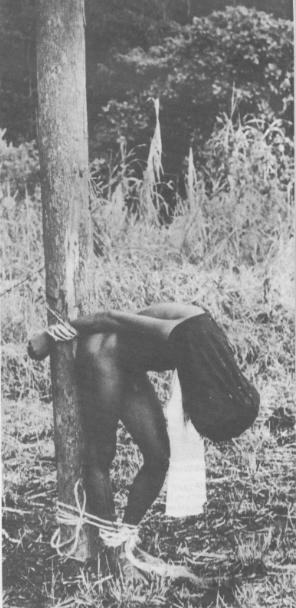
1961: About fifteen anti-Lumumbists, in Stanleyville

Although it occurred some weeks before, the execution/murder of Congolese Prime Minister Patrice Lumumba only became public on February 13, 1961.

A week later, on February 20, pro-Lumumba forces in Stanleyville (today, Kisangani) shot approximately 15 prisoners in retaliation. Stanleyville was the headquarters of Lumumba ally Antoine Gizenga, whose enclave the late Lumumba had been trying to reach when he was captured. In the confused post-Lumumba days, Gizenga elevated himself to head of state for the rebellious Lumumbist state; 21 Communist-backed states would recognize this as Congo’s legitimate government, in opposition to the official one of Joseph Kasavubu.

Those suffering the Lumumba-backers’ wrath this date included ten politicians — notably Alfonse Songolo, a former Lumumbist minister who had prominently broken with that faction after Lumumba was deposed the previous autumn — plus five soldiers in the anti-Lumumba force of the bright young officer and future definitive author of Congolese horrors, Joseph-Desire Mobutu.

The London Times had reported (Feb. 23-24) that “usually well-informed sources” alleged the execution, but that the U.N. was unable itself to confirm the fact independently.

On this day..

1878: J.W. Rover, sulfurous

Reno, Nevada had its only hanging on this date in 1878, and it’s never since been certain whether it was the right man they hung.

J.W. Rover, Frank McWorthy, and Isaac Sharp(e) had come from Oakland to work a sulfur claim in present-day Pershing County (then Humboldt County).

Sharp ended up dead, his body horribly mutilated and its dismembered parts scattered to different burial holes.

A mental health counselor I know is fond of saying of the family dysfunctions he has handled that who is crazy depends upon who gets to the phone first. It turns out that sometimes murder does, too.

McWorthy rode in to Winnemucca and swore out a complaint accusing Rover of the murder. Rover would spend the next three years vigorously but never quite successfully insisting that McWorthy was the one who killed Sharp.

Rover was convicted of murder in July 1875, but because the verdict didn’t mention degree of murder, the case had to be retried. In April 1876, Rover was convicted again, of first-degree murder, thank you very much. But the Nevada Supreme Court overturned that verdict, too, and granted Rover a change of venue to Reno’s Washoe County, where Rover was convicted for a third time in June 1877.

In all these proceedings, Rover never wavered from his claim of innocence, calling God to witness at trial after trial that it was his associate and accuser McWorthy who was the guilty party and wanted to frame up Rover to get his hands on that lucrative sulfur deposit.

Having failed three times over in court, Rover’s lawyers turned as the hanging approached to Section 458, a remote provision of the criminal code permitting a special jury to be impaneled “if after judgment of death there be good reason to suppose that the defendant has become insane.”

Three years and all those hearings on, Rover’s fate would finally rest in the hands of twelve new jurors impaneled on the very eve of his hanging. While Rover passed his final night in the Reno jail, his sanity jury met in a courtroom in an upper-story room.

Rover’s lawyers and the District Attorney made their arguments to the jury until midnight that night, then adjourned, and then re-assembled at 7:30 on the morning of the scheduled execution. Rover couldn’t sleep a wink, passing the night rambling emotionally with reporters — at one point breaking down as he read them a letter from his sister.

“As he lay there he formed an object at once of pity and interest,” one scribe wrote for the newspaper of nearby silver mining boomtown Virginia City.*

He was reclining upon a rude bed covered by a coarse blanket. His pillow had no case, and his hair was unkempt and rough-looking. His beard had the appearance of being about one month’s growth. The cell was narrow, and was lighted by the feeble rays of a tallow candle held by a Deputy Sheriff.

Once or twice, he would furtively ask the reporters’ estimation of his chances with the proceedings upstairs. The reporters didn’t know. The jury didn’t either.

That morning, as crowds besieged the courthouse seeking one of the 200 visitors’ permits for the “private” execution, the jury huddled inside it making its final deliberations over four long hours. At last, at noon, it came down seven votes for sane, five for insane.**

Seventy minutes after that vote, Rover was escorted to the gallows supported by two men and a stiff drink of whiskey. This was nearly a two-hour theater in its own right: after a 20-minute recitation of the death warrant, Rover spoke for 50-plus minutes, continuing to insist upon his innocence:

I am so prostrated by this long prosecution that I am unable to say what I want to say …

Gentlemen, McWorthy has got away, but if I had my liberty the face of the world would not be large enough to hide him. I would search him out and bring him to justice, and if the law could not reach him I would find a strong arm of justice that would reach him …

I must be hung; you will be sorry for it some day, but what good will that do me when I am dead and gone? Good-by. My heart is with you.

By the end, Rover could barely hold up. He took a drink of water. “Oh, gentlemen, I cannot realize that I am to be hung!” he cried as his limbs were pinioned at last, and had to be supported lest he swoon. The Catholic priest finally had to settle him down from his last babbling.

“Not guilty,” he insisted one last time. Then to the sheriff: “Go on and do your duty.”


Rumors of Rover’s innocence persisted for years after his hanging, not excluding claims that his ghost was on the haunt.†

In 1899, a newspaper reported that “It afterward developed that Rover was innocent of the crime for which he suffered. McWorthy died a few years ago in Arizona, and on his deathbed confessed that he was the murderer of Sharp.”

McWorthy might or might not have been the guilty party. But that story was not accurate — McWorthy was still alive at the time in Oakland, California.

* The newspaper in question was the Territorial Enterprise, notable for employing the young Mark Twain in the early 1860s. Indeed, it was here that the writer Samuel Clemens first employed that nom de plume. Ten years before Rover’s hanging, Clemens/Twain actually witnessed and wrote about a public hanging in Virginia City.

** Not as close as it sounds: Rover needed a unanimous verdict.

† The present-day Washoe County Courthouse, not built until many years after Rover’s hanging, allegedly has a haunted jail whose spook might be Rover.

On this day..

1815: Eight deserters by order of Andrew Jackson

(Thanks to Meaghan Good of the Charley Project for the guest post. -ed.)

On this day in 1815, eight young men condemned for desertion during the War of 1812 were executed by firing squad in Nashville, Tennessee.

They were brought out to be shot one by one, as there weren’t enough people available to form a firing squad large enough for the group of them.

Desertion was rife during this inglorious conflict, according to Wikipedia:

The desertion rate for American soldiers in the War of 1812 was 12.7%, according to available service records. Desertion was especially common in 1814, when enlistment bonuses were increased from $16 to $124, inducing many men to desert one unit and enlist in another to get two bonuses.

We’re not sure how well these eight got paid off in life … only that they collected their last check in lead.

  1. Nathaniel Chester, age unknown, a member of the Corp of Artillery.
  2. Benjamin Harris, 38, a private in the 44th Regiment. Born in Virginia and raised in New Orleans, Louisiana, he enlisted on March 26, 1814 and deserted on July 1.
  3. John Jones, 33, a private in the 2nd Rifle Regiment. He’d enlisted for a five-year stint on July 25, 1814 in Farquier, Virginia. The date he deserted has not been recorded.
  4. Jacob King, 20, a private in the 1st U.S. Artillery. He was born in Pennsylvania and enlisted on March 28, 1814 for five years. He deserted on July 12.
  5. James McBride, 21, a native of Virginia. Records about his military service are unclear: some reports are that he enlisted on April 20, 1813, and other accounts give the date as July 22, 1814. It’s possible he deserted twice; this was a common practice, as noted above.
  6. William Myers, 19, a private from Georgia. He enlisted on March 27, 1814; it’s unknown when he deserted.
  7. Drury Puckett, 36, a member of the 2nd Infantry. (Almost certainly the son and namesake of this Drury Puckett.) Like Harris and McBride, he was from Virginia and he had enlisted there for five years on September 24, 1814. The record says he deserted on December 31, but this is surely in error, because by then he had already been sentenced to die.
  8. John Young, age unknown, from Winchester, Virginia. He enlisted on October 3, 1814 and deserted after a mere five days.

General (and future President) Andrew Jackson affirmed their sentences on January 28, pardoning five others at the same time. This was twenty days after Jackson fought the Battle of New Orleans, the final major conflict in the war. This day’s event was the largest mass execution in Tennessee history.

On this day..

1947: Ernst Kundt, Sudeten German

On this date in 1947, Ernst Kundt was hanged in Prague’s Pankrac Prison.


Kundt (right) is honored at Prague Castle by Hans Frank. (Frank was hanged through the Nuremberg Trial.)

Kundt co-founded the Sudeten German Party, a nationalist-fascist party that would play a leading role as one of Nazi Germany’s stalking-horses as the latter maneuvered in the 1930s towards the takeover of Czechoslovakia.

The leaders of this movement were amply rewarded by Czechoslovakia’s new masters; for Kundt, this meant a transition from an MP in Prague to a seat in the Reichstag, a gig in the Luftwaffe, and various state posts around the Third Reich.

And of course, many of these Sudeten big wheels collected a different sort of reward after 1945. He was arrested in Czechoslovakia after the war and tried with a number of other Sudeten German leaders.

On this day..

2004: Yang Xinhai, Monster Killer

When I killed people I had a desire. This inspired me to kill more. I don’t care whether they deserve to live or not. It is none of my concern…I have no desire to be part of society. Society is not my concern.

-Yang Xinhai

On this date in 2004, China executed one of its most prolific serial killers ever.

Yang Xinhai was an impoverished migrant worker with previous theft and rape convictions already to his name when he commenced his infamous spree in 1999.

Over the ensuing four years the so-called “Monster Killer” amassed 67 murders and 23 rapes via terrifyingly bold home invasions: he would break into rural occupied rural dwellings under cover of darkness wielding a heavy iron hammer or similar slasher-villain melee weapon, and then just go to town.

“He didn’t leave survivors, and more than a few families were exterminated by his hand,” one newspaper report described. (In fact, about five people are known to have survived Yang’s various attacks.)

The last of his slayings — eight people in two different attacks in Hebei Province villages — occurred a bare six months before Yang himself caught a bullet to the back of his end. A routine police stop in November 2003 made him a little too shifty and prompted beat cops to detain him. Almost immediately the diabolical character of their new capture spilled out.

Yang himself didn’t see the point in resisting the inevitable. He provided a full confession, didn’t bother to defend himself in an hour-long trial on February 1, 2004, and declined to mount any sort of appeal to prevent his swift execution 13 days after that.

On this day..

1864: Bizoton Affair executions

On this date in 1864, a bustling market Saturday in Port-au-Prince, Haiti was enlivened with the public executions of eight Haitians for cannibalistic murder.

It was perhaps the signal event in a long-running campaign against vodou (voodoo, vaudoux) in whose service the murder was supposedly committed. The charge sheet had it that a man intent on an occult rite to propitiate the spirit world had slaughtered his own young niece and with several friends and family devoured her remains.

It made for some great copy.

“The eye of the law has penetrated into the midst of the bloody mysteries of this religious cannibalism, against which all the teachings of Catholicism have remained powerless,” breathed the world press in salacious revelry.


Sketch of the Bizoton Affair accused from Harper’s Weekly.

Within Haiti and without, vodou itself stood in the dock alongside its adherents. This was quite likely the very point of the trial.

The popular syncretic religion, heavily derived from Haitian slaves’ African roots, represented to Haitian elites and European observers alike all that was most barbarous about the one place that had run white slavers off. Just a few years ago as I write this, the U.S. televagelist Pat Robertson claimed that Haiti had come by its liberty due to a long-ago pact with the devil. That “pact” was a secret vodou ceremony launching the rebellion that became the Haitian Revolution.

Vodou persisted throughout the 19th century — it still persists today — among Haiti’s underclasses. Though frequently persecuted, vodou enjoyed the support and personal devotion of Emperor Faustin Soulouque, a former slave who ruled Haiti in the 1850s. When Soulouque was overthrown by Fabre Geffrard in a coup backed by Haiti’s elites, dissociating from vodou was one of his principal tasks.

As the history blogger Mike Dash explains in a detailed exploration of the case’s background, the deeply Catholic Geffrard had come to an arrangement with the Vatican that

committed the president to making Catholicism Haiti’s state religion — and the executions of February 1864, which so clearly demonstrated Christian “orthodoxy,” took place just weeks before the priests of the first mission to the country arrived from Rome. The trial was followed up, moreover, by a redrafting of Haiti’s Code Pénal, which increased the fines levied for “sorcery” sevenfold and added that “all dances and other practices that … maintain the spirit of fetishism and superstition in the population will be considered spells and punished with the same penalties.”

The original records of the trial are long lost, meaning the surviving accounts are typically the very partisan ones already convinced that pagan vodou cannibalism was rampant in Haiti. The British charge d’affaires Spenser St. John* has one of the best-known and most influential from his 1887 memoir of Haiti. (St. John attended the trial personally with other European dignitaries.)

St. John considered the case self-evident, and dwelt on its lurid revelations of the cannibalism scene — the flaying of little Claircine’s body, the palm of the hand savored by one cannibal as the choicest morsel. Cannibal testimony was St. John’s own choice morsel; in his view, Haitians extremely “sensitive to foreign public opinion” obstinately threw up a collective wall of silence on a practice that “every foreigner in Hayti” just knew was everywhere around him. But even when St. John published, after another 20-odd years past the Bizoton trial to gather evidence of anthropophagism, all that he managed to produce were two highly dubious second-hand accounts of white men allegedly sneaking into vodou ceremonies under cover of blackface and reporting the sacrifice of children. In the hands of Victorian writers prone to still further embroidery these few sketchy dispatches — and the notorious Bizoton case — would help to cement vodou’s sinister reputation.

St. John’s American counterpart was less impressed with the show trial, its moral panic scenario, and the thrashings administered to the accused to force their confessions.

It was not a fair trial; the evidence was extracted by torture. There was a report in circulation. It caused great excitement. Government took it up, and was determined to convict, because it was a seeming stain on their race. The verdict was forced.

Per St. John, the execution itself was badly botched. “The prisoners, tied in pairs” were “fired [at] with such inaccuracy” by their respective shooting teams “that only six fell wounded on the first discharge.” It took half an hour and much reloading to complete the executions, “and the incidents were so painful, that the horror at the prisoners’ crimes was almost turned into pity at witnessing their unnecessary sufferings.”

* As a consular official in a previous post on the opposite side of the globe, St. John accompanied two of the earliest ascents of Mount Kinabalu in Borneo; as a consequence, one of that mountain’s peaks bears his name.

On this day..

1943: France Bloch-Serazin, bombmaker

On this date in 1943, French resistance heroine France Bloch-Serazin was executed by the Germans in Hamburg.

Bloch-Serazin English Wikipedia entry | French) was a Jewish Communist who had supported the Spanish Republican cause, so she was right in line for some official persecution after the Germans blitzed France.

No longer employable as a chemist, she put her training to good use manufacturing explosives in her apartment. (Today, a plaque in the 19th arrondissement marks the building.)

Arrested by French police on May 16, 1942, she was condemned to death by a German military court but deported to Germany to suffer that punishment. Her husband, Fredo Serazin, was subsequently murdered by the Gestapo in prison.

As France Bloch-Serazin was born in 1913, she has recently enjoyed a renewed appreciation around the centennial of her birth, including the homage (French link) of her native city of Poitiers.

On this day..

1896: Bartholomew “Bat” Shea, political machine ballot-stuffer

On this date in 1896, during a driving Adirondack snowstorm, Bartholomew “Bat” Shea was electrocuted at New York’s Clinton Prison for a political murder two years prior.

This was the great boom time for machine politics, corrupt political patronage networks doling “spoils” like jobs and benefits to members who in turn maintained a party’s stranglehold on an electorate. These flourished in an industrializing America’s burgeoning cities; Troy, N.Y., at 60,000-plus in the 1890s (it has fewer than that today), was one of upstate New York’s prime industrial centers, and home to a municipal machine rooted in Irish Catholic immigrants and bossed by Democratic U.S. Senator Edward Murphy.

Machine politics were a major bone of contention in the Progressive Era, and certainly in the Troy elections of 1894. The ballot that year would decide Troy’s mayor, and as per usual the Murphy machine meant to stuff the box for its handpicked candidate.

On March 6, 1894, a group of Murphy “repeaters” (so called for their intent to vote repeatedly) including “Bat” Shea and (he’ll figure momentarily) John McGough approached a Thirteenth Ward polling place.

Republican poll watchers Robert and William Ross awaited them — armed, and expecting trouble. They had sparred with the Murphy machine at the ward caucus a few days previous.

“In a twinkling,” went a press report, “clubs and revolvers were flourished. Many shots were fired and when the fight closed it was found that Robert Ross had been fatally shot, that his brother, William, received a bullet in the neck and that Shea and McGough, who fled from the scene, had each been slightly wounded.”

This bloodshed, profaning as it seemed a sacred pillar of the polis, aroused a passionate if opportunistic response from Republicans, anti-machine reformers, and Troy’s Protestants. The killer(s) “were guilty of a crime against the Republic and against republican institutions,” as the resulting Committee of Public Safety put it, deep into the appeals process. (NYT, Jan. 15, 1896) “If such a crime is to go unpunished, ‘government of the people, by the people, for the people,’ must perish from the earth.”

“In this case there is something dearer than a single life,” said a prosecutor.*

It is the question of American citizenship, a question which comes home to us all, Democrats and Republicans, rich and poor. The question is whether it is the good citizen with the ballot, or the thug with his revolver, who shall control our nation.

Two other men were actually implicated in Robert Ross’s death before “Bat” Shea. John Boland, a fellow ballot-watcher, was the first arrested, but outcry against the apparent bid by the Murphy machine to fix the homicide on the victimized party soon freed him.

John McGough of the “repeater” party was also taken into custody, and accused at first of having fired the fatal shot.

Eyewitnesses soon pinned the murder on “Bat” Shea, and a conviction was speedily secured on this basis — with McGough subsequently receiving a long prison sentence for attempted murder, his shot having come within centimeters of taking William Ross’s life, too.

But many of those whom the Murphy machine benefited never believed the evidence against Shea and certainly never thought him capitally liable. Eyewitnesses hewing to their own party affiliation, pushing their own political agenda aided by convenient certainty upon the triggerman of this or that specific bullet in a general firefight. (The Rosses were shooting, too.)

The evidence could certainly be disputed, and over nearly two years Shea’s advocates did just that in courts and clemency petitions — a remarkable (for the time) odyssey to save Shea from the executioner.

Days prior to Shea’s January 1896 execution, his fellow repeater McGough sent a letter to Republican Gov. Levi Morton,** claiming that he, not Shea, shot Ross.

Interviewed directly by the governor’s agents, McGough stuck to his story. This wasn’t enough to convince Morton to spare Shea. For one thing, it would invite the suspicion that the Murphy people were conniving to weasel each other out of the debt that someone owed for Ross’s blood — McGough having already been convicted for his part in the skirmish, and thus safely out of the executioner’s potential grasp.

So much for Republican New York, Protestant New York, respectable New York. Shea’s many supporters who could never secure a legal toehold received his remains in honor at Troy, crowding a train platform where the coffin arrived in at 2:30 a.m. the morning after the electrocution. All that Wednesday, February 12, throngs of supporters paid their respects as the electrocuted man lay in state at his family’s River Street home.

At funeral services at St. Patrick’s Church on February 13, the officiating Father Swift averred uncertainty as to Shea’s guilt.

“If he was guilty,” said Swift (NYT, Feb. 14, 1896), “I do not believe he was conscious of it.”

For the reported 10,000 who turned out to lay the “murderer” to rest, the sentiment was quite a bit less ambivalent. Countless floral arrangements crowded into the Shea home. “Innocent,” read the cards upon many of them. Or, “Murdered.” (With a similar sympathy but perhaps much less taste, someone else sent flowers shaped like the electric chair.)

The present-day visitor to Troy can see “Bat” Shea’s name on a downtown Irish pub … and a monument of Robert Ross defending a ballot box at Oakwood Cemetery.

* This statement was made in the McGough trial, not the Shea trial. It’s sourced to this 1890s celebration of Ross and his cause.

** Morton had been U.S. Vice President from 1889 to 1893. More interestingly for this blog, Morton was U.S. President James Garfield’s 1881 appointee as ambassador to France. This was the very diplomatic post for which Charles Guiteau had petitioned Garfield, and being passed over (on account of being a whackadoodle obscurity) caused Guiteau to assassinate Garfield. Morton was succeeded as governor by Frank Swett Black … a Troy clean-elections crusader who had gone into politics after sitting at the prosecution’s bar in the case of “Bat” Shea.

On this day..

1973: Tom Masaba, Sebastino Namirundu, and 10 other Uganda Fronsana rebels

On this date in 1973, 12 actual or supposed Ugandan guerrillas opposing the Idi Amin dictatorship were shot in groups of one or two at various places around the country — having been condemned just days before in military trials for terrorism and assassination plots.

The Fronasa rebel movement was a new player on the Uganda political scene, and it drew a ferocious government response. Idi Amin’s regime was reluctant even to dignify its opposition by naming it, but it certainly made no secret about the punishments. “The public are to attend,” said the official announcement, ominously. (London Times, Feb. 8, 1973.)

“The execution by firing squad that has been carried out today is a real lesson to the people of Uganda to know that involvement in guerrilla activities means loss of life,” a military spokesman explained, unnecessarily. (Times, Feb. 12) Just to make sure the public turned up thoroughly for the lesson, the shootings were filmed and televised.

There’s an extensive photographic series of at least one set of executions — that of Tom Mabasa and Sebastino Namirundu in Mbale. It’s viewable here. Per the image captions,

Masaba and Namirundu were interrogated, stripped naked, fitted with short white aprons and tied to their execution posts. Masaba, who was accused of being a terrorist, was reported to have said, “Let those, like me, who are killing innocent people in the country, come out and report to the authorities.”

The book Battles of the Ugandan Resistance contains an account of Namirundu’s capture. According to the author, Namirundu was a mere bystander whe Ugandan troops arrived to his area trying to arrest rebel leader (and present-day Uganda president) Yoweri Museveni. Museveni gave them the slip, but as soldiers rudely searched houses, the teenaged Namirundu made a panicked run to get away from them, which act was taken as self-incrimination and led him to the stake.

On this day..

c. 415 B.C.E.: The men of Melos

On an uncertain date in the winter of 416-415 B.C.E., the island of Melos surrendered to an Athenian siege during the ruinous Peloponnesian War.

Athens put all of Melos’s adult men to death, selling its women and children into slavery.

This ghastly event is covered by ThucydidesHistory. Thucydides’ account of the diplomatic negotiation between the mighty Athenians and the hopelessly outmuscled Melians is the subject of the Melian dialogue — a timeless classic of philosophy and statecraft.

The Athenians’ coldly realistic position — and their ultimate disposition of their conquest — is summed up in the wonderful epigraph, “the strong do what they will, and the weak suffer what they must.” (And numerous variations of this translation.)

As the reigning naval power, Athens (at war with a league led by its rival, the land power Sparta) had decided that an independent and neutral Melos would no longer be in the offing. The Melian dialogue pits Athens’ ultimatum to Melos to submit and save itself, against the Melians’ vain attempt to assert the justice of their cause; likewise, it is the dialogue of an imperial order against a holdover independent city-state from a fading era.

It’s a riveting read. The excerpts below are from this public-domain translation; there are others here and here.

Athenians: Well, then, we Athenians will use no flue words; we will not go out of our way to prove at length that we have a right to rule, because we overthrew the Persians; or that we attack you now because we are suffering any injury at your hands. We should not convince you if we did; nor must you expect to convince us by arguing that, although a colony of the Lacedaemonians, you have taken no part in their expeditions, or that you have never done us any wrong. But you and we should say what we really think, and aim only at what is possible, for we both alike know that into the discussion of human affairs the question of justice only enters where the pressure of necessity is equal, and that the powerful exact what they can, and the weak grant what they must.

Melians: Well, then, since you set aside justice and invite us to speak of expediency, in our judgment it is certainly expedient that you should respect a principle which is for the common good; and that to every man when in peril a reasonable claim should be accounted a claim of right, and any plea which he is disposed to urge, even if failing of the point a little, should help his cause. Your interest in this principle is quite as great as ours, inasmuch as you, if you fall, will incur the heaviest vengeance, and will be the most terrible example to mankind.

Athenians: The fall of our empire, if it should fall, is not an event to which we look forward with dismay; for ruling states such as Lacedaemon are not cruel to their vanquished enemies. And we are fighting not so much against the Lacedaemonians, as against our own subjects who may some day rise up and overcome their former masters. But this is a danger which you may leave to us. And we will now endeavour to show that we have come in the interests of our empire, and that in what we are about to say we are only seeking the preservation of your city. For we want to make you ours with the least trouble to ourselves, and it is for the interests of us both that you should not be destroyed.

Melians: It may be your interest to be our masters, but how can it be ours to be your slaves?

Athenians: To you the gain will be that by submission you will avert the worst; and we shall be all the richer for your preservation.

Melians: But must we be your enemies? Will you not receive us as friends if we are neutral and remain at peace with you?

Athenians: No, your enmity is not half so mischievous to us as your friendship; for the one is in the eyes of our subjects an argument of our power, the other of our weakness.

Over and over the Melian envoy is dismayed by his visitors’ indifference to the moral high ground. Frustrated of any concession, he resolves his embattled city to embark upon the remote hope of resistance in preference to voluntary servitude — leading the Athenians to part with this chilly sentiment:

You told us that the safety of your city would be your first care, but we remark that, in this long discussion, not a word has been uttered by you which would give a reasonable man expectation of deliverance. Your strongest grounds are hopes deferred, and what power you have is not to be compared with that which is already arrayed against you. Unless after we have withdrawn you mean to come, as even now you may, to a wiser conclusion, you are showing a great want of sense. For surely you cannot dream of flying to that false sense of honour which has been the ruin of so many when danger and dishonour were staring them in the face. Many men with their eyes still open to the consequences have found the word honour too much for them, and have suffered a mere name to lure them on, until it has drawn down upon them real and irretrievable calamities; through their own folly they have incurred a worse dishonour than fortune would have inflicted upon them. If you are wise you will not run this risk; you ought to see that there can be no disgrace in yielding to a great city which invites you to become her ally on reasonable terms, keeping your own land, and merely paying tribute; and that you will certainly gain no honour if, having to choose between two alternatives, safety and war, you obstinately prefer the worse. To maintain our rights against equals, to be politic with superiors, and to be moderate towards inferiors is the path of safety. Reflect once more when we have withdrawn, and say to yourselves over and over again that you are deliberating about your one and only country, which may be saved or may be destroyed by a single decision,

Athens wasn’t kidding.

Finding no traction with the Melian delegation, the greater power immediately besieged Melos. Thucydides recounts the Melians’ subsequent fate:

So the summer ended.

In the following winter the Lacedaemonians had intended to make an expedition into the Argive territory, but finding that the sacrifices which they offered at the frontier were unfavourable they returned home … About the same time the Melians took another part of the Athenian wall; for the fortifications were insufficiently guarded. Whereupon the Athenians sent fresh troops, under the command of Philocrates the son of Demeas. The place was now closely invested, and there was treachery among the citizens themselves. So the Melians were induced to surrender at discretion. The Athenians thereupon put to death all who were of military age, and made slaves of the women and children. They then colonised the island, sending thither 500 settlers of their own.


On top of everything else, the Athenian sack put an end to the production of Melian reliefs. (The island still had the glory of the Venus de Milo to look forward to, however.)

If there was a consolation for the scattered remains of the ruined Melian polis, it was that Athens’ cruel imperial hubris led it just months later to launch a catastrophic invasion of Sicily.

That defeat helped turn the Peloponnesian War decisively against Athens. Just eleven years after overrunning Melos, haughty Athens itself surrendered to a Spartan siege.

Thucydides, an exiled former Athenian general, deploys the classical dialogue form to great effect; his own perspective on the various arguments advanced in the Melian debate is difficult to discern with confidence. Clearly, however, it’s a topic of great interest to Thucydides, as his account dwells repeatedly on the conundrums touching justice and international relations: he’s one of the first intellectuals to explore what’s now thought of as the “realist” view of foreign policy. Compare the Melian Dialogue, for instance, to the Athenian demos‘s Mytilenian Debate; or, to the Plataean speech making a Melos-like appeal to the powerful Spartans.* And in one early passage, private Athenians appeal to Sparta and Corinth not to commence on war against the hegemony of Athens with words similar to those later used at Melos: “It has always been a rule that the weak should be subject to the strong; and besides, we consider that we are worthy of our power. Up till the present moment you, too, used to think that we were; but now, after calculating your own interest, you are beginning to talk in terms of right and wrong. Considerations of this kind have never yet turned people aside from the opportunities of aggrandizement offered by superior strength.”

At any rate, Thucydides’ proud city-empire would never recover from the inglorious fall inflicted by this war. The result was a fourth-century power vacuum which the Macedonia of Philip II and Alexander the Great eventually rose to fill.

* Thucydides also reports the Athenians hoisted by their own realpolitik when, in the Sicilian invasion, they attempt to appeal to Camarina for support. That city spurns the appeal, fearing subjugation should expansionist Athens prevail, and the revenge of their overwhelmingly powerful neighbor Syracuse otherwise.

On this day..