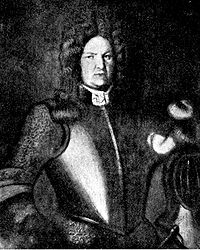
1964: Nguyen Van Troi, Viet Cong urban guerrilla

On this date in 1964, South Vietnam executed a 17-year-old Communist for a plot to assassinate American Secretary of Defense Robert McNamara.

The young electrical worker and Viet Cong urban guerrilla Nguyen Van Troi was nabbed in the spring of 1963 trying to off both McNamara, famous for the megatonnage he would bestow on Southeast Asia, and U.S. ambassador Henry Cabot Lodge, Jr.

(Later, when the South Vietnamese client president whose guests these men ostensibly were was being shot in an armored personnel carrier with the Americans’ blessing, Ngo Dinh Diem might have had cause to wish this youth’s inhospitable gesture had not been undone by his men. Lodge was a particularly vocal advocate in the Kennedy administration for overthrowing Diem.)

For the months leading up to his public shooting, he became an international cause celebre; North Vietnam would later milk his martyrdom with a postage stamp, an award, and numerous public streets.

The international reach of his case was underscored when a Venezuelan revolutionary cell kidnapped an American officer shortly before Troi’s execution, and threatened to shoot him in retaliation. (They didn’t.)

Against this, South Vietnam counterposed the unedifying spectacle of a 17-year-old patriot put to death, energetically declaiming at the stake while cameras rolled,

It is the Americans who have committed aggression on our country, it is they who have been killing our people with planes and bombs…. I have never acted against the will of my people. It is against the Americans that I have taken action.

Naturally, he became a worldwide leftist martyr. There’s an Estadio Nguyen Van Troi in Cuba; American actor Troy Garity, son of Jane Fonda from her “Hanoi Jane” days, is also named for Nguyen Van Troi.

Robert McNamara, meanwhile, had many, many years yet to live, and many, many more Vietnamese deaths to burden his conscience.Troi’s widow wrote a 1965 book about him, out of print but still available on the used book market.

On this day..

1767: William Guest, coin shaver

On this date in 1767, a larcenous bank clerk was hanged at Tyburn for robbing the till.

Sleigh ride: Detail of a studious William Guest being drawn to Tyburn (click for full print).

In this case, it wasn’t anything so gross as grabbing the money and running. No, our malefactor William Guest — the “son of a clergyman of unblemished character” whose “constant handling of gold [for the Bank of England] shook his integrity” — started milling the edges of the guineas he handled and innocuously returning them to the bank’s stock whilst piling up his own supply of gold filings.

It’s sort of the pre-digital version of the Office Space scheme: “I’m just talking about fractions of a penny here, but we do it from a much bigger tray. A couple of million times. So what’s wrong with that?” Literal profit on the margin: perfect for the FIRE sector.

Though 18th century London’s perpetual necktie party was obviously focused on the lowest classes, its busy gallows had room enough for the occasional white-collar crime.

And by England’s lights, debasing the currency was as serious a crime as there was: Guest’s conviction wasn’t for larceny or fraud, but for treason.

Because of that, he didn’t get the plain-old cart ride to the gallows, but was drawn on a sledge — the “drawn” bit of “hanged, drawn, and quartered,” although for this penny-shaver the execution itself didn’t entail the horrible quartering.

After enduring this archaic ignominy, the minister’s son “was indulged to pray on his knees” before being noosed and “his whole deportment was so pious, grave, manly and solemn, as to draw tears from the greatest part of the numerous spectators.”

On this day..

1864: Ranger A.C. Willis, parabolically

On this date in 1864, Confederate ranger A.C. Willis — whose Christian name is given as Albert or Absalom — was captured in Rappahannock County, Virginia and summarily, spectacularly hanged.

The context was the increasingly dirty war in Virginia against Confederate guerrilla John Mosby, whose rangers were severely hampering Union operations in Virginia. The northern army had resorted to less than genteel expedients with the previous month’s summary execution of a half-dozen (actual or suspected) Mosby’s Rangers.

On this date, they did it again.

According to Custer and the Front Royal Executions of 1864:

[Col. William] Powell’s men had first tied the rope they used to hang Willis with to the top of a young sapling, which was then bent nearly double. When it was released, it shot Willis skyward in an abrupt, strangled flight. Powell was jubilant about the execution he had ordered. Powell stated in his report: “I wish it distinctly understood by the Rebel authorities that if two to one is not sufficient I will increase it to 22 to one, and leave the consequences in the hands of my Government.”

We don’t have a picture of this jubilation-worthy execution, but we’ll make do with the picture in our heads.

On this day..

1943: Willi Graf, anti-Nazi medic

On this date in 1943, anti-Nazi student activist Willi Graf was beheaded at Munich’s Stadelheim Prison.

Graf was a conscientious Catholic whose disaffinity for Naziism manifested in an early refusal to join the Hitler Youth: he did a short stint in prison in 1938 for having continued associating with a banned Catholic youth league.

This subversive fellow might have been destined for the chop regardless in the black years to come, but for a thoroughgoing radicalization, he was drafted into the army as a medic and got a front-row seat on the Holocaust and the horrors of the eastern front.

During a 1942 study leave back in Munich, Graf met White Rose resistance figures Hans and Sophie Scholl and began participating in that circle’s distribution of illicit anti-Nazi leaflets.

He was arrested within months and condemned on April 19, 1943 to die as a traitor — though actual execution of the sentence waited several months on the Gestapo’s vain exertions to extract from their prey actionable information on other collaborators.

A number of schools around Germany are named in Graf’s honor.

On this day..

1878: Bill Longley, gunslinger

On this date in 1878, “gunfighter” Bill Longley was hanged for murder in Giddings, Texas.

This flim-flam man was an anti-hero of the Wild West, a near-exact caricature of everything disreputable about his milieu. Remorselessly homicidal, virulently racist, and pathologically unfaithful to any bond of honor or friendship: “an idle boaster, a notorious liar and a man of low instinct and habits,” in the estimation of an officer of the army cavalry regiment from which Longley deserted.

And he was a relentless self-promoter pleased to exaggerate both the quantity and the valor of his sixguns’ conquests.

Longley’s end at the end of a rope — for murdering his childhood friend in solidarity with some uncle’s ill-founded grudge — makes a fittingly puerile end to a repulsive career, and not least because Longley’s family later circulated rumors* that Longley had connived with his executioners to escape the noose and been spirited away under a false name.

Recent DNA testing proved that story false, but most of the Longley mythos is regrettably forensic-proof.

The outlaw himself was his own Homer, perhaps consciously playing catch-up with the legendary bandits already afoot in the land.** It’s certainly the case that he was a wanted killer, and a renowned marksman. Upon these gifts, Longley spun preposterous tales of his exploits in 1860s-70s Texas: being shot out of a noose at an attempted lynching;† slaughtering men and women (particularly blacks: his favored prey) in bunches; riding with the Cullen Baker gang; killing people in fair fights and not for their money.

“His hot temper, his fondness for liquor, and unsettled conditions during reconstruction led him to become one of the most daring gunslingers of his day,” is how a Texas state grave marker reckons him, with a warmth the Lone Star State does not reserve for its present-day “daring gunslingers.” No doubt “unsettled conditions” have been involved in many of those crime sprees as well.

Anyway, such of Longley’s record that can be substantiated better resembles a string of ambushes and uncomplicated murders, perpetrated to start with against freedmen during Reconstruction (Longley’s first known killing was of an uppity former slave in 1867, during a highway stickup), and then almost willy-nilly for plunder, race hatred, or personal pique against defenseless targets misfortunate enough to cross his path. His most “romantic” exploit was over a love rivalry … not a Capulet-and-Montague affray, but the killer bursting in on the reverend father of the girl who frustrated his designs, and wasting him with a shotgun.‡ (His actual rival got off with a pistol-whipping.)

Longley’s last arrest in 1877 removed him from these pursuits long enough to burden the local Giddings Tribune (and anybody else who would listen) with a steady supply of letters trumpeting his ferocity … and as his fate became apparent, his eventual treacly and apparently sincere contrition. “My first step was disobedience; next whisky drinking; next, carrying pistols; next, gambling, and then murder, and I suppose the next step will be the gallows.” The classic fall and redemption story.

After an escape attempt and a foiled scheme to bribe the guards, Longley gamely took his redemption in a botched hanging that dropped him so far that his feet reached the ground. The executioners had to muscle the rope back up into the air and keep it there for 11 minutes to get him where he could choke to death.

There’s an excellent HistoryNet article describing “Bloody Bill” Longley’s times and crimes in great detail here. There’s a wee genealogy, including the interesting tidbit that Longley’s father helped bury the dead of Goliad, here.

* Apparent cause of the rumor: the mom couldn’t deal with Longley’s wicked character and dishonorable death, so the family deceived her, even forging letters from “Bill Longley”.

** Most particularly, John Wesley Hardin. Longley eagerly claimed responsibility for killings that might not even have happened, in an apparent attempt to top Hardin’s body count (27 or 28) with his own (allegedly, 32). Just prior to his execution, influenced by redemption or hope for clemency or whatever, Longley downgraded his career notch count to “only” eight.

† This most famous and fantastic of all Longley’s “exploits” seems to be sourced to nobody but Longley himself; notwithstanding that prima facie credibility deficit, it’s still retailed as fact on a number of online Longley bios.

‡ This last episode was among the crimes of Longley’s last three years’ liberty that might have been prevented had not the Lone Star State refused in 1874 to honor a reward posted on the outlaw by that carpetbaggers’ Reconstruction regime. Un-paid, Longley’s captors simply turned him loose instead. That’s federalism at its finest.

On this day..

1707: Johann Patkul, schemer

On ths date (N.S.) in 1707, Livonian nobleman Johann Patkul was broken on the wheel at Kazimierz Biskupi, Poland for a decade’s treasonable scheming against the Swedish crown.

Livonia — essentially present-day Latvia, plus a chunk of Estonia — was at this time a part of the Swedish Empire in the latter’s twilight as a world power.

Financially pinched after the protracted and bloody but indecisive Scanian War, the Swedish king Charles XI imposed his great reduction — a heavy tax on the landed aristocracy allowing the crown to reclaim as its own any property that it had held formerly and granted out. There was a lot of such land mortgaged out generations before to raise capital for the Thirty Years War. War giveth, war taketh away. Hands up everyone who feels bad for the nobility.

Of course, all the 17th century nobles felt bad for the nobility.

Johann Patkul was the young — maybe too young — man deputized by Livonian bluebloods to go complain about it to Charles. When sharp but respectful eloquence predictably failed to obtain his ends, he dropped the “respectful” part — and for this lese majeste had to bug out of Sweden with an in absentia death sentence at his heels.

Having failed to obtain pardon from the offended monarch or from his heir Charles XII, Patkul just decided to change teams full stop. You could call this treachery (Charles XII did) but this is an age before nationalism. What was the Swedish royal house to a Latvian noble if he could get a better deal elsewhere?

“Elsewhere” for Johann Patkul meant Polish-Lithuanian king Augustus the Strong, and/or Russian tsar Peter the Great. Our refugee aristocrat spent the 1700s conducting vigorous behind-the-scenes shuttle diplomacy to engineer an alliance against his former masters and carve their respective pounds of flesh out of Sweden. Patkul himself, of course, would get a healthy bite from Livonia for his trouble.

In this campaign Patkul was merely an “unhappy instrument” (as a British correspondent quoted here put it): the antagonists in question had ample reason of their own for this statecraft; had they not, some itinerant conspirator pining for a lost manor could scarcely have conjured it.

But Patkul was a useful instrument: energetic, discreet, willful, and so he could surely claim some ownership of the product. Think of him as the convenient enabler — the Ahmed Chalabi of the Great Northern War that tore apart the Baltic environs for the first two decades of the 18th century.

It was rather fitting, then, that Patkul was devoured by his offspring when Sweden forced a peace upon Poland that resulted in Patkul’s being handed over to the Swedish authorities. The man’s extradition was specified by name in the treaty.

Patkul’s brutal execution inflamed some outside opinion against the Swedes (which presumably mattered not a whit to the progress of hostilities); a purported account of his execution-eve conversation with his confessor is given in this extremely sympathetic English pamphlet.

Though it’s safe to say that Patkul didn’t get what he wanted — let’s guess that the public shattering of his bones prior to a protracted death by exposure was towards the “worst case scenario” end of the calculus — the Great Northern War did indeed loose Livonia from the Swedish yoke … in favor, instead, of the Russian. Peter the Great accepted Livonia’s capitulation in 1710.

Mission accomplished.

Patkul is not to be confused with Baron Peikel/Pykul, a different fellow who was also executed for disobedience to Sweden in 1707.

On this day..

Feast Day of Saint Denis, cephalophore

October 9 marks the feast date of the early Christian martyr Saint Denis.

Guess how he died:


(cc) image from minifig of the saint’s statue at Notre Dame.

When this missionary bishop to Paris got the Roman chop* for his conversions sometime after 250, he scooped up his own severed noggin and carried it to his preferred burial spot.

Upon that eventual pilgrimage site would spring up a medieval basilica whose 12th century renovation turned it into a pioneer of Gothic architecture.

(Denis is also sort of the namesake for the Parisian hill Montmarte where he’s supposed to have been put to death: “mountain of Mars” in heathen times, it Christianized to mons martyrium, “Martyrs’ Mountain”.)

While many Christian martyrs carry the instruments of their martyrdom in iconography, and a few others roll with the bits of severed flesh exacted by those martyrdoms, Denis is only the most notable of an entire designated sub-class who carry their own heads: cephalophores.

This subject, seemingly tailor-made for a They Might Be Giants song, finally got one in 2011: “You Probably Get That A Lot”.


A most profane footnote was appended to our holy man’s legend during the French Revolution.

Journalist Camille Desmoulins once recklessly sneered of Robespierre‘s vain lieutenant Saint-Just, “He carries his head like a sacred host.”

Saint-Just is supposed to have retorted upon hearing the slight, “I’ll make him carry his like Saint Denis.” He did it, too.

* Two companions, Rusticus and Eleutherius, were doing the same conversions and suffered the same execution. Nobody named cathedrals after them.

On this day..

Unspecified date: British soldiers by urophagia

Today is the 10th anniversary of America’s post-9/11 invasion of Afghanistan, two short decades after the Soviets tried the same thing with disastrous results.


Never get involved in a land war in Asia …

In honor of this impressive anniversary, we travel back in time and into the twilit frontier between fact and legend to another century’s intervention in that Graveyard of Empires — the Second Anglo-Afghan War, 1878-1880. Dr. Watson was there; maybe even his literary compatriot Sherlock Holmes, too.

It’s too bad we don’t have the services of those excellent detectives in this matter. We can’t date this particular method, or attribute any specific victim to it, or even substantiate the actuality of the practice to our liking (though there are several books by British soldiers of that war which traffick in the report). Frankly, everything about it smells. But we think you’ll agree that execution by urophagia is a story that needs to be told.

The following is an account from a biography of English officer and novelist John Masters. We’ll label it Mature Content both for what it describes and the manner of its description, just to make you really want to savor every word.

War for the Pathans [Pashtuns] was an honourable, exciting and manly exercise, in which each succeeding generation needed to prove itself, but war was also ruthless; no mercy was shown and none was expected. Neither side aimed to take prisoners. The Pathans customarily mutilated and then beheaded any wounded or dead who fell into their hands. Women often carried out these operations. A well-known torture was called the Thousand Cuts, whereby flesh woulds were newly made and grass and thorns pushed into them so that they would hurt horribly. A prisoner might be pegged out on the ground and his jaw forcibly opened with a stick so that he could not swallow, then women would urinate in his mouth until he drowned. Frank Baines, who served on the North-West Frontier and later with Masters in Burma, put it more crudely:* ‘If you got captured, you were not only killed in a lively and imaginative manner, you were carved up and quartered and had your cock cut off and stuffed in your mouth for good measure.’

-John Clay in John Masters: A Regimented Life

* Baines penned this memorable line for his book Officer Boy

On this day..

1999: Chen Chin-hsing, Taiwan’s most notorious criminal

On this date in 1999, Taiwan put to death a man who, as the Reuters story about his case led it, “shook public confidence in law and government with the kidnap-murder of a TV celebrity’s daughter and a string of subsequent gun battles, killings, rapes and a hostage drama.”

Dramatic enough for you?

This operatic crime spree was the work of three men, Chen Chin-hsing, Lin Chun-sheng, and Kao Tien-min.

They punched their ticket to popular infamy when they snatched 16-year-old schoolgirl Pai Hsiao-yen in New Taipei City on April 14, 1997.

Her family received terrifying photos of the girl stripped naked and bound, a severed pinkie finger, and a demand for $5 million U.S. And they were in a position to get it, because Pai’s mother was celebrity singer and TV personality Pai Ping-ping. (Alternatively: Bai Bing-bing.)

However, despite multiple attempts to drop the ransom, the kidnappers kept not showing up, and the captive, who’d been brutalized and raped during her captivity, was eventually murdered and dumped in a drainage ditch.

Pai Hsiao-yen’s murder not only captivated media but crystallized public backlash against politicians and police who showed as ineffective in the midst of a massive crime wave. It helped cave in the government of Taiwan’s first democratically elected president.

The criminals themselves magnified the case by drawing out the initial public horror into a seven-month drama as they eluded police manhunts. At one point, they forced a plastic surgeon at gunpoint to alter their appearances, then murdered him after he was finished.

Chen Chin-hsing was finally captured (after the other two had judiciously committed suicide when about to be apprehended) after a televised standoff wherein Chen gave self-valorizing media interviews while holding a South African ambassador’s family hostage.

All this made Chen a dead man, and few in the Republic of China much pitied the serial rapist and spree killer’s fate of taking a magazine of automatic rifle ammunition in the chest. (Several others in this dreadful affair also got non-capital sentences for various forms of aiding and abetting.)

It also made Pai Ping-ping into a tough-on-crime social activist. Taiwan’s death penalty has been in the news recently with the government’s admission that it executed an innocent man in an unrelated case. Pai vehemently opposes the resulting abolition efforts that other case has helped along; in 2010, she helped to break a 52-month death penalty moratorium and force a resumption in executions when she threatened to commit suicide if Taiwan went through with abolition. That would be operatic indeed.

On this day..

1816: Camilo Torres, Manuel Rodriguez, and other leaders of independent New Granada

On this date in 1816, Spain hanged the leaders of a breakaway former New World possession in a vain effort to maintain control of what is now Colombia.

The United Provinces of New Granada was la Patria Boba, the “foolish fatherland” of Colombia: a welter of rival provinces and municipalities which capitalized on the mother country’s fall to Napoleon to declare independence and immediately commence fratricidal civil war.

The United Provinces had leave of several years for this foolishness before the Peninsular War ended with the restoration of Ferdinand VII, who promptly dispatched a massive expedition under the notorious command of Pablo Morillo to bring these disobedient satellites to heel … and to hemp.

The gentlemen whose death-day we commemorate today were the ones at the seat of government when the music stopped playing. Those positions, and even the forms of government itself, had been regularly reshuffled in the Patria Boba as federalist and anti-federalist, republican and royalist, threw their respective weights (and armies) around.

Morillo, who is still infamous in Colombia for his cruelty, had the most weight of all.

As Morillo’s reconquista invaded the Provinces, Camilo Torres (English Wikipedia page | the much more detailed Spanish) resigned the presidency. Torres is best-remembered now as the author of the Memorial de Agravios (Spanish link; it translates as “Memorial of Grievances” or, more Office Space-ishly, “Memorandum of Grievances”).

This incendiary document prophetically insisted that

the union between America and Spain [rest on] the just and competent representation of its people, without any difference among its subjects that they do not have because of their laws, their customs, their origins, and their rights. Equality! The sacred right of equality. Justice is founded upon that principle and upon granting every one that which is his.

-Memorial de Agravios, as translated in The Independence of Spanish America, by Jaime Rodriguez

Stuff like this was liable to get you on Morillo’s enemies list political office or no; cowing — or killing — seditious intellectuals was part of his whole project.

Torres, his predecessor and vice president (same guy) Manuel Rodriguez, and several other ministers of state were nabbed together trying to make an escape to sea.

Morillo had them subjected to a snap trial, and Torres and Rodriguez were executed this date along with Pedro Felipe Valencia (Spanish link) and Jose Maria Davila; simultaneous property confiscation left the men’s survivors penniless. (Later, Simon Bolivar would personally support the widow Torres.)

Once hemp got through with the necks this day, old-fashioned blades did their redundant work: Torres’s head was hewed off and mounted in Bogota for public viewing.

It’s noteworthy that the author of this sort of nasty warning to the public would later sign his name opposite his New World antagonist Simon Bolivar in a Treaty of Armistice and Regularization of War (more Spanish) undertaking to stop murdering prisoners and non-combatants and fight only “as do civilized peoples” — one of the seminal documents in the development of human rights and the law of war.

Spanish speakers may appreciate this timeline site on the life and times of Camilo Torres.

* Torres, that Colombian Tom Paine, took some overt inspiration from the recent American Revolution, arguing that “to exclude the Americas from such representation … would forever alienate their desires for such a union.” After all,

If the English government had taken such an important step, perhaps today it would not rue the separation of its colonies. But a feeling of pride and a spirit of vanity and superiority led to the loss of those rich possessions.

On this day..