1816: Marci Zöld, Hungarian outlaw

Legendary Hungarian outlaw Marci Zöld was executed on this date in 1816.

Zöld — Hungarian link, as are most in this post; we’ve inverted the Hungarian surname-first naming convention for ease — followed his father’s footsteps into outlawry; his heyday comprised the months following a Christmas 1815 escape from a previous imprisonment after which he and a confederate “kidnapped and plundered for several months in Sárrét, and in Bihar, Szabolcs, Heves and Szolnok counties.” (Heves was his native soil, so he’s also known as Marci Hevesen.)

By summer he had teamed up with another bandit named Pista Palatinszky and formed a gang that raided promiscuously throughout Transdanubia, escaping justice until he didn’t.

The allure of the road — moreso than any evident virtue distinguishing the brigand’s actual conduct — qualified him to be taken up by poets of the emerging Romantic age, like Sandor Petofi‘s poem which inaccurately portrays Marci doing Robin Hood wealth redistribution. Mor Jokai, Jozsef Gaal, and Lajos Kormendi are among the many other authors who have paid him tribute.

To some extent, his defiance of the Austro-Hungarian empire expressed an inchoate longing for rebellion, like the Balkan hajduks. Even moreso, it was a matter of good timing — for the 18th-19th century pivot was a peak era for romanticizing highwaymen, now that the species was disappearing into the crucible of modernity. This is the same period for the likes of Schinderhannes and Diego Corrientes Mateos; equally, it’s the moment when artists of various nationalities elevated into the cultural canon decades-dead outlaws like Dick Turpin (England) or Juraj Janosik (Slovakia).

On this day..

1903: Phil Davis, Walter Carter and Clint Thomas, multiracial lynching

From the Dec. 1, 1903 Augusta (Ga.) Chronicle:

On this day..

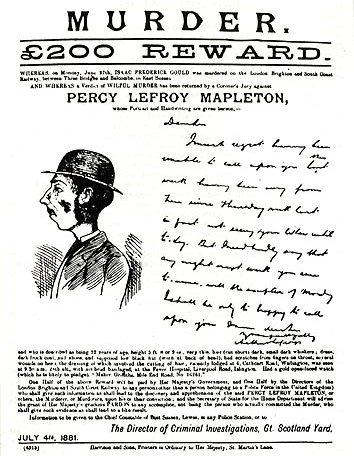
1881: Percy Lefroy Mapleton, police sketch milestone

When Percy Lefroy Mapleton plunged through the gallows-trap at Lewes Prison on this date in 1881 for robbing and murdering a train passenger, he had the consolation of a minor milestone in policing history: he was the bobble-headed subject of the first published police sketch.

Mapleton (he gave his name initially as Percy Mapleton Lefroy) entered the annals of crime lore at Brighton‘s Preston Park railway station on the 27th of June, a mere five months before his execution. On that occasion, he presented himself, bloodied and bedraggled, to a ticket agent with a complaint that he’d been assaulted on the train by two unknown men.

Maybe it was the gold watch chain dangling out of his boot (the man said he’d stashed it there for safekeeping) or an unexplained couple of Hanoverian medals he possessed (the man didn’t know anything about those!), or his keen desire to ditch the investigators and return immediately to London for some business (so why take the train to Brighton in the first place?). There wasn’t quite sufficient reason to hold him, but there was ample cause to give him a minder for his ride back to London.

Apparently Sgt. George Holmes hadn’t been fully briefed on suspect escort protocol.

During their ride, police searching the rail line by which the strange bloodied man had arrived turned up the body of an elderly coin dealer named Isaac Gold, the sort of character who would have pocket watches and Hanoverian medals to steal. A telegraph sent from the nearest station arrived ahead of Mapleton’s train, reading

Man found dead this afternoon in tunnel here. Name on papers “I Gold”. He is now lying here. Reply quick.

At this point, explicit instructions to keep eagle eyes on Percy Mapleton would hardly seem to be required — yet they were indeed forthcoming. Despite what headquarters and common sense were telling him, however, Sgt. Holmes allowed the murder suspect to talk him into letting him “change clothes” unsupervised in a house. And so began a nationwide manhunt.

This manhunt would be distinguished by a police sketch of the fugitive created with the help of Mapleton’s acquaintances. London Metropolitan Police’s (then-newborn) Criminal Investigation Department appealed to the press for help and the Telegraph made history by printing the man’s profile, first time such a drawing had hit newsprint for this purpose.

Age 22, middle height, very thin, sickly appearance, scratches on throat, wounds on head, probably clean shaved, low felt hat, black coat, teeth much discoloured … He is very round shouldered, and his thin overcoat hangs in awkward folds about his spare figure. His forehead and chin are both receding. He has a slight moustache, and very small dark whiskers. His jawbones are prominent, his cheeks sunken and sallow, and his teeth fully exposed when laughing. His upper lip is thin and drawn inwards. His eyes are grey and large. His gait is singular; he is inclined to slouch and when not carrying a bag, his left hand is usually in his pocket. He generally carries a crutch stick.

The publicity blitz generated dozens of erroneous reported sightings throughout the country, but successfully put the screws to the wanted man who was hemmed into an untenable boarding house bolt-hole with an increasingly suspicious landlady and a dwindling pool of money. At last he was

apprehended on Friday evening, July 8, at 32, Smith-street, Stepney, where he took lodgings two days after his disappearance from Wallington … He went out very little, and chiefly at night … He described himself as an engraver, and as one who needed quietness. A telegram sent by Lefroy from 32, Smith-street, to his friend Seele was the cause of his arrest. It appears that the suspicions of his landlady, Mrs. Bickers, being aroused by his peculiar mode of living, she sent her daughter to the address indicated on the telegram, which ran as follows: —

From G. Clark, 32, Smith-street, Stepney, to S. Seele, at J.T. Hutchinson’s, 56, Gresham-street, London, E.C. — Please bring me my wages this evening, about eight, without fail. Flour to-morrow. Not 33.

This telegram led some unknown person, it is said, to call at Scotland-yard, and give information.

On this day..

1789: Ann Davis, the first woman hanged at Sydney Cove

The first woman hanged in colonial Australia was Ann(e) Davis, on this date in 1789.

Convicted in London “for feloniously stealing, on the 27th day of April, eight pair of silk stockings, value 8s. the property of James Atkinson,” Davis was one of 101 female convicts transported to Sydney Cove with the First Fleet aboard the Lady Penrhyn.* Davis would have been in the crowd of onlookers the year before when the fledgling colony conducted its very first execution.

This spectacle did not un-sticky Davis’s fingers, for she was sentenced in Sydney Cove for again plundering wardrobes to the tune of

four linen shirts of the value of twenty nine shillings and six pence; one cheque shirt of the value of four pence; one linen waistcoat of the value of two shillings; two cambrick handkerchiefs of the value of three shillings; one silk waistcoat of the value of two shillings; one dimety waistcoat of the value of eighteen pence of the goods and chattels of the said Robert Sidaway; and one linen bed gown of the value of two shillings; one linen apron of the value of eighteen pence; two linen caps of the value of sixpence; one piece of a cap of the value of one penny; one muslin handkerchief of the value of six pence; and one pair of linen pockets of the value of one penny of the goods and chattels of Mary Marshall in the same dwelling house.

Davis attempted to plead her belly, failing to impress a jury of matrons impaneled to scrutinize her for pregnancy.

Seaman Jacob Nagle piteously recorded her end:

Some time after this, one of the wimen [Ann Davis] stole some wet clothes and was condemned and hung. She strove to bring a free man in guilty that belonged to our ship that was on duty on shore, it being proved by a number of witnesses that he was innocent and new nothing of it. Otherwise, she might have been saved, as the Governor left it to Captain Hunter, but he would not for give her, and when brought to gallos, leading her by two wimen, she was so much intocsicated in liquor that she could not stand without holding her up. It was dreadful to see heir going to aternity out of this world in such a senceless, shocking manne.

As noted by Australia’s Dark Heart the experience of dispatching this creature might have been especially traumatizing to the colony’s unwilling executioner James Freeman — for he was found roaring drunk a few days later and punished with 100 lashes.

* After discharging its human cargo, the Lady Penrhyn proceeded upon further circulating in the Pacific and the Far East; in 1788, she sighted and named the Cook Islands atoll of Penrhyn.

On this day..

2010: Li Haito, reliquarian

From IANS on Friday, Nov. 19 of 2010. (via)

China executes official for plundering cultural relics

Beijing, Nov 19 (IANS) China Friday executed an official for stealing and selling cultural relics protected by the state, reports Xinhua.

Li Haitao was the chief of the cultural relics protection authority of the imperial garden in the Hebei provincial capital of Chengde.

He was executed after China’s Supreme People’s Court approved the death penalty on a conviction of embezzlement, the Intermediate People’s Court of Chengde said.

By taking advantage of his post between 1993 and 2002, Li had stolen 259 cultural relics stored in the depository of the Eight Outer Temples, an imperial compound built on the three-century old Summer Mountain Resort.


Putuo Zongcheng, one of the Eight Outer Temples. (cc) image from Ana Paula Hirama.

Li, 50, replaced the relics with copies, inferior or incomplete objects, and asked his subordinates to alter the records.

The stolen items included gold gilded Buddha statues, five of which were listed as state relics under first class protection, 56 were in the second grade and 58 in the third.

Li pocketed more than 3.2 million yuan ($482,240) after selling 152 stolen pieces.

Police have seized 202 relics and are still hunting for 57 other items.

Li’s four accomplices — Wang Xiaoguang, Yan Feng, Zhang Huazhang and Chen Fengwei — were given jail terms of up to seven years with fines.

His crimes went unnoticed until a Chinese expert found two royal cultural relics belonging to Beijing’s Palace Museum at an auction in Hong Kong in 2002.

The expert reported his discovery to the state cultural heritage authorities, which prompted a probe that found Chengde was the source of the relics.

Covering an area of 5.6 million sq metres, the Summer Mountain Resort was the temporary imperial palace of the Qing Dynasty (1644-1911) emperors Kangxi and Qianlong.

The mountain villa, the largest remaining classical imperial garden architecture in China, and the outlying temples were placed on the World Heritage list in 1994.

On this day..

1872: Joseph Garcia, for the Llangibby Massacre

Spanish seaman Joseph Garcia was hanged at Usk Prison on this date in 1872, for the Llangibby Massacre.

It occurred in the Welsh village of that name, inland from the mouth of the Severn where Garcia had alit as a mariner at Newport nearly a year before.

He’d committed a burglary there, and been committed to jail for his pains. His sentence was nine months … followed by release to a foreign land whose language he barely spoke, his ship long gone and no friend or occupation to direct him.

A “short, thin man, just five feet five inches tall, with a swarthy complexion, coarse black hair and beard,” Garcia trudged the road in to the farming town. Several times he was observed loitering there but his presence was really announced by the billows of smoke pouring from the home of William Watkins, a farmworker — and neighbors who rushed to the scene beheld the horror of its owner dead from a stab wound through his throat, his wife similarly dealt with, and all three of their small children also put to the blade — their wee corpses already partly charred from the fire.

The stranger’s foreignness invited attention, of course, and when he was arrested back at Newport circumstantial evidence appeared to confirm the connection: he had some injuries and bloodstains that suggested a scrap, a pair of boots that might have been stolen from Watkins, and some stolen household articles that a surviving daughter of Watkins fortunate enough to be away from the house at the fatal hour recognized as the family’s own. He also possessed a knife that he hadn’t been discharged with.

Then as now the fury for a swarthy outlander come uninvited to go a-viking among law-abiding Britons was potent; while legal proceedings were entirely regular, “the noise outside the court was powerful enough at times to prevent the witness from being heard, and from the character of the exclamations which permeated to the interior of the court the crowd appeared ready to lynch Garcia.” (Period press quoted here.) Indeed, such a sentiment was openly published in at least one broadsheet murder ballad:

May the murderers to justice quickly be brought,
And suffer the penalty they surely have sought,
Lynch law in some countries they would very soon find,
And their bodies be swinging on the trees to the wind.

On this day..

1925: Fritz Angerstein, crime without criminal

German spree killer Fritz Angerstein was beheaded on this date in 1925.

This tuberculotic managerial type (English Wikipedia entry | German) completes an infernal trinity of notorious mass murderers of Weimar Germany, along with Fritz Haarman and Peter Kürten.

He lived a life of moderate domestic angst, with a sickly wife Käthe whom he loved and who could not carry to term any of her six pregnancies with him; once they had contemplated committing suicide together but called it off; once (seemingly no more than that) Fritz had cheated on her, but he returned to his wife willingly and didn’t actually want to discard her. Things were frostier with the meddling mother-in-law and even known to come to blows, yet still little other than a bog-standard rocky in-law relationship.

By 1924 this family was mired in debt, living in a villa owned by the mining firm who had detected Angerstein’s peculation.

On the night of November 30 to December 1, 1924, as his wife lay coughing up blood, the man snapped and turned that company villa into a charnel house.

After wildly stabbing his wife to death with a hunting knife, Angerstein went downstairs to kill himself only to be interrupted in the act by a scream upstairs as his mother-in-law discovered her daughter’s corpse. He stalked upstairs and visited a like fate on that poor woman; when the family maid burst in, he chased her down the halls as she fled for the door of her attic chamber and hacked her down too.

In a home now with the stillness of the grave, Angerstein caught a few hours’ sleep to ready himself to continue the rampage in the morning.

His 18-year-old sister-in-law arrived overnight on a train: Angerstein butchered her with an axe. A clerk and a bookkeeper of the mining firm came later in the morning, reporting in for work: Anger axed them too. The gardener, the gardener’s assistant, even a german shepherd — all met the same fate.

One might anticipate that this slaughter would culminate in that suicide the man kept attempting but instead he gave himself some non-lethal stab wounds and attempted to set his house on fire, then summoned the police with a story about a deadly home raid by a gang of bandits. Forensics, and Angerstein’s own admissions, soon rubbished this cover story.

The out-of-nowhere senselessness of this bloodbath fascinated and perplexed observers who struggled over interpretations of the — the what? the criminal? the madman? the abyss of the modern soul? He had to be sure points of stress and provocation, ingredients that could plausibly suit the backstory of a monster, but they were also ingredients carried by numberless functionaries of state indistinguishable from Angerstein who were day by day merely quietly dissipating their pains in little hobbies or shabby love affairs, in career obsession, career neglect, alcoholism, cat-fancying, countryside rambles, newspaper perusal, games of darts down the pub, and all the million little ways that we little people pass our little days. That seemed to leave Angerstein’s own instance of these slings and arrows markedly insufficient for the extraordinary consequence, if the money troubles and ailing wife are really supposed to stand for cause. Why this explosion, from this guy, at this time? Surely it wasn’t merely because the hated mother-in-law had ruined the soup that night?

One prominent knight upon these lists was thinker-scribbler Siegfried Kracauer, who might be best-known to later generations as a film critic and a mentor of Adorno. In ruminations published as Tat ohne Täter: Der Mordfall Fritz Angerstein (Crime Without Criminal: The Murder Case of Fritz Angerstein), Kracauer decoded in Angerstein’s outrage the horror of relationships dehumanized, “become objectified, with emancipated things gaining power over people rather than people seizing hold of the things and humanizing them.” Small wonder, then that “the disfigured humanity that has been repressed into the deepest recesses of unconsciousness will reappear in hideous form in the world of things.” (Quoted in Cool Conduct: The Culture of Distance in Weimar Germany.)

A deed without a doer — that is the provocative, the incomprehensible aspect of the Angerstein case. The deed is inconceivable: an orgy of ax blows and arson. Intimidating in its mere magnitude, the crime bursts the bounds of customary statutes as only an elemental event can. It is impossible to do more than stare at it; it is not to be subsumed within existing categories. Nevertheless, there it is, an undeniable fact that, for well or ill, must be registered.

But where is the doer that belongs to the deed? Angerstein? The little, subordinate fellow with modest manners, a feeble voice, and a stunted imagination? … At bottom a mere petit bourgeois, Angerstein can be outfitted with a vicious appearance only in retrospect by overheated journalists. Had one encountered him prior to the crime on the street, one would have asked him for a light and quickly forgotten his features.

Even today, or today once again, he remains stubbornly at home in the narrow confines of inborn mediocrity. His behavior during the trial has been minimal in every respect. There have been no sudden eruption to help us chart a connection between the man and what he did, no outbursts to suggest a subterranean fiendishness, nor the kind of silence that would correspond to what happened. Instead, he has withdrawn into trivialities into a dull state of shock wholly incommensurate with its cause, a confused acceptance of what he himself does not understand.

Angerstein, in Professor Herbertz’s depiction of the events, did not commit the deed; the deed happened to him. Having transpired, it detached itself from him and now exists as a purely isolated fact for which there is no proper cause. It rose up out of nothing for the while of the murders, a dreadful “it” out there in space, unconnected with him. If the soup had not been burned — a triviality become a link in a chain of external causation — Angerstein’s victims would have gone on living and no one but his fellow citizens of Haiger would ever have heard his name. The crime looms gigantically over him; he disappears in its shadow.

In the winter of 1924, the event comes out of nowhere. Minor illegalities preceded it, a confusing swindle, no one knows how or why. Running amok, it seems that a physician’s attentions merely added to the burdens. His previously neatly bounded world was slipping through his fingers. The woman of his obsession draws him with her toward a longing for death, for an end to it all. He may have been thinking of suicide as he stabbed her — but why the frenzy with the hunting knife and the ax, why the senseless bashing of the skulls of uninvolved others? What sucked him, the minor administrator, for a night and a day into the cyclone of devastating violence?

Many details confirm the assumption that the quiet manager was caught unawares by some unknown something inside him. He admits that he himself cannot understand, cannot conceive, that the gigantic fact came out of him. His early attempts to deny it are ridiculously petit bourgeois. Now that he has acknowledged being the perpetrator, he gazes fixedly at what others designate his crime. His evasions from now on have to do with incidentals, his excuses with mere details. The actual misdeeds weigh on him like a block of lead he cannot cast off.

If he is conscious he flees into sleep, sleeping double the usual amount, because his memory wants to disappear. The fact outside there, which is undeniably related to him is completely overwhelming; he does not like to taste or feel it. Suicide is also beyond the bounds of his horizon, now narrowed to a point. His reading is the Bible, which perhaps brings him by way of detours into contact with his wife.

A deed without a doer that has nothing, but nothing, in common with those great crimes committed by people whose names live on in popular memory. Those crimes were manifestations of a will, however misguided; they were eruptions of unbridled natures, twisted minds, the expression of outsized drives and passions. They stemmed from a place in the guilty person, were not just there alongside him, existing inadequately in space.

The deeds that now go by the name of Angerstein lack a personal point of reference, without, however, that meaning that they were born of mental illness. That there is no sufficient reason for them in the consciousness of the doer is what turns them into a tormenting puzzle, what lends them the uncanny remove of mere facts. It may be that depth psychology is correct in claiming that they emerge to the light of day out of the craters of unconscious psychic life; it has not, however, solved the puzzle of how such a thing is possible.

On this day..

1615: Anne Turner

For Sommersett must love Essex faire wife
by wich his deerest servant lost his life.
losse upon losse, all things grow cleane contrary
and thus our sinfull times themselves doe vary.

From a 17th century libel

On this date in 1615, Anne Turner hanged at Tyburn for a shocking society murder remembered as the Overbury Affair.

Turner was quite a character herself, but her journey to the pages of Executed Today begins in the bedsheets of the nobility. In fact, events revolve around a marriage alliance between two families of notable beheadings, in the persons of Frances Howard — the grandsondaughter of Queen Elizabeth’s enemy Thomas Howard (beheaded 1572) — and Robert Devereux, Earl of Essex — son of Queen Elizabeth’s lover also named Robert Devereux (beheaded 1601).

‘Twas often that noble pairings were cynical, loveless expediencies but this union exceeded most in its deficiencies.

They married so young — 13 to 14 years old as they tied the knot — that they were initially kept apart to prevent them sleeping together but this failure to consummate developed into firm policy. Devereux was impotent with her — even though, per Francis Bacon’s investigation, “before and after the marriage, he hath found an ability of body to know any other woman, and hath oftentimes felt motions and provocations of the Flesh, rending to carnal copullation” — and Howard seemingly systematically refused him. (Devereux was elsewhere heard to note that his virility failed because his wife “reviled him, and miscalled him, terming him a cow, and coward, and beast.”)

By that time — we’re into 1613 here — the missus was also intentionally trying to force an annulment of the marriage, so that she could pursue love and power with the king’s young favorite, Robert Carr. Both spouses agreed that their union had never been consummated, a fact “verified” by a panel of matrons who inspected the wife’s bits to confirm the presence of the hymen. Frances was veiled during this humiliating spectacle to preserve her modesty and/or identity, as widely believed rumor held that she’d swapped in a ringer to pass the exam.

This maide inspected;
But fraud interjected
A Maid of more perfection:
The midwives did her handle,
While the Kn[igh]t held the candle
O there was a clear inspection!

While Frances was orchestrating all this, her lover’s close friend Sir Thomas Overbury was energetically counseling that youth against the match, going so far as to write one of the classics of Jacobean poetry, “A Wife”, expounding on the preferred virtues of such a partner in an apparent attempt to underscore to his chum Frances Howard’s conspicuous want of them, e.g.

Where goodnesse failes, ’twixt ill and ill that stands:
Whence ’tis, that women though they weaker be,
And their desire more strong, yet on their hands
The chastity of men doth often lye:
Lust would more common be then any one,
Could it, as other sins, be done alone.

Long story short, the mistress won the struggle over the valuable Robert Carr and her powerful family arranged to sideline Overbury by means of a royal appointment to Russia. When Overbury refused the post, the outraged King James had him locked up in the Tower of London for his impertinence; Overbury soon died there, and Frances Howard and Robert Carr tied the match before 1613 was out.

Carr should have listened to that poem.

It was no more than months ere that gentleman was being eclipsed in King James’s favor by George Villiers, and his eroding status licensed the interest of court enemies in the surprise death of Carr’s friend.

Suspicions of foul play soon appeared vindicated, and we come at last at this point to our gallows-fruit Anne Turner, a wealthy woman in the train of Frances Howard, for the evidence developed by Bacon indicated that Turner acted as Howard’s agent in arranging for Overbury’s guards to poison him off.

The affair was the ruin of her patron, who was convicted along with her prized new husband.* Both of these blueblooded types were spared, but no such mercy obtained for the four commoners who had been the Lady’s instruments.

Turner, who did a brisk business in saffron supplying the royal court its fashionable yellow accoutrements, arranged for “tarts and jellies” procured from a sinister chemist to be delivered to the men at the Tower for ministration to the imprisoned poet. Really it was just as Overbury had tried to warn Carr:

A passive understanding to conceive,
And judgement to discerne, I wish to finde:
Beyond that, all as hazardous I leave;
Learning and pregnant wit in woman-kinde,
What it findes malleable, makes fraile,
And doth not adde more ballast, but more saile.

She, the chemist, and both Overbury’s jailer and the governor of the Tower of London would all four suffer execution on distinct occasions for doing the Lady Howard’s bidding in this matter. Turner’s hanging at Tyburn had a classic dash of showmanship: both the victim and the executioner were pointedly dressed in the yellow saffron ruffles whose lucrative traffic had empowered Anne Turner with the werewithal to corrupt the king’s dungeon. The design fell speedily out of fashion.

Our intrepid assassin, however, had the consolation of a vigorous literary afterlife as her character became a fixture of the 17th century theater. (So did Overbury’s.)

The Overbury Affair’s rich text touching power, gender, commerce, revenge, social climbing, print culture, and murderous intrigue has continued to fascinate new audiences ever since then, intermittently refreshed by many new volumes both fiction and non-.

* Frances Howard confessed the plot — accurately, as it is generally understood. Robert Carr never did, and he’s often been read as a plausible naif, blind to his pretty new wife’s vengeful treatment of his former bosom friend.

On this day..

1989: Solomon Ngobeni, the last hanged in South Africa

South Africa conducted its last execution on this date in 1989: that of Solomon Ngobeni, for robbing and murdering a taxi driver.

Apartheid South Africa had long been one of the world’s most prolific users of capital punishment. According to Wikipedia it had logged nearly 3,000 executions over the 30 years previous, including a one-year count of 164 as recently as 1987.

But the policy was about to see a sudden reversal — along with the policy of apartheid itself.

Earlier that same year, the South African presidency had been assumed by F.W. de Klerk. Much to everyone’s surprise, the copper-bottomed Nationalist Party conservative set about dismantling the entire white-rule infrastructure. Once he’d secured his term de Klerk moved with alacrity, immediately permitting some anti-apartheid marches that his security services wanted to shut down and proceeding apace to more dramatic reforms that within a few years saw off apartheid altogether.

Shuttering the Pretoria Central Prison gallows was one early gesture in this same campaign, considering the many martyrs that platform had made of regime opponents down the years. In 1990, de Klerk pronounced a formal moratorium on executions and he never lifted it; in 1995, the first politically weighty ruling of the post-apartheid Constitutional Court abolished capital punishment.

However, Ngobeni has no assurance of maintaining his milestone distinction in perpetuity. In present-day South Africa, blighted by a great deal of violent crime, reinstatement of capital punishment enjoys the support of several political parties and a sizable majority of the public.

On this day..

1951: Marcel Ythier, Andre Obrecht’s first

On this date in 1951, Marcel Ythier lost his head as France gained a headsman.

Ythier escaped a life sentence at hard labor and fled to Aix-en-Provence to build a burglary career, which improved to a murder career when he shot dead the constable who surprised him in the act in May 1950.

Ythier’s was the first execution conducted by Andre Obrecht, nephew to the great head-chopper Anatole Deibler and the latter’s heir as France’s chief executioner. Indeed, Obrecht would be the last chief executioner in every sense but literally, carrying the title from 1951 to 1976, when he beheaded Christian Ranucci, the third-last fall of the guillotine. (Francophone specialists might go for Obrecht’s memoirs.)

Obrecht resigned the post a few weeks after Ranucci’s controversial death, leaving his own nephew (and longtime assistant executioner) Marcel Chevalier to write the illustrious profession‘s Gallic finale with the two last executions in French history.

Not to worry: the classic bourreau lives on as one of the jokers in Executed Today’s pack of custom playing cards.

On this day..