1986: Kevin Barlow and Brian Chambers, Dadah is Death

On this date in 1986, Malaysia hanged Australian nationals Brian Chambers and Kevin Barlow for trafficking heroin.

The two men were nabbed together at the Penang island airport with 179 grams of heroin in their packs. While Chambers was an experienced drug courier, Barlow was a rookie; reportedly, his visible nervousness in the airport gave the game away. (He had also refused out of revulsion to pack the product into his stomach or anus.)

Although the amount they carried far exceeded Malaysia’s then-brand-new 15-gram threshold for an automatic death sentence, “Westerners” so-called had never yet actually been hanged there. The two were initially sanguine about their situation, expecting a mixture of bribes and diplomatic logrolling to do the trick.

Over the 20 months between arrest and their July 1985 trial, they realized their true predicament.

According to Bruce Dover, who covered their trial for Australia’s Herald Sun, “They turned on each other. The parents and family members who Barlow and Chambers had early agreed to ‘keep out of it’ now watched on helplessly from the court gallery, as each man tried to implicate the other in a desperate gambit that at best would send one man to the gallows while the other walked free … [and] in their efforts to save themselves, each had condemned the other to die.” In Dover’s estimation, the very best they could have hoped to achieve was to have one man shoulder the blame to save the other.

International appeals from all the usual suspects — Australia Prime Minister Bob Hawke, the Pope, various human rights organizations, and even Margaret Thatcher (because Barlow was a British-born dual citizen) — failed to move the Malaysian Prime Minister Mahathir Mohamad. If anything, the clamor only strengthened the domestic political imperative to advertise Malaysian resolve in a high-profile case against the special pleading of foreign busybodies.*

“Like many people of European descent, they [Barlow and Chambers] have assumed that a white skin was protection against local laws,” a Kuala Lumpur newspaper editorialized. “That is also the unspoken assumption among many in the foreign media who are now in this country. The two men should be hanged.”

They were.

A 1988 Australian television film about the Barlow and Chambers case, Dadah Is Death — “dadah” being the Malaysian word for drugs — is a star-studded affair, featuring Julie Christie on the marquee as Kevin Barlow’s mother in her fight to save her son, opposite appearances by then-little-known youngsters Hugo Weaving, Sarah Jessica Parker, and John Polson.

* A similar script played out in neighboring Singapore with a Dutch smuggler a few years later.

On this day..

1961: Edwin Bush, Identikitted

On this date in 1961, Edwin Bush was hanged at Pentonville Prison. On March 3 of that same year, he’d stabbed to death an assistant at a Loondon antiques shop just off Charing Cross, using a pair of antique daggers from the shop’s own stock. (The scene of this long-ago crime is presently a bookstore.)


The Identikit sketch, and the actual photo, of the culprit.

Although a small-time criminal, Bush was an important milestone in the evolution of the panopticon.

Poor Elsie May Batten had been attacked early in the morning, and nobody witnessed the crime. The killer/robber (he stole a sword that he later sold for 15 quid — nothing else) hadn’t left behind any usable physical clues.

“It could have taken weeks to identify the culprit,” notes this MyLondon.News profile, “but luckily a change in police technology would be of great assistance.” This new system, called Identikit,

used a standardised set of facial features to help a witness build a more accurate picture of a suspect.

In shop owner Louis Meier’s interview, Identikit was used to build a picture of the suspicious man who had gone into the shop the day before Elsie’s killing to admire the sword.

Another witness, who had seen a man and his blond girlfriend try to sell a sword on St Martin’s Lane that very same day, also did the Identikit procedure. Two facial likeness from two different witnesses were unmistakably the same man — and they were printed in the local newspapers asking people if they had seen a man looking like this and his blond girlfriend.

Janet Wheeler, the 17-year-old blond girlfriend of Bush, saw the Identikit and joked about how they fitted the description, unaware of what her boyfriend had done.

But Eddie couldn’t count on such naivete from Londoners who weren’t his girlfriend. An eagle-eyed beat cop recognized Bush from the same wanted pictures and arrested him on March 16, just steps away from the antiquarian. He was with Janet, shopping together for engagement rings. Once they had him, fingerprints, lineup identifications, and eventually a confession all fell into place.

What’s been left unspoken thus far is the story’s racial character, but that factor permeates everything. Edwin Bush’s mixed Asian-white parentage helped consign him to the periphery of London’s economic life, his unusual look possibly helped cinch the surveillance triumph for Identikit … and if Bush is to be believed, it was everyday racism that triggered his crime.

Provoked, he said, when he visited the store just to browse for the second consecutive day only to have Batten drop a racial slur on him (“You niggers are all the same. You come in and never buy anything.”), Bush

went back to the shop and started looking through the daggers, telling her that I might want to buy one, but I picked one up and hit her in the back. I then lost my nerve and picked up a stone vase and hit her with it. I grabbed a knife and hit her once in the stomach and once in the neck.

Of course, only Bush and Batten were present for their conversation, and it must be acknowledged that when Bush made this allegation about his victim, he needed to give the courts reason to mitigate his sentence.

You can hear all about the case on your run or commute in episode 7 of the Murder Mile UK crime podcast.

On this day..

1945: Harold Pringle, the last Canadian military execution

The only Canadian soldier to be executed during (… actually well after!) World War II, Harold Pringle, caught a fusillade in Italy on this date in 1945.

A 16-year-old — he fibbed about his age — enlistee from small-town Ontario, Pringle joined the Hastings and Prince Edward Regiment.

Pringle and a mate in the Hasty P’s name of “Lucky” MacGillivray linked up with some British deserters to form a black market outfit in conquered Rome. The “Sailor Gang”* enjoyed several weeks of picaresque living in the lawless city. Unsurprisingly, as Allied military authorities got control of the place they were eager to make examples of these minor gangsters. (Major gangsters were a different matter.)

The shooting death of that mate MacGillivray gave military prosecutors the means to sink the Sailors. One of their number was induced by a sweetheart deal to finger Pringle as for murdering him. Pringle and his comrades all contended that “Lucky” had been shot by mischance during one of the outlaws’ frequent drunken bouts, and having died en route to the hospital, Pringle shot him up posthumously in hopes of making the body look like it had been prey to a gang hit.

Despite all the trouble taken to secure a very dubious conviction, the execution itself was carried out in great secrecy by a tiny rump contingent of Canadians — all their fellows had already been withdrawn from Italy — who were not to speak of it afterwards.

According to Andrew Clark, the author whose research revealed the event to the wider public in A Keen Soldier: The Execution of Second World War Private Harold Pringle, it all came down a political balancing act. Canadian Prime Minister William Lyon Mackenzie King faced a June 1945 election (followed by formation of a coalition government) that a controversial execution might complicate.

However, the British had executed two of their guys in the Sailor Gang case, and reciprocity was expected on a diplomatic level. So the solution was to do it as quietly as possible, and cover it with an official secret designation. Even Pringle himself didn’t find out his sentence was confirmed until the morning of the execution.

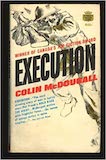
Book CoverBook Cover
Left: The classic antiwar novel inspired by the Pringle case, which was the only novel published by Colin McDougall. Right: The 2002 nonfiction treatment that brought the affair to the public eye. Below: A 1955 episode of Four Star Playhouse also seems to be based on the Pringle case, and Colin McDougall is credited with the story.**

There’s a riveting audio interview here with a member of the Hastings and Prince Edward Regiment who had guard duty on the condemned youth on the last night of his life. “Just as brave as could be,” Orville Marshall reports.

* There’s another infamous troupe of deserter-gangsters operating in Rome in this same period, the Lane Gang. The said “Lane” — whose real name was Werner Schmiedel — was hanged by American authorities in June 1945.

** McDougall served in Italy up to the end of Canada’s involvement there, and that is surely how he came to know about the secret execution in a general sense; any more specific vector of information appears to be unknown. However discovered, Pringle clearly haunted McDougall: he took several years to write his magnum opus, and also published a short story in McLean’s in the early 1950s called “The Firing Squad”.

On this day..

1778: Bathsheba Spooner, the first woman hanged in the USA

Bathsheba Spooner, the first woman executed* in the post-Declaration of Independence (i.e., post-July 4, 1776) United States.

The daughter of one of Massachusetts’s most prominent Tory loyalists — the latter fled to Nova Scotia during the events comprising this post, owing to the ongoing American Revolution — Spooner was married to a wealthy Brookfield gentleman whom she utterly despised.

From late 1777 into 1778, Bathsheba beguiled three young would-be Davids — Ezra Ross, a wounded former Continental Army soldier whom she nursed back to health; and James Buchanan and William Brooks, two redcoat deserters — into getting rid of Mr. Joshua Spooner.

Ross she sent on February 1778 business trip with her hubby and instructions to dose him with nitric acid. The youth chickened out and didn’t do it — but neither did he warn his proposed victim what was afoot.

A couple of weeks later, the Brits achieved by main force what their American opposite dared not attempt by stealth, and “on the evening of the first of March, about 9 o’clock, being returning home from his neighbors, near by his own door was feloniously assaulted by one or more ruffians, knocked down by a club, beat and bruised, and thrown into his well with water in it.” Ross, importantly, had been invited by his lover/sponsor to return and he helped to dispose of the body.

They had not a day’s liberty after this shocking crime, evidently having thought little beyond the deed; the very young Ross especially stands out for his naivete — certainly mingled with lust and cupidity as he contemplated the prospect of attaining a frolicsome, wealthy widow — when the wife went to work on him.

As She was going to Hardwick She asked me the Reason of my being so low Spirited?  I made answer It was my long absence from home.  She replyed that her Opinion was, I wanted some one to lodge with — I told her it would be agreeable.  She asked me if Such an One as her self would do?  I made answer If She was agreeable I was.  [Marginal notation: The Dialect was so.]  Upon which She said “After She came off her Journey she would See.”
 
N.B. After her Return She Gave me an Invitation to Defile her Marriage Bed; which I Expected. [accepted] And after that she proposed constantly every sheam [scheme] for her Husbands Death.  [Marginal notation: The spelling is so.]
 
Ezra Ross

The above is a written account given in jail to the preacher Ebenezer Parkman, who preached a thundering sermon three days after the executions titled “The Adultress Shall Hunt for the Precious Life””

a woman who … allows her loose imagination to range and wander after Others, nay not a few, & rove from [her husband] to pollute & defile the marriage bed [indulging] her own wanton salacious desires … How loathsome are all such, and how directly opposite the pure & holy Nature, Law, and Will of God.

So keep thee from the Evil woman, from the flattery of the tongue of a strange woman. Neither let her take thee with her eyelids. There are a thousand dangers, that poor young wretches are in by reason of the snres & traps which are everywhere laid … particularly the poor beardless youth not quite 18. (As quoted in Deborah Navas’s book about the affair, Murdered by his Wife)

Mrs. Spooner, whose Loyalist family ties did her no favors in this moment, sought a reprieve on grounds of pregnancy. Many condemned women in those days made such requests; more often than not they were temporizing devices that bought no more than the time needed for a panel of matrons to examine them and dismiss the claim. In her case, four examiners submitted a dissenting opinion to the effect “that we have reason to think that she is now quick with child.” Although overruled, they were correct: after the dramatic quadruple execution under a thunderstorm at Worcester’s Washington Square, an autopsy found that Spooner was about five months along with what would have been her fifth child.

According to an early 20th century Chicago Chronicle retrospective (retrieved here via a reprint in the Charleston News and Courier, Jan. 24, 1904) her grave can be located on a manor at Worcester that formerly belonged to the great New York City planner Andrew Haswell Green: Bathsheba Spooner’s sister was Green’s grandmother.

A full original record of the proceedings does not survive for us, but this public domain volume has a lengthy chapter about events, with an appendix preserving some of the original documents.

* We’re at the mercy of uncertain documentation in this context, of course, but there are at least none whose executions can be established that predate Spooner’s within the infant republic. Per the Espy file, a woman named Ann Wyley was hanged in Detroit in 1777, but at the time that city was under British administration as part of the province of Quebec.

For its part, Massachusetts hanged several more women in the 1780s, but has not executed any other women since the George Washington presidential administration. It’s presently a death penalty abolitionist jurisdiction.

On this day..

2004: David Harris, Errol Morris subject

Errol Morris’s classic 1988 docudrama The Thin Blue Line helped to exonerate former death row inmate Randall Dale Adams.* He’d been convicted of shooting a Dallas police officer to death during a traffic stop.

On this date in 2004, the man who really pulled the trigger, David Ray Harris, received lethal injection. It wasn’t the murder of Officer Robert Wood he was being punished for: after more or less confessing the crime to Morris’s recorders, Harris was never charged with it. By that time, he was already on death row for an unrelated 1985 murder.

Randall Adams published a book about his ordeal. He died of brain cancer in 2010.

* Adams avoided execution in 1980 and had his sentence commuted. He was still in prison, but no longer on death row, at the time of the film’s release. He was released outright in 1989. Filmmaker Morris describes how he came to make the film — and how Adams “never will be exonerated” officially — in this interview with Bill Moyers.

On this day..

1958: Raymond John Bailey, for the Sundown Murders

On this date in 1958, itinerant carpenter Raymond John Bailey was hanged for one of Australia’s most sensational crimes.

This case derives its gloomy appellation, the Sundown Murders, from the same crepuscular handle dignifying the abandoned South Australia station where the bodies of Sally (Thyra) Bowman (43), her daughter Wendy Bowman (14), and family friend Thomas Whelan (22) were discovered in their Vanguard. All three had been bludgeoned and shot, as had the Bowman’s two dogs — an utterly shocking outrage.

The Outback dirt retained sign of the killer’s own conveyance with its telltale trailer; reported sightings pursuing this clue led a gigantic manhunt to the Queensland hospital where Bailey had gone to work … having driven there with a caravan in tow on a northbound course suitable to cross paths with the victims. He owned an unlicensed rifle; the theory of the case, supported eventually by a confession which Bailey repudiated as given under duress,* was that Bailey set upon the vehicle to rob it and even took the trouble to siphon the petrol — which was “dear up in that neck of the woods and Bailey’s old car and caravan would not be doing more than 10 or 12 miles to the gallon.” (Crown prosecutor E.B. Scarfe)

In the 21st century, investigative journalist Stephen Bishop has notably pitched a case for Bailey’s outright innocence. Bishop’s The Most Dangerous Detective: The Outrageous Glen Patrick Hallahan contends that the titular lawman — he’s the leftmost fella on the picture above, taken at Bailey’s arrest — railroaded the suspect, forcing him into a confession that “does not tally with other evidence” and ignoring potentially exculpatory details like footprints at the murder scene too large to be Raymond Bailey’s.

Bishop’s appeals for an official exoneration have thus far gone nowhere.

* Not his own torture, but the threat — in fact the nearby sound — of his sobbing wife being interrogated.

On this day..

1786: Phoebe Harris, coiner

(Thanks to Richard Clark of Capital Punishment U.K. for the guest post, a reprint of an article originally published on that site with some explanatory links added by Executed Today. CapitalPunishmentUK.org features a trove of research and feature articles on the death penalty in England and elsewhere. -ed.)

Up to 1790, women convicted of High Treason and Petty Treason were burned at the stake. Although I am sure you have a perception of what High Treason is, as a crime in those days, it also encompassed several other offences, notably coining. Coining covered several individual offences relating only to gold and silver coins, e.g. clipping coins to provide coin metal for forgeries, colouring coins to make them appear of higher value, making counterfeit coins and having the equipment to do any of the above. Coining was considered treasonable because it directly affected the State and confidence in the currency.

The crime.

Under the name of Mrs. Brown, Phoebe Harris had rented a room from one Joel Sparkes at a house in Drury Lane, London (No. 19, in Swan-yard) before Christmas 1785. A friend of hers, Francis Hardy, had recommended her to Sparkes, describing her as a captain’s widow with a private income. In reality, it seems that Phoebe had been separated from her husband for two or three years. Whilst Phoebe lived at this address she was regularly engaged in filing and clipping coins and then using the metal to make new counterfeit coins in sand moulds. Francis Hardy was the person who was later to inform the police of the goings on at No. 19. There was a suggestion, flatly denied by him in court, that Francis Hardy had had a relationship with Phoebe. He did, however, take her teenage daughter in as a servant on the day of her mother’s arrest.

Arrest.

At about 5 o’clock in the afternoon of Saturday, the 11th of February 1786, John Clarke (a constable) went to No. 19 in consequence of the information he had received and found Phoebe Harris and Elizabeth Yelland in the first floor room. He and his assistants, George Meecham, Patrick Macmanus, and William Andrews, broke down the locked door and arrested the two female occupants. They then searched the room in which they found some counterfeit coins and the necessary equipment for coining in an adjoining closet.

When John Clarke compared the counterfeit shillings to genuine ones, it was clear that they had been cast from a mould made from a genuine shilling. In all, some 12 counterfeit coins were discovered, both shillings and sixpences. One of the genuine sixpences had a hole in it and this was evident in the counterfeits.

A little later, after the rooms had been searched, Elizabeth’s brother, Joseph Yelland, returned home and was also arrested. All three were taken to Bow Street to appear before a magistrate. They were remanded in custody at Newgate to stand trial at the next Sessions of the Old Bailey.

The trial.

Capital trials at this period took up very little time with a number being conducted during a single day. The April Sessions of the Old Bailey in 1786 were held on Wednesday, the 26th of that month, before Mr. Baron Eyre. Among those indicted were Joseph Yelland, otherwise known as Holman, Phebe Harris (spelling of Phoebe as given in the original indictment) and Elizabeth Yelland, who were jointly charged with two specimen counts, as follows: “for that they, on the 11th of February last, one piece of false, feigned, and counterfeit money and coin, to the likeness and similitude of the good, legal, and silver coin of this realm, called a shilling, falsely, deceitfully, feloniously, and traiterously did counterfeit and coin, against the duty of their allegiance, and against the statute.” There was also a second count of coining a sixpence. The shilling is the equivalent of the current 5p coin, whilst a sixpence is the equivalent of 2.5p. Although in 1786, these two coins had much greater purchasing power they were still coins of small denomination.

The prosecution was opened by Mr. Silvester, assisted by Mr. Wilson and Mr. Garrow led the defence. [Silvester and Garrow were famous combatants at the bar. See this post for another instance. -ed.]

The case was heard before the 2nd Middlesex jury, consisting of twelve men. Both sides were able to call witnesses and cross examine those for the other side. In this case, the Crown called the constables involved in the raid, together with the landlord and his son. They also called Francis Hardy, who gave direct eyewitness evidence of the manufacture and colouring of the counterfeit coins. The coining equipment found in the rooms was produced in court as evidence. Hardy also suggested that the group had bought forged coins from other criminals to pass off as good — also a capital crime then, known as uttering. He stated in his testimony that she continued with the coining business even though she knew that Hardy was fully aware of what she was doing. It appears that there had been some disagreement between Hardy and Phoebe and this may have led to him informing on her.

The defence was principally based upon the testimony of character witnesses for each of the defendants who averred them to be people of good character. Phoebe addressed the court as follows: “My Lord and Gentlemen of the Jury, I am an unhappy woman; I was desired by a young man of the name of John Brown, to take the room, which I did, and he brought the things found in the room; and desired me to secrete them, and I not knowing the nature of them, or for what purpose they were intended, did do so, and so I told the gentleman when they came and took me: as to my sister-in-law, I being very ill, she came to clean the room for me, and the gentleman found her cleaning it on her knees: and my brother-in-law came some time after the gentlemen had been in the room.”

She also called two character witnesses.

The jury took some time in their deliberations before finding Phoebe guilty and, despite Francis Hardy’s evidence against them, acquitting Elizabeth and Joseph Yelland. As was normal sentencing of all those convicted, took place at the end of the Sessions. Nine prisoners were condemned to death, these being: Hannah Mullins, William Smith, Edward Griffiths, James May, George Woodward, Daniel Keefe, Jonathan Harwood and William Watts, who were sentenced to be hanged while Phoebe was condemned to be burned at the stake. Many other prisoners were sentenced to transportation or imprisonment. Hannah Mullins and James May were subsequently reprieved to transportation. The condemned were returned to Newgate prison to await their fates.

Execution.

Phoebe Harris was to be the first woman burnt at Newgate, as distinct from Tyburn or Smithfield, and her execution was carried out just after 8.00 a.m. on the morning of Wednesday the 21st of June 1786. A huge crowd, estimated at some 20,000 people, had turned out to watch this gruesome spectacle.

At 7.30 a.m. six men, Edward Griffiths, George Woodward, William Watts, Daniel Keefe, Jonathan Harwood and William Smith were brought out through Newgate’s Debtor’s Door and led up onto the “New Drop” gallows. They were prepared in the usual way and the drop reportedly fell around 8.00 a.m.

After they were suspended, Phoebe was led from the Debtor’s Door of Newgate by two sheriff’s officers to a stake that had been erected halfway between the gallows and Newgate Street. The stake was some 11 feet high and had a metal bracket at the top from which a noose dangled. Phoebe was described as, “a well made little woman of something more than thirty years of age, with a pale complexion and not disagreeable features.” She was reported to be terrified and trembling as she was led out. She mounted a stool and the noose was placed around her neck and was allowed a few moments to pray with the Ordinary before her support was removed and she was left suspended. According to V. A. C. Gatrell’s book The Hanging Tree she died hard, he reported that she choked noisily to death over several minutes.

After hanging for half an hour, the executioner put an iron chain around her upper body and fastened it to the stake with nails. Two cart loads of faggots were now piled around the stake and then lit. It is reasonable to assume that she would have been quite dead by this time. After a while, the fire burnt through the rope and Phoebe’s body dropped, remaining attached to the stake by the chain. It took over two hours to be completely consumed by the fire, which continued to burn until midday.

Comment.

Only two more women were to suffer Phoebe’s fate. These were Margaret Sullivan on the 25th of June 1788 and Catherine Murphy on the 18th of March 1789, both for coining. At the April Sessions of 1790, Sophia Girton was also convicted of this offence but her execution was delayed until after Parliament had passed an Act (Act 30 Geo. III, c.48) substituting ordinary hanging for coining offences on the 5th of June 1790. In fact, Sophia was ultimately pardoned, on condition of transportation for life to New South Wales, on the 12th of June 1790.

Executions by burning at Newgate were distinctly unpopular with the local residents of what was a respectable business area of the City. They had sent a petition to the Lord Mayor requesting that Phoebe’s execution be carried out elsewhere. This was an early version of “not in my back yard” rather than a protest against the severity of her punishment. It was later reported that some locals became ill from the smoke from her body. There were similar protests over the Sullivan and Murphy executions and a great feeling of relief when Sophia Girton was reprieved, and the whole ghastly business passed into history in 1790.

The Sheriffs were also becoming increasingly unhappy about attending burnings, and it was they who brought forward the Bill to end this practice. Even though by this time the condemned woman was dead before the faggots were lit, it must have still been a gruesome and revolting spectacle and one which conveyed a feeling of injustice. Men convicted of coining offences were hanged in the same way as other condemned males. The Times newspaper took up this theme after Phoebe’s burning and printed the following article: “The execution of a woman for coining on Wednesday morning, reflects a scandal upon the law and was not only inhuman, but shamefully indelicate and shocking. Why should the law in this species of offence inflict a severer punishment upon a woman, than a man. It is not an offence which she can perpetrate alone — in every such case the insistence of a man has been found the operating motive upon the woman; yet the man is but hanged, and the woman burned.” One can only agree with the “Thunderer’s” sentiments as the Times came to be known. Other London newspapers carried similar articles. Again similar outrage was expressed two years later at the burning of Margaret Sullivan, although strangely there was little media interest at the burning of Catherine Murphy.

On this day..

2014: Mahmoud Al Issawi, murderer of Laila Ghofran’s daughter


Hiba Al Akkad (standing) embracing her famous mother.

Mahmoud Al Issawi was hanged at Wadi el-Natrun prison outside Cairo on this date in 2014.

In 2008, he stabbed to death Hiba Al Akkad, the 23-year-old daughter of Moroccan star singer Laila Ghofran, along with Heba’s friend Nadine Gamal, in the course of a botched burglary in Cairo’s affluent Sheikh Zayed suburb.

On this day..

1751: Thomas Quin, Joseph Dowdell, Thomas Talbot, and five others at Tyburn

From the Newgate Calendar:

THOMAS QUIN, JOSEPH DOWDELL, AND THOMAS TALBOT

A Gang of Notorious Thieves, executed at Tyburn, June 17, 1751, for robbery.

At length these miserable robbers see,
Unhappy fruit, suspended on the tree;
They teach, sad lesson! in their wretched state,
That shame and ruin are the villain’s fate;
And that too late each guilty man will find,
Justice, though sometimes slow, is never blind.

The villains disclosed in this narrative, will shew the necessity of the act of parliament for inflicting punishment on masters and mistresses giving a false character. of a servant.

A corrupt servant is the most dangerous inmate of a house; and therefore too much caution cannot be used in admitting such domestics.

Quin, a murderer in his own country, Ireland, was recommended to London as a youth of good morals; while his disposition was base to a great degree.

Dowdell, who in his apprenticeship had injured his first master, procured a recommendation to another, to whom he also proved a villain.

The Case of the unhappy WILLIAM GIBBS, now under Sentence of Death.

On the 13th of March I went to the House of John Duncombe, at Nine at Night, to get a Pint of Beer. I lived five Doors from him. I sat down to drink my Beer, and in came Litchfield, Corbet, Smith, Jackson, and one Gordon; Litchfield went away, and left the rest; Smith and Corbet went to Cards, and Wine came in plentifully. I being a Neighbour, was desired to take Part, which I did. About Two o’Clock Mrs. Duncombs took her Purse, and dropt it over the Bar, I believe, in the Sight of all, except Jackson, who was drunk, and asleep on the Ground, notwithstanding he took upon him to swear hard against me, and was scarce able to stand or sit upon a Chair. I seeing Mrs. Duncombe so careless, and for no other Reason than to make her careful another Time, took the Purse, thinking it was Silver, (and not imagining a Sum of that Consequence would be so heedlessly handled) took it, and went and laid it on a Bulk, (which, by the bye, was his own Wife’s Green-Stall) a few Yards from Duncombe’s Door. Mrs. Duncombe missing the Purse, cried out, I have lost twenty-three Guineas; which frightened me almost out of my Senses, and she called her Husband. I denied the taking of it, and desired the Servant to call my Wife, thinking to get her to bring the Purse, and drop it in the Bar, or thereabouts; for, when I heard of the Sum, my Heart melted within me. Mr. Duncombe said, There’s no Occasion to call any Body, it is a Joke, and I will give a Bottle of Wine, and a free Pardon, and Thanks to him that will give an Account of it. I was very glad to hear that, and called him Backwards into the Yard, and said, Mr. Duncombe, I am sorry I should jest with such edged Tools, I little thought the Contents, but as I am a Neighbour, and live in Credit, pray let it go no farther; he said it should not; I told him where it was, and sent him for it. The Purse he had intire, and brought in a Bottle of Wine; and shook Hands; and, to all Appearance, were good Friends, as formerly, I having used his House ever since he kept it. And when he went to take Ship to go to Scotland, and carried a great Charge of Money, he chose me to conduct him, at Midnight, from Hyde-Park Corner to Hermitage Stairs. I really loved him, and would have done him any Service, as soon as I would have done it for myself; but a Person in Company, Corbet by Name, said we could not make the Matter up without going before a Justice. We agreed to go, Mr. Duncombe, myself, and another, privately. We did so, and Mr. Duncombe told the Justice, who lives near Golden Square, St. James’s, that it was a Jest, but that he wanted to be safe, and we were recommended to give general Releases. While my Wife was gone to get Releases drawn, an inveterate Enemy of mine came into the publick House where we were waiting, who called Mr. Duncombe out, and persuaded him to go to another Justice, and take out a Warrant for me, and before my Wife came back with the Releases, they had served a Warrant on me; and although we were within five or six Doors of the aforesaid Justice, they were ashamed to take me there, but took me about a Mile to another, by whom I was committed, although before recommended for Releases by the other. It plainly appears I had no Intent to keep the Purse or Contents for several Reasons: As first, No Person could lay it on me more than another, for there were four Persons in the House besides myself, and, as I am a dying Man, I never had a Thought of defrauding him of a Shilling. Secondly, I, as a Friend and Neighbour, have been Night and Day entrusted in his House, all the same as his Brother, and he never lost any thing as I ever heard of. Lastly, My Circumstances were not so bad as to cause me to do an ill Action, for I kept two Shops, one at Hammersmith, where my aged Father and Mother lives, and the other at Hyde-Park Corner; and when I came into Trouble I had two Apprentices, one of whom I have turned over since I have been in Newgate. I have a Wife and three Children, a Father and Mother, the one 80, the other 85 Years of Age, whose grey Heirs, without God’s great Mercy, will be brought with Sorrow to the Grave. When this great Misfortune happened to me, I worked for a great many noble Families, and I praise God, wherever I worked there was nothing lost. That unhappy Day, the 13th of March, I had been part of it at work at a worthy Gentleman’s, and was weary, and wanting a Pint of Beer before I went to Bed, could not be content to have it at Home with my Family, but must unfortunately go to the House, whereby I put myself in the Way of this great Misfortune, and if it be the Will of Divine Providence that I must suffer, I am content and resigned.

William Gibbs.
May, 1751.

Letter of one of the five other men hanged with Quinn, Dowdell, and Talbot

Talbot, the third of this dangerous gang, after having robbed on the highway; and being afraid of apprehension; applied to be restored to honest servitude, and was refused; but his master, in pity to his distresses, recommended, him to a nobleman.

Talbot, on the first opportunity, robbing his noble employer, we would ask whether the late master, knowing the servant to have been a thief, was not, in recommending him to an honest employ, virtually, the greater villain of the two? In fine, they were all from early youth, delinquents; and each had been imposed on honest people by those who knew them to be such. No wonder, then, that they will be found thereof the greatest rascals in this calendar of crimes.

Quin was a native of Dublin, the son of honest, but poor parents; and his father dying while he was a child, his uncle put him to school, and afterwards placed him apprentice to a buckle-maker, with whom be served three years faithfully; but his friends supplying him with clothes too genteel for his rank in life, he began to associate with gay company, and was guilty of many irregularities.

These thoughtless youths were frequently concerned in riots, and Quin was considered as the head of the party. In one of these nocturnal insurrections, Quin murdered a man, whose friends, watching him to his master’s house, desired that he might be delivered up to justice; but some of the journeymen sallying forth with offensive weapons, drove off the people; on which a warrant was issued for apprehending the murderer, when his master advised him to depart for England.

A subscription for his use being raised by his friends, he came to London, having recommendations to some gentlemen in that city; but of these he made no use, for, frequenting the purlieus of St. Giles’s, he spent his money among the lowest of his countrymen, and then entered on board a man of war.

After a service of six months, he quitted the ship at Leghorn, and sailed in another vessel to Jamaica, where he received his wages, which he soon spent. He now agreed to work his passage to England, and the ship arriving in the port of London, he took lodgings in St. Giles’s, and soon afterwards became acquainted with Dowdell and Talbot, of whom we are now to give an account.

Dowdell was the son of a bookbinder in Dublin, who being in low circumstances was unable to educate his children as he could have wished. His son Joseph, who was remarkable for the badness of his disposition, he ‘prenticed to a breeches-maker, but the graceless youth grew weary of his place before he had served two years of his time.

Dowdell being ordered by his master to take proper care of some green leather, particularly to defend it from the snow; instead thereof, he heaped such quantities of snow and ice on it, that it was greatly reduced in value. This circumstance so exasperated his master, that he was glad to get rid of him by delivering up his indentures of apprenticeship.

Thus at large, and the father ill able to support him, he was recommended to the service of a gentleman in the country, with whom he might have lived happily: but he behaved badly in his place, and running away to Dublin, commenced pickpocket.

After some practice in this way, he became connected with a gang of housebreakers, in company with whom he committed several depredations in Dublin. Having broke open a gentleman’s house, he was opposed by the servants, and effected his escape only by the use he made of a hanger; soon after which he was taken by the watchmen, and being carried before a magistrate, he was committed to prison till the next morning, His person was advertised, and he was brought to trial, but none of the servants being able to swear to him, he was acquitted for want of evidence.

He now renewed his dangerous practices, and committed a variety of robberies. The following is one of the most singular of his exploits. Going to the house of a farmer, near Dublin, he pretended to be a citizen who wanted a lodging, for the benefit of his health, and he would pay a liberal price.

The unsuspecting farmer put his lodger into the best chamber, and supplied his table in the most ample manner. After a residence of ten days, he asked the farmer’s company to the town of Finglass, where he wanted to purchase some necessaries. The farmer attending him; Dowdell purchased some articles at different shops, till seeing a quantity of gold in a till, he formed a resolution of appropriating it to his own use.

Having returned home with the farmer, Dowdell pretended to recollect that he had omitted to purchase some medicines, which he must take that night, and which had occasioned his going to Finglass. Hereupon the farmer ordered a horse to be saddled, and Dowdell set forwards, on a promise to return before night. On his arrival at Finglass he put up his horse, and stealing stealing unperceived into the shop above-mentioned, he stole the till with the money, and immediately set out for Dublin.

In the interim, the farmer missing his lodger, went to Finglass, and not finding him there, proceeded to Dublin, where he chanced to put up his horse at the same inn where Dowdell had taken up his quarters.

In a short time he saw our adventurer with some dealers, to whom he would have sold the horse; on which the farmer procured a constable, seized the offender, and lodged him in prison.

For this presumed robbery (a real one, doubtless, in the intention) he was brought to trial; but it appearing that the farmer had intrusted him with the horse, he could be convicted of nothing more than a fraud, for which he received sentence of transportation.

The vessel in which he sailed being overtaken by a storm, was dashed on the rocks of Cumberland, and many lives were lost, but several, among whom was Dowdell, swam on shore, and went to Whitehaven, where the inhabitants contributed liberally to their relief. Dowdell travelling to Liverpool, entered on board a privateer, which soon took several prizes, for which he received 60l. to his share, which he soon squandered in the most thoughtless extravagance. Being reduced to poverty, he robbed a Portuguese gentleman; for which he was apprehended, but afterwards released on the intercession of the gentlemen of the English factory; on which he sailed for England, and arrived at London.

He had not been long in the metropolis, before he associated with a gang of pickpockets and street-robbers (among whom was one Carter), whose practice it was to commit depredations at the doors of the theatres. Dowdell had not long entered into this association, before he and Carter went under the piazzas in Covent-garden, where the latter demanded a gentleman’s money, while Dowdell watched at a little distance, to give notice in case of a surprise. While Carter was examining the gentleman’s pockets, he drew his sword and killed the robber on the spot, and a mob gathering at the instant, it was with great difficulty that Dowdell effected his escape.

He now went to the lodgings of a woman of ill fame, who having been heretofore kept by a man of rank, he had given her a gold watch and some trifling jewels, which Dowdell advised her to pawn, to raise him ready money.

The girl hesitating to comply, he beat her in a most violent manner, on which she swore the peace against him; whereupon he was lodged in Newgate, but discharged at the next sessions, no prosecution being commenced against him.

He was no sooner at large, than he made a connexion with a woman of the town, whom an officer had taken to Gibraltar, and during her residence with him she had saved a hundred moidores. Dowdell having possessed himself of this sum, soon spent it extravagantly, and then prevailed on her to pawn her clothes for his support.

Talbot was the son of poor parents, who lived in Wapping, and having received a common education, he engaged himself as the driver of a post-chaise, in the service of a stable-keeper in Piccadilly. While he was driving two gentlemen on the Bath road, a highwayman stopped the carriage, and robbed them of their watches and money.

This circumstance gave Talbot an idea of acquiring money by illicit means; wherefore, on his return to London, he made himself acquainted with some highwaymen, assuring them that he was properly qualified to give them the intelligence necessary for the successful management of their business.

His proposal met with a ready acceptance; and a company having soon afterwards hired a coach and six of his master to go to Bath, Talbot gave one of the highwaymen notice of the affair; and it was resolved that the robbery should be committed on Hounslow-heath.

The highwaymen meeting the carriage on the appointed spot, robbed the parties of all they had, so that they were obliged to return to London for money before they could pursue their journey. Talbot’s share of this ill-gotten booty amounted to fifty pounds, which gave him such spirits that he resolved to pursue the same iniquitous mode of living.

In consequence of this resolution, Talbot informed the highwayman of some company going to Bath, and he attempted to rob them, but a gentleman in the carriage shot him dead on the spot.

Mortified at this accident which had befel his friend, Talbot no sooner arrived in London than he determined to resign his employment, and commence robber on his own account; but previous to engaging in this business, he spent his ready money in the worst company.

After several attempts to commit robberies, and having narrowly escaped the hands of justice, he grew sick of his employment, and requested his former master to take him into his service. This he declined, but in pity to his distress, recommended him to a nobleman, in whose family he was engaged.

Talbot had been but a short time in his new place, before he robbed the house of several articles of value, which he sold to the Jews, to supply the extravagance of one of the maid servants, with whom he had an amour.

This theft was not discovered at the time; but Talbot was soon discharged from his place, in consequence of the badness of his temper, which rendered him insupportable to his fellow servants.

On his dismission he spent his ready money with the most abandoned company, and then commencing housebreaker, committed a variety of depredations in the neighbourhood of London; for one of which he was apprehended and brought to trial at the Old Bailey, but acquitted for want of evidence.

On the very evening he was acquitted, he stopped a carriage in Drury-lane, and robbed a gentleman of his money, which he soon spent among the most dissolute of both sexes; and within a week afterwards, he broke into a house in Westminster, where he obtained plate and cash to a large amount, but was not apprehended for this offence.

In a few days he was taken into custody for picking a gentleman’s pocket, brought to trial, at the Old Bailey, sentenced to be transported for seven years, shipped to America, and sold to slavery.

He had not been long in this situation, when he embarked at Boston, in New England, on board a privateer; but when at sea he entered into a conspiracy with some of the sailors, to murder the officers, and seize the vessel; but the confederacy being discovered in time, a severe punishment was inflicted on Talbot and the other villains.

Talbot, quitting the privateer, sailed to England in a man of war, and engaging with some street-robbers in London, was apprehended, convicted, and sentenced to die: but he found interest to obtain a pardon on condition of transportation.

However, he had not been long abroad before he returned, in company with an abandoned woman, who had been transported at the same time; and this woman introduced him to the acquaintance of Quin and Dowdell, in company with whom he committed a considerable number of robberies.

These accomplices robbed six coaches one evening, and obtained considerable plunder; but this being soon spent in extravagance, they at length embarked in a robbery which cost them their lives.

Having made a connexion with one Cullen, they all joined in a street-robbery, and stopping a coach near Long Acre, robbed a gentleman of his watch and money. Some people being informed of the affair, immediately pursued them; and Cullen, being taken into custody, was admitted an evidence against his accomplices, who were apprehended on the following day.

Being brought to trial at the next sessions at the Old Bailey, they received sentence of death; but, after conviction, seemed as little sensible of the enormity of their crimes, as almost any offenders whose cases we have had occasion to record.

Dowdell and Quin were Roman Catholics; and Talbot refusing to join in devotion with the ordinary of Newgate, at the place of execution, we can say nothing of the disposition of mind in which they left this world.

We would have wished the following exclamation the mouths of these miserable sinners, at the time they made their dying atonements

O omnipotent Creator! Such hellish deeds
My soul abhors. O Lord! behold my frame,
My inmost frame, and cleanse my sinful thoughts
Then ever guide me in thy perfect way,
The way established to eternal bliss?

These men died, we fear, unrepenting sinners.

On this day..

2000: Qader Aktar Hassan, Anis Qassem Dahnassi and Fatima Yussef al-Din Sayed

According to Amnesty International’s death penalty news,

Executions [in Qatar] resumed after 12 years when two men and a woman, all Indian nationals, were executed in Doha prison on 14 June [2000]. Qader Aktar Hassan, Anis Qassem Dahnassi and Fatima Yussef al-Din Sayed had been convicted of murder. The death sentences were upheld by the Court of Appeal and ratified by the Amir.

While Qatar has retained the death penalty this whole time for a variety of crimes, and sentenced other people to death, the trio aforementioned constituted almost the only actual executions in that Gulf monarchy in the last 30 years — a dry spell so long as to lead campaigners to class Qatar as “de facto abolitionist”, meaning that in practice it’s no longer a death penalty jurisdiction. (Arun Abraham, another Indian national was shot for murder on March 10, 2003; his was the literal last Qatar execution for a generation.)

No longer so: mere days ago as of this writing, Qatar broke its moratorium with the execution of a Nepali national named Anil Chaudhary on May 21, 2020.

The reader will have noted that all the Qatar executions referenced in this post involve non-Qataris. Foreign workers make up 88% of Qatar’s 2.6 million residents.

On this day..