1856: Auguste Chapdelaine, saintly casus belli

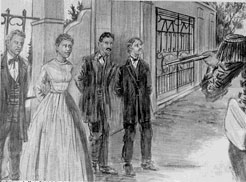
On February 29, 1856, local Chinese officials in Guangxi beheaded French missionary priest Auguste Chapdelaine — and handed his countrymen a pretext for war.

Chapdelaine (English Wikipedia page | French) had gone illegally to the Chinese interior to proselytize Christianity.

The local mandarin Zhang Mingfeng was no doubt disposed to take such an harsh line against this provocation by virtue of the ongoing, Christian-inspired Taiping Rebellion, which had originated right there in Guangxi and was in the process of engulfing all of southern China in one of history’s bloodiest conflicts.

So Chapdelaine and his associates were snapped up, put to a few days’ dreadful torture, and on this date a Chinese convert and Chapdelaine were both summarily beheaded. (A female convert, Agnes Tsaou-Kong, expired under torture around the same time.)

Pietistic accounts of believers’ last extremes are here and here.


(Images from this French page.)

It took months for word of this martyrdom to reach French consular officials, and many months more for the gears of international diplomacy to turn — but when they did so, France pressed a demand for reparations.

Since pere Chapdelaine had been acting illegally in the first place, the Qing’s obdurate Viceroy Ye(h) adamantly refused to offer Paris satisfaction.

By 1858, this intransigence sufficed to license French entry (alongside Britain) into the Second Opium War, from which the Europeans won by force of arms a noxious treaty guaranteeing their right to push Christianity in China, extracting a couple million silver taels in damages, and (of course) assuring their right to traffic opium into China.

It would be rather ungenerous to hold all the ugly imperial consequences personally against our day’s martyr. August Chapdelaine was canonized by the Catholic Church in 2000 as one of 120 Martyrs of China.

China was not impressed by this celebration of a onetime colonial catspaw, and met the Vatican’s “anti-China” celestial promotion announcement with one of its own — charging that Chapdelaine “collaborated with corrupt local officials, raped women and was notorious in those areas [where he preached].”
On this day..

1845: Maria Trinidad Sanchez, Dominican Republic heroine

We’ve previously noted in these pages Francisco del Rosario Sanchez, one of the Dominican Republic’s founding heroes, who in 1861 was shot for propounding independence.

Martyrdom was the family business.

On February 27, 1845, his sister Maria Trinidad Sanchez (Spanish link) had been, well, shot for propounding independence. (More Spanish)

That date, February 27, also happens to be the Dominican Republic’s Independence Day celebration — because a year to the date before her death, Maria Sanchez, her brother, and others of the anti-colonial La Trinitaria proclaimed independence from a bloody 22-year Haitian occupation.

Maria Sanchez, together with another woman named Concepcion Bona, made the first Dominican Republic flag.


Sanchez and Bona’s original flag for the Dominican Republic.

This was all well and good, until the resulting head of state steered the Dominican Republic towards recolonization by Spain, as a hedge against reconquest by Haiti. La Trinitaria types took an understandably dim view of this gambit, so busting them up was part of the deal.

Many of the country’s founding heroes, including brother Francisco, were chased into exile; Maria was rounded up by the new government and tortured for information about the Trinitarian “plots” against the new regime. She refused to name any names, and was shot on the country’s first independence anniversary.

On this day..

1897: Henri-Osime Basset

On this date in 1897, all Versailles turned out to witness the beheading of recidivist pedophile Henri-Osime Basset, a 23-year-old who had kidnapped and strangled to death (French link) 13-year-old Louise Millier the previous summer.

Executioner Anatole Deibler and crew arrived at 3:30 a.m. to erect the portable guillotine at the pont Colbert* for the occasion, under the eyes of a curious pre-dawn crowd restrained by dragoons; by 4:45 la sinistre machine was fully installed.

About an hour after that, the prisoner Basset was awoken from his fitful sleep — he’d been plagued by restless guillotine-themed dreams lately, for some reason — and advised that his application for presidential clemency had been denied.

Le Petit Parisien nevertheless found the prisoner in steady enough spirits for his expiatory moment. He took the bad news with equanimity, received communion, and stuck close by the comforting priest to whom he had already given his last confession. (And who helpfully steeled the doomed man’s nerves with a steady supply of rum, cigars, and Bourdeaux wine.)

In any event, the practiced French executioners did not give Basset long to stew on his fate. After the toilette to prepare him for the blade, he was out the door shortly after 6 a.m. — broad daylight by now, and the crowd swollen in anticipation of the show. The blade fell at 6:33, and the remains of the late Henri-Osime Basset were immediately deposited at the Cimetirie des Gonards.

* This is pont Colbert in Versailles, not the cool then-new steel bridge in Dieppe, which is now the last hydraulic turn bridge still in use in Europe.

On this day..

1942: Five Jews in Sokal

(Thanks to Meaghan Good of the Charley Project for the guest post. -ed.)

The synagogue at Sokal.

On this day in 1942, the Nazis shot five Jewish men from Sokal, which was then part of Poland and now belongs to the Ukraine.

During the first years of the war, the Germans had designated Sokal as a Judenstadt (literally “Jew-town”), a central destination point for all Jews expelled from nearby towns and villages. Or, as diarist Moshe Maltz put it, “A solitary island in a sea of blood.”

It was Maltz, an Orthodox Jew and native of Sokal, who recorded the executions described in this entry. He kept regular notes throughout the war about the plight of Sokal’s Jews — not a diary exactly, but a chronicle, meant for the benefit of history.

On February 24, five Jews from Sokal were taken to a place somewhere on the outskirts of town and shot. One of them was Yeshaye, son of Yankel the coachman. In 1940, during the period of Soviet occupation, Yeshaye had been a coachman working for the NKVD. Now the Gestapo called him and ordered him to turn over to them the reins of his horses. They said to him, “We’ll give you three days to deliver those reins to us. If we don’t get them by that time, we’ll have you shot.” Yeshaye thought that the Gestapo must be joking. How could he go on working as a coachman without his reins? Unfortunately for Yeshaye, the Gestapo men were in dead earnest.

Also among the five shot was Dr. Knopf, a lawyer who had converted to Christianity. The Germans had ordered him to dismiss his Gentile maid so that she could be sent to work in Germany. Knopf petitioned the Gestapo to let him have his maid back. That’s why the Germans shot him. Despite his baptism, he was simply not an Aryan. The third victim was blind Yankel, who was found guilty of buying and slaughtering a calf. Under German occupation regulations, cattle can be slaughtered only by officially approved butchers.

In October 1942, the Jews of Sokal were confined to a ghetto. The following month Maltz wrote, with the same dispassionate tone, of the murder of his fourteen-month-old daughter at the hands of the Nazis.

Later in November he escaped from the ghetto with his wife and surviving son. They had made an arrangement with a Polish woman who lived nearby, and moved into her hayloft, above the pigsty.

Eventually fourteen people from three families in all would come to live in the hayloft. All of them survived except Maltz’s sister, who died of fever while in hiding. The others staggered out into daylight, barely able to walk, when the Russians liberated the area in July 1944.

Maltz and his entire family eventually emigrated to the USA.

After his death in 1993, his diary was translated and published under the title Years of Horror, Glimpse of Hope: The Diary of a Family in Hiding. In 2009, a Pennsylvania State University professor made a prize-winning documentary based on the book, called No. 4 Street of Our Lady. You can watch it on Netflix or read an article about it here.

On this day..

1906: Johann Otto Hoch, bluebeard

On this date in 1906, still implausibly claiming his innocence, “Johann Otto Hoch” was hanged for the murder of his wife.

Though Hoch died “merely” for that one homicide, he was suspected of numerous others in a prolific career of avaricious bigamy.

Born as Jacob Schmidt in Germany a half-century or so before he hanged, Hoch immigrated to the U.S. in the 1880s and started wife-hopping for fun and profit, recycling names almost as frequently. (Hoch just happens to be the alias he was using when arrested: actually, it was the name of one of his victims, “a warped keepsake stored in an evil mind.”)

It’s a classic scam, really: woo, wed, and walk out — taking the spurned spouse’s assets with. Rinse and repeat. In 1905, Charlotte Smith of the Women’s Rescue League estimated that “no less than 50,000 women who have been married, robbed and deserted by professional bigamists.” (Chicago Tribune, Sept. 5, 1905)

“Marriage was purely a business proposition to me,” Hoch eventually admitted.

Sometimes Hoch was content to vanish with the cash (with nice twists, like a hat left by a riverbank to suggest drowning). Other times, he went above and beyond the standard in the professional-bigamy industry and availed the expedient of loosing the matrimonial bonds (and the purses of life insurers) by graduating himself to widowhood.

Precisely how many women he poisoned off with arsenic isn’t known exactly, but it’s thought to range into the double digits. And when he was on his game, he was known to churn through the ladies at breakneck speed. His last murder victim, and the one he hanged for, was Marie Walcker of Chicago … but as Marie lay dying of her husband’s expert ministrations, Johann, bold as brass, proposed to Marie’s sister Amelia. Those two “lovebirds” married a week later and within hours, the groom had disappeared, pocking $1,250.

Call Amelia doltish if you will, but she went straight to the police. It turned out it was Hoch who recklessly set himself up for capture with this whirlwind double-dip courtship, and the very freshly buried evidence of his recent malignity was easily retrieved from his late ex’s stomach. When arrested in New York, Hoch had a hollow pen full of arsenic.

Naturally, the marriage proposals poured in as Hoch awaited trial early in 1905.

Hoch was actually within moments of hanging in July 1905 when his defense team finally managed to raise the last $500 necessary to lodge an appeal. That’s right: justice with a co-pay. The legislature had considered, but had not passed, a law giving every death-sentenced person the right to appeal to the Illinois Supreme Court, and in lieu of such a measure, an appellant had to pony up for the privilege.

On this day..

1684: Three Covenanters

Just three indistinguishable Covenanters among very many in the Killing Time.

From the journal of John Erskine of Cardross:

22 February 1684. — After dinner I went to the Laigh Council house, where the three condemned men were brought before Baillie Chancellour, who inquired if they had any more to say for themselves, and if they would bid God save the King? They said, they were not now come to answer, neither would they answer questions, and the refused not to obey all the King’s lawful commands. They refused to hear one of the town curates pray; but he beginning, not desired, George Martin offered to interrupt him the time of his prayer, by saying, ‘Let us be gone, what have we to do here?’ but he ended his prayer without stopping. They were hanged in the Grassmarket, but I went not to the place of execution.

On this day..

1677: Five witches at the Gallowgreen of Paisley

On this date in 1677, Janet Mathie, Bessie Weir, Margaret Jackson, John Stewart, and Marjory Craig were hanged for having bewitched a Sir George Maxwell of Pollok.

These unfortunates were “sacrificed on the altar of popular superstition”, in the words of a later broadside — one element of that superstition being the belief in the superordinary insight of the deaf-dumb.

God hath taken away the tongue and ear of the dumb, and hath given them a rich gift of knowledge in the room of it; and by this would teach all of us his goodness to his creatures, and that we should study humility and sobriety of mind.

This is a culture working with some embarrassingly primitive forensics to begin with.

So, when the Pollok lord started ailing, the indications by “a young deaf and dumb girl, of unknown origin,” to the effect that a local family was doing him mischief by stabbing a wax effigy, well, that was enough to open a case. When they found a wax effigy right where the girl pointed, “The prosecution wanted no stronger proof.”

So they got the 14-year-old daughter (she was spared execution this date) to confess, and tortured her brother into agreeing that the devil appeared as a cloven-hooved Negro, and our unnamed detective-girl miraculously found not one, not two, but three different effigies all attributed to the diabolical voodoo parties to cinch the condemnation.

It’s rather embarrassing what tripe did then and can still now pass for persuasive indicia of guilt among parties already committed to convicting someone. Like show trial victims, even the condemned were swept into the act of auto-denunciation — one final tenuous strand to link an outcast to her community, even from the stake. At least, some of them were.

John and Annabel exhorted their mother to confess, reminding her of all the meetings which she had had with the devil in her own house, and that “a summer’s day would not be sufficient to relate what passages had been between the devil and her.” But Jennet Mathie was a stern, brave, high-hearted Scotch woman, and would not seal her sorrow with a lie. “Nothing could prevail with her obdured and hardened heart,” so she and all, save young Annabel, were burnt; and when she was bound to the stake, the spectators saw after a while a black, pitchy ball foam out of her mouth, which, after the fire was kindled, grew to the size of a walnut, and flew out into sparks like squibs. This was the devil leaving her. As for Bessie Weir … the devil left her when she was executed, in the form of a raven; for so he owned and dishonoured his chosen ones.

“The dumbe girl, Jennet Douglas, now speaks well, and knows Latine, which she never learned, and discovers things past!” says Sinclair. But she still followed her old trade. She had mesmeric visions, and was evidently a “sensitive;” and some of the people believed in her, as inspired and divine, and some came, perhaps mockingly, to test her. (From E.L. Linton)

Sometimes, at least, these malevolent professional accusers get their comeuppance.

The dumb girl herself was afterwards carried before the great council at Edinburgh, imprisoned, scourged through the town, and then banished to “some forraigne Plantation,” whence she reappears no more to vex her generation. God forgive her! She has passed long years ago to her account, and may her guilty soul be saved, and all its burning blood-stains cleansed and assoilzed!

On this day..

1836: Giuseppe Fieschi, Pierre Morey, and Theodore Pepin, infernal machinists

On this date in 1836, three men were guillotined for a spectacular but unsuccessful regicide attempt.

Giuseppe Fieschi

This was in the days of the July Monarchy, a much-despised government of the country’s wealthiest elites that generated opposition both right and left and a ceaseless string of assassination attempts (French link) against King Louis-Philippe.* As Marx put it,

when the liberal banker Laffitte led his compère, the Duke of Orléans, in triumph to the Hôtel de Ville, he let fall the words: “From now on the bankers will rule”. Laffitte had betrayed the secret of the revolution.

It was not the French bourgeoisie that ruled under Louis Philippe, but one faction of it … the so-called financial aristocracy. It sat on the throne, it dictated laws in the Chambers, it distributed public offices, from cabinet portfolios to tobacco bureau posts.

Hard to imagine such a state of affairs.

Fieschi (English Wikipedia page | French) et al conceived a bold attempt to destroy the entire ruling family in a single fusillade, and to that end constructed a machine infernale of 25 gun barrels mounted together to fire on a single fuse.

Unleashed upon a royal procession along the Boulevard du Temple on the fifth anniversary of the monarchy’s founding July days, this monster proved quite impressively destructive.


The assassination attempt of Fieschi, 28 July 1835 by Eugene Lami.

The infernale barrage took out an esteemed marshal and a bunch of bystanders, but somehow managed to miss everyone in the royal family. (Louis-Philippe himself was grazed … and his horse was hit.)

Exploiting the familiar power of a terrorist incident to enact horrible new policies not available in normal times, “Parliament was hastily recalled and in a near-panic atmosphere passed severe measures against the newspaper press,” notes William Fortescue. “Approximately thirty more republican newspapers were closed down by the September 1835 Press Laws.”

Police soon traced the conspiracy to Fieschi, a truly Gallic character of mixed-up national pride, personal honor, class envy, and opportunistic lechery, who had fought for Bonaparte and helped Joachim Murat on the latter’s fatal attempt to re-take “his” kingdom of Naples back in his youth. But lately, a more worn-out and middle-aged Fieschi had been booted out by his mistress and lost all his money.

Fieschi, according to Barricades: The War of the Streets in Revolutionary Paris, 1830-1848, basically became a dependent of Morey and Pepin, true-blue republicans who helped channel Fieschi’s unmoored passions into engineering his hydra-headed musket. He’d be back on the French-nationalism side by the end.

“I’m going to appear before God,” Fieschi said on the scaffold, after Morey and Pepin had preceded him. “I have spoken the truth. I die content. I have rendered a service to my country in signaling my accomplices … I regret my victims more than my life.”

More repressive laws and radical-hunting followed. They did not slake the thirst abroad in France for regicide.

* Louis-Philippe’s royal dad backed the French Revolution, but was still executed by Robespierre.

On this day..

1799: Constantine Hangerli, tax man

On this date* in 1799, Constantine Hangerli was deposed from his post as Prince of Wallachia by a Moorish executioner.

A veritable watchword for bad times, Hangerli was one of a clutch of disposable puppet rulers situated on the Wallachian throne by the Ottomans around the turn of the 19th century.

As had often before been the case, Wallachia was sorely pressed at this time by the cumulative exactions of its native boyars, the Ottoman Porte, and the plunder taken by the expeditions of rising Bosnian warlord Osman Pasvan Oglu.

Our man is famous, in particular, for the “Hangerli winter” of 1798, just after his elevation — when a confiscatory tax regime seized most of the countryside’s lifestock. Hangerli had a message for the generally currency-poor common man who objected to the much-despised per-head duty on cattle.

Pay the taxes, and you won’t be killed.

Hangerli’s real problem this year wasn’t the unmourned misery of his overtaxed serfs, but the Ottoman commander sent to rein in the Bosnians. Pasvan Oglu whipped that expedition, and its general Hussein Kucuk turned up at Hangerli’s doorstep late in 1798.**

Since it was dangerous for Ottoman generals to lose, Kucuk evidently arrived intending to put some blame on Hangerli — or at least, Hangerli thought that was the case. Secret dispatches from both parties to Istanbul ensued.

Whoever it was who schemed first, Kucuk schemed best. Selim III (later to die of palace scheming himself) decreed Hangerli’s immediate execution and dispatched a kapucu, one of the frightening envoy-executioners (two different men, in this case) who carried such decrees to their victims.

* I believe this may be per the Old Style/Julian date still in use in the Orthodox world.

** Having executed Rigas Feraios in Belgrade en route.

On this day..

1524: Not Jean de Poitiers, father of the mistress

On this date in 1524, the French aristocrat Jean de Poitiers, Seigneur de Saint Vallier lay his head on a chopping-block.

He kept it there for a full hour, but the headsman never swung the blade — and Jean de Poitiers walked away with a royal clemency.

This lucky Seigneur had been caught up in an English- and Habsburg-backed plot by the Constable of France to break off a chunk of France. (Said Constable fled to Charles V.)

Jean de Poitiers skated on noblesse oblige and lesser culpability, but there’s a scurrilous story that he was heard thanking God as he was led back from the scaffold for his daughter’s many charms.

Diane de Poitiers

The aforesaid beguiler, then-24-year-old Diane de Poitiers, had gone to King Francis to plead for her father’s life. Apparently she made an impression. (Or the king was planning to pardon Jean anyway.)

The implication of having gone the extra mile derives not from any particular fact known about that meeting, but from Diane’s subsequent, and rather illustrious, career as mistress to the monarch — not to Francis, but to his son Henri II.

In the 1530s, when Diane was a cougar-aged widow,* she became the mistress of the teenaged prince — and the rival of his teenaged bride, Catherine de’ Medici.

Diane was anything but the other woman in this arrangement: the brilliant, forceful personality whom Henri trusted as no other, it was Diane de Poitiers who wielded queen-like power during her lover’s reign. (They even had an H-D monogram.) She made calls in statecraft and in the royal household, and one can fancy the fury Queen Catherine conceived for having her husband’s older mistress decide how to raise the kids.

Diane’s career ought to have ended in a state funeral, but the hale and hearty Henri suffered a freak jousting accident in 1559 that reordered female influence in the Valois dynasty. Catherine wouldn’t even let Diane near the deathbed of the king as he painfully expired — and the queen exiled the former royal favorite to a distant estate as soon as possible.

* Diane de Poitiers was on either end of May-December arrangements in her time, and the monument that she put up for her much-older husband Louis de Breze can be seen at the cathedral in Rouen.

On this day..