1813: John McDonald and James Black, Edinburgh robbers

From the Edinburgh Annual Register for 1813:

On Wednesday, M’Donald and Black, who were convicted before the High Court of Justiciary of the robbery and murder of Mr. Muirhead, near Coltbridge, were executed upon the spot where the murder was committed. About one o’clock these unfortunate young men were brought out of prison and placed upon a cart, having seats elevated and railed round.

They were escorted along the Lawn Market, Bank-street, the Mound, and Prince’s street, by the magistrates of the city, the high constables, a detachment of the Northampton and Norfolk militias, a party of the 7th dragoons, and the city guard.

Upon reaching the west end of Prince’s street, the procession halted, where the magistrates delivered over the prisoners to the sheriff of the county, and they were then escorted by a strong detachment of the Mid Lothian yeomanry cavalry, and the sheriff and police constables, through the village of Coltbridge to the place of execution.

After some time spent in devotion, the prisoners mounted the platform, and about a quarter before three they were launched into eternity.

On the way to the place of execution the prisoners employed their time in reading, but occasionally looked round on the surrounding multitude. At the place of execution they behaved with seeming fortitude and resignation; in a particular manner, Black, who first mounted the platform, and prayed.

M’Donald was not visited by any catholic [sic] clergymen till after sentence had been passed upon him. On the first visit, he was found not so grossly ignorant as might have been apprehended, seeing that he had never attended any religious duty: and his dispositions seemed to correspond with his awful situation.

On the scaffold, as on the way to it, and indeed during the whole preceding day, he seemed entirely taken up with those exercises of devotion which had been suggested to him as proper for the occasion. In all appearance he died truly penitent and resigned to his fate.

At half past three the bodies were cut down, and conveyed in the same cart, escorted by a body of constables, to the College of Edinburgh, and delivered over to the professors of anatomy.

On this day..

1860: Albert Hicks, the last pirate hanged by the US?

The hanging of Albert Hicks on Bedloe’s Island on this date in 1860 marked perhaps the last execution for piracy in U.S. history.*

This was a century and more past the Golden Age of Piracy. By the mid-19th century, the picaresque buccaneer had long ago hornswaggled his last doubloons and retired from Atlantic sea lanes into literary nostalgia. According to the Espy file, there had been only a single piracy death case, a double execution in Virginia in 1852, over the preceding quarter-century.

Hicks, who alternately went by William Johnson, wasn’t exactly Captain Kidd: think less freebooter, and more hijacker.

Shipping out of New York on the sloop E.A. Johnson, Hicks — urged on by the devil, he later claimed — seized the vessel by murdering two crewmates, Oliver and Smith Watts, and the captain, George Burr. As that was the entirety of his company, that gave him the ship too. He didn’t mean to raise the Jolly Roger and go a-plundering with his prize: he simply stripped his victims of portable valuables, pitched their bodies into the drink 50 miles off Sandy Hook, and abandoned ship. Eventually the creepy hulk of the E.A. Johnson drifted back into New York’s harbor.

Hicks was tracked down in Providence, R.I. and arrested a few days later — the only survivor of a bloodstained mystery ship who happened to have a large quantity of coins he couldn’t quite account for.


1860 ballad, set to the tune of “The Rose Tree”.

As pieces fell into place, it emerged that Hicks had some previous experience as a seaborne desperado. Indeed, he published a confession admitting to quite an extensive career in. The life, trial, confession and execution of Albert W. Hicks, the pirate and murderer, executed on Bedloe’s Island, New York Bay on the 13th of July 1860 for the murder of Capt. Burr, Smith and Oliver Watts on board the oyster sloop E.A. Johnson: containing the history of his life is available free online and details a bloody life’s adventure from Peru to gold rush California that might even qualify as a swashbuckle — if it’s true.

Newsmen meeting him during his incarceration not infrequently express skepticism of Hicks’s veracity and motivations as he attaches himself to new outrages; in particular, Hicks might have been interested to create sensational gallows copy in order to support the family he would soon leave behind. One report shortly after Hicks’s arrest (Boston Courier, March 29, 1860) has his soon-to-be-widow visiting Hick’s cell where “she broke out upon him in the most vituperative language, charging him with being a bloody villain. She held her child up in front of the cell door, and exclaimed, ‘Look at your offspring, you rascal, and think what you have brought on us. If I could get in at you I would pull your bloody heart out.'”


Execution report from the July 14, 1860 New York Herald.

* The U.S. also enforced — loosely — its anti-slaving provisions under piracy statutes, so the 1862 execution of slave trader Nathaniel Gordon occurred under an anti-piracy law. Whether that makes him pirate enough for the milestone, the reader may judge.

On this day..

1995: Boris Dekanidze, the last in Lithuania

Lithuania conducted its last execution on this date in 1995, distinguishing Vilnius crimelord Boris Dekanidze with the milestone.

Dekanidze was born in Georgia, but had no citizenship anywhere. His father Georgy cashed in on the collapse of Soviet rule with businesses that, to survive and thrive in the 1990s, would be mobbed-up practically by definition. “When you have a collapse of government and total incompetence, people appear who can organize themselves and influence the lives of others,” Georgy said in this Newsweek report. “I can’t say if this is good or bad.” Georgy ran the Hotel Vilnius, an apt metaphor for the era.
The dapper son was convicted of ordering the murder of investigative reporter Vitas Lingys, founder of the still-extant Lithuanian newspaper Respublia* — a conviction sustained on the evidence given by the admitted gunman, Igor Akhremov.

“The collapse of government and total incompetence” was a much more nettlesome foe than this or that murderer, however. The single bullet fired into Dekanidze’s head on the morning of July 12, 1995 crippled his own criminal syndicate, the “Vilnius Brigade” — but it was not long before new gangs emerged to replace it.

Lithuania abolished the death penalty in 1998.

* Despite the punishment meted out in this one case, a wave of 1990s journalist assassinations around the former Soviet Union during the 1990s went mostly unsolved.

On this day..

2006: Derrick O’Brien, for murdering Jennifer Ertman and Elizabeth Pena

Ten years ago today, Texas executed Derrick O’Brien for an infamous Houston gangland crime — the rape-murder of Jennifert Ertman and Elizabeth Pena.

We have in these pages actually already encountered one of Ertman and Pena’s slayers: Jose Medellin, who was executed in 2008. That case was notable for the litigation resulting from Texas’s failure to comply with the Vienna Convention by notifying the Mexican consulate of Medellin’s arrest — and the Medellin post focuses on that issue. This post turns instead to the crime itself.

On June 24, 1993, Ertman and Pena — 14- and 16-year-old Waltrip High School students desperate to beat curfew — took a late-night shortcut along a railroad skirting the White Oak Bayou.

At a railroad trestle in T.C. Jester Park, just moments from home, they encountered our man Derrick O’Brien, Jose Medellin, and four other young men toasting a gang initiation. The six fell on the vulnerable girls and raped both, then strangled them with shoelaces.

Even for a city as large as Houston, it was a shattering crime that still haunts the lost girls’ friends and neighbors.


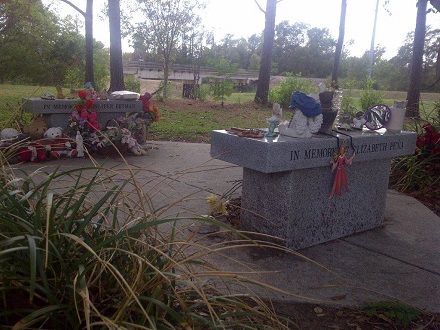
Memorial to Ertman and Pena in T.C. Jester Park. (cc) image by Pepper Hastings.

Politically, it thrust gangs to the front of the agenda for Houston pols. The girls’ kin* also fought successfully to adjust Texas Department of Criminal Justice procedure in order to permit victims’ family members to witness executions, an innovation that is now widely used throughout the U.S.

O’Brien, barely 18 when he took part in the murder, turned up in the crowd gawking at the crime scene when it was first discovered, and some video footage chances to catch him smiling and laughing. He would eventually be the first person put to death for the Ertman-Pena murder.

Besides O’Brien and Medellin, the gang leader Peter Anthony Cantu was also executed for this murder. Efrain Perez and Raul Villareal, both 17 years old at the time of the attack, were condemned to death initially but had their sentences commuted after the U.S. Supreme Court barred the execution of juvenile offenders. Fourteen-year-old Venancio Medellin — Jose’s brother — caught a 40-year sentence that he’s still serving.

* Notably, Jennifer Ertman’s father Randy became an outspoken crime victim advocate until he succumbed to cancer in 2014.

On this day..

1858: Isaac Wood

From the Livingston Republican of July 1858, by way of Murderpedia:

On this day..

2010: Wen Qiang, prey of Bo Xilai

On this date in 2010, Chongqing politician Wen Qiang was executed for corruption — but the rival who felled him was on the brink of his own destruction.

Wen, the longtime Public Security Bureau chief in the southwestern city of Chongking, was a big dog to most. To Bo Xilai, Wen looked more like trophy game.

Son of an “immortal” Communist pol Bo Yibo, the aggressive and charismatic Politburo member Bo was then an ascending star on the national stage.

In 2007, Bo won the Communist Party’s appointment as party chief of Chongqing — effectively giving him control of the city. From this platform, Bo launched a high-profile crackdown on graft and organized crime rife in the 30 million-strong megacity.

During a campaign from roughly 2009 to Bo’s own fall in 2012, some 9,000 people were investigated for corruption, and nearly half of them jailed … or in Wen’s case, worse.

“Dare to fight against the devil, never compromise with the gangs”: Bo’s act resonated powerfully in a country fractured by economic development and widely afflicted by beak-wetting. But Bo’s political angle was not merely playing to the peanut gallery: it was also a factional power play, implicitly critical of his similarly powerful predecessor Wang Yang for having tolerated the mobsters’ rise.

And Wen Qiang, a holdover from even before the Wang years, was Bo’s highest-ranking prey.

Xinhua reported that he was found guilty of soliciting USD $1.7 million worth of bribes, of protecting criminals like his sister-in-law who happened to be the “godmother” of crime in Chongqing, and even of raping a university student. Media circulated salacious stories of buried sacks of cash, mistresses collected and discarded, and secret luxury villas.

In these years, Bo went from victory to vctory and destroying Wen was just another stepping-stone towards the top leadership circles in the People’s Republic.

But merely 16 months after Wen faced his executioner, Bo’s own star also dramatically fell to earth.

In November 2011, British businessman and Bo associate Neil Haywood was found suspiciously poisoned in his Chongqing hotel. Practically overnight, Bo Xilai found himself the target instead of the author of the investigation — politically stricken as all his own chickens came home to roost.

An incredible sequence of events ensued: Bo’s chief of police (and Wen’s own Javert) Wang Lijun bizarrely fled to the (temporary) sanctuary of an American consulate the following February, days after Bo demoted him — apparently citing fear that Bo might have him, too, murdered.

Within weeks, Bo had been sacked as Chongqing party boss and dismissed from the Politburo while his wife Gu Kailai arrested for Neil Heywood’s murder. Wang was arrested when he left the American consulate. Politically impotent now, Bo had months to wait before his own divisive case finally came to a courtroom resolution in 2013. As of this writing, Wang and Bo and Gu are all serving long prison sentences. (Gu’s was a suspended death sentence recently commuted to life imprisonment.)

Through Bo’s precipitous fall, Bo’s own patron Zhou Yongkang was also ruined, forced out of national leadership, and eventually sent to prison on corruption charges of his own.

Bo’s disgrace has brought a re-examination of his rough rule in Chongqing — though many targets of his bygone anti-corruption drive still languish in prison, vainly protesting their innocence.

Though he is no longer around to protest on his own behalf, and there appears to be little sentiment that he was clear of corruption in an absolute sense, Wen has also been re-evaluated in light of those events — including indications that the most incendiary allegations against him might have been ginned up for show:

police buried the bundles of cash, carefully wrapped in waterproof paper, in the morning and then dug them up in front of the cameras that afternoon.

Another key piece of evidence used to convict Wen — two luxury villas worth more than 30 million yuan that Wen allegedly owned — has also been questioned.

A former senior police officer in Chongqing who was close to Wen insisted he was the real owner of the villas, where Wen allegedly kept mistresses and which were later turned into destinations for “anti-graft education” tours.

The (possibly apocryphal) story has it than in a prison meeting, the doomed Wen prophesied Danton-like to his persecutor Wang, “You’ll meet the same fate as me.”

There are affecting interviews with Wen’s wife and son, and even a reporter’s conversation with Wen during the very last hours of his life, all here.

On this day..

1916: Trooper Alexander Butler

One hundred years ago today at Bussy-les-Daours on the Somme, Canadian Trooper Alexander Butler was shot for the unprovoked murder of another soldier during World War I.

Butler was a veteran soldier with six-plus years in the 7th Hussars. For obscure reasons possibly tracing to multiple head injuries he had sustained in falls from horse during World War I, Butler on June 8 approached a fellow Hussar named Mickleburgh and suddenly poured five rifle rounds into his chest.

Butler was one of only two Canadian soldiers executed for murder during the Great War. (Twenty-two others were shot for desertion, and one for cowardice.) Those two soldiers were excluded from the 2006 posthumous pardon of Commonwealth servicemen who were “shot at dawn” during the war.

On this day..

1726: Joseph Quasson

Hanged on this date in 1726, Joseph Quasson enjoys a minor distinction in the annals of the gallows press: according to friend of the blog Anthony Vaver, Samuel Moody’s account of Quasson’s long* jailhouse sojourn was the first published in the colonies as a standalone conversion narrative, without cover of an attached ministerial sermon.

And here it is:

* Quasson fatally shot a fellow enlistee serving during Father Rale’s War. There was no question about his guilt, but when the murder took place the next sitting of the court was nine months away so the man just got to cool his heels.

On this day..

1784: Fifteen crooks hanged at Newgate

On this date in 1784, no fewer than 15 men hanged on the public scaffold outside London’s Newgate Gaol. Per the next day’s Parker’s General Advertiser and Morning Intelligencer,

William Smith, Isaac Torres, Charles Barton, Patrick Burne, Patrick Birmingham, John Lynch, James Farrel, James Davis, Daniel Bean, Archibald Burridge, Robert Ganley, and Thomas Randal, for burglary; Peter Haslet alias Edward Verily, for personating and assuming the name of Thomas Howard, of his Majesty’s ship the Pallas, with intent to receive his wages; and Joseph Haws and James Hawkins for a street robbery. The above unhappy men came upon the scaffold a little before seven o’clock; they all seemed devout and penitent, and behaved in every respect as became their miserable situation. The plat-form dropped about a quarter before eight, and at the same moment they were all launched into eternity. The concourse was immense; the windows and roofs of the houses commanding a view of the fatal spot, were crowded, and many thousands of people were assembled in the Old-Bailey before six o’clock.

Despite the immense concourse, this gigantic hanging of miscellaneous thieves rates little better than footnote mention in the period’s press. England was gallows-mad; CapitalPunishmentUK.org makes it 56 hangings in 1784 in London alone. There would be an even larger mass execution (20 people) the next February!

Even by the standards of the Bad Old Days, Old Blighty set a terrific pace. “The frequency of English executions was widely noted by foreign observers,” V.A.C. Gatrell writes in The Hanging Tree: Execution and the English People 1770-1868

The Prussian code had restricted capital punishment as early as 1743, and after 1794 only murderers were executed. Catherine‘s reforms to similar effect followed in Russia in 1767 and Joseph II‘s in Austria in 1787. Philadelphia Quakers dispensed with capital punishment after the American Revolution. In Amsterdam in the 1780s less than 1 a year were killed; barely 15 were executed annually in Prussia in the 1770s, and a little over 10 in Sweden in the 1780s. Towards 1770 about 300 people a year were condemned in the whole of France; over twice that number were condemned annually between 1781 and 1785 in London alone. [most were reprieved -ed.] Before the guillotine’s invention French punishments were crueller than English … even so, only 32 people were executed in Paris in 1774-7, against 139 in London.

On this day..

1996: Daren Lee Bolton

(Thanks to Meaghan Good of the Charley Project for the guest post. -ed.)

On this date in 1996, 29­-year­-old Daren Lee Bolton was executed in Arizona for the 1986 kidnapping, rape and murder of a Tucson toddler. Bolton had taken two­-year­-old Zosha Lee Pickett from her bedroom at night, stabbed her to death and left her body in an abandoned taxi in a storage lot two blocks from her home. It was found a couple of days later.

The medical examiner would testify that the toddler may have suffered “excruciating” pain for up to half an hour before she bled out.

After little Zosha’s death, the police lifted some fingerprints but couldn’t match them to any suspect, so in 1987 they sent them out to other states for them to have a try. Bolton had some convictions in Illinois, and so his prints were in the computerized system there. (Arizona didn’t have such a system in place at the time.) In 1990, during a training exercise, Illinois police officers found a match between Bolton’s fingerprints and a print on Zosha’s window screen. At the time, he was already serving time in Arizona for unrelated charges.

At his trial, Bolton admitted he’d been to Zosha’s home and to the cab where her body was found, but denied any part in her murder. Instead, he said he’d planned to break into the Pickett residence with an accomplice named “Phil” but was scared away. Phil, he said, had come back later and taken and killed the little girl. Bolton had then murdered the man and buried his body in the desert.

The jury saw through this wild story and convicted him of burglary, kidnapping and first-degree murder in 1991.

Bolton had the kind of childhood you might expect: shuttled back and forth between his divorced parents and his grandmother, the victim of physical abuse and possibly also sexual abuse, he was designated “severely emotionally handicapped” and had a long string of assaults to his name by the time he dropped out of school.

He was also charged in the 1982 murder of seven-­year­-old Cathy Barbara Fritz, also of Tucson, but he was executed before he could be tried in that case. The child had been abducted walking home from a friend’s home, sexually assaulted and then beaten and stabbed to death, all while a “Take Back The Night” demonstration was going on nearby. Bolton was sixteen years old at the time, and he knew the Cathy’s brother. DNA evidence later tied to him to the crime.

He maintained his innocence in both murders, but fired his lawyers and dropped his appeals after less than four years; he said he’d rather die than spend the rest of his life in prison.

His last meal consisted of lasagna, cheesecake and Pepsi.

Zosha Pickett’s parents and Cathy Fritz’s father and brothers were among the thirty witnesses who got to watch him die. He had no last words and, while he glanced at the Picketts once, he refused to acknowledge the Fritz family before he breathed his last, a few minutes past midnight.

On this day..