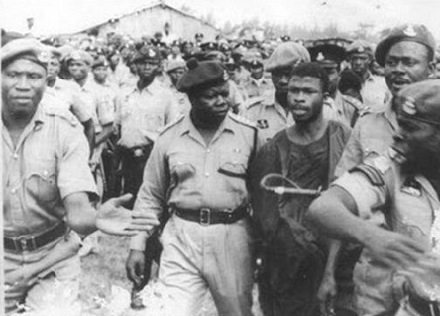
1971: Ishola Oyenusi, smiling to his death

On this date in 1971, the Nigerian robber Ishola Oyenusi — “smil[ing] to his death,” in the words of the next day’s paper — was publicly shot with his gang at Lagos Bar Beach.

Dubbed “the most dangerous criminal of this decade” even though the Seventies were barely underway, “Doctor” Oyenusi — as he liked to style himself — sprang out of the wreckage of the 1967-1970 Nigerian Civil War, a charismatic, cocksure gangster whose lordly disdain for the law cast the terrifying portent of social breakdown.

Beyond Oyenusi loomed a systematic collapse of order that long outlived him. In years to come, other celebrity crime lords would follow; eventually, armed robbery proliferated into a frightfully ubiquitous feature of life in Lagos. Maybe the Doctor smiled at the stake because he foresaw his legacy.

Disturbingly unable to combat the plague systematically, authorities would resort to occasional high-profile executions instead, provided, of course, that the culprit’s misappropriations were of the retail street-crime variety, rather than the fruits of wholesale corruption.

Oyenusi was never in the same universe with such exalted impunity as enjoyed by the masters of the state. He got into the robbery business back in 1959, boosting a car (and murdering its owner into the bargain) to make it rain for his broke girlfriend. While he eventually expanded his operations into a brutal syndicate, he was still just a hoodlum; the infamy that packed the Bar Beach with 30,000 fellow humans who booed and jeered Oyenusi to the stake was merely enough to make him worth the quashing. (He was condemned to death specifically for a raid on the WAHUM factory in March 1971 that also claimed the life of a police constable.)

Six members of Oyenusi’s crime ring went with him to the stake on the same occasion. An eighth man was also shot in the batch for an unrelated armed carjacking.

There is a 1977 film by Nigerian director Eddie Ugbomah based on this flamboyant gangster’s life, The Rise and Fall of Dr. Oyenusi.

On this day..

1914: Seven retreating Frenchmen, with surprising results

One hundred years ago today, during the Battle of the Marne, seven French soldiers were shot without trial for retreating. Most of the resources about this Gallic tragedy are in French, and so are most of the links in today’s post.

The French book Fusille Vivant traces the life of Francois Waterlot, a prolific correspondent who wrote some 250 letters after surviving this date’s execution, before finally dying at the front the following year.

All were enlistees of France’s 327th Infantry Regiment. On the night of September 6, German shelling panicked their sister 270th Regiment into a disorderly retreat away from the front lines. That rout ran right into the 327th, behind them, and panicked that regiment too.

Further in the army’s rear, the hubbub awoke from his farmhouse bivouac division commander Gen. Rene Boutegourd. Boutegard had a simple solution, and ordered seven of the soldiers caught away from their posts to be executed the next morning by way of example. While the war’s later years would feature notoriously unfair courts-martial with predetermined sentences, Gen. Boutegourd didn’t even see the need to pay that much tribute to procedural regularity in this case.

The Battle of the Marne was still ongoing, and the situation in the field, pre-trench warfare, was fluid. Shoot them out of hand and be done with it! Then, the rest of the division will understand the consequences of unauthorized retreat.

Barbieux, Caffiaux, Clement, Delsarte, Dufour, Hubert, and Watrelot were stupefied to learn that they suddenly had mere hours left to live.

According to a postwar newspaper article — printed in 1922, when the bizarre case came to public attention and led to a posthumous pardon — they immediately began pleading for their lives. “Put us in the first wave of the next attack, but I beg you not to subject us to French balls,” Delsarte cried.

In those opening weeks of what was supposed to be a short war, with men’s minds still half at home in the pleasurable prewar idyll, the cruel frequency of the execution pour l’exemple had not yet set its stamp on things. The first such instance had occurred only the week before.

Maybe the men detailed to kill the “deserters” were equally stunned: it is hard to put down the results of the shootings merely to the uncertainties of technology or the hardiness of flesh and bone.

Palmyr Clement survived the fusillade and only died two agonizing days later from his firing squad injuries. This is a bizarre outcome even for those occasional cases where a fellow survives the scaffold. Implicit in such a fate is that there was no coup de grace administered after the volley. Is this oversight intentional — even an expression of distaste for the justice of the sentence soldiers had been tasked with visiting on their comrades?

And could distaste extend so far as an intentional or an indifferent failure of marksmanship by the firing details?

Such doubtful speculation can point to Francois Waterlot, who did Clement one better: he survived the execution full stop (dropping to the ground with the volley even though he was actually uninjured) and returned to the ranks, dying in battle on June 10, 1915. This uncommon feat earned him the nickname “le fusillé vivant”, “the shot alive” (somewhat literally) or “the living corpse” (more to the sense of it). That sobriquet is the title of a French book about Waterlot.

France executed about 600 of her own soldiers during World War I, the second-most (to Italy) of all belligerents in that conflagration. There is a great deal about this particular execution on this French page.

On this day..

1771: Matthias Klostermayr, the Bavarian Hiasl

On this date in 1771, the German outlaw Matthias Klostermayr was broken on the wheel in Dillingen.

The “Bavarian Robin Hood” (English Wikipedia entry | German) led a band of poachers (their merriness or lack thereof is unrecorded) who in the 1760s did a famous business, exploiting the jigsaw of tiny statelets in the region to keep the heat off by ducking across a border every few weeks.

Their exploits zestily raiding the hated private hunting preserves of haughty lords elevated them in the popular imagination to social bandits. They’re really said to have distributed a portion of their booty to the poor. They were slated with nine homicides during their run, of game wardens or soldiers whom they did not hesitate to handle much less generously. The gang’s long run proliferated legends multiplying their prowess, even crediting them with supernatural powers like invulnerability to bullets.

Klostermayr was the subject of folk songs even in his lifetime, and that exposure meant that he eventually became the subject of multilateral coordination among the principalities whose limited jurisdictions he so expertly exploited. A 1769 mutual-assistance arrangement permitted authorities to cross the border in hot pursuit; by the end of 1770, an outright military expedition with 300 troops had been arranged. They took Klostermayr by storm on January 14, 1771 in the town of Osterzell; the theater and the shooting club still carry Klostermayr’s name in Osterzell, a small testament to the robber’s enduring popularity two and a half centuries on from his death.

That death was bound to be a demonstrative one, revenging all the offenses Klostermayr had done to his superiors.

The agonizing public shattering of his bones on the breaking wheel, preserved for us in graphic drawings, did no disfavors to the bandit’s fame. Buttressed by his thinly-veiled appearance a few years later as the protagonist of Schiller‘s first play, The Robbers, Klostermayr’s renown persists in Germanophone Europe right down to the present day.


Detail view (click for a larger image) of the terrifying device on which Bavarian outlaw Matthias Klostermayr was stretched out to have his limbs crushed with a breaking-wheel on September 6, 1772.

Detail view (click for a larger image) of Matthias Klostermayr being broken on the wheel.

On this day..

1782: Bartolina Sisa, indigenous rebel

September 5 is International Indigenous Women’s Day, in honor of the torturous execution in Bolivia on this date in 1782 of the Aymara peasant rebel Bartolina Sisa.

Sisa (English Wikipedia entry | Spanish) shared with her husband Tupac Katari leadership of a huge indigenous uprising against the Spanish.

Eighteen months before Bartolina’s execution, she and Tupac Katari — Julian Apasa, to use his given name before he staked out a nom de guerre claiming the inheritance of Tupac Amaru and Tomas Katari — laid La Paz* under siege with an army 40,000 strong. Over the course of that spring summer, the Bolivian capital lost 10,000 souls and teetered on the brink of collapse — actually in two separate three-month sieges with a brief interim between.

Bartolina Sisa was recognized by the rebels as the coequal of her husband; the two took command decisions together in consultation.

As such, when the siege was finally relieved and the natives defeated that October, Sisa was in line to share her husband’s fate. This was easy to effect because she had been betrayed into Spanish hands between the first and second sieges. Her enemies refused Tupac Katari’s every blandishment to exchange her, and in time had the cruel pleasure of forcing her to watch her defeated husband’s butchery. Nearly a year later Sisa tasted a like fate, and her body was thereafter chopped up to display as a warning in various towns to cow potential future native insurgents.

A present-day peasant women’s union bears Sisa’s name, the Bartolina Sisa Confederation; the president of Brazil’s 2006 Constituent Assembly that drafted the country’s current constitution was an indigenous Quechua woman named Silvia Lazarte, who was the Bartolina Sisa Confederation’s former executive secretary.

* The city‘s full original name was Nuestra Señora de La Paz, “Our Lady of Peace”. It was founded in 1548 at the site of a former indigenous village and the “peace” referred to is the restoration of calm after Gonzalo Pizarro‘s rising.

On this day..

1822: Francisco Javier de Elio

On this date in 1922, Spanish royalist Gen. Francisco Javier de Elio was garroted in Republican Valencia.

Elio (English Wikipedia link | Spanish) was a career Spanish officer noted for being the last Viceroy of the Rio de la Plata in South America.

The Rio de la Plata forms the border between present-day Uruguay and Argentina, and by the time Elio self-proclaimed his viceregal rank, the May Revolution had confined Spanish authority to Uruguay.* He maintained the Spanish monarchy’s power in Montevideo until revolutionaries routed his forces at the Battle of Las Piedras** and Elio had to return to Spain.

This was just in time for the Spanish crown, as that country’s liberals had answered the chaos of the French invasion by promulgating in 1812 one of Europe’s most forward-thinking constitutions. King Ferdinand VII wholly repudiated this constitution upon his re-enthronement at the end of the Napoleonic Wars, and this soon led to yet another liberal revolt in 1820† and yet another French invasion.

Elio, who administered Valencia with a rough hand for Ferdinand, was such a ferocious monarchist that revolutionaries took him prisoner in the 1820-1823 “Liberal Triennum”. The attempt by a group of mutinous cannoniers in 1822 to place Elio at their head (with or without the general’s foreknowledge) led to his condemnation by a military court.

The September 26 London Times preserves two accounts by opposing partisans of Elio’s end.

EXECUTION OF GENERAL ELIO

The infamous General Elio has at length suffered the pain of death (by the garotte). His execution took place this morning at 11 o’clock, after having been publicly divested of his rank and honours. The General was not condemned on account of his conduct as Captain General, but in consequence of the revolt of the cannoniers who occupied the fort of Valencia, on the 30th of May. Being tried before an ordinary Court Martial on the 2d of June, at which General Villa-Campa presided, he was on the 27th of August adjudged to the most ignominious death known to the Spanish laws, that of the garotte. This sentence, submitted to the Auditor of War to be revised, was not only approved, but the Auditor demanded its immediate execution, comformably to the martial law of the 17th of April, 1821. The arrival of the Brigadier Espina, who was provisionally invested with the military command of this district was regarded as the signal for the execution. If it had been retarded, we should have broken into the prison, and ourselves have conducted the victim to the scaffold. The people maintained that demeanour which becomes an heroic nation, and accompanied the culprit to the scaffold with shouts of — ‘To death with Elio! his blood will cement the constitutional edifice.’

And a contasting version …

The scaffold on which General Elio was strangled at Valencia, on the 4th instant, was erected close to a delightful garden which belonged to him when he was all-powerful in that town. It appears that this spot was selected in order that his tragical end might be marked by a circumstance which was calculated to make him regret life. One of our journals, which is at all times distinguished for its violence, affirms that General Eio, previously to walking to the scaffold, knelt down and asked pardon of the authorities who were present, for all the mischief he had occasioned — this is wholly false. Above 12,000 persons were witnesses of the firmness which he showed on this sad occasion, and of the last words which he pronounced. The General protested his innocence in the face of God and man; he declared that he had only carried into execution the orders which he had received from the Government during the period of his command; that he was utterly unconnected with the revolt of the cannoniers; and, finally, that he begged of God to pardon his murderers, as he himself forgave them. ‘I wish,’ he added, ‘that my blood may be the last which is shed in Spain. Spain will one day do justice to the purity of my intentions, and repeat the cry which is now my last prayer — ‘”Long live the King and religion.”‘

* When a Spanish colony, Uruguay was known as the Banda Oriental.

** The date of this decisive battle, May 18 (1812), is still kept as a Uruguayan national holiday.

† Guess what happened to the guy who led that 1820 revolt.

On this day..

1944: Three Soviet infiltrators, the last in Finland

The last executions in Finland occurred on this date in 1944, claiming the lives of three Soviet spies who had been parachuted behind Finnish lines.

I have been unable to locate the names of these men. They’re invariably presented simply in connection with — or as the denouement following — the September 2 execution of Finnish deserter Olavi Laiho.

The next morning (Russian link), Finland announced its disengagement from its problematic German alliance, an arrangement brokered by the western Allies who wanted to keep Finland democratic and non-communist despite sitting in Russia’s back yard and joining the wrong team in World War II. The Soviet Union immediately redeployed its forces away from the Finnish theater; a formal armistice was signed before September was out and prisoner transfers began in October.

Finland abolished the death penalty for all peacetime crimes in 1949, for all crimes full stop in 1972, and wrote the abolition into its constitution in 2000.

On this day..

1944: Olavi Laiho, the last Finn executed in Finland

Olavi Laiho was the last Finn executed in Finland, on September 2, 1944.

Laiho (English Wikipedia entry | Finnish) was conscripted to the Finnish Navy to fight in Finland’s theater of war against the Soviet Union.

As a Communist himself — Laiho had been imprisoned in the 1930s for his labor agitation — Laiho inclined better to the cause of the other side, and fled to the woodlands near Turku where he gathered intelligence to pass to the Soviets and aided other war deserters. He spent the best part of two years winding towards his date with a military police firing detail after being arrested in December 1942.

While Olavi Laiho was the last Finn executed in Finland, on September 2, 1944, a trio of Soviet paratroopers caught behind Finnish lines were shot as spies on September 3, 1944. Those three men are the last ever put to death in Finland.

Laiho doesn’t technically have the distinction of being the last in all of Finnish history, but he’s the one remembered as the milestone moreso than the Russian paratroopers. Laiho is the last one of the Finns’ own, the last who emerges as an individual with a fate that speaks to the fate of his countrymen in those times. “Through Olavi Laiho, we empathize with the with the story of the first half of the 20th century,” this dissertation put it.

Readers with Finnish proficiency might enjoy the Laiho biography En kyyneltä vuodattanut (I Never Shed a Tear).

On this day..

1916: Kosta Kromphold


According to the Portland Oregonian, Kosta Kromphold mellowed to a phonograph in his jail cell on the eve of his execution — including “If I Had a Thousand Lives to Live.”

A Russian native, the forgettable Kosta Kromphold had left his dear mum in New York City and chased his fortune to the Pacific coast, where he found it at gunpoint in the money-box of a Chinese restauranteur in Marysville.

Kosta really got himself into the egg drop soup during the subsequent chase by two bicycle (of course — this is California!) cops. Firing back at his pursuers, he shot officer John Sperbeck dead, right through the mouth.

According to April Moore’s Folsom’s 93: The Lives and Crimes of Folsom Prison’s Executed Men, “A Mrs. A. Meyers of New York City wrote to Governor Hiram Johnson on behalf of her housekeeper, Johanna Kromphold, the condemned man’s mother, saying that Mrs. Kromphold had already lost two of her three children. Mrs. Meyers’s message continued, ‘By taking this young boy’s life, you not only take one but two, as I am positive she will never live through this terrible ordeal.'”

This appeal didn’t work, and on September 1, 1916, Kromphold imparted a dying plea to the Folsom Prison chaplain: “Write my mother. I haven’t the heart to do it.”

On this day..

1878: Sevier Lewis, a family affair

(Thanks to Meaghan Good of the Charley Project for the guest post. -ed.)

On August 30, 1878, Sevier (aka Severe, Savier) Lewis was hanged in Empire City, Oregon — today known as Coos Bay — for the murder of his much younger half-brother, Zachariah T. “Zack” Lewis on May 22, 1876.

The brothers were two of Hiram Hamilton Lewis’s nine children. Hiram was 74 years old at the time of Zack’s murder, and ambitious in spite of his age: he was running for state legislature.

Sevier, who was in his early fifties, was married and had seven children. Zack was twenty-five, single and still living at home. It was said he’d taken an interest in Sevier’s sixteen-year-old daughter Sylvia. Her father warned him to stay away, but Zack wouldn’t listen and kept coming around pestering his niece with unwanted advances. Finally Sevier had had enough.

Well, that’s one version of the story. Here’s another one:

Sylvia confided to her young uncle that she’d been raped by her father, and become pregnant. Zack went to Sevier and told him to stop the molestation immediately or he would tell the entire family what he had done. He helped Sylvia move in with her grandparents to protect her, and told Sevier that if he touched her again, he would kill him. Sevier touched her again.

These starkly contrasting purported motives may assign which characters, in the ensuing violent tableau, don the white hats and which the black. But either way, one late spring day, Sevier loaded his gun and went to his father’s home where he found little brother working in the fields. Sevier shot him dead, and then took flight.

In December 1877, a full year and a half after the shock murder and probably about the time Sevier was getting comfortable with having gotten away with it, a Coos County man chanced to recognize the fugitive in a hotel bar in Seattle and had him arrested.

Sevier’s own father and Sevier’s own son both testified against him at the subsequent trial, traveling 200 miles to to so. His defense attorney didn’t try to pretend he was innocent and only pleaded for a recommendation of mercy. He was convicted of his brother’s murder in June 1878 and sentenced to be hanged by the neck until dead. The judge also ordered him to cough up $830.10 in court costs, including $21 worth of beer he’d been prescribed during his incarceration.


Oregonian, August 31, 1878.

Lewis’s scaffold speech was bitter and disjointed — “bravado and blasphemy on the gallows,” the Portland Oregonian headlined it. He rambled on about how everyone was prejudiced against him, expressed love for his family and added, “If I could die a thousand times and save my daughter I would do it. If I could save her I would be satisfied to die.”

Author Diane L. Goeres-Gardner describes his final moments in her book Necktie Parties: Legal Executions in Oregon, 1851-1905:

Defiant, stubborn and vindictive, he finally forced Sheriff Aiken to manhandle him closer to the hanging rope. Even as the black cap was pulled over his head and he was being pushed forward he yelled, “What in the hell are you doing that for? I am not afraid to die.”

It was a clean hanging. His neck snapped and Sevier Lewis died within minutes.

What happened to Hiram Lewis’s political aspirations? Well, given the scandal, it’s no surprise that he lost the election. He moved to Lane County after Zack’s murder and died in 1879, supposedly of a broken heart.

What can history tell us about which brother to believe? Was Sevier really trying to protect his daughter, or did Zack pay the ultimate price for his attempt to rescue Sylvia from her predatory father?

Andie E. Jensen, author of Hangman’s Call: The Executions and Lynchings of Coos County, Oregon 1854-1925, studied the available records and notes that Sevier’s youngest child Lucy’s year of birth is unknown — the dates range from 1875 to 1877 — while all his other children had their exact date and place of birth recorded. He speculates that Lucy, said to be the daughter of Sevier and his wife Elizabeth, was in fact Sylvia’s child.

“Fact or fiction,” he concludes, “we will never know for sure. The end result was the execution of Sevier Lewis, whose act of murder victimized more than just his half brother Zack.”

On this day..

1865: Gerardo Barrios, Salvadoran statesman

August 29 is a National Day of Commemoration in El Salvador, honoring the execution on this date in 1865 of the country’s beloved ex-president Gerardo Barrios.

Today, you’ll find Barrios (English Wikipedia entry | Spanish) entombed adjacent Francisco Morazan, an apt deposition for both those great statesmen of Central American union. Barrios was just old enough — he enlisted at age 14 — to have served in Morazan’s army of the United Provinces of Central America, the abbreviated political expression of a wonderful vision for Spain’s former possessions. “This magnificent location between the two great oceans,” Bolivar once enthused of Central America,

could in time become the emporium of the world. Its canals will shorten the distances throughout the world, strengthen commercial ties with Europe, America, and Asia, and bring that happy region tribute from the four quarters of the globe. Perhaps some day the capital of the world may be located there, just as Constantine claimed Byzantium was the capital of the ancient world.

El Salvador was the capital of this prospective emporium, and not only in the sense that its government met at San Salvador.* As the “provinces” of Guatemala, Honduras, Nicaragua and Costa Rica pursued more autonomy and, eventually, outright independence, El Salvador was also the bastion of support for the failing union. It’s where Morazan fell back to as the United Provinces fractured, and it’s where he landed to mount a doomed reunification campaign.

Gerardo Barrios, come to political maturity as well as to manhood in Morazan’s service, was a Senator by the time the union ended. He followed Morazan into exile, and he raised a battalion for the abortive restoration attempt that cost Morazan his life.

After Morazan’s execution, Barrios increasingly became the key leader of remaining unionist aspirations, which also meant leadership of El Salvador’s liberal faction. This was the country — independent at last because all her sister provinces had declared independence from her — that Gerardo Barrios assumed leadership of in 1859,** a generation on from Morazan’s execution. Actual political reunification of the former provinces was by then as distant and gauzy a dream as Bolivar’s Byzantium; perhaps their most noteworthy common-purpose act in the meantime had been the coordinated defeat of American filibuster William Walker, an operation for which Barrios provided essential behind-the-scenes diplomacy.

So Barrios’s executive tenure would be a crucial period of state-building for Nicaragua: building up roads, schools, and other pillars of civil infrastructure; professionalizing the army; promulgating a comprehensive legal code; and economic development.†

It is from this farsighted era that Barrios won lasting fame as his country’s great statesman. And crowning the period with martyrs’ laurels has surely not done his reputation a bit of harm. His regional rivalry with the Guatemalan caudillo Rafael Carrera broke out into war in 1863, which quickly pulled in Honduras (on the side of El Salvador) and Nicaragua and Costa Rica (on the side of Guatemala). The populist Carrera, Guatemala’s “supreme and perpetual leader for life,” had been the central anti-unionist and anti-liberal figure dating back to the Morazan era, and besides his international alliances he gained the support in 1863 of Salvadoran Catholic clergy opposed to the secularization part of Barrios’s modernizing project. Finally encircled by his enemies in a besieged San Salvador in October of that year, Barrios was once again forced into exile.

Carrera died on April 14, 1865‡ and with the passing of the local hegemon Barrios — by now cooling his heels in Panama — saw an opportunity to regain leadership of his country. But the attempted rising that was to augur his re-entry into El Salvador came to nothing, and Barrios realizing the failure turned around to return to Panama almost as soon as he had arrived. Alas for him, a storm grounded his schooner in Nicaraguan waters.

Nicaragua extradited Carrera back to his native soil, albeit with an arrangement that the prisoner — who had been declared a traitor in absentia during his exile — would not face the death penalty. Once the man was in hand, El Salvador reneged on that part of the agreement and subjected Barrios to a military trial. “Today Duenas pronounces my sentence,” Barrios observed of his successor and enemy late the night of August 28, when the tribunal condemned him to be shot just hours thereafter. “But tomorrow I receive the verdict of history.”

The latter judgment has been an unmitigated victory for our man. His life is taught to schoolchildren and his image has graced the Salvadoran currency repeatedly. Two Salvadoran towns (Gerardo, and Barrios) are named in his honor, and many others have streets or plazas that bear his name, including a huge one in the center of San Salvador, ornamented with a monumental equestrian statue of its namesake.


(cc) image from Bradier044 of the Barrios statue in San Salvador’s Plaza Gerardo Barrios, also known as Plaza Civica.

* San Salvador, which is the present-day capital of El Salvador, was the capital of the United Provinces from 1834. Prior to that time, the capital was Guatemala City.

** Barrios had also been president on a brief interim basis for a few months in 1858.

† If you enjoy brewing a morning pot of El Salvador’s top agricultural export, coffee beans, tip your mug to Barrios: he’s credited with introducing coffee cultivation in the country.

‡ The same date John Wilkes Booth shot Abraham Lincoln.

On this day..