2009: Li Peiying, corrupt aviation kingpin

On this date in 2009, China executed Li Peiying, the former chairman of a vast airport conglomerate that managed, among many others, Beijing Capital International Airport.

Li was convicted on corruption charges that netted £11 million in bribes and embezzled public funds from 1995 to 2003. Li’s case for leniency was that he gave it all back; the court’s case for aggravation was that Li had solicited (and not merely accepted) the bribes, an “extremely serious crime” resulting in “large economic losses.” For instance, nightclub mogul Qin Hui* was able to secure through Li $90 million in loans and guarantees

The state-owned Capital Airports Holding Co. that Li managed was reported at the time of his execution to employ 38,000 people and handle 30% of China’s air traffic.

In 2011, the successor to the corporate titancy Li was deposed from, Zhang Zhizhong, was himself convicted of wholesale corruption.** Perhaps in deference to China’s ongoing gradual de-escalation of penalties imposed for white-collar economic crimes, Zhang received only a 12-year prison sentence.

* Qin Hui shares a name with a villain in the classical story of Yue Fei. Our Qin Hui just owned the Paradise club in the Great Wall Sheraton.

** China’s aviation industry as a whole is notorious for corruption.

On this day..

1788: John and Robert Winter, father and son

On August 6, 1788, “John and Robert Winter, the father and son, were executed at Morpeth, pursuant to their sentence, for breaking open the house of William Charlton, esq., of Hesleyside. As they had lived for many years in a course of the most daring and shameless villainy, at their death, they testified the most brutal want of feeling, fear, or compunction.”

On this day..

1943: Red Orchestra members, in the Nazi Paradise

From 7 to 8 p.m. on the evening of August 5, 1943 the Fallbeil at Plotzensee Prison destroyed 17 members of the Berlin Red Orchestra resistance circle.

We have touched previously on Die Rote Kapelle in the context of the first 11 executions that claimed its leadership on December 22, 1942.

But the Gestapo had a much wider network than that to break up; ultimately, there would be nearly 50 death sentences associated with Red Orchestra, for activities ranging from outright espionage to merely dissident leafletting, and other rounds of executions had taken place over the preceding months.

The executions this date were more of the sad same, and noteworthy for some sincere and ordinary citizens so sympathetic that even the Reich Military Court recommended mercy for some. Adolf Hitler refused it across the board. The victims, predominantly women who had been moved to Plotzensee for execution that very morning, included

  • Cato Bontjes van Beek, an idealistic 22-year-old ceramicist.
  • Liane Berkowitz. Two days short of her 20th birthday when she was beheaded, Berkowitz had given birth to a child while awaiting execution.
  • Eva-Maria Buch, who translated propaganda leaflets destined for illicit distribution to the forced laborers employed in German munitions factories.
  • Else Imme, an anti-fascist whose sister had emigrated to the Soviet Union.
  • Ingeborg Kummerow.
  • Anna Krauss, a 58-year-old businesswoman.
  • Klara Schabbel, a Comintern agent who in her youth had fought against the French occupation of the Ruhr after World War I.
  • Rose Schlosinger.
  • Oda Schottmuller, a dancer and sculptor who used her arts-related trips to act as a courier.
  • Writer Adam Kuckhoff. His widow Greta would go on to head the East German central bank.
  • Emil Hubner, an 81-year-old retiree, along with his daughter Frida Wesolek and her husband Stanislaus.

Besides the above, at least three others among the condemned in this group paid with their lives for an arts activism attack on Das Sowjetparadies (The Soviet Paradise), a Reich exhibition in May-June 1942 that used photographs and captured artifacts from the war’s eastern front to depict “poverty, squalor and misery” in the USSR. This associated propaganda film gives a taste of the vibe:

The Orchestra orchestrated an “attack” littering the exhibition with counter-propaganda


“Permanent Exhibition
The NAZI PARADISE
War Hunger Lies Gestapo
How much longer?”

This act of wehrkraftzersetzung was a factor in the sentences of —

  • Hilde Coppi, one of the circle’s principal members and the wife of the previously executed Hans Coppi. Like Liane Berkowitz, she was spared the first rounds of executions to bear and nurse her child.
  • Maria Terwiel, a Catholic barrister with a Jewish mother.
  • Ursula Goetze.

On this day..

1743: Gen. Charles Emil Lewenhaupt, scapegoat

There’s a good chance that you experience an unpleasant degree of performance pressure from time to time in your environs, whatever they might be. Lord knows even the executioner is not immune to it.

But it’s doubtful very many are under the sort of professional pressure that Swedish general Charles Emil Lewenhaupt succumbed to on this date in 1743, when he was beheaded for command incompetence thanks to his country’s defeat in the 1741-1743 Russo-Swedish War.

An aggressive political faction of “Young Turks” — er, Young Swedes — known as the Hats had kicked the country’s cautious former president to the curb and aimed to restore the great power status Sweden had coughed up to Russia decades prior. In Sweden, their engagement with Russia would become known as the Hats’ War.

Lewenhaupt himself was elevated to command of Sweden’s Finland forces — for Finland was Swedish territory at this point, although it had been brutally occupied by Russia from 1714 to 1721 and only returned when Sweden ceded its Baltic possessions to Peter the Great — over a general who opposed the adventurous scheme. Ironically, the whole thing would ultimately redound to the benefit of Peter the Great’s daughter.

In 1741 as the War of Austrian Succession consumed the rest of Europe, Lewenhaupt was placed in charge of the opening gambit, an invasion of Karelia. Russia’s autocratic Empress Anna had just died in 1740, leaving her niece Anna Leopoldovna in charge as regent for the the infant Ivan VI. The idea from the Swedish side was to pair the invasion (with a short line to St. Petersburg, then the capital) with an internal coup against the shaky monarch; further to that latter end, Swedish diplomats* maneuvered behind the scenes to position Peter the Great’s popular daughter Elizaveta to seize power, whereupon she would cede back to Sweden (either out of gratitude or by compulsion of the arriving Swedish armies) the Baltic lands recently torn from Stockholm’s hands.

Make sense?

The entire project was a fiasco for Sweden.

Sweden’s Hats-dominated Riksdag declared war on Russia in July of 1741, but the joint land and naval attack that was supposed to ensue completely failed to materialize: the Swedish fleet had been ravaged by an epidemic while awaiting the action, and the Swedish army massing at Villmanstrand had not yet finished assembling. So having thrown down the gauntlet, the Swedes just stood flat-footed, and it was the Russians who launched the invasion by routing the army at Villmanstrand. Our Gen. Lewenhaupt only arrived at that army two weeks after the battle.

Things went pear-shaped from that point for Sweden, but back in St. Petersburg the invasion’s prospective beneficiary was doing just fine.

Elizaveta had cagily accepted the aid of her French and Swedish “benefactors” but without committing any reciprocal promise to paper. Far from being a catspaw of foreign interests, this daughter of Russia’s conquering tsar was a popular figure in her own right, especially with the elite Preobrazhensky Regiment; on the evening of November 24, 1741, Elizaveta displayed herself at the regimental barracks dramatically clad in a breastplate and wielding a silver cross, summoning her supporters to mount a coup that the guards themselves had long sought. It was achieved (by Elizaveta’s own insistence) without bloodshed** that very night.

Duly installed, Elizaveta simply continued prosecuting a war that was going quite nicely for her side thank you very much, eventually forcing Sweden to conclude the war with a treaty ceding yet more territory to Russia.

The tribulations of this embarrassing (and costly) war led for Sweden to an internal rebellion — but the Hats were able to crush it and hold onto power by farming out blame for their failed war of choice onto the generals in the field. In 1743, Gen. Lewenhaupt and Gen. Henrik Magnus von Buddenbrock were sentenced to death for command negligence. Buddenrock was executed on schedule on July 27, but Lewenhaupt managed to escape — briefly. He was recaptured aboard a ship fleeing for Gdansk and beheaded on August 4.

Needless to say the great classical tradition of “with your shield or on it” did not extend to the Hats’ civilian leadership. These fellows maintained their hold in the Riksdag long enough to fling Sweden into yet another costly war of choice with Prussia in 1757, where they got their ass kicked again by Frederick the Great.

* Joined by French diplomats, whose interest in Elizaveta’s takeover was to abort Russia’s alliance with Austria and England in the continental war. The Hats had aligned Sweden with France; the latter helpfully supplied the cash Elizaveta needed as the intrigue unfolded over 1741.

** Never the violent type, Elizaveta is especially notable in these pages for her pledge never to approve a death warrant under her reign. Russia would not see another execution until 1764, under Catherine the Great.

On this day..

1548: Seraphin d’Argences

On this date in 1548, the Calvinist evangelist Robert de Lievre — better known by his nom de prosélytisme Seraphin d’Argences, or as Antoine Deschamps — was burned at Paris’s Place Maubert.

According to their hagiographies, the martyrs’ steadiness caused their assigned Catholic hector Francois Le Picart to lay off the browbeating and comfort them in their last pains.

This neat trick was achieved by the dread Chambre Ardente, really earning its name in this instance, which wanted the example made of this itinerant preacher to match the scope of his roving heresy. Seraphin d’Argences had even had the temerity to administer reformed Lord’s Suppers, leading the judgment against them to cite not only the obvious heresy stuff but “acts repugnant to the holy Catholic faith and the sight of the Holy Church, outraging the Blessed Sacrament of the altar.”

The show began with the minister’s collaborators, Jean Thuillier, Michel Mareschal and Jean Camus, piled into a cart for the ride to the stakes. Seraphin d’Argences trailed right behind them, drug on a sledge pulled by the tumbril.

At the Place Maubert, they all burned the same, but the heresiarch’s stake was consciously elevated above the other three — a sure nod to the developing age of spectacular capital punishment.

Following his bodily execution, Seraphin d’Argences was re-executed in effigy in various towns where he had been active: Langres, Sens, Blois, Bourges, Angers, and others all hosted ceremonial “executions” of lifelike likenesses of the lifeless schismatic.

On this day..

1868: Stefan Karadzha, Bulgarian national hero

On this date in 1868, the Ottoman Turks executed Bulgarian revolutionary Stefan Karadzha.

Karadzha was one of several nationalist cheta (guerrilla) leaders aspiring to father the future sovereign Bulgaria.

Operating from adjacent, and conveniently independent, Romania, around 1866-1867, Karadzha and others of his ilk — Hadzhi Dimitur Nikolov, Filip Totyu, and the dramatically mustachioed Panayot Hitov — slipped over the mountainous border to organize revolutionary cells and foment ill-feeling towards the Sublime Porte.

In Bulgaria’s late 19th century progress towards independence, these figures are transitional characters between the vanguard leadership of Georgi Rakovski, and the ensuing primacy of Vasil Levski.

Levski himself was a guerrilla in this period; after the cheta legions suffered some backbreaking defeats in the field — one of which saw our man Karadzha captured so badly wounded that he was “half-dead before the emergency Turkish court”* when condemned to hang — Levski set about honeycombing his country with the revolutionary network that would shape the future revolutionary struggle.

A national hero of lesser stature than Levski, which is sure no disgrace, Karadzha has a village named after him.

* The quote is from the unimpeachable source of Karadzha’s Wikipedia page.

On this day..

1746: Francis Towneley, of the Forty-Five

On this date in 1746,* the English Jacobite Francis Towneley was hanged, drawn and quartered at London’s Kennington Park.

This Lancashire Catholic had relocated residence and loyalty to France at age 19 in 1728, and fought in that country’s army. He was right at the sweet spot of veteran seasoning and youthful enterprise by the time “the Forty-Five” rolled around: the last great Jacobite rising to reverse the Glorious Revolution and re-enthrone the dispossessed heirs of King James.

With British armies deployed around Europe and the colonies in the 1740s during the War of Austrian Succession, the French decided to back a Jacobite bid to restore the exiled Stuart pretender, using the customary geopolitical strategem of teaming up with the Scottish. Being a Lancashire local, Towneley was commissioned a colonel and dispatched as an advance party to Manchester to scare up a regiment of Stuart loyalists there who would join up with Highlanders on the march from points north.

Towneley’s Manchester Regiment turned out to number just 300 hardscrabble souls. Discouraged by the thin show of public support — and by reports of a large loyalist army that turned out to be pure bluff — the Jacobites retreated, dropping off Col. Towneley’s regiment on the way to garrison Carlisle. Just days later, this small rearguard was overrun and forced into unconditional surrender by a guy named William the Butcher. This wasn’t destined to end well.

Towneley’s legal defense made the case that he was a commissioned officer of France, and not of the Stuarts themselves, which made him a prisoner of war rather than a traitor, an interesting debating point for barstool barristers but the sort of jurisprudence that will inevitably be determined in the breach by policy instead of principle. Policy in this instance was not to go easy on the Jacobites.

After he had hung for six minutes, he was cut down, and, having life in him, as he lay on the block to be quartered, the executioner gave him several blows on the breast, which not having the effect designed, he immediately cut his throat: after which he took his head off then ripped him open, and took out his bowels and threw them into the fire which consumed them, then he slashed his four quarters, put them with the head into a coffin, and they were deposited till Saturday, August 2nd, when his head was put on Temple Bar, and his body and limbs suffered to be buried.

Towneley’s family still had his severed, spike-holed head into the 20th century, when they finally interred the macabre mememto.

* We’re sticking with the local date in England here. England was still on the Julian calendar at this point (though for just a few years more). You’ll also see August 10 cites out there: that’s the equivalent date on the Gregorian calendar, which was current in France and throughout Europe’s Catholic realms.

On this day..

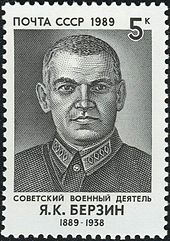
1938: Janis Berzins, Soviet military intelligence chief

On this date in 1938, the Soviet intelligence agent Janis Berzin(s) was shot in the basement of Moscow’s Lubyanka Prison.

A Latvian radical back to Riga’s chapter of the 1905 revolution,* Berzins became a trusted associate of Lenin in exile, and transitioned with the 1917 Revolution into a variety of political-security-military leadership positions in the new Soviet state.

For most of the 1924-1937 period, Berzins directed — indeed, practically createdSoviet military intelligence. He’s credited with personally recruiting the legendary World War II spy Richard Sorge; in 1936-1937 he was the chief Soviet military advisor in the Spanish Civil War under the nom de guerre “Grishin”. Russians fighting in Spain just referred to him as “the old man.” (Source)

Of course, no degree of seniority was sufficient safety during the frightful purging years of the Yezhovshchina. Once back in Moscow, Berzins fell instantly, almost randomly, over a spurious accusation of internal espionage.

His conviction was reversed after Stalin died.

* But not one of the Latvian revolutionaries who ended up in a shootout with London police.

On this day..

1938: Vladimir Kirshon, Bulgakov antagonist

On this date in 1938, Soviet playwright Vladimir Kirshon was shot at the Kommunarka “special object” shooting range outside Moscow.

Kirshon (English Wikipedia entry | Russian), purged as a “Trotskyist counter-revolutionary” as one might assume from the date and place. And like many peers in those terrible years, it was Kirshon’s to suffer the martyr’s fate without the merit of the martyr’s service.

In his day — which ran up to the spring 1937 fall of his patron, NKVD chief Genrikh Yagoda — Kirshon had distinguished himself with servility.

In his capacity as a Soviet writer’s guild bigwig, the ideologically rigorous Kirshon had been a point man in the depressing 1929-1932 campaign against the early Soviet Union’s rich literary heterodoxy. (Sample slogan: “For the hegemony of Proletarian literature! Liquidate backwardness!”)

This chilly period drove dystopian novelist Yevgeny Zamyatin to exile, and futurist poet Vladimir Mayakovsky to suicide.* The novelist and playwright Mikhail Bulgakov, a writer whose manuscripts from the furnace of Stalinism were forged for immortality, was also long harried by Kirshon. Kirshon’s pull nearly ruined Bulgakov’s career at what should have been its peak.

Bulgakov returned the contempt of his persecutor from a position of considerable literary superiority. Kirshon’s own work tended to the glorification of doctrinaire communism — he produced a verse celebrating the Civil War’s martyred 26 Baku commissars; Bulgakov has on his c.v. perhaps the signal achievement of 20th century Russian letters, The Master and Margarita. Little wonder to find Bulgakov complaining in private correspondence of the waste Kirshon has made of a trip to Europe, churning out the sort of tendentious and formulaic Soviet-man-abroad literature that any loyal commissar could have written without setting foot from Moscow. But despite the very real injuries Kirshon had done to him, Bulgakov found the baying denunciation theater so distasteful that he declined to say a public word against Kirshon when the latter fell.

The diary of Bulgakov’s wife Elena is not quite so diplomatic.

21 April 1937

A rumour that Kirshon and [Alexander] Afinogenov are in trouble. They say that [Leopold] Averbakh has been arrested. Is it possible that Nemesis has been visited upon Kirshon?

23 April 1937

Yes, Nemesis has come. There are very bad stories in the press about Kirshon and Afinogenov.

(These entries, quoted via J.A.E. Curtis’s Manuscripts Don’t Burn: Michael Bulgakov: a Life in Letters and Diaries, refer only to Kirshon’s professional fall. He was not arrested until that August.)

Kirshon was posthumously rehabilitated in the Khrushchev era and some of his work has even been performed in post-Communist Russia. But according to this Russian-language Bulgakov trove, that old foe made perhaps Kirshon’s lasting literary monument by using him as the model for the character Polievkt Eduardovich in Bulgakov’s short story “It Was May” (Russian link): it’s a story about a foppish critic who returns from abroad with specious critiques that force the narrator to ruin his own play by diverting the story to the arrest and purging of its principal character.

Thanks to friend of the blog Sonechka for translation and background.

* Mayakovsky shot himself at age 37; there’s also a popular hypothesis that he did this to check out at the same age as Pushkin.

On this day..

1973: Mimi Wong Weng Siu, jealous hostess

On this date in 1973, former cabaret star Mimi Wong Weng Siu and her husband Sim Woh Kum were hanged for the murder of Wong’s Japanese lover’s wife.

“Overwhelmed by a consuming jealousy” (her prosecutor’s words) for Hiroshi Watanabe, a land reclamation engineer from Osaka who was in Singapore working to prepare Bedok for development, Wong recruited her estranged husband to help her get rid of the competition. (Sim was just in it for the payment Wong promised him.)

On the evening of January 6, 1968, the two broke into the home when Ayako Watanabe was alone there. Sim threw bleach in the victim’s eyes to incapacitate her, as Wong fatally gashed her neck and abdomen with a small knife.

The resulting 26-day trial riveted Singapore with the risque details of the dance hostess’s adulterous trysts. (And said dance hostess’s two courtroom fainting episodes.) But their manifest guilt plus their confessions — each vainly attempting to blame the other — assured their convictions.

While Sim situates as a side character of little lasting interest, Mimi Wong’s hanging was among the few that would really stick with long-tenured Singapore hangman Darshan Singh.

The title character, if you like, of Alan Shadrake’s Singapore death row critique Once a Jolly Hangman, Singh executed more than 850 people in more than four decades on the job and never wavered in his support for the policies that kept him occupied. Even so, Singh felt compassion for the individual humans he was called upon to kill; he was known to go out of his way to get to know condemned prisoners and to comfort them in their distressing situation.

According to an October 2013 AsiaOne profile, Singh had an unusually close pre-execution relationship with the first woman hanged in the only recently (since 1965) independent Singapore.

In prison, she was a difficult inmate who would at times strip naked and refuse to put on her clothes even when ordered by prison guards. She even threw urine at the wardens, said Madam Jeleha.

“Darshan was the only one who could control her. He would say ‘Mimi, wear the blanket and cover yourself. Don’t do this or you won’t be beautiful any more’, and she would listen to him,” Madam Jeleha said.

The two forged an unlikely friendship and other prison officers even joked that Wong was his girlfriend. Mr Singh never minded.

Before her execution, Wong told Mr Singh they should be lovers in the next life and she wanted to take him with her.

“After he hanged Mimi Wong, he fell very sick for a month. He was in Toa Payoh Hospital for more than two weeks,” his wife said.

Even when probed, he refused to tell his wife about Wong’s final moments.

On this day..