1901: Filipino insurgents on Luzon

The American occupation of the Philippines from 1899 spawned a widespread indigenous resistance whose “hatred of our people is as bitter as it is groundless,” one American general puzzled.

Not all Americans saw it that way. William Jennings Bryan‘s populist magazine The Commoner slagged the U.S. Army for its liberal use of “the methods best calculated to give them new reasons for hating us.”


Cartoon on the cover of Life magazine’s May 22, 1902 issue (click for larger image) shows colonial European powers chortling, ‘Those pious Yankees can’t throw stones at us any more’ as they watch Americans apply the water cure to a Filipino captive. Torture by water cure was widespread during the Philippines-American War.

“The native is tied down flat on the ground and his mouth forced open with sticks or a string,” one soldier described it (pdf source; it’s on page 23). “Water is poured down his throat through a bamboo tube, which is nearly always handy. The native must drink the stuff, and it is poured down him until he can hold no more. As much as a gallon can be forced into a man that way. Then the water is pumped out of him by stamping on his stomach or rolling him over. When he comes to the native is always ready to talk.”

Apart from guerrillas in the field, Filipino insurgents opposed the occupiers’ superior firepower with the nasty asymmetrical tactics of assassination and terrorism, and that’s what brings us to today’s post.

Filipino terrorists known as Ducots, Mandoducots, or Sandathan on August 28, 1900 murdered a wealthy Los Banos landowner named Honorato Quisumbing who served as a town “presidente” under the American occupation.

A U.S. military court found that nine prisoners at the bar (in combination with “other natives whose names are unknown”) made “an assault upon the said Honorato Quisumbing with clubs, knives, bolos, and daggers, and did then and there wilfully, feloniously, and with malice aforethought kill and murder the said Honorato Quisumbing by striking, cutting, and stabbing the said Honorato Quisumbing with the said clubs, knives, bolos, and daggers.”

The decedent was a Visayan doing business as a merchant at Santa Cruz and Los Banos … formerly loyal to the Spanish Government and transferred his loyalty, active assistance, and cordial good will to the succeeding Government of the United States … Because of his friendshipfor, and willingness to aid, the forces of the United States, he was made a marked man, and the order went forth from the insurgent chiefs that he should be secured, dead or alive; and, as the sequel shows, a money reward was offered for his life.

General Arthur MacArthur — father of World War II General Douglas MacArthur — commuted four of the sentences to prison terms, and approved the remaining five executions for April 5, 1901.

Honorato Quisumbing’s widow was compensated by American authorities to the tune of $1,500. One of the victim’s seven sons, Eduardo, grew up to become his country’s leading botanist.


Further north on Luzon that same date, the pueblo of Mexico witnessed the hanging of insurgent captain Isabello del Rosario, also by authority of the American military government.

He’d been convicted of various depredations as what his prosecutors called “a notorious outlaw,” the most shocking of which was buring alive a man who had been reported to have made suspicious inquiries as to the whereabouts of the guerrillas. (He was also convicted of rape, extortion, and the most egregious war crime, fighting out of uniform.)

On this day..

1884: Henry Rose

Special dispatch to the St. Louis Globe-Democrat (April 5, 1884), which perhaps accounts for the outsized interest in the provenance of the rope.

MEMPHIS, TENN., April 4. — Henry Rose was hanged to-day at noon at Osceola, the county seat of Mississippi County, Ark., for the killing of Dempsey Tyler, a well-to-do negro who resided near Osceola. The preparations for the hanging were made by Sheriff W. Huskins some two weeks ago. The scaffold was newly built, as it was the first execution there for several years. The rope used was made at St. Louis of hempen material, and was 18 feet long and three-fourths of an inch in diameter. In ordering the rope Sheriff Haskins said he wished it to be good and strong, as the culprit weighed 200 pounds. A large crowd of negroes witnessed the execution. Rose, who is a negro, made a full confession of his guilt, and in a rambling speech on the scaffold told his listeners to be warned by his fate. His neck was broken by the fall.

THE CRIME.

The murder was a cold-blooded affair, as Taylor was killed while seated at his fireside one dark and stormy night, a load of buckshot being fired into the back of his head through a window only a few feet distant with fatal effect. The murderer escaped for the time being, but he left tracks which led to his discovery, arrest and conviction. He had gone to Taylor’s house in his stocking feet, and Sheriff Haskins, suspecting him of being the guilty party, inquired of a little girl at his residence for the stockings Rose wore on the night of the killing. The girl in reply to the Sheriff said, “Dey am under de bed, hid.” The tell-tale objects were found, and they led to further developments, which fixed the deed where it properly belonged. The man killed was popular with his race, but was regarded as an impudent and overbearing person by his white neighbors. It was for some slight or fancied wrong that Rose sought to revenge himself by slaying Taylor in the manner he did.

On this day..

2003: Scott Hain, the last juvenile offender executed in the United States

On this date in 2003, the state of Oklahoma executed Scott Hain for a Tulsa carjacking that netted $565 and two dead bodies.

The Hain that was strapped down on the gurney that evening was a 32-year-old with a nebbishy middle manager look, high forehead pursuing his hairline to the scalp’s horizon where it had drawn up a wilting rearguard picket fringing an egg-bald pate.

But back in 1987 when he stuffed Laura Lee Sanders and Michael Houghton into the boot of their own car and set it ablaze, Scott Hain was 17 years, 4 months, and 4 days of age.

American jurisprudence through the ages has regularly compassed the execution of minors, sometimes astonishingly young ones. But come the late 20th century the still-ongoing execution of a few men (they were all men) for crimes they had committed when still only boys was a deeply contentious subplot of the death penalty drama.

Because of the protracted judicial processes, there was no longer any question at this point of boosting wispy teenagers into electric chairs as South Carolina had done in 1944. The Scott Hains of the world were grown men by the time they died: grown up on death row.

They were, to be sure, nearly men when they killed as well.

The prevailing jurisprudence at this point was the 1989 Supreme Court decision Stanford v. Kentucky, which set the minimum age for death penalty eligibility at 16.*

And so 17- and even sometimes 16-year-old offenders not considered equal to adult responsibility** in most other spheres of life continued to face the executioner through the 1990s and into the 21st century, a period when the death penalty itself picked up steam.

This became an increasingly awkward situation. For one thing, it placed the United States internationally among a very small handful of countries with unsavory human rights records. Maybe it was a matter of the raw numbers; on the day Stanford came down, the United States had executed only 114 people in its “modern” era, and just three of them were juvenile offenders. For the 1990s, there would be an average of 48 executions every single year, and (again on average) one of those would be a juvenile offender.

But even as the numbers grew, only 20 of the 38 death penalty states permitted such executions, and only three states — Virginia, Texas, and Hain’s Oklahoma — actually conducted any such executions at all after 1993.

Foes argued over those years that the diminishing scope of the juvenile death penalty reflected an emerging national consensus against it — which could in turn be held to create a constitutional prohibition under the 8th Amendment’s proscription of “cruel and unusual punishment.”

Most of the death-sentenced juveniles made similar arguments in the course of their appeals, hoping to be the case that would catch the conscience of the court. Hain’s appellate team made this argument, too. It didn’t take, like it didn’t for any of the others who tried it.

Except, it was taking. Those evolving standards of decency were about to evolve right past a tipping point: in 2004, the justices accepted a new case from Missouri that placed the juvenile death penalty question before it once more.

The nine-member high court’s inconstant swing vote Anthony Kennedy — who had once upon a time (call it a youthful indiscretion) voted with the majority in Stanford to permit juvenile executions — wrote the resulting 2005 decision Roper v. Simmons, barring the execution of juvenile offenders in the United States.†

Scott Hain remains the last person executed in the United States for a crime committed in his childhood.

* The bright-line court ruling was necessary because states had indeed death-sentenced even younger teenagers. For example, Paula Cooper was condemned to death by an Indiana jury for a murder committed at age 15; her sentence was commuted to a prison term, and she was eventually released in 2013. The victim’s grandson, Bill Pelke, notably supported Cooper and has become a leading anti-death penalty activist in the intervening years.

** The notion of age 18 as the age of majority predominates worldwide, but is of course as arbitrary as any other, and has not been the threshold selected in all times and places. The Austrian empire declined to execute Gavrilo Princip for assassinating Archduke Ferdinand in 1914 and precipitating World War I because it could not establish that he had reached the age of 20 when he did so.

† Among the notable cases affected was that of Lee Boyd Malvo, the underaged collaborator of Beltway sniper John Muhammad. Malvo was being considered for capital charges in Virginia at the time Roper came down.

On this day..

1880: James Madison Wyatt Stone, landing on his feet

The wonderful blog Ghosts of D.C. calls our attention (via SanhoTree) to a fabulously gruesome botched hanging in the nation’s capital on this day in 1880.

James Madison Wyatt Stone was condemned for a brutal double-throat-slashing attack on his estranged wife, Alberta, and her sister, Lavinia Pitcher. Those two women lived together in Northwest D.C. along with Alberta’s two children by Stone; they had already had to shoo away the husband on previous occasions.

On Oct. 5, 1878, Stone forced his way into their residence and attacked Lavinia — she just happened to be in the sitting room when Stone burst the door. Pursuing her into the yard, Stone slashed her throat with a razor. Alberta came rushing down the stair to her shrieking sister’s aid, and Stone turned on her and delivered a similar injury. Alberta died the next morning; Lavinia survived.

Stone was chased down by neighbors who had been roused by the very noisy assault, which citizen captors then fended off attempts to exact summary justice until police arrived to take Stone into custody.

So that’s the crime. But get a load of the punishment.

Stone was hanged in a prison courtyard from a gallows 20 feet high, with just a five-foot drop of the rope. The details are important here because you might think from the story that follows that he was dropped almost all the way to the ground: the violence of the noose striking tends to cause a hanged body to oscillate. “He’s only got to be an inch or two off-centre and he’ll swing like a bloody pendulum when he’s dropped,” the executioner Syd Dernley remembered being told during his 20th century training program.

You can see pretty easily why that’s pertinent from the Washington Post‘s account of what happened when the trap was dropped.

Instead of the dangling and possible convulsed form of the dying man being as expected, all were horrified at seeing the body standing for a moment headless on the ground, the blood spurting in thin jets from the neck. Before anyone had time to realize what had occurred the decapitated trunk fell back, prone. The head had shot backwards also and bounded against the frame of the scaffold, falling about four or five feet from the body, the bleeding base being uppermost.

Falling 20 feet to land arrow-straight upright while your black-bagged head is torn off by a rope must be something like tossing a coin and having it come up … sides.

Physicians coolly retrieved the head from its bloodied sack, and found Stone’s visage “placid, and the lips moved as if about to say something.” (New York Times) It was sewed back to the murderer’s formerly blood-jetting neck for burial.

On this day..

2013: A day in the death penalty around the Persian Gulf

A year ago today, three Persian Gulf states made the news for their April 1 executions.

Iraq

Iraq four people on April 1, 2013 for terrorism-related offenses, including Munaf Abdul Rahim al-Rawi.

This onetime al-Qaeda figure once styled the “governor” of Baghdad was arrested in 2010 and actually cooperated with his captors, enabling U.S. and Iraqi officials to assassinate two other al-Qaeda leadersAbu Abdullah al-Rashid al-Baghdadi and the long-hunted Abu Ayyub al-Masri.


Munaf Abdul Rahim al-Rawi, in a 2010 interrogation

Such cooperation didn’t come with any assurance for safety of his own. After the operations his intelligence made possible, al-Rawi went on trial for his life. “One of the investigators said a death sentence is waiting for me,” he told a reporter nonchalantly. “I told him, ‘It is normal.'”

The hangings were Iraq’s 19th, 20th, 21st, and 22nd of the year.

Saudi Arabia

On April 1, 2013, Saudi Arabia beheaded Abdul Rahman Al Qah’tani in Riyadh. He “shot dead Saleh Moutared following a dispute.”

His was the 29th execution of the year.

Kuwait

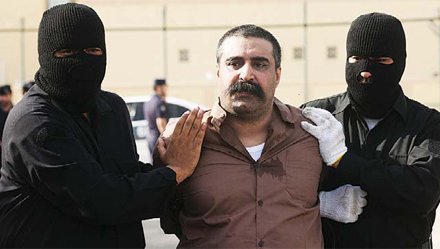
Three men were hanged at the central jail in Sulaibiya, Kuwait, on April 1, 2013, the first executions in the gulf monarchy since May 2007.

  • Pakistani Parvez Ghulam, convicted of strangling a Kuwaiti couple in 2006.
  • Saudi Faisal Dhawi Al-Otaibi, who stabbed a friend to death.
  • A stateless Arab Bedouin, Dhaher (or Thaher) al-Oteibi, who killed his wife and children and claimed to be the long-awaited twelfth imam. One imagines there was conceivably some mental instability there.

Kuwait employed the gallows with some regularity, with 72 hangings from the death penalty’s introduction in 1964 up until 2007. At that point, it ceased carrying out executions without any public explanation, though it has never ceased handing down death sentences.

This date’s resumption of hangings did not play at subtlety: media invitations resulted in a harvest of gallows photography. (See below.)

“We have begun executing death sentences as criminality and brutality have increased in our community, and the court issues sentences for serious crimes on a daily basis,” Kuwaiti prosecutor Mohammad Al-Duaij said in announcing the hangings. “These executions should eliminate the increasing number of crimes and be a deterrent.”

He added, ominously, that the other 48 people then on Kuwaiti death row had had their cases submitted to the emir for approval.

On this day..

1949: Dr. Chisato Ueno, because life protracted is protracted woe

The Truk Atoll, in Micronesia, is more commonly known today as Chuuk. It’s a hot diving location notable for the many sunken World War II Japanese hulks to be explored there — the legacy of its once-pivotal position in the Pacific War.

Japan used Truk as forward naval base in the South Pacific, and armored up its little islands like an armadillo.

Rather than capture it outright, the U.S. Navy bombed Truk right out of the war in February 1944, leaving that enormous warship graveyard and a stranded stronghold of starving soldiers who were left to wither on the vine. At war’s end, it was just a matter of circling back to collect 50,000 surrenders.

Unfortunately, the castaway Truk garrison did not pass the last months of the war with sufficient care for its foreseeable postwar situation.

According to testimony given the postwar Guam war crimes tribunal, 10 American prisoners were murdered on Truk in 1944 “through injections, dynamiting, tourniquet applications, strangling and spearing.” (Source) Hiroshi Iwanami was executed for these gruesome experiments/murders in January of 1949.

Ueno, a lieutenant surgical commander, hanged for two other killings that read quite a bit murkier.

Five American POWs were being held in a temporary stockade that was hit by an American bombing raid in June 1944 — killing three of those prisoners.

The surviving two were severely injured, eventually leading Dr. Ueno on June 20, 1944, to perform what he characterized as a legitimate exploratory surgery on one of those men. His prosecutors framed it instead as a fiendishly gratuitous vivisection.

During that procedure, an order arrived for the execution of both the prisoners. The other guy, the one Dr. Ueno wasn’t operating upon, he never had in his care at all; that unfortunate fellow ended up being bayoneted to death. The man on the table (both men’s names were unknown to the prosecuting court) Dr. Ueno stitched back together well enough that subalterns could stretcher him out to a swamp and chop off his head.

Here’s the difficult part: Ueno actually gave the immediate order to execute his ex-patient.

As described in the National Archives’ Navy JAG Case Files of Pacific Area War Crimes Trials, 1944-1949, the physician’s barrister mounted a quixotic philosophical defense of this deeply indefensible order, noting the principled acceptability of euthanasia in Japanese hospitals (so he said), the inevitability of the prisoner’s approaching execution via superior orders, and the agony the man was already in from his wounds.

[Dr. Ueno] had expected that some other person would dispose of this prisoner. But he could not find anyone who looked like the person to carry this out … the thought dominated his mind that all hope is lost to save this prisoner. His fater has been determined. Yet the prisoner is in pain …

He was faced with the predicament of killing by his order the prisoner which he had treated as hiw [sic] own patient. What sarcastic fate was this that he had to face? As the Napoleon, described by George Bernard SHAW, and as McBeth [sic] described by William SHAKESPEARE, the accused, UENO was also “a man of destiny.”

A certain English poet wrote, “Life protracted is protracted woe.” If the life of the prisoner in the present case was protracted one second, he would have so much more suffering to endure. Should it be condemed [sic] so severely to shorten one’s life under such circumstances and shorten his last woe in this world?

There were in all either 10 or 13 official executions of Japanese war criminals on Guam from 1947 to 1949. It’s devilishly difficult to find those 13 enumerated by name and date, but it appears to me that Ueno and his boss Admiral Shimpei Asano were the very last to achieve that distinction.**

The readable little history on Truk island and the U.S. Navy operations against it, Ghost fleet of the Truk Lagoon, Japanese mandated islands”, captures the scene.

Shortly after eight o’clock on the humid, tropical evening of March 31, 1949, according to War Department Pamphlet #27-4 Procedure For Military Executions, the 5’6″ Japanese surgeon with extremely strong neck muscles was escorted up the nine steps to the gallows. The handcuffs were removed by a Marine guard and a strap placed to secure his arms to his side and another placed around his legs. A black hood was placed over his head and at 8:26 p.m. the floor panel on which he was standing fell from under his feet and Ueno dropped 94 inches to eternity. He was the last to die, as Rear Admiral Shimpei Asano* had preceded him only moments before. Under the dubious honor that rank has its privileges — the Admiral went first.

* Executed for these same two murders on Truk, as well as two other POWs killed at Kwajalein, in the nearby Marshall Islands.

** Angered by Naval administration of the island, Guam’s Congress had staged a walkout earlier in March 1949. This action did successfully force an end to Naval government.

On this day..

1875: John Morgan, slasher

On this date in 1875, a private named John Morgan was hanged for murdering his fellow.

The London Times reported the trial (March 12, 1875: Morgan did not outlive his victim by so much as a month) thus:

THE SHORNCLIFFE MURDER

Home Circuit.
Maidstone, March 11.
Crown Court.– (Before Mr. Justice Denman.)

The Court was occupied all day with a trial for murder — a case of a very remarkable character.

John Morgan, a private in the 82d Regiment, was indicted for the murder of Joseph Foulstone, another private in the same regiment, at Shorncliffe, on Saturday last.

Mr. Biron and Mr. Denny were for the prosecution; Mr. Norman, at the desire of the learned Judge, defended the prisoner, and was assisted by Mr. Grubb.

The prisoner Morgan and Foulstone, the deceased, were quartered at Shorncliffe. The prisoner and Foulstone occupied the same “hut,” No. 26. At 9 o’clock on the night of last Saturday they were in the same room together, with two boys and a man named Reader, who was fast asleep, sleeping off the effects of drunkenness. Just after 9 the prisoner asked one of the boys to go and get him some sweets, giving him a shilling for the purpose, and when he was gone told the other boy to go and get him some sauce. When they left the hug Foulstone was reading near a bed (not the one on which Reader was sleeping, but another one). Almost immediately afterwards a man named Brown, in the next hut, was horrified at seeing Foulstone, the deceased, coming staggering towards him, holding his throat with both hands and the blood gushing from it rapidly. He motioned for writing materials and wrote something not in evidence. [n.b. — he wrote “Morgan done it” -ed.] The attempts to stop the flow of blood from his throat were vain, and in a minute or two he dropped his head and died. The prisoner was found in his hut, standing over a can of water, evidently in the act of washing. There were marks of blood on his shirt, and one of his sleeves was wet as if recently washed. There were also drops of blood on his coat and trousers and boots. When brought into the presence of the dying man the latter motioned with his hands towards him. The prisoner said, “I did not do it; he did it himself,” and that was the defence set up. The evidence of the surgeon, however, went to show that the wound was such as the deceased could not have inflicted himself. There was a clean fresh cut on the prisoner’s thumb, and there were cuts both on the left and right hand of the deceased. A razor covered with blood was found in the hut, and was evidently the weapon with which the wound was inflicted.

The suicide story seemed so far-fetched that the jury had little difficulty reaching its verdict. In time, Morgan did confess to the crime; according to the London Times of March 31, 1875 he admitted the motive for it only to his chaplain and under a strict seal of confidentiality — an unusual stricture that can’t but put one in the mind of a scandalous subtext like the love that dare not speak its name.


Since consummate professional hangman William Marwood was busy long-dropping Morgan at Maidstone Gaol, a yokel named George Incher had to be recruited to carry out a simultaneous execution at Stafford Gaol. Twenty-three-year-old John Stanton had murdered his uncle in a quarrel earlier that month, and spent his last weeks pleading contrition for this family tragedy to anyone who would listen; this non-Marwood hanging used the old “short drop”, which meant that Morgan just strangled to death.

Part of the Daily Double: Victorian Soldiery.

On this day..

1875: Richard Coates, gunner and rapist

On this date in 1875, artilleryman Richard Coates (or “Coote”) was hanged for murder.

He’d been detailed as a schoolteacher for the Purfleet garrison. One day deep into his cups, he raped a 6-year-old* girl. And then killed her by bashing her head into a privy.

The “Purfleet Murder” got all kinds of copy on the Victorian crime wire, for the crime was very simple and simply horrendous. After he had done with his victim, Coates tucked her broken body under his greatcoat like a shoplifter and smuggled her down to the river to dispose of.

Adding humiliation to the greater sins of the day, he was unable there to get the body up over the palings, so he abandoned it inside the fence. Presumably no veteran hand at homicide, Coates appeared palpably agitated to basically everyone else who saw him that day, and his clothes turned up bloodstained. He was an easy suspect to collar.


To the tune of Civil War hymn “Just Before the Battle, Mother” by George F. Root.

Richard Coates, that cruel murderer,
Now is cold within his grave,
None could show him any pity,
None stretch for a hand to save;
His horrid crime was so unmanly,
I’m sure we no excuse could give,
He did disgrace our gallant soldiers,
And he was not fit to live.


CHORUS

Richard Coates, the Purfleet murderer,
On Easter Monday met his doom;
He killed the soldier’s little daughter,
Now he’s dead and in his tomb.

For the murder of poor Alice Bougham
He justly was condemned to die,
For a murder so outrageous,
The country for his death did cry;
You never heard or ever read of
Such treatment to a little child,
Altho’ so innocent and so loving,
Cruelly murdered and defiled.

A full confession of the murder
To the champlain he has made,
He has told the truth to those around him,
For which his poor old mother prayed;
He took his victim to the closet,
Frightful was his conduct there,
He took her life in a cruel manner,
Before his death he did declare.

He tried to throw his victim’s body
Over the pailings in the sea,
The fence was high, he could not do it,
It was ordained it should not be;
Could he have thrown her in the water,
And the tide have carried her away,
The murder of the soldier’s daughter
Would not have been found out to-day.

He might have done well in the army,
In the barracks he was born,
Alas! he has disgraced his father,
Who the uniform has worn;
Heaven help his poor old mother,
She has been a true good soldier’s wife,
She would sooner have seen him shot in action,
Than in such a way to lose his life.

Then let us all now take a warning
By his sad and fearful end,
Don’t give way to unholy passion,
Nor against the laws offend;
Try to be honest and be sober,
I’m sure you’ll find it is the best,
In the world let’s do our duty,
As we hope in heaven to rest.


[audio:Driven_From_Home.mp3]

This one is set to “Driven From Home” by William Shakespeare Hays.

Upon Easter Monday within Chelmsford gaol,
A murderer, when dying, his crime doth bewail,
Upon the dark scaffold he drew his last breath,
The penalty of murder he paid with his death;
Richard Coates was his name, by Sata beguiled,
He outraged so cruel a dear little child,
And all through the country it has been the cry,
His sentence was just, he deserved to die.


CHORUS

Gone from this life, gone from this world,
By the hands of the hangman to Eternity hurled,
May heaven forgive him, is all we can say,
As we hope for forgiveness on our dying day.

There never was known such a cowardly crime,
That we are relating at this present time;
It is dreadful to think there could be a man,
Who in his senses this murder could plan.
He pleaded “not guilty” almost to the last,
Till he saw all the chance of forgiveness was past;
His poor moter begg’d him the truth to unfold,
And confess to his crime for the sake of his soul.

He took the poor child to the coset, he said,
Innocent and smiling to her death she was led.
He murdered her there at the bottom of the field,
And beneath his great coat her dead body conceal’d,
He went to the edge of the wide rolling sea,
To throw the child in but it was not to be,
Tho’ time after time the villain did try,
He could not reach over the pailings so high.

When he found that his crime he could not conceal,
He left the child’s body ‘neath the grass in the field,
Where the dear little angel soon after was found,
By those who so long had been searching around.
They seized him and ask’d him the crime to explain,
He cried “I’m not guilty” again and again;
They could not believe him in spite of denial,
They sent him to saol to wait for his trial.

As he walked from the cell through the sweet morning air,
At the end of the prison the gallows was there;
‘Twas the last time he’d gaze on that beatiful sky,
As he walked to the spot where he knew he must die.
The hangman was ready, deep sounded the bell,
‘Twas scarcely a moment before the drop fell!
The murderer, Coates, from the world was torn,
His body was there, but his dear life was gone.

May his fate be a warning to both old and young,
May it be an example to everyone,
From the straight path of duty never to stray,
Or we shall regret it on our dying day.
The murderer now is gone from this world,
By his own folly to destruction is hurled,
Then pray let us all to this warning attend,
And may heaven preserve us from his fearful den.


According to Flat Earth: History of an Infamous Idea, Coates’s condemnation was immediately followed — in the same courtroom, before the same judge — by the tragicomc libel trial of nutbar flat-earther John Hampden for his ongoing campaign to savage the reputation of Alfred Russel Wallace.**

The bombastic Hampden — who denounced “that Satanic device of a round and revolving globe, which sets Scripture, reason, and facts at defiance” and actually wrote Wallace’s wife wishing that her hubbie would have “every bone in his head smashed to a pulp” — would have been right at home with the Coates ballad that vengefully prayed,

While the spotless soul of little Alice,
Is taken to a better land
May perdition light upon the monster,
Who has disgraced the name of man.

* Reports of age differ, but Alice Boughen was definitely a prepubescent youngster well under the age of 10.

** Wallace is the guy whose collegial letters to Darwin mooting Wallace’s own ideas about natural selection led the previously reticent Darwin to rush into publication with On the Origin of Species.

Part of the Daily Double: Victorian Soldiery.

On this day..

1958: Jeremiah Reeves, Montgomery Bus Boycott inspiration

In 1954, the Dexter Avenue Baptist Church in Montgomery, Alabama hired as its pastor a 25-year-old fresh out of Boston University’s doctoral program.

In his memoir, Dr. Martin Luther King, Jr. remembered his entry to civil rights activism in Montgomery. One of his first steps was setting up a Social and Political Action Committee for his church, prominently emphasizing voter registration.

But his next engaged a major death penalty case that haunted Montgomery throughout the 1950s.

After having started the program of the church on its way, I joined the local branch of the NAACP and began to take an active interest in implementing its program in the community itself. Besides raising money through my church, I made several speeches for the NAACP in Montgomery and elsewhere. Less than a year after I joined the branch I was elected to the executive committee. By attending most of the monthly meetings I was brought face to face with some of the racial problems that plagued the community, especially those involving the courts.

Before my arrival in Montgomery, and for several years after, most of the NAACP’s energies and funds were devoted to the defense of Jeremiah Reeves. Reeves, a drummer in a Negro band, had been arrested at the age of sixteen, accused of raping a white woman. One of the authorities had led him to the death chamber, threatening that if he did not confess at once he would burn there later. His confession, extracted under this duress, was later retracted, and for the remaining seven years that his case, and his life, dragged on, he continued to deny not only the charge of rape but the accusation of having had sexual relations at all with his white accuser.

The NAACP hired the lawyers and raised the money for Reeve’s defense. In the local court he was found guilty and condemned to death. The conviction was upheld in a series of appeals through the Alabama courts. The case was appealed to the United States Supreme Court on two occasions. The first time, the Court reversed the decision and turned it back to thes tate supreme court for rehearing. The second time, the United States Supreme Court agreed to hear the case but later dismissed it, thus leaving the Alabama court free to electrocute. After the failure of a final appeal to the governor to commute the sentence, the police officials kept their promise. On March 28, 1958, Reeves was electrocuted.

The Reeves case was typical of the unequal justice of Southern courts. In the years that he sat in jail, several white men in Alabama had also been charged with rape; but their accusers were Negro girls. They were seldom arrested; if arrested, they were soon released by the grand jury; none was ever brought to trial. For good reason the Negroes of the South had learned to fear and mistrust the white man’s justice.

Stride Toward Freedom: The Montgomery Story

Reeves’s plight struck much closer to home for Claudette Colvin.

A Montgomery native, she was a classmate of Reeves at Montgomery’s segregated Booker T. Washington High School.

On March 2, 1955, Colvin boarded a city bus in front of King’s church on her way back from school, and plopped herself down in the middle of it. As the bus meandered on its route, it began to fill up. Montgomery’s segregated-bus rules at the time reserved a few rows up front for whites, and opened the middle rows for blacks … but only until the white rows overflowed, at which point black riders in the midsection were expected to give up their seats.

Colvin refused to do it.

She furiously argued with the police summoned by the bus driver, invoking her constitutional rights.

When they arrested her, she didn’t do nonviolent resistance: she fought back.

“I was really struggling,” she said in Ellen Levin’s Freedom’s Children: Young Civil Rights Activists Tell Their Own Stories.

“Other kids got home and told Mama what happened,” Colvin remembered. “She already knew how hurt I was about Jeremiah Reeves. She knew this wasn’t a one-day thing. This was a rebellious time that started with Jeremiah … I just couldn’t get over Jeremiah being framed.”

Colvin’s spur-of-the-moment act of civil disobedience predated the more famous refusal of Rosa Parks by nine months. (Colvin’s parents knew Rosa Parks, and Parks was an advisor to the NAACP Youth Council, which Colvin was involved in.)

Montgomery civil rights leaders were already looking for a test case to mount a challenge against Montgomery buses’ racial ridership rules. Colvin was considered for the part, but ultimately Montgomery’s leaders took a pass on the case: she was an angry teenager, very dark-skinned, and from a working-class family; moreover, she soon became pregnant by an older, married man whom Colvin refused to name. Nevertheless, her name, and her act, became well-known in Montgomery and nationwide. The first pamphlets about Parks’s arrest reference Colvin as the well-known precedent.

Rosa Parks, a dignified and nonviolent matron, was eventually judged the palatable public figurehead to rally behind. Days after Parks’s December 1, 1955 arrest,* the Montgomery Improvement Association — with King at its head — mounted its famous bus boycott. Parks is the name everyone knows … but Colvin was the first.

And Colvin was one of four plaintiffs in the federal suit that forced desegregation in Montgomery.

Claudette Colvin’s refusenik notoriety made it so difficult for her to work in Montgomery that she moved to New York in 1958 — the same year her schoolmate was finally electrocuted for that supposed rape.

Days after Reeves died in Alabama’s electric chair, an Easter rally assembled on the lawn of that state’s capitol building to protest the execution — and gird for the struggles still to come.

We assemble here this afternoon on the steps of this beautiful capitol building in an act of public repentance for our community for committing a tragic and unsavory injustice. A young man, Jeremiah Reeves, who was little more than a child when he was first arrested, died in the electric chair for the charge of rape. Whether or not he was guilty of this crime is a question that none of us can answer. But the issue before us now is not the innocence or guilt of Jeremiah Reeves. Even if he were guilty, it is the severity and inequality of the penalty that constitutes the injustice. Full grown white men committing comparable crimes against Negro girls are rare ever punished, and are never given the death penalty or even a life sentence. It was the severity of Jeremiah Reeves’s penalty that aroused the Negro community, not the question of his guilt or innocence.

But not only are we here to repent for the sin committed against Jeremiah Reeves, but we are also here to repent for the constant miscarriage of justice that we confront every day in our courts. The death of Jeremiah Reeves is only the precipitating factor for our protest, not the causal factor. The causal factor lies deep down in the dark and dreary past of our oppression. The death of Jeremiah Reeves is but one incident, yes a tragic incident, in the long and desolate night of our court injustice.

Let us go away devoid of biterness, and with the conviction that unearned suffering is redemptive. I hope that in recognizing the necessity for struggle and suffering, we will make of it a virtue. If only to save ourselves from bitterness, we need vision to see the ordeals of this generation as the opportunity to transfigure ourselves and American society … Truth may be crucified and justice buried, but one day they will rise again. We must live and face death if necessary with that hope.

-Martin Luther King, ““Statement Delivered at the Prayer Pilgrimage Protesting the Electrocution of Jeremiah Reeves” (pdf transcription)

* Parks would say that she had been thinking on the occasion of her refusal of that summer’s murder of Emmett Till in Mississippi.

On this day..

1878: The Brassell boys

On this date in 1878, Joe and Teek* Brassell were hanged in Cookeville, Tennessee.

These brothers (their eldest sibling Jim Brassell wisely bowed out of the scheme) and two other buddies got into the whiskey moonshine from the Brassells’ own home still, and decided to knock over a nearby lodging where two guests thought to be heavy with cash were staying.

So the quartet blacked up faces and turned clothes inside out by way of disguise and around midnight tromped up to the Allison Stand Inn wielding pistols.

“Don’t worry!” Russell Allison called to his guests, recognizing his onetime schoolmates. “It’s the Brassell boys!”

Great disguise.

Nothing daunted by their identities outed, the moonshine party invaded the log residence. A bedroom melee ensued, and in the course of it Teek Russell shot Russell Allison fatally in the gut; another shot only narrowly missed Mrs. Isbell, the wife of the tax collector W.J. Isbell whom the party was trying to target in the first place.** Isbell wasn’t there at all, and the whole band fled the house not a penny richer, but about to be wanted men.

The next day as Allison lay expiring from his painful wound, the Allison family rounded up its own posse and descended on the Brassell residence. Again, Teek gut-shot an Allison — Russell’s brother Joe — and killed him, too. But the rest of the posse detained the desperados and they were soon hailed to Cookeville Jail. The murder became extremely notorious in the area and the Brassells boys were easily condemned, albeit after nearly two years’ worth of legal continuances.†

We’ve liberally included these youths in our arsenic themed set. Of course, these young men worked their mayhem with firearms and not philters, but in a sense their case underscores the ubiquity of that poison for 19th century crime. Desperate to escape, even the brutally direct Brassell boys turned like dissatisfied housewives and furtive insurance adjusters to inheritance powder: in their case, they managed to have some smuggled to them in jail, which they planned to insinuate into some apples they would share with their guards while being moved between Nashville and Cookville.

As it transpired, the guards caught wind of this scheme and foiled it, along with several other jailbreak attempts. But that was the great thing about that innocuous dust: everywhere someone would profit from some other fellow dropping unexpectedly dead, the first thought was invariably arsenic!

Frustrated of this and all other exits from their grim condition, the Brassell boys at last had to face the hemp. It would be the only judicial hanging in the history of Putnam County, Tennessee, and it would not want for ceremony. The execution itself occurred on a Wednesday; on the Sabbath preceding, the local Sunday school’s curriculum included (pdf) a visit to the condemned cells, where prisoners and children sang “Let us cross over the river”.

On hanging-day itself, the boys were up early for press interviews in the jailhouse. Shortly after 11 a.m., they piled into a wagon, grabbed seats on their own coffins, and were taken under guard to the double gallows specially built for them on Billy Goat Hill. Their sister Amanda trailed the wagon, but after a farewell hug she complied with Joe and Teek’s request to leave without seeing them hang.

Amanda had plenty of time to comply. The hanging wasn’t until 1:30!

The Brassells passed their last two hours or so of life on the scaffold. As they sat under their hanging-nooses, a crowd of thousands — some estimates put it as high as 20,000; old folks in the early 20th century would still say that it was the largest crowd Cookeville had ever seen — imbibed a series of preachers and religious songs, the warnings of the condemned duo themselves, and a scene where their intended target Mr. Isbell climbed up on the platform himself and pressed the two for a confession. Joe admitted his guilt. Teek refused until the very end to do so.‡ To cap off the drama, the sheriff, hatchet in hand to chop the fatal rope, counted down the last five minutes.

It seems this whole event, from the murder to the hanging, still survives in Cookeville folklore. There’s a lengthy ballad about the Brassell boys’ crime and execution, available here (pdf). Also see this fantastically detailed web page about the crime, including a blurry restored photograph of the hanging, and this pdf roundup.

A fragment of the Brassell boys’ joint headstone can still be seen at a family plot adjacent to Upperman High School in the small town of Baxter, just outside Cookeville.

* Teek had “George Andrew” on his birth certificate.

** William Jefferson Isbell was a tax collector carrying his proceeds; he had fallen ill that day and had to stop elsewhere. The Isbells and Allisons were related through marriage.

† “Justice, when most severe to him who has offended, is always most merciful to him who would offend,” the Supreme Court most severely ruled — admonishing the young men not to entertain any hope of reprieve. (Quoted in the St. Louis Globe-Democrat, March 28, 1878)

‡ Teek’s obstinacy on claiming innocence when the evidence against him seemed so overwhelming led to some later speculation that he might have semi-willingly taken the rap for a different Brassell — maybe Jim, the one who supposedly bowed out of the raid, or maybe even Amanda.

Part of the Themed Set: Arsenic.

On this day..