1856: Six Tennessee slaves, election panic casualties

On this date in 1856, the white citixens of Dover, Tennessee hanged at least six black slaves in the midst of a regional panic.

They could well sense, as could all Americans, the hollowing authority of slavery in the 1850s with the Civil War looming ahead in 1861. Conflict over the issue had split the country sectionally over the disposition of the huge territory annexed in the Mexican-American War; the matter came to literal blows on the western frontier in the “Bleeding Kansas” bush war.

On the cultural plane, these are the years that germinated the definitive anti-slavery novel Uncle Tom’s Cabin (1852); on the legal plane, they produced the the notorious pro-slavery Dred Scott Supreme Court case (1857).

And on the political plane, the slavery issue tore apart the old Whig Party — and so the 1856 presidential election for the first time featured the new anti-slavery Republican Party as the chief opposition. The very first Republican presidential nominee, John Fremont, carried 11 states on November 4, 1856: not enough to capture the White House, but enough to put the Slave Power in fear for its human chattel and catalyze, in the weeks surrounding the vote, paranoid reactions in various southerly locales to the effect that Fremont-inspired blacks would be coming to dispossess all the masters.

Now it only takes a glance at Twitter to evidence the capacity of a presidential ballot to dominate the public mind, so there can hardly be doubt that seditious rumors of liberty fell from black lips which had never been so close to tasting emancipation. “Wait till Fremont is elected, and den I guess as how, missess, you will have to dew de pots yourself,” a Memphis kitchen-slave supposedly told her mistress on the eve of the election. (New York Herald, December 11, 1856) The masters too would have spoken of the same topic, but with trepidation; nobody knew but what the future could hold, and words overheard would have worked their way to and fro across the color line to shape hope, terror, anticipation. The newspapers from the last weeks of 1856 have reports of rumored insurrections and white vigilance committees in Missouri, in Texas, in Arkansas, in Louisiana.

As is usual in slave rising panics no firm evidence exists that black plots consisted in this moment of anything more substantial than whispered hopes. Whites in scattered localities saw Nat Turner everywhere — and nowhere was this more the case than in western Tennessee. There, slaves around the Cumberland River were believed to be organizing a Christmas Day rising* to cut their masters’ throats, run amok, and rendezvous with an imagined army of Fremont liberators. One correspondent described for northern papers how

the credulity of these poor people is such that, in the belief of the whites who excite them, they imagine that Col. Fremont, with a large army is awaiting at the mouth of the river Cumberland … Certain slaves are so greatly imbued with this fable, that I have seen them smile while they are being whipped, and have heard them say that ‘Fremont and his men can bear the blows they receive.’ (via the Barre (Mass.) Gazette, Dec. 19, 1956)

Against such hope — more blows. A truly horrifying and widely republished editorial in the Clarksville (Tenn.) Jeffersonian that Dec. 3 proposed an overwhelming bloodletting to crush this prospective jacquerie.

It is useless to shut our eyes and deny the facts, or sneer at the developments which have been made. Every hour multiplies the proof and corroborates previous discoveries. It is no Titus Oates affair, but a solemn, fearful and startling reality, and must be dealt with accordingly.

The crimes contemplated should be atoned for precisely as though those crimes had been attmpted and consummated. Fearful and terrible examples should be made, and if need be, the fagot and the flame should be brought into requisition to show these deluded maniacs the fierceness and the vigor, the swiftness and completeness of the white man’s vengeance. Let a terrible example be made in every neighborhood where the crime can be established, and if necessary let every tree in the country bend with negro meat. Temporizing in such cases as this is utter madness. We must strike terror, and make a lasting impression, for only in such a course can we find the guaranties of future security …

The path of future safety must be wet with the blood of those who have meditated these awful crimes. Misplaced clemency, and we believe that any clemency would be misplaced, may at no distant day bring upon this people, the horrors and the inexpressible crimes which marked the enfranchisement of St. Domingo. While retributive justice, sternly and unbendingly enforced, will certainly remove the cause of the evils we now suffer and prove our sure protection against their repetition in all time to come.

So far as this writer can establish it is not certain how many people overall in Tennessee and throughout the Slave Power met the guns and nooses of white vigilantes, but some of the best-established are a sextet hanged at Dover on December 4, 1856. This town on the Cumberland was roiled by rumors that slaves from nearby communities intended to march, armed, on Dover itself, an idea that seems not much less fanciful than that of deliverance by Fremont; it became thereby an epicenter of the suppression, and favors us from a sea of unreliable timelines and misstated figures with a concrete eyewitness description.

Tuesday morning [sic — the writer means Thursday, Dec. 4, having narrated Wednesday, Dec. 3 immediately prior], I went to Dover, and arrived there about 2 o’clock. The people had hung four negroes at 11 o’clock that morning, and two more then in town to be hung. I got to the place of execution in time to see the last one go off. Of the six that were hung, three had been preachers. They were all proved to be ring-leaders. I learned that the men at the forge were at work whipping the truth out of their negroes, so I rode out there that night, and was up with them all night. I never had such feelings in my life. I saw a list of negroes that had been whipped, and was told what they all had stated, and then I heard the balance examined — some taking five and six hundred lashes before they would tell the tale … One of the negroes at the forge died from whipping that night, several hours after the operation.

We are at work here to-day. We have one negro in chains, and will hang him I think, certain; if the committee will not the community are determined to do it. I think we will have quite an exciting time here before we get through. I have no doubt but that it is a universal thing all over the Southern States, and that every negro fifteen years old, either knows of it or is into it … (Louisville Daily Courier, Dec. 29, 1856)

Two key academic sources on this affair are:

  • Harvey Wish, “The Slave Insurrection Panic of 1856,” The Journal of Southern History, May, 1939
  • Charles Dew, “Black Ironworkers and the Slave Insurrection Panic of 1856,” The Journal of Southern History, August 1975

* Shades of Jamaica.

On this day..

2009: Bobby Wayne Woods

Bobby Wayne Woods was executed by lethal injection in Texas on this date in 2009.

A proud bearer of the classic middle name, Woods in 1997 broke into his ex-girlfriend’s home and kidnapped her two children, both of whom he did to what he thought was death. (11-year-old daughter Sarah Patterson, whom Woods also raped, did die; nine-year-old son Cody Patterson survived a savage beating, barely.)*

What distinguished Woods from a run-of-the-mill capital murder was his disputed competency — a product of what Australia’s Sydney Morning Herald aptly termed a “legal grey area.” A landmark 2002 U.S. Supreme Court case, Atkins v. Virginia, bars the execution of mentally disabled prisoners … but punts the definition of this protected class to the very states that are trying to execute them. Ah, federalism.

Woods was a barely-literate middle school dropout with I.Q. test scores ranging from 68 to 80; the commonplace threshold for mental disability is about I.Q. 70. He definitely did the crime, but was he entitled to protection under Atkins?

The case stuck in the judicial craw, scratching a scheduled 2008 execution and resulting in appeals that resolved only half an hour before Woods received the needle. The whole thing was essentially stalemated by dueling experts on retainer who made the arguments you’d expect them to make for their sides. And since the legal standard is whatever Texas feels like enforcing, that means the guy is not disabled.

* The victims’ mother, Schwana Patterson, was convicted of felony child neglect for failing to intervene in the abduction, out of fear of the assailant; she served eight years in prison for this.

On this day..

2005: Kenneth Boyd, the 1,000th modern execution in the U.S.

On this date in 2005, Kenneth Lee Boyd died to lethal injection in Florida. His was the 1,000th execution conducted in the so-called “modern” death penalty era in the United States.

“I’d hate to be remembered as that,” Boyd said of his prospective milestone distinction. “I don’t like the idea of being picked as a number.”
He’d not needed a number to fight in Vietnam thirty-odd years before: he volunteered, and worked heavy equipment under fire, which his attorneys would later argue made him a PTSD victim.

The victims of the PTSD victim were his estranged wife Julie Curry Boyd and Julie’s father Thomas Dillard Curry, both of whom he gunned down with a .357 magnum in the presence of his and Julie’s three children back in 1988. Then he called 911 with the report, “I’ve shot my wife and her father — come on and get me.” In his voluntary confession upon surrender to the responding officers, he invoked the ghost of his youth’s imperial war.

It was just like I was in Vietnam. I pulled the gun out and started shooting. I think I shot Dillard one time and he fell. Then I walked past him and into the kitchen and living room area. The whole time I was pointing and shooting. Then I saw another silhouette that I believe was Julie come out of the bedroom. I shot again, probably several times. Then I reloaded my gun. I dropped the empty shell casings onto the floor. As I reloaded, I heard someone groan, Julie I guess. I turned and aimed, shooting again. My only thoughts were to shoot my way out of the house. I kept pointing and shooting at anything that moved.

The press comments from people linked by kinship to this horror make heartbreaking reading. This excerpt is from the New York Times report:

As to the provision of justice, Marie Curry, who lost her husband and her daughter when Mr. Boyd shot them 17 years ago, said she was at a loss to provide any answers. “I really don’t know,” she said.

Mrs. Curry raised Mr. Boyd’s three sons, Christopher, Jamie, and Daniel, after their father was sent to prison for their mother’s murder. “It’s just a sad day. The bible says to forgive anyone that asks you, and I did,” she said, “But I can’t ever forget.”

On this day..

1958: Istvan Angyal, Hungarian revolutionary

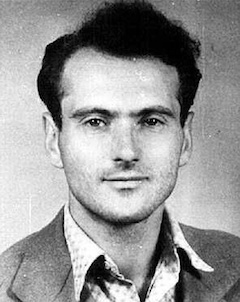
On this date in 1958, Angyal Istvan was hanged for the failed 1956 Hungarian revolution.

A working-class Jew who survived Auschwitz as a boy — his mother and sister were not so fortunate — Angyal was a convinced leftist who became disaffected with the Hungarian regime not because of its Communism but because of its failure to realize the democratic and egalitarian aspirations of that ideology.

A fixture on the youthful intellectual ferment in Budapest in the early 1950s, he was one of the leaders of street protests against Soviet domination during the doomed Hungarian Revolution of 1956, even conferring personally with Prime Minister Imre Nagy during its last days. In a gesture that not all of his comrades would have supprted, he set out the hammer and sickle along with the Hungarian national flag on November 7, the very eve of the revolution’s defeat, arguing to Soviet troops that they were fighting against true communism.

He’s commemorated today at an Angyal István Park in Budapest; it’s evidently “a modern social place with free Internet” and a nifty paper plane art installation.

On this day..

1885: Robert Goodale, messily

(Thanks to Richard Clark of Capital Punishment U.K. for the guest post, a reprint of an article originally published on that site with some explanatory links added by Executed Today. CapitalPunishmentUK.org features a trove of research and feature articles on the death penalty in England and elsewhere. -ed.)

45-year-old Robert Goodale was a market gardener who had been married to a lady called Bethsheba for 22 years. He owned a piece of land at Walsoken Marsh, near Wisbech, where he grew fruit and vegetables. On the property was a house that was used only for storage and not lived in, together with a well. The Goodales lived in Wisbech with their two sons, aged 18 and 21. All of them would walk to Walsoken in the mornings and work on the land.

On the 15th of September 1885 Bethsheba did not arrive at the market garden and a search was made for her. Her body was discovered the following day in the well. Examination of the body revealed that she had been struck three times on the head, most probably with a bill-hook, and then thrown down the well, where she drowned.

Goodale was arrested by Sgt. Roughton on suspicion of murder and later charged with the crime. He came to trial at the Norfolk Assizes at Norwich before Mr. Justice Stephen on Friday the 13th of November 1885.

Evidence was presented of the Goodales’ unhappy marriage and of threats of violence made against Bethsheba by her husband. A witness testified that he had heard a quarrel in the Goodales’ house on the afternoon of the murder. Dr. Stevenson the Home Office analyst said he had found traces of mammalian blood on the prisoner’s hat and jacket.

The defence led by Mr. Horace Browne contended that the case against Goodale was very weak. He conceded that husband and wife were not on good terms but insisted that Goodale’s conduct was not consistent with that of a murderer. He rebutted the blood stain evidence and suggested that it had come from the prisoner having a nose bleed. At this time it was not possible to determine the group to which the blood belonged and therefore it could not be certain that it was the victim’s blood, or even that it was human rather than animal blood.

The trial resumed on the Saturday and after the closing speeches and the summing up it took the jury just 20 minutes to reach their verdict of guilty of the wilful murder of his wife. Goodale was sentenced to death and removed to the Condemned Cell in Norwich Castle to await execution on Monday the 30th of November.

He was visited by his two sons and his sister on the Friday. Later that day he asked to see the governor of Norwich Castle, Mr. Dent. He and the Chief Warder went to Goodale’s cell where he told them that the crime had taken place due to extreme provocation. He claimed that his wife had told him that she liked other men. Mr. Dent took Goodale’s statement down in writing and sent it to the Home Secretary. The Rev. Mr. Wheeler and a former Sheriff of Norwich went to London and made representations for a reprieve at the Home Office. On Sunday the 29th of November the governor received a letter saying that the Home Secretary had not found cause to grant a reprieve.

James Berry had arrived at the prison and tested the drop on the Monday morning in the presence of the governor and under-sheriff. The gallows there had been constructed some three and a half years earlier for the execution of William Abigail on the 22nd of May 1882. The trap doors were set level with the floor over an 11′ 5″ deep brick lined pit in the middle of a small yard. This yard was approximately 48 feet long by 15 feet wide near the Castle wall, opposite Opie Street. The gallows consisted of a black painted wooden beam supported by two stout uprights set over the black painted trap doors.

Goodale stood 5′ 11″ tall and was a heavy man at 15 stone (210 lbs.) with a weak neck. Berry considered that a drop of 5′ 9″ should be given. He used a “government rope” that had been used for the hanging of John Williams at Hereford a week earlier.

At 7.55 a.m. on the Monday morning the bell of St. Peter’s church began to toll and the officials proceeded to the condemned cell. A procession then formed consisting of the governor, the Rev. Mr. Wheeler, the surgeon, Mr. Robinson and the under-sheriff, Mr. Hales. Mr. Charles Mackie of the Norfolk Chronicle represented the press. They went down a passage that connected the cell to the gallows yard where Berry met them and pinioned Goodale, after which they continued into the prison yard.

Here Berry strapped Goodale’s legs and applied the white hood and the noose. Goodale several times exclaimed “Oh God, receive my soul.” As the church clock struck for the eighth time Berry released the trap doors and Goodale disappeared into the pit, but the rope sprung back up to the horror of the witnesses.

As they looked down into the pit they could see the body and the head lying separately at the bottom.

The law required that an inquest be held after an execution and this was presided over by Mr. E. S. Bignold, the Coroner. Mr. Dent gave evidence that the machinery of the gallows was in good working order and that Goodale was decapitated by the force of the drop. Mr. Dent did not think that a drop of 5′ 9″ was excessive and in fact thought it was insufficient for a man of ordinary build. He also stated that James Berry was perfectly sober.

Berry himself testified and at the end of this the Coroner absolved him of any blame for what had happened. The jury returned a verdict that Goodale “came to his death by hanging, according to the judgement of the law.” They further said “that they did not consider that anyone was to blame for what had occurred.”

This is the only occasion of a complete decapitation occurring at a hanging in England, Scotland and Wales, although Berry had several partial ones.

Assuming that Goodale actually weighed 15 stones (in some reports it is given as 16 stones) and that Berry had correctly set the drop at 5′ 9½” or 5′ 10″ then the energy developed would have been around 1218 foot lbs. This is around 100 foot lbs. more than would have been given after 1939 for a man of normal build with a normal neck. The “Goodale Mess” as it came to be known, led to a lot of unfavourable comment in the press.

Just one day after the most damning newspaper editorials had appeared, the head of the Prison Commission, Sir Edward Du Cane, wrote to the Home Secretary on the 2nd of December. In his letter he suggested the setting up of a Committee on Capital Punishment (which became the Aberdare Committee).

Footnote:

The Norwich Chronicle published an interview with Goodale’s spiritual advisor, the Rev. Mr. Wheeler, a Baptist minister. He felt that maybe Goodale might not have been convicted of murder if he had said earlier what he said in his confession on the Friday evening. When Bethsheba fell into the well, he fetched a ladder to go down and look for her but that he could not get down the well since the opening was just 18 inches wide and he could not physically fit through it.

Had he spoken up earlier, Mr. Wheeler said, the police would have found the ladder still in the well and the dirt of the well on Goodale’s clothes. It might have led to a verdict of manslaughter.

When Goodale finally came forward with this tale, it was too late.

On this day..

1937: Vincenzo Baccala

Italian Communist Vincenzo Baccala was executed on this date in 1937 … but not by the fascists.

The blackshirted turn of his country in the 1920s had driven Vincenzo into emigre exile, pursued by an in absentia prison sentence for “subversive propaganda tending to insurrection and incitement of class hatred.” He went first in Paris and then in 1931 to the USSR.

Although present in the fortress of Communism at the Party’s direction, and eventually an outright Soviet citizen, Baccala came into trouble after criticizing Stalin in 1933 and had to leave his family in Odessa as he struggled to find work. Come the height of the purges in the later 1930s, he was predictably denounced.

Baccala’s wife Pia Piccioni swallowed a bitter draught of her own; unable to see her husband or find support amid Stalin’s purges, she returned to her native country, finding little comfort either in Mussolini‘s Italy (for obvious reasons) or in postwar Italy (where red comrades shied from traducing the USSR). She wrote a book about her own and Baccala’s experiences, Compagno Silenzio: Una vedova italiana del gulag racconta.

On this day..

1943: Floyd McKinney

Nevada executed Floyd McKinney in its gas chamber on this date in 1943.

McKinney had caught a ride westward across the state on Highway 50 with 2nd Lt. Raymond Fisher and his wife.

Somewhere around Sand Springs, McKinney murdered Lt. Kinney with some sort of bludgeon, like a car jack, and shot Mrs. Fisher.

No motive was ever established, it might have been pecuniary since McKinney subsequently sold the Fishers’ car in Reno for $650.

On this day..

1766: John Clark and James Felton

We resort to a footnote in a Newgate Calendar edition for today’s interesting anecdote:

John Clarke was a watch-case maker, of good repute, in London. He had long been in the habit of occasionally working by himself in a closet; and his apprentice, jealous of the master’s being there employed on some work in which he would not instruct him, secretly bored a hole in the wainscot, through which he saw him filling guineas. He gave information, convicted, and brought his master to the gallows.

Clarke, for this offence, suffered at Tyburn, along with James Felton, an apprentice, on the 26th of November, 1766, who was the first offender convicted on the act which makes stealing bank-notes, &c. out of letters, a felony. It was proved that he stole a bank post-bill out of a letter at Mr. Eaton’s receiving-house, in Chancery Lane.

(There is no Ordinary’s Account for this date: installments of this venerable series were very sparse during the term of Joseph Moore, in the late 1760s. -ed.)

On this day..

1793: Francois de Laverdy, former Controller-General

On this date in 1793, Clément Charles François de Laverdy, Marquis of Gambais and the ancien regime‘s former Controller-General of Finances, was guillotined in Paris.

“Un financier erudit,” Laverdy (English Wikipedia entry | French) was a member of the Paris Parlement and a scholar who at one point unearthed previously unknown manuscripts about the trial of Joan of Arc — but became a bit overmatched when political machinations situated him at Louis XV’s treasury.

A physiocrat, Laverdy made a go in the 1760s at liberalizing the grain trade by authorizing via a July 1764 edict the free export of grain, then reaped the whirlwind when grain prices spiked. In the 1760s, the whirlwind just meant losing his job: by the 1790s, the loss was very much more dear.

Laverdy labored in a pre-industrial kingdom, at a time when the field of economics still lay in its infancy. Nevertheless, he is a recognizably modern character, both in his principles and his disposition, as Steven L. Kaplan describes him in Bread, Politics and Political Economy in the Reign of Louis XV:

Laverdy correctly believed that traditional attitudes toward subsistence constituted the single greatest barrier to change. But, like many self-consciously enlightened ministers and reformers, he neither understood nor sympathized with it. Diffusing light, to be sure, was no easy matter; since all men were not equally equipped to seize the truth, often it was necessary to force them to accept it. To re-educate the public, Laverdy saw no alternative to brutal and relentless reconditioning.

Impetuously, the people believed that their right to subsist took precedence over all the rights prescribed by natural law as the basis of social organization. They assumed that it was the solemn duty of the state to intervene when necessary to guarantee their subsistence without regard for so-called natural rights. Such views, in Laverdy’s estimation, were erroneous and pernicious; they misconceived the role of the government and its relation to the citizenry and did violence to the soundest principles of political economy. In a word, they were irrational; the Controller-General refused a dialogue with unreason. “The people,” he lamented, “hardly used their reason in matters of subsistence.” …

To combat and discredit this mentality, Laverdy chose to belittle and insult it with all the sophistry of progressive thinking. It consisted of nothing more than a crazy quilt of “prejudices.” “Prejudice” was one of the harshest epithets in the political vocabulary of the Enlightenment; it acquired added force when accompanied by Laverdy’s favorite metaphors, light and sight. Their prejudices “blinded the people,” not only to the “veritable principles of things,” but also to “their true interests.” (A decade later, in similar fashion, Turgot explained popular resistance to his liberal program on the grounds that the people are “too little enlightened on their real interests.”) In letter after letter, the Controller-General railed against the “old prejudices which still subsist against liberty of the grain trade.” He hated “ignorance” and “prejudice” en philosophe for the “obstacles … always contrary to all sorts of good [which they] opposed to progress.” …

Only a tough, unbending stance would produce results. “By stiffening against the prejudices of the people,” he predicted, “they will gradually weaken and we will succeed in accustoming them to a bien,” though, he conceded, “they will continue to misjudge [it] for still some time to come.” Misjudging it, however, was one thing, and actively opposing it, quite another. The threat of bludgeoning them into submission was the only real incentive the Controller-General offered the people to embrace the liberal program.

The bread riots that afflicted the remainder of his term he could not but ascribe to this unreason; proceeding from the certainty that his policies were objectively correct, “Laverdy claimed that grain was abundant and prices moderate” and riots “could only have resulted from ‘the prejudice which exists against the liberty of the grain trade.'”

Or, as a liberal journal serenely put it, the riots “are not and cannot be the effect of real need” because in a regime of liberty, “the dearth that the enraged minds fear, or feign to fear, is manifestly impossible.” …

Two assumptions, in Laverdy’s view, seemed to have emboldened the people. First, that they could riot with “impunity,” an expectation encouraged by many police authorities — those at Rouen, for example — who fail to put down popular movements swiftly and mercilessly and who in some instances even seem to sympathize with the insurgents. Second, “the persuasion which the populace of the cities ordinarily shares that the fear of the riots which it might excite will force the King to modify the laws which established liberty.” Nothing was “more essential,” according to the Controller-General, than to “destroy” these aberrant opinions.

To dispel the idea that consumers could riot without risk, Laverdy instructed and exhorted the police after every episode to repress with dispatch and pitilessness. Repeatedly, he asked for “a few examples of severity,” which would serve not only to “contain the people,” but also to “destroy those prejudices” which motivated them, presumably by revealing the futility of following their lead. If the repression were to be delayed, the didactic advantages would be lost. “Nothing is more important,” Laverdy wrote Joly de Fleury in reference to a riot which took place in the fall of 1766, “than to accelerate the procedures instituted against the principal authors … examples in such circumstances are of the greatest necessity and when they are deferred, they do not produce nearly the same effect.” … Impatient with “the slowness of the official inquiries, the appeals, the forms to which the [ordinary] tribunals are subjected,” the Controller-General considered resuscitating a draconian repressive law which had been used before to bypass local jurisdictions …

Soft sentences annoyed Laverdy as much as dilatory ones. Even as he urged the police to show rigor in the streets and marketplaces, so he goaded prosecutors to demand heavy penalties and judges to pronounce them. He followed cases eagerly in all their details, made his expectations clearly known, and bristled with indignation when the results displeased him. In the wake of a massive riot at Troyes, for example, in which the police had failed to deal harshly with the insurgents, Laverdy pressed for a stern judicial reckoning. He was satisfied to learn that the royal procurator and the rapporteur would ask the death penalty for three of the putative leaders and stringent punishment for the others. In anticipation of such a verdict and a hostile popular reaction, extra brigades were sent to reinforce the constabulary. To virtually everyone’s surprise, the presidial rendered a stunningly mild provisional sentence which could lead to the release of all the prisoners in three months. The Controller-General angrily denounced the verdict and demanded an explanation; “the excesses to which the people have given themselves in this circumstance,” he wrote, “require a much more severe punishment.”

On this day..

1763: Charles Brown, security consultant

This primer appeared in Lloyd’s Evening Post (Dec. 21, 1763) and is also to be found in a 1764 compendium called The polite miscellany: containing variety of food for the mind ; being an elegant collection of moral, humourous, and improving essays, &c. both in prose and verse:

Some Hints, by way of Caution to the Public, to prevent or detect the designs of Thieves and Sharpers.

Left in a manuscript, by Charles Speckman, alias Brown, executed at Tyburn the 23rd of November, for robbing Mrs. Dixon, in Broad-street, Carnaby-market, in September last, of some lace.

  1. Never place many different articles on the counter at one time; nor turn your back on the customers, but let some other person put the different articles up, whilst you are intent upon the business before you.
  2. It is in general to be suspected if a person pulls out a handkerchief, lays it down, and takes it up often, that some ill is intended. This was my constant practice with Milliners and others, with regard to what lay in a small compass. It never failed of success. The following is one instance of my manner of using it: At Reading, in Berkshire, I went to a Milliner’s shop, under pretence of buying some lace, to go round a cap and handkerchief, for my sister. The Milliner asked if I was not too young a man to be a judge of lace? I replied, being young, I should hope for better usage, and left it entirely to her generosity to serve me of that which was best of the kind. At this moment I fixed my eye on a particular piece. Pretending to have a bad cold, I took my handkerchief out to wipe my nose, laid it down on this piece of lace, which repeating again, I took the lace up with my handkerchief, and put it in my pocket, and then told the Milliner I would stay till I was grown older; though it is clear I was too old for her now. I took my leave, and marched gravely off, without the least suspicion; and went directly to the Crown Inn, hired a horse for Maidenhead, but pushed on for London.
  3. The shopkeeper, on seeing such methods as this made use of, should remove the handkerchief from off the goods; which will make the Sharper suspect his design is seen through.
  4. It is common at Haberdashers and other shops, which deal in small articles, that for every article which is wanted to be paid for, the Tradesman applies to his till for change; his eyes being fixed thereon, then is the time something the nearest at hand on the counter is moved off.
  5. Watchmakers and Silversmiths are imposed on principally thus: In a morning or evening the Sharper, well dressed, as a Sea-officer, will go to their shops, look at watches, buckles, rings, &c. when a variety of these are laid on the counter, if opportunity offers, the handkerchief is made use of; should this fail, then the goods are ordered to a tavern, coffee-house, or private house, as best suits for elegance or honesty; then the person is instantly sent back for something omitted, whilst the prize is secured, and the Sharper moved off another way. Though this is an old and stale trick, it is amazing how successful the Practitioners in it still are.

The following is part of the affecting account which this unhappy young man gives of himself:

“During my long course in wickendess, I never was addicted to common or profane swearing, to excess in eating, or to drunkenness, and but little to women. I never was fond of even conversing with thieves and robbers, tho’ at accidental meetings I have met with several, who, guessing I was of their profession, would set forth the advantages of associates, or appearing in company to rob and plunder the honest and unwary. Pallister and Duplex, lately executed at Coventry, who called themselves the heads of a great gang, pressed me to go on the highway with them and their companions, but all they could say was in vain. I never would make use of, or indeed knew, the flash or cant language, in which these two men were very expert. My father, who lived in good reputation in London, where I was born, put me to a boarding-school, and bestowed more money on my education than on all the rest of my brothers and sisters (I was the eldest of 18) for all which I never made any grateful return, which gives me now great affliction, and the most pungent remorse. The misfortunes I have undergone have been, I am certain, entirely owing to the continual state of rebellion that I lived in with my parents; and God, for such unnatural practices, has been pleased to bring me to the most just and deserved punishment I am now shortly to suffer. If children did but properly consider, the very fear of bringing their innocent parents to disgrace and shame, would prevent them from pursuing those wicked practices which end in being publickly exposed to a censorious world, and suffering an ignominious death.”

This youth finished his career at the age of 29: he was about five feet nine inches high, thin and genteel in his person, and affable in his behaviour, with much seeming innocence in his countenance.

On this day..