1860: Khan Bahadur Khan Rohilla, Bareilly rebel

On this date in 1860, the British hanged Khan Bahadur Khan Rohilla, a Pashtun leader who when India revolted in 1857 set up a short-lived independent government at Bareilly.*

Having word of the burgeoning rebellion elsewhere on the subcontinent, Bareilly’s native troops mutinied on May 31, 1857. Three captured European civilians were shot that evening; three more followed the next day.

Though Bareilly did not furnish the most spectacular massacre of the rebellion, it was one of several** that became grist for industrial Britain’s burgeoning mass media … and reports of bloody deeds prepared the British public to respond in kind. One Englishman wrote the London Times on June 3 (it was published on July 14): “When this crisis shall have passed, stern and unflinching vengeance on those who have mutinied and been guilty of atrocities, tempered with judicious and gracious clemency to those who were only misled into a willingness to joining them, will, I fondly hope, tend greatly to create and consolidate a lasting loyalty throughout our native troops.”

Other Britons were far more interested in the unflinching vengeance than the lasting loyalty. Outraged at the news that the Governor-General of India was offering mutineers amnesty, one wrote in a private correspondence on October 4,

I wish I were Commander in Chief in India. The first thing I would do to strike that Oriental race with amazement (not in the least regarding them as if they lived in the Strand, London, or at Camden Town), would be to proclaim to them in their language, that I considered my Holding that appointment by the leave of God, to mean that I should do my utmost to exterminate the Race upon whom the stain of the late cruelties rested; and that I begged them to do me the favor to observe that I was there for that purpose and no other, and was now proceeding, with all convenient dispatch and merciful swiftness of execution, to blot it out of mankind and raze it off the face of the Earth.

That imperial genocide enthusiast was a liberal man of letters known to be downright softhearted when beholding his own countrymen condemned to death singly: Charles Dickens.

After the initial shock of the various risings, Great Britain set about methodically putting down the revolt.

In 1858, it was Bareilly’s turn. Fresh off defeating the most vigorous rebel commander Tantia Tope, the British commander Colin Campbell wrapped up the Indian campaign by marching his Highland regiments “in red coats, kilt, and feather bonnet, under a blazing sun, showing 112 degrees in the shade.”

That wished-for stern and unflinching vengeance marched with them.

Sergeant David McAusland of the 42nd Highland Regiment recalled that during his service in Bareilly during the Rebellion, “three scaffolds and six whipping posts stood outside of the town along side of the jail and there [took place] executions to the number of six every day.” The judge in charge of trials had lost his wife during the conflict, and had told McAusland, “if ever I get the chance of [judging] these Black rebels I will hang a man for every hair that was in my wife’s head.” McAusland responded by asking him how many men he had executed already, “he told me close on 700 well I said if you just continue you will have made good your work and turning to Sergt … Aden I said you mind what Sir Colin [Campbell] said to us at Cawnpore that every man that had a black face was our enemy and we could not do wrong in shooting him so you know how to act here.” (Source pdf, an essay eventually integrated into the author’s book-length study Martial Races: The Military, Race and Masculinity in British Imperial Culture, 1857-1914

As the man who had styled himself chief of Bareilly in opposition to British power could scarcely expect to escape such indiscriminate revenge.

“The complicity of this wretched man in the atrocities committed at Bareilly admits of no doubt whatever, and to allow him to escape from the gallows would be an outrage upon the memory of his unhappy victims,” the London Times reported on April 21, 1860, upon receiving (much belated) word of his execution.

* Great Britain’s initial seizure of Bareilly (Rohilkhand) from Khan Bahadur Khan’s ancestors in a 1774 war became part of the impeachment case Edmund Burke leveled against colonial official Warren Hastings. As we’ve seen elsewhere on this site, that remarkable charge also involved a shady execution.

** The largest and most inflammatory, of course, was Cawnpore/Kanpur.

On this day..

1862: Nathaniel Gordon, slave trader

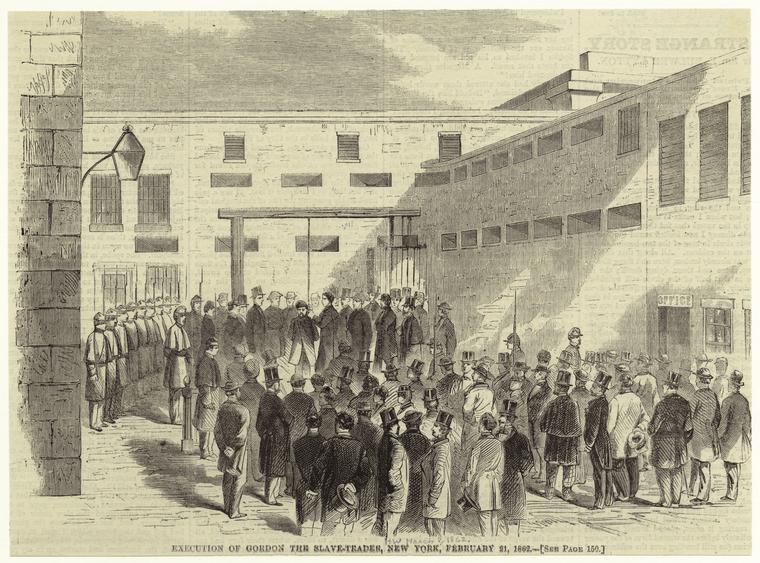
On this date in 1862, the American commercial shipper Nathaniel Gordon was hanged at the Tombs for slave trading.

Importing slaves to the U.S. had been nominally illegal for over half a century, but had never been strongly enforced. In 1820, slaving (regardless of destination) had even been defined as piracy, a capital crime.

Importation of kidnapped Africans into the United States did significantly abate during this period, and that was just fine with U.S. slaveowners ever paranoid of servile rebellion.

But a voracious demand for conscript labor persisted elsewhere whatever the legal situation. About 3 million slaves arrived to Brazil and Cuba, the principal slave shipment destinations, between 1790 and 1860 — even though the traffic was formally illicit for most of this time.

Great Britain was endeavoring to strangle the Atlantic slave trade, but the diplomatic weight she had to throw around Europe didn’t play in the U.S. Washington’s adamant refusal to permit the Royal Navy to board and search U.S.-flagged ships made the stars and stripes the banner of choice for human traffickers profitably plying the African coast. “As late as 1859 there were seven slavers regularly fitted out in New York, and many more in all the larger ports,” one history avers.

Hanging crime? No slave-runner had ever gone to the gallows as a “pirate” — not until Nathaniel Gordon.

The U.S. Navy did mount its own anti-slaving patrols, but the odd seizure of human cargo was more in the line of costs of doing business than a legal terror for merchants.

So Gordon, son of triangle trade port Portland, Maine and a veteran of several known slaving runs, didn’t necessarily think much of it on August 8, 1860, when the Mohican brought Gordon’s ship to bear 50 miles from the Congo with 897 naked Africans stuffed in the hold, bound for Havana. Half of his slaves were children.

“The stench from the hold was fearful, and the filth and dirt upon their persons indescribably offensive,” Harpers reported.

Gordon chilled in very loose confinement in the Tombs, even enjoying family leave furloughs as he readied for the customary slap on the wrist.

But with Abraham Lincoln’s election in 1860, Gordon was promoted to demonstration case.

After a hung jury in June 1861, the feds won a conviction and death sentence on those long-unused piracy laws in November 1861.

Many New Yorkers were shocked at the prospect of such draconian punishment.

Abraham Lincoln found himself besieged by appeals public and private against the unprecedented judgment. “For more than forty years the statute under which he has been convicted has been a dead letter, because the moral sense of the community revolted at the penalty of death imposed on an act when done between Africa and Cuba which the law sanctioned between Maryland and Carolina,” Gordon’s counsel Judge Gilbert Dean wrote in an open letter to the President* — an argument that could hardly be more poorly calibrated to impress in 1862.

Despite Lincoln’s famous proclivity for the humanitarian pardon, he stood absolutely firm on the precedent Gordon’s hanging would set — especially in the midst of a bloody civil war driven by the very legal sanction Dean had cited so approvingly. As Lincoln wrote on February 4, 1862,

I think I would personally prefer to let this man live in confinement and let him meditate on his deeds, yet in the name of justice and the majesty of law, there ought to be one case, at least one specific instance, of a professional slave-trader, a Northern white man, given the exact penalty of death because of the incalculable number of deaths he and his kind inflicted upon black men amid the horror of the sea-voyage from Africa.

Gordon’s hanging was the one case — the only one ever.

* New York Times, Feb. 21, 1862.

On this day..

1878: J.W. Rover, sulfurous

Reno, Nevada had its only hanging on this date in 1878, and it’s never since been certain whether it was the right man they hung.

J.W. Rover, Frank McWorthy, and Isaac Sharp(e) had come from Oakland to work a sulfur claim in present-day Pershing County (then Humboldt County).

Sharp ended up dead, his body horribly mutilated and its dismembered parts scattered to different burial holes.

A mental health counselor I know is fond of saying of the family dysfunctions he has handled that who is crazy depends upon who gets to the phone first. It turns out that sometimes murder does, too.

McWorthy rode in to Winnemucca and swore out a complaint accusing Rover of the murder. Rover would spend the next three years vigorously but never quite successfully insisting that McWorthy was the one who killed Sharp.

Rover was convicted of murder in July 1875, but because the verdict didn’t mention degree of murder, the case had to be retried. In April 1876, Rover was convicted again, of first-degree murder, thank you very much. But the Nevada Supreme Court overturned that verdict, too, and granted Rover a change of venue to Reno’s Washoe County, where Rover was convicted for a third time in June 1877.

In all these proceedings, Rover never wavered from his claim of innocence, calling God to witness at trial after trial that it was his associate and accuser McWorthy who was the guilty party and wanted to frame up Rover to get his hands on that lucrative sulfur deposit.

Having failed three times over in court, Rover’s lawyers turned as the hanging approached to Section 458, a remote provision of the criminal code permitting a special jury to be impaneled “if after judgment of death there be good reason to suppose that the defendant has become insane.”

Three years and all those hearings on, Rover’s fate would finally rest in the hands of twelve new jurors impaneled on the very eve of his hanging. While Rover passed his final night in the Reno jail, his sanity jury met in a courtroom in an upper-story room.

Rover’s lawyers and the District Attorney made their arguments to the jury until midnight that night, then adjourned, and then re-assembled at 7:30 on the morning of the scheduled execution. Rover couldn’t sleep a wink, passing the night rambling emotionally with reporters — at one point breaking down as he read them a letter from his sister.

“As he lay there he formed an object at once of pity and interest,” one scribe wrote for the newspaper of nearby silver mining boomtown Virginia City.*

He was reclining upon a rude bed covered by a coarse blanket. His pillow had no case, and his hair was unkempt and rough-looking. His beard had the appearance of being about one month’s growth. The cell was narrow, and was lighted by the feeble rays of a tallow candle held by a Deputy Sheriff.

Once or twice, he would furtively ask the reporters’ estimation of his chances with the proceedings upstairs. The reporters didn’t know. The jury didn’t either.

That morning, as crowds besieged the courthouse seeking one of the 200 visitors’ permits for the “private” execution, the jury huddled inside it making its final deliberations over four long hours. At last, at noon, it came down seven votes for sane, five for insane.**

Seventy minutes after that vote, Rover was escorted to the gallows supported by two men and a stiff drink of whiskey. This was nearly a two-hour theater in its own right: after a 20-minute recitation of the death warrant, Rover spoke for 50-plus minutes, continuing to insist upon his innocence:

I am so prostrated by this long prosecution that I am unable to say what I want to say …

Gentlemen, McWorthy has got away, but if I had my liberty the face of the world would not be large enough to hide him. I would search him out and bring him to justice, and if the law could not reach him I would find a strong arm of justice that would reach him …

I must be hung; you will be sorry for it some day, but what good will that do me when I am dead and gone? Good-by. My heart is with you.

By the end, Rover could barely hold up. He took a drink of water. “Oh, gentlemen, I cannot realize that I am to be hung!” he cried as his limbs were pinioned at last, and had to be supported lest he swoon. The Catholic priest finally had to settle him down from his last babbling.

“Not guilty,” he insisted one last time. Then to the sheriff: “Go on and do your duty.”


Rumors of Rover’s innocence persisted for years after his hanging, not excluding claims that his ghost was on the haunt.†

In 1899, a newspaper reported that “It afterward developed that Rover was innocent of the crime for which he suffered. McWorthy died a few years ago in Arizona, and on his deathbed confessed that he was the murderer of Sharp.”

McWorthy might or might not have been the guilty party. But that story was not accurate — McWorthy was still alive at the time in Oakland, California.

* The newspaper in question was the Territorial Enterprise, notable for employing the young Mark Twain in the early 1860s. Indeed, it was here that the writer Samuel Clemens first employed that nom de plume. Ten years before Rover’s hanging, Clemens/Twain actually witnessed and wrote about a public hanging in Virginia City.

** Not as close as it sounds: Rover needed a unanimous verdict.

† The present-day Washoe County Courthouse, not built until many years after Rover’s hanging, allegedly has a haunted jail whose spook might be Rover.

On this day..

1947: Ernst Kundt, Sudeten German

On this date in 1947, Ernst Kundt was hanged in Prague’s Pankrac Prison.


Kundt (right) is honored at Prague Castle by Hans Frank. (Frank was hanged through the Nuremberg Trial.)

Kundt co-founded the Sudeten German Party, a nationalist-fascist party that would play a leading role as one of Nazi Germany’s stalking-horses as the latter maneuvered in the 1930s towards the takeover of Czechoslovakia.

The leaders of this movement were amply rewarded by Czechoslovakia’s new masters; for Kundt, this meant a transition from an MP in Prague to a seat in the Reichstag, a gig in the Luftwaffe, and various state posts around the Third Reich.

And of course, many of these Sudeten big wheels collected a different sort of reward after 1945. He was arrested in Czechoslovakia after the war and tried with a number of other Sudeten German leaders.

On this day..

1989: Vladimir Lulek, the last Czech executed

On this date in 1989, the then-united Czechoslovakia hanged Vladimir Lulek for slaughtering his wife and four children. (Czech link, as are the others in this post.)

Lulek, who died at Prague’s Pankrac Prison, has the distinction of being the last person executed in what now constitutes the present-day Czech Republic. (A Slovak man named Stefan Svitek was put to death later that same year in Bratislava; Svitek holds that same distinction for both present-day Slovakia and for the former Czechoslovakia as a whole.)

On this day..

1902: A day in the death penalty around the Pacific Northwest

The U.S. states of Washington and Oregon both hanged murderers on this date in 1902.

Oregon

The death knell for local public(ish) hangings in Oregon took place this morning in the courthouse of Portland’s courthouse under the eyes of 400 invited witnesses and numerous additional gawkers who scaled telegraph poles or stationed themselves on nearby rooftops.

Jack Wade and William Dalton hanged together for murdering one James Morrow just three months for two bits. It was an uncomplicated crime: the villains stuck Morrow up as the latter returned one night from paying court to a young lady, then shot him when Morrow made a sudden move.

On hanging day, the pair addressed an ample breakfast of ham, chicken and eggs, knocked out some hymns and an impromptu rendition of “Where Is My Wandering Boy Tonight?”

… and then took a cavalier stroll to the gallows where Wade displeased right-thinking folk with his devil-may-care attitude towards his own execution. He tossed a cigar to the crowd, and played his fingers over the hemp as the rope was fastened, remarking with a wink, “it is tough.”

While the hanging itself went off without a hitch, the curious onlookers pushed through the rail meant to restrain them once the bodies were cut down and began scrabbling for bits of hemp. The sheriff finally had to clear the courtyard.

Even worse, “ten or 12 women witnessed the execution” from atop a building at Fifth and Main street, according to the Oregonian‘s report the next day. “It is doubtful if such a thing ever occurred before at a legal hanging in this country.”

The legislature some years previous had tried to get a handle on execution decorum by moving hangings off public squares and into jails, so this public(ish) execution wasn’t technically public at all. But as seen, these facilities with their barrier-toppling invited mobs and conspicuously feminized illicit peepers surrounding still affronted the alleged solemnity of the moment and led the legislature at its next sitting in 1903 to enact a statute requiring that “all executions should take place within the walls of the [state] penitentiary, out of the hearing and out of sight of all except officials.”

Wade and Dalton weren’t actually the last to hang publicly(ish) in Oregon, however. Since the law wasn’t retroactive, several additional executions occurred after the penitentiary-hanging law was enacted — the last as late as 1905. (See Necktie Parties: A History of Legal Executions in Oregon, 1851-1905).

Washington

Chinese immigrant Lum You was hanged at South Bend, Washington on January 31, 1902. He shot a man named Oscar Bloom during a drinking bout that turned into a drunken bout.

Lum You actually escaped his condemned cell on January 14 when his dinner was being fetched by the jailer and stayed on the lam for a couple of days, but was recaptured on January 17 by a posse. He allegedly begged them to shoot him dead right there, then changed his mind when some business-minded character actually produced a weapon. (Credit to the great Northwest for its highly accommodating vigilantes.)

On this day..

1820: Not Stephen Boorn, saved by newsprint

January 28, 1820 was the scheduled hanging-date for Stephen Boorn in Vermont, who was spared by the stroke of luck in one of the Republic’s seminal wrongful conviction cases. For all its vintage, it has a disturbingly current feel.

Stephen Boorn and his brother Jesse were farmers in Manchester living with their possibly feebleminded brother-in-law Russell Colvin when Colvin suddenly vanished in May 1812. Vanishing unexplained for weeks on end was actually an established behavior for this peculiar gentleman, so it was only gradually that suspicion of foul play accumulated. There was some bad blood known to exist between Colvin and his brothers-in-law; they had even been seen in a violent quarrel just before Russell Colvin disappeared (pdf). There were whispers, but never any real evidence.

And so weeks stretched into months, and then to years. Many years. Was it possible two neighbors of the good people of Manchester, Vt., had gotten away with murder plain as day and gone about bringing in their crops just like nothing happened?

The break arrived in 1819 courtesy of the brothers’ aged uncle Amos Boorn. Amos reported that Russell Colvin had appeared to him in a dream and accused his former in-laws of murder. Now a dream couldn’t be read in evidence, but it proved sufficient to re-open a cold case and endow the investigation with official “tunnel vision” so familiar to the staging of a wrongful conviction.

The other classic trappings of that scene followed anon: shoddy evidence, a jailhouse snitch, and even a false confession.

Once under the pall of suspicion, random events around the Boorns began to seem sinister. The dream-Russell’s accusation led to a cellar-hole being excavated, which turned up some random junk (a penknife, a button); was it Colvin’s random junk? A barn on the Boorn farm burned down; had it been torched to conceal evidence? A boy found bones at a stump on the property; were they human remains? (They turned out to be animal remains.)

Stephen Boorn had moved to Denmark, New York, but Jesse Boorn was taken into custody for interrogation. There he was parked in a jail cell with a forger named Silas Merrill.

Lo and behold, Jesse Boorn immediately spewed to his bunkmate the awful secret of the murder. Yup, after keeping it quiet for seven years he detailed it all to Silas Merrill one “night, when he and Jesse had waked from their sleep, and without any previous persuasion or advice on the subject” and also just happened to tie in all that random sinister stuff from the investigation like the barn and the bonestump. Naturally, Merrill was released for relaying to his jailers this valuable and in no way impeachable information.

Now cornered, Jesse confessed to the murder. The causes of false confessions are complex, but the advent of DNA exonerations has underscored the alarming frequency of this phenomenon. A strictly rationalist explanation might postulate that Jesse thought he could avoid hanging by taking responsibility for a crime he was now certain to be convicted of, and framing it in the least culpable possible light; the murkier fathoms of human psychology might suggest a desire to please his captors or a conscience conforming itself to the conviction of his neighbors. Whatever the case, the confession got Stephen extradited from New York, and under interrogation Stephen too confessed. Stop confessing to things, people! (In fact, best say nothing at all.)

Despite retracting the confession, the brothers were convicted with ease in a trial held at the town’s church, the better to accommodate huge crowds that would have overflowed the courtroom. They were both slated to hang on January 28.*

While Jesse Boorn won a commutation his brother appeared doomed.

As an almost literal last gasp, Stephen took out newspaper advertisements searching for Russell Colvin. And they worked. At least, this is the version of the story as it is commonly recounted, dating I believe to this 1932 volume on wrongful convictions. The primary sources referenced there actually appear to me to indicate that the Boorn-saver, a New Jersey gentleman named Taber Chadwick, responded with a letter to the editor to a simple news report of the case, which report naively credited the dream-driven conviction as “divine providence”.


From the New York Evening Post, Nov. 26, 1819.

Luckily, Mr. Chadwick realized that he knew a Russell Colvin from Manchester whose mental state was thoroughly addled.


New York Evening Post, Dec. 10, 1819.

A fortnight after this letter hit the press, Colvin was back in Manchester … and this time, it was not in a dream.

Colvin confirmed that his brothers-in-law hadn’t hurt him at all and both Boorns — who, we remind you, had each previously confessed to killing a man who was now here in the flesh and blood to exonerate them — both these Boorns walked free.

Update: Embarrassingly not noticed by my own self in researching this post, a comment from the outstanding 19th century crime blog Murder By Gaslight flags the hypothesis that the entire exoneration was staged using an imposter to weasel the Boorns out of prison.

* According to this biography of the African-American divine Thomas Lemuel Haynes, Haynes was the Boorns’ confessor while they awaited execution, and one of the only people to believe the brothers’ protestations of innocence. Haynes was eventually moved to spend his own money on the famous advertisement hoping that “any person who can give information of the said Colvin may save the life of an innocent man.” If there’s one Vermonter who comes out of this astonishing story smelling like a rose, it’s Reverend Haynes.

On this day..

1681: Isabel Alison and Marian Harvey, Covenanters

We turn today to William Crookshank’s (certainly partisan) narrative of the hanging of two Scottish Covenanters on this date in Edinburgh, as told in his The history of the state and sufferings of the Church of Scotland.


On the 25th of December some of the students in the College of Edinburgh brought to the head of the Cowgate the effigy of the pope in his robes, with his keys, mitre, and triple crown; and, when they had excommunicated him, they carried him about in a chair, like that wherein he is elected at Rome, to the foot of the Blackfriars’ Wynd. The students, knowing the thing had taken air, gave out that they were to carry his holiness in procession to the Grassmarket, the place of the execution of criminals; whereupon the guards marched thither. Meanwhile the boys marched in procession by the Black-friars’ Wynd to the High-street, three of them going before with lighted torches. Being come thither they condemned his holiness to be burnt: accordingly the torchmen blew up the effigy with gun-powder, notwithstanding their being attacked by some soldiers commanded by Linlithgow and his son; whom they warned to beware whom he struck, since he had relations among them.

The Duke of York’s [the future James II -ed.] being now in Scotland sharpened the edge of the persecution; so that no less than twenty were executed in the course of this year 1681.

The sufferers had, it is true, declared against the king’s authority, for which many of them were hanged, and otherwise persecuted by their enemies, and’censured by their friends. They branded them as madmen, enemies to government and civil society; but it is very plain that they never opposed government or monarchy as such, but only wicked, perjured, and persecuting governors. These they did oppose, and that for the very same reasons that brought about the Revolution and the protestant succession.

I cannot express this better than in the words of the author of the Memoirs of the Church of Scotland, when speaking of the Torwood excommunication. Says he,

I desire the impartial reader to compare it with the memorials above-mentioned, [to wit, the memorial to the Prince of Orange from the people of Great Britain, to invite him to come to their assistance] and see if it be posible for any British protestant, who owns the justice of the Revolution, to reflect upon the zeal of these people, without blushing for himself and the whole nation, that they did not see and abhor the tyranny of those reigns sooner; then they had joined with those people instead of censuring their zeal; the Revolution had then been brought about without sovereign help at all; the Prince of Orange had then been called over, as peaceably as King George, to take possession of the crown; and the blood of near 20,000 people, who were one way or other murdered and destroyed by that now abdicated race of tyrants, had been saved. What a shame is it, says he, to us, and how much to the honour of these persecuted people, that they could thus see the treachery and tyranny of those reigns, when we saw it not; or rather, that they had so much honesty of principle, and obeyed so strictly the dictates of conscience, as to bear their testimony early, nobly, and gloriously to the truth of God and the rights of their country, both civil and religious; while we all, though seeing the same things, yet betrayed the cause of liberty and religion, by a sinful silence and a dreadful cowardice.

But suppose, through the treatment, the unacountable treatment they met with, they had gone a little beyond due bounds, and though sometimes their expressions were not so well chosen, can that either condemn the principles of religion and liberty upon which they acted; nay, or their actual disowning those tyrants, who, for nothing but the matters of their God and Saviour, had declared them outlaws, rebels and traitors? Besides, the blood of many was shed, against whom they could prove nothing, but what they extorted from them by their ensnaring questions. Nay, even some of the weaker sex were hanged or drowned on this score. But I shall relate the matters of fact as they happened in the order of time.

It was a dreadful affront to the Duke of York to find his holiness treated in such a manner, on that grand festival the 25th of December; and therefore the sycophant managers must not overlook such an indignity.

Accordingly, on the 4th of January, the masters of the college declared their abhorrence of what their scholars had done; and on the 6th, the council commanded the magistrates to order the college gates to be shut, and the classes to be dissolved. About this time several of the students were imprisoned, besides Mr Ridpath, which so exasperated the rest, that it is said, they threatened to burn the provost’s house at Priestfield, because the magistrates, who were patrons of the college, instead of protecting them, had acted violently against them; and in a few days the house of Priestfield was burnt.

Whereupon the council, on the 17th, issued a proclamation, offering 2000 merks and a remission, to any who should discover the actors: but it does not appear that any discovery was made …

The order of time leads me to the case of Isobel Alison and Marion Harvey, two young women, who were executed this month, to the perpetual disgrace of the bloody managers, who could have no acts of what they called rebellion, in the least, to lay to their charge.

When they were taken, I know not. Isobel Alison was apprehended at Perth, where she lived, only for speaking against the severity used to sundry good people there; for they could accuse her of nothing else. Marion Harvey was seized while going one day from Edinburgh to hear sermon in the fields, and was last year before the council. But though they had nothing against these two young women, they were resolved to shed their blood: and therefore upon what they owned at their examination they founded their indictment, and took away their lives. That the reader may have a specimen of the injustice of this period, that afterwards became common, I shall here insert the substance of their examination first before the council, and next before the lords of justiciary.

When Isobel Alison was before the council, she was interrogated as follows:

Q. Can you read the Bible?

A. Yes.

Q. Do you know the duty we owe to the civil magistrate?

A. When the magistrate carrieth the sword for God, according to what the scripture calls for, we owe him all due reverence; but when they overturn the work of God, and set themselves in opposition to him, it is the duty of his servants to execute his laws and ordinances on them.

Q. Do you own the Sanquhar declaration? [a speech disavowing Presbyterian allegiance to the government]

A. I do own it.

Marion Harvey’s examination before the council was upon the same points with that of her fellow-sufferer … Only, among other tilings, they said, Will you cast away yourself so? To which shy replied, I love my life as well as any of you, but would not redeem it upon sinful terms. They said, the rock, the cod and bobbins, were as fit for her to meddle with as those things. They offered her the assistance of ministers, but she would have none of their pro. vidiug

On the 17th of January they were brought before the Lords of Justiciary; for it was the constant practice at this time, the one day to bring such as fell into their hands before the council, and there by ensnaring questions, to bring them into a confession of such things as they accounted treason, and next day to prosecute them before the criminal court. These two women were accused for hearing at field-conventicles, harbouring Messrs Cargill, Cameron, &c. owning the Rutherglen and Sanquhar declarations, &c.

When Isobel Alison was before them, she was examined as follows:

Q. Do you abide by what you said the last day?

A. I am not to deny any thing of it. She owned she had converged with David Hackstoun, and disowned their authority.

Q. Do you disown us and the king’s authority in us?

A. I disown you all because you carry the sword against God, and not for him, and have, these nineteen or twenty years, made it your work to dethrone him, by swearing, year after year, against him and his work, and assuming that power to a human creature which is due to him alone, and have rent the members from their Head, Christ.

… Then they said, Your blood be on your own head, we shall be free of it. She answered, So said Pilate, but it is a question if it was so; and ye have nothing to say against me, but for owning of Christ’s truths and his persecuted members. They made no reply, but desired her to subscribe what she had owned, and, upon her refusing, did it for her.

Marion Harvey, before the justiciary, owned the Sanquhar declaration, &c. and then protested that they had nothing to say against her as to matter of fact; but only that she owned Christ and his truth, his persecuted gospel and members; of which she said, Ye have hanged some, others you have beheaded and quartered quick. To this they said nothing; but called those who were to sit on the jury, who appeared with reluctance. One of them said, He did not desire to be engaged in this matter; but he was obliged: then he desired that the confessions of the two prisoners might be read, because he knew not what they had to say against them. When he was ordered to hold up his hand and swear, he fell a-trembling. The jury being fixed, the confessions were read, and the advocate in a speech, aggravated every particular, in order to prove them guilty of treason. Some of the jury urged that there was no fact proved against them. The advocate said, But treason is fact; and taking himself again, he said, It is true, it is only treason in their judgment, but go on according to our law; and if you will not do it, I will proceed. The jury brought them in guilty on their own confession; however, the passing of the sentence was deferred till the 21st, when they were both condemned to be hanged at the Grassmarket on the 26th.

Meanwhile, on the 20th, the council enlarged the powers of the laird of Meldrum for apprehending those who were in the rebellion. The many searches which were made in consequence of this were most oppresive. The same day the magistrates of Edinburgh were ordered to call all the masters of coffee-houses before them, and obliged them to come under a bond of 5000 merks, to suffer no news-paper to be read in their houses, but such as are approved of by the officers of state.

Next day all the students in the college of Edinburgh were ordered to retire fifteen miles from that place, within twenty four hours, and not to come within these bounds without leave from the council, under the pain of being treated as seditious persons. A fine protestant government, to make such a splutter about burning the pope! But it was decent to compliment his Royal Highness the Duke!

On the 26th, Isobel Alison and Marion Harvey were executed according to their sentence. The reader will find what passed between them and Mr Riddel in the Cloud of Witnesses, together with their respective testimonies. When they were brought from the prison to the council-house, in order to be carried from thence to the place of execution, Marion Harvey said, with a surprising chearfulness and heavenenly transport, Behold, I hear my Moved saying unto me, Arise, my love, my fair one, and come away. When in the council-house, Paterson bishop of Edinburgh (such was the spirit of the man!) said, Marion, you said you never would hear a curate, now you shall be forced to hear one; and immediately ordered one of his suffragans, whom he had prepared for the purpose, to pray. When he began, she said to her fellow-prisoner, Come, Isobel, let us sing the 23d Psalm; which they did, and thereby drowned the curate’s voice, and confounded their persecutors.

Their behaviour on the scaffold is not to be omitted. Isobel having sung the lxxxiv Psalm, and read Mark xvi, cried over the scaffold, and said, Rejoice in the Lord ye righteous; and again, I say, rejoice. She was not suffered to pray till she came to the foot of the ladder. As she went up, she cried out, ‘O be zealous, sirs, be zealous, be zealous! O love the Lord, all ye his servants! O love him; for in his favour is life!’ And added, ‘O ye his enemies, what will ye do? Whither will ye fly in that day? for now there is a dreadful day coming on all the enemies of Jesus Christ. Come out from among them, all ye that are the Lord’s people.’ Then she concluded, ‘Farewell all created comforts; farewell sweet Bible in which I delighted most, and which has been sweet to me since I came to prison; farewell Christian acquaintances. Now into thy hands I commit my spirit, Father, Son, and Holy Ghost.’ Then the executioner threw her over.

Marion Harvey likewise sung Psal. lxxxiv. and having read Mal. iii, she said, ‘I am come here to-day for avowing Christ to be Head of his church and King in Zion. O seek him, sirs, seek him and ye shall find him: I sought him and I found him; I held him, and would not let him go.’ Then she rehearsed briefly the heads of her written testimony. Going up the ladder she said, 0 my fair one, my lovely one, come away. And, sitting down on the ladder, she said, ‘I am not come here for murder; for they have no matter of fact to charge me with ; but only by judgment. I am about twenty years of age: at fourteen or fifteen I was a hearer of the curates and indulged; and while I was a hearer of these I was a blasphemer and Sabbath-breaker, and a chapter of the Bible was a burden to me; but since I heard this persecuted gospel, I durst not blaspheme nor break the Sabbath, and the Bible became my delight.’ Upon this the commanding officer called to the executioner to throw her over, which he did accordingly.

On this day..

1855: Emmanuel Barthelemy, duelist

The winner of England’s last fatal duel was hanged at Newgate on this date in 1855 … but not for the duel.

Both participants in that duel, Emmanuel Bart(h)elemy and Frederic Cournet, were French emigres* who had commanded Parisian barricades during the 1848 revolution.

On its surface the duel was one of those trivial affairs of honor: Barthelemy heard that Cournet (otherwise unknown to him) had repeated some defamatory rumors about Barthelemy already abroad in France, and challenged Cournet on that basis; Cournet at first dissociated himself from any such smears, but upon better consideration thought he considered Barthelemy’s notice a little on the ultimatum side and took exception to that.

The consequent set-to was delayed some time by negotiations over every element of its ceremony. When at last it was arranged, it unfolded thus:**

it should commence with pistols, the combatants, being 40 paces apart, advancing 10 paces before firing if they chose, and having two shots each, miss-fires not counting; that the choice of position, the choice of pistols, and the signal for firing should be determined by tossing up; that if the pistols proved ineffectual swords should be resorted to to terminate the affair.

Cournet won the toss and got to choose his position and take the first shot. Barthelemy had to stand stock-still as Cournet

advanced his 10 paces and fired, but though on 14 similar occasions he had never failed to hit his opponent this time he missed. Barthelemy then told him that he had his life in his hands, but would surrender his right to fire if Cournet would agree to terminate the duel with swords. [Barthelemy had wanted swords to be the dueling weapon in the first place -ed.] Cournet declined to do so, saying that he would stand his adversary’s fire and take his second shot. Barthelemy then levelled his pistol, but … it snapped. He put a fresh cap on and it snapped a second time,† and it was then agreed that he should use Cournet’s pistol, which was loaded and handed to him. Before discharging it, however, he again offered ineffectually to terminate the contest with swords. He then fired, and with fatal precision.

Barthelemy himself and all four of the seconds involved (both Barthelemy’s and Cournet’s) were arraigned in this case, but the jury returned only a manslaughter verdict. Barthelemy served a few months; he would have to exercise fatal precision once again to find a different route to the scaffold.

In his non-duelling life, Barthelemy was a mechanical engineer, and it was in this capacity that a soda-water manufacturer named George Moore employed him to repair his machinery at 73 Warren Street, just off Fitzroy Square.

Late the night of Friday, December 8, Barthelemy showed up with a veiled woman at the place and asked for Moore. Minutes later, the servant-girl saw all three emerge struggling violently together from their private meeting. As she raced to the door to scream for help she saw the Frenchman raise a pistol and fire …

“Murder!”

Her screams started attracting the neighbors as Barthelemy burst past her, but an iron gate in front of the house obstructed him. Before more people could assemble he fled back into the house and locked it shut behind him.

Moore’s neighbor, a former East India Company man named Charles Collard, thought quickly to his own grief. Collard raced around the back side of the house where a garden opened onto another street, and arrived just in time to catch Barthelemy vaulting over the garden wall. Collard pounced on him, and in the ensuing melee Barthelemy shot him, too.

This was all too late for Barthelemy, for the delay had brought an onrushing of neighbors and passersby who quickly subdued the gunman. Somehow — nobody quite knew how — his companion was nowhere to be found. She had vanished from the house leaving only her veil, and as she had surely not escaped by the front gate it was thought that she must have found some way to slip out the back casually amid the commotion and made a nonchalant escape. She was never seen again.

Moore was found quite dead in his home: he’d been shot through the head, and the marks on his body indicated that the fatal wound had been preceded by some whacks with a cane. Collard lingered on many hours in agony — long enough for his captured murderer to be brought before him and Collard to deliver a signed j’accuse identifying Barthelemy as the villain.

Barthelemy must have had a way with jurors because even in convicting him for murder on this occasion, the panel still recommended mercy. There seems to have been some thought that the mysterious dispute in the house might have been a spontaneous affair qualifying as manslaughter, while the murder of Collard might have passed (since Collard grabbed Barthelemy) as self-defense. The crown unsurprisingly did not share this exceptionally generous view of a man who had already been in the dock for homicide in the past and declined to extend mercy.

Barthelemy disdained the religious entreaties of his captors, scandalizing the right-thinking with bon mots like “it is no use to pray to God, as God will not break the rope.” Indeed, He did not.

* It was perhaps fitting that Frenchmen, a people with an abiding enthusiasm for the duel, who transacted this milestone encounter. En garde!

** Per the London Times of Oct. 28, 1852, summarizing evidence presented in court.

† Upon post-duel examination it emerged that Barthelemy’s pistol had failed to discharge because of a bit of linen rag stuck in the breach. This eyebrow-raising fact gave rise to the suspicion of foul play, though on whose part and to what end is less distinct. Both guys ended up with a shot at one another with the exact same pistol. Cournet just missed his.

On this day..

2013: Alireza Mafiha and Mohammad Ali Sorouri, viral video stars

A 37-second security camera clip of a Tehran being mugged by machete-wielding assailants went viral to great outrage in Iran in December 2012, and resulted in the very speedy execution on January 20, 2013, of the culprits.

Alireza Mafiha and Mohammad Ali Sorouri were publicly hanged at a still-dark 6:30 a.m. before a crowd of about 300 people for Moharebeh (waging war against God)

There’s a photo series of the execution here.

Two other accomplices (the video captures four assailants in all) received 10 years in prison and 74 lashes.

On this day..