1681: Leticia Wigington, apprentice-flogger

On this date in 1681, Leticia, Letitia, or Laetitia Wigington was hanged at Tyburn for beating her apprentice to death.

A case that would presage the next century’s better-remembered Brownrigg outrage, the Ratcliff Catholic coat-maker Wigington and her lodger John Sadler took five quid from one of Sadler’s fellow-sailors to apprentice their daughter.

On Christmas Eve 1680, Ms. Wigington took exception to the 13-year-old Elizabeth Houlton’s performance or caught her stealing from them or something, and set about thrashing her. After taking an hour to fashion a cruel cat o’ nine tails so they could really give it to her, these two

stript the poor Child barbarously and immodestly stark naked, and [Wigington] held her and ram’d an Apron down her Throat, to prevent her crying out, and the foresaid [Sadler] most inhumanely whipt her for 4 hours or more, with some short intervals of their Cruelty, and, having made her body raw, and all over bloody, sent for Salt, and salted her wounds, to render their Tortures more grievous. Of which Savage usage she dyed next morning [i.e., Christmas].

Salted her wounds?

Sadler fled, and was on the run for nearly a month; he was sentenced to die on February 25 and specifically prohibited from pleading for royal pardon before his March 4 execution.

Wigington got off a little “easier”, pleading her belly after a January conviction and delaying execution all the way to September 9. That’s quite a wait — a suggestive wait, one might think, though no actual record remains to confirm that Wigington left a little bundle of joy behind her to the world’s cat o’ nine tails.

For her part, Wigington went to her death asserting her innocence — “as the Child unborn” — and denouncing her enemies for inducing her “Apprentice Rebecca Clifford by name, who was not full 12 years of age, to swear against me” falsely.

On this day..

1686: Jonathan Simpson, merchant turned highwayman

Jonathan Simpson, hanged on this date in 1686, had a good many virtues to judge by the account of his life left by the Newgate Calendar.

He was, first, an enterprising man, who served his apprenticeship “with reputation” and then set up shop as a successful linen-draper in the city of Bristol.

This business enabled him to augment the fortune of his own business by marrying a merchant’s daughter — “but the union proved unhappy, because the young lady was before engaged in affection to a gentleman of less fortune in the neighbourhood, whom her father hindered her from having, and with whom she continued a familiarity that soon displeased her husband.”

Such a scenario has been the germ of many a denizen of this here blog, but Simpson didn’t reach the gallows doing anything as straightforward as murdering his rival or his spouse out of pique.

Instead — and the Calendar leaves the hows and whys of this translation unexplored — he channeled his jealousy into a crime spree. Maybe that’s just the writer’s projection: fella went around the bend, it must’ve been because of a woman. The Newgate Calendar, too, had a home life, and many was the Briton who dreamt of escaping the drudgery of it all for a life of adventure and romance making gentlemen stand and deliver.

At any rate, Simpson managed a career of 18 months on the road, burning through his linen-draper savings (and his highwayman “earnings”) to escape a couple of potential capital prosecutions. (At this time, criminal complaints were initiated by private prosecutions, meaning that a victim prepared to accept direct restitution could potentially be bought off pressing a case.)

This brings us to another of Simpson’s admirable qualities: his silver tongue.

One can only speculate how he wheedled his onetime victims behind closed doors to drop their suits. But the Newgate Calendar attests to the man’s wit under pressure once he was finally hauled to the fatal tree.

It turns out that Simpson did well in business because his family had done well in business before him, and dad staked him to £1,500 when the lad went into business himself. These prosperous burghers accordingly rallied to exert their own wealth and influence behind the scenes to obtain for their kin a timely commutation, delivered only “when he was at Tyburn, with the halter about his neck, and just ready to be turned off in company with several others.” Then bureaucracy happened.

When he was brought to the prison door, the turnkey refused to receive him, telling the officer that, as he was sent to be executed, they were discharged of him, and would not have anything to do with him again, unless there was a fresh warrant for his commitment; whereupon Simpson made this reflection: “What an unhappy cast-off dog am I, that both Tyburn and Newgate should in one day refuse to entertain me! Well, I’ll mend my manners for the future, and try whether I can’t merit a reception at them both the next time I am brought hither.”

That’s kind of funny, right? In a self-destructive braggadocio sort of way?

And then Simpson demonstrated a third quality that (in addition to dad’s money) helped him succeed in commerce before his midlife crisis: his phenomenal industry. Simpson, we are told, committed “above 40 robberies” in Middlesex in the six weeks after his reprieve, a healthy pace of one per day.

He robbed the powerful (our writer credits him with a successful stickup of the king’s own son); he robbed the hoi polloi (“the robberies he committed on drovers, pedlars, market-people, etc., were almost innumerable”); he robbed on ice skates;* when he was finally captured, it was by two captains of the Foot Guards whom he was also attempting to rob.

The man lived to rob. On this date in 1686, he finally died for it.

* The online text versions of the Calendar notice Simpson’s skatebourne pilfering during “the great frost of 1689, which held thirteen weeks,” obviously not chronologically correct relative to his execution date. This is an error, likely on the part of software somewhere along the line; the year in question should be 1684 (computers like to mix up fours and nines). 1684 was one of the longest and deepest winter freezes on record, leaving the iced-over Thames bustling with Londoners at the “Frost Fair”.


“[W]hat unheard of rendezvous is daily kept upon the face of [London’s] navigable river; what long and spacious streets of booths and tents are builded; what throngs of passengers, both horse and foot, do travel; what pyramids of provisions, baked, boiled, and roast; what deluges of wine, coffee, beer, ale, and brandy, for sale; what fleets of vessels sailing upon sledges; what troops of coaches, caravans, and waggons; what games and new invented sports and pastimes, bull-baiting, bear-baiting, &c.; together with shops for the vending of most sorts of manufactures and for working artificers, the account of which alone would require a volume to describe …” (Source)

On this day..

1849: Elisha Reese, suitor

A number of comment threads on this site attest that many accidental visitors to Executed Today are genealogy researchers turning up information about a famous ancestor. The Internet age is a true renaissance for genealogists; while it’s not this blog’s specific objective, it’s a happy side effect if we throw the odd ray of light on the very odd bits of a family’s history.

It’s in that spirit that we present this date’s profile of Elisha Reese, hanged before a reported 5,000 spectators on September 7, 1849 just outside the city limits of Macon, Ga.

As with many crimes, it was the news on everyone’s lips in its own day, but then passed rather quickly into obscurity. Elisha Reese, age 50, was rejected in his marriage suit by 60-year-old widow Ellen Pratt. The nature of their relationship is not known, but Reese took this badly enough that Ellen’s father, 90-year-old Revolutionary War veteran David Gurganus, swore out a peace warrant against his would-be son-in-law … and then Reese took the existence of this peace warrant with a downright vengeful fury.

For what happened next, click on through to the proper genealogist — and Gurganus descendant — who has researched this story already and posted it as a three-parter on her site, A Southern Sleuth.

  1. Murder In Macon
  2. Murder In Macon Part 2
  3. Murder In Macon, the Final Chapter: Trial

On this day..

1833: Antoine LeBlanc, billfolded

On this date in 1833, Antoine le Blanc was hanged on the Morristown (N.J.) village green.

A cigar-chomping French immigrant, LeBlanc came to the New World to seek his fortune and found himself doing grueling farm work for Samuel and Sarah Sayre in exchange for a dank basement room but no pay.

After just a couple of weeks in this unsatisfactory situation, LeBlanc clobbered Samuel Sayre with a spade … and then did the same to Sarah Sayre … and then killed their infant child. Stuffing all the portable valuables he could find into pillowcase sacks, he hopped on a horse and fled for New York, hoping to pawn his booty for passage back to Europe.

Like an inept Scooby-Doo villain, LeBlanc in his haste managed to dribble a trail of the Sayres’ goods on the road, and these helped his pursuers corner him in the Meadowlands — an incriminating parcel of his ill-gotten gains right there beside him.

The trial was a mere formality. The execution on an upward-jerking gallows drew an excited crowd several times the 2,500 souls residing in Morristown itself.

And then, it really gets creepy.

LeBlanc was condemned to post-execution medical anatomization, and the good doctors of Morristown took that as license for every posthumous indignity in the 19th century book. First, the late LeBlanc got a course of electrical shocks — a popular corpse experiment of the day whose object was discovering a means of reanimation but whose consequence was merely a ghoulish danse macabre of senseless, jerking limbs as each jolt charged the putrefying flesh.

When they’d had their fill of zombie Antoine LeBlanc, they skinned the murderer and sent his hide off to be made into wallets and book covers which then got hawked to Morristown’s finest citizens. That sounds like an urban legend, but scroll down this page for the pictures: some of these objects have made it to museums, but it’s thought that others persist in private collections, handed down over the generations or just stashed away forgotten until they can emerge for a starring role on Antiques Roadshow.

Apparently the old Sayre house (significantly rebuilt after a 1957 fire) still stands in Morristown … and it’s haunted by LeBlanc and his last victim, the baby Phoebe.


Sources:

The always wonderful Murder By Gaslight blog

The New Jersey Hall of Shame (this is the link with the LeBlancskin wallet pictures)

Weird New Jersey

On this day..

1981: Nasiru Bello, a little overeagerly

It’s certainly understandable that dilatory appeals leaving it nigh-impossible to actually carry out a meritorious death sentence provoke aggravation.

But as always, one is left in the real sphere of human endeavor to choose among alternatives that each sport their own drawbacks — and where “drawbacks” are no mere debating points but actual lives on the line. After all, even a years-long appellate process that actually results in an execution can go and execute the wrong guy, to say nothing of systems that promise more immediate enforcement.

In a similar vein is the maxim that however adroit the hangman, etiquette forbids him entering the scene before the legally constituted appellate process — of whatever length it may be — has actually run its course. At least that much patience is not merely a virtue but absolutely de rigueur.

On this date thirty-two years ago, Nigeria committed a serious breach of that decorum.

Nasiru Bello, on death row for armed robbery — a crime the recently installed civilian government appeared to be easing off treating as a hanging offense* — was abruptly put to death by Oyo State before a filed and pending appeal could actually be heard by the court.

That’s what you’d call an irreversible error.

Five years later, Bello’s kin won a unanimous Supreme Court judgment against Oyo State for the wrongful execution, which stirringly declared that

“the premature execution of the deceased by the Oyo State Government, while the deceased’s appeal against his conviction was still pending, was not only unconstitutional, but also illegal and unlawful.** By it, the deceased has lost both his right to life and his right to prosecute his appeal.”

And then that same court reduced the plaintiffs’ claimed damages of 100,000 naira to 7,400: about US $1,900 by the local currency’s black market exchange rate. Bello, of course, stayed dead.

* See the 1980 entries in this pdf of Amnesty International reports on Nigeria.

** Unconstitutional, unlawful and illegal here being used in particular, juridically distinct senses. Despite the finding, nobody involved faced criminal sanctions for reasons boiling down to sovereign immunity.

On this day..

1951: King Abdullah’s assassins

AMMAN, Jordan, Sept. 4 — Four men sentenced to death here last week for complicity in the assassination of King Abdullah in July were hanged today in Amman prison. Regent Emire Naif had confirmed the sentences of the special tribunal.

Those put to death were Musa Abdulla el-Husseini, Abed Okkeh, Abdulkadir Farhat and Zakariya Okkeh.

Col. Abdulla el-Tell, former governor of Jerusalem, and Musa Ayyubi who were sentenced to death in absentia are reported to be living in Egypt.

New York Times, September 5, 1951*

The men hanged this day were among the authors of “the most dastardly crime Jordan ever witnessed”: the July 20, 1951 assassination of independent Jordan’s first king.

The cagey Hashemite monarch Abdullah I had been emir of Transjordan, an artificial British mandate jigsaw-piece that Abdullah got by virtue of cutting a deal with Winston Churchill.

This sinecure came with the significant drawback of dependency on London’s reach and interests, and Abdullah’s great achievement was to set Transjordan-cum-Jordan** on firm enough footing to survive the postwar sunset of the British Empire.

Abdullah faced an early test of Jordan’s chops shortly after his country’s 1946 independence when the Arab-Israeli War erupted. For Abdullah, this was a state-building opportunity; indeed, his government had for years backed Palestinian-partition plans that other Arab states had opposed — with the expectation that Jordan could help itself to the eastern part of that partition.

Abdullah did just that in 1948, invading and annexing the Jordan River’s West Bank all the way to East Jerusalem … while willingly acceding to (some have said actively colluding in) the creation of a partitioned Jewish state that was theoretically anathema to Jordan’s allies.

Jordanian territorial aggrandizement, however, brought with it the West Bank’s Palestinian population, severely aggrieved at having seen their aspirations to statehood cynically sacrificed by Abdullah. They got, into the bargain, Jordanian citizenship and a severe suppression of independence agitation.

So when Abdullah came to visit Jerusalem’s Al-Aqsa Mosque, a Palestinian gunman murdered him.

While the assassin himself was immediately shot dead by the king’s bodyguards, ten allegedly in on the plot were very hastily tried in mid-August … eight in the Amman courtroom, and two overseas in Egypt tried in absentia. Dr. Musa Abdullah el Husseini, Abdel Kadir Farahat, and the brothers Abed and Zakariya Okka were condemned to die, along with the absconded Abdulla el Tel and Musa Ahmed el Ayoubi. (The latter two would never be executed.)

According to the London Times‘ Aug. 29, 1951 wrap of the legal proceedings,

The events leading up to the murder, as they were described during the hearing, began with two meetings in Egypt, in September and October [1950], between el Tel and el Ayoubi, who decided then that the king should die. El Tel then met el Husseini i Cairo, and henceforth directed and financed the plot with el Ayoubi as his chief lieutenant. Abed Okka acted as an intermediary, and Zachariya Okka and Farahat were later drawn into the plot, the latter ultimately providing the murderer with a revolver.

The remaining four men who faced trial — Dr. Daud el Husseini, Franciscan Father Ibrahim Ayyad, Tawfik el Husseini, and Kamil Kaluti — were acquitted.

This event, which might have been feared to prefigure a more terrible disruption within Jordan, within Palestine, even in the entire Middle East, did nothing of the sort. Power transitioned to the long reign of Abdullah’s grandson King Hussein, who was actually present at his grandfather’s assassination. (And might have shared his fate, save for a medal the teenaged Hussein had pinned to his breast that deflected a bullet.)

As Mary Cristina Wilson writes,

There was an element of cover-up in the conduct of the trial. The grievances and frustrations of the accused were not broached … The idea of an independent Palestine was, for the moment, dead. Abdullah’s assassination was a terrible revenge wreaked for the death of that idea, but it signified retribution for events that were already history, not the beginning of the new order … Though not without parallels in the future, it was without echoes.

Jordan would govern the West Bank, albeit absent virtually any internationally-recognized legitimacy there, until Israel attacked and occupied the territory in the Six-Day War in 1967. The legacy of this event will be familiar to the reader.

In 1988, Jordan officially resigned its own claims on the West Bank to the Palestine Liberation Organization, “the sole legitimate representative of the Palestinian people.”

* Any number of online sites say this hanging occurred on September 6. Given the existence of September 5 papers reporting the execution, I think it’s safe to rule those erroneous. Wikipedia sources this version to James Lunt’s Hussein of Jordan.

** “Transjordan” officially became simply “Jordan” in 1949. Events in this post span either side of that re-branding, so for the sake of clarity, we’re just going to use “Jordan” throughout.

On this day..

1924: Patrick Mahon, for the Crumbles Murder

On this date in 1924, Patrick Mahon was hanged for the so-called “Crumbles Murder”. Despite a nickname worthy of the family pet, this one was decidedly adult fare.

Patrick Mahon was a 30-something minor crook and major tomcat who had recently conquered his co-worker at the bankrupt soda fountain company Consol Automatic Aerators.

Emily Kaye was “a woman of the world” by Mahon’s nudge-nudge wink-wink report, but she had a mind to be more than a bit on the side for Mahon.

“Her idea,” Mahon later explained in the box as he stood trial for Kaye’s murder, “was that if we were alone together and she could act as my wife, doing the cooking and everything, she would convince me that I could be entirely happy with her.” Such a design the 37-year-old Miss Kaye had no real hope of achieving, but our lothario was more than happy to go along with “this experiment — this love experiment, we called it.”

Their laboratory would be a rented bungalow on the Sussex coast near Eastbourne at a charming strip of beach known as the Crumbles.

Mahon figured it would be convenient for everyone. “After we had finished our experiment and Miss Kaye had returned, my wife and I could use the bungalow.” Clearly these were people involved in two altogether different canoodles. But those canoodles stood Kaye two months pregnant by the time they joined up at the bungalow on April 12, and she was putting her opposite number in a tight spot by telling people that they were engaged. The “love experiment” quickly turned into a Frankenstein’s monster.

On Wednesday, April 16, Mahon left the bungalow alone and took a train back to London, where he kept an assignation with yet another woman, Ethel Duncan. At Mahon’s invitation, Duncan spent that weekend — Easter weekend — at that same Crumbles bungalow. Later, when her little fling was the subject of a humiliating public reckoning, Duncan tearfully said she’d seen no sign of foul play there.

But behind a door that Mahon had screwed shut against his latest girlfriend’s accidental intrusion was a large brown trunk, stuffed with Emily Kaye’s contorted remains.

Mahon’s eventual story — once circumstances required him to produce a story — was that the two had quarreled over their mismatched visions of the future until an enraged Kaye attacked her lover and the two toppled over a chair. Miss Kaye struck her head on a coal bucket in the fall, said Mahon: that’s what killed her.

It was a dubious tale. The lead investigator Bernard Spilsbury, knighted for his pioneering forensic work on the English homicide beat since Dr. Crippen and the Brides in the Bath, noted that a fall upon the bucket heavy enough to cause a mortal injury ought also to have crumpled the bucket. Plus, Mahon had suspiciously purchased a knife and saw just hours prior to the fatal rendezvous.

But Plan A was never to talk to an investigator at all. Mahon was a warm-blooded man when the opportunity presented itself, obviously, but he also had the steel nerve to do the revoltingly meticulous butcher’s work that almost gave him a shot to get away with it.

Once Ethel Duncan returned to London, Mahon unscrewed his secret room and set about thoroughly destroying his victim’s corpse. The head that had shared his pillow Mahon incinerated in the sitting-room grate (apocrypha has it that Mahon said Emily Kaye’s dead eyes flew open during the immolation). Day by day he stewed flesh in pots to soften it for his purposes, so he could systematically cut it down for disposal in the fire or in small bags he could casually dump. Remember that knife and saw he bought just before moving into the bungalow?

As so often with mistresses, the downfall was the wife. Mavourneen had called Patrick Mahon husband since 1910, so she knew what being stepped out on looked like. In late April, she surreptitiously checked the traveling salesman’s jacket pockets and found a railway baggage claim ticket; prevailing on a friend to peep on the left luggage revealed human blood — and when it was reported, authorities set a watch on the bag. Once Mahon turned up to claim it, well, he had a good four months left to reflect on the advisability of disposing of his kit just as thoroughly as he had disposed of Emily Kaye. Maybe he meant to: when police turned up to search the fetid bungalow, they had four parcels of not-yet-disposed human remains for Spilsbury to reassemble as best he could.

On this day..

1887: Josiah Terrill, “I ain’t guilty of this here charge”

From the out-of-print The palace of death, or, the Ohio Penitentiary Annex: A human-interest story of incarceration and execution of Ohio’s murderers, with a detailed review of the incidents connected with each case by H.M. Fogle (1908):


Chapter 4

Josiah Terrill
September 2, 1887

Hanged Sept. 2, 1887, for the murder of a Meigs County, Ohio, citizen. It is believed that he was innocent but lacked friends and finances to clear himself.

Died Brave, Proclaiming His Innocence


Josiah Terrill, serial number 18,872, a Meigs County murderer, was hanged September 2, 1887. He met his fate bravely and, as is said of college graduates, “acquitted himself with great honor.” Like nine-tenths of the men who die upon the gallows, Terrill denied all knowledge of the crime with which he was charged, and with a last breath declared that he suffered death as an innocent man.

A few hours before the time appointed for his execution, the condemned man awoke from a refreshing sleep and asked for something to eat. The request, of course, was granted. Someone unguardedly expressed surprise at the desire to eat, and Terrill said, “You ain’t going to choke me off that way are you, without anything to eat?”

While Terrill was eating, a Missouri Colonel conversed with him, urging him to unburden his mind if he had any guilty knowledge. The murderer reiterated his oft repeated declaration of innocence, and requested the Warden to give him a drink of whiskey. But the man’s nerve was so great that the Warden declined to give him a stimulant to raise his courage for the trying ordeal.

After the final administration of spiritual comfort, the Warden read the death warrant, and the condemned man was lead [sic] to the scaffold.

Terrill was perfectly cool and collected, and his features shone in their natural color. As he stepped to the trap, Warden Coffin asked him if he had anything to say, to which he replied, “I say I ain’t guilty of this here charge.” “You say you are guilty?” queried the Warden who, with others, misunderstood him. “I say I ain’t guilty of this here charge,” reiterated Terrill. “God in heaven knows I ain’t guilty. There are some people and lawyers in Pomeroy who think they have got satisfaction on me now. That’s all I’ve got to say.”

Warden Coffin then stepped over and shook hands with the condemned man, bidding him good-bye. The minister gravely followed his example, saying in a solemn tone: “Josiah, put your confidence and trust in the Lord.” “I have,” replied Terrill.

He was placed over the trap and, standing as if being measured for a suit of clothes, permitted Deputy Cherrington to adjust the ropes. There was some difficulty in fastening a strap, and he considerately moved his feet to facilitate operations. The black-cap–a rude bag–was placed over his head and the noose adjusted. At 12:34 A.M., before the audience realized that it had happened, Warden Coffin shot the lever from north to south. Rattle went the trap against the sides of the scaffold, and with a boom the body of the condemned man shot down seven feet, oscillated once or twice and then became quiet. There was not a twitch of the muscles or a movement of the body.

Instantly there was a plank placed across two chairs on the platform directly under the body of the hanging man, and two doctors sprang upon the plank to take note of the pulse and respiration. The heart beats were very rapid at first, but after six minutes began to lessen. In twelve minutes he was dead. The rope was lowered so the body could be placed on the plank, the knot was cut and the noose loosened, and then the black-cap removed, exposing the swollen and blackened face. His neck had been broken by the fall, but the rope had not cut the flesh. The body was placed in a coffin and shipped to Pomeroy, where it was buried by the dead man’s mother.

Strange to say, he expressed no desire to meet the aged woman before his death; on the contrary, he remarked at supper that the only person he cared to see was his child (illegitimate).

There has always existed grave doubts in the minds of some of Meigs County’s best citizens as to Terrill’s guilt. The evidence against him was purely circumstantial, but the jury evidently thought it strong enough to warrant a verdict of guilty.

He was accused of murdering an old man for whom he had previously worked. The opinion of the writer is that Josiah Terrill died an innocent man. This opinion is based upon evidence, and what could be learned from some of Meigs County’s best citizens. Certain it is that he was a poor illiterate man, without money and without influential friends.

Charles Phillips, the murdered man, was aged and decrepit. By frugality and hard toil he had accumulated quite a sum of money. Robbery was the motive of the crime, and a bludgeon and knife were the instruments of destruction.

Innocent or guilty, Terrill is in the hands of a just God, where he will remain until that great “Day of Judgment,” when all wrongs will be righted, and the innocent shown and the guilty punished according to the unerring judgement of an ETERNAL GOD.

On this day..

1942: Henryk Landsberg, Lvov Judenrat

[Adolf Eichmann] did not expect the Jews to share the general enthusiasm over their destruction, but he did expect more than compliance, he expected — and received, to a truly extraordinary degree — their cooperation. This was “of course the very cornerstone” of everything he did … Without Jewish help in administrative and police work — the final rounding up of Jews in Berlin was, as I have mentioned, done entirely by Jewish police — there would have been either complete chaos or an impossibly severe drain on German manpower …

To a Jew this role of the Jewish leaders in the destruction of their own people is undoubtedly the darkest chapter of the whole dark story.

-Hannah Arendt in Eichmann in Jerusalem

Among the many horrors of the Holocaust were the Judenräte, Jewish administrative councils set up under the aegis of Nazi Germany’s occupation of Eastern Europe.

Typically recruited from local elites and granted special privileges by the Germans, these collaborators managed the day-to-day operations of the ghettos, up to and including the horrible sharp end of Final Solution: confiscating Jewish property for the Germans, registering and organizing Jews destined for slave labor or extermination, and even managing deportations with the desperate hope that willingly engaging a sacrifice they could never prevent might enable them to save some others. Once all the deportations were done, the Judenrat itself would be executed or deported: Faust had nothing on this bargain.

Chaim Rumkowski, perhaps the most (in)famous Judenrat administrator, issued posterity the definitive howl of a collaborator’s agony when he was forced by the imminent Lodz Ghetto children’s action to implore Lodz’s families to peaceably surrender their young people to certain death: “I never imagined I would be forced to deliver this sacrifice to the altar with my own hands. In my old age, I must stretch out my hands and beg. Brothers and sisters: Hand them over to me! Fathers and mothers: Give me your children!”

Rumkowski, a deeply checkered figure who fended off liquidation of his ghetto until the very late date of 1944, well knew that Judenrat personnel were entirely disposable. After all, he delivered this plaintive speech on September 4, 1942 — just three days after his counterpart in the Lvov Ghetto had been publicly strung up on a balcony.


Six Jews (including Henryk Landsberg) hanged in the Lvov Ghetto, September 1, 1942 (via). The US Holocaust Memorial Museum also identifies this clearly distinct execution as a picture of Lvov Jewish Council members being hanged in September 1942.

The city of Lwow/Lvov (or to use its present-day Ukrainian spelling, Lviv) had had a centuries-old Jewish population when the Soviet Union seized it from Poland in consequence of the Molotov-Ribbentrop pact. That population almost immediately doubled as Jewish refugees fleeing the half of Poland that Germany got in the deal poured into the city.

Practically on the frontier of the German/Soviet border, Lvov was captured in the opening days of Germany’s June 1941 surprise invasion of the USSR. In November-December 1941, the 100,000-plus Jews* still surviving in Lvov (after several post-conquest massacres) were crammed cheek to jowl into the new Lvov Ghetto. There they endured the usual litany of privations for World War II ghettos: starvation rations, routine humiliation, periodic murders. forced labor at the nearby Janowska concentration camp.

The ghetto’s first chairman, Dr. Josef Parnas, didn’t live to see 1942 before he was killed in prison for non-cooperation. Dr. Adolf Rotfeld followed him, and died of “natural” causes in office a few months later.

Dr. Henryk Landsberg, a lawyer, succeeded Rotfeld. He had been a respected community figure before the war, but was disposable to the Nazis as his predecessors; during a large-scale Aktion to cull the camp and further reduce its boundaries, a Jewish butcher resisting the SS killed one of his persecutors. Landsberg and a number of the Jewish policemen employed by the Judenrat were summarily put to death.

“I have gladly accepted the nomination,” Landsberg’s successor remarked. “Maybe they will shoot me soon.” He was indeed shot (or perhaps committed suicide to avoid that fate) in the first week of January 1943. (All this from Judenrat: The Jewish Councils in Eastern Europe Under Nazi Occupation)

The Lvov Ghetto was liquidated June 1, 1943; a bare handful of its former inmates escaped into the sewers or managed to avoid death in the camps before the war ended. After the Red Army took back the city, a 1945 survey of the Jewish Provisional Committee in Lvov tallied just 823 Jews. Today, there are all of 5,000.

* Among the Lvov Ghetto residents was Simon Wiesenthal.

On this day..

1876: Jesse Pomeroy’s sentence commuted

(Thanks to Meaghan Good of the Charley Project for the guest post. -ed.)

On this date in 1876, serial killer Jesse Pomeroy was reprieved by a 5-3 vote of the Governor’s Council of Massachusetts. Rather than hanging him, they elected to bury him alive instead.

With a “mere” two deaths to his name, at first glance Jesse Pomeroy may not seem like much of a serial killer. In fact, according to some definitions that require a higher body count, he wasn’t a serial killer at all. But give the kid some credit: he was only fourteen years old when he was caught. What’s more, his two murders were committed in a most brutal, sadistic manner.

Jesse was born in Massachusetts in 1860, the son of a violent and abusive father and a doting mother. He’d always been considered a “difficult” child and had tortured the family pets, but his known criminal career didn’t begin until he was twelve years old.

Over the course of nine months, he lured eight young boys between five and eight years old to remote areas and attacked them, beating them badly with a stick, a belt or his hands. In his later attacks he took to biting, and started using a knife as well. He tried to stick a needle into one child’s eyes, another boy, age six, was stabbed between the shoulders and had his penis nearly half cut off. Eventually Jesse would let his victims go, leaving them physically and mentally scarred for life.

Each attack was worse than the last, and each time the intervals between them got shorter. There were three months between the first assault and the second, and only five days between the seventh incident and the eighth (which was the last).

In his biography of Pomeroy, Fiend: The Shocking True Story of America’s Youngest Serial Killer, Harold Schechter described the assaults vividly:

The seventh attack occurred … on Wednesday, September 11. This time the “boy torturer” lured a seven-year-old named Joseph Kennedy to a vacant boathouse near the salt marshes of South Boston bay. Once inside the building, he slammed his victim’s head against the wall, stripped him naked, and administered a ferocious beating, breaking the little boy’s nose and knocking out several of his teeth. Then, pulling out his pocketknife, he forced the seven-year-old to kneel and ordered him to recite a profane travesty of the Lord’s Prayer, in which obscenities were substituted for Scripture.

When young Joseph refused to commit this blasphemy, his tormentor slashed him on his face, his back, his thighs. Then he dragged the bleeding child down to the marsh and — laughing delightedly at the little boy’s suffering — doused his wounds with salt water.

Most serial killers have a basically normal appearance, and some are downright handsome.

Jesse, however, actually did look pretty creepy. His head was too large for his body, he was blind in his right eye and the eyeball was covered by a whitish film that was deeply unsettling to look at. One of the boys he attacked said the eye looked like a “milkie,” a white marble. After that, the press often referred to the unknown assailant as “The Boy with the Marble Eye.”

On the day of his arrest on September 20, 1872, the police brought Joseph Kennedy, one of Pomeroy’s victims, around to various local schools to see if the child could find his attacker in the classrooms.

When little Joseph entered Jesse’s classroom, Jesse lifted his head when the teacher told him to but kept his gaze directed down at his desk. Joseph couldn’t see his deformed eye and didn’t recognize him. That afternoon, however, for some reason Jesse decided to pop in to the local police station on the way home from school. The boy was there and this time he recognized him.

Arrested and subjected to several hours of grilling, Jesse quickly confessed to his crimes, saying he “could not help himself” and wasn’t sure why he’d done such terrible things.

His victims identified him as the boy who had hurt them, and five of them testified against him in juvenile court. Jesse was sent off to the Lyman School for Boys, a juvenile reformatory.

The authorities were supposed to keep him locked up until he turned 18, but Pomeroy, who was no fool, read the fine print in his sentencing and discovered that if he “reformed,” he would be released early.

He immediately set about becoming an absolutely angelic inmate. He obeyed all the rules, did all the work assigned to him and didn’t talk back to the staff. When the other boys tried to bully him, he ignored them.

Before long, he was awarded the coveted position of dormitory monitor, with some responsibility over the other boys. On the outside, his devoted mom, who never believed in his guilt, kept up a letter-writing campaign, asking anyone with influence to help get her son released.

Jesse’s good behavior was rewarded and he was paroled to his mother’s custody in February 1874. He had been in custody for less than a year and a half. By then, his mother had left his father and was running a small store in South Boston.

On March 18 that year, six weeks after Jesse was released from the reformatory, ten-year-old Katie Curran disappeared. She was last seen when she went into the Pomeroy family’s store to buy a notebook for school. A neighbor boy saw her go into the store, where Jesse was manning the counter, but no one ever saw her come out.

Shockingly, in spite of his antecedents, the police at the time didn’t consider him a suspect in Katie’s disappearance, didn’t thoroughly search the store, and accepted his story that he hadn’t seen Katie at all that day.

This may have been because Jesse had never been known to attack little girls. In any case, over the ensuing six weeks the search instead concentrated on the Boston Wharf, on the theory that she’d accidentally fallen off a dock and drowned. Another theory was that she had been kidnapped.

The investigation went nowhere.

On April 22, Jesse accosted four-year-old Horace Millen while the child was on the way to the bakery with a few pennies to buy a sweet. Numerous witnesses saw them together, hand in hand, walking to the harbor; most of them assumed they were brothers out for an adventure.

What happened next is unprintable.

Suffice it to say that at 4:00 p.m., Horace’s body was found beyond a hill in a remote area near the shore. He’d been stabbed eighteen times in the chest, his throat was cut, and his face and genitals were mutilated. His fists were still clenched, the nails biting into his palms, indicating he’d been conscious during the attack and died in considerable pain.

As the police began their murder investigation, someone remarked that Horace’s injuries were remarkably similar to the attacks Jesse Pomeroy had committed before he was locked up two years ago.

As soon as the cops discovered Jesse was in fact on parole, they rushed to his house and took him into custody. His boots were caked with mud and grass was stuck to the soles, his face was scratched and his pocketknife was bloodstained.

At first, Jesse denied having done anything wrong. But when he was confronted with Horace Millen’s corpse, he cracked and started sobbing. “Please don’t tell my mother,” he pleaded. “Put me somewhere, so I can’t do such things.”

Unaccountably, more than a month passed from the time Jesse was arrested until Katie Curran’s body was found, and it was located by accident. Jesse’s mother and brother had to move out of their store in the wake of the murders. A new tenant moved in to the building and decided to refurbish the basement. Workers found Katie’s body. Her throat had been cut and her genitals mutilated.

When confronted with the news about Katie, Jesse denied any knowledge of her death and seemed indignant. “After all,” Harold Schechter noted, “aside from the fact that he was already in custody for child-murder and the little girl’s decomposed corpse had been found in the cellar of his family’s store, there was no reason in the world suspect him.”

Jesse ultimately confessed to killing the girl as well. He said he’d lured Katie down into the basement by saying there were some notebooks down there for her to look at. As soon as they reached the bottom of the steps, he took hold of her and cut her throat. He hadn’t even concealed her body very well, just tossing it in the ash heap.

The police search of the Pomeroys’ store must have been perfunctory indeed to have missed it.

(Jesse would later retract both confessions and claimed, to the end of his days, that he had never harmed a child in his life and was the victim of circumstances, coercive tactics by the police and a deliberate frame up.)

At his trial, his defense was one of insanity.

Three psychiatrists, or “alienists” as they were known in those days, examined him, one for the defense and two for the prosecution. Jesse told them he would get “a sudden feeling” that prompted his violence to small children and “I could not help doing it.”
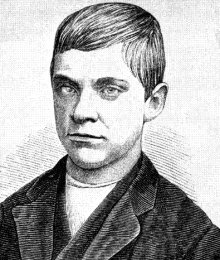

Jesse Pomeroy, young and old.

The doctors noted his lack of remorse or any sympathy for his victims. They believed Jesse would always be dangerous to society. His attorney argued that he should be found not guilty by reason of insanity and then locked away in a mental institution for good.

In the end, the jury convicted him of first-degree murder, for which the mandatory penalty was hanging. However, they issued a recommendation of mercy on account of his youth.

Although juveniles had been executed in the United States before and would be again, the state of Massachusetts had never hanged a boy of fourteen. On the other hand, Jesse had committed no ordinary crimes. By any standard he was a monster. His case was extremely controversial and the governor, William Gaston, was besieged with petitions both for and against clemency.

Gaston didn’t want to hang Jesse Pomeroy and stalled on the issue for as long as he could. It may well have cost him re-election. But his successor, Alexander Rice, didn’t want to hang Jesse either, campaign promises to the contrary.

So in August 1876, two years after Jesse’s murder conviction, by which time the furor in the press had died down, Rice commuted the now-sixteen-year-old’s sentence to life in prison. But there was a catch: the sentence had to be served in solitary confinement.

He would spend 41 years in a tiny cell, isolated from the world. His mother visited him once a month until her death. The only other people he saw were the guards. He was allowed to exercise alone in the prison yard and was allowed to read books. He wrote some bad poetry. Most of his efforts, however, were concentrated on escape. Schechter records:

Nothing — no amount of time locked in a dungeon, no beatings administered with a brass-tipped cane, no efforts at reinforcing his cell — discouraged Jesse for long. When plates of boiler-iron were bolted to his walls to keep him from digging at the stones, he set to work prying loose the bolts. When the walls were painted with a white preparation that would make even a pin-scratch conspicuous, he turned his attention to the floor, cutting loose one of the heavy boards, then digging at the ground underneath … Over the course of fifty years, virtually everything that fell into his hands became a potential implement of escape … He managed, over the decades, to fashion an amazing assortment of tools: awls, chisels, saws, drills, files, pry bars.

He never even came close to breaching the prison walls and his escape attempts mainly just made him a pain in the prison’s collective ass. Then again, a man needs a hobby.

In 1887, his ninth year in the solitary cell, he caused an explosion that blasted a hole in the ceiling and temporarily blinded him but didn’t get him anywhere. Only in 1912 was he ever able to actually make it out of the cell, something that took three years of work to accomplish — and he was caught within minutes. By then he was fifty-two.

His sentence was relaxed in 1917 and he was allowed into the general population. By then, Jesse’s health was failing, and his crimes were passing out of local memory. New inmates to the prison no longer recognized his name, something that deeply upset him. In 1929, he was transferred to the prison farm at Bridgewater. He took a car to get there, his very first automobile ride, but didn’t he didn’t seem interested in his surroundings. One reporter described him as “a deadened creature gazing with lusterless eyes upon a world that means nothing to him.”

He died at the Bridgewater Prison Farm on September 29, 1932, having spent sixty of his seventy-two years behind bars.

On this day..