1981: Mustapha Danso

On this date in 1981, Mustapha Danso was executed for an attempted coup in Gambia.

Gambia (or “The Gambia”: we’re going to dispense with the article here) is a sliver of a country hugging the Gambia River, entirely surrounded (save the coast) by Senegal.

It became independent of Great Britain in 1970 under the leadership of Dawda Jawara, who held the Gambian presidency democratically from that time until 1994. Mustapha Danso, our date’s principal, was one of a coterie of disaffected Gambian junior officers who were scheming a coup against Jawara as the 1980s got underway.

In October 1980, Danso walked up to the deputy commander of the Gambia Field Force, Eku Mahoney, and coolly shot him dead. “Although the first speculations blamed the constable’s action on possible illicit drug influence,” notes a book about Gambia’s subsequent, and successful, 1994 junior officers’ coup, “Mustapha Danso’s unresentful attitude after the incident convinced many people that there was more to it than what met the eye.” Mahoney may have been killed because he was viewed by the prospective coupists as an obstacle.

Danso caught a death sentence, but since Gambia never actually executed anyone, it was essentially symbolic.

That is, until July 1981, when Jawara was in London to attend the wedding of Prince Charles and Lady Diana. Danso’s former comrades in the Field Force seized the opportunity to join a coup mounted by leftist politician Kukoi Samba Sanyang against the “corrupt, tribalistic, and despotic” Jawara in favor of “the dictatorship of the proletariat.”

From London, Jawara summoned Senegalese aid: Gambia’s neighbor and sometime rival dispatched troops who successfully crushed the rebellion within a week. Some 500 people lost their lives during the turmoil, and its leaders fled abroad. (Kukoi Sanyang died a few months ago as of this writing, but his version of the “people’s revolution under my able leadership” can be perused here.)

While the coup itself was suppressed, Jawara went pretty easy (as these things go) on his actual or perceived enemies. Danso was the only party to the plot who was executed, and Jawara went out of his way to declare normalcy instead of using a national security emergency to smash up everything.

“In the aftermath of this threat to our internal security some have asked whether it would be appropriate at the time to consolidate both the power of the State and the power of the executive. Let me state categorically and unequivocally that the system of democracy that has always existed will prevail. There will be no dictatorship in The Gambia — neither by the President, nor by the Government, nor by the proletariat.” (Source)

Danso was the first and, for 30 years the only, person executed in Gambia; the country has retained the death penalty in law, but was long considered de facto abolitionist. That changed suddenly in August 2012 when current president Yahya Jammeh unexpectedly ordered nine condemned prisoners put to death on a single day.

On this day..

1893: Scuffletonians in Mt. Vernon, Georgia

From the Crittenden Press, Marion, Ky., Oct. 5, 1893, page 1 (pdf).

ON ONE SCAFFOLD.

Five Murderers Executed In Public at Mt. Vernon, Georgia

Three Killed a Merchant, the Fourth a Child and the Fifth a Companion.

Mt. Vernon, Ga., Sept. 29. — Five murderers were executed upon one scaffold at this place at 2:05 p.m. today. They were Hiram Jacobs, Hiram Brewington, Lucien Manuel, Purse Strickland and Weldon Gordon. All were commonly called negroes, but the first four named were descendants of the Crowatan Indians of North Carolina, and locally were known as “Scuffletonians,” from the name of the community from which they came. Three of them murdered Alexander Peterson, a rich merchant, last July, the fourth killed a five-year-old child and the fifth murdered a negro companion.

Over ten thousand people, white and black, witnessed the executions. Every incoming train deposited its load of human freight and steamboats on the Oconce and Attamba rivers ran a daily schedule. Thousands of women viewed the spectacle without a shudder.

The condemned men spent their last night on earth without any perceptible dread. This morning in the jail several colored ministers offered prayer for their spiritual salvation, exhorting them to be firm and courageous. At 1:30 p.m. the march to the scaffold was begun. The sheriff and prisoners were seated in a hack surrounded by a score of armed guards. They stood side by side on the scaffold. They were requested to make a statement if they desired.

Manuel said: “I have every reason to believe that I am going to meet the angels above. I fear nothing, my sins are forgiven and I shall go to heaven. I tell you my friends, to put your trust in God — good-bye.”

The others followed in the same strain. Strickland shed tears, while the vast throng sang, “A Charge to Keep I Have.” The Rev. Mr. Ross, a colored minister, prayed fervently. Then Sheriff Dunham adjusted the black caps and a photographer took their pictures.


Image from here, which appears to misdate the execution.

At this moment Sheriff Dunham bid them farewell, shaking each other by the hand, saying: “May God have mercy on your souls.”

At 2:05 p.m. the trap was sprung. There were no signs of a struggle, and the bodies hung straight and motionless. Half an hour later the bodies were cut down and deposited in pine coffins.

Update: Here’s a lovely wrap-up of the whole sordid affair.

On this day..

1926: Sataro Fukiage, serial killer

On this date in 1926, serial killer Sataro Fukiage (English Wikipedia entry | Japanese) was hanged at Ichigaya prison for rape-murder.

Most of what’s out there about Sataro Fukiage is in Japanese (like this book). Born in 1889, his hardscrabble upbringing saw him enter the workforce at age nine. He was not a model apprentice, alternating escape attempts with evictions for bad conduct; stealing from his master to procure a prostitute landed him in Kyoto prison at the tender age of 12, and it was in his periodic incarcerations that, Oliver Twist-like, he learned the finer points of pickpocketing from yakuza. He would need those finer points to do the breadwinning for his penniless mother in between his stints behind bars.

His somewhat sympathetic childhood also included a voracious and deviant sexual appetite which was to blossom in time into a carnivorous pattern of abuse.

Fukiage committed his first murder in 1906, when he took an 11-year-old acquaintance to a remote location, then raped and strangled her, only avoiding the death sentence because he himself was still underage at that time.

Released in 1922, he immediately brought himself to widespread public notoriety for a 1922-23 rape spree with at least 27 victims — most of them, again, underage girls. He mixed at least six murders into the one-man crime wave.

He completed an autobiography in prison, but it was banned shortly after its publication.

On this day..

1803: Joseph Samuel survives three hangings

On this date in 1803, Joseph Samuel just wouldn’t hang.

Transported to Australia in 1801 for theft, Joseph Samuel was part of a cohort of Sydney Cove convicts who, on the night of August 25-26, burgled a house.

The band was surprised by constable Joseph Luker, himself a former convict. One or more of the thieves battered him to death on the spot with whatever was at hand: recovered with Luker’s broken body at morning’s light were a bloodied wheelbarrow wheel, and the hilt of Luker’s own cutlass, buried in his brains. Luker was the first policeman killed on duty in Australia, and his name can be found on the country’s National Police Memorial.

But the order of the day in 1803 was a different sort of memorial. “Avenging Heaven directs the Hand of Justice, and the Manes of the Deceased inspires us with Indignation and Resentment,” the Sydney Gazette fulminated. The need to cut a deal for crown’s evidence with one of Samuel’s compatriots eventually meant that Samuel was the only one to bear the vengeance of Luker’s Manes. (A third man, Isaac Simmonds, was acquitted at trial, but he was so heavily suspected that he was made to attend the execution.)

We’ll pick up the narration of the Sydney Gazette (Oct. 2, 1803):

James Hardwicke were brought, in pursuance of the sentence passed upon them on the preceding Friday.

Both prisoners conducted themselves with becoming decency; and when the Reverend Mr. MARSDEN had performed the duties of his function, and quitted Hardwicke, he turned to Samuels (who being a Jew, was prepared by a person of his own profession) and questioning him on the subject of the murder of Luker, he solemnly declared, that during the interval of his confinement in the cell with Isacc [sic] Simmonds, nicknamed Hikey Bull, they in the Hebrew tongue exchanged an oath, by which they bound themselves to secrecy and silence in whatever they might then disclose.

Conjured by that GOD before whom he was shortly to appear, not to advance any thing in his latter moments that would endanger his salvation, he now repeated with an air of firmness what he had before declared ; and appearing deeply imprest with a becoming sense of his approaching end, appealed to Heaven to bear him testimony that Simmonds had, under the influence of the oath by which they were reciprocally bound, acknowledged to him that Luker had accidentally surprised him … and that he, in consequence thereof, had “knocked him down, and given him a topper for luck!” … [and] that he would hang 500 Christians to save himself.

Simmonds, as we’ve noted, was right there in forced attendance at the public hanging, and as Samuel’s accusations started the audience murmuring, Simmonds tried to interject his denials. The very fact that the words were spoken by a man on the brink of death and presumably in fear for his soul made Samuel a credible accuser in the eyes of the populace, “in whose breasts a sentiment of abhorrence was universally awakened … and the feelings of the multitude burst forth into invective.” Yikes.

While the gendarmes moved to protect Simmonds from the possible wrath of his neighbors, and Hardwicke received a last-minute pardon,* Samuel commenced the inadvertently superlative finishing act of his persuasive performance.

at length the signal was given, and the cart drove from under him; but by the concussion the suspending cord was separated about the centre, and the culprit fell to the ground, on which he remained motionless with his face downwards. The cart returned, and the criminal was supported on each side until another rope was applied in lieu of the former: he was again launched off, but the line unrove, and, continued to flip until the legs of the sufferer trailed along the ground, the body being only half suspended.

All that beheld were also moved at his protracted sufferings; nor did some hesitate to declare that the invisible hand of Providence was at work in the behalf of him who had revealed the circumstances above related. To every appearance lifeless, the body was now raised, and supported on men’s shoulders, while the executioner prepared anew the work of death. The body was gently lowered, but when left alone, again fell prostrate to the earth, this rope having also snapped short, close to the neck.

Compassion could no longer bear restraint; winged with humanity, the Provost Marshal sped to His EXCELLENCY‘S presence, in which the success of his mission overcame him; A Reprieve was announced — and if Mercy be a fault, it is the dearest attribute of GOD, and surely in Heaven it may find extenuation!

Samuells when the Provost Marshal arrived with the tidings which diffused gladness throughout every heart, was incapable of participating in the general satisfaction. By what he had endured his reasonable faculties were totally impaired; and when his nerves recovered somewhat from their feebleness, he uttered many incoherences, and was alone ignorant of what had past. Surgical assistance has since restored him; And MAY THE GRATEFUL REMEMBRANCE OF THESE EVENTS DIRECT HIS FUTURE COURSES!

It didn’t.

In 1806, Samuel made an escape attempt with some other convicts by boat. It was swept away in a tempest, with all presumed lost at sea.

* A number of sources claim that Hardwicke did hang successfully while Samuel’s rope repeatedly broke. We think the eyewitness newspaper report days after the execution to the effect that Hardwicke was reprieved is by far the more credible report.

On this day..

1884: Two Pennsylvania murderers

On this date in 1884, Joseph Sarver was hanged as a parricide at Indiana, Pennsylvania.

Sarver became enraged by his father’s affair with their housekeeper Mary Kelley, and shot the father dead in his doorway. (He also shot Mary Kelley; she survived.)

As if the parricide rap wasn’t enough to get the blood up, he “greatly intensified the popular feeling against him” by behaving after his arrest like an all-around jerk. Sarver reportedly fought with jailers over the timeliness of his breakfast, made merry in prison, and blithely boasted that “they could never hang him because he was a Democrat, and so was Governor Pattison.” (St. Louis Globe-Democrat, Nov. 14, 1883; Galveston Daily News, same date. It made the national crime blotter.)

He eventually made a full confession, and was said to have died firmly.


Executed on the same date in Cambria County, Penn., Michael Murray “dictated a letter, to be made public after his death, in which he charged that certain persons, possessing the powers of witchcraft, had exercised a spell over him, and while under its influence, he committed the deed.” The deed created by this sorcery was shooting a man on the Pittsburgh turnpike who called Murray a name.

On this day..

1729: Jephthah Big, ineffective extortionist

On this date in 1729, Jephthah Big was hanged at Tyburn — “so ill at the place of execution, that he could not attend the devotions proper for men in his calamitous situation,” according to the Newgate calendar.

This member of the all-name team got his from an Israelite warrior-judge noted for the human sacrifice of his daughter. The sin of Jephthah Big was much the smaller.

When Big’s brother got hired as a London gentleman’s coachman, Jephthah decided to make a quick hundred guineas of his own off the guy by sending him “such a letter as would make the gentleman tremble.”

The difficulty in this scenario is always in actually taking possession of the boodle without exposing oneself to capture.

Jephthah’s big plan was to ask for the money to be delivered to the Black Boy ale-house in Goodman’s Fields, but while his confederate Peter Salter was holding down a bench there day after day waiting for the windfall, Salter chanced to read a newspaper advert taken out by the target himself offering a reward for busting the shakedown. When a porter turned up asking for their extortionist alias, Salter sagely opted not to answer to it and instead left the tavern … but the porter had his own suspicions, and when he saw Salter by chance again a few days later, he had him arrested.

Salter got out of the scrape by turning crown’s evidence against Jephthah Big, who was hanged as the instigator of the whole mess.

On this day..

1953: Louisa May Merrifield, elder abuser

(Thanks to Meaghan Good of the Charley Project for the guest post. -ed.)

On this date in 1953, housekeeper Louisa May Merrifield, the so-called Blackpool Poisoner, was hanged at Machester’s Strangeways Prison for killing her employer.

She was the third-last woman hanged in Britain and the very last woman to be executed at that particular prison, which now houses only men; the job was performed by Albert Pierrepoint.

Born in 1906, Louisa had already served prison time for ration book fraud by the time of the murder, and she lost custody of her four children due to her excessive drinking and neglect.
She couldn’t seem to hold on to a man (she was married three times) or a job (she had 20 in three years).

She took her final position on March 12, 1953, after she and her husband of one month, 71-year-old Alfred Edward Merrifield, became housekeepers and live-in companions to Sarah Ann Ricketts, a spinster who was nearly eighty years old. Sarah Ricketts owned a bungalow at 339 Devonshire Road, North Shore, Blackpool.

The Merrifields indulged in elder abuse and neglect, and Sarah Ann complained she didn’t get enough to eat and that her housekeepers swilled rum on her dime. Meanwhile, Louisa was going around boasting that she’d inherited a £3,000 house.

When someone asked her who had died, she answered, “She’s not dead yet, but she soon will be.”

Louisa’s prophecy was eerily accurate: Sarah Ann Ricketts expired on the night of April 14, 1953, only a month after she’d hired the Merrifields and three days after Louisa’s prediction … but not before drafting a new will which left her bungalow to the Merrifields.

Louisa didn’t call a doctor until the next morning. She said that, as the old woman was clearly beyond help, she didn’t want to drag anyone out of bed in the middle of the night.

The suspicious GP refused to sign a death certificate and insisted on an autopsy, which revealed the cause of death as phosphorus poisoning, administered in the form of a rat poison called Rodine.

Although a police search of the bungalow didn’t turn up any Rodine, a check at the local pharmacy showed Louisa had recently purchased the stuff and signed the poison register.

The Merrifields found themselves charged with murder. Louisa was arrested first, two weeks after Sarah Ricketts died, and Alfred a few days later.

At their trial in July 1953, Louisa was convicted and sentenced to hang. The judge called her crime “as wicked and cruel a murder as I ever heard tell of.”

The jury couldn’t reach a verdict on Alfred, however, and the district attorney decided not to prosecute again. He was released and in due time inherited a half-share in Mrs. Ricketts’s bungalow. He died in 1962 at the age of 80.

Louisa Merrifield’s ghost is said to haunt the cell she once inhabited at Strangeways Prison.

On this day..

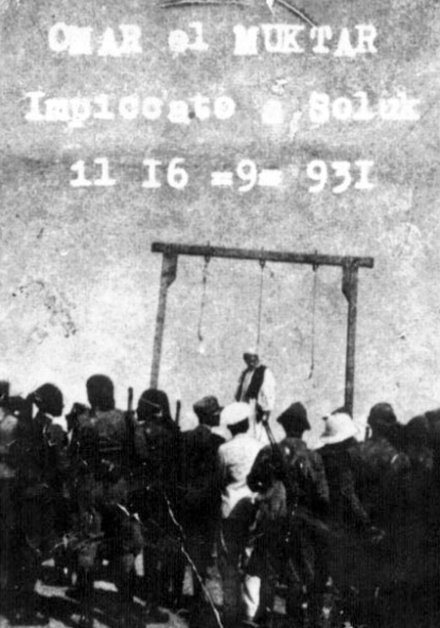
1931: Omar Mukhtar, Libyan revolutionary

On this date in 1931, Libyan independence martyr Omar [al-]Mukhtar was publicly hanged by the Italians at their concentration camp in Suluq.

Mukhtar (English Wikipedia entry | Italian) was born an Ottoman subject back in 1858 and had lived long enough to see his native Libya seized in the 1911-12 Italo-Turkish War.

Mukhtar, a religious teacher and follower of the Senussi movement, became the leader of the Libyan resistance that dogged the Italian occupation. Mukhtar proved an energetic and successful desert guerrilla fighter, and he had to be given the Italians’ mechanized military.

The Italians executed an estimated 4,000 Libyans in the 1920s, and drove hundreds of thousands into concentration camps, and gradually, only gradually, gained the upper hand on their adversaries.

Captured in battle after he abandoned a 1929 truce, Mukhtar was denied prisoner-of-war status and subjected to a snap military tribunal in one of the small coastal enclaves actually controlled by Italy — “a regular trial and consequent sentence, which will surely be death,” as the Italian general directed. It surely was.

He’s played by Anthony Quinn in the 1981 film Lion of the Desert — a better movie than you might think given that it was bankrolled by Muammar Gaddafi.

A national hero for contemporary Libyans across any social divide you’d care to name, Omar Mukhtar was valorized by the rebels who recently overthrew the aforementioned Gaddafi (here’s Mukhtar on a billboard in rebel-held Benghazi). “The whole world knows what Omar al-Mukhtar did,” Mukhtar’s 90-year-old son told media during the civil war. “That’s where they get their energy from. Ask the youth, they’ll tell you they are all the grandsons of Omar al-Mukhtar.”

His steely profile can be seen on Libya’s 10 10 dinar note.

On this day..

1864: George Nelson, Indiana Jones rapist

(Thanks to Meaghan Good of the Charley Project for the guest post. -ed.)

On this day in 1864, Private George Nelson of Company F of the 13th United States Colored Troops was hanged for rape in Nashville, Tennessee.

He committed his crime on November 13, 1863. Nelson and two other men were on Nashville Pike outside of the town of Dickson when they encountered an unmarried white woman named, no lie, Indiana Jones.

They asked her where she lived and she said her house was about a mile away. The men claimed they’d been fighting with some rebels near her house and said she must go with them.

Miss Jones refused, and Nelson threatened to shoot her if she did not comply. She went with him for about 250 yards, begging him to release her. Private Nelson put a bayonet to her side and told her to come into the woods with him or he would run her through. Miss Jones started crying then, and he threatened to strangle her with a rope if she did not shut up. They went into the woods together while the other two men held the horse.

As Miss Jones later testified, “I again begged of him to let me go, when he cocked his gun and said if I did not be still he would blow my brains out. He then took hold of me, threw me down, and committed a rape on my person.”

When he was done he robbed her of $1.50, but the other soldiers made him give the money back. Then they let her go.

George Nelson’s accomplices were tried separately, and on cross-examination the victim was asked, “Did you use your utmost endeavors to prevent him from executing his desires, or did you simply cry out, thus yielding a tacit consent?”

As if she could have done anything else with a gun trained on her!

The three defendants were all court-martialed. President Lincoln approved the death sentence for Nelson in August 1864 and he hanged the following month. His partners-in-crime got twelve and ten years in prison respectively.

On this day..

1801: Jason Fairbanks, lackadaisical escapee

On this date in 1801, Jason Fairbanks was hanged for murder in Massachusetts.

Fairbanks hailed from one of the oldest families in Anglo North America; the house where he whiled away his pre-homicide idleness is today the Dedham museum Fairbanks House.

A youth of about twenty-one, weak, sickly, with a stiff right arm,” Jason had a thing for 18-year-old “neighbor” (they lived more than a mile apart) Elizabeth Fales and she for him, but the Fales family opposed the romance.

So one day in May 1801, Fairbanks “told two of his friends, that he should meet [Fales] in the pasture on Monday, and endeavour to induce her to go off with him, and marry him; and that if she refused to do so he would attempt her chastity.”*

Evidently she just wasn’t that into him, because later that day of their rendezvous, Jason weirdly showed up at the Fales house covered in blood with a cock-and-bull story about how Eliza had committed suicide and he, Jason, had tried and failed to follow suit. Jason Fairbanks was indeed seriously injured (he convalesced in his victim’s family’s house), but Eliza’s wounds were the more interesting: her throat was slashed — she was still breathing faintly through her gashed windpipe when found — and she had stab wounds in her arms and between her shoulder blades.

It’s an atypical suicide who stabs herself in the back.

There was, of course, the matter of Fairbanks’s crippled arm (so did he really overpower Eliza?) and his own injuries (so was it a fight, or what?) — sufficient ambiguity for dueling attorneys to spin every manner of hypothetical to account for the maximum or minimum villainy of the suspect.

But when a dude says he’s off to attempt the chastity of a virtuous young woman and she emerges from the encounter with a stab in the back and a slash through the throat, he’s going to have a hard time repelling the charge. Fairbanks was easily convicted of murder on August 8.

Nine days later, or rather nights, this young-love tragedy took an even more amazing turn: Fairbanks’s friends broke him out of prison. Newspapers all over America were soon raising the hue and cry

STOP THE MURDERER
1000 Dollars Reward

The absconding of Jason Fairbanks from the jail of Dedham has excited much interest in the breasts of every one who regard the peace of society and the security of life; it will be the duty of the citizens of the United States to exert themselves in securing the condemned criminal without pecuniary reward, but as that may be the means of stimulating many who would otherwise be inactive, a large gratuity is now offered. Every newspaper printed in the U.S. it is hoped will publish the advertisement of the Sheriff … and by other means extend the hue and cry against him. (Quoted here)

Despite the bulletins, Fairbanks made it all the way to Whitehall on the southern tip of Lake Champlain, where a hired boat waited to carry him to freedom in Canada. Instead of boarding ASAP, Fairbanks and his escort paused for a parting breakfast on the very morning of the prospective embarkation — it’s the most important meal of the day, you know — and the fugitive was there apprehended addressing his table, steps away from safety.

* 1801 murder pamphlet, “A Correct and Concise Account of the Interesting Trial of Jason Fairbanks”

** We couldn’t help but enjoy this explanation for the murder published in the Philadelphia Gazette of the United States as part of an unsigned “Letter from Dedham”: “Fairbanks had been seduced previous to his becoming a murderer, by some European travellers; and joined with a society of Jacobin Deists, who held their meetings in this town. Among other of their tenets, they avowed that a rigid observance of chastity in man or woman was ridiculous; being contrary to natural impulse.” Dedham was to Federalists of 1801 sort of what San Francisco is to the present-day Tea Party, thanks in large measure to a ridiculous case recently charging a so-called “Jacobin” under the ridiculous Alien and Sedition Acts; there was an abortive attempt in the Federalist press to ascribe Fairbanks’s jailbreak to a revolutionary mob.

On this day..