1691: Jack Withrington, highwayman

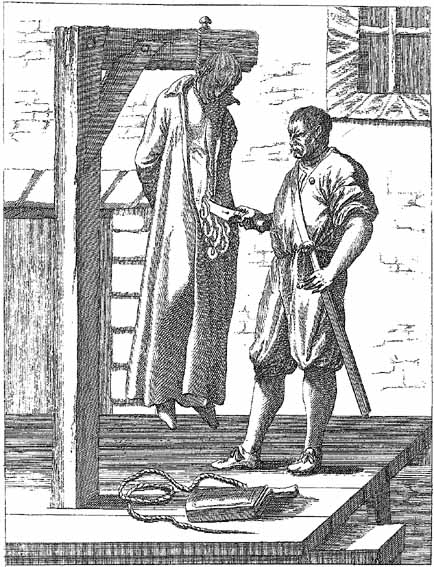
On this date in 1691, highwayman Jack Withrington hanged at Tyburn.

THIS fellow was the youngest of five brothers, who were all born at Blandford, in Dorsetshire. The other four were all hanged in the country, but Jack had the good fortune to be reserved for Tyburn, and by that means to have his name transmitted to posterity. He was bound to a tanner in Shaftesbury, a town in his native county, with whom he served about three years. Then he entered into the Earl of Oxford’s Regiment of Horse, in which, when Monmouth‘s rebellion was suppressed in the West of England, he came up to London, where he soon met with opportunities of discovering his valour to the world. These occasions were two quarrels in which he was engaged: the first with a man famous for fighting, against whom he behaved with so much bravery and skill that it won him a vast reputation; the second with a person of great estate, but a noted coward, when he showed himself a gentleman by his adherence to the point of honour and good breeding. By these duels he won abundance of applause, so as thereby to contract a familiarity with all the greatest fighting men of the time, especially those in his own regiment. Withrington however carried his manhood so far as to get himself turned out of the regiment within a year after, for challenging his captain. He then became a perfect bully and gamester; and, being fortunate, in a little time by these means saw himself master of a considerable sum of money. Notwithstanding all this good luck at first, he found himself afterwards subject to the fate of gamesters —- viz. to be frequently without money in spite of his large winnings. This brought him at last to consider the uncertainty of Fortune and endeavour to make himself master of her, by supplying with fraud what he might want in plain open skill. But this also did not continue long; for everyone began to be aware of him as a common sharper, and none who knew him would venture to play with him.

In the common scale of knavery the next step above a sharper is a downright thief. Withrington made bold to ascend this degree, and was resolved to take the most honourable station thereon, that of a highwayman. He had money enough to buy him a good horse and accoutrements, so that the resolution and the real attempt were not long asunder. His first adventure was with a farmer, from whom he took forty pounds, giving him in return only an impudent harangue, occasioned by the countryman’s reproaching him with the robbery.

The next that fell in Withrington’s way was Mr Edward Clark, gentleman usher to the Duchess of Mazarin. They met in Devonshire, on the road between Chudleigh and Ashburton. Mr Clark made some resistance, so that in the scuffle Withrington’s mask fell off and discovered his face, which Mr Clark knowing, he called him by his name, and said he hoped he would not rob an old acquaintance. “Indeed I shall, sir,” quoth Withrington, “for you get your money much easier than I do, who am forced to venture my life for a maintenance; you have so much a year for eating, drinking and entertaining your lady with scandal and nonsense. What I shall take from you will do you little harm; it is only putting a higher price upon half-a-score reputations, which you know how to do as well as any coxcomb in England. Ladies never let such faithful servants go unrewarded, nor will yours suffer your loss to fall on yourself.” He got about eight guineas out of this gentleman’s pocket, and for old acquaintance sake bade him “Good-b’w’ye” very heartily.

Withrington’s robberies in less than a year and a half were talked of almost all over the kingdom. But alas! he met with a diversion, common to mankind, that draws even the most stupid into the rank of polite persons. The poor man was in love; and with whom but a rich widow inn-keeper in Bristol! Farewell to the highway: Withrington has another scent to pursue. No more robberies to be thought of from a man who was himself robbed of his heart! He employed an old bawd in the affair, who was intimately acquainted with our hostess, and by this flesh-broker’s mediation things had like to have come to an issue, and Jack to have been master of the Swan Inn. In short, there was nothing prevented it but the accidental coming of a certain gentleman, who knew our highwayman, and informed his mistress what he was. The effects of this discovery were Jack’s being kicked out of doors by the ostler and chamberlain, and the commitment of madam the negotiatress to Bridewell, in order to mill Dolly.

After his return to the highway he and one of his companions met with Mr Thompson, a noted tailor, in a part of Hertfordshire that was convenient for robbing. They took from him about thirty pounds in silver, and then, dismounting him, they ordered him to stay where he was till they brought him more company. As soon as they were gone from him he remounted his horse and attempted to ride off as fast as he could; but our highwaymen perceiving what he was at, and having the best horses, they fetched him back, and mistrusting he had more money, by his being in so much haste, they searched him afresh, he protesting all the while that he had not so much as a farthing left if it were to save his soul. In a literal sense he might be right; but they made a shift to find forty guineas, which they thought better than farthings. Withrington upon this exclaimed that it was a sad thing that one Christian could not believe another! They then shot his horse, to put a stop to his speed, and so rode away and left him.

These, we pause to digress, are not the only stock and store among the (surely half-legendary) c.v. of this colorful bandit. The verbosely entitled Complete History of the Lives and Robberies of the Most Notorious Highwaymen, Footpads, Shoplifts and Cheats of Both Sexes reports that Withrington delivered himself of an even wordier critique of the nascent economic order of the day.

[T]ravelling the road, he met a rich farmer, from whom he took £40. Quoth he, Is not this a downright robbery? Roberry? replied Withrington; So let it be; who is there now-a-days does not rob? The tailor steals before his customer’s face; the weaver steals by eking out the length of a piece of cloth with the remainder of broken ends; the surgeon steals by prolonging a cure; the apothecary steals with a quid pro quo, using one drug for another for cheapness, without any regard to the age and constitution of the patient; the merchant steals by putting his money into the Bank of England; the scrivener steals by selling the soul of a poor man for the money that he can take of a forfeit; the grocer steals by using false weights; the vintner steals by adulterating his wine; the butcher steals by blowing up his meat; the victualler steals by drawing in short measures; the cook steals by roasting his meat twice over; the baker steals by raising his bread when there’s no occasion; and the shoe-maker steals by stretching his leather as much as he does his conscience. Thus, as there is cheating and cozening in all trades but mine, you cannot blame me for borrowing this small trifle; which I shall honestly pay you when we meet again; so till then, farewell.

And a bit of, er, gallantry.

Another time Jack Withrington meeting a gentleman and his wife on the road betwixt St. Albans and Dunstable, he very submissively craved their benevolence; but they not instantly granting his request, he shot the horse on which they both rode, and swore that as he denied him his money, he would take his wife. So forcing her into an adjacent copse, and acting a man’s part by her, he restored her to her husband again, from whom taking eleven or twelve guineas he said, This is no more than my due for I am not obliged to do your drudgery for nothing.

Rape and repartee! Dreamy.

But we know where this is heading.

The last robbery Withrington committed was alone. He stopped a nobleman on Hounslow Heath attended by two footmen. There was a short dispute, but Withrington having the best of it, he took a portmanteau in which were two hundred and eighty guineas, sixty pounds in silver, and a parcel of fine linen. A hue and cry was soon issued out after him, and he was apprehended by means of it at Malmesbury, in Wiltshire, from whence he was removed to London, where he was condemned for this fact.

The sentence of death seemed to have no effect on his temper, for he was as gay and humorous under that circumstance as ever he had been before. When he was riding up Holborn Hill he ordered the cart to stop, and calling up the Sheriff’s deputy, “Sir,” said he, “I owe a small matter at the Three Cups, a little farther on, for which I am afraid of being arrested as I go by the door; therefore I shall be much obliged to you if you will be pleased to carry me down Shoe Lane and bring me up Drury Lane again into the road by which I am to travel this devilish long journey.” The deputy informed him that if such a mischance should happen he should come to no damage. “For,” says he, “I’ll be bail for you myself, rather than you shall go back to prison again.” “Thank you heartily, sir,” quoth Jack; “I protest I could not have thought that I had a friend in the world who would have stood by me so in such a time of need.” After this he rode very contentedly to the place of execution, where he was tucked up with as little ceremony as usual. This fatal day was Wednesday, the 1st of April, in the year 1691.

Part of the Themed Set: Selections from the Newgate Calendar.

On this day..

2001: Mariette Bosch, love triangulator

On this date in 2001, Botswana secretly hanged creepy South African emigre Mariette Bosch for whacking her neighbor in order to steal the neighbor’s husband.

That the black widow was actually white only threw the lurid scenario into sharper relief. In the well-heeled enclaves of Gaborone, one Ria Wolmarans was found shot dead in 1996, and inside a month her former husband Tienie Wolmarans had moved in with Mariette Bosch.

The big break in the case came from Mariette’s sister Judith, to whom the murderess had unguardedly confided her love for Tienie prior to the shooting. (The lovebirds’ official story was that their loins only heated up as Ria Wolmarans’ body cooled.) Judith got ahold of the 9mm Mariette had borrowed and handed over to the police what proved to be the murder weapon.

Although the courts found Mariette’s erratic defense — something about hypnotism and her victim’s boss — absurdly implausible, her elite status helped make her the lightning rod for capital punishment in Botswana.

The international attention she attracted, however, simultaneously pressured the government to close the books with a very speedy hanging.

Bosch was hanged at 6 a.m. this date upon 24 hours’ notice to herself and none whatsoever to the outside world: Tienie — who always avowed disbelief that Bosch killed his wife — was turned away from the prison on what he figured was a routine visit the previous day, and found out about Bosch’s execution with the rest of the country when it hit the news two days later. Bosch had to go her last day on earth alone.

Although it remains an emblematic case, Bosch’s disposal hasn’t exactly changed Botswana’s hanging protocol: brief appeals process, executions in secrecy, scant prospect of clemency. The country’s politicians make no apologies about it, notwithstanding the high-profile work of its domestic human rights organization Ditshwanelo. (Here’s its statement on Bosch.)

On this day..

1945: Max Schlichting, for realism

On this date in 1945, a Hamburg coal worker was executed for an excessively realistic take on the war effort.

Although — or because — Germany’s administrative infrastructure was falling apart under the Allied onslaught late in World War II, its judiciary had no compunction about doling out death sentences.

While the overall number of cases dealt with by most special courts was much lower than in previous years, due to the gradual collapse of the court system, in these last months of the war some judges passed proportionally more death sentences than ever before. Legal officials continued to justify their brutal sentencing by claiming that this would prevent another ‘stab in the back’.

In other words: Clap louder!

Poor Max Schlichting, a coal worker with an unfortunate communist past, was sentenced to death for Wehrkraftzersetzung — “subversion” or “undermining the war effort,” the same thing they got Remarque’s sister on.

Specifically: he remarked to a soldier, in the aftermath of the American landing at Normandy, that Germany was going to lose the war. An undercover Gestapo spy overheard him.

Although hard evidence of Germany’s situation (German link) would have been difficult for a Hamburger to overlook, Schlichting received no clemency and was executed — six weeks before Hamburg surrendered to the Allies.

His sentence and (banal) last letter are recounted here, in German.

On this day..

1699: William Chaloner, Isaac Newton’s prey

(Thanks to Thomas Levenson of the Inverse Square Blog. Prof. Levenson is head of the Graduate Program in Science Writing at MIT, and author of the forthcoming Newton and the Counterfeiter.)

Early in the morning of March 22, 1699, William Chaloner raged.

Chaloner, a convicted coiner, refused the Newgate Jail Chaplain’s plea to show proper penitence, shouting with “more Passion than Piety,” of his wronged state and unmerited destination (according to his anonymous biographer in the one surviving account of his life). In time, he calmed sufficiently to accept the sacrament, and so proceeded to the execution convoy to be borne from Newgate to the hanging tree at Tyburn (now Marble Arch, just to the west of the old City of London).

There Chaloner’s fury mounted again, and he shouted to the crowd, drawn as always to the spectacle of public hanging days, that “he was murder’d … under pretence of Law.” He mounted the ladder to the top of Tyburn’s gibbet. He prayed, and then pulled the hood over his eyes without aid. When the moment came, the executioner’s men pulled the ladder out of the way and Chaloner dangled, twitching and jumping (the “hangman’s dance”) as long as it took –- minutes, at least — for life to choke out of him. Richer men often paid the hangman to pull on their legs to speed death. Not the destitute Chaloner. He had to choke till he drooped, to the greater amusement of the crowd.

The investigator who had sent Chaloner to the noose was not present; or at least nowhere in his copious notes and letters did he admit to curiosity about the fate of a man whose pursuit occupied him for almost three years. The Warden of His Majesty’s Mint had more pressing duties to perform, and so Isaac Newton allowed the date of Chaloner’s death to pass unmarked.

Isaac Newton? That Newton?


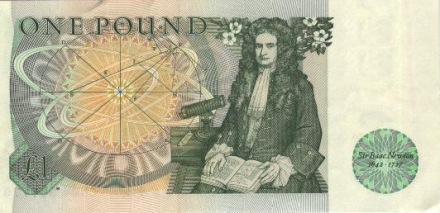
Appropriately, Newton himself wound up on the currency.

The accidents of place and time that brought the man who was recognized in his own day as the greatest mind of the age into conflict with Chaloner, an uncommonly gifted common criminal have fascinated me since I first learned of them through reading Chaloner’s last, piteous letter to the implacable Newton, written days before the hanging. In it Chaloner begged, writing “O dear S[i]r nobody can save me but you O God my God I shall be murderd unless you save me.”

What I wanted to answer was the obvious question: how and why did Isaac Newton come to pass judgment on the life of any other man? I had always thought of him as the nearly cloistered scholar of Trinity College, Cambridge, his home for more than thirty years. It was there he performed the experiments and the calculations that led him, in 1687, to write his masterwork, Philosophiae naturalis principia mathematica the Mathematical Principles of Natural Philosophy — better known simply as the Principia -– as well as pursuing his decades-long program of alchemical research.

So how, I wondered, did he end up in London, wallowing in the muck with the capital’s criminal underground?

Not to put too fine a point on it, finding out has turned into a book Newton and the Counterfeiter, published by Houghton Mifflin Harcourt and scheduled for release on June 4. But, to anticipate that longer story, here is the gist: Newton, after Principia found himself an international celebrity, and, as one of Cambridge University’s representatives to the Convention Parliament of 1689 that legitimized William of Orange‘s seizure of the English throne from the deposed Stuart King James II, he had nearly a year to enjoy the acclaim of London and Europe’s thinking and political elites before returning to the quiet of Cambridge, then a small town of about 5,000 inhabitants. It was an intellectual backwater too, especially compared to the big city in which he encountered figures like Robert Boyle, John Locke, Robert Hooke (whom he despised), Samuel Pepys (whom he did not) and so on. So he started, with Locke’s help, to seek a patronage appointment that would allow him to live comfortably in London. It took six years to find the right one, but ultimately he was offered the Warden’s post at the Mint. That job was supposed to be a sinecure, a nearly no-show position that would pay him a very comfortable wage.

And so it would have turned out were it not for the terribly debased state of England’s silver coinage, which had deteriorated to about half its legal weight for a whole host of reasons. So Newton arrived at a time when (a) the Mint was attempting to recall and recoin the entire stock of silver money for the entire country –- all the smaller units of money essential to everyday transactions –- and (b) coining, counterfeiting, was flourishing as enterprising men and women set out to get rich by filling in the gaps in the money supply with coins that never felt the stamp of an official Mint die. As Warden, it became Newton’s duty to see that legal money was produced fast and fairly, and to pursue all those who set up on their own.

Of those who did none were more technically skilled or ambitious than William Chaloner. His is a fascinating story, told at much greater length in my book, in which you see the currents of rapid economic change, class and ambition all converge within this one, barely remembered life. He was born desperate poor, a weaver’s son in Lincolnshire. He ran from his first apprenticeship to London, where he started out at the very bottom of the criminal ladder, hawking porn on street corners. He rose rapidly, first with his clearly impressive gift of gab, and then, after falling in with someone who knew how to gild surfaces, as the central figure in a series of ever grander schemes to counterfeit gold and silver money. He had sidelines as an informer, betraying conspiracies that he would himself set up, but his central gift and fascination was in the creation of fakes. Ultimately, he was one of the first to recognize the power of paper, and he started to counterfeit a variety of the early experiments with paper money and bank instruments.

In this sense Chaloner’s career –- and Newton’s urgent pursuit of him –- offer a window into the birth of the modern idea of money, of finance. And one of the things that fascinated me about this case is the degree to which this old story tracks some of our immediate problems. England’s and Europe’s economies were in rapid revolution in the late seventeenth century. The old idea of money as a chunk of metal with a pretty picture on it could no longer come close to accommodating the kind of enterprises governments and individuals wanted to undertake, from war to the funding of global webs of trade. And so people came up with all kinds of different ways of trying to represent value and exchange and even the idea of the changing worth of an investment over time. And the people making these experiments did not fully understand the implications of each expedient they tried. The last piece of paper Chaloner counterfeited was called a Malt Lottery Ticket, and it was at once simply paper money, a bond, and a gamble. Traders attempted to value these kinds of things in embryonic financial markets -– which would in a couple of decades blow up in a financial collapse that possess some striking similarities to our current predicament. Newton himself would lose a considerable fortune in that collapse, a sum worth a couple of million pounds, maybe more, in 21st century money.

It was that sense of precariousness that made the pursuit of counterfeiters so urgent in the midst of the late 17th century; England’s money supply was genuinely at risk, and no one had a good grasp of what it would take to make both the daily experience of small transactions and the high finance of war and trade go smoothly. So anyone threatening either or both levels of money was public enemy number one.

Of those who tried their hand at currency crime, Chaloner was the most accomplished, and notorious. By his own admission he counterfeited on the order of 30,000 pounds worth of currency over a seven- or eight-year career, an enormous fortune for the day. His big mistake, though, was to challenge Newton directly, accusing him in public of incompetence or fraud in his management of the recoinage of silver money between 1696 and 1698. He laid that charge both in testimony to Parliament and in a pamphlet he had printed for public distribution, and the scandal could genuinely have wounded Newton, were it not for the influence of his friends in power in Parliament at the moment.

It was enough, certainly, to propel Newton into an extraordinary investigation, an exercise of what may be seen as true non-fiction scientific detection. He set up a net of agents and informers throughout the worst neighborhoods and pubs in London, tracking any instance of coining he could find, interrogating suspects at the Tower or in jail, trying to build a web of connections around Chaloner. That story is contained within a collection of several hundred depositions and summaries of interrogations, all signed by Newton, that have survived, largely unexamined until now. Those records show that it took Newton almost two years in all, but aided in the end by listeners whose lives he held at his disposal inside Chaloner’s cell at Newgate, he managed to collect a sufficient weight of testimony to ensure that he could convict a prisoner clever enough to have escaped several previous attempts at prosecution.

The trial itself was something of a sham. Chaloner had feared being charged on the Malt Lottery Ticket forgery, (as we know from the accounts in Newton’s files of informers in the cells) but Newton actually presented evidence of a coining spree that almost certainly did not take place as described. Among other confounding facts, Chaloner was supposed to have made six different denominations of both silver and gold coins in a single day, which would have involved an enormous confusion of tools and materials that ran counter to basic counterfeiting practice.

No matter: the sheer volume of precise detail that Newton’s witnesses were able (or convinced) to provide produced a conviction within a very short time –- the whole trial took no more than an hour or so on March 3, 1699. There was a truncated appeal process -– really just a request for clemency from the crown, which was denied, and Chaloner’s sentence came down.

Formally, he had been found guilty of high treason, an assault upon the crown in the form of the king’s likeness and authority represented on the face of England’s coins. The punishment for high treason was essentially that suffered by William Wallace of Braveheart fame: to be strangled to the point of death, to be disemboweled whilst still living, to be beheaded and then quartered. By the date of Chaloner’s execution, the punishment had eased this far: convicted coiners were drawn to the place of execution on a rough sledge, subject to all the filth and abuse London’s open-sewered streets possessed; then hung until dead, and then, on rare occasions, to suffer post-mortem dismemberment. Chaloner himself was not, so far as any records revealed, actually cut into pieces. (As a gesture to public decency, women convicted of coining or other capital crimes were not supposed to be hung, lest their twitching at rope’s-end seem lewd. So they were burnt instead – though by the eighteenth century it was common to strangle them to death before lighting the pyre. Mercy, after the fashion of the times.)

Levenson lectures on his book at the MIT Writer’s Series.

One last note in a post gone much too long: Newton was involved in a number of counterfeiting investigations, and by some reckonings at least two dozen people went to their deaths as a result. Some historians, notably Frank Manuel, have speculated that Newton pursued this work with implausible eagerness, out of a kind of frustrated blood lust born of his abandoned and unhappy childhood.

This seems to me to be nonsense. The specific historical context matters here: Newton did not author the bloody code, nor did he send everyone he could to the gallows. Rather, the record of his depositions shows him to be simply a relentless practical man doing his job. He used little fish to catch big fish, and at least some of those low on the ladder received their escape from the gibbet. What you can see here, surprisingly, is the birth of a modern idea of a civil service. The Warden -– even Isaac Newton — was simply a man in a job doing the functions of that job, which included organizing the investigation and prosecution of counterfeiters.

What’s striking, of course, is that this civil servant, this bureaucrat, happened to possess the greatest scientific mind in history. And that’s the real sting in this tale. There is a connection between Newton’s pursuit of counterfeiters and his attempts to understand nature. He did employ the same resources of concentration and logical organization in his criminal investigations that he did when he tackled any problem. But more than the commonality of work habits, there is, I think this link: Newton can be seen as many people: the mathematician, the theoretical physicist, the empirical experimentalist, the alchemical mystic, the heretically devout religious thinker –- and the government functionary too.

And yet he was, of course, a single man, one with many interests, but ultimately with a consistent ambition, to reduce to order the complexity of any problem which was posed to him. Newton did not expect as Warden to have to chase crooks; when he found out that was part of the job he wrote a rather whiny letter to the Treasury to see if he could wriggle out of the duty. When he found he could not, he responded as he always had to the job at hand.

As one consequence, on this day three hundred and ten years ago, William Chaloner died.

On this day..

1809: Mary Bateman, the Yorkshire Witch

It’s the bicentennial today of the unnatural passing of the Yorkshire witch.

Mary Bateman ran her fraudulent fortune-telling business under the name “Mrs. Moore”, and had some years’ success separating fools from their money without running afoul of the law.

In fact, she outlived her fatal crime — plying with poisoned puddings a bilked couple, lest they realize their medium was defrauding them — by months, even continuing to leach money off the surviving husband after her ministrations had killed the wife.

Let’s just say she knew how to pick her clientele.

When the sucker finally got wise to the scam,* the jig was up for Mary in a sensational trial. (It’s recounted at length here — and capped by what must have a grimly comic spectacle when Mary attempted to plead her belly and the women in the courtroom bolted for the exits to avoid impaneling on a jury of matrons to adjudge the claim. The judge ordered the doors shut up before his jury pool could escape.)

Three days after conviction, she was hanged at York Castle before a crowd of thousands, who subsequently paid (.pdf) to see her corpse (and to get cured cuts of her skin as charms: even unto death, Mary had ’em swallowing her snake oil).

After execution, Mary Bateman’s body was given over for dissection in Leeds — remaining a curio worthy of public preservation to this day at that city’s Thackray Medical Museum. (Update: The museum reports that Ms. Bateman’s remains were only on loan from Leeds University, and have since been returned.)

* Source of enlightenment? Not the death of his wife, but the fact that magical financial windfalls promised by the Yorkshire witch had failed to materialize after two-plus years of paying her.

On this day..

1789: Catherine Murphy, Britain’s last burning at the stake

On this date in 1789, Catherine Murphy was led past the hanging bodies of her husband and their other male codefendants at Newgate Prison, secured to a stake, and put to the last burning at the stake in English history.

The convicted coiners — counterfeiting rated as high treason at the time — were the last heirs to gender-specific execution methods before the Treason Act of 1790 gave coin-shaving ladies equal access to the halter.

Though Murphy thereby earned an unenviable historical footnote, the de facto practice on the scaffold had long since been changed to spare lawmen the spectacle of a woman roasting to death. Murphy, in fact, was killed by hanging — and the “burning” part of the sentence only imposed upon her corpse. (This, however, was still more than enough: NIMBYing prison neighbors appalled by the stench of burning flesh had lent their support to the Treason Act’s reforms.)

On this day..

2005: Mohammed Bijeh, the desert vampire

On this date in 2005, Iran “desert vampire” was flogged to the point of collapse and hanged before a bloodthirsty throng in Pakdasht.


Mohammed Bijeh collapses during his flogging (top); then, as he is hoisted by a crane — with what one would take to be the stab wound from a victim’s brother visible on his back. More frightful photos of this execution here.

Bijeh confessed to raping and murdering 16 boys age 8 to 15 over a yearlong spree.

His modus operandi? Lure them into the desert on the pretext of hunting animals.

Unsurprisingly a figure of intense public hatred, Bijeh stolidly endured his own death before a jeering mob.

Riot police held back the angry crowd, but at one point a brother of one of the victims managed to break through and stab Bijeh in the back.

After 100 lashes, the desert vampire was noosed to a crane arm by one of the victims’ mothers, and hoisted 10 meters into the air for public strangulation, to the cheers of onlookers who had to be restrained from savaging the body when it was finally brought down.

An accomplice, Ali Baghi, somehow avoided execution and got off with whipping and a prison term.

On this day..

1551: Alice Arden, husband killer

On this date in 1551, Alice Arden was put to death for one of 16th century England’s most shocking crimes.

Stuck in what one gathers was a dull marriage of political convenience, Alice Arden took up with a lover, Richard Mosby.

Although the whole scene was tolerated by her husband, Alice and Richard conspired to have Thomas murdered, because nobody would ever suspect the vivacious wife and her paramour to be behind the unexplained death of her husband. (And, Alice reckoned, Thomas “was so evil beloved that no man would make inquiry after his death.”) Holinshed‘s chronicle saw fit to include this tabloid-esque crime in its narrative of English history.

Arden’s wife, Mistress Alice, young, tall, and well favoured of shape and countenance, formed a criminal connection with a paramour, named Mosbye, a black, swart man. Mosbye had been servant to Sir Edward North, Alice’s father in law; and then settled as a tailor in London. The infatuated wife, lost to all sense of duty and morality, conspired with Mosbye to put an end to her husband’s existence, in order that she might marry the profligate black, swart man.

They employed as their confederates one John Green, a Faversham tailor; George Bradshaw, a goldsmith of the same town; and one Black Will, of Calyce (Calais), a murderer, which murderer was privily sent for to Calyce by the earnest sute, appoyntment, and confederate of Alice Arden and Thomas Mosbye.

The conspirators watched Master Arden walking in Poule’s (St. Paul’s Cathedral, the nave of which was a public promenade in those days), but could not find an opportunity to murder him; they then lay in wait for him on Rainham Down, and a second time in the Broomy Close (two places near Faversham), but on all these occasions failed in obtaining an opportunity.

The wicked wife then laid a plot for murdering her husband in his own house. She procured the services of Mosbye’s sister, Cicely Pounder, and of two of Arden’s domestic servants, Michael Saunderson and Elizabeth Stafford. On a particular day selected Sunday, too Black Will was hidden in a closet at the end of Arden’s parlour. After supper, Arden sat down to play some kind of game with Mosbye; Green stood at Arden’s hack, holding a candle in his hand, to shaddowe Black Will when he should come out; and the other conspirators had their cue. At a given signal in the game, Black Will came with a napkyn in his hand, and sodenlye came behind Arden’s back, threw the said napkyn over his hedd and face, and strangled him; and forthwith Mosbye stept to him, and strake him with a taylor’s great pressing iron upon the scull to the braine, and immediately drew out his dagger, which was groat and broad, and therewith cut the said Arden’s throat.

Having failed to convincingly position the body, and thereby leading police straight back to her house, Alice was immediately implicated in the crime. The conspiracy unraveled and the various people involved were brought to swift and merciless justice, including one poor bastard who had known nothing of the plot but had inadvertently supplied the credentials of that colorful assassin “Black Will” by decrying him as a murderous villain.

Alice Arden herself was burned in Canterbury while her confederates suffered various executions in various places around a country duly scandalized by the bold crime.

Six lives were taken for that of a worthless miser who connived at his wife’s infidelity. It was a sign of the horror inspired by husband murder among the Elizabethans. (Source*)

Indeed, the homicide and resulting executions kept as public scandal so long that the tale was reproduced as an Elizabethan tragedy, Arden of Faversham, in the 1590’s.

A possible uncredited Shakespeare play, it can be read for free in The Shakespeare apocrypha

Gentlemen, we hope youle pardon this naked Tragedy,
Wherin no filed points are foisted in
To make it gratious to the eare or eye;
For simple trueth is gratious enough,
And needes no other points of glosing stuffe.

FINIS.

Intriguingly, Richard Helgerson argues in Adulterous Alliances: Home, State, and History in Early Modern European Drama and Painting that this play restores some relevant political context to the Arden crime that Holinshed, perhaps deliberately, obscures. The Arden of Faversham victim is an apparatchik of the Duke of Somerset, a connection perhaps exaggerating Thomas Arden’s rank but not his position as the king’s man, with some important sponsors. Alice Arden and Richard Mosby, too, were national-level elites, Helgerson says.

The very (still-standing) Arden house was obtained through the English Reformation‘s dissolution of the monasteries; the London transplant Arden apparently used his (some must have felt) ill-gotten lands and power to impinge upon the prerogatives of his neighbors.

Helgerson doesn’t quite have an ah-ha conclusion to the tale, but the suggestion of a more layered meaning lurking behind what typically plays as straight Tudor police blotter throws a different light on the affair.

Arden’s appropriation of the abbey lands in Faversham finds its counterpart in Mosby’s appropriation of Alice Arden’s body … Seen this way, adultery is no longer a purely private crime … [but] rather a vehicle for thinking about history, for thinking, in particular, about that “improvement in the sovereignty” that was responsible both for the emergence of politic history and for the dissolution of the English monasteries, including Faversham Abbey.

* This source also supplies the date of March 14. However, the date is difficult to come by generally, and it may not be fully dependable.

On this day..

1615: St. John Ogilvie

On this date in 1615, Scotland’s only post-Reformation Catholic martyr was hanged at Glasgow Cross.

The Protestant-born Ogilvie had been educated in Europe and there fallen under the sway of the Catholic faith forbidden in his homeland. He converted, trained as a Jesuit, and at his own request returned to minister to the secret Catholic population in Glasgow.

Within a year he was in irons, awaiting a death sentence he refused to spurn with a timely submission to King James‘ spiritual supremacy. Ogilvie greeted his conviction for treason — and like most Catholic martyrs in the British Isles, he protested his loyalty in vain — with the words,

God have mercie upon mee! … if there bee heere anie hidden catholikes, let them pray for me, but the Prayers of Heretickes I will not have.


John Ogilvie? (See Update below)

There’s a multilingual Jesuit text celebrating Ogilvie available free from Google books.

Glaswegians can watch for more demonstrative tribute at St. Andrew’s Cathedral, which is poised to produce a monumental mural by Peter Howson.

Part of the Themed Set: The Church confronts its competition.


Update: Friend of the blog Louise Yeoman, whose guest post on a witchcraft execution remains one of the best pieces in this humble space, has an interesting correction to offer on Saint J.O. According to Yeoman, disemboweling “was not part of Scots law until 1708, when the British government wanted to hang draw and quarter some of those involved in the abortive Jacobite uprising of that year and were shocked to find that Scotland had no such penalty.” She’s backed by this contemporaneous account of Ogilvie’s death, which observes that even the “quartering” part of the sentence was not carried out.

So, what gives with the image, if Ogilvie’s corpse wasn’t carved up?

It’s from this (U.S.) Library of Congress page which marks it as a representation of Ogilvie in a late 17th-century text of Bohemian Jesuit propagandist Matthias Tanner. That provenance, of course, would be consistent with a bit of sanguinary exaggeration. It’s also possible that it’s mislabeled on the Library of Congress page, whose identification of it seems a bit oblique.

Working as I am from secondary sources, I tread cautiously here and welcome further clarification or correction.

On this day..

1009: St. Bruno of Querfurt

We have the rare privilege this date* to salute 1,000 years since the martyrdom of St. Bruno of Querfurt.

St. Bruno — also Brun or Boniface — had his head chopped off, and 18 companions were allegedly simultaneously hung or hacked to pieces, by a chieftain who did not appreciate the bishop’s efforts to Christianize the Baltics. The wherefores, and even the wheres (different sources locate it in Prussia, Rus’, or Lithuania) of this missionary’s end are permanently obscure to us.

But this relatively forgotten saint has something to tell us about the fluid area of contact between the Latin and Greek Christian spheres in the decades before their schism.

Lithuanian Institute of History scholar Darius Baronas argues** that although Bruno’s missions were conducted independently under papal authorization, he received support from the courts of both the Polish king Boleslaw the Brave and the Grand Prince of Kievan Rus’ Vladimir the Great.†

Both rulers hoped to extend their influence among the still-pagan lands of Europe, a secular incarnation of the rivalry between eastern and western rites.

So why is he so little-known to posterity? Baronas observes that St. Bruno

is a supreme example of a missionary saint and his activities ranged almost from the Baltic to the Black Sea. Yet despite his activities, let alone his glorious death, he did not receive much praise from his contemporaries and still less from later generations. His subsequent cult was rather circumscribed and was largely forgotten.

Precisely because of his ambiguous place between these two competing powers, and because his mission did not conform precisely with either’s policies of statecraft, neither Boleslaw nor Vladimir promoted a cult of Bruno: each realm was uncertain which side Bruno was on, and which side would profit most from his inroads among the pagans.

* February 14, 1009 is also cited as a date for St. Bruno’s martyrdom — for instance, by the Catholic Encyclopedia; the source of this may be the chronicle of Thietmar of Merseburg. In the absence of a determinative reason to prefer that earlier date, and allowing that 1,000-year-old executions are prone to shaky dating, I’m placing it on March 9 based on the Annals of Quedlinburg.


This text, reading “St. Bruno, an archbishop and monk, who was called Boniface, was beheaded by Pagans during the 11th year of this conversion at the Rus and Lithuanian border, and along with 18 of his followers, entered heaven on March 9th,” also happens to be the earliest surviving written reference to Lithuania.

** Darius Baronas, ‘The year 1009: St. Bruno of Querfurt between Poland and Rus”, Journal of Medieval History (2008), 34:1:1-22

† Vladimir the Great is himself a saint, too — in the Catholic tradition as well as the Orthodox.

Part of the Themed Set: The Church confronts its competition.

On this day..