2003: Allen Wayne Janecka, hit man

Contract killer Allen Wayne Janecka was executed in Texas on this date in 2003.

This bearer of the classic middle name was the instrument and the last casualty of a Houston insurance agent’s campaign for blood money. Markham Duff-Smith, the insurance agent in question — a man whose lifestyle rather outstripped his premiums — had hired Janecka way back in 1975 to murder his, Duff-Smith’s, adoptive mother so that he could take early collection on some inheritance.

Janecka did that, and everyone got away with the crime, Gertrude Duff-Smith Zabolio being taken for a suicide. But of course Duff-Smith’s issue was voracity and by 1979 he’d burned through the windfall … and he ran the same play a second time, retaining Janecka to murder his adoptive sister Diana Wanstrath, her husband, John; and their 14-month-old son, Kevin. When this trio was found shot to death, the coroner initially ruled it a murder-suicide.

A Javert-like detective who was convinced of foul play cussedly kept the investigation going, even publicly airing his dissent from the official finding which caused Duff-Smith to contemplate whacking him. When the only tool you have is a hit man, every problem looks like a hit.

(Janecka in this instance was the voice of reason, refusing the contract on the obviously correct grounds that such an act would bring way too much heat. You can read all about dogged investigator Johnny Bonds in The Cop Who Wouldn’t Quit.)

Not until late 1980 did the needed break emerge, in the form of some incriminating letters between Duff-Smith’s go-between and Janecka. The latter’s unveiling in the suspect brother’s orbit soon exposed the murder scheme, including the 1975 hit.

Duff-Smith was executed in 1993 for instigating the whole catastrophe.

On this day..

1880: George Bennett, assassin of George Brown

He has gone to his death through an oversight on my part. It was a foolish thing for me to have drawn the revolver, but I was in liquor or I would have never done it. I could not control the event. I went there purely on a matter of business and my business was very simple and very plain. The result was as it was. I am prepared to die.

-George Bennett

George Bennett hanged at Toronto on this date in 1880 for murdering George Brown.

By far the more consequential figure in the transaction was the victim. One of the Fathers of Confederation, the visionary Scottish emigre bequeathed to the country he helped to shape such institutions as the Liberal Party and the Toronto Globe (now the Globe and Mail, after a 20th century merger with a rival newspaper). His personal and political rivalry with Conservative lion John A. Macdonald, and the “Great Coalition” formed by these two to steer a faltering polity deadlocked by the mutual vetoes Anglophones and Francophones towards the Canadian Confederation, is the subject of a fine 2011 CBC film, John A.: Birth of a Country.

Brown’s killer, and our date’s principal, was Brown’s employee for five-ish years, as an engineer in the boiler room. He had a dissolute, chaotic life, marked by frequent domestic disturbances and heavy drinking. It was his propensity for turning up to work drunk that set in motion the tragedy, for his mishandling of the boiler one night early in 1880 led to his dismissal by the foreman.

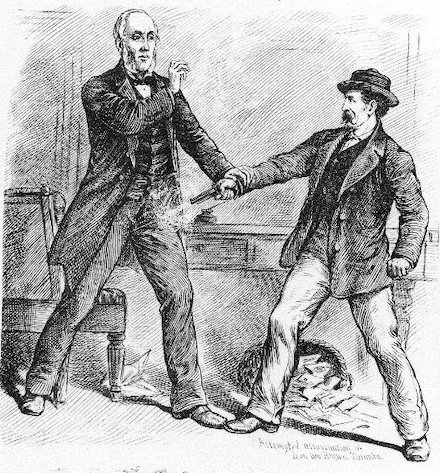
A great scribbler of words, Bennett in this time produced copy by turns vengeful and despairing, and of course he kept hitting the bottle. On March 25, he turned up at his former workplace where he rantingly accosted several former coworkers. By late afternoon he’d found his way to George Brown’s office, and inviting himself in he proceeded to importune the publisher with his disordered grievances. At last he pressed Brown to sign a paper affirming his length of employment. Brown had little idea who this impertinent drunk was, and still less that the impertinent drunk was armed; the boss’s attempts to redirect Bennett to his supervisor or the business administrators to address his paperwork request enraged his ex-employee, who suddenly produced a pistol and through a scuffle put a ball into George Brown.

One wouldn’t think the injury pictured above would be fatal; indeed, the next day’s Globe exulted that “Yesterday afternoon one of the most seditious and dastardly attempts at murder ever made in this city took place in the private office of the Hon. George Brown in the Globe Building. Fortunately, owning mainly to Mr. Brown’s presence of mind and superior physical strength, the attempt was unsuccessful, the only results being a severe flesh wound to the thigh and the nervous prostration which is the inevitable result of such an encounter. Had the miscreant who made the murderous assault been a little more prompt in taking his aim, or had the pistol been of a different construction, the attempt could hardly have resulted so favourably, for he persisted in his efforts to effect his bloody purpose until he was overpowered and the weapon was wrenched from his grasp.” But the relief proved premature when the leg wound torn by Bennett’s bullet turned gangrenous and eventually — seven weeks later — killed Brown.

Monuments to the murdered statesman abound in Canada, including the Second Empire home he built and died in, preserved as the historic George Brown House, and George Brown College. His whiskered statue strides on Parliament Hill.

Brown’s widow returned to Scotland with her children, and the Canadian hero’s son George Mackenzie Brown followed his father’s career in both printing and politicking: per Wikipedia, “As a publisher, he produced Arthur Conan Doyle’s books; as a politician, he beat him to win election to the House of Commons.”

On this day..

1881: Albert and Charles Talbott, bad sons

Dr. Perry H. Talbott was among the most prominent citizens of Nodaway County, Missouri. In addition to being a skilled physician, Talbott was state legislator, a writer and a newspaper editor. He was a civic minded citizen with strong beliefs, highly admired by friends and neighbors. But towards his family, Dr. Talbott was cold and distant. Miserly and neglectful, he had little interaction with his children beyond the occasional scolding. When Dr. Talbott was shot by an unknown assassin on September 18, 1880, in his dying breath he blamed his political enemies. The Nodaway county authorities, however, believed the killer was someone closer to home.

-Profile of the July 22, 1881 Marysville, Missouri hanging of Albert and Charles Talbott at friend of he site Murder By Gaslight. Enjoy in full here.

On this day..

1721: Walter Kennedy

(Thanks to Captain Charles Johnson — perhaps a pseudonym for Daniel Defoe — for the guest post. It was originally part of Chapter XI “Of Captain Bartho. Roberts, And his Crew” in Johnson’s magnum and only opus, A General History of the Pyrates. As noted by his placement, Kennedy was only a minor figure in the Golden Age of Piracy, a treacherous officer of the Bartholomew Roberts who bumbled right into the noose back on native shores. For another blurb on this bold but mediocre buccaneer, see Marcus Rediker.)

After some Days, the long-wish’d-for Boat came back, but with the most unwellcome News in the World, for Kennedy, who was Lieutenant, and left in Absence of Roberts, to Command the Privateer and Prize, was gone off with both. This was Mortification with a Vengeance, and you may imagine, they did not depart without some hard Speeches from those that were left, and had suffered by their Treachery: And that there need be no further mention of this Kennedy, I shall leave Captain Roberts, for a Page or two, with the Remains of his Crew, to vent their Wrath in a few Oaths and Execrations, and follow the other, whom we may reckon from that Time, as steering his Course towards Execution Dock.

Kenney was now chosen Captain of the revolted Crew, but could not bring his Company to any determined Resolution; some of them were for pursuing the old Game, but the greater Part of them seem’d to have Inclinations to turn from those evil Courses, and get home privately, (for there was no Act of Pardon in Force,) therefore they agree to break up, and every Man to shift for himself, as he should see Occasion. The first Thing they did, was to part with the great Portugueze Prize, and having the Master of the Sloop (whose Name I think was Cane) aboard, who they said was a very honest Fellow, (for he had humoured them upon every Occasion,) told them of the Brigantine that Roberts went after; and when the Pyrates first took him, he complemented them at an odd Rate, telling them they were welcome to his Sloop and Cargo, and wish’d that the Vessel had been larger, and the Loading richer for their Sakes: To this good natured Man they gave the Portugueze Ship, (which was then above half loaded,) three or four Negroes, and all of his own Men, who returned Thanks to his kind Benefactors, and departed.

Captain Kennedy in the Rover, failed to Barbadoes, near which Island, they took a very peaceable Ship belonging to Virginia; the Commander was a Quaker, whose Name was Knot; he had neither Pistol, Sword, nor Cutlass on Board; and Mr. Knot appearing so very passive to all they said to him, some of them thought this a good Opportunity to go off; and accordingly eight of the Pyrates went aboard, and he carried them safe to Virginia: They made the Quaker a Present of 10 Chests of Sugar, 10 Rolls of Brasil Tobacco, 30 Moidors, and some Gold-Dust, in all to the value of about 250 l. They also made Presents to the Sailors, some more, some less, and lived a jovial Life all the while they were upon their Voyage, Captain Knot giving them their Way; nor indeed could he help himself, unless he had taken an Opportunity to surprize them, when they were either drunk or asleep; for awake they wore Arms aboard the Ship, and put him in a continual Terror; it not being his Principle (or the Sect’s) to fight, unless with Art and Collusion; he managed these Weapons well till he arrived at the Capes, and afterwards four of the Pyrates went off in a Boat, which they had taken with them, for the more easily making their Escapes, and made up the Bay towards Maryland, but were forced back by a Storm into an obscure Place of the Country, where meeting with good Entertainment among the Planters, they continued several Days without being discovered to be Pyrates. In the mean Time Captain Knot leaving four others on Board his Ship, (who intended to go to North-Carolina,) made what hast he could to discover to Mr. Spitswood the Governor, what sort of Passengers he had been forced to bring with him, who by good Fortune got them seized; and Search being made after the others, who were revelling about the Country, they were also taken, and all try’d, convicted and hang’d, two Portuguese Jews who were taken on the Coast of Brasil, and whom they brought with them to Virginia, being the principal Evidence. The latter had found Means to lodge Part of their Wealth with the Planters, who never brought it to Account: But Captain Knot surrendered up every Thing that belonged to them, that were taken aboard, even what they presented to him, in lieu of such Things as they had plundered him of in their Passage, and obliged his Men to do the like.

Some Days after the taking of the Virginia Man last mentioned, in cruising in the Latitude of Jamaica, Kennedy took a Sloop bound thither from Boston, loaded with Bread and Flower; aboard of this Sloop went all the Hands who were for breaking the Gang, and left those behind that had a Mind to pursue further Adventures. Among the former were Kennedy, their Captain, of whose Honour they had such a dispicable Notion, that they were about to throw him over-board, when they found him in the Sloop, as fearing he might betray them all, at their return to England, he having in his Childhood been bred a Pick-pocket, and before he became a Pyrate, a House-breaker; both Professions that these Gentlemen have a very mean Opinion of. However, Captain Kennedy, by taking solemn Oaths of Fidelity to his Companions, was suffered to proceed with them.

In this Company there was but one that pretended to any skill in Navigation, (for Kennedy could neither write nor read, he being preferred to the Command merely for his Courage, which indeed he had often signaliz’d, particularly in taking the Portuguese Ship,) and he proved to be a Pretender only; for shaping their Course to Ireland, where they agree to land, they ran away to the North-West Coast of Scotland, and there were tost about by hard Storms of Wind for several Days, without knowing where they were, and in great Danger of perishing: AAt length they pushed the Vessel into a little creek, and went all ashore, leaving the Sloop at an Anchor for the next Comers.

The whole Company refresh’d themselves at a little Village about five Miles from the Place where they left the Sloop, and passed there for Ship-wreck’d Sailors, and no doubt might have travelled on without Suspicion; but the mad and riotous Manner of their Living on the Road, occasion’d their Journey to be cut short, as we shall observe presently.

Kennedy and another left them here, and traveling to one of the Sea-Ports, ship’d themselves for Ireland, and arrived there in Safety. Six or seven wisely withdrew from the rest, travelled at their leisure, and got to their much desired Port of London, without being disturbed or suspected, but the main Gang alarm’d the Country where-ever they came, drinking and roaring at such a Rate, that the People shut themselves up in their Houses, in some Places, not daring to venture out among so many made Fellows: In other Villages, they treated the whole Town, squandering their Money away, as if, like Aesop, they wanted to lighten their Burthens: This expensive manner of Living procured two of their drunken Straglers to be knocked on the Head, they being found murdered in the Road, and their Money taken from them: All the rest, to the Number of seventeen as they drew nigh to Edinburgh, were arrested and thrown into Goal, upon Suspicion, of they knew not what; However, the Magistrates were not long at a Loss for proper Accusations, for two of the Gang offering themselves for Evidences were accepted of; and the others were brought to a speedy Tryal, whereof nine were convicted and executed.

Kennedy having spent all his Money, came over from Ireland, and kept a common B—y-House on Deptford Road, and now and then, ’twas thought, made an Excursion abroad in the Way of his former Profession, till one of his Houshold W—s gave Information against him for a Robbery, for which he was committed to Bridewell; but because she would not do the Business by halves, she found out a Mate of a Ship that Kennedy had committed Pyracy upon, as he foolishly confess’d to her. This Mate, whose Name was Grant, paid Kennedy a Visit in Bridewell, and knowing him to be the Man, procured a Warrant, and had him committed to the Marshalsea Prison.

The Game that Kennedy had now to play was to turn Evidence himself; accordingly he gave a List of eight or ten of his Comrades; but not being acquainted with their Habitations, one only was taken, who, tho’ condemn’d, appeared to be a Man of a fair Character, was forc’d into their Service and took the first Opportunity to get from them, and therefore receiv’d a Pardon; but Walter Kennedy being a notorious Offender, was executed the 19th of July, 1721,* at Execution Dock.

The rest of the Pyrates who were left in the Ship Rover, staid not long behind, for they went ashore to one of the West-India Islands; what became of them afterwards, I can’t tell, but the Ship was found at Sea by a Sloop belonging to St. Christophers, and carried into that Island with only nine Negroes aboard.

Thus we see what a disastrous Fate ever attends the Wicked, and how rarely they escape the Punishment due to their Crimes, who, abandon’d to such a profligate Life, rob, spoil, and prey upon Mankind, contrary to the Light and Law of Nature, as well as the Law of God. It might have been hoped, that the Examples of these Deaths, would have been as Marks to the Remainder of this Gang, how to shun the Rocks their Companions had split on; that they would have surrendered to Mercy, or divided themselves, for ever from such Pursuits, as in the End they might be sure would subject them to the same Law and Punishment, which they must be conscious they now equally deserved; impending Law, which never let them sleep well, unless when drunk. But all the Use that was made of it here, was to commend the Justice of the Court, that condemn’d Kennedy, for he was a sad Dog (they said) and deserved the Fate he met with.

* The correct date is Friday, July 21 (per the then-current Julian calendar). Speculatively, the author might have crossed date references in a source surveying multiple executions, such as this Gazetteer which reports both Kennedy’s hanging, and some executions on July 19 in Dublin, and several other death sentences carried out besides those.

On this day..

1573: Lancelot van Brederode, sea beggar

Dutch revolt general Lancelot van Brederode was beheaded on this date in 1573, bequeathing posterity the gorgeous ruin of his sacked castle.

Lancelot van Bredrode, detail from an illustration of him alongside fellow ‘sea beggar’ Jan van Duivenvoorde, by Johannes Hilverdink.

Lancelot van Brederode (English Wikipedia entry | Dutch) was the bastard half-brother of Hendrick, Lord of Broderode, and both men numbered among the ranks of Calvinist Low Countries nobles determined to break away from Spanish Catholic domination.

This faction became known as the Geuzen, meaning “Beggars”; so prominent was Hendrick that he was the Grote Greus, or “Big Beggar”. Alas, he was chased into exile by the Spanish crackdown and became the Died Young Beggar.

Lancelot’s talents were on the waves, and it’s no surprise that seafaring Watergeuzen were the most prominently successful Beggars of all in the unfolding Dutch Revolt. Unfortunately he was not successful at supporting the defense of Haarlem against Spanish siege: when the Spanish took the city, Lancelot lost his head. To add insult to injury, they destroyed Brederode Castle; the gorgeous ruins were protected as a national monument and partly restored in the 19th century.


The Ruins of Brederode Caste, by Meindert Hobbema. For a more present-day view of the shattered citadel, see here.

Lancelot’s young (at the time of dad’s beheading) son Reinoud van Brederode went on to become a powerful lawyer and diplomat in the Dutch Republic. But not so powerful that he could save his father-in-law, Johan van Oldenbarnevelt, from his own date with Executed Today.

On this day..

1943: The hanging of the twelve

This testimonial refers to an incident at the Auschwitz concentration camp.

Those hanged were Poles from a forced-labor detail suffering collective punishment for the escape of other inmates from the same group; Janusz Skrzetuski was the man who kicked out his own stool.

On this day..

1980: Winfried Baumann

East German frigate captain Winfried Baumann was shot on this date in 1980 as a spy.

He and a collaborator, Dr. Christa-Karin Schumann,* were caught by the prolific DDR mail surveillance program dropping messages for the West German Federal Intelligence Service. (This Bundesnachrichtendienst, originally founded in 1956, remains unified Germany’s intelligence agency today.) East Germany’s last executioner Hermann Lorenz carried out the sentence by shooting at Leipzig Prison.

On this day..

1821: Fulgencio Yegros, former Paraguay head of state

Fulgencio Yegros was executed on this date in 1821.

Yegros (English Wikipedia entry | Spanish) was one of the key conspirators in the 1811 mutiny that brought about independent Paraguay and subsequently the chief of the five-man Junta Superior Gubernativa — making him at least arguably Paraguay’s first head of state.

His run didn’t last long; by 1814, this career officer had been sidelined by a far more potent character, Jose Gaspar Rodriguez de Francia. Francia’s despotism drew resistance from Asuncion‘s Creole elites, including the retired Yegros, whose participation in an 1820 plot to overthrow the government was betrayed — and whose furious repression with dozens of executions initiates a period of absolute dictatorship marked as the “Franciato”, to terminate only with the man’s death in 1840.

Four days after his former 1811 revolution collaborator Pedro Juan Caballero committed suicide in prison — leaving scrawled on his prison walls the words “I know that suicide is against the law of God and man, but the Tyrant’s thirst for blood shall not be quenched with mine” — Yegros became part of the quenching. He and seven other conspirators, notably Dr. Juan Aristegui and Captain Miguel Montiel, were shot under an orange tree just outside Francia’s state residence, probably while the dictator himself watched. “Those not killed by the initial volley were dispatched by machete or bayonet, for the executioners, three in number, were permitted but one ball each per victim.” (Source)

On this day..

1788: Elisabetha Gassner

Thief Elisabetha Gassner (English Wikipedia entry | German) was beheaded in Oberdischingen by executioner Xaver Vollmer on this date in 1788.

Gassner (English Wikipedia entry | German) was an industrious laborer who, born a vagrant and soon after losing her father, busted her hump into a home and a small farm of her own while maintaining a large family (seven kids by the time of her beheading, plus an invalid mother).

Nimble fingers made her this nest egg — fingers for knitting stockings, and, more and more, for picking pockets in Biderberg and WĂĽrttemberg.

With a purported 300+ thefts attributed to her, she acquired outsized reputation as a thief transcendent enough to apotheosize her under the nickname Schwarze Lies (“Black Lisa”) alongside the legendary outlaws of the day.

Her ambition for a foothold in this precarious world made her as bold with the quality of her targets as their quantity: her arrest was for lifting a 1,700 guilder purse from Count Franz Ludwig Schenk von Castell, in the chapel of Ludwigsburg Palace.

On this day..

1942: Wenceslao Vinzons

Filipino politician/guerrilla/national hero Wenceslao Vinzons was executed by the occupying Japanese on this date in 1942.

He gained prominence as a Manila university activist under U.S. administration for Malaysian-Indonesian-Philippines unification, then went on to co-found the Young Philippines party and become a delegate – at the tender age of 24 — to the 1935 Constitutional Convention that set the framework for his homeland’s independence. He’s the youngest signer of that constitution.

Subsequently governor of Camarines Norte and then a legislator in the National Assembly, Vinzons found his political trajectory interrupted by Japan’s December 1941-January 1942 takeover. Vinzons wasted no time trying to work within the system: he immediately began organizing armed resistance, building a guerrilla army some 2,800 strong over the course of the next months.

An informer betrayed him to the occupiers and after refusing every blandishment to collaborate, Vinzons was bayoneted to death at a Japanese garrison at Daet on July 15, 1942. Several of his family members also executed afterwards, although other surviving descendants have remained fixtures of public life down to the present day.

His hometown — formerly “Indan” — is now named “Vinzons” in his honor, and he’s renowned as the “Father of Student Activism in the Philippines”. A number of buildings and institutions connected to education are named for him.

On this day..