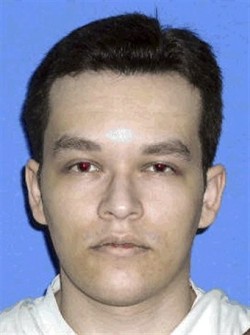
2005: Richard Cartwright, uncensored

On this date in 2005, Richard Cartwright was executed in Texas for robbing and murdering a gay man in Corpus Christi.

Cartwright attained some recognition (if not exactly a plausible purchase on clemency) as the writer of Uncensored from Texas Death Row, a sort of death row blog.

(As befits a blogger in the early 2000s, Cartwright also had a MySpace page, which remains active. “Chi-town” grew up in Chicago. He played youth hockey there, for this club. This is the sort of thing one learns about bloggers.)

Cartwright was admittedly involved in the robbery-murder, though he insisted he wasn’t the one who did the murdering.

Whatever one makes of that, his fairly prolific “Uncensored” series over the last six months of his life furnish a sometimes bracingly personal chronicle of a man among the lowest of the dead … and drawing nearer and nearer to a fate he realizes he cannot avert.

People are looking at me differently, like they are trying to instill into memory or something. They don’t mean to, but they do, and it is spooky. Like I am already dead.

On this day..

1995: Girvies Davis, framed?

On this date in 1995, Illinois executed Girvies Davis for murdering 89-year-old Charles Biebel in Belleville, Ill.

A small-time African-American hood reared in an alcoholic home, Davis was not linked to the murder by any physical evidence, or even any eyewitnesses. There was only one piece of evidence against him: his signed confession.

Unfortunately, the source lacked all credibility.

Davis copped to some 20 crimes under police interrogation. Officially, he did this when he voluntarily wrote out a list of evildoings and spontaneously passed it to a guard, which would be hard to believe even if the guy weren’t nearly illiterate. (Even the official story later became that Davis must have dictated the confession to someone else, like a cellmate.)

According to Davis’s later account, he signed statements the police had prepared for him … at gunpoint. The police logs say that he was taken out for a drive that night (“for evidence”), and conveniently confessed in the small hours of the morning.

Even though our man’s involvement in most of these “admitted” crimes (anything outstanding in the area that was still unsolved, it seems) was disproven, he couldn’t get traction in the courts once his conviction by an all-white jury was secured. Paradoxically, because there was no other evidence in the case to discredit, that “a-ha!” exoneration moment became all but impossible to secure despite the other holes in the case.

More action was had in the court of public opinion, where the usual suspects enlisted any number of pro-death penalty prosecutors and Republicans with serious misgivings about the case.

Time magazine lodged a naive early entrant in the “wait, wrongful confessions happen?” genre. The New York Times also covered the Davis clemency campaign:*

“The public sees the Bundys and the Gacys executed and they cheer,” said Gary V. Johnson, a former Kane County, Ill., prosecutor, who sought the death penalty in the past but opposes the execution of Mr. Davis. “The public doesn’t see the Girvies Davises.”

What savvy pols like Illinois Gov. Jim Edgar could see was that in the 1990s, all the political upside was in denying clemencies. So that’s what he did.

Years later, Davis’s last appellate attorney still believes “that the State of Illinois executed Girvies Davis for a crime I am sure he didn’t commit.”

Northwestern University journalism professor David Protess was also convinced of Girvies Davis’s innocence, and led a team of students researching the case back before he was famous for doing exactly that sort of thing. His work did not yield success on this occasion, but to judge by his account (pdf) of a last conversation he and his students had hours before Davis was put to death, it helped lead to the school’s later headline-grabbing wrongful conviction exposes.

Protess put [Davis] on the speakerphone, and the group gathered around. “Try not to mourn for me,” Davis said. “Move on with your lives. Just try to help people like me who get caught up in the system.” …

Davis had a final request: He wanted Protess and the students to promise that this wouldn’t be their last crusade in a capital case.

The room fell silent. “Of all the guys you know on the Row, who do you think most deserves help?” Protess asked.

Buck Williams,” Davis answered without hesitation. “I’m certain he’s innocent.”

Protess … vowed that he and his next group of students would leave no stone unturned for Williams.

Protess was as good as his word.

In less than a year, Williams along with Verneal Jimerson, Willie Rainge and Kenneth Adams were free men after a generation in prison.** These men, known as the “Ford Heights Four”, would win the largest civil rights lawsuit payment in U.S. history for their wrongful imprisonment.

* Davis may also have been the first death-row prisoner in the U.S. with his own Internet site and online clemency petition, although these interesting artifcats have long since vanished into the digital oubliette. Gov. Edgar reportedly received 1,200 emails asking him to spare his prisoner’s life … testament even then to elected officials’ disregard for online advocacy.

** Williams and Jimerson were on death row; Rainge and Adams were serving life sentences.

On this day..

2005: Michael Ross, the Roadside Strangler

As of this writing, New England has seen only one solitary execution in the past half-century.*

That one execution happened five years ago today: the lethal injection of serial murderer/rapist Michael Ross in Connecticut.

The “farm boy from Brooklyn, Conn.”, sexual sadist, and Cornell University graduate** went no a rape-and-murder spree in the early 1980s. He would confess to eight homicides.

Condemned in 1987, Ross spent 17 years fighting execution before a 2004 volte face had him waiving his appeals in the interests of sparing victims’ families any further agony.

This precipitated an intense last-minute legal melee over whether the admittedly disturbed Ross possessed legally sufficient competency to pursue his own death. A scheduled execution in January was scratched at the last moment when a federal judge insisted on a competency determination.

A serial killer who consents to his own execution wouldn’t typically be the sort to attract a lot of sympathy, but in true-blue New England, any brush with the executioner is cause for public hand-wringing.

Ross, of course, was adjudged competent to drop his appeals, and that was that.

After the execution, one of the psychiatrists who disputed Ross’s competency to choose execution received a mailed taunt from the killer, dated May 10:

Check, and mate. You never had a chance!

And it seems our date’s principal reserved an even gnarlier gambit for the judge who once blocked his execution.

District Court jurist Robert Chatigny has found himself much in the news with Michael Ross since he was nominated by President Barack Obama for a seat on the Second Circuit Court of Appeals. That nomination has been held up thus far largely because Chatigny berated and threatened Ross’s attorney (the one who was trying to get his client executed) with disbarment.

* The last one before Michael Ross? Joseph Taborsky, electrocuted in Connecticut on May 17, 1960.

** His criminal career began in Ithaca, N.Y. Cornell is famous for its suicides, but Ross apparently couldn’t go through with his after he contemplated taking his own life.

Ross was also a graduate of something called Killingly High School. True story.

On this day..

1985: Stephen Morin, serial killer convert

On this date in 1985, Texas executed serial killer Stephen Morin for murdering and robbing Carrie Marie Scott in 1981 — one of at least three, and up to thirty, of his victims, most of whom were (unlike Scott) abducted for rape and kindred brutalizing.

Just the sixth person executed in Texas under its modern death penalty regime, Morin was an IV drug addict.

Death chamber technicians required 40-plus minutes to bore through the resultant scar tissue well enough to poison Morin. He’s been a bullet point on the anti-lethal injection brief ever since. (Oddly, Morin’s execution is not on this list of recent botches.)

But Morin’s most prominent afterlife is a very different object lesson: not medical ethics, but spiritual warfare.

It seems the last woman he kidnapped, Margy Mayfield, survived the encounter by converting the desperate fugitive to evangelical Christianity; this story is still stocked and sold by Focus on the Family. This is Mayfield’s own account of their meeting.

[audio:http://withusisgod.org/wp-content/uploads/audio/margy-mayfield.mp3]

To judge by his last statement, Morin took his conversion to the gurney.

But others who knew Morin better in life (and, creepily, helped him soundproof his murder-mobile) … are a bit more skeptical about him.

On this day..

1996: William Flamer, Alito’d

On this date in 1996, William Flamer was executed for murder in Delaware.

He’s a forgettable criminal who, with an accomplice executed 19 months before, robbed and stabbed to death Flamer’s elderly aunt and uncle.

He has his small footnote in modern American death penalty jurisprudence in a case decided by then-circuit court judge Samuel Alito, which was — er — exhumed when President George W. Bush elevated Alito to the Supreme Court.

The matter was, to all but the initiated, a fairly picayune legal issue: if the jury that imposed his sentence used an aggravating factor subsequently found to be unconstitutional, could the sentence stand with the multiple other, constitutional aggravating factors it also used?

Little compelling as the issue might sound to all but the already converted, this sort of salami-slicing goes on justices’ daily bread to make up the great hero sandwich of jurisprudence. Mmm-mmm.

Anyway, the State of the Union head-shaker held — as Flamer’s presence in this blog would suggest — against the appellant.

Pdf examinations of Flamer v. Delaware (and other Alito death penalty legal opinions) prepared around the justice’s confirmation hearing are available from the Congressional Research Service and from the Criminal Justice Legal Foundation, the latter a pro-death penalty source.

(This decision also affected fellow Delaware death row inmate Billy Bailey, whom we have just met as the last man hanged in that state. Flamer could have had that distinction for himself; he chose lethal injection instead, and died four days after Bailey hanged.)

On this day..

2009: A day in the death penalty around the world

Capiital punishment may be an ancient historical phenomenon, but it’s hardly ancient history.

The executions that several of the 21st century world’s more aggressive death penalty users coincidentally carried out a year ago today testify together to the enduring place (and variegated guises) of the headsman in modernity.

China

Three prisoners were reported killed in Jinan in China on Jan. 15, 2009.

Two were men who had been serving prison terms for separate crimes when they incurred a death sentence for a violent (though seemingly non-lethal) escape attempt.

Liu Junjie, 35, and Wang Bing, 31, broke out of the prison in Zibo City on December 8, 2007 as a truck was moving out of the prison gate, according to a statement from the Shandong Provincial High People’s Court.

They hit a prison worker and two policemen with iron bars and choppers as they forced their way out. They were later caught as they fled along a road.

Former cabbie Bo Lijun shared that fate for a series of thefts, rapes, and murders.

According to the court, Bo raped and suffocated a female barber on Oct. 23, 2002 in Dongying.

Bo attempted to rape a female passenger in a wooded area near Dongying on July 29, 2006. Although he abandoned the rape attempt, he clubbed her to death for fear she would inform the police, and he buried the body at the site.


Saudi Arabia

One Mushabeb Al-Ahmari was beheaded in the province of Asir for “killing a compatriot with a machine gun” (who he killed and why was not reported).

Al-Ahmari was a minor when he was sentenced. The statement said his execution was delayed until he came of age.


United States

62-year-old James Callahan suffered lethal injection in Alabama Jan. 15, 2009, after 26 years on death row for raping and murdering a Jacksonville State University student in 1982. Callahan

requested a last meal of two corn dogs, french fries and a Coke … spent the day visiting with family and spiritual supporters … receive[d] communion at 4:30 p.m.

Callahan’s will bequeaths to his son $36.42 from his prison account, a black and white Radio Shack TV, two watches, a Walkman, some headphones, a leather belt, two pairs of boots, one pair of Nike tennis shoes, food items and legal papers.


Updated: Somalia

(This incident was not brought to our attention until after the post was already up, but in the peripatetic spirit of the entry, we thought it suitable to append.)

Somali politician Abdirahman Ahmed (also known as Waldiire) was shot by an Islamist militia in the port of Kismayo on Jan. 15, 2009.

Perhaps the first pol executed by Islamists, Ahmed was once the spokesman for a faction in the Somali civil war. He was put to death for collaborating with the Ethiopians who invaded Somalia at U.S. behest. As the Ethiopians were Christian, this behavior qualified as “apostasy” to the militants’ sharia court.

In January 2009, Ethiopia was in the process of withdrawing its military presence in its war-torn neighbor.

On this day..

2002: Craig Neil Ogan, drug war informant

(Thanks to David Carson of the informative Texas Execution Information Center for the guest post, originally run on his site. -ed.)

Craig Neil Ogan, 47, was executed by lethal injection on 19 November 2002 in Huntsville, Texas for the murder of a police officer.

Mugshot clipped from Texas Department of Criminal Justice. More information, including some of Ogan’s own writing, at the Clark County Prosecutor site.

Craig Ogan had worked as an informant for the federal Drug Enforcement Agency since January 1988. Upon his request, the DEA relocated him from St. Louis to Houston in late 1989 after his identity had been revealed in a court proceeding. Ogan was under orders to not personally get involved in any drug transactions. He was also prohibited from carrying a weapon. Despite these instructions, Ogan insisted on arming himself and seeking involvement in drug transactions.

On 8 December 1989, Ogan, then 34, called the DEA agent who supervised him and told him that he was in a restaurant where he had just had an armed confrontation over a drug deal that fell through. He said that a man pointed a gun at his head and called him “narc.” He said that he feared for his life and asked for an escort from the restaurant. The agent arranged for two Houston police officers to escort Ogan from the restaurant back to his apartment. Once at the apartment, the officers watched as Ogan packed his belongings, which included a pistol, a sawed-off shotgun, and some knives. They then followed him to a motel. Ogan checked into a room, and the officers left at around 9:00 p.m.

At about 12:30 a.m., Ogan went to the lobby to complain about his telephone charges and the heater in his room. He argued loudly with the clerk and began kicking at a door. When the clerk called 9-1-1 for assistance, Ogan left.

Around this time, Houston police officers Clay Morgan Gainer and James C. Boswell pulled a car into a parking lot across the street from the motel, for a minor traffic violation. Ogan, then 34, walked over to them and knocked on the passenger window. Officer Boswell, 29, lowered his window and asked Ogan what he wanted. After a heated exchange, Boswell got out of the car. Ogan took Boswell’s pistol and shot him once in the head. He ran. Officer Gainer chased Ogan on foot, shot him in the back, and arrested him.

At Ogan’s trial, Gainer testified that when Boswell lowered his window and asked Ogan what he wanted, Ogan replied, “DEA dropped me off out here, and I’m cold.” Boswell told Ogan that they would help him as soon as they finished with the traffic stop, and to back away from the car. Boswell then raised his window. Ogan, however, demanded immediate attention. He knocked on Boswell’s window again, repeating that he was a DEA informant and that he was cold. Boswell told him, “You need to get out of here if you are not willing to step out of the way and wait. You either need to leave, or you are going to jail.” Ogan persisted with his demands. Boswell got out of the police car. According to Gainer, Boswell removed his sidearm from the holster and held it down against his leg. As he was reaching into the car to unlock the back door, Ogan grabbed Boswell’s gun and shot him once in the head. Ogan then said, “Well, [expletive] you then” and ran.

In addition to the above testimony, Darryl O’Leary, one of the two officers who escorted Ogan from the restaurant, testified that Ogan was “extremely excited” when he arrived. O’Leary said that when he told Ogan he could not take him until a backup officer arrived, Ogan became “impatient, hostile, and loud.”

Ogan had no prior criminal convictions. He had numerous assault charges that had been filed against him, then dismissed.

Sally Webster, a psychologist testifying for the defense, said that Ogan suffered from paranoia and had a passive-aggressive personality, but that these disorders were not mental illnesses and had no bearing on his competency to stand trial. She described Ogan’s mental state on 8 and 9 December as “anxious, agitated, almost hyperactive, very touchy, very worried.” Ogan’s lawyers called Webster to testify in an attempt to assert his mental state as a mitigating factor in determining his punishment, but the tactic backfired. Instead, prosecutors convinced the jury that Ogan’s history of high-strung paranoia made him a future danger to society.

A jury convicted Ogan of capital murder in June 1990 and sentenced him to death. The Texas Court of Criminal Appeals affirmed the conviction and sentence in April 1993. All of his subsequent appeals in state and federal court were denied.

In his appeals, Ogan’s attorneys claimed that their client suffered from a mental illness and that his trial counsel was incompetent for failing to use that in his defense. Ogan, who had an IQ of 140, had attended college, and spoke several languages, told a reporter, “They’re trying to sell me as a nut case. I don’t appreciate that.”

Ogan had a longstanding interest in espionage and had ambitions of joining the Central Intelligence Agency. In one of his letters from death row, he claimed that he had an appointment for an interview with the CIA the day he killed Officer Boswell. His career as a spy, however, never took off. At his trial, DEA agents testified that they considered Ogan to be, though a “marginally successful” informant, mostly a comical figure who ducked behind newspapers whenever a stranger entered their office. They derisively called him “special agent double-oh-five” behind his back. They also criticized him for getting involved in a drug deal without their permission, then calling for their assistance when it got him into trouble.

From death row, Ogan wrote letters that were posted on an anti-death-penalty web site. In one of them, he claimed that his execution represented the “premeditated mass murder” of possibly thousands of his potential descendants. He also provided his version of the conversation between himself and Officer Boswell. In Ogan’s account, he was extremely polite, courteous to a fault, and non-confrontational. Boswell and Gainer, on the other hand, were hostile to him without provocation and called him a “[expletive] DEA snitch.” Ogan wrote that when he told Boswell, “All right, sir; I was only asking for help,” Boswell then threw his door open and burst out of the car “in an insane rage, running/lunging furiously right at me, like a football tackle gone berserk, and clawing frantically at his gun/holster.”

An anti-death-penalty spokesman who visited Ogan on death row described him as “extremely tense.”

Ogan’s execution was delayed for nearly an hour as the Supreme Court considered late appeals questioning his mental competence.

“I would like to say first of all the real violent crimes in this case are acts committed by James Boswell and Clay Morgan Gaines,” Ogan said in his lengthy last statement. “I am not guilty; I acted in self-defense and reflex in the face of a police officer who was out of control,” he said. Ogan referred to a head injury Boswell had suffered and suggested that he had mental problems. He described Boswell as “filled with anger” and “mad at the world.” The lethal injection was given while Ogan was two minutes into his last statement. At 7:05 p.m., he was still talking about Boswell when he paused briefly to collect his thoughts. The lethal drugs took effect as Ogan then snorted, gasped, and lost consciousness. He was pronounced dead at 7:13 p.m.

By David Carson. Originally posted on 20 November 2002. Revised on 5 December 2002.
Sources: Texas Department of Criminal Justice, Texas Attorney General’s office, U.S. Fifth Circuit Court documents, Associated Press, Houston Chronicle, letters from Craig Ogan.

On this day..

2009: Khristian Oliver, Bible basher

(Thanks to John Temple, author of The Last Lawyer: The Fight to Save Death Row Inmates and journalism professor at West Virginia University, for the guest post. -ed.)

Barring a last-minute stay of execution, Khristian Oliver will be put to death late this afternoon.

(Update: Khristian Oliver has indeed been executed as scheduled. His likeness lives on in an altarpiece made by his father, an artist.)

In 1998, Oliver, now 32, shot and killed a man whose home he was burglarizing. Oliver’s guilt isn’t being questioned. The argument his attorneys and supporters are using to stave off his upcoming execution has to do with how the jurors in his case handled his sentencing.

An Oct. 15 story in The Guardian described the scene in the jury room this way:

A clutch of jurors huddled in the corner with one reading aloud from the Book of Numbers: “The murderer shall surely be put to death” and “The revenger of blood himself shall slay the murderer.”

Another juror highlighted passages which she showed to a fellow juror: “And if he smite him with an instrument of iron, the murderer shall surely be put to death.” (Apparently one of the same passages, Numbers 35:16, in fuller context.)

Juries debating this most difficult decision often reach for Biblical guidance, and there are no shortage of verses that relate to capital punishment, including the famous “eye for an eye” passage(s). Courts have ruled this improper, not because the Bible is a religious document, but because it is extrinsic evidence, meaning it was not properly introduced as evidence.

The same issue arose in the central case in my new book, The Last Lawyer: The Fight to Save Death Row Inmates.

To write the book, I shadowed a North Carolina legal team for four and a half years as they fought to overturn the death sentence of a man named Bo Jones. The attorneys crisscrossed the back roads of North Carolina to track down and interview most of the jurors from the trial, two of whom chased them off their property. In the end, the attorneys found one woman who claimed that a Baptist minister on the jury had brought a Bible into the room and quoted passages from it.

In the end, this claim didn’t help Bo Jones. A federal appeals judge threw it out, saying his lawyers hadn’t proved that the Bible-quoting had influenced the jury’s verdict. But Jones’s attorneys had plenty of other arguments up their sleeves, while Oliver’s supporters seem to be putting most of their emphasis on the Bible argument.

It remains to be seen whether this will bewas not enough to spare his life.

Update: Prolific death penalty defense attorney David R. Dow (author of Autobiography of an Execution) on his client, Khristian Oliver.


On this day..

2005: Luis Ramirez, claiming innocence

On this date in 2005, Luis Ramirez was executed in Texas for engineering the murder-for-hire of his ex-wife’s new flame.

Ramirez went to his death still insisting on his innocence.

I did not kill your loved one, but I hope that one day you find out who did. I wish I could tell you the reason why, or give some kind of solace; you lost someone you love very much. The same as my family and friends are going to lose in a few minutes. I am sure he died unjustly, just like I am.

Maybe so. Maybe not.

Contrary to the widespread misapprehension that DNA and other forensic evidence are rendering criminology a perfect science, the majority of criminal procedures make do without them — consequently depending on the more impressionistic and time-honored pillars of jurisprudence: a weighing of circumstantial evidence; an estimate of the credibility of competing witnesses; the structural advantage of the well-resourced prosecutor’s office against its typical adversaries.

There may never be an answer to Luis Ramirez’s last statement, simply because there’s no obvious prospect of a dramatic forensic science reveal.

Wherever Ramirez’s soul might truly stand on the matter of capital murder, he left behind this interesting portrait of human connection on death row.

I’m about the share with you a story who’s telling is long past due. It’s a familiar story to most of you reading this from death row. And now it’s one that all of you in “free world ” may benefit from. This is the story of my first day on the row.

I came here in May of 1999. The exact date is something that I can’t recall. I do remember arriving in the afternoon. I was placed in a cell on H-20 wing over at the Ellis Unit in Huntsville, TX. A tsunami of emotions and thoughts were going through my mind at the time. I remember the only things in the cell were a mattress, pillow, a couple of sheets, a pillow case, a roll of toilet paper, and a blanket. I remember sitting there, utterly lost.

The first person I met there was Napoleon Beazley. Back then, death row prisoners still worked. His job at the time was to clean up the wing and help serve during meal times. He was walking around sweeping the pod in these ridiculous looking rubber boots. He came up to the bars on my cell and asked me if I was new. I told him that I had just arrived on death row. He asked what my name is. I told him, not seeing any harm in it. He then stepped back where he could see all three tiers. He hollered at everyone, “There’s a new man here. He just drove up. His name is Luis Ramirez.” When he did that, I didn’t know what to make of it at first. I thought I had made some kind of mistake. You see, like most of you, I was of the impression that everyone on death row was evil. I thought I would find hundreds of “Hannibal Lecters” in here. And now, they all knew my name. I thought “Oh well,” that’s strike one. I was sure that they would soon begin harassing me. This is what happens in the movies after all.

Well, that’s not what happened . After supper was served, Napoleon was once again sweeping the floors. As he passed my cell, He swept a brown paper bag into it. I asked him “What’s this?” He said for me to look inside and continued on his way. Man, I didn’t know what to expect. I was certain it was something bad. Curiosity did get the best of me though. I carefully opened the bag. What I found was the last thing I ever expected to find on death row, and everything I needed. The bag contained some stamps, envelopes, notepad, pen, soap, shampoo, toothpaste, tooth brush, a pastry, a soda, and a couple of Ramen noodles. I remember asking Napoleon where this came from.

He told me that everyone had pitched in. That they knew that I didn’t have anything and that it may be a while before I could get them. I asked him to find out who had contributed. I wanted to pay them back. He said, “It’s not like that. Just remember the next time you see someone come here like you. You pitch in something.”

I sat there on my bunk with my brown paper bag of goodies, and thought about what had just happened to me. The last things I expected to find on death row was kindness and generosity. They knew what I needed and they took it upon themselves to meet those needs. They did this without any expectation of reimbursement or compensation. They did this for a stranger, not a known friend. I don’t know what they felt when they committed this act of incredible kindness. I only know that like them, twelve “good people” had deemed me beyond redemption. The only remedy that these “good people” could offer us is death. Somehow what these “good people” saw and what I was seeing didn’t add up. How could these men, who just showed me so much humanity, be considered the “worst of the worst.”

Ever since Napoleon was executed, for a crime he committed as a teen, I’ve wanted to share this story with his family. I would like for them to know that their son was a good man. One who I will never forget. I want for them to know how sorry I am that we as a society failed them and him. I still find it ridiculous that we as a people feel that we cannot teach or love our young properly. I’m appalled at the idea that a teen is beyond redemption, that the only solution that we can offer is death. It’s tragic that this is being pointed out to the “good people” by one of the “worst of the worst”. God help us all.

What’s in the brown paper bag? I found caring, kindness, love, humanity, and compassion of a scale that I’ve never seen the “good people” in the free world show towards one another.

On this day..

2002: Aileen Wuornos, Monster

“Thanks a lot, society, for railroading my ass!”
-Aileen Wuornos

On this date in 2002, the tragically, horrifically iconic serial killer Aileen Wuornos checked out at Florida’s Starke Prison (and into an afterlife as an Academy Award-winning role) with the appropriately bizarre last words,

“I’d just like to say I’m sailing with the rock, and I’ll be back like Independence Day, with Jesus June 6. Like the movie, big mother ship and all, I’ll be back.”

Her sensational FBI-bestowed reputation as America’s “first” female serial killer rests on exaggeration,* but there’s something of the larger-than-life about prostitute/manslayer Aileen Carol Wuornos.

Heck, Aileen herself sold rights to her story within weeks of her arrest. So did investigators who worked the case. A year before our day’s perp faced lethal injection, her surname titled “the world’s first opera about a lesbian prostitute serial killer survivor of child abuse who is now on death row.” (Here’s the opera’s home page.)

That’s not the sort of legacy usual for a seven-time murderer. But there wasn’t much usual about Aileen Wuornos.

Wuornos — “Lee,” to her friends — projects for all her trail of bodies an irrepressibly humanity; Charlize Theron played her in Monster as the most sympathetic serial killer ever put to celluloid, her crime spree a desperate and impossible cry after human love that her life’s many travails had warped but never drained.

Still professing love for the lover who had sold her out and thereby ducked prosecution, Wuornos resigned her appeals and went her own way out this date in 2002.

Books and Films about Aileen Wuornos

* Or, if you like, a precision of definition not likely shared by the majority of her headline-reading public. What made Wuornos distinctive was killing strangers in a pattern over time; the stereotypical female multiple-murderer kills in a single spree, and/or for distinct pecuniary motives, and/or kills family members or other intimates.

Part of the Themed Set: Women Who Kill.

On this day..