1916: Eamonn Ceannt, Michael Mallin, Con Colbert, and Sean Heuston

On this date in 1916 — following a Sunday respite — executions in the aftermath of the Irish Republican Easter Rising against British power resumed with four more shootings at Dublin’s Kilmainham Gaol.

Eamonn Ceannt was an Irish Republican Brotherhood leader and was the fifth of the seven men who signed the Proclamation of the Irish Republic to be executed. (The remaining two, James Connolly and Sean Mac Diarmada, were shot on May 12th.) On the night before his execution, he wrote a ferocious although arguably counterproductive summons to future Irish revolutionaries

never to treat with the enemy, never to surrender at his mercy but to fight to a finish. I see nothing gained but grave disaster caused by the surrender which has marked the end of the Irish Insurrection of 1916 — so far at least as Dublin is concerned. The enemy has not cherished one generous thought for those who, with little hope, with poor equipment, and weak in numbers, withstood his forces for one glorious week. Ireland has shown she is a nation. This generation can claim to have raised sons as brave as any that went before. And in the years to come, Ireland will honour those who risked all for her honour at Easter in 1916 …

I wish to record the magnificent gallantry and fearless, calm determination of the men who fought with me. All, all, were simply splendid. Even I knew no fear, nor panic ,nor shrank fron no risk [sic], even as I shrink not now from the death which faces me at daybreak. I hope to see God’s face even for a moment in the morning. His will be done.

His firing squad failed to kill him cleanly, necessitating a gory coup de grace.

Michael Mallin was the co-founder with the pacifistic Francis Sheey-Skeffington of the Socialist Party of Ireland, and the second-in-command for the aforementioned James Connolly of the socialist union militia Irish Citizen Army. In the latter capacity Mallin led the detachment which seized St. Stephen’s Green during the Easter Rising.

A devout Catholic as well as a revolutionary militant, Mallin’s last letter to his family urged two of his children to take up holy orders. They indeed did so, and his youngest son, Father Joseph Mallin SJ, died only days ago as of this writing at the age of 104.

Con Colbert was another deeply religious rebel; an Irish Republic Brotherhood officer, he commanded rebels at several locations including the Jameson’s whiskey distillery at Marrowbone Lane.

The youngest of the group — who were, like all the Easter Rising rebels, shot sequentially rather than en masse — was 25-year-old Sean Heuston, also known as Jack or J.J. James Connolly had dispatched him to hold the Mendicity Institution for a few hours to delay the British advance; Heuston’s garrison of 26 ended up defending it for two days against several hundred enemy troops until, food and ammunition exhausted, they surrendered at British discretion.

His confessor cast the young patriot in a positively beatific light at the end:

A soldier directed Seán and myself to a corner of the yard, a short distance from the outer wall of the prison. Here there was a box (seemingly a soap box) and Sean was told to sit down upon it. He was perfectly calm, and said with me for the last time: ‘My Jesus, mercy.’ I scarcely had moved away a few yards when a volley went off, and this noble soldier of Irish Freedom fell dead. I rushed over to anoint him; his whole face seemed transformed and lit up with a grandeur and brightness that I had never before noticed

Never did I realise that men could fight so bravely, and die so beautifully, and so fearlessly as did the Heroes of Easter Week. On the morning of Sean Heuston’s death I would have given the world to have been in his place, he died in such a noble and sacred cause, and went forth to meet his Divine Saviour with such grand Christian sentiments of trust, confidence and love

On this day..

1916: John MacBride

Major John MacBride was shot on this date in 1916 for his improvised role in the Easter Rising.

A doctor by training and a republican by heart, MacBride earned his officer’s commission when, as an emigre to South Africa, he raised the Irish Transvaal Brigade to fight against the British during the Second Boer War. (The Boer nationalist cause was wildly popular among Irish nationalists: they had the same enemy.)

The British during that conflict were aggressive about treating as “rebels” even guerrillas whose nationality was in question, so the fact that the Irishman MacBride accepted citizenship from the Transvaal Republic and went to war against the Crown made him a right traitor in London’s eyes. After the war, he laid low in Paris and married Maud Gonne to the annoyance of the lovestruck poet W.B. Yeats who had unsuccessfully wooed Gonne.*

Back in Ireland once gone from Gonne, MacBride’s Boer War bona fides made him such an obvious locus of sedition that the Easter Rising conspirators kept him entirely away from their plot for fear of inviting the attention of whomever was watching MacBride. Instead, he walked into events accidentally, finding the rising occurring while he was in town to meet his brother.

A proper Irish patriot with military experience that the revolutionaries sorely needed,** MacBride recognized what was happening and presented himself to Thomas MacDonagh — who gave him a snap appointment to the command team occupying Jacob’s Biscuit Factory.

After events had run their course, MacBride embraced his martyrdom with such equanimity that some wondered whether he hadn’t tired of life. More likely, he was just being realistic: as he halloed to another prisoner who hailed him, “Nothing will save me, Sean. This is the end. Remember this is the second time I have sinned against them.” His dignified and fatalistic final address to the court that condemned him concluded,

I thank the officers of the court for the fair trial I have had, and the Crown counsel for the way he met every application I made. I have looked down the muzzles of too many guns in the South African War to fear death, and now please carry out your sentence.

* The two married in 1903 and divorced in 1905. Yeats alleged in private correspondence that MacBride had molested Gonne’s daughter, Iseult. (Repeatedly rebuffed by Maud Gonne, Yeats later also proposed to Iseult, who was 30 years his junior. There’s a lot going on here.) This allegation has blackened MacBride’s name down the years although its credibility remains in question since the jealous Yeats was an extremely hostile observer.

After the Easter Rising was crushed, Yeats spared some verse in his poem “Easter, 1916” to throw some (qualified) shade at his dead rival, which drew him a rebuke from Maud.

This other man I had dreamed
A drunken, vainglorious lout.
He had done most bitter wrong
To some who are near my heart,
Yet I number him in the song;
He, too, has resigned his part
In the casual comedy;
He, too, has been changed in his turn,
Transformed utterly:
A terrible beauty is born.

** General Charles Blackader, who suppressed the Easter Rising and presided over the ensuing courts-martial, reportedly admired “the most soldierly” MacBride: “He on entering the court stood to attention, facing us. In his eyes, I could read: ‘You are soldiers, so am I. You have won. I have lost. Do your worst.'” (From Secret Court Martial Records of the Easter Rising)

On this day..

1916: Edward Daly, Michael O’Hanrahan, Willie Pearse, and Joseph Plunkett

On this date in 1916, four Easter Rising rebels were shot in Kilmainham Gaol’s Stonebreakers Yard — an almost novelistic selection of thematic successors to the three men who had been executed there the day before.

Journalist/novelist Michael O’Hanrahan was the close friend and aide-de-camp of one of those May 3 executees, Tom MacDonagh — the two of them directing the rebel occupation of the Jacob’s Biscuit Factory during the week of April 24.

Edward Daly was the brother-in-law of Fenian ultra Tom Clarke, another man who had been shot on May 3.

Daly, at least, was a battalion commander during the Easter Rising and a part of the rising’s leadership; sculptor Willie Pearse was a mere run-of-the-mill rebel of the type that the British were not executing … save for that surname which he shared with his brother Patrick, the third Republican ringleader shot on May 3. Having seemingly absorbed an extra ration of fury intended for his brother, Willie Pearse’s execution was keenly felt as an injustice from the first.

But perhaps none of the Easter Rising executions tugged the heartstrings quite like that of Joseph Plunkett, a poet and Esperantist who was also one of the signatories of the seditious Proclamation of the Irish Republic. Plunkett had been one of the conspiracy’s secret emissaries to Germany, arranging shipments of arms that the British ultimately intercepted.

At midnight, due to be shot in a few hours with the day’s first light, Plunkett was married by a prison chaplain to his sweetheart, artist and Sinn Fein activist Grace Gifford. This tragic union made Grace Gifford and her sister Muriel double widows, for Muriel’s husband was Tom MacDonagh — the aforementioned already-executed associate of Michael O’Hanrahan.

There are roads, railway stations, football clubs, and the like named for all four of these men at various places in Ireland.

On this day..

1916: Thomas MacDonagh, Patrick Pearse, and Thomas Clarke

Thomas MacDonagh, Padraig (Patrick) Pearse, and Thomas Clarke — three of the principal Irish Republican leaders of the Easter Rising against British domination that had been crushed just days before — were shot in Dublin’s Kilmainham Gaol on this date in 1916.


Illustration from the New York Times, May 7, 1916.
“To a Poet Captain”
by Thomas MacDonagh

His songs were a little phrase
Of eternal song,
Drowned in the harping of lays
More loud and long.

His deeds were a single word,
Called out alone
In a night when no echo stirred to laughter,
To laughter or moan.

But his songs new souls shall thrill,
The loud harps dumb,
And his deeds the echoes fill
When the dawn is come.

MacDonagh and Pearse were contemporaries of one another: poets, progressive educators, Gaelic revivalists; men who girded for battle “with a revolver in one hand and a copy of Sophocles in the other.” Each dreamer commanded a unit of Irish Volunteers during the week of April 24-30, MacDonagh occupying Jacobs Factory and Pearse the iconic General Post Office, in which post it was Pearse’s sorrow to issue the surrender order by the end of the quixotic week.

Clarke, cut from another cloth, was a Fenian revolutionist of an older vintage, who had disappeared into British prison after trying to bomb London Bridge in the 1880s, then emigrated for a time to the United States. Drawn to a reviving nationalist movement, Clarke had the honor of affixing his name first upon the Rising’s Proclamation of the Irish Republic. Pearse and MacDonagh signed it too: a fatal endorsement for they three and for each of the other four men to lend it their signatures.

“My comrades and I believe we have struck the first successful blow for freedom,” Clarke said via a statement given out by his impressive wife Kathleen. “And so sure as we are going out this morning so sure will freedom come as a direct result of our action … In this belief, we die happy.”


This traditional Irish song was updated with patriotic verse by Patrick Pearse.

On this day..

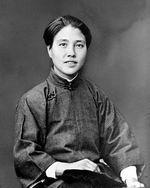
1928: Xiang Jingyu, Communist

The Chinese Communist Xiang Jingyu was martyred on May Day of 1928.

The preeminent female cadre of her time, Xiang was the 16-year-old daughter of a merchant when imperial China fell in 1911. She came of age, and radicalized, in the tumultuous aftermath, becoming an early advocate for women’s liberation as an essential objective of the revolution. She also became the wife of Mao crony Cai Hesen.

Xiang made her mark with a seminal 1920 essay, published while studying in France, “A discussion of women’s emancipation and remoulding.” In it, “Xiang called upon women who had realized consciousness to form four organizations: a study and propaganda society, a free choice in marriage league, a student loan society, and public nurseries.” (Andrea McElderry, “Woman Revolutionary: Xiang Jingyu,” The China Quarterly, March 1986)

Returning to China the following year, she became one of the Communist Party‘s leading voices in the women’s section, where she dunked on bourgeois feminism (“The result of their efforts will be that the whole bunch of them will enter the pigsties of the capital and the provinces where together with the male pigs, they can preside over the nation’s calamities and the people’s misforturtunes”) and gained only halting traction campaigning for girls’ education and mobilizing female factory workers. Her dour and driven demeanor earned her the nickname “Old Grandma”.

Arrested by French soldiers in Hankou‘s French Concession, Old Grandma had no time for the captors who would betray her to the Kuomintang, and her own death. “I am Xiang Jingyu, a member of the Chinese Communist Party. You can kill me and cut me to pieces. I myself have no hope, but tens of thousands of Xiang Jingyus will rise up in my place.”

The present-day Communist Party esteems her a hero.

On this day..

1389: Fra Michele Berti, “Cristo povero crocifisso”

“This is a truth that resides in me, to which I cannot bear witness if I do not die.”

-Fra Michele Berti, at the stake

On this date in 1389, the Fraticelli friar Fra Michele Berti da Calci burned in Florence as a heretic.

This excommunicate movement of “Spiritual Franciscans” who insisted upon the poverty of an order that had come to enjoy its emoluments had for decades now dogged the Church with a persuasive critique and credo: “io credo in Cristo povero crocifisso,” as our man Michele Berti said to his inquisitors. “I believe in Christ, poor and crucified.”

The quote is from a remarkable surviving account, “La passione di frate Michele” — whose title explicating the saint’s similarity to ancient martyrologies reveals where its sympathies lie. It can be perused online in Italian here or here.

According to the passione, the Florentine populace joined Michele’s persecutors in urging him to reconcile and save his life, as he made his public progress across the city to his death dressed in a mantle painted with demons in a sea of fire. The friar’s steadfastness eventually turned onlookers to his side, so that as his procession neared the Prato della Giustizia, “a believer began to cry out, saying: stand firm, martyr of Christ, who will soon receive the crown.”

Awestruck after Berti went to the pyre singing Te Deum, the crowd began to murmur, and “many said he seems a saint, even his adversaries … and they could not have their fill of railing against the priests.”

In Umberto Eco’s great literary monument to the Fraticelli, The Name of the Rose, the young oblate Adso reminisces at one point of visiting Florence, and of witnessing an execution that appears to be modeled on on this very account including such details as Michael’s criticism of Pope John XXII and Thomas Aquinas, his refusal to kneel before a “heretic” bishop, and the tongue-lashing he gave to skulkcowl Franciscans en route to his death.

A heretic Fraticello, accused of crimes against religion and haled before the bishop and other ecclesiastics, was being subjected to severe inquisition at the time. And, following those who told me about it, I went to the place where the trial was taking place, for I heard the people say that this friar, Michael by name, was truly a very pious man who had preached penance and poverty, repeating the words of Saint Francis, and had been brought before the judges because of the spitefulness of certain women who, pretending to confess themselves to him, had then attributed sacrilegious notions to him; and he had indeed been seized by the bishop’s men in the house of those same women, a fact that amazed me, because a man of the church should never go to administer the sacraments in such unsuitable places; but this seemed to be a weakness of the Fraticelli, this failure to take propriety into due consideration, and perhaps there was some truth in the popular belief that held them to be of dubious morals (as it was always said of the Catharists that they were Bulgars and sodomites).

I came to the Church of San Salvatore, where the inquisition was in progress, but I could not enter, because of the great crowd outside it. However, some had hoisted themselves to the bars of the windows and, clinging there, could see and hear what was going on, and they reported it to those below. The inquisitors were reading to Brother Michael the confession he had made the day before, in which he said that Christ and his apostles “held nothing individually or in common as property,” but Michael protested that the notary had now added “many false consequences” and he shouted (this I heard from outside), “You will have to defend yourselves on the day of judgment!” But the inquisitors read the confession as they had drawn it up, and at the end they asked him whether he wanted humbly to follow the opinions of the church and all the people of the city. And I heard Michael shouting in a loud voice that he wanted to follow what he believed, namely that he “wanted to keep Christ poor and crucified, and Pope John XXII was a heretic because he said the opposite.”

A great debate ensued, in which the inquisitors, many of them Franciscans, sought to make him understand that the Scriptures had not said what he was saying, and he accused them of denying the very Rule of their order, and they assailed him, asking him whether he thought he understood Scripture better than they, who were masters. And Fra Michael, very stubborn indeed, contested them, so that they began provoking him with such assertions as “Then we want you to consider Christ a property owner and Pope John a Catholic and holy man.” And Michael, never faltering, said, “No, a heretic.” And they said they had never seen anyone so tenacious in his own wickedness. But among the crowd outside the building I heard many compare him to Christ before the Pharisees, and I realized that among the people many believed in his sanctity.

Finally the bishop’s men took him back to prison in irons. And that evening I was told that many monks, friends of the bishop, had gone to insult him and enjoin him to retract, but he answered like a man sure of his own truth. And he repeated to each of them that Christ was poor and that Saint Francis and Saint Dominic had said so as well, and that if for professing this upright opinion he had to be condemned to the stake, so much the better, because in a short time he would be able to see what the Scriptures describe, the twenty-four elders of the Apocalypse and Jesus Christ and Saint Francis and the glorious martyrs. And I was told tht he said, “If we read with such fervor the doctrine of certain sainted abbots, how much greater should be our fervor and our joy in desiring to be in their midst?” And after words of this sort, the inquisitors left the prison with grim faces, crying out in indignation (and I heard them), “He has a devil in him!”

The next day we learned that the sentence had been pronounced, and I learned that among the crimes of which he was accused, it was said that he even claimed that Saint Thomas Aquinas was not a saint nor did he enjoy eternal salvation, but was, on the contrary, damned and in a state of perdition — which seemed incredible to me. And the sentence concluded that, since the accused did not wish to mend his ways, he was to be ocnducted to the usual place of execution et ibidem igne et flammis igneis accensis concremetur et comburatur, ita quod penitus moriatur et anima a corpore separetur.

Then more men of the church went to visit him and warned him of what would happen, and said: “Brother Michael, the miters and copes have already been made, and painted on them are Fraticelli accompanied by devils.” To frighten him and force him finally to retract. But Brother Michael knelt down and said, “I believe that beside the pyre there will be our father Francis, and I further believe there will be Jesus and the apostles, and the glorious martyrs Bartholomew and Anthony.” Which was a way of refusing for the last time the inquisitors’ offers.

The next morning I, too, was on the bridge before the bishop’s palace, where the inquisitors had gathered. Brother Michael, still in irons, was brought to face them. One of his faithful followers knelt before him to receive his beneiction, and this follower was seized by the men-at-arms and taken at once to prison. Afterward, the inquisitors again read the sentence to the condemned man and asked him once more whether he wished to repent. At every point where the sentence said he was a heretic Michael replied, “I am no heretic; a sinner, yes, but Catholic,” and when the text named “the most venerable and holy Pope John XXII” Michael answered, “No, a heretic.” Then the bishop ordered Michael to come and kneel before him, and Michael said no one should kneel before heretics. They forced him to his knees and he murmured, “God will pardon me.” And after he had been led out in all his priestly vestments, a ritual began, and one by one his vestments were stripped away until he remained in that little garment that the Florentines called a “cioppa.” And as is the custom when a priest is defrocked, they seared the pads of his fingers with a hot iron and they shaved his head. Then he was handed over to the captain and his men, who treated him very harshly and put him in irons, to take him back to prison, and he said to the crowd, “Per Dominum moriemur.” He was to be burned, as I found out, only the next day.

And on this day they also went to ask him whether he wished to confess himself and receive communion. And he refused, saying it was a sin to accept sacraments from one in a state of sin. Here, I believe, he was wrong, and he showed he had been corrupted by the heresy of the Patarines.

Finally it was the day of the execution, and a gonfalonier came for him, and asked him why he was so stubborn when he had only to affirm what the whole populace affirmed and accept the opinion of Holy Mother Church. But Michael, very harshly, said, “I believe in Christ poor and crucified.” And the gonfalonier went away, making a helpless gesture. Then the captain arrived with his men and took Michael into the courtyard, where the bishop’s vicar reread the confession and the sentence to him.

I did not understand then why the men of the church and of the secular arm were so violent against people who wanted to live in poverty and I said to myself, if anything, they should fear men who wish to live in wealth and take money away from others, and introduce simoniacal practices into the church. And I spoke of this with a man standing near me, for I could not keep silent any more. He smiled mockingly and said to me that a monk who practices poverty sets a bad example for the populace, for then they cannot accept monks who do not practice it. And, he added, the preaching of poverty put the wrong ideas into the heads of the people, who would consider their poverty a source of pride, and pride can lead to many proud acts. And, finally, he said that I should know that preaching poverty for monks put you on the side of the Emperor, and this did not please the Pope. Except that at this point I did not understand why Brother Michael wanted to die so horribly to please the Emperor.

And in fact some of those present were saying, “He is not a saint, he was sent by Louis to stir up discord among the citizens, and the Fraticelli are Tuscans but behind them are the Emperor’s agents.” And others said, “He is a madman, he is possessed by the Devil, swollen with pride, and he enjoys martyrdom for his wicked pride; they make these monks read too many lives of the saints, it would be better for them to take a wife!” And still others added, “No, all Christians should be like him, ready to proclaim their faith, as in the time of the pagans.” As I listened to those voices, no longer knowing what to think myself, it so happened that I looked straight at the condemned man’s face, which at times was hidden by the crowd ahead of me. And I saw the face of a man looking at something that is not of this earth, as I had sometimes seen on statues of saints in ecstatic vision. And I understood that, madman or seer as he might be, he knowingly wanted to die because he believed that in dying he would defeat his enemy, whoever it was. And I understood that his example would lead others to death. And I remain amazed by the possessors of such steadfastness only because I do not know, even today, whether what prevails in them is a proud love of the truth they believe, which leads them to death, or a proud desire for death, which leads them to proclaim their truth, whatever it may be. And I am overwhelmed with admiration and fear.

But let us go back to the execution, for now all were heading for the place where Michael would be put to death.

The captain and his men brought him out of the gate, with his little skirt on him and some of the buttons undone, and as he walked with a broad stride and a bowed head, reciting his office, he seemed one of the martyrs. And the crowd was unbelievably large and many cried, “Do not die!” and he would answer, “I want to die for Christ.” “But you are not dying for Christ,” they said to him; and he waid, “No, for the truth.” When they came to a place called the Proconsul’s Corner, one man cried to him to pray to God for them all, and he blessed the crowd.

At the Church of the Baptist they shouted to him, “Save your life!” and he answered, “Rum for your life from sin!”; at the Old Market they shouted to him, “Live, live!” and he replied, “Save yourselves from hell”; at the New Market they yelled, “Repent, repent,” and he replied, “Repent of your usury.” And on reaching Santa Croce, he saw the monks of his order on the steps, and he reproached them because they did not follow the Rule of Saint Francis. And some of them shrugged, but others pulled the cowls over their faces to cover them, in shame.

And going toward the Justice Gate, many said to him, “Recant! Recant! Don’t insist on dying,” and he said, “Christ died for us.” And they said, “But you are not Christ, you must not die for us!” And he said, “But I want to die for him.” At the Field of Justice, one said to him he should do as a certain monk, his superior, had done, abjuring; but Michael answered that he would not abjure, and I saw many in the crowd agree and urge Michael to be strong: so I and many others realized those were his followers, and we moved away from them.

Finally we were outside the city and before the pyre appeared, the “hut,” as they called it there, because the wood was arranged in the form of a hut, and there a circle of armed horsemen formed, to keep people from coming too close. And there they bound Brother Michael to the stake. And again I heard someone shout to him, “But what is it you’re dying for?” And he answered, “For a truth that dwells in me, which I can proclaim only by death.”

They lit the fire. And Brother Michael, who had chanted the “Credo,” afterward chanted the “Te Deum.” He sang perhaps eight verses of it, then he bent over as if he had to sneeze, and fell to the ground, because his bonds had burned away. He was already dead: before the body is completely burned it has already died from the great heat, which makes the heart explode, and from the smoke that fills the chest.

Then the whole hut blazed up, like a torch, and there was a great glow, and if it had not been for the poor charred body of Michael, still glimpsed among the glowing coals, I would have said I was standing before the burning bush. And I was close enough to have a view (I recalled as I climbed the steps of the library) that made some words rise spontaneously to my lips, about ecstatic rapture; I had read them in the books of Saint Hildegard: “The flame consists of a splendid clarity, of an unusual vigor, and of an igneous ardor, but possesses the splendid clarity that it may illuminate and the igneous ardor that it may burn.”

On this day..

1916: Francis Sheehy-Skeffington, Patrick McIntyre and Thomas Dickson, by Captain Bowen-Colthurst

On the morning of this date in 1916, British Captain John Bowen-Colthurst ordered the summary execution of three Irish journalists in his custody: part of a still-notorious murderous rampage through Dublin amid the Easter Rising.

Bowen-Colthurst’s subsequent “insanity” skate has been a sore subject in the century since its predictable enactment.

The product of landed Anglo-Irish elites — his childhood manor, Dripsey Castle, still stands — had trotted the globe in service of the empire: the Boer Wars, India, Tibet, and the western front.

It’s the sort of background that should have made Bowen-Colthurst a calm hand in a tight spot.* Instead, the Easter Rising panicked him. Atrocities against Irish nationalists are not exactly surprising in the abstract here, but Bowen-Colthurst’s behavior in these hours was so erratic and violent that his men would remark that he had lost his head … although they strikingly never disobeyed his patently illegal orders.

At Portobello Barracks in Dublin, which in this week swarmed chaotically with off-duty leave soldiers reporting themselves for duty in the face of the armed insurrection, the Third Royal Irish Rifles’ commander was absent on sick leave and evidently took command discipline with him. “Captain Colthurst, although not the equal in rank of Major Rosborough, was the senior office in point of service and, according to all the evidence, considered himself at liberty to ignore his brother-officers,” Francis Sheehy-Skeffington’s widow explained.

Sheehy-Skeffington — a gentle pacifist affectionately known among antiwar socialists and the women’s movement as “Skeffy” — had been arrested on sight on April 25th, while out and about trying to dissuade looters. Bowen-Colthurst marched him out overnight as a human shield for a random patrol, and did not mind murdering before his eyes a passing young man caught out after curfew.

Proceeding along, Bowen-Colthurst grenades a tobacconist’s shop, mistakenly thinking that its owner, named Kelly, was Sinn Fein man Tom Kelly. In fact, the tobacconist Kelly was a loyalist, as were the two publishers that Bowen-Colthurst arrested at his place: Patrick McIntyre and Thomas Dickson.

Ignoring their protests, our unstable captain brought all three men back to the barracks. By morning’s light, he had decided on no authority but his own to have them executed.

“I am taking these prisoners out and I am going to shoot them because I think it is the right thing to do” was all the justification that he submitted. Later, he would say that he feared the prisoners would escape; that, believing that Germans were landing and revolutionaries were gunning down Black and Tans throughout Dublin, “I took the gloomiest view of the situation and felt that only desperate measures would save the situation.” So he shot the one guy who didn’t want to fight and two guys who were on his own team. According to later testimony, he would even order Skeffy to be re-shot upon being informed that the man was still moving several minutes after execution.

Still, the tilting captain had enough self-possession to openly worry to a brother-officer that he might have committed a hanging offense … and to actively conceal the evidence of it. Had events not been exposed by a courageous whistleblower, Sir Francis Vane, everything surely would have been obfuscated into the soupy fog of war. Embarrassingly compelled by Vane’s tattling to court-martial Bowen-Colthurst only to pass him off to an asylum (and later, to Canada), the brass took it out on Vane by terminating his career a few months later: “this officer was relegated to unemployment owing to his action in the Skeffington murder case in the Sinn Fein rebellion.”

Uproar at the Bowen-Colthurst affair had some interesting knock-on effects: for one thing, the naked impunity available to an officer at a time when enlisted men in France were being shot at dawn for minor disciplinary lapses might have contributed to the British command’s decision later in 1916 to permit the execution of a shellshocked lieutenant. And, an associate of the loyalist British commander in Ireland during the Easter Rising claimed that Sheehy-Skeffington blowback subsequently led to the execution reprieve granted to Eamon de Valera: that future president of independent Ireland just so happened to have his name “first on the list” when the matter came to a head.

Today, a visitor center at the former Portobello Barracks (now called Cathal Brugha Barracks) memorializes the three men executed there on April 26, 1916.

* We don’t mean to be cavalier about the psychological strains inflicted by violence. Bowen-Colthurst seemed to exhibit signs of shell shock in the trenches, whether due to the shells themselves or to having lost his younger brother in the war.

On this day..

Feast Day of Saint Leonides of Alexandria

April 22 is the Christian feast date of Saint Leonides of Alexandria, the patron saint of being surpassed by your children.*

The Christian historian Eusebius recorded of our man in his Ecclesiastical History that

when Severus raised a persecution against the churches, there were illustrious testimonies given by the combatants of religion in all the churches every where. They particularly abounded in Alexandria, whilst the heroic wrestlers from Egypt and Thebais were escorted thither as to a mighty theatre of God, where, by their invincible patience under various tortures and modes of death, they were adorned with crowns from heaven. Among these was Leonides, said to be the father of Origen, who was beheaded, and left his son behind yet very young.

We don’t have much more on Leonides but that son, Origen, was said to have attempted to turn himself in with dad to face missionary martyrdom together; he was only a teenager at the time. His mother forbade the willful boy throwing his life away and it’s a good job she did: Origen went on to become one of Christianity’s seminal** theologians.

(Sadly, a sizable corpus of Origen’s work is lost to history because for a period in later antiquity his thought was denounced as heresy; the Byzantine emperor Justinian had Origen’s writings burned.)

* According to Wikipedia, Leonides is actually the patron saint of “large families” (he had at least six other children besides Origen), which we assume must surely include large sons.

** That’s a little etymological pun, as the reader will discover with an image search on “Origen castration.”

On this day..

1345: Giovanni Martinozzi, missionary Franciscan

On this date in 1345, Giovanni Martinozzi died for the faith in Cairo.

Martinozzi was a Franciscan who hailed from one of the prominent families of Siena. Like the famous founder of his order, Martinozzi undertook to convert the Saracens: part of a missionary movement of Franciscans abroad from Europe which had been encouraged by the papacy as a means to discharge the troublesome ferment of the Franciscan movement. (As a reference point, Martinozzi would have died in the generation following the events of The Name of the Rose.)

Where Saint Francis found the Ayyubid sultan al-Kamil mild and welcoming, Martinozzi attained from the Mamluks the laurels of “missionary martyrdom” that had eluded the master.

After re-converting a Genoese merchant who had apostatized to Islam, Martinozzi was tortured and on April 15, 1345, immolated along with the inconstant entrepreneur.

According to S. Maureen Burke (“The ‘Martyrdom of the Franciscans’ by Ambrogio Lorenzetti”, Zeitschrift für Kunstgeschichte, 65 Bd., H. 4 (2002)), a fresco of Beato Martinozzi’s martyrdom once adorned the Basilica of San Francesco in Siena; the fresco either does not survive or has eluded my online peregrinations. Giotto’s thematically topical 1320s Ordeal by Fire before the Sultan of Egypt will have to serve: it alludes to an episode (perhaps apocryphal) during Saint Francis’s travels in Egypt a century before.

On this day..

1943: Leen Kullman, Soviet hero

Soviet spy Helene (“Leen”) Kullman was shot by the Germans on this date in 1943 … or was she?

Kullman (English Wikipedia entry | the much more detailed Estonian) was just out of teaching school when the Germans occupied Estonia. She joined the Red Army and was eventually trained as an intelligence agent, infiltrated by parachute behind German lines in September 1942, and arrested by the Gestapo in January 1943.

This is where things get interesting.

According to the Soviet hagiography that resulted in her decoration as a Hero of the Soviet Union in 1965, Kullman defied her torturers and was shot by them on March 6, 1943: a standard Great Patriotic War martyr.

However, stories in post-Soviet, and heavily anti-Soviet, Estonia have circulated to the effect that Leen Kullman wasn’t killed in 1943 at all — that she cooperated with her captors and ended up dying peacefully in West Germany in 1978. One family member allegedly received a cryptic message in the 1960s, “Leen lives with the man who saved her life, and has two children. I’m not allowed to say more.”

Almost everything about her available online is in Estonian; readers with that particular proficiency might also enjoy this 1965 radio interview with her sister.

On this day..